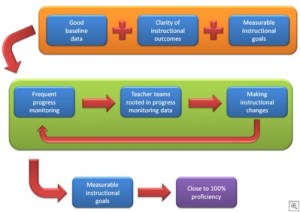
Image from "Guest Blogger Scott McLeod on Data-Driven Decision Making" on the eduwonkette blog, click on image for more on D3M from that sorely missed blog.
Diane Ravitch has some more words of sanity on Data Driven policy making at the Bridging Differences blog. Click the link for the entire post; here is an excerpt:
This approach rests squarely on the high-stakes use of testing. One only wishes that the proponents of this mean-spirited approach might themselves be subjected to a high-stakes test about their understanding of children and education! I predict that every one of them would fail and be severely punished.
We agree that a better approach is needed to assess how well students are learning what they are taught. We agree that current standardized tests are not adequate to the task of determining the fate—whether they should be rewarded or punished—of children, teachers, and their schools.
I think that testing is important and can be valuable, as it helps to spotlight problems and individuals in need of help. But the determinative word here is “help.” The so-called reformers want to use accountability to find people in need of termination and schools in need of closure. Let’s hope this punishment-obsessed crowd is never put in charge of hospitals!
Unfortunately, events are not breaking in the direction we both prefer. The stimulus bill includes millions so that every state can create a data system. This system will track the test scores of every student, from pre-K to college, and attribute their test score gains (or lack thereof) to their teachers. When the information is available, it will be used and misused. Every teacher (at least those who teach the tested subjects) will have a public record detailing whether his or her students made gains or not. This information will be used to establish calibrated merit pay schemes, so that each teacher will get more or fewer dollars depending on the scores of the year. Is this piecework?
The federal government seems ready to impose a Dr. Strangelove approach on our schools to turn them into “data-driven systems.” Not, as you suggest, “data-informed” systems, but data-driven systems. Teachers will certainly teach to the tests, since nothing else matters. The only missing ingredient from this grand data-driven scheme will be education.
More on data driven policy on AMPS here.
Thomas J. Mertz



 AMPS
AMPS 