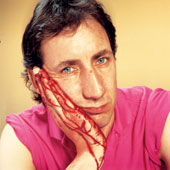
Pete Townshend photographed by Annie Leibovitz, for more information click on the image.
The Who, “Won’t Get Fooled Again” (click to listen or download)
This budget season in Wisconsin began with Governor Jim Doyle’s Orwellian statement that ““Not getting cut is the new increase in this budget.” It has been all downhill from there. The latest cut of $291 million in education aid has been accompanied by the misleading factoid that after these changes, school district revenues from federal, state and local sources are still expected to increase by approximately 5% on a biennial basis.
This distracting rhetorical labeling of cuts in programs and services as a monetary “increase,” is a classic Republican ploy. The idea is to discourage an examination of the impact of the cuts. In the case of the Governor’s latest budget proposal, touting the 5% figure is an attempt to hide more than cuts. It shifts the accountability from state resources to federal and local ones, creating a funding cliff of federal stimulus money that can only be used in targeted ways.
Never mind that conservative estimates put the cost of continuing the same educational opportunities for Wisconsin’s students at a level that would require a biennial increase at a minimum of 7.5% to 8%. Never mind too that the majority of that 5% comes from federal money, over which Doyle has little or no say, and most of which will be gone in two years, leaving the state and the districts on the edge of a cliff. Also, about 1/3 of that federal money comes with huge strings attached and can only be used for specific purposes, mostly to “supplement, not supplant” state and local expenditures. Further, to get to that 5% increase, school boards will need to significantly increase property taxes….(more about the numbers below and in a subsequent post).
Never mind all this, the Governor wants us to think about that 5% increase and forget about the reality of cuts in educational opportunities and shifts from state money to federal and local revenues.
The governor wants you to ponder, “how can people complain about cuts to education when there is an increase?” Don’t be fooled (again).
The rhetoric and numbers concerning school funding coming out of the Governor’s office have consistently been presented in ways designed to obscure the reality of significant decreases in state aid, as well as a level of combined state and federal aid that is far below “cost-to-continue” or even the level required to keep school budget cuts at the 1% to 2% that has been the norm in Wisconsin for the last 15 years under our broken state school finance system.
Before further going into the recent rhetoric and numbers, a little history lesson is in order.
All sorts of budgets — schools, states, households… — grow each year even if there is no expansion, because the same activities, programs, services or purchases get more expensive. This is the idea behind “cost-to-continue” or “same service” budgeting. It gives a baseline that says, if we want to continue doing the same things in the same ways, this is what it will cost.
Way back in 1996, President Bill Clinton proposed changes in the Medicaid program. The changes included new efficiencies and discontinuing some things. As a result, the total cost of the Clinton proposal was less than the cost of continuing the program as it had been (although more than current spending levels). Clinton repeatedly referred to “cuts” in the Medicaid budget.
Then Speaker of the House (and now Obama advisor), Newt Gingrich, repeatedly called Clinton a “liar” for saying he was cutting the Medicaid budget. According to Gingrich, the only things that counted as cuts were those that decreased the dollars. This rejection of “cost-to-continue’ basis became the Republican frame for budget discussions.
[Read about the Clinton/Gingrich conflict over the meaning of “cuts” here.]
In most cases, the GOP has used this to try to deny that less than “cost-to-continue” increases are cuts. That’s what State Rep. Brett Davis and other Republicans did in the last budget cycle.
In the past, Democrats in Wisconsin resisted this rhetorical fraud; now Governor Doyle is doing exactly what Gingrich and Davis did, telling us that cuts aren’t cuts. Pretty disgusting.
At the press conference on the budget fix Governor Doyle said, “overall school districts will have more money.” He also said that it would be difficult for some districts, and rhetorically averred from “sugar coating” the situation. Yet the emphasis on the “increase” is a coat of sugar.
This message of an overall increase was repeated, with numbers attached, in a memo issued today by Secretary of Administration Micheal L. Morgan. Here is the main part on education funding:
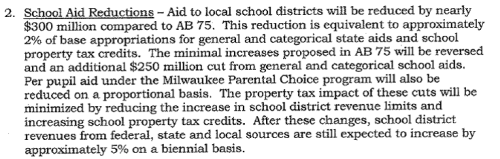
Note the last line “school district revenues are still expected to increase by approximately 5% on a biennial basis.” Elsewhere in the memo the total new “School Aid Reduction” is given as $291 million.
Just to be clear (before moving on), that reduction isn’t from real district-by-district “cost-to-continue” budgeting or even from a “cost-to continue,” based on the already inadequate funding levels of the 2007-09 state budget. It is from the previous Gubernatorial proposal which represented a significant decrease in school aid levels, resulting in an estimated shift from the fictional 2/3 state portion of general aids to less than 62% coming from the state, as well as cuts in categorical aids of 1% (the Legislative Fiscal Bureau memo is here). It looks like the new cuts will bring a further shift to property taxes (to be examined in a subsequent post). The new reductions are Doyle’s second cut with the knife (or the third if you count the annual cuts created by the structural gap built into Wisconsin’s school funding system, a system that Governor Doyle has not lifted a finger to fix).
By my calculations a 5% increase in total education funding (federal, sate and local) over the biennium comes to about $1.105 billion ( I am working on a post providing a closer look at the numbers and fed/state/local breakdowns). About 35% of this increase is in $381 million of ARRA/Stimulus funding for Title I and IDEA programing. This money cannot be spent on general operations, and with some limited exceptions, must be used to supplement not supplant state and local funded efforts targeting children in poverty and special education students. The inclusion of this money is questionable as both rhetoric and policy. Without this money included, the net increase over the biennium would be about 3.28% (remember that cost-to-continue is at least 7.5% to 8%).
About 50 districts in Wisconsin will receive no Title I money and only about 35 will receive over $1 million in IDEA money. The Wisconsin Association of School Boards further notes that
…the U.S. Education Department is asking states to submit much more detailed information on how they plan to improve student learning before they can tap a sizable portion of the second round of ARRA funding, which is scheduled to go out in the fall. To tap a portion of special education aid and Title I funding for disadvantaged students, states must explain how they will comply with transparency and accounting requirements.
If the state simply offsets state aid for federal aid, there may be difficulty in securing the second round of funding. The U.S. Department of Education also plans to allocate $4.35 billion in “Race to the Top” grants, which aim to reward states and districts that make significant strides in closing achievement gaps, raising academic standards, tracking student progress, and improving the distribution of high-quality teachers. Dramatic cuts to state education spending may hinder the state’s and local school districts’ efforts to secure these grants.
In other words, if Wisconsin school districts use the stimulus money in the manner the Governor has advised, the state may be ineligible for the remainder of their anticipated payments and will certainly be disqualified from the $5 billion in the “Race for the Top” funding.”
The 5% is a chimera and the cuts are real. As Curtis Mayfield said, “If you are cut you are going to bleed.” All the talk of 5% increases won’t change that reality.
Education in Wisconsin has been cut repeatedly for 15 years and the blood has been flowing for just as long. Even though the Governor only pulled the knife out again late on Thursday, May 21, some districts are already anticipating the latest bloodletting.
On Wisconsin Public Television’s “Here and Now,” Madison Superintendent Dan Nerad spoke of $2 million in additional cuts (on top of the $3.8 million already cut). Nerad also spoke of the difficulty of the timing of the Governor’s announcement, the continuing uncertainty about flexibility to make up for lost state revenue with property taxes under the revenue caps, and most importantly the need for comprehensive school finance reform to give Wisconsin adequate, equitable and sustainable education funding.
The Sheboygan Area School District cut $5 million and eliminated 45 full time teaching positions, 11 librarians and 2 guidance counselors three weeks ago. In the wake of the Governor’s announcement, they anticipate the need for $3 million to $5 million more in cuts.
In Hudson, where unemployment is a full point above the state average, the district has struggled to preserve education while limiting property taxes. Ideas to address the problems include a salary freeze, cuts in transportation, summer programs, layoffs…
You can be sure that there will be ugly budget sessions in districts around the state in the months to come. AMPS will report on as many as we can.
One indication of the direction this is going comes from the Wisconsin Association of School Boards. Their most recent press release carried the message “Don’t Cut Our Future,” but a legislative alert issued a day prior included a request for members to lobby for “Changing state statutes to allow school boards to lay off staff for the 2009-10 school year.” These are desperate times.
Cuts and layoffs, cuts so large and late that school boards need a change in the law to make them, cuts on top of cuts. Too many cuts to hide behind the transparent rhetoric of “5% increases.”
Stop insulting the people of Wisconsin with this talk of Governor Doyle. Stop using Republican spin to hide the full impact of your politically motivated choice to cut, instead of tax . Stop undermining any hope for comprehensive reform in the future by muddying the water with talk of increases at a time when you are cutting.
Let’s call all cuts, cuts.
Thomas J. Mertz



 AMPS
AMPS 