

Monthly Archives: June 2017

Class Size Budget Amendment (Annotated)

vegan-meat-alternative-sausage-onion_1

I had joked that the previous post should have been illustrated with a picture of sausage being made, but that I didn’t want to alienate vegans and vegetarians. The amendment is now finished, and the sausage pictured here is vegan.

“Step by Step” — The Boyer Brothers (click to listen/watch)

Yesterday afternoon I submitted the final version of an amendment on class sizes to the Madison Metropolitan School District 2017-18 Preliminary Budget.  The Board of Education will consider and vote on this (and other amendments), as well as the Budget at our meeting on June 26, 2017 (6:00 PM, Doyle Building Auditorium).  In my previous post I presented my then current thinking about the amendment and asked for feedback.  This post is a brief walk-through of the final version, highlighting (and to some extent explaining) changes.

In general, the legislative process requires compromise, and tempering idealism with realism.  I have tried to keep that in mind throughout the budget work, but at this penultimate step compromise and realism become more prominent.

From top to bottom, excerpts followed by comments.

Amend the 2017-18 MMSD Preliminary Budget by immediately allocating an additional $500,000 to expand the number of budgeted unallocated classroom teacher positions, and

Dependent on the per pupil categorical aid provisions of the biennial Wisconsin State budget allocating up to an additional $1,000,000 to expand the number of budgeted unallocated classroom positions proportionately with no additional allocation if the categorical aid increase is $100 or less, up to $1,000,000 if it is $200 or more, and

Both compromise and realism are present here.  Reviewing the Budget, previous and pending actions; talking and listening to budget staff, Board Members, community members, I have concluded that the present Budget can support targeted class size allocations of $500,000, and that a favorable State Budget would justify an increase to that amount of $1,000,000.  I am sure we will hear more on this from all parties prior to and at the June 26 meeting.

I try to be forthcoming and transparent, so I want to acknowledge that the best projections indicate that spending the $1,000,000 which is dependent on the State Budget will push the property tax levy increase beyond the 3.97% projected in relation to the November 2016 referendum, to approximately 4.3% (there won’t be final numbers till October).  I should also note that my proposed increase in levy is only one half of the projected $2,000,000 that would be available.

One other thing of importance here is the shift from talking about the number of positions to talking about dollars.  Being a budget amendment, that is necessary.  Translating dollars to FTE is an inexact calculation.  MMSD makes wide use of a figure of about $80,000 to budget full time teachers, inclusive of benefits, payroll taxes and everything else.  However, teachers hired late tend to be less experienced, have lower levels of post-graduate education, and are less likely to enroll in “family” insurance plans, making them somewhat cheaper.  If I had to guess, I would say that the probable cost per FTE hired under this amendment would be about $60,000, so $1,500,000 would yield 25 FTE, but it could be higher and the yield could be fewer than 20.

Establishing the following guidelines for the prioritizing the allocation of these new positions to schools: setting standards, but allowing for flexibility based on unique circumstances, local knowledge, and professional judgment, with primary consideration to be given to allocating positions to meet the standards in the order listed below:

  1. High Poverty, K-3 not to exceed 18 students.
  2. High Poverty, 4-5, not to exceed 23 students.
  3. Other Schools, K, not to exceed 20 students.
  4. Other Schools, 1-3, not to exceed 22 students.
  5. Other Schools, 4-5, not to exceed 25 students.
  6. High Poverty, 6th Grade, Core Academic Classes (Reading, Math, Science, Social Studies), not to exceed 25 students.
  7. Other Schools 6th Grade, Core Academic Classes (Reading, Math, Science, Social Studies), not to exceed 27 students.
  8. High Poverty, 7-8, Core Academic Classes (Reading, Math, Science, Social Studies), not to exceed 27 students.
  9. Other Schools, 7-8, Core Academic Classes (Reading, Math, Science, Social Studies), not to exceed 29 students.
  10. 9th Grade Core Academic Classes (Reading/English, Math, Science, Social Studies), not to exceed 28 students.
  11. 10-12 Grade Core Academic Classes (Reading/English, Math, Science, Social Studies), not to exceed 30 students.

For the purposes of this amendment designating the following schools as High Poverty:

K-5 (non-AGR schools marked with *; non-Title I schools marked with #)

Allis Elementary
Emerson Elementary
Falk Elementary
Glendale Elementary
Gompers Elementary
Hawthorne Elementary
Huegel Elementary#
Kennedy Elementary*
Lake View Elementary
Lapham Elementary*#
Leopold Elementary
Lincoln Elementary*
Lindbergh Elementary
Lowell Elementary
Mendota Elementary
Midvale Elementary
Muir Elementary#
Nuestro Mundo Elementary
Orchard Ridge Elementary
Sandburg Elementary
Schenk Elementary
Stephens Elementary*#
Thoreau Elementary#

6-8 (non-Title I schools marked with #)

Badger Rock Middle
Black Hawk Middle
Cherokee Middle
Jefferson Middle#
O’Keeffe Middle
Sennett Middle
Sherman Middle
Toki Middle#
Whitehorse Middle#
Wright Middle

There are two significant changes here.  The first is in the composition and ordering of the priorities. The second is moving from “hard caps” to “guidelines” or “standards.”

On the presentation of the priorities, the feedback I received was crucial.  Overwhelmingly, people were most concerned about the early grades in high poverty schools, and advocated a “the smaller the better” policy for these grades.  My personal preference for something more nuanced (read complicated) and giving more attention to (what I consider) extremely large classes in some of our lower poverty schools remains, but these are compromises I can endorse.

Budgeting hard caps is difficult, amending a budget that wasn’t built on hard caps is even more difficult (especially when proposed hard caps are smaller than the numbers used to make initial allocations).  Going forward, revising the current (weak) MMSD Class Size Policy, and giving more attention to class size at every stage of the budget process may create a more favorable environment for hard caps in future budgets, but not this one.

While understanding that (almost) any absolute rule will on occasion lead to less than optimal choices, I am wary of calls for flexibility.  Some years ago I wrote about the introduction of “flexibility” in SAGE and other policies:

Remember warnings about your face getting stuck in some ugly expression? I think the champions of “flexibility” in Wisconsin and elsewhere need loud and repeated warnings that their “flexibility” in educational policy (along with privatization, cuts in funding, destruction of local control…) in fact constitutes a possibly permanent acceptance of declining educational quality and is an ugly betrayal of our traditions and our responsibility to our children. They are bending our schools out of shape and our children will be stuck with it.

The events of the last six years have only reinforced my wariness.

My ideal method for balancing mandates and flexibility is to mandate default choices, but simultaneously create a process by which deviations from the default are justified and approved.  Although the amendment doesn’t go that far, I do think the reporting requirements (below) embody some of this concept and will create opportunities for accountability.

Requiring that public reports be made to the Board of Education, which include the amount of funds remaining from this allocation, the number of sections or classrooms added to date from this allocation for each of the listed priorities, the number of sections or classrooms remaining that exceed the guidelines for each listed priority based on then current enrollments.

At minimum three public reports be made,

  1. A Baseline Report to be issued as soon as possible after the passage of the Preliminary 2017-18 Budget, but no later than July 14, 2017.
  2. A Start of School Report, to be issued no earlier than the completion of registrations (August 21, 2017) and no later than the end of the second week of school (September 15, 2017).
  3. A Report, to be issued with the October/November Enrollment Reports.

I hope these reports accomplish two additional things.  First is increased transparency in school and classroom staffing.  I think these are the most important part of our Budget, and MMSD has been more translucent than transparent with them.  Second, I think the reports will contribute to the ongoing discussion of the costs and impacts of spending on class size reduction.

Before closing I want to note that I left out any mandate tying the allocation of the new positions to specific dates.  The main purpose of that was to give greater weight to the highest priorities, but the process was awkward, and the reconfiguration of the priorities accomplished some of this.

In closing I am going to cut-and-paste the closing of my previous post, once again urging participation in this process:

If you think I did more right than wrong, please let the Board (and the world) know about your support for the amendment.  As usual, you can email us [board@madison.k12.wi.us], or testify at the June 26th meeting where we will be voting on this and the entire preliminary budget.  Talk to your neighbors, co-workers, and friends, write a letter to the editor, post on Facebook. Instagram, or tweet something, draw something, dance…be creative.

Thanks in advance for the feedback and support.

Thomas J. Mertz
2 Comments

Filed under "education finance", Accountability, Best Practices, Class Size, education, finance, Local News, MMSD, School Finance, Take Action, Uncategorized

Notes for Final Class Size Amendment

Betty Everett — “Getting Mighty Crowded” (watch and listen).

On Monday June 12, the Operations Work Group of the Madison Metropolitan School District received an update on the 2017-18 budget, and discussed amendments submitted by Board Members (video here, meeting materials may be found at BoardDocs, here; it appears a second cost analysis on class size prepared by the district has not been posted on BoardDocs, it may be found here, a cost analysis prepared by community members is somewhat lower).

An amendment I submitted establishing “hard caps” on class sizes, and differentiating among classes and schools by grade span and a different poverty calculation than participation in the state Achievement Gap Reduction program (AGR, formally SAGE) has garnered much attention and more than a little support.  My amendment, with an explanation of poverty measure may be found here (a little more below).  The next step is preparing a “final” amendment for submission and vote (with the understanding that the amendment may be amended at the June 26, 2017 meeting, prior to a vote).  That process is the topic of this post.

The intent of my initial amendment was three-fold.  First, I wanted to get some sense of the costs involved.  Second, I wanted to shift thinking away from average class size to maximums, and away from AGR as the only means to differentiate between high and low poverty schools in this context.  Last, I wanted to give people opportunities to think, and talk, and write about class size in our district.  The numbers I used were not my ideal class sizes, and not intended to be final.

I have learned a little more about costs; made some impacts in how class size is being considered; and learned much about all aspects of class size impacts from the many staff, parents, and teachers who have opined in public and private.  Thank you all.

I want this discussion to continue, but soon the focus must shift to making concrete progress in addressing the most important class size issues in our district.  To do this I have to draft a budget amendment, and try to get it passed.

This involves prioritizing among the many issues and actions that have been discussed, and finding mechanisms to budget according to those priorities.  In an effort to be transparent, and as a plea for one more round of feedback and ideas from our community, I am presenting here what I see as the choices involved, and much of my current thinking.

Big Picture — Class Size Matters (in a Multitude of Ways)

No single education policy or practice will fix every area of concern with our schools, but research and experience have consistently demonstrated that small class sizes can help bring improvement in many of the most important areas, including student achievement, opportunity gaps, behavior, school climate, inclusion and differentiation, staff morale and retention, and family engagement.  This isn’t the place to work through the research, but I do want to point people to the Class Size Matters web site; recent local op eds from Cris Carusi, Andy Waity, and Jennifer Wang; and offer one excerpt from a recent evaluation of the SAGE program by the Value Added Research Center of the University of Wisconsin-Madison (if any of the people who have written the Board or testified — or others –would like to share your communications wider, I encourage you to use the comments on this post):

When comparing characteristics of students in SAGE versus non-SAGE schools, the Value-Added Research Center (VARC) observed large differences in their respective demographic profiles. The selection process into the program explains these differences and precludes simple comparisons across the two groups. Thus, VARC used statistical methods to control for these differences with the goal of estimating the impact of the SAGE program on student growth in mathematics and reading. Results from the statistical analyses of growth yield:

• An estimated positive effect of the SAGE program on reading academic growth in kindergarten as compared to students in non-SAGE schools, and

• An estimated positive effect of the SAGE program on mathematics and reading academic growth from kindergarten through third grade as compared to students in non-SAGE schools.

New to this year’s evaluation is an analysis of the effect of SAGE on students’ high school completion outcomes and on their choice of dropping out of high school. The results show:
• A positive effect of the SAGE program on students choosing to stay in high school in both ninth and tenth grade, and

• A positive effect of the SAGE program on students completing high school and not dropping out for students from African-American and economically disadvantaged backgrounds.

Finally, this year’s SAGE evaluation also included results from the SAGE End-of-Year Report survey to examine non-academic outcomes. The results from the survey show increased flexibility with classroom design, benefits for students unrelated to standardized testing such as having more individual time to work with students, and benefits for teachers in recruitment and retention.

Choice # 1 — How Many Positions (FTE — Full Time Equivalent)?

It is clear that at this point in the budget process it would be impossible to reallocate or find enough money to achieve what I would consider reasonable class sizes throughout the district.  The best option seems to be to offer an amendment budgeting an increase in the number of unallocated classroom positions and setting rules for how they are to be allocated.  I need to do some more digging and thinking, and have some more conversations with budgeting staff and other Board Members before arriving at the number for the final amendment.

What happens with the state budget — especially the “per pupil categorical aid,” but also equalization aid — will make a huge difference.  For that reason, I am leaning to linking the number of unallocated positions in the amendment to state budget provisions.

Choice # 2 — Where Are Class Size Limits Most Needed and What Should They Be?

This is where the feedback I have heard has been most valuable in opening my eyes to the myriad of experiences, viewpoints, and ideas.  It is also where I most want further feedback.  If we can’t do everything, what should we do first (and second, and third…)?

Everything here begins with the assumption that previous allocations remain in place (hold harmless), and that existing guidelines or standards are not preempted in order to achieve the new priorities.   I am not proposing that already allocated positions be moved, but that new allocations be used in this manner.

Below is my current list of priorities, in order.  Whatever the number of unallocated positions added, or the mechanism used to allocate them, it is highly unlikely that any will end up being allocated for any of the priorities after #5 or #6 (maybe not even these), but I do think it is essential to be comprehensive, to make a statement about (almost) every class in every school. All are for maximum limits, or “hard caps.” As before, it isn’t my ideal, and it isn’t final (but it does need to be final soon):

  1. High Poverty, K, 18 students.
  2. High Poverty 1-3, 19 students.
  3. Other Schools, K, 20 students.
  4. Other Schools, 1-3, 22 students.
  5. High Poverty, 4-5, 23 students.
  6. Other Schools, 4-5, 25 students.
  7. High Poverty, 6th Grade, Core Academic Classes (Reading, Math, Science, Social Studies), 25.
  8. Other Schools 6th Grade, Core Academic Classes (Reading, Math, Science, Social Studies),  27.
  9. High Poverty, 7-8, Core Academic Classes (Reading, Math, Science, Social Studies), 27
  10. Other Schools, 7-8, Core Academic Classes (Reading, Math, Science, Social Studies), 29.
  11. 9th Grade Core Academic Classes (Reading/English, Math, Science, Social Studies), 28.
  12. 10-12 Grade Core Academic Classes (Reading/English, Math, Science, Social Studies), 30.

These priorities recognize the research that has found differential impacts of class size reduction, with greater impacts for students in poverty and African American students, and in the early grades; as well as the general equity principal that resources should be directed toward higher need schools and students.  As mentioned above, I want the district to use a more expansive definition of “high poverty” than currently employed.  Here is the explanation from my initial amendment:

Defining “High Poverty”

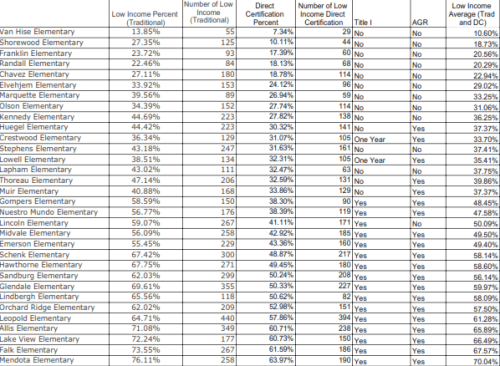
The AGR designation does not reflect current demographics of our K-5 schools, and other than via Title I MMSD has not designated Middle Schools as “High Poverty.” MMSD currently uses both self identification (traditional) and Direct Certification to designate students as “Low Income.” These methods produce very different results (see spreadsheets here for K-5 and here for 6-8). It is impossible to say if one is a “better” measure than the other. I would suggest using an average of the two to rank our schools, and 35% (rounded up) as the “High Poverty” cut point for K-8.  By this method the following schools are designated ‘High Poverty”

K-5 (non-AGR schools marked with *; non-Title I schools marked with #)

Allis Elementary
Emerson Elementary
Falk Elementary
Glendale Elementary
Gompers Elementary
Hawthorne Elementary
Huegel Elementary#
Kennedy Elementary*
Lake View Elementary
Lapham Elementary*#
Leopold Elementary
Lincoln Elementary*
Lindbergh Elementary
Lowell Elementary
Mendota Elementary
Midvale Elementary
Muir Elementary#
Nuestro Mundo Elementary
Orchard Ridge Elementary
Sandburg Elementary
Schenk Elementary
Stephens Elementary*#
Thoreau Elementary#

6-8 (non-Title I schools marked with #)

Badger Rock Middle
Black Hawk Middle
Cherokee Middle
Jefferson Middle#
O’Keeffe Middle
Sennett Middle
Sherman Middle
Toki Middle#
Whitehorse Middle#
Wright Middle

Looking closer at the K-5 spreadsheet brings to light some of the issues involved.

K-5 Poverty AGR Title

First is that Lincoln — a high poverty school by any calculation — and Lapham, Stephens, and Kennedy — relatively high poverty schools — are left out of the AGR/Not AGR scheme, but included here.  Depending on how you count, these schools educated either 848 or 533 low income students last year.  This points to another observation, which is that there are a substantial number of low income students in our non-low income schools — by one method 180 at Chavez alone — and that these schools and students cannot be completely left out of our equity efforts.  It should also be acknowledged that one current AGR school — Crestwood — doesn’t make the cut.  I would be open to retaining that school.

Choice #3 — How To Allocate the New FTE?

If you want to make sure that the maximum number of the new sections go to the highest priority grades and schools, and maximize the likelihood that none of the classes in the highest priority categories exceed the designated limits, all allocations to lower priority categories would have to be delayed until after the Third Friday Count, and the end of allocations.  I am open to that idea (if you support it, let me know), but it isn’t my first choice (at this time).

In order to hire the best teachers, have the least disruption in class assignments, deal with physical and other logistics, best integrate faculty into school communities, and many other reasons, allocating earlier is better than allocating later.

What I am proposing for consideration here (and may end up proposing in the final amendment, depending on the feedback I receive), is an allocation process that seeks to balance the competing desires of maximizing addressing the highest priorities, and timing the additions in the way that makes the most sense.  Here goes version #1 (dates, details, and percentages, as well as the whole concept open for discussion and change).

  1. Beginning July 1, 2017 allocations of the new FTE will be made on a weekly basis, in order of and according to the priorities listed above, using then current enrollment or roster data.
  2. No more than 50% of the new FTE may be allocated prior to August 1, 2017.
  3. No more than 80% of new FTE may be allocated prior to the Third Friday Count.
  4. Middle and High Schools may address large sections via partial FTE and overload authorizations.
  5. The Board of Education will be provided bi-weekly updates on allocations made under this amendment, and any and all grades or courses at any school that exceed the limits above where there has not been an allocation made.  These reports shall be public.

I was tempted to make it even more complicated by having X% at this date, and Y% at the next date, and Z%, and on and on, with a new percent (almost) every week, but I decided not too.  I am still tempted to try to adjust the dates around the enrollment/registration week (August 14-18), or the opening of school (September 5 & 6).  As I said above, I am open to adjusting any part of this, or abandoning the attempt to balance.  I like it, but I don’t love it.

What Next?

To be fair to my fellow Board Members and our hardworking staff, I should finalize and submit this early next week (end of the day Monday 6/19 or mid day Tuesday 6/20 at the latest).

Between now and then, I hope to hear more from our well-informed and creative community (that means you!).  You can comment on this post, send an email directly to me — tjmertz@madison.k12.wi.us, or the entire Board — board@madison.k12.wi.us, I promise to read them all, but may not be able to respond individually.  You can even call me (the number is on the Board page).

Once I finalize this amendment, I will post it here, at AMPS.  Then you can weigh in and tell me what I did wrong.

If you think I did more right than wrong, please let the Board (and the world) know about your support for the amendment.  As usual, you can email us, or testify at the June 26th meeting where we will be voting on this and the entire preliminary budget.  Talk to your neighbors, co-workers, and friends, write a letter to the editor, post on Facebook. Instagram, or tweet something, draw something, dance…be creative.

Thanks in advance for the feedback and support.

Thomas J. Mertz
Leave a comment

Filed under "education finance", Accountability, AMPS, Best Practices, Budget, Class Size, education, Equity, finance, Local News, MMSD, School Finance, Take Action