
Click on image for pdf.
All the Education Tweaks can be found here.
Thomas J. Mertz
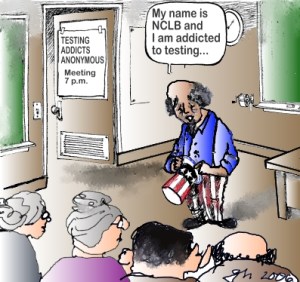
Click the image for more NCLB cartoons.
The Bush administration allowed states to phony-up statistics on everything from graduation rates to student achievement to teacher training and state education standards. As a result, the country has yet to reach not only the goals that were clearly laid out in the law but also farsighted education reforms dating to the mid-1990s. (emphasis added)
New York Times, “A New Day for School Reform,” editorial, February 21, 2009.
There may be some truth to the cause and effect on teacher training, but the implied idea that the failures of No Child Left Behind are due to setting standards (curricular and Adequate Yearly Progress) too low is illogical and reinforces multiple flaws in the NCLB.
Some asides at this point. I want to be clear that communicating high expectations to students in all contexts while giving them the support they need to meet those expectations is good policy. Changing state standards and cut scores at best comprises a very, very small part of this concept and at worst leads to shaming and other counterproductive punishments. Better — not necessarily higher — curricular standards do have a place in reform.
First, standards in practice mean standardized tests and standardized tests are very limited as assessments and even more limited as a means of improving education. To be fair, there is some language in the stimulus package (the subject of the quoted editorial) that may induce a move away from standardized tests (see below).
Second, and most importantly, the whole notion that lax standards are the biggest problem in education defies logic and the historical record.
In terms of logic, just ask yourself if the way to improve archery scores is to use smaller targets. If they can’t hit the larger target, how will they hit a smaller target?
As to the history, here is the data for Wisconsin under the current system:
| Year | # Schools Failed AYP | # Districts Failed AYP |
| 2007-8 | 153 | 4 |
| 2006-7 | 92 | 2 |
| 2005-6 | 87 | 1 |
| 2004-5 | 49 | 1 |
This graphic tells us about the history and projected future (more here).
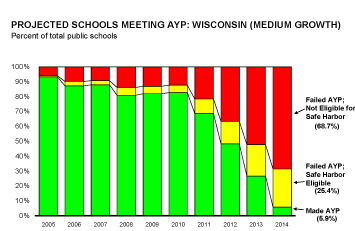
The current standards have resulted in clear trend of increasing failure to meet those standards, a trend that is projected to increase with current standards.
Some quotes from “How Feasible is Adequate Yearly Progress (AYP)? Simulations of School AYP “Uniform Averaging” and “Safe Harbor” under the No Child Left Behind Act” by Jaekyung Lee may help clarify.
It does not appear to be feasible for many schools across the nation to meet the current AYP target within its given 12-year timeline. It is not realistic to expect schools to make unreasonably large achievement gains compared with what they did in the past. Many schools are doomed to fail unless drastic actions are taken to modify the course of the NCLB AYP policy or slow its pace. (emphasis added)
When a majority of schools fail, there will not be enough model sites for benchmarking nor enough resources for capacity building and interventions. This situation can raise a challenging question to the policymakers: is it school or policy that is really failing? There is a potential threat to the validity of the NCLB school accountability policy ultimately if such prevailing school failure occurs as an artifact of policy mandates with unrealistically high expectations that were not based on scientific research and empirical evidence. (emphasis added)
An identified problem with NCLB is that standards are unrealistically high, the New York Times’ solution, raise the standards. Stunning illogic.
This is the kind of “harder is better” mentality reflected in the Pangloss Index and expected from people like the Walton and Bradley Foundation funded Thomas B. Fordham Institute, not “the paper of record.”
Later in the editorial, the assessment reform potential of the stimulus bill is touted:
States will also be required to improve academic standards as well as the notoriously weak tests now used to measure achievement — replacing, for instance, the pervasive fill-in-the-bubble tests with advanced assessments that better measure writing and thinking.
This seems to be a gross overstatement. Here are the relevant parts of the stimulus bill:
(4) STANDARDS AND ASSESSMENTS.-The State-
(A) will enhance the quality of the academic assessments
it administers pursuant to section 1111(b)(3) of the
ESEA (20 U.S.C. 6311(b)(3)) through activities such as
those described in section 6112(a) of such Act (20 U.S.C.
7301a(a));
(B) will comply with the requirements of paragraphs
(3)(C)(ix) and (6) of section 1111(b) of the ESEA (20 U.S.C.
6311(b)) and section 612(a)(16) of the IDEA (20 U.S.C.
1412(a)(16)) related to the inclusion of children with disabilities
and limited English proficient students in State
assessments, the development of valid and reliable assessments
for those students, and the provision of accommodations
that enable their participation in State assessments;
and
(C) will take steps to improve State academic content
standards and student academic achievement standards
consistent with section 6401(e)(1)(9)(A)(ii) of the America
COMPETES Act.
A and C send us to the two prior acts, with vague “such as” language in A. Here is the section cited in A:
(1) To enable States (or consortia of States) to collaborate with institutions of higher education, other research institutions, or other organizations to improve the quality, validity, and reliability of State academic assessments beyond the requirements for such assessments described in section 1111(b)(3).
(2) To measure student academic achievement using multiple measures of student academic achievement from multiple sources.
(3) To chart student progress over time.
(4) To evaluate student academic achievement through the development of comprehensive academic assessment instruments, such as performance and technology-based academic assessments.
and the section cited in C:
(ii) identifying and making changes that need to
be made to a State’s secondary school graduation
requirements, academic content standards, academic
achievement standards, and assessments preceding
graduation from secondary school in order to align
the requirements, standards, and assessments with
the knowledge and skills necessary for success in academic
credit-bearing coursework in postsecondary education,
in the 21st century workforce, and in the Armed
Forces without the need for remediation;
I certainly don’t see a requirement to end “fill-in-the-bubble tests” here. I see some good but weak language opening the door to multiple assessments, some possibility of better assessments in general and buzz words about the “21st century workforce.” I also have not seen anything in Wisconsin’s plans for the stimulus money that indicates that the WKCE will be gone anytime soon (since the contract requires two-year notice be given, I don’t see that long awaited day being pushed up).
This editorial is unfortunately typical of the confusion on education policy in our media and consequently in our society. Education policy can be confusing. This makes the role of the press even more critical and the failures of logic and accuracy like those in the Times editorial more damaging.
Thomas J. Mertz

The Coasters, “Charlie Brown” (click to listen or download)
With the stimulus, elections, budget and school finance proposals, a few smiles seems like a good idea. It has been a little while since the last Education Tweak so I thought I’d pass along a couple of items from the Britsh site NewsBiscut (hat tip to Judy Schmidt).
Balls announces Hindsight to be taught in schools
The Minister of Education, Ed Balls, has announced today that from September 2009, the teaching of hindsight will become a compulsory addition to the national curriculum at Key Stage 3 and above.‘Clearly, the benefits of hindsight have long been recognised, but schools have provided little or no formal teaching of the subject to date. It is to remedy this deficit that we are moving straight to an expectation that a minimum of an hour per week’s hindsight will be taught to all children aged 11 plus’ from the beginning of the next academic year.’
Further details of the curriculum are to be released shortly, but the Minister did confirm that both GCSE and A level Hindsight would be offered to students, although pupils wishing to pursue the subject would not be able to sit their final exams until several years after the completion of their formal education.
The Government are also considering the teaching of ‘Retrospective Foresight’ ‘Tip of the Tongue’ phenomena and ‘Unknown Unknowns’ although there have been delays drawing up the syllabus for the latter.
While the Opposition supported the new plans, the Conservatives said that the teaching of Hindsight should have been introduced much earlier. ‘Knowing what we know now, it’s obvious that hindsight should have been introduced ages ago,’ said Tory education spokesman Michael Gove. ‘I can’t believe that they have waited until now.’
National Curriculum to include ‘Bleedin’ Obvious’
The Department of Education has announced that it is widening the National Curriculum to include lessons in the Bleedin’ Obvious.
Research has shown that much of Britain’s workforce is under-educated in this area, and continues to fall for email scams, Readers Digest appeals and offers of extended warranties.‘In the modern global economy Britain’s workforce needs to be highly skilled and educated,’ said Junior Education Minister Sarah Beaumont. ‘Frankly if we still got people thinking that they really are the millionth visitor to a certain website, then there really isn’t much hope for any of us.’
Lessons in the Bleedin’ Obvious will also explain that being rude to a policeman who has pulled you over for a driving offence will not result in a quick resolution of the matter or smaller fine nor is it generally making worth making jokes about bombs and terrorism to airport security staff.
Pupils will also be taught that if they get seriously into debt with the bank, then paying it off by borrowing lots of money from that dodgy bloke on the estate may not be the end of all their problems. Another lesson includes learning what happens if you try and clear the compacted grass cuttings off the lawn mower blade while it is still connected to the mains.
‘It’s great to get proper training in the Bleedin’ Obvious before we head out to the workplace’ said 16 year old Simon Jonson. ‘I’ve seen a really well paid job I want to apply for that will let me work from home. It was advertised on a bit of paper tied onto a lamp post so it must be from a really reputable source.’
Thomas J. Mertz
Filed under Best Practices, Gimme Some Truth
Click on Image for pdf.

Click on image for pdf.
As always, past and future Education Tweaks can be found here.
Thomas J. Mertz
Filed under Best Practices, education, Gimme Some Truth, National News, nclb, No Child Left Behind

“Not getting cut is the new increase in this budget.”
Wisconsin Governor Jim Doyle speaking to the Wiscosnin Association of School Boards Convention.
1984, David Bowie (click to listen or download)
There were lots of rumors about Doyle seeking a position in the Obama administration. Since that didn’t happen it appears that he is angling for a gig with the Ministry of Truth, who gave us such slogans as “War is Peace” and “Ignorance is Strength” in George Orwell’s 1984.
Thomas J. Mertz
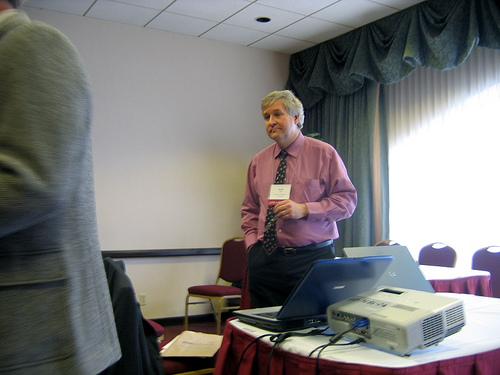
Andy Hall, long time education reporter for the Wisconsin State Journal is leaving the paper to start a nonprofit Wisconsin Center for Investigative Journalism. Andy is a fine reporter and will be missed.
Andy writes clearly and always does his homework. Part of the project at AMPS has been to improve understanding of education issues by addressing the failings of the media coverage; I don’t think we’ve ever seen a need to use one of Andy’s stories as an example of what’s wrong.
Beyond consistently excellent coverage of the Madison schools, he derserves special praise for his 2007 “Squeezing Schools” series, which has had a statewide impact by doing much to enhance comprehension of Wisconsin’s broken school finance system.
This is the kind of thing we need journalists to do more of. A couple of quotes from Andy indicate that continuing this sort of work is the mission of his new undertaking.
“Mainstream journalism is in economic trouble, but the needs of our democracy are greater than ever,” said Andy Hall, executive director of the center and its sole initial employee.”
…”He said the mission is to protect the vulnerable, expose wrongdoing and seek solutions to pressing problems.”
We wish Andy and the Center the best!
Thomas J. Mertz
Filed under "education finance", education, finance, Gimme Some Truth, Local News, School Finance, Uncategorized
Filed under Best Practices, Gimme Some Truth, National News, nclb, No Child Left Behind
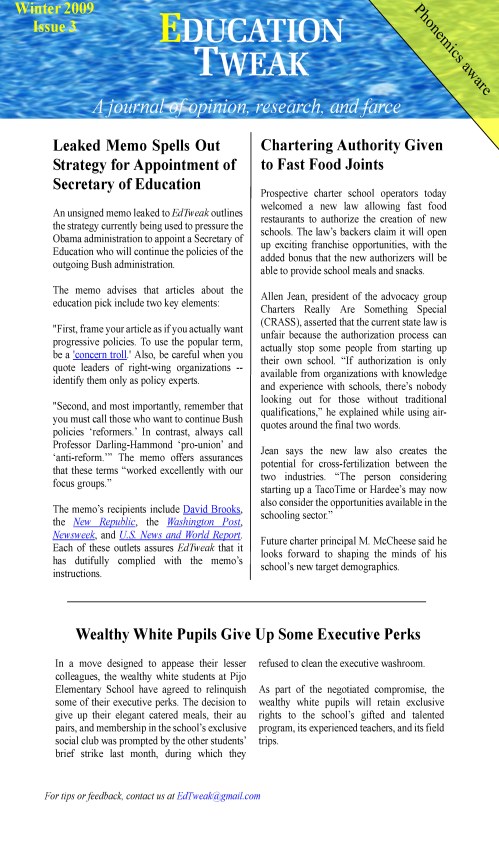
Click on image for pdf.
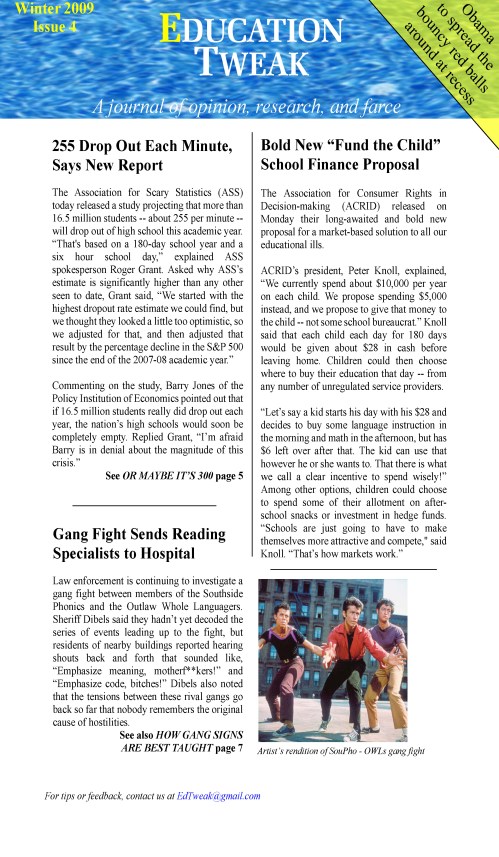
Click on image for pdf

Click image for pdf.
All the Education Tweaks can now be found at this page.
Thomas J. Mertz
Filed under Best Practices, education, Gimme Some Truth, National News, nclb, No Child Left Behind

Click on image for pdf
The fun continues.
Thomas J. Mertz
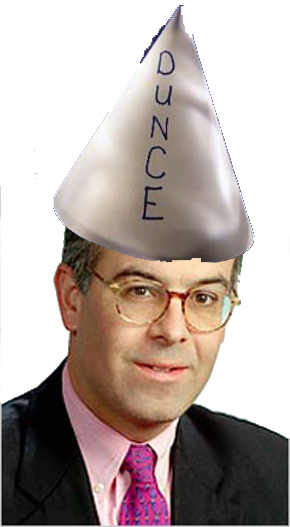
There is a lot of buzz on David Brook’s latest column and its topic — Obama’s pick for Secretary of Education and the direction of education policy in his administration (weigh in on the latter here). Many of the buzzers, like Brooks, simplemindedly frame the choice as between choosing a “reformer” and choosing a stalwart defender of the status quo (in Brooks’ case the latter is described as “teachers’ unions and the members of the Ed School establishment, who emphasize greater funding, smaller class sizes and superficial reforms”).
We’ve seen this in Madison before — the subtle “reformers as good guys,” others as uncaring, self interested or misguided defenders of a failed system. It wasn’t accurate or useful then and it isn’t now.
Much of the current discourse is derived from what Marion Brady in 2001 identified as a the narrowing of reform to “introducing market forces” via “standards and accountability” and the definition of standards and accountability as standardized testing and blaming teachers (and teacher unions), with a little privatization in the mix.
If it isn’t obvious to you how wrong and destructive this is, click the link and read what Brady had to say.
For myself, I’ll just hit a few very quick points. First, market forces aren’t what they’ve cracked up to be (pun intended). Second, the way to improve teaching is not by attacking teachers, teacher trainers and teacher unions…none of them are going away and all them are interested in improvement. Greater funding and smaller classes are not superficial, just look at the research or ask a teacher — oh yeah Brooks has dismissed the knowledge of researchers and teachers, pretty clever of him. Last, this crisis mentality is throwing the baby out with the bathwater. We have many great schools and teachers, a system that works for most and desperately needs to be improved in order to work for all. I don’t see Brooks calling for Socialism or Communism as a fix for a financial and industrial system that is obviously broken; why call for radical changes in an education system that isn’t broken?
A couple of links: Jim Horn’s take at Schools Matter and Bob Somerby at the Daily Howler on this column and related failings in education reporting (scroll down).
Thomas J. Mertz
 Fund a Classroom Project in Madison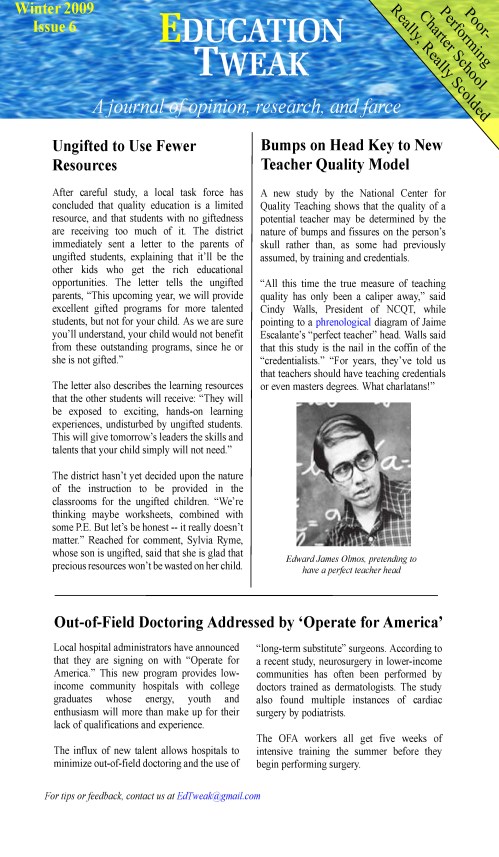
 AMPS
AMPS 