Category Archives: Local News

Jim Doyle, a Governor for 1984?

doylefestivus

“Not getting cut is the new increase in this budget.”

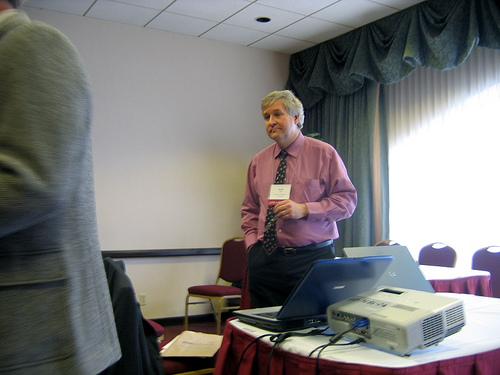
Wisconsin Governor Jim Doyle speaking to the Wiscosnin Association of School Boards Convention.

1984, David Bowie (click to listen or download)

There were lots of rumors about Doyle seeking a position in the Obama administration.  Since that didn’t happen it appears that he is angling for a gig with the Ministry of Truth, who gave us such slogans as “War is Peace” and “Ignorance is Strength” in George Orwell’s 1984.

Thomas J. Mertz

Leave a comment

Filed under "education finance", Budget, education, Elections, finance, Gimme Some Truth, Local News, Quote of the Day, School Finance

Andy Hall, Moving On

2410935952_732ff04a9c

Andy Hall, long time education reporter for the Wisconsin State Journal is leaving the paper to start a nonprofit Wisconsin Center for Investigative Journalism. Andy is a fine reporter and will be missed.

Andy writes clearly and always does his homework.  Part of the project at AMPS has been to improve understanding of education issues by addressing the failings of the media coverage; I don’t think we’ve ever seen a need to use one of Andy’s stories as an example of what’s wrong.

Beyond consistently excellent coverage of the Madison schools, he derserves special praise for his 2007 “Squeezing Schools” series, which has had a statewide impact by doing much to enhance comprehension of Wisconsin’s broken school finance system.

This is the kind of thing we need journalists to do more of.  A couple of quotes from Andy indicate that continuing this sort of work is the mission of his new undertaking.

“Mainstream journalism is in economic trouble, but the needs of our democracy are greater than ever,” said Andy Hall, executive director of the center and its sole initial employee.”

…”He said the mission is to protect the vulnerable, expose wrongdoing and seek solutions to pressing problems.”

We wish Andy and the Center the best!

Thomas J. Mertz

1 Comment

Filed under "education finance", education, finance, Gimme Some Truth, Local News, School Finance, Uncategorized

One Contested Seat — Madison School Board

55066921

I had been thinking about a post asking and speculating why Madison would have two consecutive school board elections without contested seats (I’m still interested in the lack of candidates, may post on it later and would love to read your thoughts in the comments); instead I get to write about the contest between Board president Arlene Silveira and newcomer Donald Gors Jr.

If you follow school politics in Madison, you already know enough to have formed an impression of Arlene Silveira (mine is complicated and contradictory, I think she is solid, caring, I share many beliefs with her but also disagree on some things in both policy and governance style…).  Gors is a mystery.

A little Internet searching sheds some light.

In 2004, in the midst of a difficult budget season, Gors testified before the MMSD finance committee. I’m not sure what to make of what he said, so I’m just going to quote the minutes:

Don Gors, parent, stated that the district should be expanding services to children and the need for flexibility in meeting the needs of society, however, things could not be done in the same way. Suggested that the district stop late buses and cab rides. He asked that they not do what constituents think but involve the teachers more and change the delivery of services and make the community accountable.

Maybe it made more sense when you heard the whole thing?

Dors and his spouse also had a letter on Mathematics education published in the State Journal in 2005.  Again, I’m going to quote the entirety:

Children are confused

My three children attend Madison public schools in grade 10 at Memorial High School, and sixth and eighth grades at Jefferson Middle School. We have seen how the introduction of numerous elementary and middle school math programs have negatively impacted our children during these past 10 years.

We have noticed that if your child is in grades four, six, eight or 10 (the years our children are tested), that during the first two months of school our children are exposed to an explosion of different math challenges that seem to be all over the map. Our children come home confused and mad, and when we look at the math they are struggling to learn, there appears to be no fundamental building block for the learning of it. My wife and I have come to the conclusion our children are exposed to the variety of math challenges because they may be on the test.

Be careful when you hear the data being thrown around by our administrators and our Wisconsin DPI. We know when our children are struggling. If our kids can’t do the basic math of addition, subtraction, division, multiplication, fractions, decimals (without a calculator) and do four-step word problem-solving by the end of grade six your child needs help!

One size never, ever fits all. When will our educators take it as their failure to teach and not our children’s failure to learn?

I like the skepticism toward the test data, and the call not blame children for their lack of progress (although all students need to be encouraged to take charge of their educations) but the rest seems, well “confused.”

The last thing I’m going to share  a letter that Dors and his spouse sent to the County Board in June of 2008 (full County Board Minutes with letter here, letter extracted here).   It is too long to reproduce, but I do want to give the flavor with a relatively long excerpt (I do suggest reading the whole thing):

Dear, All Dane County Supervisors:

What happens when times get tough …. all the issues which have been given less attention start to come to the top.

(Land Purchases, RTA, Smoking Bans, Building Jails, Lack of Accountability Methods Over Safety -Security-Basic Needs!)

Just watch as a perceived good company goes bad…what causes it to go bad? Does it happen over night or is there signs that things are going south? Maybe that’s why people say follow the money…it has been learned that is true….in all Business and Government Operations!

South..Bad…Sour…Politics before Process, maybe this is the direction that some of this Counties Supervisors are allowing Dane County to be taken…

What I mean here is when times are good more and more things are not looked at or looked after because moral is up, perceived money is coming in and money is being spent but….then all of a sudden when things slow down the money has been over spent on things that are not center to it’s core business of operation…accounting faults are found and then what …whose left with the problem?

In business the first thing that goes are employees the last thing that happens is management is dismantled and then the business is shut down.

In government the first thing that happens is a request to increase Taxes surfaces. An attempt to remove the focus from what needs to be focused on. (What Dane County spending money on?). Past and Present!

Then some will try to bring others around to what’s important (Accountability, Responsibility) then all of a sudden a spin surfaces scaring others that Services will be diminished if Taxes are not increased.
Children will begin to suffer, those who you have made dependent on Government are made the main focus when the focus really should be on You, The Administration, A Public Accounting …where has the money gone, what has the money been spent on?

You see Government never looks at itself first, how Government is spending the money, is there a value for the majority when Government makes a decision on what to spend money on?

You get further and further away from asking yourself one question: Will this expense or decision help or hurt our tax paying community?

The kicker comes about two pages later:

No new taxes until we the Public have been given a full accounting of all money spent from 2000 to 2008.” (emphasis in the original).

Looks like Arlene will be getting my vote.

Thomas J. Mertz

2 Comments

Filed under education, Elections, Local News

Quote of the Day – “A better approach”

mind-the-gap

A better approach for state leaders is to concentrate on closing the gap between what the state requires school boards to spend and the amount the state allows school boards to collect in revenue.

Wisconsin Sate Journal, editorial January 6, 2009.

The larger point of the editorial — that those considering getting rid of the QEO without providing a means for additionally  revenue are  irresponsible — is correct also.

Thomas J. Mertz

Leave a comment

Filed under "education finance", Best Practices, Budget, education, finance, Local News, Quote of the Day, School Finance

Non Sequitur of the Day — More from the MMSD Math Report

[Edited 10:25 PM]
From MMSD Mathematics Task Force Report

From MMSD Mathematics Task Force Report

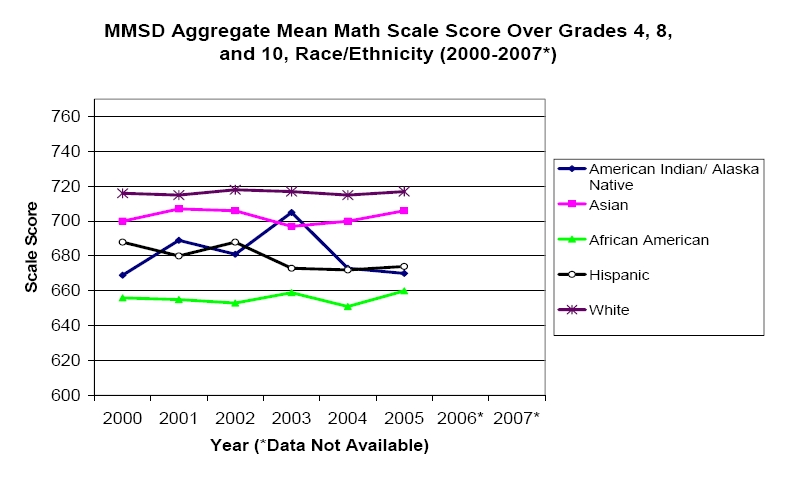
Assigning a meaning and interpretation to the decline in mathematics achievement scale scores over eight years is more difficult. As indicated in Exhibit I.3, the racial composition of the MMSD changed over this same period from about one-third minority students to nearly one-half minority students.

MMSD Mathematics Task Force Report, section 3, page 7.

Wow.

In the middle of a discussion of declining achievement, after a warning that this trend is difficult interpret — bang — a “helpful” reminder about the growing minority population.  Talk about you subtle invitations to insert your favorite crap about race and intelligence.  Shameful.  Disgusting.

Look, we all know that achievement gaps are a reality but this is not the way to discuss or present that information.  It might be OK if it was followed by some discussion of why these gaps exist and what can, (should and must) be done to address the gaps.

Don’t look in the report for that.  The only recommendations that even indirectly acknowledge the gaps are these:

8. In making improvements and investing resources, the district should consider how best to reduce the large achievement gaps among subgroups of students.

9. More time should be provided for teacher collaboration for teachers to learn from each other, analyze achievement data, meet needs of diverse learners, plan for instruction, and ensure both horizontal and vertical alignment of the curriculum. (See Section 4: Survey of Teachers, Parents, and Students.)

And there is no accompanying discussion of strategies to address the gap [correction, these issues are given some attention in the section on curriculum materials, basically saying that the materials MMSD uses are among those found to be good in addressing achievement gaps]. I thought they were supposed to give more guidance on  “how best.”

If I’m reading the charts right (the presentation leaves much to be desired), low income 10th graders score below non-low income 8th graders.  They are over two years behind.   This and other achievement differentials deserve serious attention.  Instead the Task Force gives us colorful charts and an invitation to racism.

Somewhere the lessons about high expectations leading to higher achievement have been lost.

I’m going to close with two items from the Equity Task Force work that actually made it into the policy:

1. Schools will be excellent only when students of all economic and demographic groups are achieving at high levels.

2. Schools should reflect fairness and high expectations for all learners.

Somebody should have told the Math Task Force these things.

Thomas J.  Mertz

Leave a comment

Filed under Best Practices, education, Equity, Local News, Uncategorized

MMSD Math Task Force Report, Thoughts on Teacher Preparation

From the International Slide Rule Museum

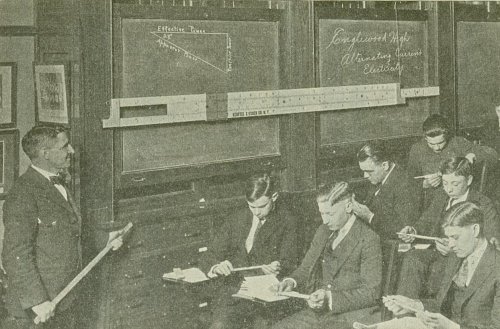
From the International Slide Rule Museum (click on image to visit).

In anticipation of next week’s public discusions of the Mathematics Task Force Report, I’ve been dipping into parts of that document.  So far, the section I’ve looked closest at  — Teacher Preparation — is pretty disappointing.  It isn’t that I disagree or agree with the conclusions (I don’t have much of an opinion), it is that the work is superficial and read closely provides little or no support for either the assertions made or the recommendations.

The introductory section on “information concerning recommendations from research reports and professional organizations for the mathematical preparation of middle school mathematics teacher” is generally fine and the review of requirements and programs in Wisconsin and neighboring states is also adequate.  However, it is worth noting that even this part of the report begins with an untested assumption that the middle schools are the proper area of focus.  Additionally  as one researcher observed “what counts as subject matter knowledge and how it relates to student achievement remains inadequately specified.”    In other words, we don’t know what what teachers should know to  improve achievement (the MMSD report indirectly touches on complexities of defining what teachers should know but does not acknowledge how thin the research base linking teacher preparation to achievement is).

Where the report is lacking is in the assessment of the appliabicality of this material to MMSD.  This is done in only the most cursory manner.

The main recommendations on teacher preparation — prioritizing “hiring middle school mathematics teachers who have advanced preparation in mathematics” (later clarified to mean “completing mathematics coursework that focuses on enhancing teachers’ understanding of the mathematical content that they teach“) and providing “increased opportunities for middle school mathematics teachers to enhance their knowledge of mathematics for teaching middle school but also require participation by more (if not all) middle school mathematics teachers” —  seem reasonable.  The real question is how much of a priority should these be, how pressing is the need.

There isn’t much here that helps answer that question.

As far as I can tell the recommendations and analysis are mostly a simplified version of the Conference Board of the Mathematical Sciences (CBMS) 2001 report The Mathematical Education of Teacher applied to MMSD without any real consideration of the situation in Madison.

This is most obvious in the use of “middle grades” to mean grades 5-8, when MMS middle schools are grades 6-8.  Therefore, the recommendations, which are focused on the “middle grades,” are not aligned with how Madison defines the middle grades.  You’d think that at some point, someone would have said “Let’s make this fit Madison and use their definition.”  They didn’t and instead stuck with what is the arbitrary definition used in the CBMS (for the arbitrariness of this definition, see Chapter 4, footnote one of the CBMS report).

In and of itself, this isn’t a big deal.  However, it is illustrative of a larger problem.  The whole teacher preparation section is an exercise in forcing Madison into preconceived ideas about what is wrong with and what needs to be done about Math education, with little attention given to assessing what is wrong with and what needs to be done with Math education in Madison.  That many of the ideas appear to be supported more by belief than evidence compounds the problem.

Taking a cue from the popular simplistic international comparisons induced crisis mentality, (for  example see the multiple citations of this report, which despite looking only at the coincidence of teacher preparation differences  and TIMMS score differences  —  think of all the other possible reasons for the achievement differences  —  says it is “premature” to “make recommendations to change the nature of US middle school teacher preparation in mathematics.”), in the introductory section, in support of the lead recommendation the MMSD report asserts  ‘The adequacy of teacher preparation is a significant problem that cannot be solved without a substantial investment in mathematics content-based professional development and a change in hiring priorities at the district level.”  There is almost no evidence offered to support this assertion.

In the teacher preparation section a caveat is added:  “it is questionable whether most of the MMSD middle school mathematics teachers possess the depth of mathematical knowledge required for effectively teaching middle school mathematics .” (emphasis added, there are many caveats in this section).

“Questionable” isn’t good enough in these days of scarce resources.

Despite an extensive survey of teachers, the only attempt to assess the mathematical knowledge and training of our teacher corps is a simple counting of those who have been certified by DPI in the subject area.  One recommendation of the report is that the certification process needs to be expanded and improved, so the report itself recognizes the inadequacy of that measure.  Moreover, certification in subject areas confers no advantages under the current teacher contract, so it is very possible that additional MMSD teachers meet the certification requirements but have not bothered to go through the process.

Certification is a much less important than knowledge.  Any agenda concerning teacher preparation should begin with the recommendation that MMSD find out how prepared our teachers are, if they know the things that research shows make them better teachers, improve achievement.  Pretty simple.

I would suggest starting with the materials being developed by the Learning Mathematics for Teaching Project at the University of Michigan or a similar inventory.  Let’s find out what our teachers know and don’t know before deciding that the solution involves teachers who know more.  Our teachers may be lacking or they may not.  Until that question is answered, the task force recommendations are unsupported and unsupportable.

As a former task force member, I am sympathetic to the constraints of the work, but this task force had grant money, professional consultants and other resources that set the bar higher.  Under these circumstances, the section on teacher preparation is woefully inadequate and disappointing.

One last clarification, I have not looked at the other sections of the report extensively and my criticisms of this section may not be indicative of the report as a whole.

Thomas J. Mertz

6 Comments

Filed under Accountability, Best Practices, education, Local News, Uncategorized

Wisconsin State Superintendent Candidates

dpilogo1

There are five announced candidates for the position of State Superintendent of Public Instruction.  Assuming at least three file the necessary signatures by Tuesday, January 6, 2009,  there will be a primary on February 17 and the top two vote getters will be in the general election on April 7.

Here are the candidates, with links to their web sites.

Todd Alan Price (web site now up and more  info here).

Tony Evers.

Lowell Holtz.

Rose Fernandez.

Van Mobley.

Price is the only one who I have been able to find saying good and meaningful things about Wisconsin’s broken school finance system.

  • Fixing the School Funding Formula. Costing out per student what it actually takes to fund an excellent education. Analyzing the tax base for funding the school system, reviewing options to improve the school funding formula and proposing an effective solution to make fair and equitable the allocation of resources for every child.

The Capital Times (via the AP) has more about the candidates.

The story reveals a curious obsession with the Qualified Economic Offer.  The State Superintendent has no constitutional role in changing the QEO and if the last few years are any guide, the bully pulpit doesn’t count for much there either.

Why does our media obsess on the QEO in stories where it is nearly irrelevant and ignore it when it is crucial?  I wish they’d get it right.

Thomas J. Mertz

Leave a comment

Filed under "education finance", Best Practices, education, Elections, Local News, School Finance

WAES School Funding Update, 12/1/2008

waesgraphic

    The Wisconsin Alliance for Excellent Schools (WAES) is a statewide, independent, membership-based organization of educators, school board members, students, parents, community leaders, researchers, citizens, and community activists whose lone goal is the comprehensive reform of Wisconsin’s school-funding system. If you would like more information about the organization — or on becoming part of WAES — contact Tom Beebe at 920-650-0525 or tbeebe@excellentschools.org.
    *******
    New report calls for balanced approach to solving fiscal deficit

    Most of us who fight for school-funding reform now understand that underfunded schools are just one symptom of a crisis in public structures. To save those services that level the playing field for all of us, we will need a balanced approach to government that includes new revenues as well as prioritization of spending and cuts in non-essential services.

    To answer the constant drumbeat calling for smaller government and no tax increases, a new report details “an inventory of options for reforming the state’s tax system and finding a balanced approach for filling the deficit.” “Catalog of Tax Reform Options” (http://www.wisconsinsfuture.org/publications/taxes/1108WI_TaxReformOptions.pdf) was authored by the Wisconsin Council of Children and Families (http://www.wccf.org/) and the Institute for Wisconsin’s Future (IWF at http://www.wisconsinsfuture.org).

    IWF’s Jack Norman, along with the report’s other authors, talked about the report in the Nov. 22 edition of the Milwaukee Journal Sentinel in an opinion piece entitled “How to raise money for our state (http://www.jsonline.com/news/opinion/34903414.html).” Norman was also Ben Merens’ guest, Nov. 24, on “At Issue” (http://www.wpr.org/merens/index.cfm?strDirection=Prev&dteShowDate=2008-11-24%2017%3A00%3A00) on Wisconsin Public Radio.
    *******
    Budget cuts could degrade Rhinelander High School

    Rhinelander Board of Education meetings are very well attended these days as the community discusses the future of their children’s education in light of a failed Nov. 4 referendum. Recent discussions are centering on moving back to a seven-period day at the high-school and put the hockey and swimming teams on the budget chopping block in light of the need to trim about $2 million from the district’s 2009-10 budget.

    Rhinelander implemented a four-period day 10 years ago because it was good for kids. High school Principal Terry Fondow told the board recently, however, that “because of the district’s fiscal reality” he was proposing moving back to a seven period day. This would mean reducing the number of graduation credits and advanced placement courses, increasing the student-teacher ratio, and eliminating staff. Fondow said, “It’s no doubt that I’m proposing a degradation of the high school, both in breadth and depth (http://www.newsofthenorth.net/article.cfm?articleID=24365).”

    Board President Chuck Fitzgerald told the audience at a recent meeting that the group would be considering budget cuts into April or May, but that athletic programs will be among them (http://www.newsofthenorth.net/article.cfm?articleID=24390). He explained that one proposal is to close the swimming pool which would mean the elimination of the hockey and swimming programs, both of which use the pool.

    Proposing the cuts, administrators said they worry they will damage education. “We are now at the level of cutting severely into what is good for children,” said co-assistant superintendent Carole Witt Starck.
    *******
    Proposed cuts in Merrill could “damage education”

    Options is the key word in the Merrill School District as the community looks to make $750,000 in for the 2009-10 school year (http://www.wausaudailyherald.com/article/20081202/WDH0101/812020464/1981). This discussion also follows on the heels of an unsuccessful referendum to exceed revenue limits ($2.9 million) on Nov. 4.

    Merrill has cut its budget each year since 2000-01, and, during that span, has cut $5 million. Recommendations include eliminating the positions of three literacy teachers, cutting two teachers in high school elective courses, eliminating a middle school band teacher (reducing lesson and instruction time), and eliminating fourth grade at Maple Grove Elementary School by splitting the students among third- and fifth-grade classes.
    *******
    Rural school finance is subject of Dec. 10 “webinar”

    Rural School and Community Trust (http://www.ruraledu.org) will be holding a webinar — a web-based seminar — on the top 10 things you can do to improve Wisconsin’s financing of rural schools. The event will be held on Wednesday, Dec. 10, at 1 p.m. and consist of a conference call and a slide presentation.

    Amanda Adler, director of the Rural Education Finance Center, will host the discussion.

    Webinars are a regular benefit to members of the Rural School Innovation Network (RSIN), but they are also open to non-members for a fee of $45. For more information on this event or joining the RSIN, go to http://www.ruraledu.org/site/c.beJMIZOCIrH/b.3937703/k.5F87/RSIN_News_and_Updates.htm.
    *******
    Waupun hopes third time a charm for referendum

    In an effort to keep two schools open, the administration of the Waupun School District recently came forward with a $3 million “high-stakes referendum” for the April ballot (http://www.fdlreporter.com/article/20081203/FON0101/812030440/0/FON0201).

    In the past two years, voters have rejected two operational referenda. The decision to try again was among seven options outlined to balance the 2009-10 budget and beyond. One Waupun resident said “we have to make it clear (to voters) what will happen if this referendum fails. If people realize these schools will close or their child has to ride the bus over an hour every day, they might vote a little differently.”

    Closing the two schools would save over $400,000. Other options for reducing the budget include cutting additional personnel, a wage freeze for non-represented employees, eliminating four athletic teams, cutting middle school extra-curricular activities, and abolishing the police liaison position.
    *******
    Membership in WAES is more important now than ever

    Two organizations and three individuals are the latest welcomed additions to WAES, a diverse, statewide coalition working for school-funding reform. Joining are Glorie Salas, Ken and Kim Bates, the Neshkoro School Visioning Committee (in the Westfield School District http://www.westfield.k12.wi.us/), and Price County Citizens Who CARE, the group that “started” the school-funding reform movement in Wisconsin when members walked from Butternut to Madison about 10 years ago to “talk about” their problems with the present finance system.

    If you haven’t joined the effort to bring the reform message to everyone, do it now. WAES is an independent, non-profit, dues-supported organization. If we are going to organize communities around the state for change, we need your talent, your time, and your financial support. Go to http://www.excellentschools.org/about/join.htm … it’s quick, it’s easy, and you can join online.

    When you pay your dues, you are helping to finance the core educational mission of WAES. Numbering 120 strong organizations and individuals, our mission is to make sure that as many people as possible get the message of reform. We do that by traveling around the state and holding school-funding change discussions in church basements, schools, kitchens, and meeting halls. You can find out how to bring this message to your community at http://www.excellentschools.org/calendar/SchoolFundingWorkshop.htm.

    Thomas J. Mertz

    Leave a comment

    Filed under "education finance", Best Practices, Budget, education, finance, Local News, Referenda, referendum, School Finance, Take Action

    Building on Victory – Next for CAST

    logo

    Join with CAST to raise school finance reform to top of the agenda!

    The referendum passed – thanks to all for your support and hard work! Now it’s time to turn our energy to school finance reform!

    Without changes in the way Wisconsin finances schools, Madison and other districts will face a future of continued budget cuts and divisive referendum battles. Our local state legislators supported the referendum and support fair funding for schools. We need them to put school finance reform on the top of their agenda for the next state budget.

    Please join CAST on Wednesday, Dec. 3rd 6:30pm at Hawthorne Library and help plan an event at the State Capitol in early January to meet our legislators and ask for their leadership.

    Let’s plan a creative and constructive action that involves everybody– kids, parents, educators, grandparents. Bring your ideas!

    Hawthorne Library is located at 2707 E. Washington Ave., 246-4548, See for this link for directions.

    If you have questions or cannot join us on Dec. 3rd, but have an idea or want to be part of the event in January, please contact Jill Jacklitz at madisoncast@sbcglobal.net

    Community and Schools Together

    Thomas J. Mertz

    Leave a comment

    Filed under "education finance", Best Practices, Budget, education, finance, Local News, School Finance, Take Action

    No need to know? (updated)

    blank-pages

    Update: The strategic planning proposal has been posted here (thanks Barb).  No time to go into depth right now, except to say that it appears to follow what was done in Green Bay fairly closely, even recommending the same facilitator (Supt. Keith Marty of Menomonee Falls).

    On the agenda for the Monday, December 1, 2008 MMSD Board of Education Meeting is an action item asking for approval of a proposed “structure and timeline for the MMSD strategic planning process,” and authorization for the “the Superintendent to pursue the key steps for implementation.”  This could be a big deal, I don’t know.  Short of contacting Board members or administrators or staff, there is no way to know.

    There is public comment at the meeting Monday.  However, any comment on this proposal would be rushed because the proposal is not posted on the web and at best the public may be able to get a copy some time Monday.

    I would guess the Board has seen and commented on versions of the proposal, but it has not been on an official agenda, nor has it been discussed at a public meeting.

    This is no way to begin strategic planning that is supposed to include the larger community.  How can we be included if we don’t even know what is going on?

    In messages to the community, Board President Arlene Silveira has promised that the strategic planning process would “include strong community input.”  Maybe that will come later.  So far there has been no effort to inform the public of anything of substance and on Monday they are scheduled to vote.

    The “structure and timeline” might not be a big deal, it might be simple housekeeping  — no way to know — but if it is important, and they are serious about involving the community, they should slow things down, share the knowledge, ask for input…and involve the public from the very start.

    Thomas J. Mertz

    2 Comments

    Filed under Accountability, Best Practices, education, Local News