Category Archives: AMPS

“We’ve given up on dreaming” — Madison Board of Education Referendum Discussion (updated)

Paul Klee, "Dream City," 1921

Paul Klee, "Dream City," 1921

Elvis Presley, “If I Can Dream” (click to listen or download)

Update on schedule of public forums below.

The MMSD Board of Education held their first discussion of a possible referendum at their Monday, July 28, 2008 meeting. Most of the right and expected things were said (more below, video should be up here soon).

What stuck with me from the meeting was something Marj Passman said. I’ve used part of her statement as the title of this post.

“We’ve given up on dreaming…the dreams that keep you going.”

The topic was the toll that the pressures from the state school finance system has taken on our district and how a referendum might help. There was much talk at other points in the meeting of wanting to avoid both a comparative discussion of potential cuts and belaboring past cuts. Ms Passman spoke to some of this, but she did something much more important; she reminded us that endless cycles of cuts have taken away opportunities to think about and work toward the best possible public schools. It made me think of the Langston Hughes poem, “A Dream Deferred.” As Marj said, we need these dreams to keep us going.

This is important in so many ways.

Struggling to do more with less without dreams or hope is demoralizing. As teachers and staff and the administration and the Board lose track of their dreams and hope, this hopelessness is inevitably communicated to our students. That’s exactly the wrong lesson to be teaching.

As the structure and dollar amounts for a referendum discussed, I hope all keep what Ms. Passman said in mind. Some will oppose a referendum of any size and many others will look to do a referendum on the cheap, partially in anticipation of planning and restructuring that Dan Nerad is already laying the groundwork for. This is the wrong attitude. We need to give Supt. Nerad some room to work; we need to finance our schools so that not every new initiative requires scaling back some existing program; we need to be able to try to make some of our dreams a reality.

I’ve got other observations about the discussion, but first some “news.”

The biggest news is that new Asst. Superintendent for Business Services, Erik Kass, in reviewing the assumptions for budget projections, “found” a $1 million “error.” That places the 2009-10 budget gap at $8.2 million, instead of $9.2 million. Mr. Kass will be doing a complete review of the projections prior to the final decision on a referendum. As Supt. Nerad pointed out, there may be no more errors or if there are additional errors found they may lead to increases or decreases in the projected budget shortfall.

The other important news concerns the schedule for decision making. The almost unspoken assumption everyone is operating under is that there will be an operating referendum on the ballot on November 4, 2008. For that to happen, the Board needs to have referendum language to the clerk’s office by the start of September. This means a pretty tight schedule for all discussions, forums, deliberations and votes. Things may change, but here is my understanding of the next steps (with some comments).

August 4, 200 Board of Education Workshop Meeting

At this meeting I think more of the nitty-gritty of a a referendum will be discussed. This may include alternate ways to look at budget history and projections (Board members had some specific requests), a projected schedule through the November vote with some initial talk of communication planning (another Board request), recurring vs. nonrecurring and other matters of type and form, maybe a presentation of some of the potential cuts or changes if there is no referendum or if a referendum fails, the scheduling of public forums prior to a referendum vote and more.

August 11, Regular Board of Education Meeting

This looks to be a continuation and expansion of the discussions from the August 4 meeting.

Week of August 11, Public Forums

This is the tentative time set aside to hear from the public. There will likely be two forums, one on the East Side and one on the West Side. In order to be as friendly as possible, the administration is seeking to schedule these at non-MMSD sites. It was heartening to hear the Board and Supt. Nerad seeking ways to involve as many people and groups as possible.

Update:

From Board President Arlene Silveira, on the The Daily Page:

We will have 2 information/public input sessions for the community to provide feedback on our options. These are scheduled for:

* Tuesday, August 12, 6:00-8:00pm, Warner Park Community Center
* Thursday, August 14, 6:00-8:00pm, Memorial High School

The discussion of the forums also touched on what the Board does and does not want from the forums, with a general agreement that the comparative cut talk isn’t very helpful. Elected officials seeking to shape the kind of input they get from the public is a tricky issue. On one hand, it is very reasonable for them to first figure out what will be of use to them and then look at ways to get this type of information. On the other hand, on things like referenda (and maybe everything else), it is important that officials be exposed to the full and free range of opinions and ideas. Whatever attempts are made to shape this process, experience tells me that people in our district will do and say whatever they want.

August 18, Board of Education Workshop Meeting

This is probably when referendum form and language will be discussed and perhaps voted on.

August 25, Board of Education Workshop Meeting

Johnny Winston (and maybe others) anticipated the possibility that the Board may not be ready to make a final decision on August 18, that they may want more time to think and hear from constituents. If this is the case, the vote will be on August 25.

A few other observations.

The presentation of the current fiscal situation by Erick Kass and Supt. Nerad was very good. I suggest you take a look.

The timing on all this is tough. Some of this has to do with the change in the Superintendency. I think it would have been better if the discussions and public input had started months ago, maybe as long ago as last Fall. It didn’t and we have to make the best of it. The Board should also learn from this and do better in anticipating and preparing to make major decisions on things like referenda. I think that in the long run the strategic planning process that Supt. Nerad is initiating will take care of this, but there may be things that will come up before that process is far enough a long to deal with them (Leopold crowding comes to mind).

Supt. Nerad and many Board members correctly identified the state funding system as the root cause and seem committed to upping the effort to work for change.

My last thoughts are two-fold. First, I urge everyone to use the available opportunities for public input and to use them to share your dreams for the schools. Second, the (pre)campaign work has begun, contact Communities and Schools Together (CAST) to get involved.

Thomas J. Mertz

3 Comments

Filed under "education finance", AMPS, Best Practices, Budget, education, Elections, finance, Local News, Referenda, referendum, School Finance, Take Action, Uncategorized

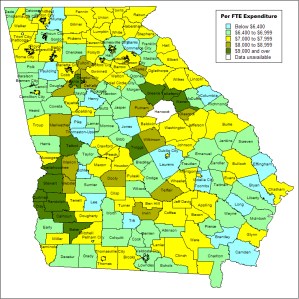
Georgia on My Mind – “Adequacy” Lawsuit

Hoagy Carmichael, “Georgia on My Mind” (click to listen or download) — from the wonderful Pacific Jazz LP, Hoagy Sings Carmichael.

It looks like an “adequacy” lawsuit filed in Georgia over four years ago may finally go to trial this October. The suit, filed by the Consortium for Adequate School Funding in Georgia contends that:

The Georgia school funding system fails to provide school districts, including Plaintiff Districts as well as other districts, with the resources needed to educate their students to meet contemporary educational standards and competitively function in a society where a high school diploma constitutes the bare minimum gateway qualification for viable employment and higher education. The educational inadequacy in Plaintiff Districts and other districts is reflected, inter alia, in high drop-out and non-graduation rates, which result from insufficient resources to provide their students with educational opportunities and interventions reasonably calculated to prepare them to function as productive members of society.

1/3 of the districts in Georgia have joined in the suit.

The “Basics of of Georgia School Finance” are similar to those of the failing Wisconsin system in that both systems are based on a combination of state and local monies, there is basic floor of funding per student, there are categorical aids for some categories of students, it iss extremely complex and it doesn’t work.

There are also some differences, the biggest one being that where Wisconsin uses a system of primary, secondary and tertiary aids based on the district property wealth and spending for equalization between “rich” and “poor: districts, Georgia uses a “Quality Basic Education” formula and a 5 mill basis to figure the local share. At least I think that;s how it is supposed to work. As I said, it is extremely complex. There is a PowerPoint from the Governor’s Education Finance Task Force linked, that may do a better job explaining things.

The 2000 decision in the Wisconsin Vincent v. Voight adequacy suit was a mixed result. The Supreme Court ruled that the state finance system did not then violate the Constitution, but the court also set standards for judging the constitutionality of the system. A good case can be made that after eight more years of placing poperty taxes above education, the system no longer meets the constitutional standard as defined by the court. Unfortunately, with Annette Ziegler and Michael Gableman as part of anew majority on the court, making a good case really won’t matter.

Thomas J. Mertz

Leave a comment

Filed under "education finance", AMPS, Budget, education, Elections, Equity, finance, Local News, National News, School Finance, Uncategorized

81st Assembly Candidates on Education (updated)

The 81st Assembly District is the only district in the Madison Metropolitan School District where there will be a primary contest for a State office this September. The Cap Times posted an overview of the race to replace Dave Travis and Q&As with the candidates last week. Since we all know that the Assembly is crucial to achieving real, positive education finance reform in our State, I thought it would be good to run down where the candidates stand in this area. Excerpted from the Q&As and websites, in alphabetical order:

Eric Englund

Q&A:

Enhanced funding for education at the primary, secondary and university level.

Website:

But our schools also face many serious challenges. They are dealing with the dramatically rising costs of things like special education and pupil transportation. And they are working with a state school funding formula that many believe is outdated and in need of serious reform.

Quality primary and secondary education in Wisconsin is shaped by the actions that occur in the State Capitol in Madison. Those actions will determine whether or not our children and grandchildren will continue the traditions of quality education in our state.

Here are some ideas of what we might do when the Legislature convenes in 2009:

Many legislators are advocating for a thorough review of our current school finance system to make sure we are providing our kids with the best possible education. Such a review could provide an opportunity to assess all aspects of state involvement in our schools to make sure we are helping, not hurting, our schools.

And we can expect that the state’s budget woes will continue. Funding of K-12 education is a major portion of the state budget, so the amount of money our schools receive from the state will continue to be front and center in the debate over the next state budget.

Education Related Endorsements:

None listed.

Peng Her

Q&A:

I have a father who was a school teacher, a sister who is a principal and three other siblings who work in the education field. As you might imagine education plays a very important role in my family. I honor them and all educators by making sure we fully fund our schools by fighting to eliminate the revenue cap, make funding equitable for schools, invest in early childhood education, shift the cost from tax payers back to corporation for fair taxation. A quality education system is the foundation of a strong democracy and healthy economy.

Website:

A quality education system is the foundation of a strong democracy and healthy economy.

To maintain a quality education system we have to:

  1. Eliminate revenue caps that are strangling our schools
    We have to stop pitting property owners against students. Every two or three years, like many school districts throughout the state, Madison Metropolitan School District (MMSD) has to go to a referendum to adequately fund the school. They did not have to introduce a referendum last year only because a TIFF Zone was closed in the city of Madison, allocating a one-time revenue source to the MMSD. Many school board members believe they will need another referendum this coming fall.
  2. Make funding equitable for schools by changing the funding formula
    The funding formula should be based on needs of the school not property value of homes in the district.
  3. Invest in early childhood education
    Research clearly demonstrates that high-quality early childhood education yields significant results throughout children’s lives, including improved academic performance, reduced special education placements, higher graduation rates, and reduced involvement with the criminal justice system.I worked for the Children’s Museum and as a father of three children I can attest to the importance and success of early childhood education. American’s first kindergarten class was created in Watertown back in 1856, and we need to get back to our roots and invest in early childhood education.
  4. Shift cost from tax payers back to corporations for fair taxation for our citizens
    Just in the last two decades, the state’s revenue from corporate income tax has been nearly cut in half. The Dept. of Revenue confirms that over 60% of companies whose tax returns showed annual receipts of over $100 million paid NO corporate income tax (2003).

Wisconsin lost $643 million in 2006 corporate tax. Imagine how much better our schools would be if corporations started paying their fair share of corporate tax. I support Senator Dave Hansen’s (D-Green Bay) Corporate Tax Accountability Act that does not raise taxes but it gives all Wisconsin citizens information about Wisconsin’s tax code and who is, and is not, paying their fair share.

Help me fulfill our promise to our children by giving them the best education possible.

Education Related Endorsements:

Arlene Silveria – Madison School Board President Bill Keys – fmr Madison School Board President Bill Clingan – fmr Madison School Board member Ray Allen – fmr Madison School Board member Shwaw Vang – fmr Madison School member, Cindy Crane – Exec. Dir. of Gay Straight Alliance for Safe Schools, Ashok Bhargava – MATC Foundation Board member, Dan Guerra – Nuestro Mundo Inc Board member.

Tim Kiefer

Q&A:

Nothing.

Website (Updated — This was sent to me by Mr. Kiefer and will soon be on his website):

A great education for all students

Tim Kiefer believes that “every kid deserves a great school.” As the first person from his family to go to college, and as someone whose educational path took him from Wisconsin public elementary and high schools to UW-Madison and finally to Harvard Law School , Tim Kiefer knows the paramount importance of education.

Tim Kiefer believes that the best way to make our schools great is to support teachers and to encourage local control of local schools. Local school boards, not Washington or Madison, should have the freedom to make decisions as to what is best for local schools.

In the 81st district, the failure of the Wisconsin legislature to fix the school funding formula has led to severe budget problems in some districts. The continued existence of the Wisconsin Heights School District is in question due to a lack of funding for that district, which is in turn the result of a dysfunctional state school funding formula. Tim Kiefer will fight to reform the school funding formula and save the Wisconsin Heights School District .

In addition, Tim Kiefer believes that closing the achievement gap between rich and poor students cannot be done by educational reform alone. As Richard Rothstein writes in his insightful book Class and Schools, improving schools “requires social and economic reform as well as school improvement.” Tim Kiefer believes that health care reform, nutrition programs, and summertime programs can all help ensure that every child has the opportunity to succeed.

Wisconsin ‘s education system faces serious challenges in the upcoming years. Tim Kiefer is committed to making the tough choices needed to ensure that our schools are second to none.

Education Related Endorsements:

Madison School Board Member Ed Hughes.

John Laubmeier

Q&A:

Invest in infrastructure to keep/make this economy healthy. By infrastructure I mean education (elementary, secondary and college). We need to keep tuition low enough at our technical colleges and public universities so that all our children can afford to get the education needed to be productive workers in this increasingly “flat” world. Included in this school funding is a reexamination of the whole school funding formula, funding caps and QEOs. We need to invest in roads, bridges, dams, utilities, etc. to make Wisconsin the envy of the other states.

Website:

Focus on the Issues: K-12 Education

“As an economics teacher, I know we can’t have everything. However, as a teacher, I can vow to make schools a top priority in the budget.”

I have literally devoted my life to education. I can honestly say that I have been a student in a classroom every single year since first grade (I hesitate to tell you that is over just over fifty straight years). Briefly, my commitment to K-12 education can be listed as follows:

  • Classroom teacher of Economics and History for the past 34 years
  • Social studies department chair for 29 years at Waunakee High School
  • WIAA official in basketball and baseball
  • Statistician and bench official for Waunakee High School boys’ home football and basketball games
  • Forensics judge
  • Debate coach
  • Teacher’s union officer for three years
  • Teacher’s union negotiator for 11 years
  • Master’s Degree in educational administration
  • Master’s Degree in curriculum and instruction
  • Licensed school administrator, guidance counselor, and teacher

I know the effect of QEOs. I know the effect of spending caps. I know the pain of failed referendums. I know the effect of crowded classrooms. I also know that I have been lucky to be in Waunakee during most of those years. Many school districts have it far worse….

In preparation for my run for the 81st Assembly district seat, I sought advice from experts on how to resolve the riddle of school financing. While the advice somewhat varied on nuisances of various funding variables, the one common thread was the need for simply more money for public education. A second theme was the need to do away with spending caps. Let the local school board members, who must literally face their voters each and every day in their small towns and neighborhoods, decide what is best for the children of their school district. Should the heavy hand of the State reach into every classroom and affect every student? Do legislators in Madison really know if a local school district should replace a roof or maintain a strings program?

Just as these experts called for more funding for schools, teachers feel that way too. The June, 2008 “On WEAC” newsletter reported that delegates to the WEAC Representative Assembly voted increased school funding as the number priority for WEAC lobbying efforts for the next session of the legislature. “School funding ‘is the critical, most important issue right now,’ said Dana Westedt, a WEAC Representative Assembly delegate from Reedsburg.” The second most important issue was health care reform.

As a teacher’s union negotiator, I know that health insurance costs eat up raises. As a teacher nearing retirement, I know that health insurance costs are a major barrier for potential retirees.

I can’t promise that I can help balance the State’s budget, increase funding of local schools, and provide a whole new health care program (in addition to funding a host of other worthwhile items from the university system to roads). However, I can promise that I will work hard in the State legislature to increase funding of schools and to bring about health care reform. Balancing the state budget is going to be very difficult. As an economics teacher, I know we can’t have everything. However, as a teacher, I can vow to make schools a top priority in the budget.

Education Related Endorsements:

Retired UW-Madison Professor of Education Administration George Kliminski, Monona Grove High School Principal Paul Brost.

Kelda Helen Roys

Q&A:

Education: Every child in Wisconsin deserves a quality public education — the best we can provide — and that means adequately funding K-12 schools as well as our great university and technical college systems.

Website:

Every child in Wisconsin has the right to a quality public education – the best we can provide.

We will only succeed economically if we invest in our children and prepare them for the jobs of the future. Our schools must be adequately funded, staffed by caring professionals, and not pitted against property taxpayers. Wisconsin has a tradition of excellent public education, but chronic underfunding has endangered our educational system. We need wholescale reform of our educational funding formula to continue providing a quality public education for every child. I am proud to be endorsed by Rep. Sondy Pope-Roberts, a leader in improving public education.

Schools are central to communities: the state should support local school boards in their efforts to keep neighborhood schools open, provide innovative and responsive teaching, and meet the needs of diverse students. State government must be a partner to school boards, recognizing that there is no “one-size-fits-all” solution to improving our educational system. The state must provide adequate resources and ensure accountability and transparency.

Accountability means more than yanking funding when test scores dip – it should reflect the broad range of skills and information that today’s students need to master, like critical thinking, problem solving, synthesizing ideas and writing. Rather than holding teachers hostage to a hollow “accountability,” we must ensure that teachers have the tools needed to succeed: proper training in their subject matter, manageable class sizes, continuing training and professional development opportuities, and responsive and effective administrators.

In addition to improving our K-12 education, we must create a culture of lifelong learning. Wisconsin’s excellent University system and technical colleges are crown jewels of our state, and the engine of our long-term economic growth. We must ensure that these institutions remain affordable for working families so that all kids who are willing to work hard have meaningful access to higher education. Likewise, we should ensure that Wisconsin workers can receive job training and continuing education to enhance their careers and their earning power.

We must stop pitting education against homeowners. Property tax escalation is a serious problem, and homeowners are now being asked to shoulder much more than their fair share of the cost of educating our citizens. Education and home ownership are twin pillars of the American dream: we all have a stake in educating America’s future workforce, and we all have a stake in ensuring that working families, retirees, and young adults are not priced out of home ownership.

Property taxes are too high, yet schools are still underfunded – why? Because under pressure from corporate interests, the legislature has systematically slashed corporate taxes. Over the last 30 years, the share of the tax burden borne by homeowners has gone from about half to a whopping seventy percent, because businesses are paying less and less. In just two decades, the state’s revenue from corporate income tax has been nearly cut in half. Wisconsin is dead-last in the share of state and local taxes paid by business, according to a Federal Reserve Bank of Boston study – in fact, the Dept. of Revenue confirms that over 60% of companies whose tax returns showed annual receipts of over $100 million paid NO corporate income tax (2003). This imbalance is unsustainable and unfair. Businesses must once again pay their fair share for the cost of producing educated, skilled workforce that will power our economy and their companies.

Solving the challenges facing our educational system will not be easy. We must make tough choices, especially politically and financially. I believe our state must comprehensively reform our educational funding formula and fully fund public education, to live up to the demands of our economy and to fulfill our collective potential.

Education related Endorsements:

State Representative Sondy Pope-Roberts, Ruth Robarts, fmr Madison School Board member.

Justin Sargent

Q&A:

Fix the state education funding formula.

Website:

Educational Opportunities & School Funding

My involvement in our neighborhood school’s PTO has allowed me to see firsthand the need for improved public education funding. We must invest in great schools for kids and lifelong learning opportunities for adults. Doing so will increase opportunities for our children, strengthen our communities and build our economy. Put simply, good schools benefit everyone.

As a proud graduate of Wisconsin public schools, I want all children to enjoy the same educational opportunities that I had growing up. These opportunities made Wisconsin an education leader for decades. For the sake of our children and our state, we can’t afford to neglect our commitment to education…

In a time of economic uncertainty and tight family budgets no one is clamoring to pay more taxes. But what I hear when speaking to people in the 81st District is not an objection to taxes but concerns about tax fairness and how the tax dollars are being spent. People want more state funds spent on the public schools to lower the burden on local property tax payers; …

The biggest problem with current Wisconsin taxes is that they fall disproportionally on middle class property owners. Recent tax policy on both the state and federal levels have reflected a pattern of giving tax breaks to the ultra-wealthy on the theory that this will trickle down and help less wealthy people. This has not happened. And, while some Wisconsin corporations are paying their share, there are many who have used tax loop holes and tax evasion methods to avoid paying taxes in Wisconsin.

Education Related Endorsements:

Senator Kathleen Vinehout, Marjorie Passman, Madison School Board Member, Former Madison School Board Member and education advocate Carol Carstensen, Barbara Arnold, Ed Blume, David Cohen, Andrew Gussert, Melissa Sargent, David Dean (Past President MATC Full Time Teachers Union & Past President AFT-Wisconsin).

Some good candidates and some strange bedfellows.

Thomas J. Mertz
3 Comments

Filed under "education finance", AMPS, education, Elections, finance, Local News, School Finance, Uncategorized

Did Frank Lasee Tell the Truth?

Jimi Hendrix, “If 6 was 9” (click to listen or download)

In the June 10, 2008 edition of “Lasee’s Notes,” State Assembly Member Frank Lasee (Republican, 2nd district) sang the praises of our current system of keeping taxes down by starving education and requiring referenda to address the structural faults in the revenue caps. In the paragraph reproduced below, Lasee cited questionable polling data:

The school referendum system has worked reasonably well and has helped to control property taxes (click for recent news that statewide property taxes have increased 3.8% this year). There aren’t many state elected officials willing to talk about removing these revenue controls (one of WEAC, the state’s teachers union’s top priorities) or taking away these spending controls (with voter override approval). This is because they enjoy 70% approval ratings when citizens are asked. Once citizens get the right to vote, they don’t want to give it up.

I was intrigued by the 70% figure, so I wrote Rep. Lasee to ask where this number came from. Four days later (June 19), I got an email asking that I provide a home address, but promising “If I have your address, I will respond regardless of where you live.” I responded that day, with the requested information. Ten days latter, I emailed again, with my address and asking about the polling numbers. On July 18, I wrote again. I haven’t heard from Rep. Lasee or his office since the initial request for my address. It appears he doesn’t want to answer my question.

Lasee is an embarrassment — it could be that like another embarrassment to the Wisconsin political traditions, Joe McCarthy — he just makes up his numbers.

I’ve done some digging and the closest polling I can find was a news story on a survey commissioned by the Wisconsin Association of School Boards (WASB) and released in 2001. The 70% figure isn’t there, the results are full of contradictions and we have had seven more years of struggles under the state school finance system since then. Here are some highlights from the story:

  • “Nearly two-thirds of taxpayers support state-imposed limits on local school districts’ spending” (no number cited).
  • 78% of those polled said the balance of financial power should shift toward the school boards and away from state government.”
  • “Majorities of respondents also said that in almost all cases, a school board should be required to seek voters’ approval before raising spending.”
    • More money for a new building – 90% wanted a referendum.
    • More money for teacher salaries or school security – 66% wanted a referendum.
    • For athletics – 64%. For computers, desks and classroom equipment – 63%.
    • For an unexpected increase in health insurance premiums – 58%.
    • For routine maintenance or for art and music programs – 55%.
  • “Only in the case of an unexpected increase in fuel costs did a majority of those surveyed, 56%, say a school board should be able to spend more money without holding a referendum.
  • A WASB backed proposal to allow school boards [to] spend an extra $148 per student each year – about 2% of the average revenue limit statewide – without holding referendums was supported 52% or respondents at the start of the survey and when asked again at the end 59% backed the “2% solution.”

So 78% favored more local control and over 52% to 59% of the respondents favored a measure that would have allowed major increases in school funding. If the 2% solution had been enacted in 2001 (at $148 per year) and renewed, this would have meant over $24 million more in the 2008-9 MMSD budget.  Hard to spin support for a change of that magnitude as support for “the school referendum system.”

After seven years of cuts and conflict, I’d guess the numbers in favor of big and small reform have grown considerably.

Whatever changes may have happened, the only poll I can find does not back Lasee up.

I’m still waiting for an answer from Frank Lasee, but I’m not expecting one.

Thomas J. Mertz

6 Comments

Filed under "education finance", AMPS, Budget, education, Elections, finance, Gimme Some Truth, Local News, Referenda, referendum, School Finance, Uncategorized

“The Next Kind of Integration”

Excerpts from the recent New York Times article, “The Next Kind of Integration” (with links and emphases added).

In the last 40 years, Coleman’s findings, known informally as the Coleman Report, have been confirmed again and again. Most recently, in a 2006 study, Douglas Harris, an economist at the University of Wisconsin, found that when more than half the students were low-income, only 1.1 percent of schools consistently performed at a “high” level (defined as two years of scores in the top third of the U.S. Department of Education’s national achievement database in two grades and in two subjects: English and math). By contrast, 24.2 percent of schools that are majority middle-class met Harris’s standard.

There are, of course, determined urban educators who have proved that select schools filled with poor and minority students can thrive — in the right circumstances, with the right teachers and programs. But consistently good education at schools with such student bodies remains the rare exception. The powerful effect of the socioeconomic makeup of a student body on academic achievement has become “one of the most consistent findings in research on education,” Gary Orfield, a U.C.L.A. education professor, and Susan Eaton, a research director at Harvard Law, wrote in their 1996 book, “Dismantling Desegregation.”

Most researchers think that this result is brought about by the advantages that middle-class students bring with them. Richard Kahlenberg of the Century Foundation lays them out in his 2001 book, “All Together Now”: more high-level classes, more parent volunteers and peers who on average have twice the vocabulary and half the behavioral problems of poor students. And, especially, more good teachers. Harris, the economist, says that poor minority students still don’t have comparable access to effective teachers, measured by preparation and experience. The question, then, is whether a plan that integrates a district by class as well as by race will help win for all its schools the kind of teaching that tends to be linked to achievement. “The evidence indicates that it would,” Harris says.

Ronald Ferguson, an economist at the Kennedy School of Government at Harvard, is less persuaded. His research highlights the nagging persistence of a racial achievement gap in well-off suburbs. “What happens with the achievement gap in a place like Louisville,” he says, “will depend on how vigilant their leaders are to make sure high-quality instruction is delivered across the board.” Such teaching is more likely in a school with a critical mass of middle-class parents, he concedes. But he stresses that to reap the benefits, poor kids have to be evenly distributed among classrooms and not just grouped together in the lowest tracks. “To the degree a district takes the kids who struggle the most academically and spreads them across different classrooms, they’re making teachers’ work more doable,” he says. “And that may be the biggest effect.”

Whatever the exact answer, there is some support for the view that schools can handle a substantial fraction of poor students without sacrificing performance. In Wake County, test scores of middle-class students have risen since instituting income-based integration. Additionally, Kahlenberg points out that middle-class students are generally less influenced by a school’s environment because they tend to learn more at home, and that the achievement of white students has not declined in specific schools that experienced racial (and thus some class) desegregation.

Would schools need to track students by ability to protect middle-class students, who are more often higher-achieving than their low-income peers? Perhaps not. In a 2006 longitudinal study of an accelerated middle-school math program in Nassau County N.Y., which grouped students heterogeneously, the authors found that students at all achievement levels, as well as minority and low-income students, were more likely than the students in tracked classes to take advanced math in high school. In addition, the kids who came into the program as math whizzes performed as well as other top-achievers in homogenous classes.

This study underscores Ronald Ferguson’s point about the value of seating students of different backgrounds and abilities in class together, as opposed to tracking them. Still, it’s worth noting that less than 15 percent of the students studied in Nassau County were low-income. So the math study doesn’t tell us what happens to the high-achieving middle-class kids when close to half of their classmates aren’t as well off.

I’ve posted about the missed opportunities for Madison to be a leader in this new integration movements many times. Two examples are linked below. I do want to make clear — as I wrote in one of those posts — I believe that “[f]or the most part MMSD has done a very good, if relatively quiet and indirect job of addressing [all kinds of] diversity. ” I’m still asking for more.

Previously on AMPS:

(Not?) Talking about Diversity and Boundaries, 2008 Style.

(Now?) Talking about Boundaries and Diversity, 2008 Style.

Talking is essential, but so are policies and actions. It is not too late.

Thomas J. Mertz

4 Comments

Filed under AMPS, Best Practices, Equity, Local News, National News, Uncategorized

The high price of “eductaion”

During a segment this weekend, Fox News’ Brett Baier said that “the high price of gas may be costing your kids some of their education. We’ll explain here.” At the same time, though, the word education was misspelled on-screen as “eductaion.”

Robert Godfrey

Leave a comment

Filed under AMPS, National News

We Are Not Alone #22 (Referendum Roundup)

It must be that time of year, or more likely the “going out of business” state finance system continuing to take its toll on districts in Wisconsin. Five more districts have placed referenda Fall ballots. That brings the total to ten by my count, eight for operation and maintenance and two to issue debt for, renovating and upgrades.

I posted before on the September 9 Colby measures, one of the debt referenda. Interestingly like Colby’s, the other debt referendum — A November 4th vote in the Clinton Community School District — also includes an attempt to move toward energy efficiency and environmentally sound practices, in this case via a Geo-Thermal heating system (Milton is also looking at Geo-Thermal). With this and the other items, Clinton is trying to plan for the future in ways that our school funding system makes nearly impossible.

The district could wait to ask residents to pay for new projects, but [Board President Randy] Gracyalny said gambling on the economy improving and prices going down isn’t a move he wants to make.

“Where will we be three years from now?” he asked. “I don’t know. No one knows. We know where we are now.

“Yeah, we might not absolutely need this, this year. But if we put it off too long, it’s going to get to that point of making some tough cuts.”

It is a smart approach and I wish them the best (more here).

In the districts seeking to pay for operations and maintenance it is the usual recipe of costs rising faster than allowed revenues, with added seasoning of declining enrollments for some.

Taking them in chronological order, Wausaukee will vote on August 19th. This is the “do or (probably) die” referendum. You can read lots more about Wausaukee in previous posts. Sadly, our local media has had nothing to say about this. Nothing. Even the Chicago Tribune picked up the story, but not our Madison newsies. The district has posted a “Fact Sheet” on the referendum and — as they have to — are moving ahead with the dissolution planning. The linked story from the Peshtigo Times is worth reading, especially the lengthy statement Board member Dave Kipp offered before voting against dissolution. Rather than excerpt that, I offer excerpts from a letter to the editor by Gert Wilson, “Retired Teacher”:

Democracy has diminished and that is sad because children learn from adults and what they see is disrespect for others’ opinions and bossy individuals who control meetings to delay or stop procedures. Of course, all people are not guilty of such actions.

We have seen this also at Coleman, Crivitz and Wausaukee in regard to education. The Times has been overwhelmed with nasty discussions, critical items in the paper and parents discussing issues in irate voices along with school boards. As usual, the students pay the price. They probably will, if Wausaukee folds and students have to ride to Crivitz. When will they eat, sleep and do school work? (emphasis added)

Amberg, a few years ago, opted to join the Wausaukee School District. Was that an error? Now it is possible these student will ride to Crivitz. Teachers, school boards and parents, are you happy about all your adult complications? I give credit to all who try to make it right.

Small towns cannot survive peaceably when all this divides friends and parents and teaches some children to rebel, be bossy, be bullies, show disrespect and have drinking problems.

You tell ’em Gert. There is also a good commentary on the Wausaukee situation from Ken Krall at NewsoftheNorth.Net.

Deerfield, Neillsville, and Montello will all vote on September 9.

Deerfield is asking for a five-year nonrecurring, with annual amounts starting at $275,000 and going to $475,000 (another version of planning for the future). Deerfield appointed a Citizens Advisory Committee last year to work on the plan and surveyed the community before proceeding. They’ve also put together a very nice web page explaining the what the referendum is about. Madison could learn some things from our neighbors fifteen miles to the East.

Neillsville has been experiencing declining enrollment at a rate of 30 or more students a year and started out as a low spending district in 1993 when the revenue caps were put in place. This is a double whammy. District spending levels are still based on what they spent over 15 years ago; because the caps are set on per member basis, declining enrollment –especially in small districts — makes it increasingly hard to cover fixed costs such as heating and transportation and almost impossible to pay for diverse offerings that larger districts take for granted. As Superintendent John Gair said: “”We’re at the point now where departments are made up of one person in some cases. If we reduce (spending) any more, we’re going to lose programs for kids.” To meet these challenges, Neilsville is asking for a five-year, $300,000 a year increase in the amount of revenue they are allowed to collect.

According to District Administrator Jeff Holmes, Montello is one year away from joining Wausaukee in dissolution (or exploring consolidation). Last September two referenda were defeated; one operating and one to borrow for things like resurfacing the parking lot and replacing air conditioning. They cut for administrators last year and have not replaced retiring teachers. This time they are going to ask for a two-year non recurring $950,000 increase in their revenue limits. If it passes, two years isn’t very long. Unless the Governor and the Legislators do something quick, they will have to go back to the voters again.

Lafarge, Mercer, Seneca, and Pittsville all have November 4 referenda scheduled.

Some may remember that in 2000 disputed ballots in the Lafarge referendum went all the way to State Supreme Court, which after years of litigation upheld “the intent of the voter” precedents and a referendum victory (unfortunately that same year the US Supreme Court threw away precedent and the Constitution and gave the Presidency to George W. Bush). This time Lafarge is one of two districts (thus far) asking for a recurring referendum, in the amount of $250,000 annually.

In Mercer they’ve reached the final year of a three-year nonrecurring referendum and the wolf is at the door. A rigged state finance system and declining enrollment are threatening to blow the house down. They also convened a Task Force, which laid out the options:

  • Approve the new referendum to keep the school open.
  • Close the school and dissolve the district.
  • Consolidate with another district.

“Dissolving” was also mentioned. They are asking for four-year, $350,000 per year revenue cap relief.

Seneca is another small enrollment, rural district with declining enrollment. I’ve described above what this does to the ability to give students the education they deserve, the Institute for Wisconsin’s Future’s Atlas of School Finance goes into more detail. They are asking for $800,000 a year on a recurring basis.

Pittsville covers 440 square miles and serves 686 students. Wrap you mind around that and you will understand that districts like this are essential (consolidate into a district that serves 1,300 students spread over 1,000 square miles?) and do not enjoy the economies that larger, more compact districts have. Because of these these issues and projected declining enrollment, the plan in Pittsville is to decrease staff even if the three-year $175,000 nonrecurring referendum passes.

These posts are a lot of work, but they are also rewarding. I learn about the districts in Wisconsin, the good they are doing, their hopes and dreams. I urge you to visit a few of the district web sites linked here; look at the pictures, read the mission statements, find things like Pittsville’s “Why enroll your child at Pittsville?” and sense the pride and dedication. You will find it rewarding too.

On most of these web sites I also see the logo for “The New Wisconsin Promise,” and wonder if the slogan “A Quality Education for Every Child” is some kind of sick joke. Our schools — even those in dire financial straits — are still doing a fine job, but how much longer can they and we hang on?

Why can’t we put in place a way of investing in our children’s future that makes those words an accurate boast? Why not Governor Doyle? Why not Senators and Assembly members? Why not?

Take the five minutes to click the links and ask them. Maybe if enough of us do, something will change.

Thomas J. Mertz

Leave a comment

Filed under "education finance", Accountability, AMPS, Best Practices, Budget, Contracts, education, Elections, finance, Gimme Some Truth, Referenda, referendum, School Finance, Take Action, Uncategorized, We Are Not Alone

Education: A shared value and “recession-proof”

An interesting report out on the survey results of presidential pollster Cornell Belcher presented at the recent 8th Annual Quality Education Conference in Washington, DC, focused on the significance of education as a political issue in America. He concluded from his research, as reported by The National Access Network at Teachers College, Columbia University, that “education is a high priority issue for most Americans: it is a “shared value” which is largely “recession-proof”—remaining important even when the economy is down.”

Education has consistently ranked highly among Americans’ most important political concerns. Belcher reported that in 2004, Americans ranked terrorism and moral values among the most important issues, while in 2008, these had been replaced by gas prices. Economic issues and Iraq ranked among the top five issues in both years—not surprising given the economic down turn and problems faced by the military. But education also remained a constant, consistently ranking among the top five political issues regardless of economic circumstances or foreign policy concerns.

Beyond this “shared value,” Belcher also highlighted the different views Americans have of education, which he described as four clusters in the poll. Approximately 30 percent of Americans viewed education as a top priority and believed that structural changes in funding and resource distribution were necessary to improve the educational system. Another 30 percent also value education highly, but they believe the solutions are more individual—increased parental involvement and behavioral changes among students. Another 30 percent value education highly but are not willing to increase funding for it. Finally, less than 10 percent of Americans in the poll did not believe education was a top priority.

Belcher underscored his view that peoples’ core beliefs do not typically change. However, he emphasized a view that various political messages—including those in support of educational equity and opportunity—can be cast to appeal to these different groups.

It’s striking to observe the current discussions on the banking industry bailout and contrast that with the typical rhetoric when it comes to some other core needs of society such as public infrastructure renewal and education. It would appear from this survey that upwards of 60% of Americans are concerned about the public financing of schools to provide more support for our nation’s future, despite the off-the-radar nature of the current public discourse. I wonder what the different percentage categories Madison’s voters would fall into in such a survey. We certainly will have a reality check in an upcoming referendum this fall that will attempt to just keep us above water due to a broken school finance system.

Robert Godfrey

Leave a comment

Filed under AMPS, Gimme Some Truth, National News, School Finance

Dan Nerad Talks 4-Year old Kindergarten

From WISC-TV

One thing that needs to be corrected is this: “After the first year, the state kicks in two-thirds of the funding and covers the full cost after four years.”

What happens is that the district must absorb all costs the first year, the second year and beyond the students are added to the member count (on a prorated basis, since 4-K is not full time) and figured in the three-year rolling average calculations for the revenue cap. This would mean they would be counted at 1/3 for the second year. 2/3 for the third year and fully thereafter. Like all other students in Madison, the state share of costs would be based on relative property wealth.  In Madison this translates into about 40% state funding.

I’ve been trying to track down how Green Bay managed the start up costs. No luck yet, but I’ll find out and post here.

One answer is via a referendum.

Thomas J. Mertz

Leave a comment

Filed under "education finance", AMPS, Best Practices, Budget, finance, Local News, Referenda, referendum, School Finance

We Are Not Alone #21

As Madison prepares to discuss a school operating referendum, it is important to remember that we are not alone.

In the past two years districts in Wisconsin have held over 150 operating and maintenance referenda simply to continue the quality and diversity of educational programming that they have had in the past. This isn’t because of local mismanagement; these referenda are a product of a school finance system designed to fail. The referenda aren’t about adding back things have been cut or expanding the good schools do by adding things like 4-year-old kindergarten, elementary foreign languages, more teacher training in things like differentiation or classroom management, support for college prep work for students not yet on the college track…(I could go on and on). These referenda are about not losing ground, about stopping the cuts and staunching the bleeding.

Many districts, like Madison, are simultaneously struggling with the annual cuts dictated by the state finance system and needs or desires for new schools (based on either inadequate facilities or population growth in areas without sufficient capacity). In La Crosse, this combination is reaching critical point.

In April the voters of La Crosse passed a five-year nonrecurring $4,175,000 a year operating referendum (5,701-4,993), but defeated a $35 million renovating and building referendum (5,144-5,417). The $35 million would have paid for a new school, allowed the district to close two schools and upgrade the “HVAC, safety, and security systems” in others (including new energy efficient equipment to create long term savings). Some of these upgrades were termed “urgent.”

“Urgent” needs don’t go away. Now the La Crosse district is contemplating what to do next.

On Monday July 8, 2008 the Board of Education voted 6-3 to take the “no referendum” option off the table.

President Christine Clair said the vote will keep board conversations centered on the administration’s other options, which include asking for the capital improvements sought in the April referendum, only separated into two questions, and addressing only the facility needs.

Board member Neil Drusky voted against eliminating the “no referendum” option:

He suggested closing two schools, which would take two to three boilers off line and buy the school district more time while the community gets involved. He also said he didn’t recall knowing about the boilers until the referendum process. [Ed Note: Those energy efficiency issues again.]

The administration will report back to the Board on July 21, 2008. Eight options (or combinations of options) are being analyzed:

  • Eliminate SAGE
  • Close a school
    • Most agree a school has to be closed, but there is disagreement about which one. It is estimated that closing a school would save about $410,000.
  • Close two schools
    • This would “eliminate the cost of replacing two to three boilers and other building repairs” but require “massive redrawing of elementary boundaries.”
  • Build a new North Side elementary school
    • “Consolidating Franklin Elementary School and Roosevelt Elementary/Coulee Montessori in a new building at the Franklin site would provide an improved learning environment and bring together the North Side community.” Maintenance issues at two of the district’s oldest — and neediest — buildings would go away, and staffing costs would be reduced by $410,000 or more.

  • April referendum — lite
    • “This referendum proposal for $21.5 million in capital improvements would address the same facility needs the board put forth in its April package, but without a new school. Safety and security equipment would be installed in schools, as would new heating, ventilation and air conditioning systems. Facility needs such as bathroom and locker remodeling, window replacement, kitchen expansion, and classroom, elevator and stair tower additions also would be addressed.”

  • A scaled-back referendum
    • “Some board members have deemed a few items on the facility needs list to be not as urgent as others. A $15 million facility needs referendum would address three-fourths of the total package with a reduced effect on annual property taxes”
  • Dip into fund balance
    • “Some board members have suggested the district dip into its $33 million fund balance to fix a few of the more “urgent” needs. They asked administration Monday to report back July 21 on the feasibility of using from $5 million to $10 million for repairs to reduce the amount potentially sought by referendum.” [director of business services Janet] Rosseter said in May that the money only should be used for unforeseen expenditures or revenue shortfalls, and the district’s needs — although deemed “urgent” and “necessary” — don’t rise to that level. She stood by that statement Thursday. [Ed Note: This is Ms Rosseter’s opinion and it is her job to share that opinion with the Board, but it is the elected Board’s job to make these kind of judgments. The DPI page of guidance on Fund Balances does not oppose or support districts employing Fund Balances in the manner being contemplated.]
  • Use instructional dollars
    • “School board members have said that without passing a capital referendum, instructional dollars are at stake because the budget is too tight.Without a passed building referendum, board member Connie Troyanek said, the board will be forced to close at least one school and raise class sizes because “we don’t have any money” to make the necessary repairs.”

Much to contemplate. Hard decisions, no real good options.  Without a successful referendum, Madison will face similar choices…larger classes, closed schools, programs eliminated…

A few final words from La Crosse to add to the mix:

From Board Clerk Mary Larson:

“There is so much going for this district. If we could just get our basic systems in order,” the district would be more appealing to outside families who want to take advantage of open enrollment.

I think that should be “if the state would allow us to get our basic systems in order.

From Board Member Deb Suchla who spoke of a:

“bidding war” between the school board and the community. Each time, the board comes back to voters asking for a little less money,…“That’s not … public policy, and that’s not how you do good work,” Suchla said.

Suchla is right, it isn’t how you do good work, it isn’t [good] public policy, but it is how we fund education in Wisconsin.

Governor Doyle? State Legislators? Are you paying attention?

Thomas J. Mertz

Leave a comment

Filed under "education finance", AMPS, Best Practices, Budget, education, finance, Local News, Referenda, referendum, School Finance, Take Action, Uncategorized, We Are Not Alone