
Category Archives: Arne Duncan

Hit Again (again and again…)

3_21_captain_america

Wisconsin may have dodged the bullet of privatizers in our State Superintendent election, but at the national level the for profit, not the public crowd are going forth with guns blazing.  President Obama, Arne Duncan and their crew are showing themselves to be,  in the words of  Diane Ravitch, “Margaret Spellings in Drag.”

Their latest hire fits the profile.  Education Week is reporting and the the Department of Education site confirms the Broad trained,  former edu-preneur with LearnNow, most recently Bill “Money Talks” Gates bag man, James Shelton III (scroll here for a bio)  is the new head of the Office of Innovation and Improvement.

I guess for at least the next four years “innovation” will continue to mean privatization and profit-seeking and improvement will continue to defined by the Ministry of Truth.

In history, one school of thought holds that industrialists and capitalists came to welcome expanded government when they realized they could “capture” the boards and departments and use them for their own ends.   Think of the fox guarding the hen house.  The Obama crew are not liberators, just a changing of the guard.

As Deborah Meir recently wrote about the mindset that is at work in the corridors of power:

Some combination of Harvard and Wall Street smarts are seen as all-purpose disinterested expertise, fit for any purpose. The master key. While disregard of educators has a long history, and demonizing of teacher organizations is hardly new, it has reached new heights. A mere 20 years ago one could not imagine school systems would be run by people who never practiced or studied schooling or education. The assumption that “smarts” based on hands-on knowledge is valuable has lost its historic place in our view of reality. Law and business and finance smarts have ruled the day for this generation. At a cost. And not just in schools….

Our schools and our economy—and, above all, our democracy—require us to restore the balance.

The Obama permanent campaign will be holding listening sessions in Wisconsin.  It might be worth trying to get in a good word for public education by and for the people, not profit.

Thomas J. Mertz

Leave a comment

Filed under Accountability, Arne Duncan, Best Practices, education, Gimme Some Truth, Local News, National News, nclb, No Child Left Behind, Take Action, Uncategorized

Mayors and CEOs (Chief Educational Officers), Oh My (Oh No)

From the American School Board Journal, circa 1900.

From the American School Board Journal, circa 1900.

Secretary of Education Arne Duncan has announced a new crusade to bring mayoral politics to all big city school districts.

His reasons are spelled out in this NY Post article:

He said mayoral control provides more accountability, stability and flexibility to implement reform.

Duncan — citing improved test scores and graduation rates, more school choice and curbing social promotion.

Currently only seven of the largest districts are under some form of mayoral control.  Not a very big sample size.  Mayoral was tried and abandoned in Detroit and Washington in the recent past and in the distant past it was common.

Never play poker with anyone who lived or worked in Mayor Richard M. Daley’s Chicago — as Duncan did — and can keep a straight face while discussing “mayoral accountability.”  The “Mayor for Life” is accountable to no one.

Yes,  that gives him more stability and flexibility.  The appeals to accountability and stability are contradictory.

In other cities, the mayor may not enjoy Richie Daley’s infinite tenure.  In those places, educational accountability may function but stability goes out the window.  Educational accountability is also present in Board of Education elections and Superintendent contracts and in these cases it is the sole issue; with mayors people vote based on everything from patronage jobs to garbage pick-up.

The record on test-scores and graduation rates is limited and mixed.  Social promotion, I have no idea.

That leaves “school choice.”  Yes, the mayoral educational Czars have liked their charter schools, as does our misguided President and his Secretary Duncan.  I have trouble believing that the core of this is about charter schools, but I may be wrong.

What is clear is that Duncan enjoyed his barely fettered reign in Chicago and doesn’t think any meddling Board members should interfere with the plans of his fellow CEO “reformers.”

That’s one  reason to favor keeping elected Boards in charge.  Inefficiency is part of democracy.

For more see:

Anne L. Bryant, “School board relations: collaboration instead of mayoral takeover is best for urban school districts.”

Harvard Educational Review, Summer 2006, Special Issue on Mayoral Leadership in Education.

Kenneth K. Wong, Francis X. Shen, Dorothea Anagnostopoulos, Stacey Rutledge, The Education Mayor: Improving America’s Schools.

[I’d like to do more with this, but my Internet connection has been in and out, so I’m going to post as is, while it is working.]

Thomas J. Mertz

Leave a comment

Filed under Accountability, Arne Duncan, Best Practices, education, National News

Quotes of the Day — Standardized Tests “Insensitive to Instruction”

By Ricardo Levins Morales from the Northland Poster Collective, click on image for more information.

By Ricardo Levins Morales from the Northland Poster Collective, click on image for more information.

Most states’ NCLB tests are, sadly, essentially insensitive to instruction, that is, those tests are unable to detect the impact of improved instruction in a school or district even if such improvement is unarguably present. The chief cause for such instructional insensitivity stems directly from the test-construction procedures employed to create almost all NCLB tests. Those procedures turn out to make scores on NCLB tests more directly related to students’ socioeconomic status than to how well those students have been taught. Instructionally insensitive NCLB tests simply can’t distinguish between effective and ineffective instruction. (Emphasis added)

W. James Popham, UCLA, “AN AUTUMNAL MESSAGE: LET FLY THE AYP PIGEONS.

These profiles emerge as an artifact of how items are selected. Test developers include in their respective proprietary item pools only those items shown to sort students in the same relative order in terms of their likeliness of getting an item correct. (In other words, ideally for each item in a given area, Student Q should always be more likely to get it right than Student S.) When high-stakes tests are then assembled using only the items that fit with these internal sorting profiles, the tests themselves also end up being remarkably robust in keeping students in the same relative order in terms of their overall scores (Student Q’s overall test score is very likely to be higher than S’s).

Using this approach, test scores will continue to predict other tests scores in ways that will remain remarkably insensitive to the quality of content-specific instruction. And just one of the unintended consequences of this insensitivity to instruction may be that those schools feeling the most pressure to improve test scores will resort to emphasizing test-taking skills, as opposed to meaningful academic content, as a compelling alternative strategy for attaining immediate, if short-lived, results. (Emphases added)

Walter M. Stroup, “What Bernie Madoff Can Teach Us About Accountability in Education.”

I came across this phrase a few times recently and I really think it captures one huge flaw with the reliance of standardized tests.  By design they do not measure learning, instead they sort into a bell (or other) curve.  If all students learn something, no matter how important that something is, it will not be included on a standardized test because it doesn’t sort.

This inescapable truth seems to be lost on President Obama, Sec.  Arne Duncan and all those in Congress, state legislatures and local school districts who keep calling for more money to be spent on testing and data systems.  Although there is potential for better testing I fear that this will only expand the inappropriate uses of the existing testing, testing that for the most part hinders real accountability by this “insensitivity to instruction,” and harms education by wasting time and money on things that don’t help students be successful in anything but taking tests.  Garbage in, garbage out.

For more, see:

Dick Schutz, “Why Standardized Achievement Tests are Sensitive to Socioeconomic Status Rather than Instruction and What to Do About It.”

Deborah Meier, “‘Data Informed,’ Not ‘Data Driven.'”

Diane Ravitch, “President Obama’s Agenda.”

John Thompson, “God Does Not Play Dice.”

And for a local angle:

Quotes of the Day” June 4, 2008, on the WKCE and Value Added.

Thomas J. Mertz

Leave a comment

Filed under Accountability, Arne Duncan, Best Practices, education, Gimme Some Truth, Local News, National News, nclb, No Child Left Behind, Uncategorized

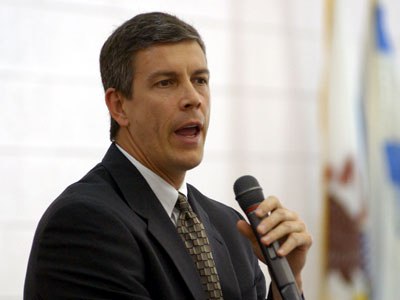
Arne Duncan, Secretary of Education

arne-duncan

Just links.  My own thoughts are much like teacherken’s (below).   I’ll add that the charters/merit pay agenda does not make me happy but balance that by saying that at least the merit pay pilot in Chicago included peer evaluations along with test scores.

The New York Times, Schools Chief From Chicago Is Obama’s Choice for Education.

teacherken, Arne Duncan as Sec Ed – it could have been worse.

Alexander Russo, District299: The Chicago Schools Blog, Duncan Pros and Cons.

Greg Palast, Obama’s “Way-to-Go, Brownie!” Moment?.

Education Week, Duncan is Obama’s Education Secretary Pick.

Good discussions in the comments at all but the NYT.

Thomas J, Mertz

Leave a comment

Filed under Accountability, Arne Duncan, Best Practices, education, Elections, National News, nclb, No Child Left Behind

The Wrong Frame, The Frame of the (Center) Right

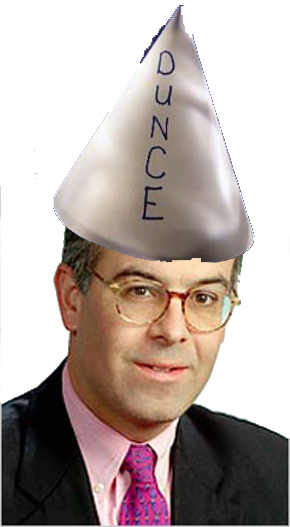
brooks-dunce

There is a lot of buzz on David Brook’s latest column and its topic — Obama’s pick for Secretary of Education and the direction of education policy in his administration (weigh in on the latter here).  Many of the buzzers, like Brooks, simplemindedly frame the choice as between choosing a “reformer” and choosing a stalwart defender of the status quo (in Brooks’ case  the latter is described as “teachers’ unions and the members of the Ed School establishment, who emphasize greater funding, smaller class sizes and superficial reforms”).

We’ve seen this in Madison before — the subtle “reformers as good guys,” others as uncaring, self interested or misguided defenders of a failed system.  It wasn’t accurate or useful then and it isn’t now.

Much of the current discourse is derived from what Marion Brady in 2001 identified as a the narrowing of reform to “introducing market forces” via “standards and accountability” and the definition of standards and accountability as  standardized testing and blaming teachers (and teacher unions), with a little privatization in the mix.

If it isn’t obvious to you how wrong and destructive this is, click the link and read what Brady had to say.

For myself, I’ll just hit a few very quick points.  First, market forces aren’t what they’ve cracked up to be (pun intended).  Second, the way to improve teaching is not by attacking teachers, teacher trainers and teacher unions…none of them are going away and all them are interested in improvement.  Greater funding and smaller classes are not superficial, just look at the research or ask a teacher  — oh yeah Brooks has dismissed the knowledge of researchers and teachers, pretty clever of him.  Last, this crisis mentality is throwing the baby out with the bathwater.  We have many great schools and teachers, a system that works for most and desperately needs to be improved in order to work for all.  I don’t see Brooks calling for Socialism or Communism as a fix for a financial and industrial system that is obviously broken; why call for radical changes in an education system that isn’t broken?

A couple of links:  Jim Horn’s take at Schools Matter and Bob Somerby at the Daily Howler on this column and related failings in education reporting (scroll down).

Thomas J.  Mertz

4 Comments

Filed under "education finance", Accountability, Arne Duncan, Best Practices, education, Gimme Some Truth, National News, School Finance