From the Wisconsin Center for Education Research report:
Educational equity issues within the school district [MMSD] are the source of much public controversy, with a relatively small but vocal parent community that is advocating for directing greater resources toward meeting the needs of high achieving students. This has slowed efforts to implement strong academic equity initiatives, particularly at the middle and early high school levels.
The rhetoric of No Child Left Behind is, I think, an appealing one. The idea is that, well, no child should be left behind. It’s an essentially egalitarian aspiration — the school system should try to do well for the hardest to teach kids, included ones coming from difficult backgrounds and ones who simply for whatever reason have a hard time with school. The idea of “gifted” programs is basically the reverse vision — that the school system should focus on the easiest cases and push them to the highest level of achievement possible.
There’s not a stark either/or choice between the hard cases and the easy cases, but at some level you do need to make a decision about priorities. Insofar as we’re serious about educational equality, that will to some extent involve shortchanging the best and the brightest. Insofar as we’re serious about taking the most talented as far as they can go, that will involve shortchanging equity. The former strikes me as more desirable than the latter, especially for people who want to think of themselves as being on the left.
If we as a society are going to make decisions concerning prioritizing scarce educational resources, it makes sense to me, for us to consider what kind of output we desire. Do we want to, for example, maximize the number of future American Nobel prize winners and enjoy the fruits of the breakthroughs that our most gifted can achieve, or do we want to maximize the educational level of the median American worker? Both results have great value, and if we were to quantify them in terms of dollars, I’m not sure which one would prove to be of greater value to society. But I think these are the questions we should be discussing. And that devoting our resources to maximizing the future opportunities of our least educationally apt children for the sake of doing so, without examining the costs, is fuzzy-headed. Which may or may not be a liberal value. But as liberals we do acknowledge that society is not just a collection of disparate competitive individual maximizers, but that we live in a community where cooperation is also an important value. And that maximizing the strength and resources of that community is itself a liberal value.
The National Access Network just reported that “the United States now has the highest relative childhood poverty rate among developed countries.” When the test scores of white American students are reported separately and compared to the test scores of students in developed countries, the United States ranks third highest. In contrast, if Hispanic and African American test scores are compared to the same international scores, the United States ranks last and next to last. It noted that “the authors of a 2001 Wisconsin study concluded that a weighting of 3.4 times the base cost for education was needed for poverty students to reach state standards.” In a new paper on class size reduction efforts, research found that “Wisconsin SAGE class-size reduction experiments showed positive effects on student performance, especially for disadvantaged students.” Economists estimate that reduction efforts targeting disadvantaged schools nationally would cost about $2 billion, and as the evidence shows, it would reap many benefits.
A behind the scenes examination of Glendale Elementary, along with an audio slide show, is on tap in this well written piece in the Capital Times. Let’s hope this a foreshadowing of things to come as our afternoon paper attempts to reinvent itself from dead tree technology to a cyber presence in a couple of weeks from now.
Robert Godfrey
Glendale Elementary may be failing by test-based standards, but it’s succeeding by human ones.
The question of how we recognize good schools and bad ones has become a pressing issue.
In Washington, Congress is debating the reauthorization of the No Child Left Behind legislation. Locally, Madison and Sun Prairie parents have recently been upset over boundary changes that some see as sending their children to less desirable schools.
At the same time, the movement toward inclusivity in special education, a growing minority population and increasing poverty rates throughout Dane County, particularly in Madison, have put a sharp point on some important questions:
Do advanced students suffer when they share a classroom with struggling students?
How should schools address the stresses of poverty?
Are test scores a reliable measure of a school’s effectiveness?
This story doesn’t attempt to answer those questions; educational researchers have been struggling with them for decades. Instead, it puts one Madison elementary school under the microscope where all those currents come together — a school that by No Child Left Behind’s test-based standards is clearing failing. Yet, by the assessment of a number of parents, volunteers and other fans, the school is succeeding beyond all expectations.
A closer look at Glendale Elementary, a 50-year-old Madison school within the noisy shadow of U.S. 51, shows a school where success is occurring in ways that test scores can’t measure and poverty rates don’t reveal.
TAME is a small group of citizens working hard to educate school boards, students, and parents about the excessive recruiting measures to sustain the all-voluntary armed forces. Because the Madison School administration has been letting slide enforcement of the current Board of Education policy regarding military recruiters in Madison’s schools, and because the Madison School Board chose to allow the military to advertise on scoreboards in the gymnasiums and football fields, also a violation of the policy, T.A.M.E. became more publicly active in the last 4 months to stop this abuse and misuse of power. In discussions with School Board members and administrators, it became clear that the Board and administration was looking for more suggestions regarding this issue. Thus, T.A.M.E. developed this list of suggestions, and presented them at the B.O.E. General meeting on March 3, 2008.
No Child Left Behind requires that military recruiters be given the same access to students as recruiters for all other post-secondary opportunities (colleges, trade schools, employers, internships…) enjoy. The penalty for non-compliance is loss of federal funding. As far as I can tell from the earlier Board discussions, TAME and the district share a goal of making sure that students are not targeted by continuous high and low pressure pitches by military recruiters, while assuring that all representatives of post-secondary opportunities have the access they need to help students make informed decisions. The problems come in with drafting and enforcing a policy in a manner that reasonably limits the military but doesn’t penalize a representative of MIT or MATC from saying hello to a student while grabbing a pop in the cafeteria. The reality is that military recruiters are hanging around the cafeterias looking for those opportunities and this has to stop.
In 2008 the military budgeted $19,210 for each recruit! That’s why they can pay people to hang around cafeterias. The reason they have to spend that much is that most potential recruits are smart enough to realize that joining the military carries dangers and restricts freedoms in ways that other options don’t.
The military has a place in our society (I pray for the day when it isn’t needed) and can be a good choice for some young people. Nothing in TAME’s proposal hinders those students interested in the military from learning more, from finding out if it is a good choice for them. TAME just wants to make sure that they have an equal opportunity to learn about options that don’t have over $19,000 to spend targeting them (imagine if the Peace Corps had that budget). Read the TAME proposal and weigh in with the Board prior to their March 24 meeting.
Democrats were harsh, with Rep. Jesse L. Jackson Jr. of Illinois calling the administration’s budget priorities “a bunch of garbage,” and Rep. Rosa L. DeLauro of Connecticut saying she was glad today was the last time she had to hear Ms. Spellings defend the president’s priorities. But Republicans were barely kinder, with Rep. John E. Peterson of Pennsylvania saying the administration’s budget “puts a zero priority on technical education,” and Rep. Dennis R. Rehberg of Montana accusing Ms. Spellings of neglecting American Indians. “I don’t know what you guys are smoking over there,” Mr. Rehberg told Ms. Spellings, “but it just ain’t working.”
1. While it is a civic responsibility to insist that schools do a better job of educating every child, we must also recognize that undermining support for public schooling threatens our democracy. The No Child Left Behind Act sets an impossibly high bar—that every single student will be proficient in reading and math by 2014. We fear that this law will discredit public educationwhen it becomes clear that schools cannot possibly realize this utopian ideal.
6. The No Child Left Behind Act blames schools and teachers for many challenges that are neither of their making nor within their capacity to change. The test score focus obscures the importance of the quality of the relationship between the child and teacher. Sincere, often heroic efforts of teachers are made invisible. While the goals of the law are important—to proclaim that every child can learn, to challenge every child to dream of a bright future, and to prepare all children to contribute to society—educators also need financial and community support to accomplish these goals.
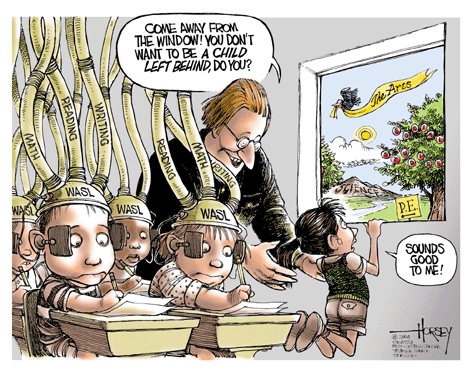
7. The relentless focus on testing basic skills in the No Child Left Behind Act diminishes attention to the humanities, the social studies, the arts, and child and adolescent development. While education should cover basic skills in reading and math, the educational process should aspire to far more. We believe education should help all children develop their gifts and realize their promise—intellectually physically, socially, and ethically. The No Child Left Behind Act treats children as products to be tested, measured and made more uniform.
9. The No Child Left Behind Act exacerbates racial and economic segregation in metropolitan areas by rating homogeneous, wealthier school districts as excellent, while labeling urban districts with far more subgroups and more complex demands made by the law as “in need of improvement.” Such labeling of schools and districts encourages families with means to move to wealthy, homogeneous school districts.
Among the districts that reported both increasing time for ELA or math and reducing time in other subjects, 72%indicated that they reduced time by a total of at least 75 minutes per week for one or more of these other subjects. For example, more than half (53%) of these districts cut instructional time by at least 75 minutes per week in social studies, and the same percentage (53%) cut time by at least 75 minutes per week in science.
District 93 officials say they’re willing to break the law this spring to shield students from the frustration and humiliation of taking an exam not designed for them.
“The board believes it’s appropriate to do that,” District 93 Superintendent Henry Gmitro said. “While there may be consequences for the adults in the organization, we shouldn’t ask kids to be tested on things they haven’t been taught.”
Illinois dropped the test that was designed for English learners this fall, after the U.S. Department of Education made a final ruling that the test wasn’t an adequate measure of state learning standards. The old test was written in simpler English.
As a stopgap measure, English learners will take standard assessments with some special accommodations, such as extended time and audio recordings, while Illinois develops a test that will meet federal guidelines.
Locally, the Wisconsin Peace & Justice Network is asking people to identify alternate uses for the money that is being spent on the Iraq war. According to their figures, Madison taxpayers have contributed about $300 million. After fully funding free quality early child education and restoring MMSD’s cost to continue cuts of the last few years, I would suggest Madison opt out of NCLB at a cost of about $5 million per year. We can dream.
We haven’t posted much on No Child Left Behind lately. Time to remedy that.
The reauthorization/reform are still pending, but don’t appear likely in this election year (see also here). I don’t know if that is good news or bad news. A straight re-authorization would be very bad news, but a better federal education policy (and less high stakes testing, less money for charters and vouchers, more money for underfunded mandates, more realistic accommodations and exclusions of special education students and English language learners for all testing) would be welcome, whatever the name.
I have to thank Madison teacher Gary L. Stout for prompting me on this post (and to add the Collaborative for Academic, Social, and Emotional Learning to the AMPS Resources page — check it out). Gary, along with David Wasserman (see here and here, on AMPS) has been doing his best to get out a teacher’s perspective on the damage the law is doing to our schools and children. Here is an excerpt from his site on NCLB (check out the Social, Emotional, and Academic Learning in Kindergarten material too, it is well worth the time if you care about early education).
Developmentally Appropriate Practices
If a person is truly knowledgeable about what constitutes Developmentally Appropriate Practices (DAP) for our school age children it is inconceivable that they support NCLB.
The concept of Developmentally Appropriate Practices are the cornerstone of what is good for our children in all schools. You will never, ever see the two phrases NCLB and DAP in the same sentence in any credible professional educational journal, never, ever. The more a person studies and works in teaching the more a person sees how developmentally inappropriate NCLB really is.
NCLB is the most destructive, vindictive piece of federal legislation ever passed. It is a deliberate assault on public education. It is a disease that is presently in every classroom, every day. It starts in kindergarten classrooms by undermining all aspects of Developmentally Appropriate Practices. It continues on through the grades and stops in High School when it lures, misleads, misinforms, and recruits our students into the all too real prospects of death or maiming. It is a tribute to the existing presidential administration
and their success at destruction and manipulation. NCLB is an all encompassing cancer that needs to be stopped.
The whole essay is here, including good quotes from our Board of Education members. One more excerpt on what we can do: Take Action!
What Can We Do?
It is easy to be critical of NCLB. The challenging part is addressing the question of what can we do to change things?
1. We need to unite and get politically active locally and nationally to eliminate NCLB or change it drastically. The problem is that political change is slow. We as a nation have been taking steps backward in the education of our children for five years now. We will continue going backwards on a daily basis as long as NCLB exists as it is today.
2. It is critical for Wisconsin to change the way our public schools are funded. The elimination of revenue caps and the use of property taxes as a major way to fund public schools has got to change.
3. Third, we need to educate many of our co-workers, parents, and the voting public as to the truth about how our schools are being deliberately set up for failure and how our schools are presently failing on a daily basis to meet even the basic needs of all our children
There are also at least three things we can do immediately as a progressive and accountable school district.
1. Stop the one dimensional focus on academic learning and teach to the whole child. We need to teach and give every child the opportunity to grow socially, emotionally, physically, and creatively as well as academically.
In March 2003 I addressed a Madison school board committee suggesting that our school districts emphasis on testing and academic learning at the expense of social, emotional, physical and creative learning was developmentally inappropriate. Since then our approach to teaching to the whole child as become even more one dimensional with the developmentally inappropriate mandates of NCLB.
2. Change the focus of the Madison summer school program. Instead of using behavioral issues as a deterrent to getting into the program, children with behavioral issues should be the first to be enrolled. The public needs to know that when a classroom has just one socially
inappropriate child, that child takes educational opportunities away from every child in the classroom. Social development is similar to reading and math development. They need to be taught every day, in every classroom, at every grade level.
3. We need to remember Rosa Parks and say no to NCLB. Our school district should be commended for having the courage to say no to the Reading First program. Lets have the courage to say no to NCLB. As a community lets find ways to fund our schools without having the George Orwell effect tied to federal dollars.
I’ll add one more. The Board of Education Communications Committee is planning forums on various topics. I think the NCLB Act should be one of them. If you agree, let them know.
Here are some of my other favorite anti-NCLB resources:
In his state of the union address last night, President Bush touted “Pell Grants for Kids,” (PGFK) a $300 million federal voucher program. Pell grants are a popular program that provides needs-based post secondary tuition assistance. The program, like most things involving education, has been underfunded during the Bush presidency. Of course PGFK also tries to do things on the cheap, promising only $500 per student in aid, hardly enough to make a difference for most of the low income families who would be eligible. As policy PGFK is ridiculous; as symbolism it is important. The hook is that like pell grants, the “new” program could be used at private and religious institutions. In 1,000 ways higher education and k-12 education developed differently in this country — for example there are no compulsory higher education laws — and using tax dollars to fund private and religious education for children is not the same as helping adults afford to attend the college of their choice.
Of course unlike PGFK, pell grants can also be used at public institutions. Wouldn’t it be great if Bush had proposed giving every school district $500 more per student in federal aid. Although this probably still wouldn’t take care of all the underfunded federal mandates, it would mean about $12 million a year more for MMSD. Don’t hold your breath.
I put “new” in quotation marks above because this is an old idea all around. It was introduced as “The GI Bill for kids” By Lamar Alexander, when he was Secretary of Education under Bush I. Again, the attempt to create confusion by naming a voucher program after a popular program for adults. This went nowhere and it was reborn as PGFK in 2004, with a push from (then and now) Senator Lamar Alexander. The Senate testimony of (then) Arlington, VA Superintendent Robert Smith from 2004 gives a nice summary of how wrongheaded the proposal was and is. Andrew Rotherman of EdSector/Edwonk noted at the time that this was all about scoring a “political point” for school choice (note: I agree with Rotherman that this was and is about politics; I don’t agree with much else he has to say about it).
The title of this post is a trick question, the correct answer is both. Invoking pell grants covers the wolf of vouchers in the sheep’s clothing. Voucher proponents like Bush and Alexander hope to smuggle a small part of their policies into law under disguise thereby scoring points with people like the Hoover Institution, opening the door to more privatization and further undermining support for public education (and less support means more underfunding, which in turn leads to less support…starve the beast).
A few weeks ago I posted some links and information about David Wasserman’s protest against standardized testing to the Education Disinformation Detection and Reporting Agency list maintained by Gerald Bracey. There some problems with the list and I only got responses yesterday. Although not as timely, I think they are still worth sharing.
I also sent this from George Lightbourn of the Wisconsin Policy Research Institute (for more on Mr. Lightbourn on AMPS, see here). More local coverage and reaction here and here and on AMPS.
Steven C. Lozeau, School District Administrator, Potosi (WI) Public Schools weighed in with a letter directed to Mr. Lightbourn:
Dear Sir:
I agree wholeheartedly with accountability, testing and with finding ways to use the information to improve student performance.
Knowing that this is only one part of the picture we must also integrate other measures that account for some of the areas you describe such as creativity and other non-standardize tested criteria.
But I disagree with shoring up your position using already overused and questionable data such as the position of US students compared to the world.
We can spend hours on such comparisons and their failings.
Please do not use non comparables to prove your point as most of what you said can stand alone. Comparing apples and oranges, which most country to country testing does only disclaims your point, propagates bad information, and damages higher education’s relationship with public schools.
Sincerely,
Dr. Steven C. Lozeau
Potosi School District Administrator
I’m not sure if this was a response to my post, but Michael Paul Goldenberg of the Rational Mathematics Education blog posted AN OPEN LETTER IN SUPPORT OF DAVID WASSERMAN . Here are some excerpts:
I am writing to support David Wasserman’s decision to refuse to administer a test in which he did not believe and to decry the way in which he was subsequently dealt with by his superiors. I am a mathematics teacher educator, teacher, and expert on standardized test preparation with more than 30 years’ experience working with students on various instruments (e.g., SAT, GRE, ACT, LSAT, and GMAT) as well as with grading state tests from Michigan, New York, and Connecticut. With that experience and expertise in mind, I am deeply troubled by the manner in which this nation has been pushed further and further towards accepting an ill-founded religious belief in the power of (for the most part) multiple-choice, multiple-guess tests to measure not only student achievement, a concept which is at best open to question, but teacher, administrator, school, district, and state competency (not to mention national status when viewing similar international tests such as the TIMSS), in total violation of one of the basic principles of psychometrics: never use a test to measure something it has not been specifically designed and normed to measure. This country has long been enamored with numbers and rankings, going back to the early decades of the 20th century, when we shamefully abused IQ scores to restrict immigration in ways that can only be viewed as unscientific and utterly racist. I urge everyone to read Stephen Jay Gould’s definitive work on the abuse of “intelligence” testing, THE MISMEASURE OF MAN, for a shocking and sobering account of how standardized tests have been misused and abused in the United States, generally out of racist and chauvinistic ignorance and bias.
It takes a brave person to risk his job and his livelihood, to put himself and his family in jeopardy, in the face of blind obedience on the part of so many of his fellow teachers and education professionals to what is nothing more than an outlandish political ploy to destroy public education, undermine teacher authority and autonomy, punish students, parents, teachers, administrators, schools, and districts MOST in need of support, and to shamelessly promote vouchers and privatization to help those most advantaged and least in need already. Sadly, there is not a single member of the US Congress (and, I suspect, of any state legislature) who has a balanced view of educational politics, who actually has K-12 teaching experience, who has a background in either education or psychometrics, and who understands that measuring something is not the way to improve it….
David Wasserman had the guts to stand up for his students and for meaningful assessment over shallow, cheaply processed “data”-gathering and number worship. His colleagues, principal, and superintendent should have applauded him. I suspect many of his students were grateful for even a moment’s thought for their plight. Instead, we saw no acts of courage from those with a little more power than a mere classroom teacher. It was business as usual, full speed ahead, and testing uber alles. How utterly sad, and how utterly tragic for real kids and real learning.
I too support Mr. Wasserman and hope that MMSD’s “reprimand” does not come to pass.
BOSTON
The state Department of Education acknowledged Monday it violated the free speech rights of a standardized test critic and agreed to pay him $187,000 to settle his lawsuit over being dumped as a speaker at a state-run conference.
Alfie Kohn, a former teacher who lectures widely, was asked to discuss his views on standardized tests, including the Massachusetts Comprehensive Assessment Systems test, at a 2001 conference on public schooling in the state’s western region.
Kohn said state education officials, after learning he planned to focus on his opposition to the MCAS, forced local organizers to cancel his speech after threatening to withdraw $28,000 in state funding. His lawsuit alleged that state officials violated his rights and kept others from hearing his views.
In a statement Monday, the education department acknowledged it had violated Kohn’s First Amendment rights. In a letter written as part of the settlement, the department said its position “is that vigorous debate about education issues is healthy and welcome.”
The suit was filed by the state chapter of the American Civil Liberties Union on behalf of Kohn, a school principal, a counselor and a parent. In the settlement, Kohn will receive $7,500 and his attorneys will get $179,500, the ACLU said.
In May, a Superior Court judge ordered the department to pay $155,000 to Kohn’s lawyers, ruling that officials violated his constitutional rights when they kept him from speaking at the conference. Mediators, however, persuaded the department to increase the amount, education department spokeswoman Heidi Guarino said.
“Our feeling is that this is a good resolution, we are glad to have this behind us and we are perfectly content with where things stand now,” Guarino said.
Kohn said in statement he, too, was happy to resolve the suit and is “hopeful that DOE’s newfound commitment to open discussion of education policies means that it will never again attempt to silence those who disagree with its policies — and that it will be open to considering the substantial evidence that indicates the MCAS testing program is doing more harm than good.”
In addition to lecturing, Kohn has written 11 books on education and parenting.
Get ready for “news” reports and blog posts (and here) from those eager to find fault with public education harping on the latest “report” from the Education Sector (more on the Education Sector on AMPS, here). In the recently released The Pangloss Index: How States Game the No Child Left Behind Act Wisonsin is ranked at #1 (along with Iowa) as the state that is most guilty of “gaming NCLB’s accountability system.” Don’t believe them.
Among the many faults of No Child Left Behind — recognized even by those who have faith in the utility of compilations of data to capture the essence of educational quality and believe that high stakes testing is the best way to create educational progress (I’m not one of them) — is that the accountability structures of NCLB in these areas are deeply flawed.
The purpose of the Pangloss Index (named after Doctor Pangloss from Voltaire’s Candide, who embodies baseless optimism) is to point out that many states avoid “accountability” (read the punishments doled out to schools that don’t meet the adequate yearly progress measures of the law) in their implementation and generally paint a rosy picture of the state of education. All well and good. If you believe in this stuff (as the Education Sector does) then you want it to be designed in a way that at least has a chance of being useful and documenting the flaws would be a good first step.
If you take the press releases (and here; I can’t resist highlighting this phrase from Kevin Carey: “even tightly constructed laws like NCLB,” “tightly constructed,” what planet is he living on?) at face value, that’s what the Pangloss Index is supposed to do. If you peek behind the curtain you will see that it is in fact a lazy and useless piece of garbage intended only to fan the flames of panic among those inclined to believe the worst about public education and “educrats.”
The whole thing is based on the absurd assumption that all positive data is wrong and all negative data is correct. Therefore, states that report good things get a high (bad) rating for “gaming” the system and states that report bad things get a low (good) rating for being honest and accountable. No effort (none at all) is made to assess the accuracy of any of the reported data or to correlate it with other measures. Don’t believe me? Here is what the report says:
This report is based on data submitted by state departments of education to the U.S. Department of Education through reports called Consolidated State Performance Reports (CSPRs)…The “Pangloss Index” found in Table 1 of this report is calculated by aggregating state rankings on 11 measures derived from the CSPRs….For each measure, states were ranked so that the states reporting the most positive results were ranked highest. For example, while states were ranked highest if they reported the highest high school graduation rates and highest percent of schools making adequate yearly progress, they were also ranked highest if they reported the lowest number of persistently dangerous schools and the lowest high school dropout rates.
This is just a stupid way to look at education policy and practice. The Education Sector has lots of money and a respectable reputation and should refrain from these kind of games if they want to keep the reputation (the money would no doubt continue to flow, money in education policy cares little about standards of honesty or scholarship).





 Get ready for
 AMPS
AMPS 