Category Archives: School Finance

Letters to the Editor — School Finance (and the QEO)

image-letter-to-the-editor-stampMany good letters to the editor in response to a recentWisconsin State Journal editorial.

QEO repeal alone would make situation worse

In 1993, Wisconsin adopted a “temporary” formula for funding public schools based on revenue caps, the QEO and a promise of two-thirds funding for education from the state.

Revenue caps and the QEO were set at levels that did not foresee today’s health care and energy costs, or the increasing percentages of students needing services such as special education. State funding falls farther behind the two-thirds goal every year. And under the current budget proposal, we would lose the QEO as well. Revenue caps left alone will not support schools. It will crush them.

It’s time for state government, which created this situation, to take responsibility for solving it. We need a sustainable education system, one that balances the needs of students, teachers and taxpayers.

Simply repealing the QEO will make the situation worse, not better.

— Sherri Swartz, Madison

Today’s schools funded using obsolete system

When I retired in 2006 after a total of over 33 years teaching, 26 of them here, I was earning $47,092, with a master’s degree plus 16 graduate credits, on a pay scale which went no higher than 13 years of experience.

This represents a small annual increase during those 26 years over the equivalent pay scale when I started in 1980 ($18,675).

In what other profession requiring a master’s degree would you expect people to work at those salary rates?

The QEO mandates 3.8 percent. But double digit inflationary increases in health insurance costs eat up most of that.

School districts can’t keep up by financing education mainly with property tax increases. We are trying to pay for education with a horse-and-buggy system. In the 21st century, this simply won’t work. Boomer-aged teachers are retiring, and few young people wanting to survive financially would consider entering such a poorly paid profession.

If you want good teachers, revamp the whole system and control health costs.

— Kay Ziegahn, Richland Center

QEO and revenue caps bad way to fund schools

The QEO does not rise with the cost of living, so teachers are being paid less and less every year. This is unfair, especially for those who have been teaching the longest.

And the revenue caps have caused a lot of damage as well. Several towns have closed schools because they no longer have enough money to run them. Other towns have cut out their sports programs.

And here in Madison, teachers have retired early so younger teachers won’t have to lose their jobs. Programs and courses have been cut, and there is less money for supplies. Computers cannot be upgraded, so they are too slow in some schools.

If we are to keep up with schools around the world, we must eliminate the QEO and the revenue caps. We must fund our schools.

— Genie Ogden, Madison

Reconsider America’s public school concept

As an educator in the public schools, I wonder why it seems like this is a panic. The QEO has been in place since 1993, and this is Gov. Jim Doyle’s second term. There should have been plenty of time to evaluate the QEO and the revenue caps, as well as comparing these to other states.

Wisconsin is not alone in struggling to fund public schools. You can blame it on our “rich” health care benefits, although I’ve never heard GHC referred to as “rich.” Maybe addressing the portion of health care would be reasonable. But Wisconsin cannot expect to attract and keep good teachers if wage increases don’t even come close to the rate of inflation.

People should be reminded that educators not only have a minimum of one degree but must also pay for six credits to maintain the five-year license that we pay for.

It may also be time for states and the Department of Education to revisit the notion of public schools and how to best prepare tomorrow’s workforce. Cutting programs, increased class sizes, fewer technological resources and closed schools is not the answer to funding education.

— Dawn Nonn, Madison

Isn’t it amazing how concerned citizens can so clearly see the need for comprehensive school finance reform, yet our elected leaders seem to be wearing blinders.

Thomas J. Mertz

Leave a comment

Filed under "education finance", Best Practices, Budget, Contracts, education, Elections, Gimme Some Truth, Local News, School Finance, Uncategorized

A Message to State Officials — My Budget Letter

Madison May Day Rally 2009, photo Dace Zeps, click on image for more information.

Madison May Day Rally 2009, photo Dace Zeps, click on image for more information.

There are lots of ways to get a message to elected officials.  You can march and rally, like many of us did on May Day in support of a variety of causes and many more of us will on June 16 to call for long-overdue school funding reform.  You can testify at a hearing like the supporters of the School Finance Network did recently.  You can visit their offices and you can always send a letter.

Here is the letter I sent today.

Governor James Doyle

State Senator Fred Risser

State Representative Mark Pocan

State Capitol
Madison, WI 53708

Dear Sirs

As work on Wisconsin’s biennial budget moves forward, you and your colleagues face increasingly difficult choices.  The current economic crisis and the difficulties you face demand real leadership.

This crisis — in the public and private sectors, at the national, state and local levels – is the product of too many years of looking for quick and easy fixes and savings.  The gimmicks have been exhausted, the savings have been proven illusionary, and the short term view has wrought extensive damage.

It is time to champion a new vision.  Wisconsin needs you to lead the state in a recommitment to a sustainable and progressive system of revenues sufficient to provide the investments in education, social services, health care, and infrastructure necessary for Wisconsin to grow stronger, more prosperous and more equitable.

The Wisconsin Council on Children and Families and the Institute for Wisconsin’s Future have produced a Catalog of Tax Reform Options for Wisconsin.  This document offers many ideas for fair and sustainable revenue policies.  I urge you to put these ideas at the center of your continuing work on the budget.

I am an active citizen, member and supporter of the Democratic Party of Wisconsin.  I have volunteered and donated and even hosted a “Take Back the Assembly” fundraiser in the last election cycle.  I’ve done this because I believed in the Democratic platform planks promising “fair taxation,” full funding of educational mandates, and “access to affordable health care,” and more.  These are the ideas that put you into office.  Now, more than ever you need to put these ideas into action.

As we all look forward to the next election cycle, it may be helpful to think about how difficult it will be to hold on to majorities and offices if all you have to offer is “We survived the economic crisis without too much harm and no fundamental changes in our approach to governance.”  Propping up the status quo also contains risks, but it offers few rewards for the citizens or the Democratic Party.  Change was the watchword last November and the increasingly apparent failures of the old way of doing things have only made the demand for change more pressing.

You are in a position to lead that change.  Please be part of building the future our state needs.

Thomas J. Mertz

Send your own letter (info here, feel free to post it in the comments); join the march and rally on June 16!  Take action!

Thomas J. Mertz

Leave a comment

Filed under "education finance", Best Practices, Budget, education, Elections, finance, Local News, School Finance, Take Action, Uncategorized

WAES School-Funding Update, the Week of May 11, 2009

waesgraphic

Click on the image to visit the Wisconsin Alliance for Excelent Schools

From the Wisconsin Alliance for Excellent Schools.  Headlines/index below, click here for a pdf of the full update, click on the linked items for related posts on AMPS

Thomas J. Mertz

Leave a comment

Filed under "education finance", Best Practices, Budget, education, finance, Local News, Pope-Roberts/Breske Resolution, School Finance, Take Action

School Budget Talk — Gov. Doyle and Sup. Nerad and Others

From WKOW, Channel 27, Madison.

Nobody seems to be saying much about what was discussed, but the little that is being said doesn’t sound good.  In fact, it sounds like Governor Doyle is looking for some cover for his previously expressed opinion that “cuts to education..will be necessary.”

Governor Doyle is wrong.  Cuts instead of investments are both unwise and unnecessary.  In these times of economic crisis, Wisconsin needs bold leadership in order to set a new path toward growth.  It would be a huge mistake to continue along the unsustainable “quick fix,” “no new taxes,” road that brought our state and our nation to the edge of collapse and puts our children’s future at risk.

Let your elected officials know that you would support moving Wisconsin in a new and better direction.

Thomas J. Mertz

2 Comments

Filed under "education finance", Budget, education, finance, Local News, School Finance, Take Action, Uncategorized

The Wisconsin State Budget Question: Who Has a Backbone?

Clockwise: Chironex Fleckeri, Governor Jim Doyle, State Senator Mark Miller, State Representative Mark Pocan.

Clockwise: Chironex Fleckeri, Governor Jim Doyle, State Senator Mark Miller, State Representative Mark Pocan.

Things have been tough with Wisconsin budget and are even tougher after revenue estimates came up about $1.5 billion short.

The talk from Governor Jim Doyle is now of more cuts, layoffs, pay cuts, and furloughs.

Like George H. W. Bush, Doyle suckered himself into a “no new taxes” pledge years ago. Unlike Bush Sr, Doyle hasn’t had the wisdom or the courage to back away from that position. There are a couple of small exceptions like cigarettes and a slight income tax bump in his most recent biennial budget proposal (you know, the one that uses the stimulus money for a big chunk of the school funding and shifts almost all of the revenue cap increase to property taxes), but Doyle has consistently resisted even things like extending the sales tax to personal services. Doyle also seems perfectly satisfied in ignoring the pledges of the Democratic Party of Wisconsin to “fully fund” educational mandates. This isn’t backbone, it is boneheaded.

Charity Eleson of the Wisconsin Council on Children and Families (WCCF) has the right idea:

“We recognize that the shortfall has become massive and that painful cuts are necessary,” said WCCF Executive Director Charity Eleson. “However, the enormity of the deficit demands that we take a balanced approach to filling the gap. It would be a serious mistake not to include revenue increases in the plan.”

….“We therefore call on policymakers to include revenue increases in the mix as they work to address the budget shortfall. Options such as reducing the tax break on capital gains—currently the most generous in the nation—and reinstating the estate tax, to name just a couple, would help minimize the devastating impact of the state’s revenue problems on the children and families least able to weather the bad economy.”

We’ve had too many years of failed policies; too many years of looking for short term gains and savings instead of seeking a balanced approach to sustainable taxation and investment. This economic crisis should be a wake up call. Trying to cut our way out of this crisis will only extend the failure; Wisconsin needs to begin building for the future again.

The WCCF has joined with the Institute for Wisconsin’s Future to research and publish a Catalog of Tax Reform Options for Wisconsin. Urge your state officials to give consideration to these ideas for moving Wisconsin toward fairer, more sustainable revenue sources to fund the investments our state needs.

Two of the key players are Joint Finance Co-Chairs, Representative Mark Pocan of Madison and Senator Mark Miller of Monona. There is a small glimmer of hope, a hint of some backbone, in their recent statements.

The Capital Times recently reported:

Budget committee co-chairman Rep. Mark Pocan, D-Madison, said he wouldn’t rule out any measure to close the shortfall, including the measures proposed by Doyle and possible additional tax increases.

WisPolitics.com quotes Miller saying similar things:

Miller said that there’s only so deep you can cut to programs at a time state residents are struggling and that all avenues should be open, “including the need to look at perhaps revenue increases.”

Miller also said he would “like to look at closing more tax loopholes that remain.” Unfortunately, “he does not anticipate Dem lawmakers proposing an across-the-board sales tax increase.” If you think this or other revenue options are viable ideas, let Pocan and Miller and all the state officials know how you feel.

The WisPolitics.com story also quotes GOP Representative Robin Vos, as saying “he doesn’t think Democrats ‘have the wherewithal’ to make the tough choices necessary to cut spending and balance the budget without raising taxes.”

Vos gets it wrong. In this political climate, it doesn’t take much backbone to cut programs and layoff workers. What takes real courage is to change the conversation and the dynamic, to proudly raise the taxes that need raising, compassionately provide for the people who are suffering and wisely invest in the things like education which will assure a prosperous future for Wisconsin. That takes backbone and heart.

I hope our state officials find that backbone and that heart. You can help by reminding them of what needs to be done. Only they can answer the quiz at the top.

Thomas J. Mertz

1 Comment

Filed under "education finance", Accountability, Best Practices, Budget, education, Local News, School Finance, Take Action, Uncategorized

Education Reporting: A Suicide Watch?

Declining-Newspaper-Readership

It is not a news flash to say that the decline in the health of American journalism is currently close to a death spiral. In a wonderfully succinct review of the current state of play for the industry in Frank Rich’s column today, he noted the many challenges that have been faced by the varied mediums throughout the 20th century, right up to the present. It’s well worth a read. But unlike the entertainment media who have had their successes at reviving their fortunes with the introduction of new technologies – and failures, he noted, “with all due respect to show business, it’s only journalism that’s essential to a functioning democracy. And it’s not just because — as we keep being tediously reminded — Thomas Jefferson said so.”

Rich goes on to write:

Yes, journalists have made tons of mistakes and always will. But without their enterprise, to take a few representative recent examples, we would not have known about the wretched conditions for our veterans at Walter Reed, the government’s warrantless wiretapping, the scams at Enron or steroids in baseball.

Such news gathering is not to be confused with opinion writing or bloviating — including that practiced here. Opinions can be stimulating and, for the audiences at Fox News and MSNBC, cathartic. We can spend hours surfing the posts of bloggers we like or despise, some of them gems, even as we might be moved to write our own blogs about local restaurants or the government documents we obsessively study online.

But opinions, however insightful or provocative and whether expressed online or in print or in prime time, are cheap. Reporting the news can be expensive. Some of it — monitoring the local school board, say — can and is being done by voluntary “citizen journalists” with time on their hands, integrity and a Web site.

I guess he would be referring to me, but not sure about the time issue.

He goes on to say that opinion is still no substitute for reporting, such as what is happening in Pakistan, Washington or Wall Street — and our local school board. I noted earlier that there was no reporting on the school finance hearing that recently took place at the capital. Nor was there any local newspaper reporting on our recent school budget decisions for next year. I’ve been told that a short TV piece aired on a 10 o’clock broadcast (update: WKOW, includes video, h/t JW) — hardly a sufficient exercise in enfranchising our community with the knowledge of how one of the largest portions of their tax money is being spent. In fact, at the moment, the Board of Education web site is even down, ironically. The latest lack of coverage by our local media about the budget deliberations, especially print, with it’s ability to dig a little deeper on issues, is a sad development. With newspaper management fixated on moving around reporters to new beats on a regular basis (from a long out-of-date model), just has they have gotten up to speed on a complex subject such as education, is indeed beyond stupid. Just because conflict has been and remains a driver of much American journalism, it does not mean that there isn’t some important education reporting that needs to be done at the moment.

Blogs, such as this one, are a woefully inadequate substitute to good reporting, one in which telephone calls to sources are made, meetings attended and then a report distributed in a medium large enough to reach a mass audience. Count me as another person who is concerned about these latest developments. What is the current thinking of the editors at the WSJ and the Cap Times?

Robert Godfrey

1 Comment

Filed under Accountability, AMPS, Best Practices, Budget, education, Gimme Some Truth, Local News, Quote of the Day, School Finance, Take Action

Save the Date – Walk on the Child’s Side 10th Anniversary School Funding Action!

sign1

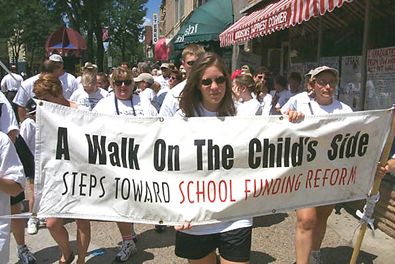
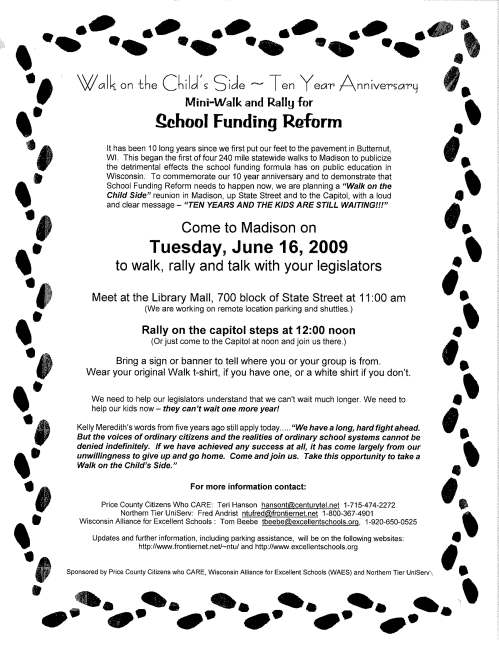
On June 16, 2009 at 11:00 AM, concerned citizens from around Wisconsin will gather at Library Mall on the UW-Madison campus and March to the State Capitol, bringing a message that comprehensive school funding reform cannot wait.

The event marks the tenth anniversary on the original “Walk on the Child’s Side.”  In 1999 and subsequent years, Price County Citizen’s Who CARE (Committee for Alternative Revenues for Education) and their allies walked hundreds of miles from Northern Wisconsin to Madison, spreading the message that Wisconsin’s broken school funding system needs to be fixed (more history and information here).

After 10 additional years of cuts to our children’s educational opportunities, the need for a fix is greater than ever!

This message needs to be heard.  Join the “Walk on the Child’s Side” veterans and newcomers to the struggle on June 16 and be part of the movement for change.

All the info is on this flier (click on the image for a pdf to print, post and share):

walk-flier-final-draft

The event is sponsored by Price County Citizens who CARE, The Northern Tier Uniserve, and the Wisconsin Alliance for Excellent Schools (check their web sites and on AMPS for updates).

You can RSVP via Facebook.

Save the date and spread the word!

Thomas J. Mertz

Leave a comment

Filed under "education finance", Best Practices, Budget, education, finance, Local News, School Finance, Take Action

May Day in Madison

Click on image for pdf.

Click on image for pdf.

The Chi-Lites, “(For God’s Sake) You’ve Got to Give More Power to the People” (Click to listen).

Among the demands of the Madison May Day March is “Real funding for public schools.”  I’m scheduled to speak on that topic.  That may change, but no matter what, I’ll be there to show support for this and other needed actions.  Join me and hundreds or thousands of others working for positive progressive change.

Here is the schedule (more details by clicking the above links).

11:00 a.m. Gathering at Brittingham Park
11:45 p.m. Depart Park to the Capitol
12:00 p.m. Capitol event, to state and federal demands
12:30 p.m. Depart Capitol to City-County Building
12:45 p.m. City-County event, to address city and county demands

Any Madison Metropolitan School District students planning to attend should provide written permission for their absences prior to Friday.

Thomas J. Mertz

Leave a comment

Filed under "education finance", education, Local News, School Finance, Take Action

Schools, Prisons and Accountability

a_supermax_0205

Since last week’s Assembly Education Committee hearing on the School Finance Network plan (video here, more on AMPS here), I’ve been thinking about schools, prisons and accountability.

Early in the hearing, Chair Sondy Pope-Roberts reminded the committee and the hundreds who packed the hearing room about the comparative direct costs of education and imprisonment. I believe she cited a figure of $30,000 per year to imprison an individual. The current cost of education per student is in the $10,000 per year range; the SFN proposals and other plans to preserve, expand and improve educational opportunities in Wisconsin would add at absolute most $1,500 per student, per year (I’ll argue from this high figure rather than quibble). Indirect costs and benefits should also be considered. As Madison Superintendent Dan Nerad has often said (paraphrase), “We need to consider what it actually costs to educate students and we need to consider what is costs to not educate students.” See also this letter from the Eau Claire Leader-Telegram about jail construction costs and school budgets and the work of the Center for Benefit-Cost Studies of Education at Teachers College, Columbia University

Later in the hearing, the representatives of the School Finance Network were pushed hard on “accountability.” The SFN proposal includes some good guidelines to work toward a better accountability system and calls for a five-year review (pp. 11-12).

There was some confusion at the hearing about the confidence in the “what works/best practices” models that served as a basis for the SFN calculations and the reluctance to guarantee results. SFN attempts to direct resources to where they are most needed and will do the most good; it isn’t just a matter of “more money” it is sufficient money to preserve and extend “best practices.” Will this lead to predictable improvements on various benchmarks? Yes and no.

Very simply, there are no guarantees in education or social science research and implementation. You’d have to be a fool to ask for or promise a rise of x points on any standardized test or other measure.

We have good research and data on many things that have improved outcomes in the past; we have good research and data on many things that have harmed outcomes in the past; we have less good data on many things in both categories; we have no “this will work 100% of the time” guarantees.

The SFN team is confident that if the plan is implemented data will show improvements in many ways and welcomes a five-year review. This is as much as can be expected given the state of knowledge.

[Sherman Dorn’s recent post, “Margins for error in policy” hits some related ideas.]

There was also some talk at the hearing of five years being too long to wait for “accountability.” I don’t know how to respond to that, except to say that I believe five years is too short (see below for a little more).

As part of the budget process the Wisconsin Legislature is also considering changes in early prisoner release laws to save money. A recent report pegs the growth of incarceration spending in Wisconsin at $500 million in the last decade and attributes much of this to “truth in sentencing” laws .

All this got me thinking about some questions:

  • Why don’t we require “accountability” when we build a new jail, supermax prison or change sentencing laws?
  • What would that accountability include; how would you figure the costs and benefits?
  • How do you quantify “feeling safer” or even crime rates in dollars and cents?
  • How do you “cost out” the family disruptions and pain caused by incarceration in your calculations?
  • How do “cost out” the fact that prisoners are not contributing economically or otherwise to society?
  • How does recidivism fit in the analysis?

You get the idea. One more:

  • Why don’t we require “accountability” for every tax break, road construction dollar, loophole, economic development initiative, …war…like our elected officials always seem to want from educational investments?

I actually have one answer for the last. Elections are the accountability mechanism for most of these.

Too bad our state officials won’t take that responsibility with educational investment, just like they won’t take the responsibility to fix the broken school funding system they created; nor are they willing to give that responsibility to local elected school boards by lifting the revenue caps.

Last thought. I said above that five years is too short. Let’s implement the SFN plan and make incarceration rates in five years and 10 years and fifteen years and twenty years part of the “accountability” analysis. Let’s also reassert things like “democratic ideals and full individual development countering ‘individual economic rapaciousness’” in our educational goals and make those part of the “accountability” too.

Thomas J. Mertz

Leave a comment

Filed under "education finance", Accountability, Best Practices, education, Elections, finance, Local News, Pope-Roberts/Breske Resolution, School Finance

A Slice of Two-Thirds

Credit: TeckPoh

Credit: TeckPoh

Following several hours of impassioned testimony from administrators, parents, and staff from school districts throughout the state, both large and small, at this week’s School Finance Network Assembly Hearing, it ended, unfortunately, on what could be charitably characterized as a flat note. Despite the hard work of disparate leaders of education groups meeting constantly for the past couple of years to come up with a thoroughly conceptualized school finance reform plan to present to the legislature, a committee composed of organizations in the School Finance Network who have often been traditionally at odds with each other in the past (for example WEAC and WASB ), came to the hearing armed with numbers vetted by both economists at the UW-Madison and the state Legislative Fiscal Bureau, including a number of suggestions for how to pay for this reform. However, the Committee on Education made it clear they were not going to take any action on this plan for the upcoming budget legislation hearings for the 2009-2011 budget. And most discouragingly there was, as far as I’m aware, no newspaper coverage of this event. I saw only one Madison tv crew present. They covered some of the personal testimony at the beginning but were not around to hear the actual presentation of the plan itself, which came late in the proceedings, too late to make it into the evening broadcast.

There are several political issues at play here, and with the funding reform process seemingly ended as soon as it was given its first oxygen to breathe, I think we may be headed towards even more dangerous waters. We will try and cover what rocky shores we may be encountering in future posts (such as the Governor’s push to repeal the QEO without other fundamental reforms). I want to draw your attention to one of them that, frankly, I missed in some of our earlier discussion on AMPS here about the use of federal stimulus money for school budgeting. In the Summary of Governor’s Budget Recommendations, Thomas Mertz pointed out his confusion with the school district’s use of their increase in their federal Title I and Individuals with Disabilities Education Act (IDEA) funding to reduce their levies and the potential bad effects this may have on district’s budgets in subsequent years. I, along with Mr. Mertz, remain quite confused about the Governor’s and the Legislative Fiscal Bureau’s thinking on the added stimulus money to IDEA and Title I as a way to keep within the Fed guidlines of “supplement not supplant.” It would appear that the Governor is planning to scale back his professed desire for the state to provide 2/3’s funding for education and instead reduce it to a level between 62.0% and 63.2% in 2010-11 and the shortfall made up with increased short-term Fed dollars. As an editorial in the New York Times noted the other day:

The education portion of the federal stimulus package gives a $13 billion boost to Title I, the federal program that is meant to provide extra help to disadvantaged schoolchildren. And the Department of Education has issued new guidelines, requiring states to give a clearer accounting of how education dollars are spent. But the federal money won’t get to the students for whom it is intended unless the department bird dogs this issue.

As envisioned by Congress, Title I is supposed to serve as an additional layer of financing for high-poverty schools that already are provided with budgets comparable to other schools in the same system. In reality, states and localities have often shortchanged schools that served the poor and used federal money to make up the difference in their basic budgets.

They further added:

The states and localities will resist the reporting requirement, which could easily unmask unethical financing gaps and even evasions of federal education law. But Arne Duncan, the education secretary, needs to hold them to the rules. The new reporting requirement is absolutely essential to school reform in general and fairness for impoverished children in particular.

But in yesterday’s State Journal report showing that MMSD would be receiving $11.7 million over two years from the stimulus bill, the Governor was quoted as warning school districts against “creating “funding cliffs”: using the short-term dollars to start new programs that would have to be sustained later by other funding.” But isn’t that what he is doing in his budget, promising something and then pretending he’s actually paying for it with two funds that are meant to supplement and not supplant state funding?

The Governor is further quoted, “This money can really protect our property taxpayers, and it also can add real quality to our schools if used correctly,” Doyle said.

Indeed. We’ll wait to see what the Obama administration has to say about this old street hustle 3-cups-and-a-ball routine.

Robert Godfrey

Leave a comment

Filed under "education finance", Accountability, AMPS, Best Practices, Budget, Equity, finance, Gimme Some Truth, Local News, National News, School Finance