Starve them into submission (with some corrections and an update)

[corrected material crossed out; new material in italics, update at bottom]

Wisconsin Superintendent of Public Instruction has officially embraced a policy of starving Milwaukee Public Schools into submission by exercising his power to withhold Federal funds from the district.

Here is the Press Release in it’s entirety (official notice here).

Evers issues notice to Milwaukee Public Schools

MADISON — State Superintendent Tony Evers issued a statement regarding the notice he signed today that will allow him to use his authority to withhold or direct federal funds allocated to Milwaukee Public Schools.

“As the State Superintendent of Public Instruction, I have a legal responsibility to the children of Milwaukee. Today, I issued a notice that will allow me to speed up change in the Milwaukee Public Schools (MPS) through the use of my authority regarding federal funds. Using the only tool allowed under state law, I am acting to ensure federal funds are used effectively to improve MPS.

“No one can or should be satisfied with the current progress in MPS to improve. I look forward to full cooperation to implement all required changes, with an increased sense of urgency, as I continue to work with MPS leaders.”

Evers had previously sought the power to  — unilaterally and  with no defined criteria —  declare any district “in need of improvement,” issue directives on almost all aspects governance and education and “withhold state aid from any school district that fails to comply to the state superintendent’s satisfaction with any of the above directives.”  That effort, Assembly Bill 534, failed.

Bribing Milwaukee into submission with uncertain Race to the Top funding also failed.  The carrot is gone now, what is left is starvation and the stick.

The last thing Milwaukee needs is more program cuts.  Just this week, the lack of resources led the distinct to discontinue SAGE class size reduction in 11 schools.  Federal dollars total about 18% of the MPS budget, Title I  — the funds targeted for poor children in play here — probably about 2/3 or more of that, call it over 12% (I’m not sure if Evers can also withhold the ARRA flow-through “state stabilization funds that his buddy Jim Doyle and others dishonestly tried to spin as “state aid”).  It isn’t clear what Evers is going to do and how he is going to do that with by cutting 18% a significant portion of the budget.

At this time there are no details, no plan, just the starvation.

Although not referenced in either the notice or the Press Release, there is a “Corrective Action Plan” that was issued in 2008 and a draft and  update from 2009.  Here is the report on the response by the Milwaukee Public Schools (I will post more relevant documents as I find them).

The lack of plan is foolish anyway you look at it.  From a policy point of view, there is no policy to look at.  From a political point of view, no positive case for the action is being made, no “this has to happen,” only “this can”t go on.”  That’s not the way to win over the undecided or convince anyone that this isn’t a political stunt.

There may be a good case to make that this is a reasonable and justified action, but the case has not been made.  That case would require more than the “No one can or should be satisfied with the current progress in MPS” in the Press Release, it would entail a detailed documentation of how MPS has failed in the Corrective Actions and why Evers thinks that withholding this money will produce better results.  My guess is that we will see some of this in the coming weeks.

Without a governance or educational case being made, this looks like a political stunt.

Since Evers has been linked at the hip to Doyle and Mayor/Gubernatorial candidate Tom Barrett on MPS issues, one calculation may be that Barrett will win votes outside of Milwaukee based on this.  I wouldn’t count on that off-setting the votes lost in Milwaukee or those lost around the state from people who actually know a thing or two about education.  My first reaction is that Barrett just lost the election.  Probably an over-reaction (really too early to tell), but not an outrageous conclusion.

The timing is bad too.  Unless this is direct reaction to the Superintendent hire, it makes no sense to not give Gregory Thornton a chance to at least get settled.  It certainly makes his job more difficult, if not impossible

It is ironic that the standards invoked (and required by statute ) are the NCLB Adequate Yearly Progress standards that Superintendent Evers has never been a fan of.   When power overcomes sense, any tool at hand looks good.

This kind of  bullying  was (mostly)  not part of what candidate Tony Evers promisedMany of us thought better of him, or at very least that he understood that a lack of adequate resources was part of the problem, not the way to a solution.  Time for second thoughts.

Update:

Wisconsin Radio Network had a story linking this to the Mayoral Control fight that brought a reaction from Tony Evers:

Update: Evers says the statement to MPS is about the district’s failure to improve in specific areas which are spelled out in the notice, and NOT about mayoral control, and that my attempt to connect the two in this post was “reprehensible.”

Good to have that information, but if you haven’t made the case on education and governance — and they haven’t —  then it seems reasonable for people to speculate about political reasons (I did, not Mayoral Control directly, but politics).

Under the circumstances “reprehensible” seems much too strong.

Whatever the combination of motives, for good and ill, politics will be part of this.

Responses from the MPS Board and Supt. William Andrekopoulos are linked here.

Update #2

Just some links.

Bob Hague at Wisconsin Radio Network has his full interviews with Evers and Andrekopoulos up here.  Worth a listen.

The main Journal Sentinel story is here.

Michael Mathias at Pundit Nation has a long and interesting post.

Gretchen Schuldt at Blogging MPS has a nice roundup (better than this one and she will no doubt be following developments more closely then AMPS, put her on the must-read list).

Thomas J. Mertz

1 Comment

Filed under "education finance", Accountability, Best Practices, Budget, education, Elections, finance, Gimme Some Truth, Local News, National News, nclb, No Child Left Behind, Uncategorized

Huge Cuts (and/or Big Taxes) for MMSD ?

At last night’s Madison Board of Education meeting (preview here) more details were given about the 2010-11 Budget situation.  There was some small good news and some large bad news.  The small good news is that because of savings and efficiencies, the gap between allowed revenues and projected costs has been reduced from about $2.8 milli0n  to about $1.2 million and that the search for savings continues.  The bad news is that due to the interaction between a broken school finance system and cuts in state aid to schools, Madison will be facing property tax hikes in the range of $312 on the average home if they tax to the max and more likely a combination of huge cuts and large property tax increases.

This is an difficult and unfortunate balancing act the Board must do because our state officials have not done the difficult work of reforming state school finance or finding better revenue sources.  To learn more and help push the state officials to do the job they promised to do (both in their campaigns and when they took their oaths of office), check these links: Wisconsin Alliance for Excellent Schools, Penny for Kids, School Finance Network and the AMPS “Take Action” page.

Here are the ugly details:

For example, limiting the property tax increase of $157.50 per average home is projected to require $14.3 million in cuts to programs and services.

Some quick points:

Next Monday, February 8, the process and time-line for choosing from among bad choices will be on the Board agenda.  If you have any ideas or thoughts, be sure to let them know:  board@madison.k12.wi.us.

I was unable to attend the meeting and would be remiss if I didn’t thank those MMSD staff people who very helpfully sent me copies of the documents linked here (after I requested them).  Thank you!

I’d also be remiss if I did not offer those links one more time: Wisconsin Alliance for Excellent Schools, Penny for Kids, School Finance Network and the AMPS “Take Action” page. .  The problem is at the state level and the answers have to happen at the state level.  Every indication is that state officials will not act unless pressured.

Thomas J. Mertz

Leave a comment

Filed under "education finance", Budget, education, finance, Local News, Pennies for Kids, School Finance, Take Action

On the Agenda — MMSD Board of Education, February 1, 2010

Taking my cue from Brenda Konkel, I’m going to try an experiment in posting the Madison Metropolitan School District meeting agenda items, with some comments, observations and questions.   I can’t promise to do this every week, but will try.

The Weekly Notice of Meetings is here and occasions my first comment.  I’m really glad to see the La Follette Area Long Range Planning Group (LFALRPG) and the Superintendent’s Human Relations Advisory Committee noticed for a change.  The first has been meeting since November 2009 (according to this from elsewhere on the agendas) and the second has been in existence for close to a decade (maybe longer).  This is the first time that I know of that they have been noticed.   It is my semi-informed opinion that because the Board has been only indirectly involved with them, they fall into a legal gray area with open meetings statutes (see the note at the bottom of this post for more).  I’m glad the district has moved to respect the spirit of the law.  Still some room to go though, there are no linked materials for either and the materials for the LFALRPG posted elsewhere are woefully incomplete (more on that below).

The post-Superintendent Dan Nerad changes in governance have the Board meeting as committees one week and the as the Board the next week.  In theory the discussions from the first week inform revisions and votes on action items the next week.  Things that don’t require action seem to get fit in here and there with little rhyme or reason.  The good thing about this is that action items are introduced and available to the public at least a week before the final vote.  The bad things include  long meetings and exhausted Board members because of the expectation that all Board be part of all steps of all items.  Items late in the agendas often receive little or no scrutiny.  For example, I don’t think there was any substantive discussion of the Strategic Plan Core Measures at either the last committee meeting or the last Board meeting where they were on agendas.

This is a Committee Meeting week.  The will begin meeting at 5:00 Pm, Monday February 1, 2010, Doyle Administration Bldg. 545 W. Dayton Street Madison, WI 53703 Room 103.  There will be public appearances at the beginning of the first Committee meeting.   Like almost all Board meetings, these will be carried by MMSD-TV.

Student Achievement and Performance Monitoring Committee is first up.  The format for this experiment is agenda items in bold, linked to materials, followed by comments (where I have comments).  Those that I think are most important are in italics.

Student Achievement Data: Value Added Analysis (Report Only).

This is a big waste.  A waste of time and effort by the people who did the work, a waste of money for the people who paid for it (you and me), a waste of the Board’s time to listen to the presentation and a waste of my time in having gone through the report.

I’ve written about the problems and limits of Value Added Analysis (VAA) before and nothing here improves my assessment of the utility of this tool, especially in Madison where differences among schools are small and the whole approach obscures the achievement gaps we all know should be given attention.  To change my mind about VAA, I would need evidence that it is making reasonable and effective contributions to policy and resource decisions; the only reasonable and effective decisions this supports is dumping Value Added and reallocating the resources.

This isn’t the time or place for a full treatment of the issues, so just an introduction.  First some general things.

The first general thing is the old “garbage in, garbage out.”  This analysis is based on the WKCE and no matter how you tart the test results up with fancy number crunching, they are still (close to) rotten at the core.

The second is that a claimed “strength” of the version of Value Added MMSD  uses is the  renorming of expected achievement gains based on demographics in order to better compare how the schools are doing with children from very different backgrounds.  These are good numbers to have, but this approach also serves to hide achievement gaps and to some degree institutionalizes low expectations.  For example, if you dig down into the report for the coefficients used to renorm (page 19 for example), you can see that for purposes of the analysis an African American 4th grade student, receiving free lunch is expected to gain 10.22 fewer points  per year on the WKCE than a non African American, non free lunch student.  Two points: 1.  The gaps should be highlighted, not obscured; 2. It might be useful to know if these disparities are similar at all of our schools, a matter that the report is silent on (although in schools with small numbers of a particular demographic the confidence intervals would be so large that the analysis would likely be of little use).

This second is of particular interest because the big take away from the report is that Madison’s schools are all doing about the same according to the average renormed student gains.  In the 2006-8 reading analysis on 7 elementary schools have 95% confidence intervals where any portion falls outside of a narrow +/- 5 point range; the middle schools’ confidence intervals are all comfortably within that range.   If I read correctly these are WKCE scale score points and looking over the DPI material on that topic (and here), this range is narrow.  To confuse matters more, there are no clear trends that I can see from the 2005-7 to the 2006-8.  This means that it is hard to say that one school is (according to these measures) doing consistently better than others.

Let’s pretend that there were significant differences (which there aren’t) and that these differences persisted over time (which they don’t appear to have).  For this observation to be of use in formulating policy, you would need to be able to make a confident assertion of causality.  With the multitude of variables at play in each and every classroom and school, this is almost impossible.  School X got a new principal and a grant for Cultural Relevance — the VAA scores went down — is it the principal or the grant programs? or something else? School Y has an active PTO and a four new teachers — the VAA scores went up — thanks to the PTO?, the new teachers?, or something else?  You get the idea.

I’m glad to know that by these VAA measures our schools are relatively consistent but am highly skeptical that this “insight” is worth the time, effort and money it took to gain it.  Last word is that sadly, President Obabma, Secretary of Education Arne Duncan and State Superintendent Tony Evers do not publicly share my skepticism and have enshrined Value Added type things at the center of the Race to the Top, especially for teacher compensation (where the teacher contact numbers are smaller and the confidence interval larger).

Update on Fine Arts Task Force Recommendations (Report Only)

(See below for the finances) Not much here, some incremental progress on items identified for incremental progress.  The two big things that were part of this Task Force’s ask were better and more remunerative  community partnerships and a long range commitment for district funding.  A little on the partnerships here, nothing  much on h0w remunerative they are and the long term local district funding commitment ain’t gonna happen as long as state aid keeps getting slashed and Wisconsin’s broken school finance system isn’t fixed.  Insert obligatory Wisconsin Alliance for Excellent Schools and Penny for Kids links.

Summer School Report and Recommendations.

Looks like some good work done in the past will continue with some tweaking.  The minority and low income percentages are astounding.  There is certainly a need there, but it should be recognized that recommendations to participate in the remediation programs come very late in the year when many non-low income families have already placed deposits for other activities.  One interesting note is that last Summer’s 8th to 9th grade transition program did not happen due to lack of enrollment.

Usage of the Infinite Campus Electronic Student Information System.

My take away is that use of this potentially valuable communication tool varies widely from teacher to teacher and by school, isn’t anywhere near as high as it could be and declined with the Middle School shift to Standards Based reporting.  Parent use is also relatively small and there are big racial and income related disparities in use.  Same is true (if less so) with student users.

Evaluation of District Reading Programs.

This is in response to the discussion that occurred with the Reading Recovery Report.   Looks generally fine, but I question hiring the Hanover Research Council to do a preliminary glorified literature/research  review (unless we are already a member in which case we’ve already paid for it, there is no cost listed) and would like to see a target price range for the actual evaluation at this point, rather than when the RFP is being drafted.

I also think it is again appropriate to post these 1949  words from the Madison Superintendent Phillip Falk

There is no one “best” method of teaching children to read. Almost every known method, technique, or device is utilized as needed – experience, phonetic, word, sentence, story, meaningful drill or practice – not in isolation, but in an approach to a particular problem of a particular group or of a particular child.

Five-Year Education for Employment Report.

This plan affirms the commitment to and the actions of school communities to: prepare elementary and secondary students for future employment; ensure technological literacy; promote lifelong learning; encourage good citizenship; advance collaboration among business, industry, labor, post-secondary schools, and school districts; and establish a role for public schools in the workforce and economic development of Wisconsin.

This is required by the state every 5 years.

Consent Items.

The only thing of interest here is the Evaluation of Learning Materials Committee purchasing adoptions.  One of these days I have to figure out the allocations and cycle on this because every time I review one of these it seems like one school is getting huge amounts and the others very little.  There may be equity related issues with these purchase patterns.  This week’s big buyer is Hawthorne.  It is also interesting to see what is being purchased.  The highlight this time is 2 “Feels Real Baby Dolls” for Falk.

On to the Planning and Development Committee.

MMSD Strategic Plan Mid-Year Report.

Some progress.  I like the Core Measures, especially the attention given to the demographics of students in advanced programs.  I also worry that the community appears to no longer be involved and all the work is being done by staff.  This leads directly to my continuing dissatisfaction with the Community Engagement measures (I have been told by an administrator that they see a need to improve these also).  It doesn’t look there will be much budget guidance this year from the Strategic Plan process, except in the most abstract ways.

La Follette Area Schools Long Range Planning Recommendations to address the Facility/Enrollment and Programmatic Needs of these Schools.

With previous similar work there have been open, public processes with multiple options laid out for all to consider.  This group has been meeting since November and this is the first time I’ve seen anything; what I’ve seeing isn’t much.  Combined with the disappearance of the community from the Strategic Planning work  it makes me wonder how much of Superintendent Dan Nerad’s talk of transparency and community involvement is just lip service.  Some recent things (like the meeting notices mentioned at the top) are a good sign, but the record in whole isn’t very good.

I should note that “Community Meetings” are mentioned in the document, but when they happened (before or after the appointment of the group) isn’t clear.

There is only minimal information about enrollment projections (more can be found here) next to nothing about transport costs and it appears that only one plan involving changing attendance areas is being considered at this point.  It is labeled “Plan 15,” so I assume there were others at some point.  You could say that it is early in the process (I think it is, but am not sure), but to me that means there should more information and more options, not less and fewer.

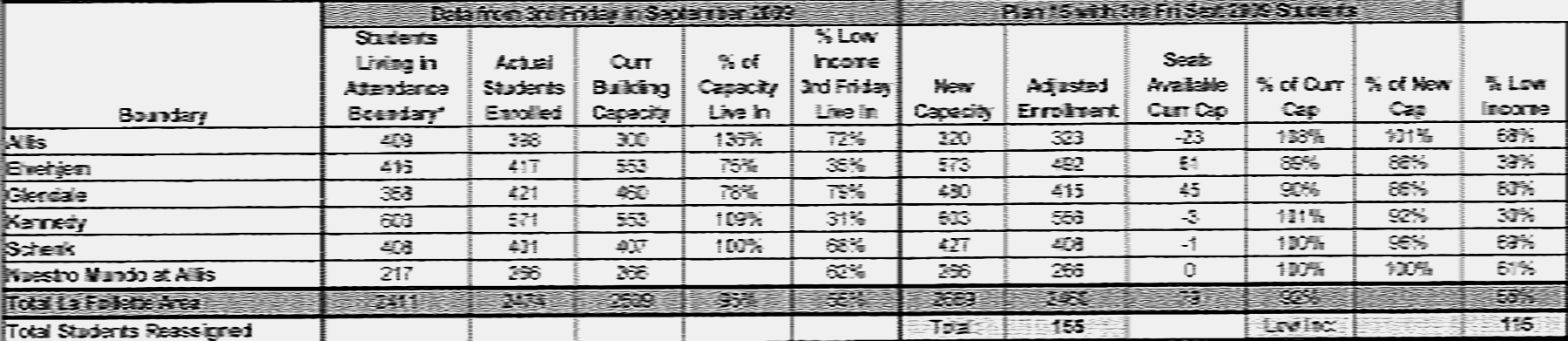
“Income Disparity Among the Schools” is one of the three “Issues to Address” in the charge, but neither Plan 15 nor anything else in this document seems to address this issue.  Here is the analysis of Plan 15 (there are no analyses for the other “options”:

Note that under this option income disparity is in some ways worse.  Not responsive to the charge at all.

For earlier posts on the need for proactive policies on socio-economic diversity see here, here,  and here and this not on AMPS, but linked in an post here.  A brief summation of my position is that overwhelming research shows that poor children do better in schools where the percentage in poverty is neither too high nor too low and that an essential part of the mission of public education is bringing people together.

Proposal for Naming Book Room at Stephens Elementary School under Board Policy 6701.

It sounds like Angie Zimmerman was well deserving of this honor.

Attachment of Three Parcels of Property located off of Sugar Maple Lane to the MMSD under Wis. Stat. §117.13.

From Middleton-Cross Plains, near Olsen School.

Two Committees down, one to go.  Much done, much left to do.  Put yourself in the place of a Board Member and think about how productive you would be for the remaining work.

Time for the Operational Support Committee.

2010-11 Projected Budget Gap, Tax Impact, and Efficiencies to Address the Gap and a later agenda item 2010-2011 MMSD Budget Development Timeline and Process (these are separated on the agenda because the latter is an “action item” and the former is not).

The big change with the Timeline is that the Preliminary Budget and statutorily required Public Hearing are pushed to July.  I can certainly see some advantages with this, give all the state uncertainties and the fact that the old timeline put new Board members right into their most difficult tasks.  I do worry that July is not a good time for public attention or involvement.  Perhaps countering that is another good sign that the administration is getting more real about public engagement, throughout March and April there are Public Hearings scheduled.

The Projections document is confusing.  It references a financial forecast prepared with PMA, but no copy of that is included.  It promises departmentally identified efficiencies, but most are listed as TBA.  In the title the “Tax Impact” is metioned, but there is no real information about the tax impact, only a promise to provide information about the “tax impact” of the “budget gap….no later than Monday’s Board of Education Committee Meeting.”

The problem with this is that most of the tax impact is not due to the “budget gap” but the lack of state support.   To put it another way, the budget gap is one symptom of a broken state finance system that requires most districts to find some combination of cuts and efficiencies each and every year; the tax impact is another symptom of this broken system that has been aggravated by the cuts in state support.

Insert obligatory Wisconsin Alliance for Excellent Schools and Penny for Kids links along with discretionary School Finance Network link.

What is here is the first estimate of the size of cuts and efficiencies needed:  $2,825,693.  Not chicken change, but it could be worse.  On the tax impact, I’m hearing that if MMSD taxes to the max it could mean over $300 and perhaps as much as $400 more  for the average home owner.  That’s what happens when state aid is cut by 15%.

Here are those links again: Wisconsin Alliance for Excellent Schools, Penny for Kids, School Finance Network and the AMPS “Take Action” page.

I also don’t see any real discussion of how the Fund Balances might be used in this budgeting.  Back in October, the discussion and development of a Fund Balance Policy was promised for January 2010 and it has not happened (more on this here).  This leads directly to the next items.

Structuring the borrowing of funds in connection with the refinancing of the district’s WRS unfunded pension liability and, potentially, to assist with funding the implementation of Four-Year-Old Kindergarten and Authorizing the Assistant Superintendent of Business Services, on behalf of the Board, to grant written permission to allow Robert W. Baird & Co. to both: (1) serve as financial advisor to the District in connection with district borrowing via notes, bonds, or other obligations; and (2) submit competitive bids seeking to purchase such notes, bonds, or other obligations, with said authority to expire on the earlier of the date of future Board action or June 30, 2011.

I’ll readily admit that I don’t understand the 4 year Old Kindergarten financing as well as a I’d like to.  I’ve also missed some of the presentations and discussions, so some of my questions and concerns may have already been raised and addressed.

Here is how I think it is supposed to work.  Because of the three year rolling average of student numbers that is used to determine the revenue limits, the first two years require substantial support from outside the regular revenue sources (or cuts elsewhere).  In Madison, the combination of the Community Plan and the high per pupil revenue limit lead to a projected future where 4K generates more in the way of revenue potential than it uses (lots of assumptions about state revenue limit growth there and ultimate costs and the escalation of those costs, but that’s what they are saying).

Based on this the administration is recommending that the district use the WRS liability refinance to in effect borrow the start up costs and then pay them back from projected excess future revenue authority.  I want to start by saying  yes , in general the refinance of the WRS liability is a good idea but how the savings of that refinance should be used I am less clear on.  If the only choices are those in the document, the “Fully Combined” option seems best, but I’m not satisfied that these should be the only options.

The whole borrowing bothers me because borrowed money has to be paid back  (it may not technically be borrowing because it is being done as a refinance, but the reality is that using this for 4K means that debt payments in the future will be higher — unless I’ve read this all wrong).  For the 2009-10 budget, MMSD shifted almost $6 million in debt to future budgets.  This is a pattern I don’t like, especially at a time when the district Fund Balances are higher than they have been in years.  I would like to see the a full discussion of the costs and benefits of using the Fund Balances vs borrowing before this plan is approved.  That was supposed to happen, but it doesn’t look like it will.

I’m also not clear why — when we have a state system that does not provide resources for cost to continue budgets in most areas — we are not talking about using the projected 4K excess to limit future cuts in other programs.   If the Fund Balance were used, this would be possible.

I want to repeat that I’m not clear on much of this and acknowledge that my ideas about using the Fund Balances might not make financial sense, but it seems to me that those options should be on the table.

Proposal for a Welcome Center and Educational Credit Union Branch at La Follette High School.

I can see good things about this, but have three worries: 1)Doing this in one or two high schools doesn’t seem right — all or none; 2)We are giving a business access to our students; 3)It looks like it will cost the district about $100,000.  I would like to hear these issues raised.

It is recommended that the Board approve all three applications pursuant to the terms of the Administrators’ Retirement Plan.

Principals Howard Fried (Crestwood), Maty Hyde (Lindbergh) and Linda Kailin (Muir) along with a reminder that Asst. Sup Steve Hartley is also retiring.  I don’t know  the others but will miss Steve’s professionalism and friendliness.   I also worry about the district’s ability to fill senior positions, last I checked too many were still “interim.”

Consideration of approval of a one-year extension of Daniel Nerad’s employment contract as Superintendent of Schools as contemplated under Section 2.02 of the Contract, said extension to result in a new two-year contract commencing on July 1, 2010 and expiring on June 30, 2012.

In Wisconsin, administrators are limited to two-year contracts, which means rolling renewals.  After 18 months, I think Supt Nerad has more than earned a renewal; I’m not so sure about a raise at this time, the symbolism of  a freeze would send a good message at a time when family and district budgets are tight.

Approval of Bills.

Purchases and Contracts.

Playground sign, Cooperative Gymnastics and Hockey Teams, Server Upgrade and some items that deserve a little attention.

The allocations for the Desktop Instructional Technology Purchases (about $200,000) are not detailed in the posted materials.  Like all resource allocations there are equity implications and I would like to see these made part of the proposal and the discussion.

With the Scholastic System 44 Pilot Project we appear to be doing a new reading remediation in advance of  the study discussed above which is intended to guide future initiatives.  With the study pending, it seems wrong to commit to a new initiative.

Fine Arts Task Force budget amendment.

(See above for the Report) Some changes  from the original plans for the $100,000.  I do like the “Arts Equity Purchase” aspect (just two week’s ago I enjoyed a concert at my son’s school featuring instruments purchased by the PTO, other PTOs cannot afford things like that).  I’m not sure how this will sit with the Task Force members and would like to hear their thoughts (not that I’d necassirly agree with them, but good to hear).

Other Financial Transactions

Grants and donations and more evidence that grants and donations create inequities.  With that observation, a few words of praise for the Foundation for Madison Public Schools are in order.  That organization seeks to structure their work in a way that minimizes inequities.

Human Resource Transactions

New hires and shifts.

Whew, that was exhausting.  Again, think about the Board Members and the prep time they put in and the need to balance all these issues in one lengthy meeting.

For those who found something worth paying attention to here, attend or watch the meeting, drop the Board a note (board@madison.k12.wi.us) and remember that votes on “action items” will not occur until February 8.

Thomas J. Mertz
Leave a comment

Filed under "education finance", Accountability, Best Practices, Budget, education, Equity, finance, Gimme Some Truth, Local News, Pennies for Kids, School Finance, Take Action, Uncategorized

A Penny for Kids Madison Follow Up

A quick follow up on this post praising our local educational leaders for supporting the  Penny for Kids dedicated sales tax for education campaign.

Madison Metropolitan School District Board of Education President Arlene Silveira highlighted the effort in her most recent Board of Education Progress Report  (read the full Report here):

A Penny for Kids: Wisconsin’s school funding system is broken and is failing our children and our community. Comprehensive school-funding reform is the long-term answer for our schools. To address the funding crisis, Wisconsin Alliance for Excellent Schools has launched “A Penny For Kids” campaign to raise the sales tax one-cent to help fill the gap in public school funding created by the 2009-11 state budget (which was devastating for MMSD) and try to keep a lid on property taxes. The Board voted to endorse the campaign. We hope you will too. To sign the petition and learn more, go to: www.apennyforkids.org.

And from the latest issue of Solidarity!, the Madison Teachers Incorporated newsletter.

Sign the Petition for the WAES “Pennies for Kids” Campaign

MTI has a long history of advocacy for school funding reform. The Union has worked for many years with the Wisconsin Alliance for Excellent Schools (WAES). Executive Director John Matthews and Assistant Directors Doug Keillor and Ken Volante have participated in WAES meetings around the State for more than a decade, in attempt to bring about progressive changes in school funding legislation.

WAES’ new campaign is to increase Wisconsin’s sales tax of 1 cent. The new campaign arose as an emergency response to the drastic cuts resulting from the current state budget. Madison schools were particularly hard hit with a 15% cut in state aid. This outrageous cut came on the heels of a decade and a half of continued revenue limits imposed by the State, which continue to starve our public schools.

One easy first step to announce your support for much needed school funding is to sign the online petition which can be found at http://www.apennyforkids.org. This small step will add to a growing list of supporters and will also help keep one advised of rallies and events in support of the proposal.

The situation in school funding is dire but the WAES proposal comes at just the right time to stabilize funding for our public schools. For more information on the campaign watch for continued updates in MTI Solidarity! or contact Ken Volante (volantek@madisonteachers.org) at MTI Headquarters.

They are doing their part.  Are you doing your’s?

Thomas J. Mertz

Leave a comment

Filed under "education finance", Budget, education, finance, Local News, Pennies for Kids, School Finance, Take Action

WAES School-Funding Reform Update, Week of January 25, 2010

From the Wisconsin Alliance for Excellent Schools.  Table of contents below — related items on AMPS linked –, full update here.

Visit the Penny for Kids website, to learn more, sign the petition and ask others to do the same.  You can also check in with WAES and the Penny for Kids effort on Facebook.

Thomas J. Mertz

Leave a comment

Filed under "education finance", Arne Duncan, Budget, education, finance, Local News, Pennies for Kids, School Finance, Take Action, Uncategorized

School Board Endorsement, or “Why I’m proud to be part of Progressive Dane”

At last night’s General Membership Meeting, Progressive Dane (PD) decided that at this time, rather than endorsing James Howard or Tom Farley in the contest for the Madison Metropolitan School District Board of Education Seat Four both candidates would be invited to participate in a PD sponsored public forum and after this forum the membership would reconsider an endorsement.  I am Co-Chair of Progressive Dane, and Chair of the PD Education Task Force.  Both this decision and the manner in which it was arrived at reminded me why I am proud to be part of Progressive Dane.

Progressive Dane has established, open procedures for endorsements.  With the exception of races where there are previously endorsed incumbents (there is a different process for those), all candidates who qualify for the ballot are invited to fill out a questionnaire and interview with the Elections Committee.   Any Progressive Dane member may take part in the interviews.  The Elections Committee may then recommend an endorsement to the General Membership.  Contrary to popular myth, there hasn’t been anything even close to  “loyalty oath” requirement for years (previously there was a statement of expectations designed to help build the party and to keep Progressive Dane endorsed candidates from actively opposing other Progressive Dane endorsed candidates).  Both Howard and Farley choose to participate in the process.

They each met with the Elections Committee for over an hour.  The members of the Elections Committee came to the interviews well prepared and with open minds.  We saw good things in both candidates, very real potential to improve the education of children in Madison.  We also had areas of uncertainty and concern with both candidates.  In the end, the Elections Committee voted not to forward a recommendation of either candidate to the General Membership.

At the General Membership Meeting members of the Elections Committee explained our decision and spoke of our impressions of the strengths and weaknesses of and uncertainties with both candidates.  Members asked many questions and various options were explored.  Throughout the discussion there was a recognition of the importance of this election, a desire to be involved and to make a careful, well-informed decision.  Recognizing the difficulties of the choice, a motion was made from the floor to postpone an endorsement and instead arrange for a forum where the membership could learn more.  Further recognizing that the entire community would benefit from knowing more about the candidates, the motion was for a public forum, with instructions to publicize widely.

Many things about what happened make me proud.  I want to highlight two.  First, there is the desire to be involved, to be active, to do something to make things better.  Second, there is the willingness to do the work to make sure that our actions are based on the best possible information and arrived at through open and democratic means.

Invitations have been sent to the candidates and the planning is just beginning.  The very tentative date is February 21.  Watch this space and elsewhere for updates.

Update:  Both Candidates have accepted the invitation.

You can become a member of Progressive Dane here and follow on FaceBook here (don’t have to be a member).

Thomas J. Mertz

Leave a comment

Filed under Best Practices, education, Elections, Local News, Take Action, Uncategorized

Howard Zinn in the Car

Click image for Googel Books page.

Click image for Google Books page.

[I just got word that Howard Zinn died and am reposting this — TJM]

The Clash, “Know Your Rights” (click to listen or download)

Tom Robinson Band, “Better Decide Which Side You’re On” (click to listen or download)

A little side trip from the usual.

This evening I was at my local gas station.  I’ve had some interactions with the guy behind the counter before.  He’s probably in his late 20s, a white guy into “Positive Hip Hop” (we’ve talked about that before).  He wears some bling, has what looks like a prison tear tattoo by his eye, I think he said takes some classes at MATC.  I’m always glad to see him.

Tonight I walked in and saw — off to the side, behind the counter —  Naomi Wolf’s Give Me Liberty: A Handbook for American Revolutionaries.

I said, ” You are reading Noami Wolf?” and smiled.

He responded “I got Howard Zinn in the car,” smiling also.

We talked a bit about Zinn and the People’s History (purchase from Rainbow Bookstore Cooperative).  I told him I taught history.

You’d be amazed at how many peple bring up Zinn when I tell them I am a historian.  I can do the “critical reading” thing with Zinn and find things that should be better, but he has done so much good for so many peoples’ understanding of our nations history and present;  in turn most of those people have become better citizens because of what they learned.  Zinn is good, the People’s History is good.

This would be a better country if more people had Howard Zinn in the car.

We talked some more;  he told me about reading the Constitution with his 11 year old daughter who wants to be  a Constitutional lawyer.  He told me that the price he extracted from his daughter for recreational computer access this Summer was a five page paper on the Federal Reserve.

We talked more about the Constitution.  As I was walking out, I quoted “Know your rights.”

He answered “They are under attack.”

With the door closing I said “Always” and he flashed me a hand sign and a smile.

These days it is easy to get discouraged about politics, activism, education and so much else.  It happens to me all the time.  I wasn’t discouraged on my way home and haven’t been since.

I’m energized.  I know that my friend at the gas station is going to keep doing what he is doing and the world is a better place for it.  I’m energized to make sure that people like him and me have opportunities to come together to work for that better future.  Mostly I’m energized to keep trying make public education live up to all of its promises, for his daughter, my sons and all the rest.

Thomas J. Mertz

1 Comment

Filed under Best Practices, education, Equity, Gimme Some Truth, Local News, Take Action, We Are Not Alone

Honesty from a Department of Education Official — Policies Are “Harming the Education of Students”

Diogenes searching with his lamp.

From Caroline Grannan, Examiner.com a report on a radio appearance by Peter Cunningham, (assistant secretary of communications for the U.S. Department of Education), where he “readily agreed with the views of another program guest that overreliance on standardized testing is detrimental to students, and that “many” charter schools, a model being promoted as a solution for troubled schools, are not successful” (listen here).

Also on the program was Richard Rothstein of the Economic Policy Institute.  As Grannan reports:

Race to the Top, Rothstein charged, is “accentuating the harm that NCLB did.” NCLB’s emphasis on testing only for math and reading is unchanged in RTTT.

“A major consequence of No Child Left Behind that’s done major harm to American education is the narrowing of the curriculum,” Rothstein said. Sciences, history, social studies, music, the arts and physical education are neglected or abandoned as educators struggle to adhere to NCLB’s emphasis on math and reading, Rothstein explained, and “Race to the Top doesn’t change that.” Abandoning other subjects “does the most harm to disadvantaged students,” Rothstein added.

Moderator Warren Olney followed up Rothstein’s comments with the question to Cunningham: “Are standardized tests a good measure of teacher performance and ultimately of school performance?”

“No, they’re not,” Cunningham admitted bluntly. “Education has been corrupted. In addition to narrowing the curriculum by abandoning other topics, what this kind of system does is create incentives to game the system. We’re actually harming the education of students in this country.” He mentioned, without more specifics, the “hope” of reauthorizing NCLB to include testing in more subjects. The prospect of increasing testing is likely to raise more concerns, but the discussion didn’t pursue that issue.

On the subject of charter schools, Rothstein disputed the view promoted by both the Bush and Obama administrations that charters are a solution for troubled schools. “The research is pretty consistent,” he said. “Charter schools on average don’t have better student performance than regular schools.”

Rothstein got no argument from Cunningham, who responded, “We 100 percent agree with Mr. Rothstein that many of them are not good” and called for more accountability for charter schools. [emphases added].

These flashes of honesty are nice, but it is sad that administration official simply acknowledging what both informed  common sense and the weight of research say is cause for hope or cheer.

There really is no excuse for the misrepresentations we have come to see as the norm and the knowing pursuit of harmful policies should be criminal.

Wisconsin, like 40 other states is so desperate for money that it has thrown away common sense and hard won research-based knowledge to twist our laws in a manner that buys us a ticket to a lottery where the prize is money that must  be spent to a great degree on testing policies that do more harm than good.  What is wrong with these people?  What is wrong with us?

Thomas J. Mertz

2 Comments

Filed under "education finance", Arne Duncan, Best Practices, education, finance, Gimme Some Truth, Local News, National News, No Child Left Behind, School Finance, Uncategorized

MMSD State of the District — Communication and Equity

[I neglected to look earlier, “State of the District” presentation was linked off the Board agenda.  It can be found here.]

On Monday, January 25, 2010, 5:30 PM,  at JC Wright Middle School (1717 Fish Hatchery) Madison Metropolitan School District Superintendent Dan Nerad will give a “State of the District” presentation.  It will also be broad and narrowcast on MMSD-TV.  I’m very interested in what will be said.  I’ve been told that among other things it will include updates on the work in response to the Math and Fine Arts Task Forces and will belatedly (by one year and eight months) fulfill the annual reporting requirements of the district’s Equity Policy.  I’m especially interested in that.

Before getting to equity, I want to say a few things about communications.  I think all recognize that the “State of the District” presentation is an exercise in public relations.  How effective an exercise will be seen after Monday, but part of public relations with things like this is the outreach that was done in advance, the hype.  I have to say that I’d give the Public Information department a  C on their advance work.

On the plus side, a press release was issued on January 13; I think I saw it mentioned in the State Journal (but can’t find it on line); an email announcement was sent to PTOs, community groups and other “stakeholders” last Friday, January 15.

There is lots on the minus side.

Besides the note in the paper, I haven’t seen any other advance news coverage.  Maybe there will be something over the weekend, but having Supt. Nerad make the rounds of radio and television giving a tantalizing preview would have increased interest.  Maybe some of that will happen over the weekend and on Monday.

The presentation is not mentioned on the district home page (capture, 1-22-09, 8:32 PM),  nor on any of the pages that link directly to the home page.  That includes, MMSD today, the district’s main newsletter.  These are important points of contact.  In a related matter, MMSD-TV and Fine Arts have Facebook presences but the district does not.

I subscribe the the Board of Education and district announcements, served on a Task Force, Co-Chaired Community and Schools Together (CAST) through two successful referendum campaigns, and maintain this blog; yet was not included in January 15 email distribution list.  I did get an announcement from the district today.  It doesn’t take much to realize that someone like me should be considered a “stakeholder” for announcement purposes.

Too many things on the minus side and none of them are all that difficult to address.

I’ve said so much in other posts about equity, the work of the Equity Task Force and the reporting requirements in the policy that I’m going to keep this brief (there is a much more detailed post on what I would like to see in the required Report here).

The Equity Task Force began our work on February 1, 2006, almost four years ago (for those who track these things, all our meetings were noticed and all our records were public).  We were charged with “making recommendations for an equity policy including: (1) a definition of equity, (2) a statement of the District’s commitment to equity, and (3) guidelines for implementation.”  The process was difficult and sometimes frustrating.   In April of 2007, we finalized our report and it was presented to the Board of Education.  In the following year the Board held a series of meetings primarily devoted to equity and on June 2, 2008 they enacted a new Equity Policy, partially based on some of the recommendations of the Task Force (some other recommendations were discussed and not included, still others were never discussed).

That policy required an annual Equity Report (as noted previously, well over a year has gone by and there has been no Report):

Reporting

Administration will report on an annual basis to the Board of Education the extent of progress on specific measures in eliminating gaps in access, opportunities and achievement.

Administration will develop an annual report that will provide data on the distribution of staff, financial, and programmatic resources across all schools.

These are the things I will be looking for in the “State of the District.”  Forgive me if I am skeptical that these can be covered properly or sufficiently in the context of the “State of the District” presentation.  Information like this needs to be thoroughly examined in an interactive process.  The Board needs to be active participants in evaluating progress and the lack of progress. This will not happen to any great degree next Monday; I hope that it does in the coming months.

The Equity process has been a long one.  Many good people have put in lots of work to increase equity in our schools.  The policy the Board enacted was designed to assess and facilitate further work.  Although the equity work continues in some fashion via the Strategic Plan and other initiatives (and is perhaps undermined by some other recent initiatives), I think it is wrong to abandon the direct work that the Task Force was part of.  It is also against spirit of the Board Policy to not have  an annual Equity Report that does justice to the reporting requirements.

Thomas J. Mertz

Leave a comment

Filed under Accountability, Best Practices, education, Equity, Local News, Uncategorized

Chop Chop — Early Cuts Come to Neenah

The Sweet, “Chop Chop” (click to listen or download).

In Neenah, they are getting an early start on cutting programs, services and personnel (read the students’ educational opportunities).  According to the Appleton Post Crescent the Board has enacted over 50 program cuts and fee increases to address an anticipated $2.8 million gap between allowed revenues and projected costs in the 2010-11 school year.  These cuts total $2.7 million, so there are more to come.  Probably much more,because if the legislators don’t address revenue shortfalls (think Penny for Kids), I don’t see anyway that there won’t be a state “budget reconciliation” in April or May, with either lower revenue limits, reduced state aid or (most likely) both.

Let’s look at what got lopped off this round (full administrative analysis here):

  • $628,000 by deferring textbook purchases
  • $240,000 by cutting four teachers at Shattuck Middle School as part of a streamlined house structure
  • $200,000 by cutting five educational assistants for special education
  • $168,000 by cutting three educational assistants and one administrative assistant
  • $162,400 by limiting eighth-graders to one fine arts class and one practical arts class
  • $150,000 by cutting two counselors
  • $100,000 by reducing staff and support for co-curricular activities
  • $80,000 by reducing overtime for hourly employees
  • $70,000 by cutting a bookkeeper at the central office
  • $60,000 by cutting a teacher from the gifted and talented program
  • $60,000 by cutting an academic support teacher
  • $42,000 by eliminating the third-grade strings program from the school day
  • Here are some other figures of interest. 

    If Wisconsin wins a Race to the Top grant and if that grant is funded at the requested level, Neenah will receive $412,938 in funding that can only be spent on programs approved by the Federal Department of Education.

    For the 2009-10 school year, to make up from cuts in state education investment, raised their tax levy $2,184,046 or by 6.8% (calculated from here and here).

    In Madison, a 15% cut in state aid is anticipated for 2010-11 (absent a “budget reconciliation”) and cuts in educational opportunities will likely be $3 million to $4 million range.  Madison has adopted a budget time line, but has not brought the axes out yet.

    There are only one group of people who can reverse the trends playing out in Neenah, in Madison and around the state:  our elected officials in the State Legislature.  There is only one proposal that has any kind of chance at all of making this happen: the Penny for Kids dedicated sales tax for education.  Go to the site and sign the petitionWrite your legislatorsWrite your local paper. Keep in touch with the Penny for Kids campaign on Facebook and Twitter (I’ll confess that I don’t “tweet”).

    Neenah’s early; many, many more cuts in many, many more districts will follow if nothing is done.

    Thomas J. Mertz

    1 Comment

    Filed under "education finance", Budget, education, finance, Local News, Pennies for Kids, School Finance, Take Action, Uncategorized