Myths of Madison Prep, Part 1

Van Morrison – “Too Many Myths” (click to listen or download)

The discussion around the Madison Preparatory Academy (MPA) proposal and the related events and processes has been heated, but not always grounded in reality.  Many have said that just having this conversation is a good thing.  I don’t agree.  With myths being so prevalent and prominent, a productive conversation is nearly impossible.  Since the vote is scheduled for Monday (12/19), I thought it would be good to take a closer — fact based, but opinionated — look at some of the myths.  This is part one, the first set.

Three things to get out of the way first.

One is that the meeting is now scheduled to be held at 6:00 Pm at the Memorial High School Auditorium and that for this meeting the sign up period to speak will be from 5:45 to 6:00 PM (only).

Second is that much of the information on Madison Prep can be found at the district web page devoted to the topic.  I’m not going do as many hyperlnks to sources as I usually do. because much of he material is there  Time constraints, the fact that people rarely click the links I so carefully include, and because some of the things I’ll be discussing are more along the lines of “what people are saying/thinking” than official statements also played a role in this decision.  I want to emphasize the last.  Some of the myths being examined come straight from “official” statements or sources,  some are extensions of “official” things taken up by advocates, and some are self-generated by unaffiliated advocates.

Last, some thoughts on myths.  With my students, I often do assignments on the relationship between myth and history.  There are three things that I tell my students to keep an eye on.  The first is to look at the relationship between the myth and reality (most, but not all myths have some basis in reality).  Second I ask them to think about how people believing the myth shaped their actions and what came next.  Last, is the “follow the money” idea of exploring who benefitd from particular myths and the actions they led to.  I’m going to be doing some of all of these, but mostly I’m also going to leave these up to the reader to ponder.

On to the myths, in no real order.

Madison Prep is a Litmus Test on MMSD’s and/or Madison’s Commitment to Students of Color and/or Students in Poverty and/or Innovation and/or Charter Schools

Madison Prep is a very specific plan with very specific educational strengths and weaknesses, potential legal entanglements, and a myriad of other issues.  The reactions and vote on Madison Prep are largely about these.

I’m reminded that Paul Soglin initially portrayed the Edgewater Development (which he then favored) as a litmus test for Madison.  Now as Mayor it looks like he has killed the project.  As he should have known in 2009, the details and specifics matter.

Yes, attitudes on all of these things listed in the heading  have shaped some of the positions people have taken, but people who share a deep commitment to the education of students of color or in poverty are on both sides of the issue, people who care little about these things are on both sides of the issue.  Many advocates for MPA believe it will help these students,  many opponents believe that it will not (more on that below and in part 2, but see this related post for now)and that it will hurt the majority of these students who will remain in MMSD schools by taking resources away.  It is a pretty bad litmus test if that’s the case.  Similar things are true with the other things in the heading (I doubt many Charter School opponents are in favor although some Charter proponents are against, … you get the idea).

And the alternative isn’t the “status quo.” That’s a false frame that has been very useful for those who attack public education.  Not doing Madison Prep does not mean not doing anything or anything better or different.

Madison Prep advocates have convinced many that there is a need to do things better and/or differently — some of us didn’t need to be convinced — but that’s much different than making the case to do MPA  (some of this is covered in the myths examined below and in part two).

It Is/Isn’t (All) About the Students

I addressed some aspects of this in relation to the Urban League and the “choice” movement in this post and this post.  In those posts I concluded that in the case of much of the “choice” movement there are larger anti-public sector forces in play, that via Kaleem Caire ULGM has strong links to those parts of the “choice” movement, and that at least one part of the Madison Prep plan needlessly exploits children and families in order to benefit the school and the idea of “choice.”

There is a more general part of these myths that applies to all of the institutional players.  It isn’t insulting to recognize the ULGM, MMSD, MTI, and even the Board of Education all have turf at stake in this matter and that they all have imperatives to protect (in the case of MTI a legal imperative to protect) and expand their turf.

It probably isn’t going too far to extend this to many of the individuals whose professional pride, reputations and to some extent livelihoods are in play.  Non-professional advocates also bring some pride to the table and many — myself included — have visions of public education we seek to expand that might be considered “turf.”

Recognizing that it isn’t “all about the students” doesn’t mean that for all it isn’t partially, or mostly, or even primarily about the good of the students, but it does take away the ridiculous posturing some are so fond of.   It can be very useful to document and delineate what else it seems to be about for institutions and individuals, but to attack one side for their interests while refusing to  recognize that  in one way or another everyone has some interest in something other than “the students”  is wrong.

It should be added that for the professional MMSD administrators, I would guess whatever desires they have to protect their turf are balanced by an understanding that controversy is rarely good for careers or school districts.  I think we can see some of this in the last myth in part one.

There Are No Legal Barriers to Approving Madison Prep As A Non-Instrumentality or Risking Legal Challenges In Order to Vote Yes is Worth It

On these legal issues (remember that according to  the Administrative Analysis the sex segregation matters still demand further review, see the ACLU for more) , the initial official MMSD position starts on page 26 of the Administrative Analysis, Ed Hughes posted his unofficial views here and the official ULGM response is here; the “despite the legal issues, vote yes” stuff is all over, the best source being this letter from Kaleem Caire.

Ed Hughes recent proposal to vote to open the school in 2013 demonstrates that  these legal barriers to approval are real and formidable.

I am not an attorney ( I written and  taught legal history, but that doesn’t count for much), so take my legal analysis for what it is, the work of an interested amateur with nothing at stake but pride.  In my opinion there are significant legal barriers to approving a non-instrumentality charter school which would violate the work preservation clauses of existing contracts.

The ULGM makes a couple of main counter legal arguments.

One is that contracts contrary to statutes  or limiting the exercise of statutory powers are void.  I see a couple of problems with this.  First, the cases cited are more about contracts that restrict exercise of constitutional duties than they are about statutory powers.  Second, and I’m not sure this is relevant, the contract did not restrict the exercise of powers when it was signed; it only restricts  the exercise because Act 10 subsequently made memorandums of understanding impossible.  If there is a conflict, it seems to be between Act 10 and the Charter School Statute.

The other is that Act 65, which allows for public employee contracts to be revised in order to cut pay or benefits also allows for a revision to employee non-union (or maybe lower paid union) employees at a non-instrumentality charter school.  This does not seem to be contemplated in the law, but I’d like to see a reaction to this (and the other issues raised by ULGM) from the district legal team.  We will probably get that on Monday; I’d like it sooner (so that we could all have something better than my inadequate legal interpretations and scribblings to go by).

It is likely that even a yes vote would not result in MPA opening.  It would be tied up in courts and odds appear to be that MMSD on behalf of ULGM would lose.

The “vote yes despite the contract/law issues” argument is based on astounding hyperbolic rhetoric, comparisons that don’t work and an end game I don’t understand.  Again, the case is made for the urgency of doing something, but that’s the litmus test myth, something does not equal MPA.   There are some very good reasons to believe that Madison Prep will do more harm than good and there is not a lot of reason to believe that opening this school will accomplish anything comparable to the examples given by Kaleem Caire of ending ” Jim Crow,” or winning Woman Suffrage (see below).   At absolute most, a few kids will have greatly improved educational opportunities.  That would be something real and good, but the scope and scale are wrong for the comparison (on the general overselling of charter schools, the miracleschools wiki is a great place to start).

The examples employed by Caire are about civil and human rights, what ULGM is asking for is to trash a contract in order to open a school.  You can see how strained is this in how Caire squeezes the word “contracts” into his rhetoric:

More importantly, will the Board of Education demonstrate the type of courage it took our elders and ancestors to challenge and change laws and contracts that enabled Jim Crow, prohibited civil rights, fair employment and Women’s right to vote, and made it hard for some groups to escape the permanence of America’s underclass? We know this is not an easy vote, and we appreciate their struggle, but there is a difference between what is right and what is politically convenient.

The history invoked is one of challenging, (sometimes breaking), and changing laws in pursuit of rights.   There is no right to open a school,  only a right to a due process decision on an application (the myth that MPA has not been treated fairly in this process, should be in part 2).  Contracts aren’t part of that history either, except in the sense that when contracts — like housing covenants  and yes ,  some union contracts (discriminatory promotional practices come to mind)  — were thought to be in violation of civil rights laws they were challenged in court (or administrative processes) after the laws were changed, not broken or disregarded.    School Boards don’t have the power to change laws and shouldn’t trash contracts.

On a radio show MPA Board Member John Roach went even further, saying that MMSD should emulate President Obama, who — according to Roach — “broke contracts” in order to kill Osama bin Laden.   In a sense diplomatic agreements are contracts and they were violated, but school boards are not heads of sovereign nations, and opposing Madison Prep really has little in common with the decisions on the choice of tactics in the “War on Terror.”

Or maybe it does, because what Caire and Roach and others are doing is a scorched earth fight, “destroying the village in order to ‘save’ it.”  Presenting these kind of false hopes and choices in this manner makes the always difficult work of school-community relations more difficult by creating unnecessary expectations and  that result  in even greater distrust.

I think the ULGM case is weak; it certainly isn’t a slam-dunk, black letter law thing.  If the vote were yes, there would certainly be challenges, legal expenses incurred, perhaps other repercussions in labor relations, and I’d guess the school wouldn’t open anyway.  With all this in mind, I don’t understand the thinking behind organizing around a false hope in a manner that will make working together in the future harder.

The Madison Prep Educational Plan Has Been Thoroughly Vetted, by MMSD, The Board and the Community.

I can’t count the number of times during this I’ve said the educational program should be central to this discussion.  It has not been.  Some of this is because other — mostly legal — issues have come up, some of it is because the MPA PR campaign and official filings have been very light on discussing how and why they see their program meeting the needs of those whose needs are not being met by MMSD, some of it is because the MMSD administration failed to address these in their analysis, some of it is that all educational programs (proposed or actual) are complex, filled with uncertainty and take work to understand.

When I point out the lack of attention given to the educational program, I am often met with disbelief or contradiction.  I can’t prove that it has not been examined, but I can point to some evidence.  The best evidence that I can think of is the official “Administrative Analysis.”  Here are some excerpts from the “conclusions” on the educational aspects (you won’t find much about education):

On sex segregation:

The Board should review these legal implications before making a judgment regarding how to proceed on this issue.

On the International Baccalaureate  (after a paragraph asking about alternatives to IB at MPA that seems to ignore the statement in the MPA plan that says “Madison Prep will offer both the Middle Years Programme (MYP) and the Diploma Programme (DP) to all its students”, the “analysis” “reccomends”

If Madison Prep is approved, it is recommended that more information be provided detailing the specific requirements for graduation.

And this on “College Preparatory Educational Program”

MMSD Response: The IB curriculum is aligned with the goal of college and career readiness without remediation.

On Harkness Teaching there is a little more in the way of questions, but no more in the way of analysis and conclusions:

…A specific teaching model (e.g. Harkness Teaching) has strengths for a range of learning and social areas (e.g. inquiry-based learning), but used exclusively, may not address the full range of learning situations required. Will other teaching methods/models will be included in Madison Prep? If so, what are examples of other acceptable models and specifically when would other teaching models be appropriate?

Recommendation: If Madison Prep is approved, it is recommended that further detail be provided regarding the appropriateness of Harkness Teaching as an exclusive teaching model or provide descriptions of the range of other acceptable teaching models and when they would be appropriate. Clarify if this method will be used daily, in all subjects, or for specific types of learning on a less frequent basis. Further information is requested regarding the potential impact on student learning and achievement during the several year period of teacher efficacy in situations where teachers may be novice in both methodology and curriculum.

This is actually the closest the analysis gets to engaging in educational issues.  All the rest are about technical matters.  My favorite is the one on the extended day/year that is a back-and-forth about a misreading of the calendar.

Remember that “how a decision to establish or not establish the proposed charter school will impact families to be served” is among the things the Administration is required to provide and the Board of Education is required to consider.  I would think that the education program would be central to that., but it isn’t there, nor has there been an extended Board discussion on this.  No wonder so many  prominent backers are silent on MPA’s educational program.  Which brings me to the next myth, but that has till wait till the next post.

Thomas J.  Mertz

3 Comments

Filed under Accountability, Best Practices, Contracts, education, Equity, Gimme Some Truth, Local News, Scott Walker, Take Action, Uncategorized

ALEC and Bill Gates, the Mask Comes Off

The Cramps, “What’s Behind the Mask” (click to listen or download)

This morning a friend tweeted me a grant listing from the Bill and Linda Gates Foundation to the American Legislative Exchange Council (ALEC).    Gates is giving ALEC $375,000

[T]o educate and engage its membership on more efficient state budget approaches to drive greater student outcomes, as well as educate them on beneficial ways to recruit, retain, evaluate and compensate effective teaching based upon merit and achievement

While bankrolling some of the worst market and profit driven, privatizing, “choice,” teacher and union bashing, data-obsessed, “reforms,” all the while leveraging public money for private ends,  Gates and the Gates Foundation have tried to preserve the illusion that they are “friends” of public education.  The mask is off.  No friend of public education or America’s children supports ALEC and their mission to destroy the public sector (see ALEC Exposed).

A few words from Susan Troller’s farewell column are in order (goodbye and good wishes  Susan, you’ll be missed):

Not all “reformers” actually want reform.

There’s a well-funded national campaign made up of conservative think tanks, public relations firms and big-money donors whose mission is to discredit public schools. Some of them just hate the teacher unions and disdain teachers and all public workers.

Others are ideologically opposed to the notion of public education and would like to privatize everything; their releases provide a steady litany about the advantages of “choice” schools, from private voucher schools to for-profit charters that operate with public dollars.

Had their been any doubt that Gates was part of this, there is no longer.

For more see:

Mark Pocan, “ALEC Watch: What I did on My Summer Vacation.”

Doug Merlino, “Bill Gates and the Shadow Department of Education.”

Anthony Cody, “Bill Gates’ Big Play: How Much Can Money Buy in Education?”

Beth Slovic, Bill Gates and the Gates Foundation” (from Seattle Education blog).

Dr. Roy Schestowitz, “Gates Monitor: February 2011 on Bill Gates-Funded Lobbyists Who Drive US Education Agenda.”

Nancy Flanagan, “Microsoft wins TEACH campaign from Education Department.”

Thomas J. Mertz


4 Comments

Filed under Accountability, Arne Duncan, Best Practices, education, Gimme Some Truth, National News, Scott Walker

Contradictions & Confusion: Madison Prep Board Members in Their Own Words

Tyrone Davis, “Can I Change My Mind” (click to listen or download)

Children should NOT be sitting, waiting in an auditorium, to find out if they won a lottery to get into a school. A right to a good education should be like the right to clean water.  And, since when, did teachers become the demons?

Dr. Gloria Ladson-Billings on “Waiting for Superman.”

Of course  Madison Prep wants the media opportunity of children waiting in an auditorium, some advocates for the school have demonized teachers, the Madison Prep Board has decided that the only way to make the school happen is to employee non-union staff and not pay them for the extended day and year (that they are also seeking  African American and Latino staff, makes this even worse).  It should also be noted that school choice backers like the Kochs, the Waltons and  (Bradley and Koch funded) ALEC aren’t all that  keen on “the right to clean water” either.

I don’t think it’s right to be admitting a large number of students who can’t do the work and then flunking them out.

J. Marshall Osburn explaining why he sued along with the Center for Equal Opportunity for the release of the University of Wisconsin’s affirmative action admissions records

Well that sounds a whole lot like the Urban Prep model of valuing college admissions over learning and college prepardness, which has been repeatedly held up by Madison Prep advocates as a model of success.  Although I detest  the use that was made of the records, I would also like to note that I think UW should have released the records (with personal information redacted) and used the opportunity to educate about why affirmative action in admissions is a necessary and positive practice.  Openness and transparency in public and tax supported institutions is essential.

But where the 4K argument really starts to lose traction is when you consider that there is no solid evidence suggesting that universal preschool programs lead to long-term improved educational outcomes for children….

If you’re still in doubt, and think universal 4K is the solution to our education ills, ask yourself this: When is the last time you heard someone say, “You know what would solve our education problems? One additional year of unionized public schooling.” Given the track record of our public schools over the past forty years, it is completely reasonable to be skeptical that million dollar per year universal 4K programs in Wisconsin will lead to any measurable long-term educational gains for our children. And while preschool can have non-educational positive effects for children, is funding that the taxpayers’ responsibility…. or the parents’?

Torrey Jaekle, opposing 4K, demonizing teacher unions, dismissing non academic aspects of schooling and calling for skepticism and research-based educational policies

I happen to think quality 4K and teacher unions are good and things and the worth of the first is well established, but those aren’t the relevant issues.

Both the “Business Plan” and marketing campaign for Madison Prep repeatedly invoke non-academic goals, this can especially be seen in the “Core Values” section of the Business Plan” (starting on page 50).  I agree, I think schools should be about more than improving test scores, but Jaekle apparently doesn’t.

I’m also a skeptic and believe in research-based policies, which is a big reason that I oppose Madison Prep.  The evidence supporting their educational plan is thin or non-existent.  Two quick examples.  First on sex segregation,  the evisceration of Madison Prep’s “research” by Janet Hyde was devastating (it is a must read).  As Nathan Comp reported in the Isthmus “It [ULGM] says science does support gender-specific learning but was unable to provide Isthmus with any empirical data underlying this element of its model.”

Second, on the International Baccalaureate (IB),  I have been looking at research on IB in non-selective and semi-selective schools and in programs targeted to low income students.  I’ll get that written up eventually, but there isn’t much there to recommend IB as a strategy for addressing achievement gaps and the needs of struggling students.   There is however much that calls into doubt Madison Prep’s attrition projections (IB programs have big attrition numbers, especially in 10th and 11th grade) and their assertion that 100% of their students will fulfill the IB Diploma requirements is laughable.   All the links on this when I get it written up, meanwhile on the achievement gaps, some quotes from a report by the Denver Public Schools:

There is no available evidence that the IB will increase student achievement in DPS schools or that the IB has had a positive effect on student achievement in similar districts or schools. A thorough search of the literature has netted no empirical studies on the effects of IB on student achievement….

[T]he model is not proven to improve student achievement in schools with low-income populations, to narrow the achievement gap, or to bring  low-achieving students up to proficiency in reading, writing or mathematics.

There is no doubt in my mind that the research supporting 4K and quality early childhood education is far superior to the research supporting Madison Prep.

So from abandoning improvement of public schools in favor of choice that serves few students, to embracing models that send unprepared students to college, through ignoring research while planning an educational program, you can see why I’m confused by these people’s support for Madison Preparatory Academy  and willingness to serve on the Board of Directors.

Thomas J. Mertz

Leave a comment

Filed under Best Practices, education, Gimme Some Truth, Local News, Quote of the Day, Uncategorized

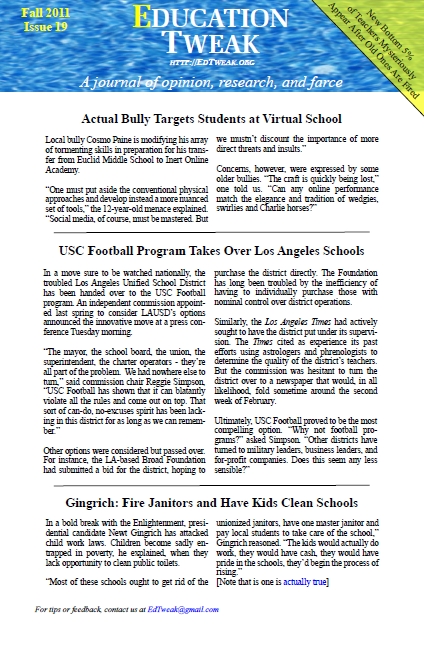
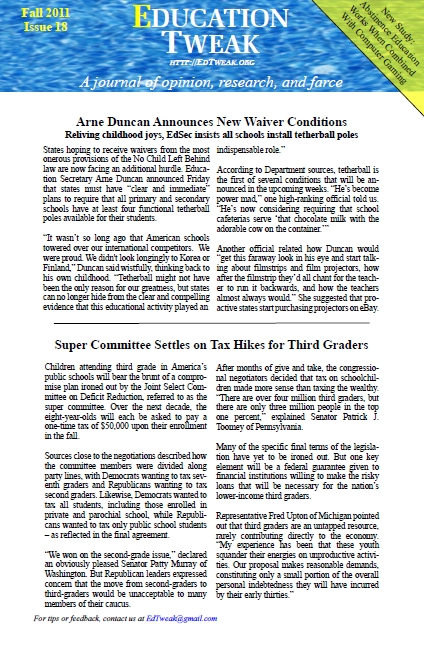
Double Your EdTweak Pleasure (#18 & #19)

Click on image for pdf.

Click on image for pdf.

If you have missed any of the previous Education Tweaks, they are all archived at EdTweak.com.

Thomas J. Mertz

Leave a comment

Filed under Arne Duncan, Best Practices, education, Gimme Some Truth, National News

Outside Agitators?, Fact Check and What Next

The Animals – “We’ve Gotta To Get Out Of This Place” (click to listen or download).

[Update, 11/22/11: New documents from ULGM have been posted here; new timeline:  Administrative Analysis by 12/4; vote on 12/19.  Too fast.]

The self-selected Board of the Madison Predatory Academy are an interesting bunch.   As the Board of Education considers their request for a non-instrumentality, non-union school charter with “total authority to make decisions related to budget, personnel, curriculum, school policy and overall operations,” I hope we hear more from and about them and their plans  After all, baring extreme circumstances (more on that below), if the charter is granted this will likely be the last time for five years that the Board and the residents of Madison they represent have any say about the school.

I have been doing a little digging and one thing that I find worth noting is that 6 of the 16 (of 17) Madison Prep Board Members I can locate information on, are not residents of MMSD (the one I could not locate information on is a recent transplant and  MATC student).

These are people who choose to live outside  of MMSD, could only send their children to MMSD schools via open enrollment, can not run for or vote in elections for the MMSD Board of Education, yet will have  a great say in the education of MMSD students and the use of MMSD tax dollars.  I don’t like it.

The breadth of the authority they are seeking was topic of recent  good and  interesting piece from Susan Troller on the Cap Times.  I’d like to dispute one statement in the piece and offer one comment (for now).

The statement that demands dispute was from Kaleem Caire, the chief advocate for Madison Prep:

“We  [Madison Prep] can be shut down for failure to make adequate progress or effectively manage our resources. Traditional public schools cannot.”

Of course traditional public schools can be shut down, for these and any other reasons that the elected Board of Education deems sufficient.  In fact, unless the contract with Madison Prep is very different than most charter contracts, for the length of that contract the elected Board of Education will have much, much, much more extensive power to shut down district schools than they will Madison Prep.

The comments are related to the the whole idea of shutting down schools.  The reality is that shutting down any school is very difficult for Boards of Education, particularly elected Boards, but even in Chicago where Mayoral control is in place the political pressure to keep open and renew the charters of schools with well organized PR operations (like Urban Prep) despite dismal achievement measures is often decisive.   I don’t have a lot of faith in this as a tool of accountability with Madison Prep.

This is one reason I think a very thorough vetting of everything about the charter request is in order prior to the vote.   The reports were that the November 28 vote is off, but that December may be the new target.  I’d like see that pushed back.

The Administrative Analysis was strong in some areas, but weak in others (most notably on the education program, transportation and facilities).  The change to non-instrumentality brings a slew of new questions.

Before the process can continue the Urban League needs to submit a new proposal and budget  Their press release of November 17 promised “Copies of the updated plan will be available on the Urban League (http://www.ulgm.org) and Madison Prep (http://www.madison-prep) websites after 9pm CST this evening,” but it has yet to be posted.   The Administration, Board, Community and proposers all deserve the opportunity to give this matter the attention it deserves   Do this right, don’t rush and the chance of regrets is less.

One MMSD Board Member recently said to me that this (and all charters) would be a leap of faith.  My response was that it doesn’t have to be a blind leap.  Eyes open and looking before leaping.

Thomas J. Mertz

Leave a comment

Filed under Accountability, Best Practices, Contracts, education

MMSD Administrative Analysis of Madison Prep and a Rumor

The Staple Singers – “This May Be The Last Time” (click to listen or download)

The required Administrative Analysis of the Madison Preparatory Academy charter school proposal  by the Madison Metropolitan School District staff has been posted, and it doesn’t bode well for approval.  The analysis identifies causes for concern and unanswered questions in many areas, including finances, staffing, governance, educational plans, single-sex segregation and many more.   There are some very strong things in the Analysis and to be honest I was slightly and pleasantly surprised by this strength.   [Update: Appendices have also been posted here   —  Appendix A – 9/20/11 WI Department of Public Instruction memo ; Appendix B – Personnel Costs; Appendix C – Summary Table Costs for Madison Prep Proposal Becoming an Instrumentality; Appendix D – Madison Prep Final Budget Proposal Instrumentality Analysis and Cost.] A long  excerpt and initial observations below, but first the rumor.

The (well-sourced) word I am hearing is that the Urban League of Greater Madison’s response to the matters raised or detailed in the analysis will be to seek a non-instrumentality, non union charter.  From another source comes the word that ULGM will announce a decision on Wednesday.  This change  may address some of the issues, but it raises others that will need attention.  The Analysis is based on the instrumentality proposal, so a new analysis may be required if the rumor is true

Many of the questions I am hearing assume the rumor is true and concern “what next?”.  As I see it there are three two possibilities.  The first is that the Board votes on November 28 as planned.    This may be preceded by altered submissions by The Urban League of Greater Madison on instrumentality status or other things and as noted above the need for aq new analysis may render this timeline impossible.  If the rumor is true and there is a change on instrumentality, I would not expect the Board to vote on November 28 unless A)Non-instrumentality is a deal killer (which it might be); or B) Other portions of the proposal and analysis unrelated to instrumentality status lead to a majority “no” vote.    So the second possibility, that the timeline gets extended, that there is a revised proposal and likely a new Administrative Analysis seems most likely to me.  More staff, Board and community time to be spent on something that even if approved seems to promise few benefits to those who are struggling most.

Now to the excerpt from the conclusion  (this is long):

CONCLUSION AND RECOMMENDATIONS

Conclusion and Recommendations

Over the past year, a very important conversation has taken place within our community about the achievement gaps we face as a District. While the Madison Metropolitan School District has been committed to closing its achievement gaps for many years and is a founding member of the Minority Student Achievement Network, the Urban League of Greater Madison should be credited for raising this dialogue to a new level within our community.

Simply put, the achievement gaps for low-income students, students of color, students with disabilities, and English Language Learners must be eliminated, and if any community is able to do so, this community can. This summary section of the administrative analysis for the Madison Preparatory Academies for Young Men and Young Women begins with a thank you to the Urban League for its persistent advocacy for our young people and for elevating the dialogue within our community. While this conversation has not been the without strain, it needed to take place, and it needs to continue.

Throughout the District’s discussions with the Urban League, three prominent issues have emerged:

  • the status of Madison Prep’s proposal as an instrumentality or non-instrumentality of the
  • District;
  • the costs of the proposed program; and
  • issues related to the single gender aspects of the Madison Prep proposal.

Instrumentality/Non-Instrumentality

The proposal submitted to the District by Madison Prep is an instrumentality proposal. By statute, as an instrumentality, all personnel must be employed by the District. As a result, involved employees become members of various collective bargaining units, subject to collective bargaining agreements.

Costs

Madison Prep submitted their budget plan to the District on October 30, 2011. Throughout the process of finalizing the plan, it has been apparent to the administration that the submitted budget did not take into account the fact that all personnel would be employees of the District, and the costs associated with this employment as required by Madison Prep’s proposal as an instrumentality. As a result, staffing costs have been recalculated with the result being a higher per pupil cost, a greater gap between the dollar amount the District could transfer from its other schools, without impacting programs, and the full costs to implement the program as an instrumentality. The current gap amount over a five year period of time within the administrative analysis is over $13 million on a break even analysis.

Gender

The administrative analysis has pointed out that there are concerns for the District should Madison Prep’s schools be implemented using a gender segregated model.

Recommendations

The achievement gaps we face must be eliminated. As we work with more urgency to identify and implement multiple strategies, this District has an interest in any proposal that provides additional, effective strategies to eliminate this unacceptable gap. Strategies like the International Baccalaureate Program, longer school days and a longer school year, mentoring support and the proposed culture of the school, as included in Madison Prep’s proposal, are all strategies we are interested in. However, we are also charged with considering the impact on all of our programs as we analyze the specifics of this proposal.

Analysis in this report is based on Madison Prep’s proposal as submitted. The purpose of this report is to provide analysis on that proposal without making programmatic changes, but as noted above, costs have been calculated to accurately reflect requirements as an instrumentality.

Madison Prep’s plan as submitted has an outstanding gap of over $13 million over the next 5 years. To fill that gap would require the District to make an investment of $15,000 – $17,000 per pupil per year. I cannot recommend that the District fund this proposal to that level. I can, however, recommend that MMSD fund Madison Prep to an amount equal to the funding we receive for every child under state revenue limits. That is a per pupil per year investment of $10,589 (2012-13 school year) – $11,389 (projected for 2016-17 school year).

This reflects an additional investment of over $5 million over the break even analysis. However, it still leaves a gap of approximately $8 million for Madison Prep’s current proposal. We are willing to work with Madison Prep to identify cost savings. As an instrumentality, we may be able to offer additional efficiencies, and are willing to continue that discussion if the Board so advises.

In addition to financial considerations, the Board must also consider the legal risks associated with Madison Prep’s single-gender proposal and the possibility of litigation.

If the Board votes to approve Madison Prep’s proposal, the following conditions should also be met.

  1. The recommendations found throughout the administrative analysis should be reviewed and discussed in development of a contract.
  2. All personnel will be employed by the District in collaboration with Madison Prep.
  3. All provisions related to collective bargaining agreements with MTI and AFSCME are followed.
  4. The budget as outlined by the District in addition, the management fee and the amount budgeted or an annual surplus should be eliminated with the surplus replaced with the amount each of the District’s middle schools is allowed to carry over, year to year ($20,000 per middle school and $40,000 per high school).
  5. The admissions process should follow the District’s enrollment timeline and acceptance into the program should be based on the lottery only. This does not prevent Madison Prep from utilizing an interview to get to know the selected students and the interview should occur after students are selected through the lottery.
  6. An ongoing bridging committee should be established to address issues that will occur when the schools are implemented.
  7. Relative to the proposal to have all board policies waived with the exception of those related to health and safety, we recommend conducting a detailed review of all Board policies to assess which should be waived and which should not.

We know more needs to be done as a District and a community to eliminate our achievement gaps, but we are also confident in our community’s ability to do so. If the Board so advises, we are willing to continue the discussions with Madison Prep and work to identify ways that costs of this proposal can be lowered, or to identify on our part, other things that we need to be doing as a school District and community to eliminate achievement gaps. These discussions need to continue on behalf of the children of this community.

Very quick observations (I want to get this up, in such a hurry I’m not even going to offer a song with this post, maybe I’ll add one later — did that, added a song).

First, a very good case can be made that Madison Prep has had their bite at the apple and failed to present a reasonable proposal in a reasonable time frame.  There is simply too much that is unresolved, uncertain, unanswered.  As I noted before, the simple requirements for a “detailed proposal” have not been met and as item #7 indicates, they still have not been met.  Despite the wishes of some, the burden is on the proposer to make their case for their plan and ULGM has not done that.

Second, the Administration floats the idea of using some of the unused levy authority to meet part of the budget gap for Madison Prep.  As one who has advocated tirelessly to get MMSD to use this authority in ways that all agree will help many students in our district schools (and has been attacked for this), I find it disturbing that the Administration — which has been recommending under-levies — now changes direction in order to fund a charter school that by their own analysis is of questionable merit.

Now in praise of the Administration for pages (4-7 and elsewhere), countering the falsehoods that MMSD cares little and does even less to address  the achievement of poor and minority students.  For a similar list, see this recent Wisconsin State Journal editorial

I’m going to close by saying that I was also very, very glad to see this from the Administration:

Simply put, the achievement gaps for low-income students, students of color, students with disabilities, and English Language Learners must be eliminated, and if any community is able to do so, this community can. (emphasis added).

And add that it was exactly that sentiment that has informed my advocacy and the advocacy of many others on budget and other matters.  Madison is place where we can achieve equitable educational opportunities, quality education, and real learning for all our students in our district schools.  We need to do this, we can do it.

What we don’t need is a charter school that embodies most of the worst policies and practices being pushed by those whose interests lay in convincing people that public education is a failure, that even in Madison, we can’t.

We can.

Thomas J. Mertz

Leave a comment

Filed under "education finance", Accountability, Best Practices, Budget, Contracts, education, Equity, Gimme Some Truth, Local News, National News, School Finance, Take Action

“It’s time to spread the truth about impact of budget on Wisconsin’s public schools”

Click the graphic for more information on WAES.

The Jam – “Time for Truth” (click to listen or download)

I haven’t posted any Wisconsin Alliance for Excellent Schools  advocacy material this way lately, so here goes.  Short version:  The “tools” aren’t working, our students aren’t getting the opportunities to learn they need and deserve, and the only way this will change is if we don’t give up, we keep agitating.

Dear education advocate:

We need your help now.  We’ve identified you as not only people who care about kids, schools and their communities, but also who have the knowledge and skills to work on their behalf. We need your help in reaching out to the rest of the state—the media, community organizations and your neighbors—in pointing out how destructive recent changes have been to our children’s opportunities to learn.

This afternoon, the Wisconsin Department of Public Instruction and the Wisconsin Association of School District Administrators released data that show, for the first time, the devastating impact of the most recently passed state budget.
While we all knew intuitively that a $1.6 billion cut in education would have an impact, the data is even worse than we could have expected and is a clear signal that our state is moving in the wrong direction as it relates to our schools.

The report is attached along with the release that was distributed from WAES. Here are the messages that we want to convey:

  • The state budget cut education by historic proportions. The state budget cut aid and revenue limit authority to Wisconsin schools by $1.6 billion in the last budget.  This is the largest cut to Wisconsin education ever and is one of the biggest cuts made by any state in the history of the country .
  • These cuts are having a devastating impact on our schools.  The data is in, and it shows that the cuts to Wisconsin schools, as a result of the state budget, are devastating and much worse than we could have expected.
  • Class sizes have skyrocketed. What happens when you cut teaching positions? Obviously, class sizes get larger. In schools large and small across the state, the average size of classes, especially at the elementary school level, have increased dramatically.
  • Course offerings have decreased.  The new data show that the numbers of programs and services for students in our public schools have declined significantly.  What’s worse, some classes, including programs for gifted students and the kinds of classes that are needed for admittance into highly selective colleges and universities, are gone. For those students who want to go to the University of Wisconsin-Madison or another highly selective school, the challenge has become even greater.
  • Schools face even greater financial challenges next year.While the news is terrible for schools this year, the data show that half of Wisconsin schools are using one-time federal dollars to balance this year’s budget shortfall, money that will not be available next year.  Moreover, two out of three districts say that next year’s cuts will be even bigger than this year’s.
  • >We’re heading in the wrong direction. The data show that we are clearly moving in the wrong direction when it comes to our schools.  At a time when the knowledge and skills of our graduates are more important than ever before—not only for them but for our entire state—why are we making such devastating cuts to our schools?

Here is what you can do now: While we are working to connect with reporters who are covering the story from a state-level perspective, we need your help in reaching reporters, bloggers, and media outlets in your area.  Here are some specific things you can do right now —

  • >Find out what’s happening at home: The data from DPI tells the story at the state level, and it is devastating to children. If you can work with your local school district to determine the local impact, it will be even more powerful.
  • Connect with local reporter: We need to make sure this report is covered in your local newspaper.  Toward that end, if you know a reporter at your local paper who would write about this issue, please contact them and urge them to do so.
  • Write a letter to the editor: We also encourage you to write a letter-to-the-editor of your local newspaper for publishing.  If you need them, e-mail addresses of many Wisconsin newspapers are attached to this message.
  • Contact local talk radio hosts and ask to go on their shows: We need to get our voices heard on this issue. Contact the hosts of local radio shows and ask them if you can go on their show to talk about the report.
  • Connect with others who will amplify our voices: Think about others in your area who are friendly to our cause and can help carry these messages.  Do you know someone who writes a popular local blog? Are you close with your local PTA/PTO president? Use your imagination and your connections to tell others about this report, and ask them to spread our messages.

Whatever you do, please do something and make sure to let us know your plans. Thanks.

The Milwaukee Journal Sentinel, Cap Times, Folkbum, and a whole lot of other places have more.

To help recall Scott Walker, check in with United Wisconsin.

Thomas J. Mertz

Leave a comment

Filed under "education finance", Best Practices, Budget, Contracts, education, Equity, finance, Gimme Some Truth, Local News, School Finance, Scott Walker, Take Action

People Have the Power: SB 22 Dead (For Now)

Patti Smith – “People Have the Power” (click to listen or download) 

Susan Troller is reporting in the Cap Times that SB 22, the bill creating a partisan, political state charter school authorizing board to override the wishes of local school boards (and more) is dead, for now.  This is a huge victory for  public education in the state,  local control, and the Wisconsin people’s mobilization.

The bill came before the Senate Education Committee on March 23, in the wake of the mass protests.  Hundreds of newly empowered individuals and groups showed up to counter the well laid plans of the FitzWalker gang, School Choice Wisconsin, Wisconsin Charter School Association, American Federation for Children and the rest of the deformers (including Madison Prep’s Kaleem Caire).  The hearing took 10 hours (so long that I had to leave before I could read my testimony).  It was spontaneous, invigorating and beautiful (you can watch it here, via WisconsinEye or read Rebecca Kemble’s report).

It was one of the first occasions where the energy of the protests was translated into this sort of action.   Soon after, much of the energy went toward the Senatorial recall efforts.  This was and is a controversial choice.  Many, myself included, had and have mixed feelings about the wisdom of diverting small d democratic potential into big D Democratic politics.

The wisdom of that choice is still open to debate (and is being debated within the Occupy Movement), but the defeat of SB 22 strengthens the case that it was  a good choice (it does not seal the case by any means).

As Troller explains the post-recall one seat Republican edge made GOP Senator Dale Schultz’s reluctance to support and GOP Senator Mike Ellis’s non-committal enough to kill the bill, for now.

The “for now” means that just that; this could come back from the dead.  One friend suggests that we should all send Schultz and Ellis notes of thanks and support to make sure they don’t defect (and you can do that by clicking their names above) .  My big worry is making sure that the Democrats don’t defect, particularly Senator Lena Taylor.

There are many things I like about Lena Taylor, but she is a favorite of the hedge-fund managers for education deform operating under the name Democrats for Education Reform (DFER, read more at DFER Watch) , having received their generous donations in the past and been named their “Reformer of the Month” for February 2011DFER Wisconsin was and is a strong proponent of SB 22.

In politics money talks and these people have money (as the recent Imagine Schools scandals remind us, some of that money was appropriated from schools and children via charter school scams).   DFER and aligned groups dropped hundreds of thousands of dollars into the recent Denver School Board races; with $3.6 million in contributions “Stand for Children” was able to push their deforms through the Illinois Legislature; the list goes on.

So contacting Lena Taylor would be a good idea too.  You can grab talking points from Public School for the Public Good, AMPS comrade Todd Price; I love My Public School, Martin Scanlan of Marquette, and my testimony linked above.  We may not have millions to give, but we people do have the power, when they use it.

Adding to the “what next” list, the Scott Walker recall kicks in very soon and United Wisconsin is the go to place to help out with that.  Just remember that progress may start with getting better people in office, but it isn’t going to get very far if we don’t remain mobilized, remain powerful.

Thomas J. Mertz

Leave a comment

Filed under Accountability, Best Practices, education, Elections, Equity, Gimme Some Truth, Local News, National News, Scott Walker, Take Action, Uncategorized

Madison Prep, More Questions than Answers

James Brown – “I Don’t Know” (click to listen or download
With only  24 days remaining till the Madison Metropolitan School District Board of Education will vote on the Madison Preparatory Academy  charter and only 9 days until the MMSD administration is required to issue an analysis of their proposal (and that is assuming the analysis is issued on a Sunday, otherwise we are talking only one week), there are still many, many unanswered questions concerning the school.  Too many unanswered questions.

Where to start?

All officially submitted information (and more) can be found on the district web site (scroll down for the latest iterations, and thanks to the district public info team for doing this).

The issues around instrumentality/non instrumentality and the status of staff in relation to existing union contracts have rightfully been given much attention.  It is my understanding that there has been some progress, but things seem to be  somewhat stalled on those matters.

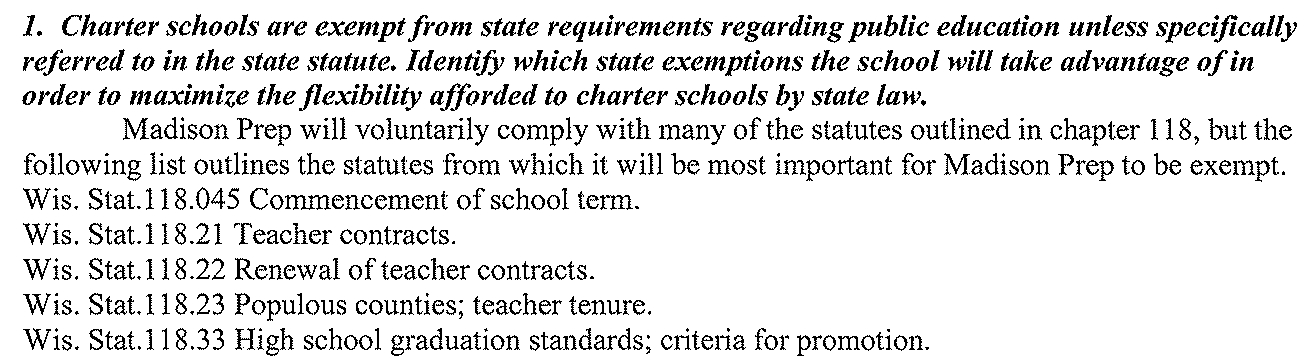
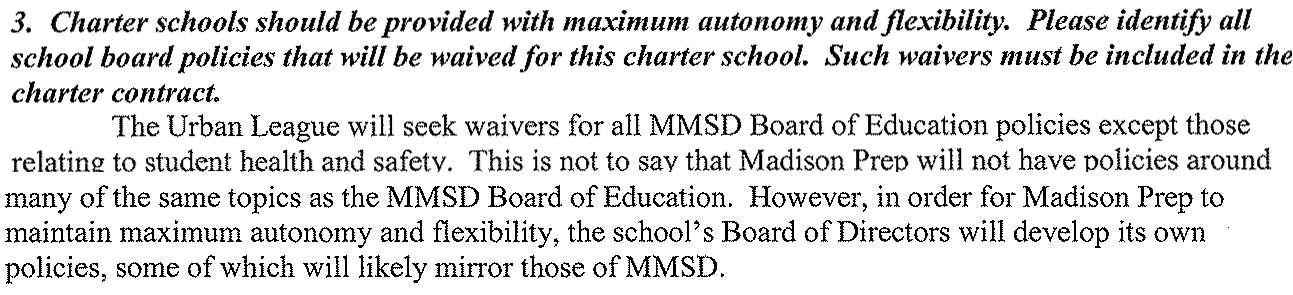
From my perspective, the biggest unanswered questions concern which policies and statutes Madison Prep is seeking waivers from. Inclusion of this information is a requirement for the submission of “detailed proposal” under the district’s policy.  I am at a loss to understand how things have come this far without this requirement being fulfilled.

It is also a common sense requirement since the very definition of a charter school is a school that is exempt from some policies.   It really is essential to know what those policies are.

The last official statements from the Urban League was in the planning grant submission and asked for a blanket waiver of all MMSD policies and select exemptions from state law.  They read (click to enlarge):

and

Well, we all know that the teacher contract statutes have changed greatly since the February date of the planning grant application and now or soon all school staff will labor under the conditions Madison Prep was seeking for their staff.    I do have some concerns and issues about graduation and promotion standards that are not clearly or directly answered in the most recent “Business Plan” or the subsequent “Education Plan” (which tellingly was an addendum to the “Business Plan”).

The MMSD policies are of greater import.  These cover everything from nepotism, to discrimination and much more.  In this case student discipline, suspensions and expulsions are one area of particular concern.  I want to know what they want waived, why and what they intend to do instead.

I’ve written about  some other unanswered questions here (in fairness, the more recent submissions partially answer these) and at the same link you can find more on what the Board is required to consider and the process.  I think a reminder on the latter is important.

According to their policies, among the things they will be considerings are:

…an analysis of how a decision to establish or not establish the proposed charter school will impact families to be served and the overall programs and operation of the District.

and

…at a minimum, consider the information included in the detailed proposal, the information provided by the Superintendent, whether or not the requirements of Board Policy have been met, the level of employee and parental support for the establishment of the charter school, and the fiscal impact of the establishment of the charter school on the District.

Board Members also have many questions which have not been answered.  You can and should review the here on them district web site.  Many, many questions, few answers.  I have been told by Board Members that additional questions have been submitted, but not posted (nor it goes without saying, answered).  Look for updates.

Other community members have questions too.  The topics I’m hearing most about include the adequacy of Madison Prep’s planning for special education students, the wisdom and legality of gender segregation, the potential for discrimination  against LGBTQ students, the budgetary and other impacts on the district and the students in the district,  the selection of students and who will be served, the IB program in general and in relation to struggling students, the attrition analysis…and much more (again, in fairness, we have more information o some of these now than we did two weeks ago).  People I know have asked both MMSD and the Urban League about many of these and have not received satisfactory answers.

The clock is ticking…the district and the Board and the community deserve adequate information in a timely manner;  the Board needs it in order to make a decision.

I believe that the lack of timely information on crucial matters in-and-of-itself recommends against granting the charter.  Under the constitution and the laws of the state the elected Board is charged with the educational well being of MMSD’s 25,000 students and the with fiscal responsibility for the funds provided by taxpayers and others.  In seeking a charter, the Urban League is asking the Board to transfer these for up to 840 students.  This should not be done lightly and  it is incumbent upon the Urban League to demonstrate that they are prepared for these responsibilities.  That so many things remain unanswered at this point does not inspire confidence.

Thomas J.  Mertz

Leave a comment

Filed under Best Practices, Budget, education, Equity, Gimme Some Truth, Local News, Uncategorized

Quotes of the Day: Martin Luther King & Kaleem Caire

If you will judge anything here in this struggle, you’re commanding that this city will respect the dignity of labor. So often we overlook the worth and significance of those who are not in professional jobs, or those who are not in the so-called big jobs. But let me say to you tonight, that whenever you are engaged in work that serves humanity, and is for the building of humanity, it has dignity, and it has worth. One day our society must come to see this. One day our society will come to respect the sanitation worker if it is to survive. For the person who picks up our garbage, in the final analysis, is as significant as the physician. All labor has worth.

You are doing another thing. You are reminding, not only Memphis, but you are reminding the nation that it is a crime for people to live in this rich nation and receive starvation wages. I need not remind you that this is the plight of our people all over America. The vast majority of Negroes in our country are still perishing on a lonely island of poverty in the midst of a vast ocean of material prosperity. My friends, we are living as a people in a literal depression. Now you know when there is vast unemployment and underemployment in the black community, they call it a social problem. When there is vast unemployment and underemployment in the white community they call it a depression. But we find ourselves living in a literal depression all over this country as a people.

Now the problem isn’t only unemployment. Do you know that most of the poor people in our country are working everyday? They are making wages so low that they can not begin to function in the mainstream of the economic life of our nation. These are facts which must be seen. And it is criminal to have people working on a full-time basis and a full-time job getting part-time income.

Reverend Doctor Martin Luther King Jr. 

defending rights of sanitation workers to unionize and receive decent wages Memphis, TN, March 18, 1968

“A janitor is a janitor.”

Kaleem Caire,

defending the use of non-union custodial staff at the proposed Madison Preparatory Academy in order to save money.Madison, WI, October 2011

An updated “Business Plan” and other documents have been posted on the MMSD site (scroll down).  The Urban League of Greater Madison, MTI, AFSCME and MMSD are meeting Monday, 10/31 to discuss union and workplace issues.

In light of state  state statutes, which read: ” If the school board determines that the charter school is an instrumentality of the school district, the school board shall employ all personnel for the charter school” and existing contracts, I am still not clear how these can be at issue if Madison Prep is to be an instrumentality.

Thomas J. Mertz

3 Comments

Filed under Accountability, Best Practices, Budget, Contracts, education, Gimme Some Truth, Local News