
Daily Archives: May 9, 2008

Board Member Budget Amendments Posted

The MMSD website just posted the proposed budget amendments of Board of Education members (and one from the administration). The Board will consider and vote on the budget on Monday, May 12. It looked like there might be some action (click for video) on class size and specials classes and some other things, but that didn’t happen.

Instead, just one amendment from the administration concerning what seems to be Fund 80 housecleaning on contributions to the Wisconsin Retirement system and the tax levy (anyone know if this is a new issue or how the retirement contributions were handled in prior years?); one from Beth Moss funding the replacement of 143 Windows 98 computers via a reduction in the reserve for contingency; and one from Marjorie Passman employing $60,000 of the Fund 80 levy (contingent on other funding?) to help continue the Madison Family Literacy/Even Start Literacy program at Lakeview/Northport. All seem reasonable to me. That’s it. Relative budget peace.

It is important to realize that this peace is the product of a one time distribution of excess Tax Incremental Finance District collections. Next year, we are back to dealing with the “going out of business” system of funding education in Wisconsin. Without a referendum, these are the budget projections (for Fund 10).
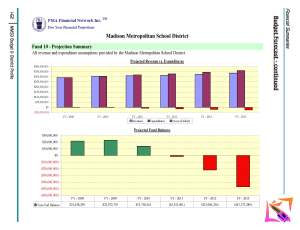
Lots of red ink ahead. Time to get to work on a referendum.

Thomas J. Mertz
1 Comment

Filed under "education finance", AMPS, Best Practices, Budget, education, finance, Referenda, School Finance, Uncategorized

Learning in and from the past

In an earlier post I mentioned that my students are working on a primary sources assignment. At least one student is writing about a document found in a recently posted digital history collection of material from Madison schools stretching from the 1880s to the mid 1970s. The project is a “cooperative effort between the Madison School & Community Education Library (MSCEL), the UW School of Education and the University of Wisconsin Digital Collections Center (UWDCC). ” It contains over 17,000 pages of material. I’ve only looked at 100 or so, but have found it fascinating.

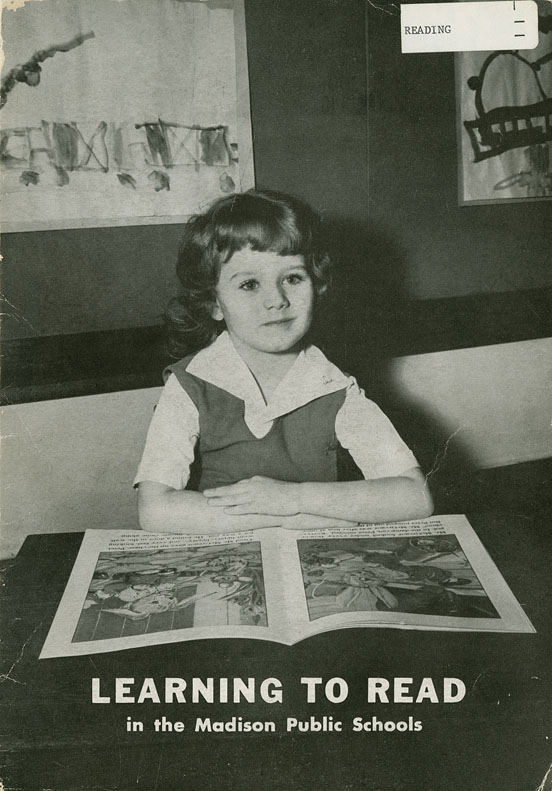
Here are a couple of choice excerpts from Superintendent Phillip Falk’s 1949 Learning to Read in the Madison Public Schools.

Problems of Long Standing

One of the most common misunderstandings in recent years is the belief that a startling new technique of teaching reading is being used which lacks some of the sterling virtues of the old techniques. Usually the implication is that either the old “alphabet” method, which began with the a b c’s, or the phonic method, which emphasized the sounds of letters, is the logical way to teach beginning reading. Any change in procedure today is looked upon as the cause of every deficiency, from inability to read well orally to poor spelling.

Few adults can remember the method by which they learned to read. Records show that the a b c method was discarded in Madison as early as 1871. In his short report for that year Superintendent B. M. Reynolds stated, “During the year the teachers in the Primary grades have discarded the Alphabetic Method of teaching reading, and have adopted what is called the ‘Word-Method’.”

By 1889 the phonic method, too, was losing ground. In December of that year Isabella Lamont, a primary teacher in Madison’s Second Ward school, read a paper before the state teachers’ convention in which she stated, “In the teaching of reading (which is the key to every other study and is therefore of the first importance) there is the a b c method, the word method, the sentence method, and the phonic method. None of these methods is wrong, but all are incomplete … ” One may well ask how new is new,or how old is old.

And (describing the practices of 1949)

There is no one “best” method of teaching children to read. Almost every known method, technique, or device is utilized as needed – experience, phonetic, word, sentence, story, meaningful drill or practice – not in isolation, but in an approach to a particular problem of a particular group or of a particular child.

Makes sense to me.

Thomas J. Mertz

Leave a comment

Filed under AMPS, Best Practices, education, Local News