Monthly Archives: January 2009

Education in Doyle’s “State of the State” — The Road to Ruin

GOV Gov-6

I’m having some trouble understanding what Governor Jim Doyle meant to communicate about education and education finance in his State of the State speech.

There was at least one good thought on the topic, I’ll give him that:

A second grader is not going to be able to come back when the economy is better and pick up where she left off if we fail her today. An older person can not check out of a nursing home and come back in a few years. There are basic needs our state has always met, and just as our predecessors met them in the most difficult times, we have a responsibility to meet them today. yesterday.

But there was also a rephrasing of his new oxymoronic slogan:  “Staying even is the new increase.”  I wonder how that formulation would be scored on a WKCE Reading or Math test?

To make matters worse, after stating that schools are among his top priorities and mislabeling the effective cuts of stable dollar funding as an increase, he continued:

And I am not going to say education funding is off limits. But I will not allow cuts that ruin the quality of our classrooms (emphasis added).

This is the new standard — anything short of “ruin” is OK.  Talk about setting the bar low.  Remember when we used to talk about quality education for all.  I do.

Hell, I remember when Doyle did:

It means fixing our broken system of school funding, and making an ironclad guarantee to every Wisconsin child that this state will give you a good start in life a quality education that enables you to succeed in tomorrow’s economy.

Governor Jim Doyle, 2002 victory speech

It gets worse.

Doyle apparently still sees a need for school finance reform, but his prescriptions are out of whack, or maybe just whack.

We can change school funding in a way that encourages the hiring and retention of good teachers, provides for high standards and encourages efficiencies in our school districts. We can take these steps to make sure our kids get a great education.

The first sounds like “merit pay,” which means asking cash strapped school districts to spend more on (some) teachers.  Explaining how “high standards” will fix school funding is beyond me (and I would guess beyond Doyle to0).  This brings us to the vaunted efficiencies.

For 15 years Wisconsin districts have sought and found efficiencies in order to balance budgets under  broken system based on a structural gap between mandated costs and allowed revenues.  Any reader of AMPS should know that in most districts the vast majority of potential savings via efficiencies has been long exhausted and that for years the cuts have been harming, if not ruining “the quality of our classrooms.”

If you want further evidence, just look at the operating referenda scheduled for this Spring and what districts are asking for.

  • Bowler, Herman, Loyal, Medford, Reedsville , Siren and Waupun aren’t very specific, only asking something like Siren’s “sustaining operating expenses with which to maintain the current level of operations.
  • Waupun also asks for funds  “for non-recurring purposes consisting of acquiring educational resources including textbooks and classroom support materials.”
  • Ripon also wants to fund “replacing textbooks” and in addition for “updating curriculum, updating technology, performing maintenance and replacing vehicles.”
  • Middleton-Cross Plains wants funds for “acquisition of instructional materials and instructional technology” and “operating expenses of a new elementary school.”
  • Salem’s ask is clear: “for non-recurring purposes which would prevent further cuts to student’s educational opportunities and prevent an increase in class sizes.”

Books, class size, technology, maintenance…As a state we should do everything in our power to make sure that these basic educational expenses are met.  We don’t.

Governor Doyle knows that and his two-faced “prioritizing” of education while doing nothing to fix a system he himself has called broken is leading us down the road to ruin.

While on the topic of leadership I want to add that the Wisconsin Association of School Boards and Superintendent of Public Instruction candidate Tony Evers both praised Doyle’s remarks on education.   I know all about catching more flies with honey than vinegar, but I think that in this case those who have spent too long in the royal court can no longer even tell when the emperor has no clothes.  Or maybe they can tell, but just won’t.

Thomas J. Mertz
Leave a comment

Filed under "education finance", Accountability, Best Practices, Budget, education, Elections, finance, Local News, Referenda, referendum, School Finance

Education Tweaks

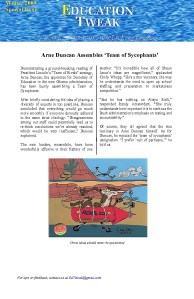
Click on Image for pdf.

Click on Image for pdf.

Click on image for pdf file.

Click on image for pdf.

As always, past and future Education Tweaks can be found here.

Thomas J. Mertz

Leave a comment

Filed under Best Practices, education, Gimme Some Truth, National News, nclb, No Child Left Behind

New Madison School Blog — Wit and Wisdom

logo

A MMSD math teacher has a “new” site and blog, Wit and Wisdom,with some good math education materials and observations on local and national education policy.  It is worth checking out.

The blog has been added to the AMPS Resources Page, where you can find all sorts of interesting and useful things.

Thomas J. Mertz

Leave a comment

Filed under Best Practices, education, Local News

Jim Doyle, a Governor for 1984?

doylefestivus

“Not getting cut is the new increase in this budget.”

Wisconsin Governor Jim Doyle speaking to the Wiscosnin Association of School Boards Convention.

1984, David Bowie (click to listen or download)

There were lots of rumors about Doyle seeking a position in the Obama administration.  Since that didn’t happen it appears that he is angling for a gig with the Ministry of Truth, who gave us such slogans as “War is Peace” and “Ignorance is Strength” in George Orwell’s 1984.

Thomas J. Mertz

Leave a comment

Filed under "education finance", Budget, education, Elections, finance, Gimme Some Truth, Local News, Quote of the Day, School Finance

Quotes of the Day — Accountability

19rothstein5151

The federal No Child Left Behind Act has succeeded in highlighting the poor math and reading skills of disadvantaged children. But on balance, the law has done more harm than good because it has terribly distorted the school curriculum. Modest modifications cannot correct this distortion. Designing a better accountability policy will take time. We cannot and should not abandon school accountability, but it’s time to go back to the drawing board to get accountability right…

Designing a new accountability system will take time and care, because the problems are daunting. Observations of student behavior are not as reliable as standardized tests of basic skills, so we will have to accept that it is better to imperfectly measure a broad set of outcomes than to perfectly measure a narrow set. We will have to resolve contradictory national convictions that schools should teach citizenship and character, but not inquire about students’ (and parents’) personal opinions. To avoid new distortions, we’ll need to make tough decisions about how to weight the measurement of the many goals of education.

Richard Rothstein, “Getting Accountability Right,” Education Week.

These quotes and the commentary were directed at NCLB reform, but I think they are also applicable to the MMSD Strategic Planning process that begins next week and want to note that Todd Price is the only candidate for State Superintendent of Public Instruction who is voicing similar ideas about the failings of NCLB and the need for more than adjustments.

Related at eduwonkette (and a hat tip); and from the Annenberg Institute, “Beyond Test Scores: Leading Indicators for Education” (many other great resources at the Annenberg site).

Thomas J. Mertz

Leave a comment

Filed under Accountability, Best Practices, Elections, National News, nclb, No Child Left Behind

Andy Hall, Moving On

2410935952_732ff04a9c

Andy Hall, long time education reporter for the Wisconsin State Journal is leaving the paper to start a nonprofit Wisconsin Center for Investigative Journalism. Andy is a fine reporter and will be missed.

Andy writes clearly and always does his homework.  Part of the project at AMPS has been to improve understanding of education issues by addressing the failings of the media coverage; I don’t think we’ve ever seen a need to use one of Andy’s stories as an example of what’s wrong.

Beyond consistently excellent coverage of the Madison schools, he derserves special praise for his 2007 “Squeezing Schools” series, which has had a statewide impact by doing much to enhance comprehension of Wisconsin’s broken school finance system.

This is the kind of thing we need journalists to do more of.  A couple of quotes from Andy indicate that continuing this sort of work is the mission of his new undertaking.

“Mainstream journalism is in economic trouble, but the needs of our democracy are greater than ever,” said Andy Hall, executive director of the center and its sole initial employee.”

…”He said the mission is to protect the vulnerable, expose wrongdoing and seek solutions to pressing problems.”

We wish Andy and the Center the best!

Thomas J. Mertz

1 Comment

Filed under "education finance", education, finance, Gimme Some Truth, Local News, School Finance, Uncategorized

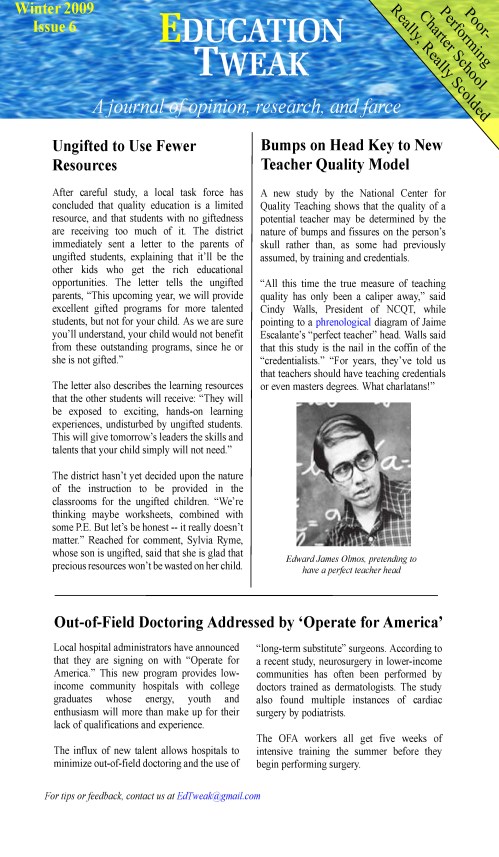
Education Tweak #6

Click on image for pdf.

Click on image for pdf.

All the EdTweaks can be found at http://edtweak.com/.

Thomas J. Mertz

Leave a comment

Filed under Best Practices, Gimme Some Truth, National News, nclb, No Child Left Behind

One Contested Seat — Madison School Board

55066921

I had been thinking about a post asking and speculating why Madison would have two consecutive school board elections without contested seats (I’m still interested in the lack of candidates, may post on it later and would love to read your thoughts in the comments); instead I get to write about the contest between Board president Arlene Silveira and newcomer Donald Gors Jr.

If you follow school politics in Madison, you already know enough to have formed an impression of Arlene Silveira (mine is complicated and contradictory, I think she is solid, caring, I share many beliefs with her but also disagree on some things in both policy and governance style…).  Gors is a mystery.

A little Internet searching sheds some light.

In 2004, in the midst of a difficult budget season, Gors testified before the MMSD finance committee. I’m not sure what to make of what he said, so I’m just going to quote the minutes:

Don Gors, parent, stated that the district should be expanding services to children and the need for flexibility in meeting the needs of society, however, things could not be done in the same way. Suggested that the district stop late buses and cab rides. He asked that they not do what constituents think but involve the teachers more and change the delivery of services and make the community accountable.

Maybe it made more sense when you heard the whole thing?

Dors and his spouse also had a letter on Mathematics education published in the State Journal in 2005.  Again, I’m going to quote the entirety:

Children are confused

My three children attend Madison public schools in grade 10 at Memorial High School, and sixth and eighth grades at Jefferson Middle School. We have seen how the introduction of numerous elementary and middle school math programs have negatively impacted our children during these past 10 years.

We have noticed that if your child is in grades four, six, eight or 10 (the years our children are tested), that during the first two months of school our children are exposed to an explosion of different math challenges that seem to be all over the map. Our children come home confused and mad, and when we look at the math they are struggling to learn, there appears to be no fundamental building block for the learning of it. My wife and I have come to the conclusion our children are exposed to the variety of math challenges because they may be on the test.

Be careful when you hear the data being thrown around by our administrators and our Wisconsin DPI. We know when our children are struggling. If our kids can’t do the basic math of addition, subtraction, division, multiplication, fractions, decimals (without a calculator) and do four-step word problem-solving by the end of grade six your child needs help!

One size never, ever fits all. When will our educators take it as their failure to teach and not our children’s failure to learn?

I like the skepticism toward the test data, and the call not blame children for their lack of progress (although all students need to be encouraged to take charge of their educations) but the rest seems, well “confused.”

The last thing I’m going to share  a letter that Dors and his spouse sent to the County Board in June of 2008 (full County Board Minutes with letter here, letter extracted here).   It is too long to reproduce, but I do want to give the flavor with a relatively long excerpt (I do suggest reading the whole thing):

Dear, All Dane County Supervisors:

What happens when times get tough …. all the issues which have been given less attention start to come to the top.

(Land Purchases, RTA, Smoking Bans, Building Jails, Lack of Accountability Methods Over Safety -Security-Basic Needs!)

Just watch as a perceived good company goes bad…what causes it to go bad? Does it happen over night or is there signs that things are going south? Maybe that’s why people say follow the money…it has been learned that is true….in all Business and Government Operations!

South..Bad…Sour…Politics before Process, maybe this is the direction that some of this Counties Supervisors are allowing Dane County to be taken…

What I mean here is when times are good more and more things are not looked at or looked after because moral is up, perceived money is coming in and money is being spent but….then all of a sudden when things slow down the money has been over spent on things that are not center to it’s core business of operation…accounting faults are found and then what …whose left with the problem?

In business the first thing that goes are employees the last thing that happens is management is dismantled and then the business is shut down.

In government the first thing that happens is a request to increase Taxes surfaces. An attempt to remove the focus from what needs to be focused on. (What Dane County spending money on?). Past and Present!

Then some will try to bring others around to what’s important (Accountability, Responsibility) then all of a sudden a spin surfaces scaring others that Services will be diminished if Taxes are not increased.
Children will begin to suffer, those who you have made dependent on Government are made the main focus when the focus really should be on You, The Administration, A Public Accounting …where has the money gone, what has the money been spent on?

You see Government never looks at itself first, how Government is spending the money, is there a value for the majority when Government makes a decision on what to spend money on?

You get further and further away from asking yourself one question: Will this expense or decision help or hurt our tax paying community?

The kicker comes about two pages later:

No new taxes until we the Public have been given a full accounting of all money spent from 2000 to 2008.” (emphasis in the original).

Looks like Arlene will be getting my vote.

Thomas J. Mertz

2 Comments

Filed under education, Elections, Local News

Quote of the Day – “A better approach”

mind-the-gap

A better approach for state leaders is to concentrate on closing the gap between what the state requires school boards to spend and the amount the state allows school boards to collect in revenue.

Wisconsin Sate Journal, editorial January 6, 2009.

The larger point of the editorial — that those considering getting rid of the QEO without providing a means for additionally  revenue are  irresponsible — is correct also.

Thomas J. Mertz

Leave a comment

Filed under "education finance", Best Practices, Budget, education, finance, Local News, Quote of the Day, School Finance

Non Sequitur of the Day — More from the MMSD Math Report

[Edited 10:25 PM]
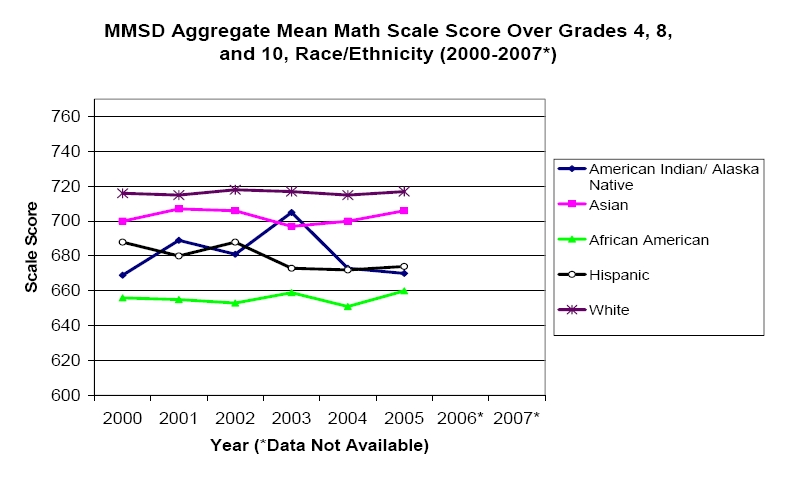
From MMSD Mathematics Task Force Report

From MMSD Mathematics Task Force Report

Assigning a meaning and interpretation to the decline in mathematics achievement scale scores over eight years is more difficult. As indicated in Exhibit I.3, the racial composition of the MMSD changed over this same period from about one-third minority students to nearly one-half minority students.

MMSD Mathematics Task Force Report, section 3, page 7.

Wow.

In the middle of a discussion of declining achievement, after a warning that this trend is difficult interpret — bang — a “helpful” reminder about the growing minority population.  Talk about you subtle invitations to insert your favorite crap about race and intelligence.  Shameful.  Disgusting.

Look, we all know that achievement gaps are a reality but this is not the way to discuss or present that information.  It might be OK if it was followed by some discussion of why these gaps exist and what can, (should and must) be done to address the gaps.

Don’t look in the report for that.  The only recommendations that even indirectly acknowledge the gaps are these:

8. In making improvements and investing resources, the district should consider how best to reduce the large achievement gaps among subgroups of students.

9. More time should be provided for teacher collaboration for teachers to learn from each other, analyze achievement data, meet needs of diverse learners, plan for instruction, and ensure both horizontal and vertical alignment of the curriculum. (See Section 4: Survey of Teachers, Parents, and Students.)

And there is no accompanying discussion of strategies to address the gap [correction, these issues are given some attention in the section on curriculum materials, basically saying that the materials MMSD uses are among those found to be good in addressing achievement gaps]. I thought they were supposed to give more guidance on  “how best.”

If I’m reading the charts right (the presentation leaves much to be desired), low income 10th graders score below non-low income 8th graders.  They are over two years behind.   This and other achievement differentials deserve serious attention.  Instead the Task Force gives us colorful charts and an invitation to racism.

Somewhere the lessons about high expectations leading to higher achievement have been lost.

I’m going to close with two items from the Equity Task Force work that actually made it into the policy:

1. Schools will be excellent only when students of all economic and demographic groups are achieving at high levels.

2. Schools should reflect fairness and high expectations for all learners.

Somebody should have told the Math Task Force these things.

Thomas J.  Mertz

Leave a comment

Filed under Best Practices, education, Equity, Local News, Uncategorized