Monthly Archives: August 2012

Labor Day Blast from the Past: Samuel Gompers on Public Education

The New York Times, September 4, 1910. Click image for pdf.

For the Chicago Teacher’s Union: Elaine Purkey – “One Day More” (click to listen and download)

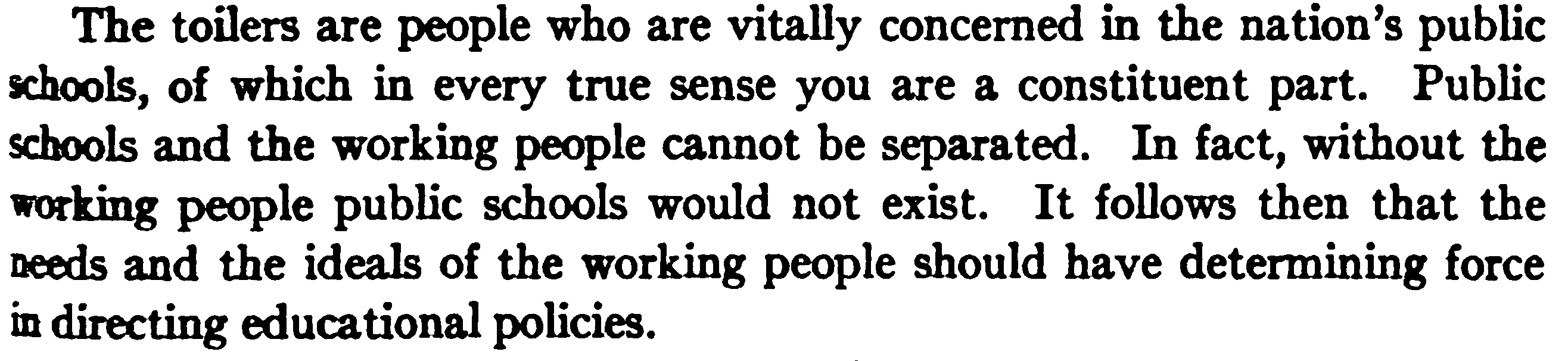
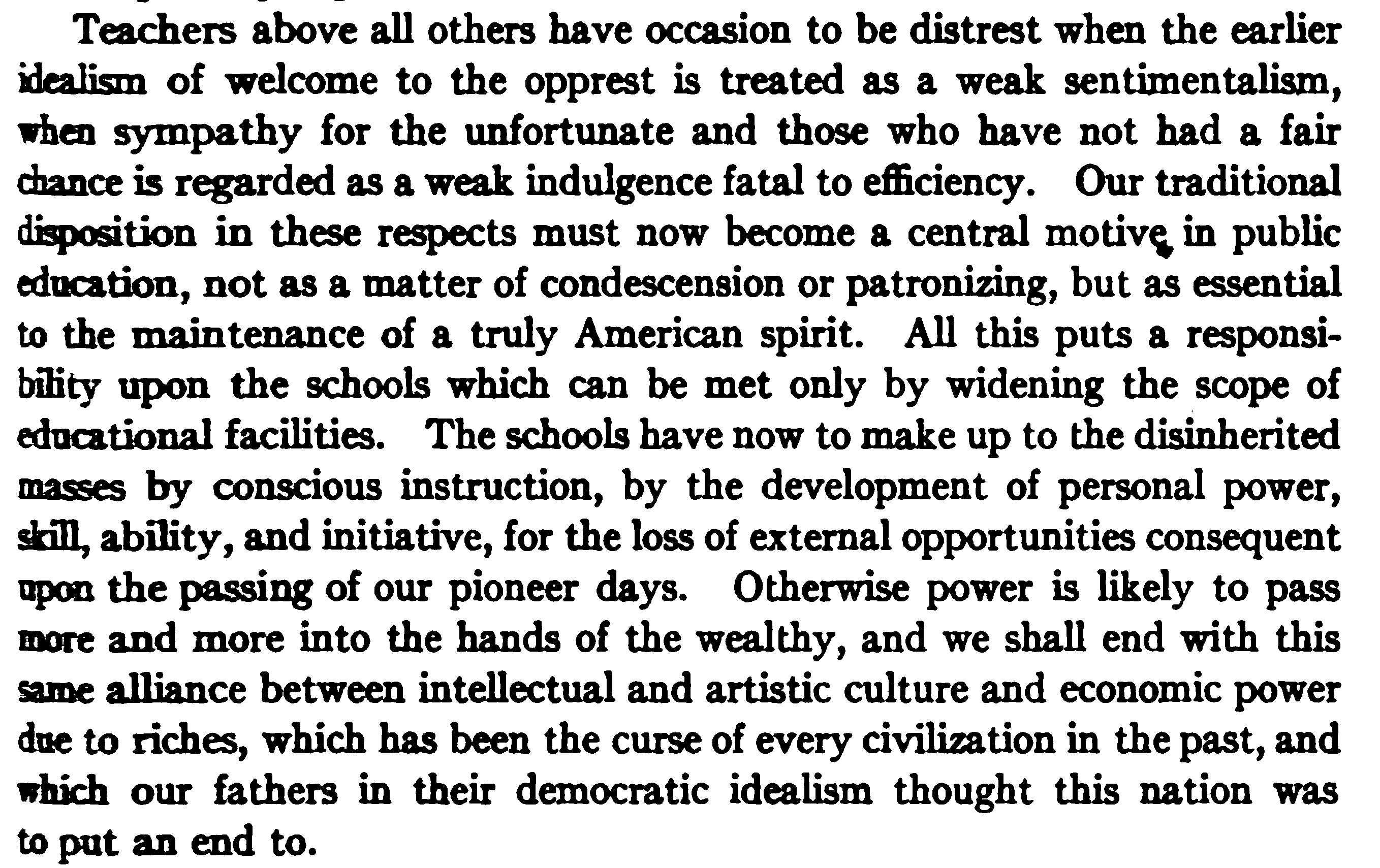
Excerpts from a speech given to the 1916 Convention of the National Education Association, “The Public Schools and the Working Man,” (full speech linked).  Gompers was followed by John Dewey on the program!

From the introduction:

On the schools, the labor movement and combating inequality:

On the role of teachers in the maintenance of a “truly American spirit”:

On Vocational Education (more here):

On Lifelong learning:On teachers in the labor movement:

Closing thoughts:

Powerful and important ideas.

For those in Madison, please join the celebration of Labor Day at LaborFest, September 3, 12:00 Noon to 5:30, at the Labor Temple, 1602 S. Park St (poster/flier linked here).  Good music, good food, good people, good idea.

Previous AMPS Labor Day posts:

Labor Day Mega Music Post.

Happy Labor Day!

Margaret Haley: A Heroine of Education, Labor, Feminism and Politics.

This is the third in a new series on AMPS: Blasts from the Past.  The series is devoted to historical materials that comment on or illuminate contemporary issues in education.

Thomas J. Mertz

1 Comment

Filed under AMPS, Best Practices, Blast from the Past, Contracts, education, Equity, Gimme Some Truth, Local News, Quote of the Day, Take Action, Uncategorized, Vocationalism

Class Size: “Getting Mighty Crowded”

Video from the 2006 MMSD school referendum campaign.

Below is a slightly edited version of an email that I sent last night to the Madison Metropolitan School District Board of Education.

Subject: Class Size
To: board@madison.k12.wi.us
Date: Thursday, August 30, 2012, 7:58 PM

I’m just back from the open house and thought you should know that 5th grade class sizes at Randall are at 28 this year.  Maybe other grades also, the last few years 2nd, 3d, & 4th [at Franklin and Randall] have mostly been at 26 & 27.

The best teachers in the world are better in classrooms with 22,23,24…not 26, 27, 28…  This is no secret.

If you are tempted to say that Randall is a low needs/low poverty school, so this is OK, I’ll remind you of that there were 86 low income and 30+ Ell last year and like Johnny Winston said “it isn’t easy being a poor kid at a rich school.”  I’ll also say that all kids deserve better than 28 per class.

Here is what I think is the most recent public info on class size in MMSD (from this post):
…The first was  an October 3, 2011 discussion of class size, cut short in order to waste more time on Madison Prep, that featured a confusing and incomplete presentation of data.  Despite promises made, in the intervening 10 months  the better data has not come before the Board, nor has the Board returned to the topic.  For what they are worth and those interested, the Middle School info is here (not too bad, but no trend info) and the Elementary info is here  (really useless).  There is nothing worth mentioning on High Schools.  For the hardcore, there was also what looks to be an outdated practices document given to the La Follette Area study committee, note that it says that the non-Sage grades 3-5 limit is 27 (it also still has SAGE classes at 15/1, over a year after MMSD went to 18/1).

As some of you know, I believe that the Board should be more informed and pro-active on class size, and that given the financial implications, this should be part of the budget process.

TJM

No responses yet, but it hasn’t been very long since I sent it.  If I get any responses, I will ask for permission to post the here.

For more on class size, see ClassSizeMatters.org.

Thomas J.  Mertz

2 Comments

Filed under "education finance", Best Practices, Budget, Class Size, education, finance, Gimme Some Truth, Local News, Referenda, referendum, School Finance

Vocational Education and the Voices of Workers: Blast from the Past #2

Rocky Mountain News, 15 October, 1896.

The Clash – “Career Opportunities” (click to listen or download).

This is the second in a new series on AMPS: Blasts from the Past.  The series is devoted to historical materials that comment on or illuminate contemporary issues in education.  Today’s is about education, work and vocational education.  There is so much going on in this area, especially here in Wisconsin, that I am sure there will be future posts, Blasts from the Past, and others.   Today I just want to look at the how the voices of workers (and to a lesser extent teachers and students) were present and are now absent in discussion and governance of Vocational Education.  Rebecca Kemble at the Progressive has been doing an amazing job covering this in Wisconsin; see these articles to catch up:

“Wis. Committee Says High Schools Need to Serve Business.”

“The Corporate Rot Eats Away at Wisconsin.”

“Walker’s Workforce Czar Wants to Make It More Expensive to Get a Second Degree.”

Cronyism and Corruption Define Walker’s Reign.”

In 1911, Wisconsin passed a pioneering Vocational Education law.  It was far from perfect, but in two places the law made sure that in making public provision for explicitly preparing students for employment our state was not simply turning education over to businesses and employers.  This was done by guaranteeing that labor had an equal voice in the programs that were created.  On the state Board:

and on local Boards:

This has not been the case with the recent planning for expanding vocationalism in Wisconsin public education.

There are three state groups working to expand vocationalisn:  The Special Committee on Improving Educational Opportunities in High School, The Governor’s Council on Workforce Investment, and The [Governor’s] College and Workforce Readiness Council.  The first has 19 members including 4 representatives of business and none from labor.  The second has 44 members, at least 23 from business (including the Widow Hendricks of “divide and conquer” fame, and two from labor unions (both from unions that have been relatively supportive of  Scott Walker’s agenda).  I can’t find a member list for the last (how’s that for open governance?).  The proclamation creating the Council called for 15 members  with one representing employees and two from employers.  The news release announcing Scott Walker’s appointments lists three business people and no workers.

The never-been-elected-to-anything, Walker appointee, Special Consultant to the Governor on Economic, Workforce and Education Development,  dissembling Tim Sullivan heads the last two and you can see the details of the plans for education (and more) in Wisconsin in the recent report issued by him.

The Career Academies in the initial Madison Metropolitan School District Achievement Gaps Plan (now on hold),  seem to have been planned with no role or contemplated future role for labor, but much input from employers and business organizations.  This despite the record of the Greater Madison Chamber of Commerce run Youth Apprenticeship Program’s record of doing fine spending MMSD money, but not so well serving our students.

Preparation for employment is certainly one function of public education, but in 1911 and in 2012, it is far from the only function.  As Wisconsin recognized over 100 years ago, allowing business to dominate this or any part of public education increased the risk that vocationalism would dominate, that the interests of employers would be put above the interests of students and workers.  By providing formal roles fro labor to balance the interests of business, in 1911 Wisconsin attempted to make sure that vocational education empowered students and future employees via an education that gave them broad knowledge and flexible skills, and that vocational programs did not simply become employee training done at the expense of taxpayers.  In 2012 we need to heed that lesson.

Thomas J. Mertz

Leave a comment

Filed under Accountability, Best Practices, Blast from the Past, education, Gimme Some Truth, Local News, National News, Scott Walker, Uncategorized, Vocationalism

Been down so long it looks like up

The dbs – “Ups and Downs” (click to listen or download)

This story  — “Bonduel school taxes going down: Increase in state aid one of reasons,” by Lee Pulaski in today’s Shawano Leader made me think of Richard Farina’s novel Been Down So Long it Looks Like Up to Me.  That’s what has been going on with school funding in Wisconsin and around the nation, the cuts have been so regular and difficult that any relief, no matter how small, appears like forward movement.  The reality,  — in the Bonduel district, in Wisconsin and in most of the United States  —  is that these small steps forward don’t come close to making up for the giant steps backward of the last few years.  The editorial board of the Wisconsin State Journal, Senator Scott Fitzgerald and others seize upon these small and local steps, but we can’t let their anecdotes distract from the big picture.  Wisconsin Sate Senator John Lehman has promised to convene the Senate Education Committee to “to examine how these 1.6 billion dollar cuts have hurt Wisconsin Schools.” That’s’ a good start, but more is needed.  We need more than examination, we need workable plans to fund our schools at a level and in a manner that puts the needs of our students first (see more on this below, at the bottom.  Update: The agenda for the hearing is out — August 31 is the date — and it looks like they’ll just be documenting the destruction and previewing future damage.).   The tools — if, as you should, you include in the tools the massive cuts in state aid to education which are central to the Fitzwalker game plan– aren’t working to provide students with the Opportunities to Learn that they deserve.

For the national scene see “New School Year Brings Steep Cuts in State Funding for Schools,” By Phil Oliff and Michael Leachman of the Center on Budget and Policy Priorities.  Here is one graph from that report.
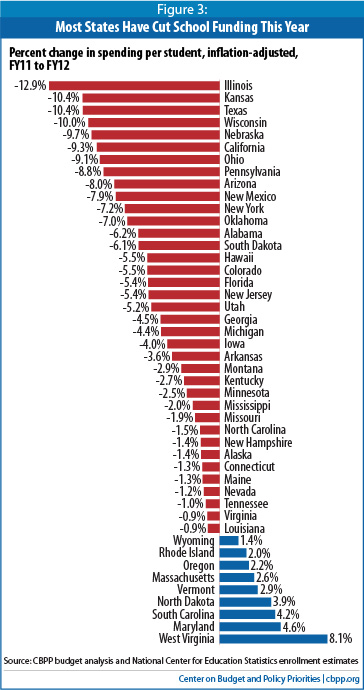
Notice Wisconsin is the fourth worst state in this chart.  That may improve this year because of a one-time $50 per pupil aid.  But according to the July aid estimates from DPI, only 155 districts in Wisconsin can expect an increase in state aid the coming year, while 267 will see a decrease.  Bonduel is one of the lucky ones.  That’s what seems to be at the center of today’s story (it appears that they took a big hit last year and thatrevenues from 4K are kicking in too, like in Madison).

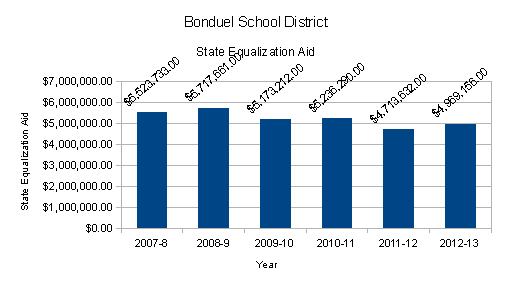
Peter Behnke, the district’s administrator, gushed good news for the taxpayers, who can expect a 3.3 percent decrease in their school property taxes due to an estimated $250,000 increase in state aid, to about $5.6 million.

“State aid is actually increasing for the first time in years, and that’s always a good thing,” Behnke said.

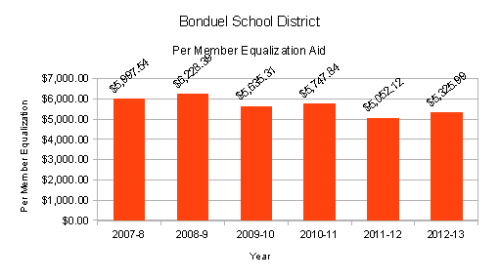
But what is missing is that the aid doesn’t come close to restoring state funding levels to what they were three years ago and leaves state aid per member for 2012-13 an estimated $671.55 belowwhat it was in 2007-08 (and in fact aid increased in both 2009-10 and 2010-11).

Here are some charts.  Note that the Bonduel district budget information is not accessible on the district website, charts were prepared using information from the Department of Public Instruction and the Legislative Fiscal Bureau, found herehere here, here, here, here, and here.  For the 2012-13 per member, the 2011-12 membership was used to estimate.

The first is total state equalization aid to Bonduel.

The second is per member aid.

That anyone familiar with this history can “gush” over the 2012-13 projections is evidence of how far down we have been pushed.

 We need to push back, up and out of this hole..  State Superintendent Tony Evers’ Fair Funding for Our Future is a start,  but it won’t be enough unless it includes an influx of new state revenues.  That’s one reason why I think something like Penny for Kids is more necessary now than ever.  Penny for Kids would provide about $850,000 annually in new revenues for our schools.  I also think that Penny for Kids inclusion of a real aid to schools educating students in poverty is essential to addressing the gaps in achievement that plague our state and district (Fair Funding includes increased state aid to districts based on student poverty, but no new money or taxing authority only property tax relief, so this will supplant, not supplement).

After all the slings and arrows, the cuts, the failed recall, the still slow economy…I know many are like the District Administrator in Bonduel, ready to accept minor improvements as cause for celebration.  I think we can’t let down look like up, we have to keep our eyes on the prize, keep on pushing, not forget what is right just because it seems out-of-reach.  I hope Senator Lehman shares that attitude when he convenes his Committee, I hope he remembers the ideals of the Pope-Roberts Beske Resolution (he was a signatory).  Here they are as a reminder:

1. Funding levels based on the actual cost of what is needed to provide children with a sound education and to operate effective schools and classrooms rather than based on arbitrary per pupil spending levels;

2. State resources sufficient to satisfy state and federal mandates and to prepare all children, regardless of their circumstances, for citizenship and for post−secondary education, employment, or service to their country;

3. Additional resources and flexibility sufficient to meet special circumstances, including student circumstances such as non−English speaking students and students from low−income households, and district circumstances such as large geographic size, low population density, low family income, and significant changes in enrollment;

4. A combination of state funds and a reduced level of local property taxes, derived and distributed in a manner that treats all taxpayers equitably regardless of local property wealth and income…

These are still things worth working for.  Just thinking about them lifts me up.

Thomas J. Mertz

Leave a comment

Filed under "education finance", Budget, education, Equity, finance, Gimme Some Truth, National News, Pennies for Kids, Pope-Roberts/Breske Resolution, School Finance, Scott Walker

Fact Checking, Spin, Media, Money and Education

Television – “Prove It” (click to listen or download)

Three stories I read today got me thinking about the relationship between media companies and education.  The first, on the Huffington Post included this revelation from Politco’s Dylan Byers:

Newsweek did not fact-check [Niall] Ferguson’s cover story, according to Dylan Byers, a media reporter at Politico. Byers wrote on Twitter that a Newsweek spokesman said the magazine does not have a fact-checking department, and that “we, like other news organizations today, rely on our writers to submit factually accurate material.”

Fortunately for those of us who care about things like facts, the Huffington Post also included a link to Matt O’Brien’s fact-check on the Atlantic site.  As I was trying to wrap my head around the complete lack of concern for truth and accuracy at one of the major news magazines, I read this report in the New York Times about the Discovery Channel and other media companies seeking to enter the education market, and this older column from Andrew Rotherman at Time ,touting the same idea.  I don’t know if Time has a fact-checking department, but after reading Rotherman’s column I’d say they need to make better efforts in that area.

Rotherman bemoans the lack of historical and civic knowledge among our students and in our nation as a whole.  As a college history instructor and political activist, I am less than sanguine about the current state of these.   Yet some of the examples Rotherman uses and the way he presents them seem closer to Ferguson’s factually challenged polemic than anything I’d want in most K-12 classrooms.

Rotherman is a member in good standing of the push reforms by misusing NAEP scores to create a panic about the state of our schools club and pays his dues again in the column cited above.  I wrote about this tactic recently here and am still trying to find the time to do a long post on the topic.  Till I get around to that, I’ll point again to National Academy of Sciences publication, “Grading the Nation’s Report Card: Evaluating NAEP and Transforming the Assessment of Educational Progress,” especially chapter 5, “Setting Reasonable and Useful Performance Standards.  Here is an excerpt:

Although standards-based reporting offers much of potential value, there are also possible negative consequences as well. The public may be misled if they infer a different meaning from the achievement-level descriptions than is intended.  (For example, for performance at the advanced level, the public and policy makers could infer a meaning based on other uses of the label “advanced,” such as advanced placement, that implies a different standard. That is, reporting that 10 percent of grade 12 students are performing at an “advanced” level on NAEP does not bear any relation to the percentage of students performing successfully in advanced placement courses, although we have noted instances in which this inference has been drawn.) In addition, the public may misread the degree of consensus that actually exists about the performance standards and thus have undue confidence in the meaning of the results. Similarly, audiences for NAEP reports may not understand the judgmental basis underlying the standards. All of these false impressions could lead the public and policy makers to erroneous conclusions about the status and progress of education in this country.

Any cite of NAEP scores without some background and context inevitably leads to “false impressions” and “erroneous conclusions.”  Here’s Rotherman:

Test scores released last month from the National Assessment of Educational Progress, a.k.a. the Nation’s Report Card, were a stark reminder of the problem: less than one quarter of all students performed at or above the proficient level on NAEP’s 2010 history test. And just 17% of eighth-graders scored at the proficient level…

No background or context, but  not technically inaccurate.

However, Rotherman continues and crosses a line from spin to false.

…meaning that the vast majority of them did not understand key events such as the infamous three-fifths compromise (the founding fathers’ solution to whether/how slaves should be counted when apportioning members of the U.S. House of Representatives based on a state’s population) or the Industrial Revolution.

In fact a majority of 2010 NAEP test takers, 59%,  did correctly answer the question on the three-fifths compromise.  Here is the report from the NAEP Question Tool).  The evidence on the Industrial Revolution is more complex, but the characterization of “a vast majority” “not understanding” is false.  There are two released sample questions that address the Industrial Revolution, one  is a multiple choice and asks about the decline of apprenticeship.   48% answered that correctly (and I would argue that at least two of the “incorrect” answers are partially true).  The other question was a short response on agricultural technology; 3% received complete credit, 9% at the “essential” level and 61% at the “partial” level.  Did anyone at Time fact-check Rotherman?

Both the lack of fact-checking by media companies and their move into the education market are driven by the bottom line, the desire for profit.  I’m not against the careful use of materials from media companies in education, but we  need to recognize that the kind of  quick and dirty repackagings that are likely to produce a profit may not serve our students very well.  Textbook publishers at least make a show of fact-checking.

The Common Core places a new emphasis on the sophistication of the texts employed.   I’m trying to imagine lessons built around the Ferguson or Rotherman pieces that would challenge students to discern and understand how and why they mislead their readers.  There is some real potential there, but I doubt that the same media companies that foist these kind of things on the public would be inclined to produce classroom materials that exposed their failings.

Thomas J. Mertz

Leave a comment

Filed under Accountability, Best Practices, education, Gimme Some Truth, National News, Uncategorized

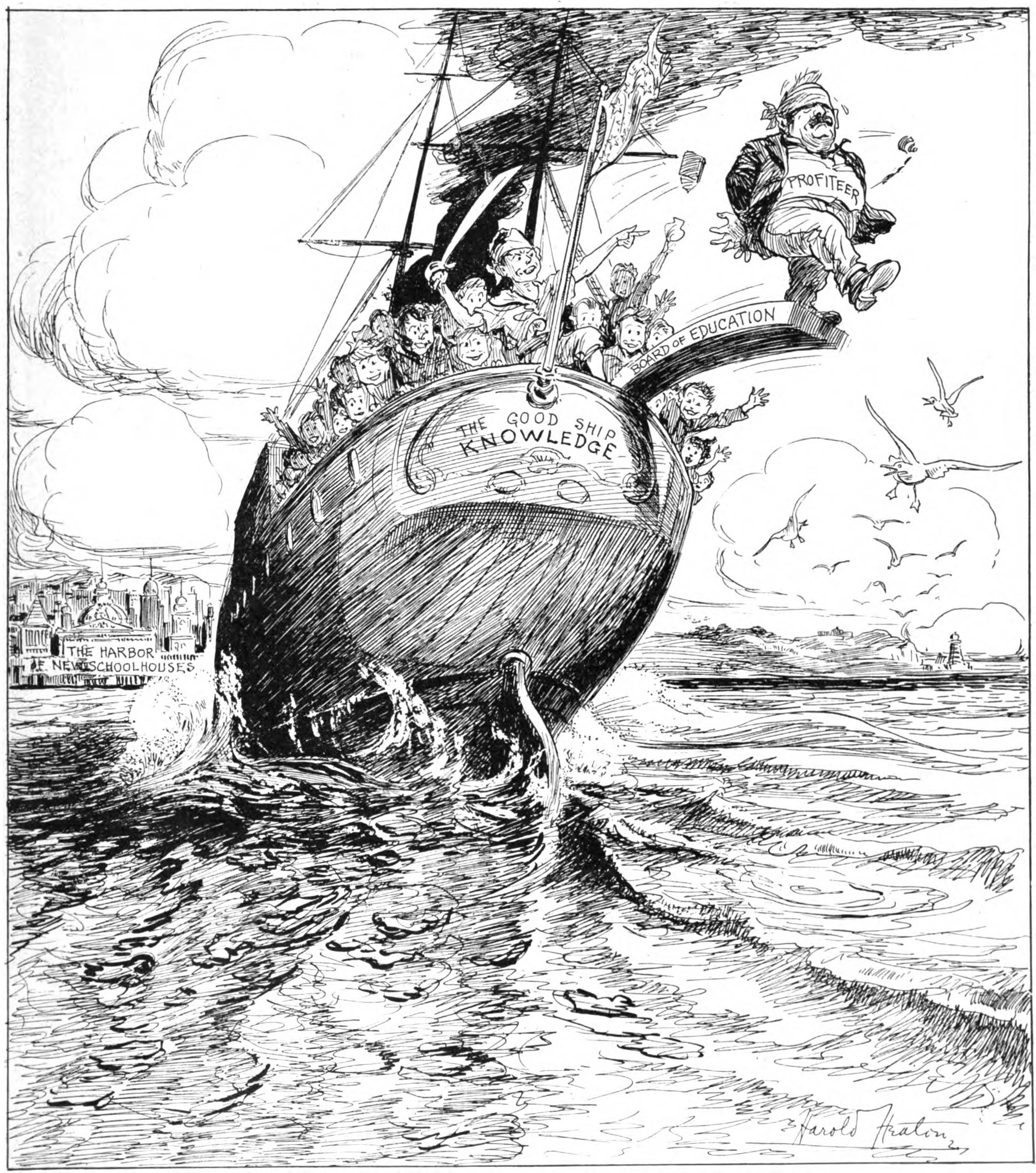
(Past) Time for education profiteers to take a walk: Blast from the Past #1

“JUST ABOUT TIME HE TOOK A WALK!.,” original caption, The American School Board Journal, July 1921.

The O’ Jays – “For The Love Of Money” (click to listen or download)

This is the first in a new series on AMPS: Blasts from the Past.  It will be devoted to historical materials that comment on or illuminate contemporary issues in education.  I’ll usually  also post some links to recent, related things and often a song too.  I’m a historian by training, so I feel compelled to say that historical analogs should always be carefully examined, developments in the past are never identical to developments in the present.  Both continuity and change should be assessed.  In this series the emphasis will be on continuity, but I realize that’s only part of the picture.

The inspiration for this series came earlier this week when I stumbled upon full volumes of the American School Board Journal in Google Books.  For my dissertation research I went page-by-page through over 30 years of that journal, I know these will provide much material for this series, but I’ll also be looking for other sources.

Some links on educational profiteers in 2012 (so many possible that I am just posting a handful of links).

Just the tip of the iceberg.  Well past time for them to take a walk.
Thomas J. Mertz

Leave a comment

Filed under "education finance", Accountability, Arne Duncan, Best Practices, Blast from the Past, Budget, Contracts, education, Gimme Some Truth, National News

The news from Lake Gonetowoe

On the agenda at tonight’s (08/13/2012) Madison Metropolitan School District Board of Education Student Achievement and Performance Monitoring Committee meeting (5:00 PM, rm 103, Doyle Building) is a presentation on the first year Measures of Academic Progress (MAP) scores in MMSD.  Explicitly and implicitly this presentation makes assumptions about test scores, cut scores, standards and achievement that are both wrong and dangerous, creating what I am calling the Lake Gonetowoe Effect, the inverse of the Lake Wobegone Effect, which posits “all the children are above average.”  In Madison we’ve decided that only half the students in the nation are “proficient,” while retaining the idea that all of our students should be “above average.”  The worst of both worlds.

 Matt DeFour’s State Journal story on the MAP scores emphasized that these test scores offer another way to document achievement and gaps in the district.  That’s not what this is about, but a few words before moving on.  Whether they are a better or more accurate measure than the ones used previously is an open question.   MAP is designed as a diagnostic, to be used to help teachers better identify their students’ weaknesses.  From my conversations with teachers, it appears that little or no professional development was done prior to implementation in MMSD.  Unlike Kansas City, for example, where “teachers in the district” were reported “drilling students for the test… practicing like a team would before a big game,” in Madison the tests stood largely outside of instructional practices.  This makes a difference, especially since changes in scores from Fall to Spring are a big part of the report.  If other districts are using the Fall results to “teach to the test” in preparation for the Spring tests and we aren’t, then it it would be expected that MMSD students would show less change.  Some more (and different critiques of MAP here).

I also need to insert the usual caveats about all standardized tests being of limited utility in understanding students, their teachers, their schools and their districts.

Both the grade level benchmark scores and the growth measures in the MMSD MAP presentation are based on the national sample of MAP test takers and are “normed” to match the demographics and school characteristics of the United States school population as a whole.  The demographics and school characteristics used to norm are  different from those found in Madison and different in ways that are associated with lower achievement, yet there seems to be a sense that our students should out-perform the national norms.  There are no published national MAP mean scores broken out by subgroup, but this from a MAP pilot in Montgomery County (MD) Public Schools has some interesting data to look at by way of comparison (not direct with the MMSD presentation, different measures were used).  That’s certainly something you want to work for, but it also leads to unrealistic expectations.  At the national level a majority of students, much less ‘all students” can not, by definition, be “above average.”  To expect a majority of students in MMSD to be above average doesn’t help in any way.  High expectations are one thing when used in a classroom to motivate and inspire students,; they are something else all together when analyzing data and making policy.

This conflation of high expectations in the classroom with higher cut scores on standardized assessments has led to the Lake Gonetowoe Effect on display in the MMSD MAP presentation.  The explicit move in this direction comes in the section comparing NAEP to the WKCE:

Comparing MAP to WKCE. Proficiency bands of advanced-proficient-basic-minimal for WKCE are established by DPI. To provide a comparable look at results, similar proficiency bands are calculated for MAP by MMSD staff. The national mean is used to mark the difference between Basic and Proficient. Students that are more than one standard deviation from the average are at the Advanced level. Students that are more than one standard deviation below are at the Minimal level.

I’m going to leave the parts about setting other cut scores via one standard deviation aside in order to highlight the definition of proficient as equal to or above the score attained by exactly one half of the normed national sample.  With that definition they label 1/2 of the nation’s (and more than 1/2 of MMSD’s) students as failures.  And this isn’t based on some platonic ideal of what students should know, it is an absolutely subjective and even arbitrary choice (all cut scores are subjective, but few seem this arbitrary).  The weird thing is that the people who produced MAP have done sophisticated alignments of  achievement levels to various state standards and tests, including the WKCE, so this wasn’t necessary.

I think it is a reflection and extension of something larger, and potentially destructive (I don’t think this was the intent, but rather that those who prepared the presentation have internalized all of the reformy messages around cut scores and did this without thinking). The big idea seems to be that if we set cut scores for “proficient” at a level few students will attain, then somehow more students will attain that level in the future.  Raising the bar via high cut scores does not help students learn.  I guess it is easier than looking at the systematic inequality, or asking what resources are need to help kids learn and then providing them.  It certainly distracts from those kind of things and as a bonus plays into the “our schools are failing” bash the teachers, bash the “status quo,” “burn the village in order to save it” mentality of many “reformers.”

This can also be seen in the adoption of the very problematic NAEP based cut scores by DPI in the new Wisconsin “accountability” system,” Many of the issues with the NAEP cut scores are detailed in the National Academy of Sciences publication, “Grading the Nation’s Report Card: Evaluating NAEP and Transforming the Assessment of Educational Progress,” especially chapter 5, “Setting Reasonable and Useful Performance Standards.  Read the whole thing.  Here’s the money quote from the intro:

In addition, the public may misread the degree of consensus that actually exists about the performance standards and thus have undue confidence in the meaning of the results. Similarly, audiences for NAEP reports may not understand the judgmental basis underlying the standards. All of these false impressions could lead the public and policy makers to erroneous conclusions about the status and progress of education in this country.

Are you listening Chris Rickert?  How about you, Superintendent Tony Evers?   Good, while I have your attention, surf on over to Jay Bullock’s Using NAEP cut scores devastates, disserves our students to get the view from the classroom on the Lake Gonetowoe Effect.

I understand the problems with cut scores that are set so low that they little of use in identifying varying degrees of achievement and create unearned good feelings.  Many states did this in order to avoid the forced and unproductive reforms associated with NCLB sanctions.  The pendulum appears to be swinging in the other direction and we seem to be entering the era of where cut scores
are designed to inspire reformy Jeremiads (if not actual learning).   I hope our stay at Lake Gonetowoe is short, because it isn’t going to be pleasant or productive.

Thomas J. Mertz

Leave a comment

Filed under Accountability, Arne Duncan, Best Practices, education, Gimme Some Truth, Local News, National News, nclb, No Child Left Behind, Uncategorized