
Category Archives: Accountability

NCLB Action

We haven’t posted much on No Child Left Behind lately.  Time to remedy that.

The reauthorization/reform are still pending, but don’t appear likely in this election year (see also here).  I don’t know if that is good news or bad news.  A straight re-authorization would be very bad news, but a better federal education policy (and less high stakes testing, less money for charters and vouchers, more money for underfunded mandates, more realistic accommodations and exclusions of special education students and English language learners for all testing) would be welcome, whatever the name.

I have to thank Madison teacher Gary L. Stout for prompting me on this post (and to add the Collaborative for Academic, Social, and Emotional Learning to the AMPS Resources page — check it out).  Gary, along with David Wasserman (see here and here, on AMPS) has been doing his best to get out a teacher’s perspective on the damage the law is doing to our schools and children.  Here is an excerpt from his site on NCLB (check out the Social, Emotional, and Academic Learning in Kindergarten material too, it is well worth the time if you care about early education).

Developmentally Appropriate Practices

If a person is truly knowledgeable about what constitutes Developmentally Appropriate Practices (DAP) for our school age children it is inconceivable that they support NCLB.

The concept of Developmentally Appropriate Practices are the cornerstone of what is good for our children in all schools. You will never, ever see the two phrases NCLB and DAP in the same sentence in any credible professional educational journal, never, ever. The more a person studies and works in teaching the more a person sees how developmentally inappropriate NCLB really is.

NCLB is the most destructive, vindictive piece of federal legislation ever passed. It is a deliberate assault on public education. It is a disease that is presently in every classroom, every day. It starts in kindergarten classrooms by undermining all aspects of Developmentally Appropriate Practices. It continues on through the grades and stops in High School when it lures, misleads, misinforms, and recruits our students into the all too real prospects of death or maiming. It is a tribute to the existing presidential administration
and their success at destruction and manipulation. NCLB is an all encompassing cancer that needs to be stopped.

The whole essay is here, including good quotes from our Board of Education members.  One more excerpt on what we can do: Take Action!

What Can We Do?

It is easy to be critical of NCLB. The challenging part is addressing the question of what can we do to change things?

1. We need to unite and get politically active locally and nationally to eliminate NCLB or change it drastically. The problem is that political change is slow. We as a nation have been taking steps backward in the education of our children for five years now. We will continue going backwards on a daily basis as long as NCLB exists as it is today.

2. It is critical for Wisconsin to change the way our public schools are funded. The elimination of revenue caps and the use of property taxes as a major way to fund public schools has got to change.

3. Third, we need to educate many of our co-workers, parents, and the voting public as to the truth about how our schools are being deliberately set up for failure and how our schools are presently failing on a daily basis to meet even the basic needs of all our children
There are also at least three things we can do immediately as a progressive and accountable school district.

1. Stop the one dimensional focus on academic learning and teach to the whole child. We need to teach and give every child the opportunity to grow socially, emotionally, physically, and creatively as well as academically.

In March 2003 I addressed a Madison school board committee suggesting that our school districts emphasis on testing and academic learning at the expense of social, emotional, physical and creative learning was developmentally inappropriate. Since then our approach to teaching to the whole child as become even more one dimensional with the developmentally inappropriate mandates of NCLB.

2. Change the focus of the Madison summer school program. Instead of using behavioral issues as a deterrent to getting into the program, children with behavioral issues should be the first to be enrolled. The public needs to know that when a classroom has just one socially
inappropriate child, that child takes educational opportunities away from every child in the classroom. Social development is similar to reading and math development. They need to be taught every day, in every classroom, at every grade level.

3. We need to remember Rosa Parks and say no to NCLB. Our school district should be commended for having the courage to say no to the Reading First program. Lets have the courage to say no to NCLB. As a community lets find ways to fund our schools without having the George Orwell effect tied to federal dollars.

I’ll add one more.  The Board of Education Communications Committee is planning forums on various topics.  I think the NCLB Act should be one of them.  If you agree, let them know.

Here are some of my other favorite anti-NCLB resources:

The Educator Roundtable (with petition).

Susanohanian.org (with a compilation of NCLB Outrages).

No NCLB.org

Thomas J. Mertz

Leave a comment

Filed under Accountability, Best Practices, Budget, Elections, Equity, finance, Gimme Some Truth, Local News, National News, nclb, No Child Left Behind, School Finance, Take Action, Uncategorized

Democracy and Efficiency (part II)

ito13.jpg

On Monday February 18 the public will get a chance to speak to the the Board of Education about the proposal to move public appearances on non agenda items to the end of meetings. I implore all interested members of the public, pro and con, to attend on Monday and make your voices heard. The meeting will be in the Doyle Building auditorium. It starts at 5:00, but the public hearing on the proposal is on the agenda after the report of the Citizens [School] Naming Committee report. I would guess this will be after 5:30.

In an earlier postI promised to offer some constructive suggestions on this proposal and the broad matter of balancing the desire for public participation with the desire for efficiency. I realize that these are not exactly the same “problems” Board President Arlene Silviera identified — “The issue is that the Board would like to focus on its business at a more reasonable hour in order to make good decisions for the children of the district” — but I think they are close enough.

When searching for solutions, it is essential to begin by demonstrating that the “problem” actually exists and if it does the next step is to assess how serious it is.

Here are the Board priorities for the year:

– Develop specific, measurable goals regarding strategic priorities

– Attendance, dropouts, truancy, expulsions, bullying

– Equity discussion – follow through/implementation

– Hiring a new Superintendent

– Considering/weighing options for a possible referendum

I don’t know everything that the Board has done, but based on what I do know and can find I’d like to go through these one by one and assess the progress.

Develop specific, measurable goals regarding strategic priorities

The Performance and Achievement Committee developed and forwarded to the Board a “Strategic Plan Accountability Matrix,” It was approved on November 11 . I believe that this is a partial fulfillment of this priority. The matrix isn’t posted on the district web site so I can’t be sure, but this appears to be related to the ongoing work of the district and Board moving toward implementing value added analysis (a blessing, but a mixed blessing in my opinion, see here, here and here, to start). The strategic priorities should also play some role in the Board’s equity work.

Attendance, dropouts, truancy, expulsions, bullying

After much work, the expulsions policy has been revised. I can’t find much on the others ( code of conduct revision here), but again the equity work should touch on them. Another partial fulfillment.

Equity discussion – follow through/implementation

One meeting devoted largely to Equity where progress was made and a second (at the end of a night made long by on-topic public appearances at the Long Range Planning Committee and other matters), where not much was accomplished. I have many things to say about process the Board has pursued with their equity work (some here), but this is not the place to go into that. I would put this in the “barely started” category.

Hiring a new Superintendent

This is huge and was hugely time consuming. They did a very good job throughout the process and ended up with a fine choice.

Considering/weighing options for a possible referendum

They started this in a timely manner, made some progress but because of the TIF windfall it ended up being “the referendum that wasn’t.”

I think this is a pretty impressive record of accomplishments. Add to it revising the school naming policy, beginning West side boundary discussions, settling the MTI teacher contract, beginning work on community forums and partnerships, as well as other initiatives that are under my radar; and weathering the storms of consolidation and budget reconsideration, General Vang Pao, and private school busing and it looks to me like a fairly successful term. I am skeptical that this record indicates a problem that rises to the level of requiring what I consider the drastic action of making it more difficult (however slightly) for the public to communicate with the Board. Obviously some Board members disagree or it wouldn’t have come up.

Although skeptical, I’ll stipulate that there is a problem, that the Board has been unable to give sufficient attention to their work and priorities. The next step should be to evaluate a range of solutions. The Board produced one “solution” and did little in the way of evaluating its’ effectiveness.

I hope to have documentation of how much time was spent on off-topic public appearances before Monday. Having sat through many meetings, watched video of others and reviewed minutes of even more, my initial impression is that the vast majority of off-topic public appearances this term have been about the school consolidation/budget reconsideration, the General Vang Pao school naming, private school busing and Military ads/recruiting. At least the first two of these are exceptional situations and concern problems of the Board’s own making. Some might say this describes the others also. My point is that week in and week out, year in and year out, off-topic public testimony does not seem to consume all that much time or energy.

In all these cases and more, I believe that the community, the district and the Board have all benefited from the opportunities for open public input. If there is to be any new limit, I would like it to be time based instead of topical. For example, if there are more than 15 registrants, limit of speakers for two minutes.

Any assessment of time or energy spent on off-topic public appearances only makes sense in the context of a comparative assessment of time spent on other tasks. I don’t have documentation on this either, but it seems the Board spends an inordinate amount of time with housekeeping matters, paying bills and and taking other actions that are required by law. The obvious solution is to use a consent agenda, to bundle these matters into a single vote. This has come up twice (that I know of) in Board discussions; once here and the second time during the discussion of the public input “problem.” Despite the efforts of some Board members, it has never appeared on an agenda. It is a reform that makes sense.

I am only going to make one more suggestion here, and this only deals indirectly with efficiency, but I think it would enhance communication and democracy and may induce fewer people to use Board meeting time with public input. Board members should hold office hours. One of the problems with the rituals of public input and the black hole of emailing or writing elected officials is that the public often feels they are not being listened to. I know Board members also have public phone numbers, but calling them seems like such an imposition. Office hours would allow dialogue between Board members and the public — something, for legal and other reasons, sorely lacking at Board meetings. Carol Carstensen used do do something like this in her home by hosting regular open houses, but these raised legal issues that led to their demise. What I am proposing is that Board members rotate and that each week at a designated time one or two be available for appointments or walk in meetings. I really think this would help.

Communication is a two-way street and the public is not without fault in the communication problems that exist. John Dewey wrote:

All communication is like art. It may be fairly said, therefore, that any social arrangement that remains vitally social, or vitally shared, is educative to those who participate in it. Only when it becomes cast in a mold and runs in a routine way does it lose its educative power. “

Too often the public input sessions — both on and off topic — consist of all parties going through the motions. With this in mind, I offer some initial tips on giving effective, communicative public input:

  • Be informed and accurate.
  • Know what can or cannot be done, but also don’t lose sight of and do communicate your dreams for the future.
  • Be polite and respectful (this one can be hard, but at least keep it civil).
  • Don’t rehash old history. Past conflicts and mistakes should be used sparingly and only to point ways forward.
  • Offer realistic alternatives.
  • Try to see the “big picture” and demonstrate that you do.
  • Remember that the School board’s primary focus and reason for being is to improve student achievement for all children
  • Use personal stories, but don’t make it personal, tie them to larger concerns.
  • Thank the elected officials for past and future things.
  • Don’t criticize the people, criticize their actions (or inaction).
  • Sustain involvement. Elected officials have more respect for people who stick around and keep working.
  • Look for common ground, but if it isn’t there be straight forward about that.
  • Don’t make threats.
  • Don’t complain about taxes unless that is the one focus of your testimony.

As usual, this is too long, so I’ll leave it at this. Your suggestions on effective input, Board efficiency or anything else are welcome. Just leave a comment.

Thomas J. Mertz

1 Comment

Filed under Accountability, AMPS, Best Practices, Local News, Take Action, Uncategorized

Democracy and Efficiency (part I)

what-threatens-democracy-2.jpg

The Madison School Board has drawn fire from Progressive Dane for a proposed policy change regarding public appearances.

The change would limit public commentary preceding school board meetings to agenda items. Individuals who want to speak on issues that are not part of the agenda would be required to speak after the business portion of the meeting was complete….

[Board of Education President, Arlene] Silveira objected to characterizing the change as an effort to limit public discussion or input.

“That is simply not true. This has been a discussion about trying to find a solution to a problem in getting the work done we were elected to do. Under this proposal, people can certainly speak on non-agenda items, just not before we begin our business meetings,” she said.

Susan Troller Capital Times, February 9, 2008 (emphasis added)

We need to move beyond the unsupportable assertions that the proposed public appearances policy revision does not limit public input (however slightly) and start asking if the new limits are an acceptable trade-off for increased efficiency.

In democratic governance there is almost always a trade-off between efficiency and democracy. More participatory structures tend to be less efficient (there are some ways of gaining efficiency that have little impact on participation and some ways of enhancing participation that have little impact on efficiency; I will touch on some of these in part II). This extends beyond opportunities for the public to vote, petition or make our voice heard to questions of balance concerning the proper breadth or shape of the responsibilities claimed by or ceded to the public, elected officials and appointed professional administrators. Among democratic systems, the least democratic structures give the most responsibility and power to those at the farthest remove from the public, professional administrators.

In school governance at one end of the spectrum would be the annual school meeting, which vested comprehensive powers in the voters who attended. At the other end would probably be the mayoral appointed superintendents given sweeping powers (Michelle Rhee in Washington DC is a recent example).

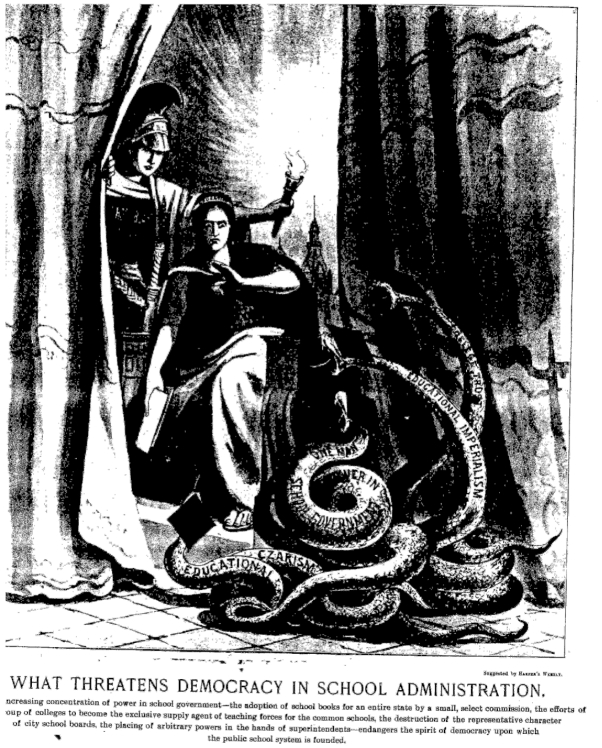
These have been live issues since at least the Progressive Era. In that period those who favored efficiency over democracy, often called “administrative progressives,” mostly triumphed, creating what historian David Tyack called “The One Best System.” Most of the histories of these conflicts focus on the winners. As a historian and an activist I have always been more attracted to their opponents, unstable coalitions of intellectuals (John Dewey for one), women’s groups, unions, Populists, Socialists, teachers, and partisan politicians who resisted what William George Bruce (Milwaukee Democratic politician – who opposed partisan politics in school governance, these coalitions were very unstable and strange –, school board member and founder of the American School Board Journal) called “Educational Czarism.” They had their victories too.

Almost everyone involved had some claim to the label “progressive.” This points to a dilemma in progressivism, then and now. Progressives have faith that politics and government can work for the common good and in order to accomplish this — to advance the common good — government must be efficient. Progressives with a democratic orientation also value democratic structures and wide participation, which make efficiency harder to achieve. This is the dilemma presented by the proposed limit on public appearances concerning non-agenda items.

The conflicts over school governance were and are entwined with conflicts over the purposes of schooling. For the most part Progressive Ea efficiency advocates emphasized the role of the schools in training workers and their opponents were more concerned with education for personal growth and citizenship. This is a gross oversimplification in that both sides favored some form of industrial or vocational education and the conflicts were about who would control it (some of the administrative progressives were happy to have private industry directly in charge) and what forms it would take (manual training was viewed as promoting personal development while vocational education was often seen as an effort to recreate inequalities in the name of “social efficiency”). Still, I think it is important to bring up as a reminder that the structures of education are related to what is taught, constituting a hidden curriculum. The lesson of limiting public appearances is that to some degree the priorities of the Board of Education take precedence over the concerns of the public. This has to be part of the discussion too.

Historically the structures and aims of education in Madison have had a relatively good balance between efficiency and democracy. I would like to see it stay that way.

As I said earlier, I would like to see this proposal set aside and have the Board and the public together tackle the broad questions of balance between efficiency and public participation. I’ve got some specific suggestions that will be included in part II of this post (as soon as I find the time to draft that…need to work on my own efficiency). I am going to close this post with some outlines of what I am talking about.

I would like to see a wider consideration of Board practices, some documentation about how much time has been spent on various tasks (including but not limited to off topic public testimony) and a variety of solutions evaluated, solutions that address “problems” confined to what the Board does as well as solutions involving the public perhaps changing our behavior too.

Whatever the results, I think that this has to be an issue that Board engages the public on. I am very glad that there now will be an opportunity for the public the weigh in on February 18, prior to the vote. That is a start, but however the vote goes, the larger dilemmas of democracy and efficiency aren’t going to go away. Rejecting the proposal could lead to constructive cooperation and creative solutions, enacting it will exacerbate distrust and resentments.


Thomas J. Mertz

For further reading:

David B. Tyack, The One Best System: A History of American Urban Education.

William J. Reese, Power and the Promise of School Reform: Grass Roots Movements During the Progressive Era.

Raymond E. Callahan, Education and the Cult of Efficiency.

Robert B. Westbrook, John Dewey and American Democracy.

2 Comments

Filed under Accountability, AMPS, Best Practices, education, Local News, Take Action

Tin-eared and Wrong-headed

eartrumplb.pngbottom.jpg

Update:

Board of Education President Arlene Silveira just posted this on The Daily Page 

 Time Out. The press release that started this thread was not accurate. There will be public speaking on this topic at the meeting on 2/18.I will continue to come back to the main point. The issue is that the Board would like to focus on its business at a more reasonable hour in order to make good decisions for the children of the district.If people do not like the proposal on the table, please recommend an alternative. An alternative is not to say “let’s leave things as is”. This does not address the problem.Looking forward to your ideas!Arlene Silveira

I am glad to see some movement and agree that both sides need to be creative.

It should be noted that according to all information available to the public prior to this The Daily Page post, the Progressive Dane Press Release was accurate. 

I was contacted earlier today by the Board of Education staff person (after the Press Release was issued) about a change but given no details.  My request for more information has not been answered yet (This is not a complaint about the Board staff people.  They, like so many in the Doyle building, do a great job and are always helpful.  I just want to be as open as possible about what I knew when.). 

See you on the 18th (and maybe the 11th too).

At the Board of Education meeting Monday (2/4/2008) a proposal was put forth to enact new limits on public testimony. This proposal and the way it was introduced and discussed showed some on the Board at their worst, both tin-eared and wrong-headed. These are overlapping criticisms, because with the interactions between elected officials and the public, perceptions (tin-eared) and realities (wrong-headed) are inseparable.

Before I go further a caveat is in order. I did not attend the meeting on Monday and only watched the last 45 minutes or so at home. Still, I’m pretty confident in what I have to say.

The proposal is a revision of Board policies 1220 and 1222. I haven’t obtained a copy of the exact language yet (that points to one problem with the way this is being done and another with the proposal iteslf, when I get an electronic copy I’ll link here), but the gist of it is that they want to move public appearances concerning topics that are not on the agenda for that meeting from the beginning (where they have been since at least 2000) to the end (an indeterminate time). K-12 students are exempted.

The rationale offered is that extensive, “off topic” public appearances have kept the Board from effectively doing the work the Board wants to do. There is no doubt that public appearances before the Board — mostly “on topic” — have at times been exhausting or that there is room for improvement on both sides of communication between the Board and the public. Rather than improving communication, the pending revision seeks to make communication more difficult.

It is outageous for a Board which has acknowledged communication and public relations problems in their goals for the Superintendent (it was also on the initial list of annual Board priorities, but Lawrie Kobza moved to delete it, Ms Kobza was conspicuous in her support of the current effort to limit public appearances) to contemplate such an action, it borders on insane that they would do so in a manner that excludes the public from having any input.

One thing needs to be made clear, whatever Board members say about the intent not being to limit public input, the result is that public input will be limited in terms of both quantity and quality. Logistically the proposal is a nightmare. Let me use the proposal itself as the first illustration.

A very general item appeared on the agenda distributed on Thursday or Friday (1/31 or 2/1). I contacted a couple of people for details and got only vague answers. It appears that the actual proposal was distributed to Board members on Monday (the day of the meeting) and the first chance the public got to see it was via the distribution of copies at that meeting.  [I have been asked to clarify the chronology and given new information to do so. Board members were given a draft policy on Thursday 1/31, an explanation via email on Friday 2/1 and the the proposed policy on Monday 2/4. A vote was possible on Monday, 2/4 but since this was not sure, the possible continuation to 2/18 was already arranged.] Monday afternoon I am contemplating making childcare and other arrangements in order to possibly give public testimony on a proposal that I don’t know the contents of. One source told me there probably won’t be a vote, so I decide not to go (it turns out there was almost a vote). The point of this is that the nature agenda items and the timing of their publication makes it hard for the public to participate. It gets worse. Thanks to the intervention of two members, the Board did not vote and will take this up again on 2/18 (mark the date). That meeting will be a workshop session, meaning no public appearances. In fact, there are no Board meetings scheduled between now and the vote where public appearances are allowed. So I missed my chance and the Board was spared the horror of listening to me for three minutes. I will however be attending the Communications Committee meeting on 2/11 and if public appearances are allowed will be saying my piece (that agenda isn’t out yet), I suggest you do the same.

This was an agendaed item, so if the new policy was in place I still could have testified at the start (and I would have if there has been any way for me to know what it was without going to the meeting). Now I want to look at non-agendaed items and what the Board is contemplating. These fall into two categories. The first consists those things that the Board is not aware of or is doing nothing about; the second consists of those things that Board has been addressing or plans to address at other meetings. If you want to talk with the Board about any of these, you will have to wait your turn. In practical terms, that means planning on sitting through a meeting that may go one hour or may go four hours (tell that to your spouse or try to arrange for childcare on those terms) and then at the very end, after the Board has done what they want, those members that stick around will give your what attention they have left to give. Is this a recipe for effective communication? I understand that the Board wants to work on what the Board wants to work on, but I also understand that the Board doesn’t know everything and that there are some things they know about that they don’t want to deal with. I like the fact that it is relatively easy for the public to try to inform the Board or get them to address things they would rather not, to speak often inconvenient truth to power (or at very least call public attention to these things). In setting the agenda, the Board (especially the President and Vice President) already have great power. This would enhance that power at the expense of the rest of us.

As usual, this is too long, but I want to work through one more example before wrapping it up. Multiple Board members cited the failure of the Board to make any meaningful progress on Equity at their 1/28 meeting as an illustration of why this policy is “needed.” They couldn’t have picked a worse example. On April 16, 2007 the Equity Task Force presented our report to the Board of Education. The Board was busy with more pending matters, gave the summary a brief polite hearing, thanked the Task Force and pledged to return to the report (no vote, but that’s what they said and what the minutes indicate). On June 20, 2007 the Board made Equity a priority for the year. On December 3, 2007 — almost eight months after the Task Force gave them our report and six months after the Board made Equity a priority — the Board held a workshop session on Equity. On January 28, 2008the Board held another workshop meeting on Equity. This is the meeting where little got done and the one that Board members used to place the blame on public appearances. On that front, the lengthy public appearances that night were for the Long Range Planning Committee and were about an agendaed item, so the proposed revision wouldn’t have changed anything!

Looking at the bigger picture, it stretches credibility well past the breaking point to assert that off topic public appearances were a major factor in preventing the Board from addressing Equity for eight months. Don’t play me for a fool. Again, it gets worse. Under the new policy, only agendaed items may be addressed at a time when members of the public are able to easily appear and the Board is paying full attention. In the eight months since the Task Force gave the Board our report, Equity has not appeared on the agenda of a single meeting where public appearances were allowed. Board members also touted other means of communicating with them. Any fool knows these aren’t the same. Prior to the January 28 meeting six Equity Task Force members (myself included) sent the Board a letter expressing concerns about the process of their work on Equity, including the lack of public input. To my knowledge only two Board members responded and our letter and concerns were not part of the discussion at the meeting. I can’t help but think that if we had been able to read that letter to them in person at the start of one or more meetings, things might have been different.

Reading through this I find that I hit the “wrong-headedness” more than the “tin-eared.” It should be obvious how counterproductive ramming through a limitation of public input (without any public input on the proposal) is to the goal of improved communications. If it isn’t, I suggest everyone — including Board members — watch the video. You’ll be amazed at how self-centered and arrogant some of our elected Board members sound.

I admire the hard work of our Board of Education and appreciate the difficulties they face in trying to do what they think is best. However, the best intentions can still lead to bad decisions. Let’s not let that happen this time. Contact the Board, testify at the 2/11 Communications Committee meeting (while you still can), write the newspapers…. If we can move past this wrong-headed mess, we can continue to work together — the board and the Public — to figure out ways to improve communication, a project that has already begun under a the auspices of a planned Progressive Dane School Budget 101 seminar (among other things I’m chair of the PD Education Task Force).

Thomas J. Mertz

An undesirable society, in other words, is one which internally and externally sets up barriers to free intercourse and communication of experience. A society which makes provision for participation in its good of all its members on equal terms and which secures flexible readjustment of its institutions through interaction of the different forms of associated life is in so far democratic.

John Dewey, Democracy and Education
8 Comments

Filed under Accountability, Best Practices, Equity, Local News, Take Action, Uncategorized

Who’s Out to Get Public Schools?

girl-staring.jpg

Gerald Bracey has an interesting report out this morning.

When people think about the groups or individuals who wish to privatize public schools, they probably think of only a few foundations and people. The late Milton Friedman and John Walton and the living Paul Peterson; the Heritage Foundation, Manhattan Institute, Hoover Institution, Heartland Institute, American Enterprise Institute, Goldwater Institute, Bradley, Scaife and a scattering of others.

This is a mistake. A recent study by the National Committee for Responsive Philanthropy studying the years 2002 to 2006 identified 132 separate school choice organizations (www.ncrp.org, “Strategic Grantmaking”). One hundred and four of these 132 received grants from 1,212 foundations with total contributions exceeding $100,000,000 in some years. The Walton Family Foundation (Wal-Mart) dwarfed all others with grants often exceeding $25 million.

These foundations also funded candidates, political parties, political action groups and 501(c)4 organizations. Overwhelmingly, the recipients of this largess were Republican candidates and causes.

… [There’s] a common flaw in the reasoning of the privatizers: it assumes that there are enough private schools to go around. In fact, the existing private schools, even if they wanted these poor kids, which most of them don’t, could accommodate no more than 4% of students now in the public schools. In the early years of the privatization movement, analogies were often drawn to fast food restaurants—new schools would spring up as fast as McDonald’s or Starbucks. The privatizers have apparently gotten past that particular stupidity and realize that a school is a large and complex ecosystem which requires expert knowledge not needed for hamburger flipping.

The privatizers can be critical of how conservatives fund voucher movements. Many think it is silly to fund the large think tanks such as AEI and Heritage, because they end up forming partnerships with people whose primary interest is in maintaining the status quo. Many advocate small funding to, say, parents, who have a direct interest (it is alleged) in change. In fact some people have accused the large conservative think tanks with having a basic distrust of democracy. Giving money directly to parents, on the other hand, reflects a belief that parents can select the schools best for their children.

It is interesting in this connection that supporters of the oldest (18 years) and largest (19,000 students) voucher program in the country, that in Milwaukee, have just begun a million-dollar campaign to build support for the program. According to an article in the January 28, 2008 Milwaukee Journal Sentinel the group “will sponsor television, radio and print advertising over the next four months as well as undertaking other activities aimed at increasing positive opinions of the program.”

Of course, the simplest way to build support would be to show that the program works. This has not been done in Milwaukee or elsewhere (the alleged big gains Paul Peterson found for blacks in New York City disappeared when proper statistical techniques were used). Evaluations of the program after five years reached contradictory conclusions, the most reasonable one being, in my opinion, that the program had no impact on reading achievement and a small impact on mathematics achievement. The researcher, Cecilia Rouse of Princeton, observed, though, that voucher students attended smaller classes and that class size could easily be the source of the voucher students’ advantage. After that evaluation, voucher supporters in the legislature expressed their confidence in the program by killing any further funding for evaluations.

And of course the other meme that will come to be employed with increasing frequency in the future, is the one that says education evaluation is not a science and therefore can’t be trusted. Except of course when it’s your own think tank that produces the results that confirm the efficacy of the voucher program you hope to promote.

Robert Godfrey


7 Comments

Filed under Accountability, Equity, Gimme Some Truth, School Finance, Uncategorized

Paul Soglin Checks in on School Finance

pennies.jpg

Former Madison Mayor Paul Soglin has given sporadic attention to state school finance issues on his blog. More would be better, but today’s is good:

The Tragedy That is California Education and Now Wisconsin

A trip last week to Los Angeles and San Francisco served as a graphic reminder of the rise and fall of public education in the state of California since the adoption of Proposition 13. The enactment of that law after a 1978 referendum created an unfair tax system, taxing property not on its use, its present value, or its potential for development, but the assessment on the day it was purchased.

The result not only creates an imbalance in taxation but it strangles deprives government of needed revenues. The most important example is California public education. In the three decades following World War II, California public schools were the best in the nation. Now they are among the worst.

Within California, test results and rankings of their schools show a clear delineation along economic lines. Schools in wealthy communities score the best. Obviously, schools in low income areas do poorly.

Starved for adequate funding, each school is dependent upon activist parents and community leaders to raise hundreds of thousands of dollars each and every year. It is no surprise that the poorest communities fail miserably at this semi-privatization of education.

One impact of Proposition 13 was, in part, to privatize the schools. Public schools cannot survive without private resources. The same thing is occurring in Wisconsin where restraints on school expenditures from public funds results in continued fundraising. Some communities like Madison centralize the fundraising for the entire district so that all schools share equitably in the private monies.

In the meantime, while some taxpayers can point to significant savings, the quality of education suffers at greater expense to all of us, particularly those dependent upon a well educated workforce.

If there are problems with the public education system, then fix it. Ensuring failure was not a wise choice.

One correction, Soglin wrote: “Some communities like Madison centralize the fundraising for the entire district so that all schools share equitably in the private monies.”

Madison does not do this. PTO raised funds are not pooled, individual donations may be targeted to individual schools or purposes, the Foundation for Madison Public Schools’ grants are often for a single school and their endowment program is based on matching grants. There is much, much inequity in MMSD fundraising.

For more on wealthy schools (or schools serving wealthy kids) scoring high, see the US News and World Report “Best High Schools” ranking/.

I hate these rankings. If I have time I’ll do a little thing on the method and methodology of the US News & World Report ranking, but without taking the time to look closely at how the rankings are made they are a complete waste of time. Sometimes even after looking they are a waste of time, more often they are interesting but not useful. At least this one is an improvement on Jay Mathews’ ridiculous “Challenge Index” (scroll to comments).

Thomas J. Mertz

Leave a comment

Filed under Accountability, AMPS, Best Practices, Gimme Some Truth, National News

Hope For the Future of our Schools

by John Smart

Two things happened recently that raised my hopes for the future:

The first was an assembly held at the Menasha High School on November 14th dedicated to learning about the ongoing genocide in Darfur, that region of Sudan where nomadic Arab militias covertly sponsored by the Sudanese dictator, Omar Hassan al-Bashir, are ravaging the countryside, murdering, raping, burning villages and driving the indigenous people from their land.

Students in teacher Dean Boyer’s social studies classes were asked to select an international issue to study, and they chose the situation in Darfur. They researched the story thoroughly, and in the process became involved with the Darfur Action Coalition of Wisconsin, an organization working to support efforts to help the victims of this bloody conflict — and to end it. The students are selling tee-shirts and raising funds to send to the Coalition.

They also asked the Coalition for someone to come and speak to a student assembly at their high school about the Darfur crisis, and I volunteered to do so. They weren’t sure how many students would choose to attend, and we were all surprised when the handsome Menasha High School Auditorium filled almost to capacity – over 700 students!

The conversation — for that is what it was — lasted for an hour, and the students were attentive and involved, they asked informed questions and related serious concerns. They exhibited genuine empathy for the unfortunate people in that far-off, African land.

I was so exhilarated from spending time with those wonderful kids that I felt airborne to my next destination! If they are representative of the youth of our state and nation, and I hope and believe they are, the future of the state and nation is indeed in capable, caring hands.

I then went from Menasha to Madison, where, the next morning, I was one of sixty plus citizens who testified at a hearing of the State Senate Committee on Education.

The November 15th public hearing had to be moved to a larger room in the Capitol to accommodate the ever-increasing crowd, and they still had to have an overflow room with a television monitor so that attendees could follow the proceedings. The turnout clearly demonstrated growing public interest in doing something constructive to support our schools.

The purpose of the hearing was to examine Senate Joint Resolution 27, co-sponsored by Assembly Representative Sondy Pope-Roberts, of Middleton, Senator Roger Breske, of Eland, 14 other senators and 43 other assembly representatives. All but one of the people testifying were in support of the resolution.

The resolution calls for the legislature to recognize that the system we’re using to pay for our schools is not fair and equitable, and simply does not work — that it underfunds our schools while throwing too much of the burden on the backs of property taxpayers, who are understandably rebelling. The resolution refers to a number of new funding formulas that all deserve consideration, and it sets a deadline for the legislature to examine these, and any others, and pass a new compromise plan for school funding reform by a deadline date of July 1, 2009.

Several members of the committee, notably Senators Glen Grothman, of West Bend, and Mary Lazich, of New Berlin, insisted on attempting to debate the merits of one or another of the plans, asking how much they would cost and where the money was going to come from. They had to be reminded repeatedly that this resolution only sets a deadline and doesn’t endorse any specific plan.

What lifted my spirits was the enthusiasm of the people attending and the seriousness with which the senators responded. Many of us have struggled for a long time to get the legislature to recognize the problems that the current funding system is causing for our schools, and finally, it is beginning to look like that light at the end of the tunnel may not be an oncoming train!

The fight isn’t over though, not at all. It is probable that the resolution will pass the committee and the senate, but it is still a question as to whether or not the Speaker of the Assembly, Mike Huebsch, will allow this resolution to even come to the floor of that body for debate.

As usual, it is important for citizens to voice their opinions. Letters and phone calls to our legislators actually do have an effect. It is the voice of their constituents that has brought legislators back to this issue again, and more are needed. Please be a part of that “squeeky wheel!”

The students of Wisconsin, like those remarkable young people at the Menasha High School, deserve the best education that we can provide for them. It’s a question of priorities, and to my mind, they are on top of the list.

John Smart serves on the Park Falls School Board, is a member of the Wisconsin Governor’s Commission on the United Nations, the UN Association of the USA and Citizens for Global Solutions. He was a Peace Corps volunteer in Uzbekistan from 1995 through 1998 and chairs the Democratic Party of Price County.

Leave a comment

Filed under Accountability, AMPS, Gimme Some Truth, Pope-Roberts/Breske Resolution, School Finance, Take Action, We Are Not Alone

Reactions to the Madison Test Protest

A few weeks ago I posted some links and information about David Wasserman’s protest against standardized testing to the Education Disinformation Detection and Reporting Agency list maintained by Gerald Bracey. There some problems with the list and I only got responses yesterday. Although not as timely, I think they are still worth sharing.

Here are the initial links:

Teacher gives in, gives test (Capital Times)
Teacher’s test protest leads to reprimand (Wisconsin State Journal)
Protesting teacher faces reprimand (Capital Times/AP)

I also sent this from George Lightbourn of the Wisconsin Policy Research Institute (for more on Mr. Lightbourn on AMPS, see here). More local coverage and reaction here and here and on AMPS.

Steven C. Lozeau, School District Administrator, Potosi (WI) Public Schools weighed in with a letter directed to Mr. Lightbourn:

Dear Sir:

I agree wholeheartedly with accountability, testing and with finding ways to use the information to improve student performance.

Knowing that this is only one part of the picture we must also integrate other measures that account for some of the areas you describe such as creativity and other non-standardize tested criteria.

But I disagree with shoring up your position using already overused and questionable data such as the position of US students compared to the world.

We can spend hours on such comparisons and their failings.

Please do not use non comparables to prove your point as most of what you said can stand alone. Comparing apples and oranges, which most country to country testing does only disclaims your point, propagates bad information, and damages higher education’s relationship with public schools.

Sincerely,

Dr. Steven C. Lozeau
Potosi School District Administrator

I’m not sure if this was a response to my post, but Michael Paul Goldenberg of the Rational Mathematics Education blog posted AN OPEN LETTER IN SUPPORT OF DAVID WASSERMAN . Here are some excerpts:

I am writing to support David Wasserman’s decision to refuse to administer a test in which he did not believe and to decry the way in which he was subsequently dealt with by his superiors. I am a mathematics teacher educator, teacher, and expert on standardized test preparation with more than 30 years’ experience working with students on various instruments (e.g., SAT, GRE, ACT, LSAT, and GMAT) as well as with grading state tests from Michigan, New York, and Connecticut. With that experience and expertise in mind, I am deeply troubled by the manner in which this nation has been pushed further and further towards accepting an ill-founded religious belief in the power of (for the most part) multiple-choice, multiple-guess tests to measure not only student achievement, a concept which is at best open to question, but teacher, administrator, school, district, and state competency (not to mention national status when viewing similar international tests such as the TIMSS), in total violation of one of the basic principles of psychometrics: never use a test to measure something it has not been specifically designed and normed to measure. This country has long been enamored with numbers and rankings, going back to the early decades of the 20th century, when we shamefully abused IQ scores to restrict immigration in ways that can only be viewed as unscientific and utterly racist. I urge everyone to read Stephen Jay Gould’s definitive work on the abuse of “intelligence” testing, THE MISMEASURE OF MAN, for a shocking and sobering account of how standardized tests have been misused and abused in the United States, generally out of racist and chauvinistic ignorance and bias.

It takes a brave person to risk his job and his livelihood, to put himself and his family in jeopardy, in the face of blind obedience on the part of so many of his fellow teachers and education professionals to what is nothing more than an outlandish political ploy to destroy public education, undermine teacher authority and autonomy, punish students, parents, teachers, administrators, schools, and districts MOST in need of support, and to shamelessly promote vouchers and privatization to help those most advantaged and least in need already. Sadly, there is not a single member of the US Congress (and, I suspect, of any state legislature) who has a balanced view of educational politics, who actually has K-12 teaching experience, who has a background in either education or psychometrics, and who understands that measuring something is not the way to improve it….

David Wasserman had the guts to stand up for his students and for meaningful assessment over shallow, cheaply processed “data”-gathering and number worship. His colleagues, principal, and superintendent should have applauded him. I suspect many of his students were grateful for even a moment’s thought for their plight. Instead, we saw no acts of courage from those with a little more power than a mere classroom teacher. It was business as usual, full speed ahead, and testing uber alles. How utterly sad, and how utterly tragic for real kids and real learning.

I too support Mr. Wasserman and hope that MMSD’s “reprimand” does not come to pass.

Thomas J. Mertz

Leave a comment

Filed under Accountability, AMPS, Best Practices, Gimme Some Truth, Local News, National News, nclb, No Child Left Behind

High School Redesign Update

Susan Troller of the Capital Times has the story.

To me, this is the best news:

The timeline for some parts of what’s known as the high school redesign has been pushed back so the new superintendent — to be hired early next year in advance of Rainwater’s June retirement — will be able to have an impact on a plan that’s likely to stir strong passions in the community.

Since Supt. Rainwater announced his resignation, I’ve been telling anyone who would listen (including Supt. Rainwater) that the success of any reform is linked to leadership and that the incoming leadership needs to be part of this. I doubt my opinion had any impact, but I’m still glad.

In related news, there is a new organization — ExcellenceWithoutAP.org — worth checking out (I hope our redesign team does). This from their site:

The reasons for moving beyond AP vary from school to school. Only one belief is shared by all of the schools listed on this site: that a locally designed curriculum better serves their students than a curriculum leading to a nationally-administered standardized test.

I had great experiences with AP classes decades ago, but much has changed since then. I’m certainly not anti-AP, nor do I think AP (or IB for that matter) is the be all and end all of excellence as some seem to.

Thomas J. Mertz

Leave a comment

Filed under Accountability, AMPS, Best Practices, Local News, National News

Rank Ranking — The Pangloss Index

Get ready for “news” reports and blog posts (and here) from those eager to find fault with public education harping on the latest “report” from the Education Sector (more on the Education Sector on AMPS, here). In the recently released The Pangloss Index: How States Game the No Child Left Behind Act Wisonsin is ranked at #1 (along with Iowa) as the state that is most guilty of “gaming NCLB’s accountability system.” Don’t believe them.

Among the many faults of No Child Left Behind — recognized even by those who have faith in the utility of compilations of data to capture the essence of educational quality and believe that high stakes testing is the best way to create educational progress (I’m not one of them) — is that the accountability structures of NCLB in these areas are deeply flawed.

The purpose of the Pangloss Index (named after Doctor Pangloss from Voltaire’s Candide, who embodies baseless optimism) is to point out that many states avoid “accountability” (read the punishments doled out to schools that don’t meet the adequate yearly progress measures of the law) in their implementation and generally paint a rosy picture of the state of education. All well and good. If you believe in this stuff (as the Education Sector does) then you want it to be designed in a way that at least has a chance of being useful and documenting the flaws would be a good first step.

If you take the press releases (and here; I can’t resist highlighting this phrase from Kevin Carey: “even tightly constructed laws like NCLB,” “tightly constructed,” what planet is he living on?) at face value, that’s what the Pangloss Index is supposed to do. If you peek behind the curtain you will see that it is in fact a lazy and useless piece of garbage intended only to fan the flames of panic among those inclined to believe the worst about public education and “educrats.”

The whole thing is based on the absurd assumption that all positive data is wrong and all negative data is correct. Therefore, states that report good things get a high (bad) rating for “gaming” the system and states that report bad things get a low (good) rating for being honest and accountable. No effort (none at all) is made to assess the accuracy of any of the reported data or to correlate it with other measures. Don’t believe me? Here is what the report says:

This report is based on data submitted by state departments of education to the U.S. Department of Education through reports called Consolidated State Performance Reports (CSPRs)…The “Pangloss Index” found in Table 1 of this report is calculated by aggregating state rankings on 11 measures derived from the CSPRs….For each measure, states were ranked so that the states reporting the most positive results were ranked highest. For example, while states were ranked highest if they reported the highest high school graduation rates and highest percent of schools making adequate yearly progress, they were also ranked highest if they reported the lowest number of persistently dangerous schools and the lowest high school dropout rates.

This is just a stupid way to look at education policy and practice. The Education Sector has lots of money and a respectable reputation and should refrain from these kind of games if they want to keep the reputation (the money would no doubt continue to flow, money in education policy cares little about standards of honesty or scholarship).

Post of interest on last year’s Pangloss Index:

Jay Bullock: Paging Dr. Pangloss

Thomas J. Mertz

Leave a comment

Filed under Accountability, AMPS, Best Practices, Gimme Some Truth, National News, nclb, No Child Left Behind