
National Center for Fair and Open Testing.
Hat tip to Jim Horn at Schools Matter.
Thomas J. Mertz
Filed under Accountability, Local News, National News, nclb, No Child Left Behind

Prince Buster, “Dont Throw Stones” (click to listen)
John Smart — of the Park Falls School Board, the Policies & Resolutions Committee of the Wisconsin Association of School Boards and the Board of Directors of the Wisconsin Alliance for Excellent Schools — provides some more big picture context and good advice related to the vote by the Wausaukee School District to dissolve.
Our schools are in danger, and some are just throwing stones
by John SmartIt was just announced that the Wausaukee School Board has voted to dissolve their school district. They have had two failed referenda asking to allow them to exceed the state-imposed revenue caps, the last one losing by 19 votes, and the Board felt it had run out of options. Board President Dennis Taylor said, “The choice is not ours. The choice is the taxpayers of this community.”
If the dissolution goes through, the 500 or so students in the district will be distributed to surrounding schools in Wabeno, Marinette or maybe Crivitz or Pembine.
So many of our school districts are having financial problems that I should have thought that everyone would have some genuine understanding of the situation by now, but apparently that’s not so. There are still “experts” in the woods who think they have all the answers.
There have been 88 school referenda in Wisconsin so far this year in attempts to override the state’s unrealistic revenue caps, and exactly half of them failed, like Wausaukee’s. That means that school districts like Washburn, Rhinelander, Chetek, Durand, Hartford and so many others are in the process of making drastic cuts in curricular and co-curricular programs, thus depriving our next generation of the wherewithall to compete in the 21st Century global economic sweepstakes. Others may be contemplating the drastic measure that Wausaukee has taken.
It’s easy to level blame on the school boards and administrators for not doing their duty, but school boards are just local citizens who are willing to take on the job because it’s so important. It’s really everyone’s responsibility to study the issues and take part in the solutions. How many local citizens attend your district’s school board meetings? Ten or twenty? More? Less? Do you?
It’s also too easy to blame teachers and their unions. Our teachers are dedicated professionals who are working overtime to educate our kids. They’ve put themselves through a minimum of four years of higher education and must continue to take classes in order to maintain their licenses. Their compensation should be compared to other professionals, like doctors, dentists and lawyers, and in that company they’re hardly overpaid. Plus – I challenge anyone who thinks that teaching in 2008 is easy to spend a day in a classroom! I have.
Enrollments are declining in most of our districts. In Park Falls, we just graduated a class of 85, but our kindergarten class was 53, which doesn’t bode well for the future.
We’re trying to consolidate with the Glidden district in order to boost our combined numbers. Even though there are always snags in such attempts, we’re hoping that we can combine our strengths and build a great new school district.
But, considering declining enrollments and the failure of the state funding formula, consolidations are far from the ultimate answer, as those of us in the trenches know only too well.
The state school funding formula is based on student numbers, so that is not working in our favor, and will continue to get worse unless major reforms are instituted.
State aids are also based on equalized property evaluations, and ours in the Park Falls School District have risen, from $303,606,538 in 1997-8 to $648,752,692 in 2007-8, thanks in large part to expensive “cottages” built on our beautiful lakes and rivers by seasonal visitors and retirees. To the state formula, which is based on property values rather than income, this makes it look like we’re more than twice as wealthy as we were ten years ago, and consequently our school aids have been reduced.
In Park Falls, we received $3,923,263 from the state ten years ago and $2,578,690 this past school year. Our enrollment may have dropped, but the expenses of running a school haven’t dropped! Everything from teachers’ salaries to energy costs have gone up, and the difference must, of necessity, be raised from local property taxpayers. In Park Falls, our tax levy has risen from $1,820,324 ten years ago to $3,844,298 this past school year.
The current state school funding formula was passed as a temporary, stop-gap measure in 1993, but is still in place. It sets the QEO, a limit to the compensation teachers can be given, and the revenue cap, a limit to how much the school districts can levy from property taxes. But it left a gap between the two that assured a fiscal nightmare, which is now upon us. It should also be pointed out that teachers are the only public employees who are limited by law in raises to their compensation packages, and school districts are the only municipal governmental units limited by caps in tax levies.
The legislature has been incapable of dealing with this issue. The “No New Taxes” people in the Assembly are determined to hold firm, resisting the clear need for sales tax and corporate tax reforms, which would put more revenue into the general fund and allow more adequate school aids.
There are good plans for school funding reform on drawing boards all over the state [and nation], and they are all hinged to the realization that there is nothing a society does that is more important than educating its young. The Wisconsin Alliance for Excellent Schools has some terrific ideas [www.excellentschools.org] – please check them out.
There is an election in November, and with it the opportunity to change the do-nothing legislature. Please make sure that your candidates understand how critical the school funding issue is, and vote accordingly.
The future demands nothing less. Please let’s make Wausaukee the last school closing in Wisconsin.
Thomas J. Mertz
Robert Godfrey

As promised, a task force associated with the Economic Policy Institute has released a framework for improving education. Here are the highlights from the press release:
1. Continued school improvement efforts. To close achievement gaps, we need to reduce class sizes in early grades for disadvantaged children; attract high-quality teachers in hard-to-staff schools; improve teacher and school leadership training; make college preparatory curriculum accessible to all; and pay special attention to recent immigrants.
2. Developmentally appropriate and high-quality early childhood, pre-school and kindergarten care and education. These programs must not only help low-income children academically, but provide support in developing appropriate social, economic and behavioral skills.
3. Routine pediatric, dental, hearing and vision care for all infants, toddlers and schoolchildren. In particular, full-service school clinics can fill the health gaps created by the absence of primary care physicians in low-income areas, and by poor parents’ inability to miss work for children’s routine health services.
4. Improving the quality of students’ out-of-school time. Low-income students learn rapidly in school, but often lose ground after school and during summers. Policymakers should increase investments in areas such as longer school days, after-school and summer programs, and school-to-work programs with demonstrated track records.
It reminds me of the video from the Educator Roundtable, in this post and this write up by eduwonkette of an American Education Research Association session, “Research on Neighborhoods and Communities: Implications for Research Methods on Social Contexts.”
It should go without saying that the this expansive view of inequality and education and what should be done about it is not “throwing in the towel,” making excuses for schools or conceding that inequality of educational outcomes is intractable (unlike the genetic determinists on the right). The broader, bolder approach realistically recognizes that educational inequality begins with childrens’ environment, living conditions and resources and seeks to address these inside and outside of school. Makes sense to me.
Become a co-signer to the statement. Work locally to make these things happen.
Thomas J. Mertz
BTW, this is post #300 on AMPS!
Filed under Accountability, AMPS, Best Practices, education, Equity, National News, nclb, Take Action, Uncategorized
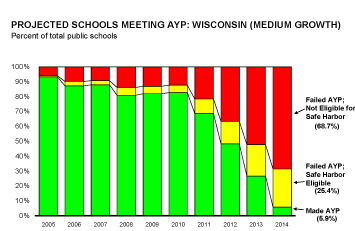
From “The Impact of the Adequate Yearly Progress Requirement of. the Federal “No Child Left Behind” Act on Schools in the Great Lakes Region,” a study released by the Great Lakes Center for Educational Research and the Education Policy Studies Laboratory at Arizona State University. See also “Many States Have Taken a “Backloaded” Approach to No Child Left Behind Goal of All Students Scoring ‘Proficient'” from the Center on Education Policy.
On June 24, The Department of Public Instruction will release the preliminary Adequate Yearly Progress Reports on schools and districts in Wisconsin, as required by the No Child Left Behind Act. My guess is that MMSD will have a higher number of “failing schools” this year. Think of Madison as being “ahead of the curve.”
AYP is not the best gauge of the work our district is doing; NCLB isn’t a good law and AYP is ridiculous yardstick.
If the flaws in and political manipulation behind NCLB weren’t obvious already, an interview with former Assistant Secretary for Elementary and Secondary Education Susan Neuman in the new Time magazine confirms what we already knew. Excerpts below.
There was always something slightly insane about No Child Left Behind (NCLB), the ambitious education law often described as the Bush Administration’s signature domestic achievement. For one thing, in the view of many educators, the law’s 2014 goal — which calls for all public school students in grades 4 through 8 to be achieving on grade level in reading and math — is something no educational system anywhere on earth has ever accomplished. Even more unrealistic: every kid (except for 3% with serious handicaps or other issues) is supposed to be achieving on grade level every year, climbing in lockstep up an ever more challenging ladder. This flies in the face of all sorts of research showing that children start off in different places academically and grow at different rates.
Add to the mix the fact that much of the promised funding failed to materialize and many early critics insisted that No Child Left Behind was nothing more than a cynical plan to destroy American faith in public education and open the way to vouchers and school choice.
Now a former official in Bush’s Education department is giving at least some support to that notion…
[T]here were others in the department, according to Neuman, who saw NCLB as a Trojan horse for the choice agenda — a way to expose the failure of public education and “blow it up a bit,” she says. “There were a number of people pushing hard for market forces and privatization.”
Neuman also regrets the Administration’s use of humiliation and shame as a lever for school reform. Failure to meet NCLB’s inflexible goals meant schools would be publicly labeled as failures. Neuman now sees this as a mistake: “Vilifying teachers and saying we are going to shame them was not the right approach.”
The combination of inflexibility and public humiliation for those not meeting federal goals ignited so much frustration among educators that NCLB now appears to be an irreparably damaged brand. “The problems lingered long enough and there’s so much anger that it may not be fixable,” says Neuman. While the American Federation of Teachers was once on board with the NCLB goals, she notes, the union has turned against it. “Teachers hate NCLB because they feel like they’ve been picked on.”
Is there a way out of the mess? Neuman still supports school accountability and the much-maligned annual tests mandated by the law. But she now believes that the nation has to look beyond the schoolroom, if it wishes to leave no child behind. Along with 59 other top educators, policymakers and health officials, she’s put her name to a nonpartisan document to be released on Tuesday by the Economic Policy Institute, a Washington think tank. Titled “A Broader, Bolder Approach to Education,” it lays out an expansive vision for leveling the playing field for low-income kids, one that looks toward new policies on child health and support for parents and communities. Neuman says that money she’s seen wasted on current programs should be reallocated accordingly. “Pinning all our hopes on schools will never change the odds for kids.”
The right wing attack machine turned on Scott McClellan when he belatedly told the truth. We can expect the same treatment for Neuman.
Thomas J. Mertz
James Brown, “Don’t Be a Dropout.”
Lots of news about dropouts and graduation rates recently.
Education Week just published their Diplomas Count report. It is pretty alarmist. Graduation rate scholars Jim Heckman, Paul LaFontaine, Larry Mishel, and Joydeep Roy raised some issues with how Education Week counted (hat tip to eduwonkette, one of my new favorite education bloggers):
In our examination of the data and methodologies available to estimate high school graduation rates we have found that insights can be gained from household surveys and from administrative data on student enrollment and diplomas granted. However, we find the measures of graduation rates in Education Week’s Diploma Counts project, computed from diploma and enrollment data, to be exceedingly inaccurate. The main problem is the assumption that the number of students enrolled in 9th grade is the same as the number of students entering high school. This assumption artificially lowers the estimates of current graduation rates, especially for minorities who are more likely to be retained (repeat 9th grade). This measure also artificially reduces the growth of the graduation rate over time because the practice of grade retention has grown over time, again, especially among minorities.
The resulting errors are sufficiently large to artificially lower the graduation rate by 9 percentage points overall and by 14 percentage points for minorities. Grade retention also differs sharply across states and localities, distorting geographic comparisons. Last, these measures do not reflect the ultimate graduation rates of a cohort of students because the data do not capture diplomas provided by adult education and other sources than schools.
Paper from Heckman and Lafontaine, here; Paper from Mishel and Roy, here.
The Wisconsin State Journal editorialized in favor of adopting the graduation rate measure endorsed by the National Governor’s Association (NGA) as a single national standard (Leslie Anne Howard of the Dane County United Way had an op. ed., mostly in support of this position). There is much to be said in favor of national statistical standardization, but if the adopted standard is flawed, you open the door to a new set of problems. The NGA measure is largely based on the one used by Florida. Sherman Dorn notes some “troubling issues” with the Florida rate calculations:
- The inclusion of alternatives to standard diplomas in the graduation numbers, with no public disaggregation
- The exclusion of alleged transfers and movers from the base (creating an adjusted cohort) without any data quality checks to ensure that transfers really show up at a private school or in another state
- The exclusion from the base (adjusted cohort) of students who drop out and immediately enroll in GED programs (as transfers to adult programs)
He also has some nice general thoughts on what to look for in graduation rate calculations here and here (lots more on his site, browse around or do a search; his posts are very accessible for those of us who are not steeped in the swamp of grad rate measures).
Information on how Wisconsin calculates dropout and completion rates. Many of the issues noted in the critiques of the various measures are present with Wisconsin’s. MMSD posted am 81.8% “regular diploma” completion rate in 2006-7, but there are great disparities among the rates for white students (90.4%), African American students (61.6%) and Hispanic students (60.8). The 2006-7 dropout rate was 2.699%, also with pronounced racial disparities (data can be accessed here).
Finally, this story in the Cap Times on Operation Fresh Start, (which has a GED component). By the way, I think this is a fine use of Wal-Mart’s money, but I still wish our legislators would get them to pay their fair share of taxes (some recent progress, but a long way to go).
Thomas J. Mertz

From Milwaukee Public Schools, 2006-7 School Report Card (click to see full report card). When value added is implemented in MMSD, we can expect similar reporting. Note that the gray areas are “error bands,” indicating 95% confidence intervals.
From an email sent by a DPI employee to Peter Sobol of the Monona Grove Board of Education.
… The WKCE is a large-scale assessment designed to provide a snapshot of how well a district or school is doing at helping all students reach proficiency on state standards, with a focus on school and district-level accountability. A large-scale, summative assessment such as the WKCE is not designed to provide diagnostic information about individual students. Those assessments are best done at the local level, where immediate results can be obtained. Schools should not rely on only WKCE data to gauge progress of individual students or to determine effectiveness of programs or curriculum.
From the WCER Value Added Research Center (contracted with MMSD and MPS).
Benefits of Value-Added Methods
Value-added methods “get the story right” by correcting for errors in the test scales, identifying and adjusting for bias in the administration of the test, in student participation, or in classroom treatments. In addition, one of the overriding goals of the work is to be transparent and fair. It is in everyone’s interest for schools to be as productive as possible for all students.
All teachers should be able to deeply understand and discuss the impact of changes in practice and curriculum for themselves and their students. Leaders should be able to make resource allocation decisions (money, staffing, etc.) informed by the best available data. Value-added methods can both showcase high levels of achievement as well as reward those who have mastered the art of improvement.
The MMSD value added analysis will rely on WKCE tests.
Anyone see a problem?
I’ve been working on a long post about the basics, benefits and limits of Value Added Analysis. Still a lot of work to do on that. Till then, here are two recent stories from Education Week (registration may be required).
New Uses Explored for ‘Value Added’ Data
Scrutiny Heightens for ‘Value Added’ Research Methods
Thomas J. Mertz
Filed under Accountability, AMPS, Best Practices, education, Local News, Quote of the Day, Uncategorized

Curtis Mayfield and the Impressions — We’re a Winner (listen)
The Wisconsin Knowledge and Concepts test results for November 2007 have been released (this lag of over six months make the results nearly worthless as a formative assessment for timely targeting at the school, class or individual level). I’ll have more to say about Madison’s results in the coming week or weeks (see here for the District analysis, here for the Cap Times story, and here for the Wisconsin State Journal’s).
Right now I just want to brag on my son’s school, James C. Wright Middle School.
In almost every category and on almost every test, Wright Students scored very well. For me most importantly, with very few exceptions the economically disadvantaged and English Language Learner students out performed their peers in Madison and in Wisconsin. This is a school with an 85%+ poverty rate, 90% minority population, beating the odds and achieving success for (almost) all.
Here is the chart for reading by economic status.

And reading by English Proficiency (something strange with the terminology when 63% of students labeled Limited English Proficient score advanced or proficient in reading).

The obvious question is “what is Wright doing right?” My answer is many things, most of which would not turn up in a Value Added Analysis and if they did would be difficult to reproduce. Chief among these are Leadership, staff and community. Principal Nancy Evans does a great job (as recognized by Wisconsin Urban Schools Leadership Project). The staff works hard and smart and works together (the last is partially a product of leadership). There is a school community and it is a community school; The staff, parents, students and much of the central Southside have a sense of ownership with Wright (this is in part a product of history, but it is a legacy that has been nurtured).
Other factors that may be reproducible are that Wright is a small school and it has the least ability grouping or tracking of any of the middle schools in Madison.
It is also a charter school, but as anyone familiar with Wright knows, it really functions more as a magnet/specialty school.
Congratulations to the Wright community for job well done (not mission accomplished, the work goes on). Panther Pride!
(Note that to access fuller data go to the WINSS site. Because of the way the site handles cookies, linking is difficult).
Thomas J. Mertz
Filed under Accountability, AMPS, Best Practices, education, Equity, Local News, Uncategorized

The Board of Education will consider and vote on a new equity policy on Monday. There will be public appearances.
In my opinion the draft policy is a huge step backward, from the work of the Task Force, from the direction the Board had been going and from the current policy.
The key is “what does the Board do with the policy.” At the prior meeting on Equity the Board worked with a document that included “considerations for determining whether equity is or will be provided” . These were the answers to that question, they moved from words to action.
The minutes of the April 21 Board of Education meeting (the last time equity was on the agenda) read:
“It was moved by Johnny Winston, Jr. and seconded by Lucy Mathiak to keep the Definition, Assumptions, and Goals and to ask the Superintendent for formulate a policy that incorporates the Considerations and bring it back to the Board. Motion unanimously carried.“
The “draft policy” for Monday doesn’t “incorporate” the “Considerations,” it simply eliminates them.
I’ll add that the reporting measures in the draft policy are very, very thin (thinner than the current, really nothing more than NCLB and State laws require in terms of reporting) and that there are no actions contemplated at all in the policy.
I don’t know what happened, why there are no “Considerations” or contemplated actions in the draft. Maybe the work on the “Considerations” and other things will go forward in a different way at a different time, but I think that it is a very bad move to enact such a “do nothing” policy. Join me Monday at the meeting to find out what’s going on and stop this before it is too late (there will be public appearances).
While I’m on my soap box, I want to add that there are some things — like the socio-economic diversity, open access to advanced programming, support for heterogeneous classrooms, early childhood/4k — where we recommended specific policies and actions and the Board has never in any form discussed, considered or addressed the recommendations (note, despite what some think, the Task Force never expected to “restrict” the Board’s “exercise of independent judgment” or “tell” any Board member “what to do,” but we did expect the Board to give our recommendations thorough exploration and apply their collective judgment This still seems like a reasonable expectation). Even with the ‘Considerations,” there is more work to be done.
I hate to see all the work of the Task Force, the Board of Education and the Administration end with a policy that is next to useless.
There is a certain strangeness that a member of the Task Force (me) which has been mischaracterized as being overly concerned with words is now protesting a draft policy because it is little more than words in a policy book. Of course if this policy is passed, then the critique will be correct, but the fault will not lay with the Task Force.
Thomas J. Mertz
Filed under Accountability, AMPS, Best Practices, education, Equity, Local News, Take Action, Uncategorized
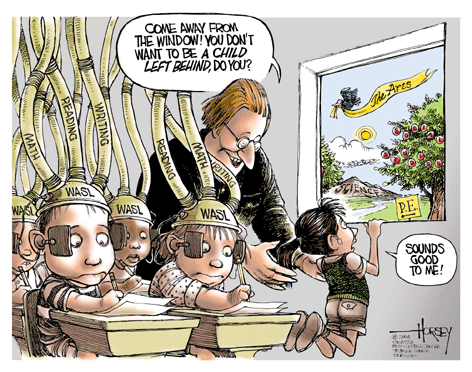
I’m going to start trying to post regularly on No Child Left Behind. This is the first (or second) collection of links and excerpts.
Education Secretary Margaret Spellings was before the House Appropriations Committee recently. The Chronicle of Higher Education reported on the session.
Democrats were harsh, with Rep. Jesse L. Jackson Jr. of Illinois calling the administration’s budget priorities “a bunch of garbage,” and Rep. Rosa L. DeLauro of Connecticut saying she was glad today was the last time she had to hear Ms. Spellings defend the president’s priorities. But Republicans were barely kinder, with Rep. John E. Peterson of Pennsylvania saying the administration’s budget “puts a zero priority on technical education,” and Rep. Dennis R. Rehberg of Montana accusing Ms. Spellings of neglecting American Indians. “I don’t know what you guys are smoking over there,” Mr. Rehberg told Ms. Spellings, “but it just ain’t working.”
The United Church of Christ has some wonderful anti-NCLB resources. I think my favorite is Ten Moral Concerns in the No Child Left Behind Act.
1. While it is a civic responsibility to insist that schools do a better job of educating every child, we must also recognize that undermining support for public schooling threatens our democracy. The No Child Left Behind Act sets an impossibly high bar—that every single student will be proficient in reading and math by 2014. We fear that this law will discredit public educationwhen it becomes clear that schools cannot possibly realize this utopian ideal.
6. The No Child Left Behind Act blames schools and teachers for many challenges that are neither of their making nor within their capacity to change. The test score focus obscures the importance of the quality of the relationship between the child and teacher. Sincere, often heroic efforts of teachers are made invisible. While the goals of the law are important—to proclaim that every child can learn, to challenge every child to dream of a bright future, and to prepare all children to contribute to society—educators also need financial and community support to accomplish these goals.
7. The relentless focus on testing basic skills in the No Child Left Behind Act diminishes attention to the humanities, the social studies, the arts, and child and adolescent development. While education should cover basic skills in reading and math, the educational process should aspire to far more. We believe education should help all children develop their gifts and realize their promise—intellectually physically, socially, and ethically. The No Child Left Behind Act treats children as products to be tested, measured and made more uniform.
9. The No Child Left Behind Act exacerbates racial and economic segregation in metropolitan areas by rating homogeneous, wealthier school districts as excellent, while labeling urban districts with far more subgroups and more complex demands made by the law as “in need of improvement.” Such labeling of schools and districts encourages families with means to move to wealthy, homogeneous school districts.
The Center on Education Policy has issued a new report on the curriculumn narrowing which has resulted from the high stakes testing in math and reading.
Among the districts that reported both increasing time for ELA or math and reducing time in other subjects, 72%indicated that they reduced time by a total of at least 75 minutes per week for one or more of these other subjects. For example, more than half (53%) of these districts cut instructional time by at least 75 minutes per week in social studies, and the same percentage (53%) cut time by at least 75 minutes per week in science.
Some news on the “opt out” front (states, districts, schools and students considering refusing to comply with the law). Virginia is on the edge of leaving NCLB behind (hat tip to Jim Horn at Schools Matter). The Carol Stream (IL) Elementary District 93 has decided not to force children who don’t speak and read English to take tests writen for English speakers (this is a violation of the law…another tip of the hat to Jim Horn is in order).
District 93 officials say they’re willing to break the law this spring to shield students from the frustration and humiliation of taking an exam not designed for them.
“The board believes it’s appropriate to do that,” District 93 Superintendent Henry Gmitro said. “While there may be consequences for the adults in the organization, we shouldn’t ask kids to be tested on things they haven’t been taught.”
Illinois dropped the test that was designed for English learners this fall, after the U.S. Department of Education made a final ruling that the test wasn’t an adequate measure of state learning standards. The old test was written in simpler English.
As a stopgap measure, English learners will take standard assessments with some special accommodations, such as extended time and audio recordings, while Illinois develops a test that will meet federal guidelines.
Locally, the Wisconsin Peace & Justice Network is asking people to identify alternate uses for the money that is being spent on the Iraq war. According to their figures, Madison taxpayers have contributed about $300 million. After fully funding free quality early child education and restoring MMSD’s cost to continue cuts of the last few years, I would suggest Madison opt out of NCLB at a cost of about $5 million per year. We can dream.
Last, I’ve added a new blog to the Resources page: the NEA’s NCLB – It’s Time for a Change!. Check it out.
Thomas J. Mertz
 Fund a Classroom Project in Madison
