
Click on image for PDF flier.
Click on image for PDF flier.
Filed under AMPS, Elections, Local News, School Finance, Take Action

(1924 National American Ballet)
Contrast the excellent coverage of what’s at stake for the various referendums taking place this coming Tuesday by my colleague TJ Mertz, in the post immediately below this one, with what was reported yesterday in the Wisconsin State Journal regarding three local ones chosen for coverage.
Three area school districts are holding referendums Tuesday — two say it’s to avoid the presidential election hoopla and another wants to finalize its budget as soon as possible.
Deerfield, Mineral Point and Weston school districts are each asking to exceed the revenue limit in order to pay for everything from daily operating expenses to maintaining staffing levels.
This type of coverage reflects the difficulties Madison will face in it’s referendum in November, this breezy piece failed to mention one of the basic W’s of good journalism – “why.” Why are these districts forced to go to referendum? For the low information voter reading about about one of these referendums for their community for the first time, they may wonder, why haven’t these school boards learned to live within their means during these tight economic times? Legitimate question, but the piece doesn’t provide the answer – it’s a dysfunctional state school finance system. A sentence or two would have sufficed. Instead, the reader is left to draw their own conclusions. I’ve brought up this issue previously of troubling referendum coverage that ignores the “why” of the story, with another journalist from the State Journal who replied to my critique (ironically enough, part of his piece was on the last failed referendum in Weston). It’s a pity the editors at the Journal have missed another opportunity to explain this budgeting shortfall, for one of the most critical functions of our government, educating our children.
Robert Godfrey
Filed under "education finance", AMPS, Budget, education, Elections, finance, Gimme Some Truth, Local News, Referenda, referendum, School Finance, Uncategorized
[Updated with more video on Montello, Sptember 7, 2008, 11:45AM]
The number of school districts seeking sufficient funding via referenda this Fall (September and November) keeps growing. My count is 20 districts committed to 23 referenda questions (12 questions in September), and this does not inlcude the Madison referendum, which will become official on Monday, September 8.
Do we really need any more evidence that the way Wisconsin funds schools doesn’t work? As Beth Sweeden exemplified so well in “I Just Want to Be A School Volunteer Again,” (her open letter to the Joint Finance Committee a year and a half ago), too many good people — educators, parents and others — are putting too much energy into trying to address the structural budget gaps the system creates, energy that could and should be spent working to help educate and improve our schools.
Today I am mostly going to write about the operating referenda not related to new capital projects to be held next Tuesday, September 9. I’ll get to the November 4 measures eventually.
The debt/building votes include two from Colby (see here and here for more); Poynette seeking $13.4 million to build and equip a new K-3 school; Rhinelander is asking for $23.575 Million for a variety of building and upgrade projects and related operational costs (in a second question); and Shawano is requesting $24.9 million to build “a new energy efficient Early Childhood through grade 2 school; [make] improvements [to] and [build] an addition to the Olga Brener elementary school to convert it to a grade 3 through 5 facility; and equipment acquisition related to said projects.” The Shawano Leader has some good stories (including “New school could be boon to economic development“).
That leaves seven operating referenda being voted on Tuesday.
Deerfield, after extensive community input and involvement, is asking for five year non-recurring authority to address structural operating revenue gaps in amounts ranging from $275,000 to $475,000 per year. I liked this from the Community Advisory Committee’s Final Report:
Ideally, some time in the next 5 years the Wisconsin State Legislature will come up with a more sane way of funding K-12 education than pitting schools against homeowners. (We can always hope…).
I was also impressed with the district referendum web page.
Another Madison neighbor, Mineral Point, has a five-year nonrecurring referendum on the ballot. The annual amounts escalate from $590,000 to $1 million. The district’s referendum documents are here. This is from the “Why a Referendum” document:
The Referendum Remedy
The revenue gap and the declining enrollment penalty are built into Wisconsin’s school funding formula. Together they ensure under funded schools. State law allows school districts to exceed the revenue limit, but only by conducting a referendum vote.
Preserving Quality Education
School quality means many things to many people and Mineral Point has high expectations for its schools.
- Quality means good instruction in core academic classes and Mineral Point students out perform students statewide on nearly all measures.
- Quality means providing opportunities in the fine arts, world languages, career and technical courses, health, PE, and extra and co-curricular activities.
- Quality also means providing program variety so that students of varying interests and abilities can pursue a meaningful educational path.
- Quality means being able to attract and retain quality staff members who are highly skilled, motivated and hard working. And that means competitive wages and benefits, ongoing training, the tools to work with and reasonable workloads.
The only path to maintaining quality education is via referenda. This has to change.
Montello will also vote on a nonrecurring operating referendum on September 9. After three failed referendums in the last year or so, they are only asking for two years at $950,000. Consolidation talks with Westfield continue and dissolution is very much on people’s minds. Administrator Jeff Holmes broached the topic back in July, now Board Member John Sheller is “scared to death” about the possibility. Here is a video report from WKOW-TV:
And another from WISC-TV.
If the referendum fails, we may have another Florence or Wausaukee to deal with.
It is nice to see the Madison media cover this story. It would be better yet if they did more with the big story of how the way all districts are funded makes it extremely difficult to maintain quality education and they should place the pending Madison referendum in this larger context.
Neillsville had a failed referendum in 2006, now they are asking for a five-year non recurring authority in the amount of $300,000 a year. According to the district fact sheet, because of declining enrollments and rising property values passing the referendum will still result in property tax mill rates going down in the district. Video from WEAU on this one:
Neillsville, like all districts, is facing rising energy costs and would like to invest in greater efficiencies for long-term savings, but are unable to under the revenue caps. The referendum would not only preserve educational quality, it would allow them to take this important step.
The small Rubicon Joint 6 district is trying for a three-year nonrecurring at $150,000 a year. In the recent past, they have eliminated World Languages and instructional aids, reduced Physical Education, Art, Music, Reading Specialists, Guidance, and Library services. They have prepared the following cut list for consideration in the event of a failed referendum:
Eliminate Cleaning (currently 50%)
Eliminate Guidance (currently 40%)
Eliminate Secretarial/Tech support (currently 80%)
Eliminate Writing tech (currently 20%)
Eliminate PE (currently 60%)
Eliminate Art (currently 25%)
Eliminate General Music (currently 25%)
Eliminate Instrumental Music (currently 25%)
Eliminate Instructional Aide (currently 50%)
Eliminate Forensics
Eliminate Student Council
Eliminate School Nurse
Eliminate Athletics
Eliminate Librarian (currently 20%)
Eliminate Library Aide (currently 80%)
Reduce Administrator 40%
No new text books
Minimal Support Staff Salary Increase
Increase student fees $20/child
Increase Athletic fee to $40 per child
Reduce tech upgrades to $1,000 per year
No additional middle school lockers (currently more students than lockers)
No new English text books
Reduce classroom supplies
Is there any doubt that these cuts would harm the education of the students?
The Salem School District voters will decide on a $1.16 million recurring referendum on Tuesday. In June a smaller four-year nonrecurring referendum failed by 34 votes out of 504 cast. Major cuts loom there too. Technical Education and Gifted and Talented may be eliminated, class sizes will increase up to 29 or 30, Chior and languages would be reduced, a total of 13 staff postions would likely be cut (see here, here and here for more details). Insanity.
Last, but not least is Weston. An April vote on a recurring referendum failed 395-364 (much more here). The new proposal is nonrecurring at $210,000 the first two years and $575,000 the last year. Like elswhere, the cuts have been going on for a long time and getting deeper each year. Republican State Senator Dale Schultz (a favorite on AMPS) was quoted on the referendum in Weston and a possible future referendum in Reedsburg:
“It’s just a dirty shame people have to put so much time and effort into another referendum,” Schultz said…
Schultz praised Weston administration and school board for doing all they could under the existing system.
“They have done an excellent job being fiscally responsible,” Schultz said. “I don’t know what more people could expect from a school district.”
Maybe he read Beth Swedeen’s letter. It sure sounds like it.
I wish all the districts well and hope they all pass. Check back after Tuesday for the results and updates on the November referenda in the weeks ahead.
Thomas J. Mertz

It wasn’t until after a recent school board meeting while listening to the views of a vote no taxpayer that “it” hit me. This opponent of the upcoming referendum will vote no due to rising taxes in his township. He said, “I can no longer afford to pay the $50 a year that it will cost me to support the Rhinelander School District’s referendum because my township continues to raise my taxes and I need this $50 to pay for those.”
It was at this moment that the “Catch 22” hit me and I realized that school districts are at such a disadvantage. Taxpayers have little say over tax increases from other governmental agencies when they need something, yet schools are required to get voter approval. The fallout of this situation is school districts so often being wrongly accused and somehow responsible for rising taxes, along with the divisions in the community. He said, “The $50 per year that it will cost me for a successful referendum is just too much to support education, students, and our community.”
Mr Wall is exactly right. I am reminded of the fact that the City of Madison is budgeting based on a 4% annual increase. School districts under the revenue caps budget for increases of about 2.5% and require referenda to issue debt over $1 million.
Thomas J. Mertz
Community and Schools Together has posted a new video on their web site. It explains why a recurring referendum (like the Board of Education voted in favor of) is better than a nonrecurring referendum.
You can see all the videos from the 2006 referendum campaign here.
Thomas J. Mertz
Filed under "education finance", AMPS, Budget, education, Elections, finance, Local News, Referenda, referendum, School Finance, Take Action

Chuck Berry, “Don’t You Lie To Me” (click to listen or download)
In his predictable screed against the November 4, 2008 Madison school referendum, Dave Blaska makes at least two statements that are demonstrably false.
Today, housing values are plummeting; unemployment is edging up…
The chart above shows housing value trends. After a drop in January, the general direction is up; by about $20,000 since the first of the year on both average and median. Sales have slowed and both the average and the median are down slightly in year-to-date measures, but one look at this chart and others reveal how unsupportable the verb “plummeting” is. There is a slight downward trend for August, but if you look at prior years there have been downward trends in August since at least 2005. According to the Dane County Real Estate Blog:
The Dane County market certainly needs to get better (especially the condo market), but once again the national numbers show that we’ve avoided the meltdown that is occurring in other parts of the country.
Blaska is even further from the truth on unemployment. According to the Department of Workforce Development’s latest report unemployment in Madison dropped 0.3% in July, is the same as it was one year ago, is the lowest rate of any Wisconsin Metro area, is 1.2% below the state rate (unadjusted) and 2.4% below the national rate (unadjusted). Sorry Dave, going down, not up and doing very well in comparisons.
Better luck next time you decide to pull “facts” out of thin air.
One reason Madison continues to attract jobs and homebuyers is the quality of our public schools. Keep our community strong and prosperous, Vote Yes for Schools!
Thomas J. Mertz
Filed under "education finance", Budget, education, Elections, finance, Gimme Some Truth, Local News, Referenda, referendum, Uncategorized

We have a referendum!
Community and Schools Together (CAST) has been working to educate the public on the need to change the state finance system and support referendums that preserve and expand the good our schools do. We are eager to continue this work and help pass the referendum the Madison Metropolitan School District Board of Education approved on Monday, August 25, 2008.
“The support and interest from everyone has been great,” said Franklin and Wright parent and CAST member Thomas J. Mertz. “We’ve got a strong organization, lots of enthusiasm, and we’re ready to do everything we can to pass this referendum and move our schools beyond the painful annual cuts. Our community values education. It’s a good referendum and we are confident the community will support it.”
Community and Schools Together (CAST) strongly supports the Madison Metropolitan School District Board of Education’s decision to place a three-year recurring referendum on the November 4, 2008 ballot. This is the best way for the district to address the legislated structural deficit we will face over the next few years.
This responsible approach provides time for the MMSD and the community to engage in the strategic planning that will take our already excellent schools to the next echelon. It will also establish a solid foundation for setting future budgets, justifying future referendums, and working for state finance reform. Such a process could be easily derailed if the community and district become distracted by discussion of major reductions in programs and services. At little cost to taxpayers, the Board’s action has given our community an opportunity to enter the Superintendent Nerad era in a way that will allow us to make good use of his talents and contributions.
“If we want to look at the big picture and plan for the future, we need the certainty that a recurring referendum provides,” stressed Hamilton Middle School parent and CAST activist Jerry Eykholt.
Since 1993 the district has reduced programs and services by over $60 million, even as other costs have continued to rise. The proposed referendum will provide basic operating funds to maintain the existing programs and services in Madison’s schools. Over the last fifteen years more than $60 million of programs and services have been cut. Without a referendum the cuts will continue at ever higher levels.
“Without the referendum, the preliminary areas identified by Superintendent Nerad and his staff for further cuts would create unwarranted stresses on our students, making it much harder to provide the education they deserve,” said Deb Gilbert, a CAST member and parent of two children at Leopold.
CAST is confident that the board and administration understand this referendum simply provides the authority to exceed revenue limits and, with the community, will continue to seek additional efficiencies and limit levy amounts to that needed to ensure a sound education for Madison’s children.
“I like the partnership aspects,” said CAST Treasurer and Falk parent Jackie Woodruff. “They clearly understand that we all need to work together to make the best use of the resources the community provides.”
A three-year referendum is a responsible way to allow the community and district to engage in a strong partnership to ensure the future success of Madison schools and students while minimizing the impact on children and tax payers.
CAST is proud of the quality of Madison’s schools and what they have achieved, even as resources have been cut and the needs of our population have grown through rapidly changing demographics-evidence of the dedication and creativity of the MMSD staff and the Madison community. Quality public education is essential to maintaining the economic health and quality of life of our community.
“We need to keep our schools strong-they are at the heart of our neighborhoods and what makes Madison such a great place to raise children” said Jill Jacklitz an activist with CAST and parent at Marquette and Lapham.
CAST is a grassroots organization of parents, educators, and community members that is dedicated to educating the citizens of Madison about school funding referenda in the Madison Metropolitan School District.
If you believe quality public schools for all is an integral part of our democracy, join us in working to assure our schools have adequate resources. We look forward to sharing a positive message about the future of the MMSD. Visit www.madisoncast.org for more information or contact:Community and Schools Together, madisoncast@sbcglobal.net.
Since I am active with CAST and quoted in the statement, now would be a good time to clarify some things.
CAST is a coalition of people dedicated to working for the passage of school referenda and educating on state school finance reform. Decisions are made collectively. Individuals involved differ on many matters related to school issues, even those related to referenda and school finance reform. As a group, we do and say what the group thinks best.
I also blog here and write about what I — as an individual — think is best. What I write or say, here or elsewhere, as an individual should in no way be considered to reflect the beliefs of CAST as an organization. Anything from CAST will be clearly labeled as such. Anything else is just me on my soapbox.
This should be obvious, but I think it needed saying.
Thomas J. Mertz
Filed under "education finance", AMPS, Best Practices, Budget, education, Elections, finance, Local News, Referenda, referendum, School Finance, Take Action

The Madison Metropolitan School Board approved placing a three-year recurring referendum on the November ballot and enacted tax mitigation policies Monday, August 25, 2008. This is a good referendum, a good package and if passed will help create a positive atmosphere for the anticipated strategic planning that will make our schools even better while minimizing the costs to local taxpayers. Much more in the coming hours, days, weeks and months.
Just one thing that needs to be said now. Both before and after the vote opponents and other “watchdogs” cultivated deliberate misunderstanding by labeling the recurring referendum a “(virtual) blank check.” It is nothing of the sort. It is a “check” (taxation authority to exceed the revenue caps by up to) for $5 million the first year, $9 million the second year and $13 million each year thereafter. A blank check is a check that may be written in any amount; this referendum asks for specific authority up to a maximum. The idea of a “virtual blank check” is illogical demagoguery. Either a check is blank or it isn’t; it is like being a “little bit pregnant,” no such thing. Those who are pushing this line are insulting the people of Madison.
Thomas J. Mertz
[There are three parts to this post: A news roundup, an explanation and analysis of the administrative proposal and my thoughts on why the first year of the referendum should be $6 million instead of the $5 million proposed. Although they are intertwined, the bulk of each part is presented in the order listed. — TJM]
Some clarifications on this report. Marjorie Passman is incorrectly identified as Lucy Mathiak. The “list of potential cuts” mentioned is very, very, very initial. It is a first effort to identify general areas that may be discussed for cuts. I heard more than one Board member grumble about what was in the list. Board President Arlene Silviera has promised to schedule a discussion of this list and potential cuts in general at a future date. I suggest all hold off on critiquing or complaining till that discussion takes place. We all know that $6 million to $8 million in cuts would be painful. For now, let’s just use our imagination as to where this pain would be experienced.
Some clarifications on this report. First the use of $2 million from the Fund Balance in the first year is based on an estimated $4 million growth in the Fund Balance as the 2007-08 year is closed out (more below). The “other” $2 million from the Community Services Fund (Fund 80) Fund Balance as part of the plan to minimize the tax impact, is actually a plan to decrease the Fund 80 levy by that in amount in 2009-10 and use excess money previously collected instead to fund on going Fund 80 programing.
OK, TV out of the way, now newspapers (radio will wait for another day). Both Tamara Madsen in the Capital Times and Andy Hall in the Wisconsin State Journal do fine jobs covering the proposal in all its complexity and reporting on the meeting. Me, I like to go to the source. Executive Summary – Three Year Financial Forecast here; Budget Gap Background and Recommendations here and video here.
That said, Madsen has a quote from Superintendent Dan Nerad worth citing:
We’re about two things here: one is ensuring that the needs of our kids are met to be educated well and the other is to be sensitive to taxpayers going forward.
And Hall quotes Marj Passman with a sobering reminder of what this is about:
[W]e’re desperate and we need this passed and even if it is passed we’re not adding anything back.
Supt. Nerad is calling this a partnership. So what’s the partnership and what’s the plan? The partnership is an addendum to the deal that was struck long ago when public education was established. At that time and since, our society has entrusted our children, our tax dollars and our futures to public schools with the understanding that the schools with the help of community members will educate the rising generation, create a society based on opportunity for all and be good stewards of the public funds provided for this most important work. While asking the voters for more funds via a referendum, Supt. Nerad demonstrates good faith and worthiness in two ways. First, the request is substantially less than is needed for “cost-to-continue” budgeting and there is a promise to meet these shortfalls by finding new ways to do things without sacrificing (and maybe improving) the quality of education. Second (but not unrelated), Supt. Nerad and Assistant Supt. Erik Kass have sought and found ways to minimize the impact of exceeding the revenue caps on local property tax payers. In other words, the addendum might read: “In exchange for a small increase in our revenue authority — less than 1.5% — we promise to use this increase responsibly to educate while doing our best to minimize the burden placed on local property taxpayers.”
This sounds like a pretty fair deal. I think it would be a better deal for our community if we upped the “small increase in our revenue authority” a bit.
I want to go through the details of the plan and my thoughts in three parts. First, what is (and is not) proposed for the referendum, then the ways that the costs to property taxpayers will be mitigated. Finally some words on why I think that the district should ask for more money in the first year. There will be some overlap.
The (Proposed) Referendum.
Recurring means that it is cumulative. The authority to exceed the revenue cap the second year will be $9 million and the third year and beyond $13 million. The advantages of a recurring referendum are two-fold: It allows for better long-term planning and it minimizes the gap and probable cuts to meet that gap in subsequent years. The disadvantage is that recurring referenda are more easily demagogued. I’m not sure why this is so, except that the words “Permanent Tax Increase” carry some emotional weight. Of course the same people who use this appeal complain about the lack of long-range planning. Consistency is rarely the strong suit of the complaining classes.
What isn’t proposed is preserving everything the way it is now. There will be cuts or reorganizations or reallocations each of the three years. They won’t be huge, they probably won’t be too divisive, but they will happen each year.
I value the fresh perspective and approaches Dan Nerad has brought. I am glad that there will be comprehensive strategic planning and that new ways of doing things will be implemented. I understand that this is being connected to asking for less than the gaps in the referendum and that is a legitimate connection.
I don’t think asking for this much less than the gaps is for the best. I think that in order for our children to realize the full benefit of contributions of the new administration we should authorize resources at least equal to a cost-to-continue budget. I’m not advocating keeping things as they are; I’m advocating reforms without cuts. I’m advocating $6 million for the first year (because of the recurring formulation, this also funds the subsequent years). This money can be used to do things like restore Ready-Set-Goals, revitalize the equity work of the district, expand funding of supplemental positions via something like the equity resource formula, fix some of the problems with class size and specials, initiate world languages in the early grades…and most importantly implement initiatives identified through the strategic planning process with less pressure to defund existing programs.
I think that as a community we can afford this. That brings me to the tax impact parts of the plan.
Mitigating the Property Tax Impact
As presented by Dan Nerad and Erik Kass, the tax impact mitigation plans have little directly to do with the referendum itself. It is likely that most of these would be implemented even if there was no referendum. However, they are indirectly related in two ways. First, they are a demonstration of the partnership principles that Supt. Nerad has articulated; second, in very real ways they make a referendum more affordable to the local taxpayers. I want to start this part of my consideration with a some charts from the administration’s presentation.
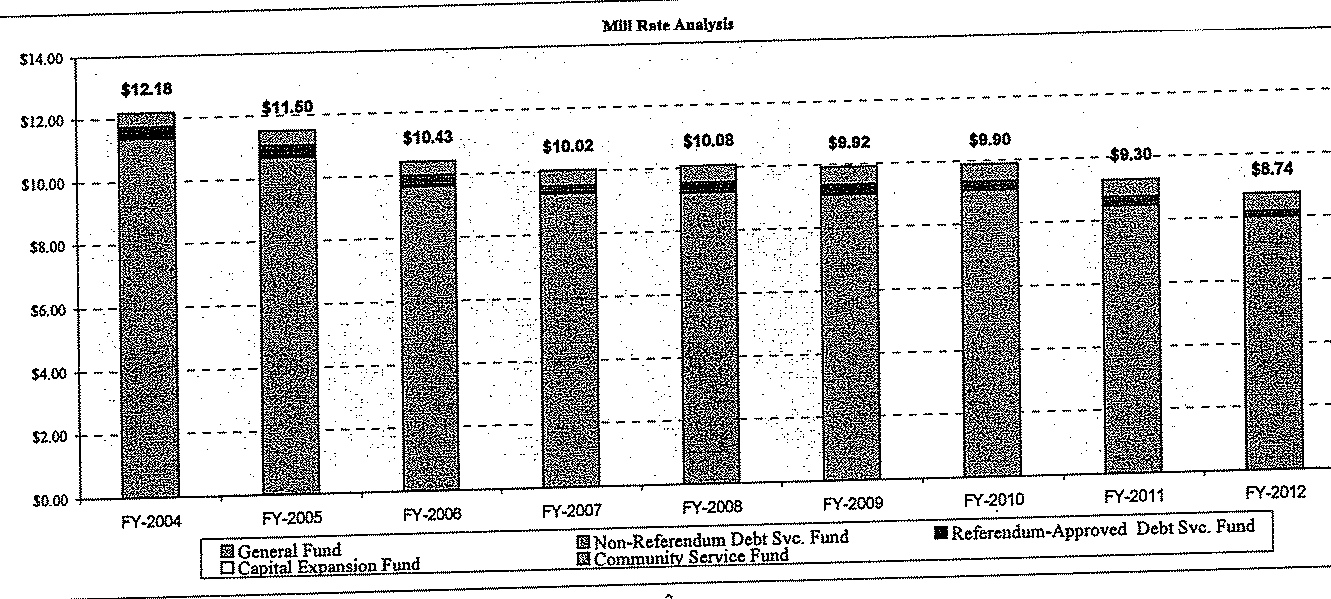
Mill Rate History and Projections without a Referendum
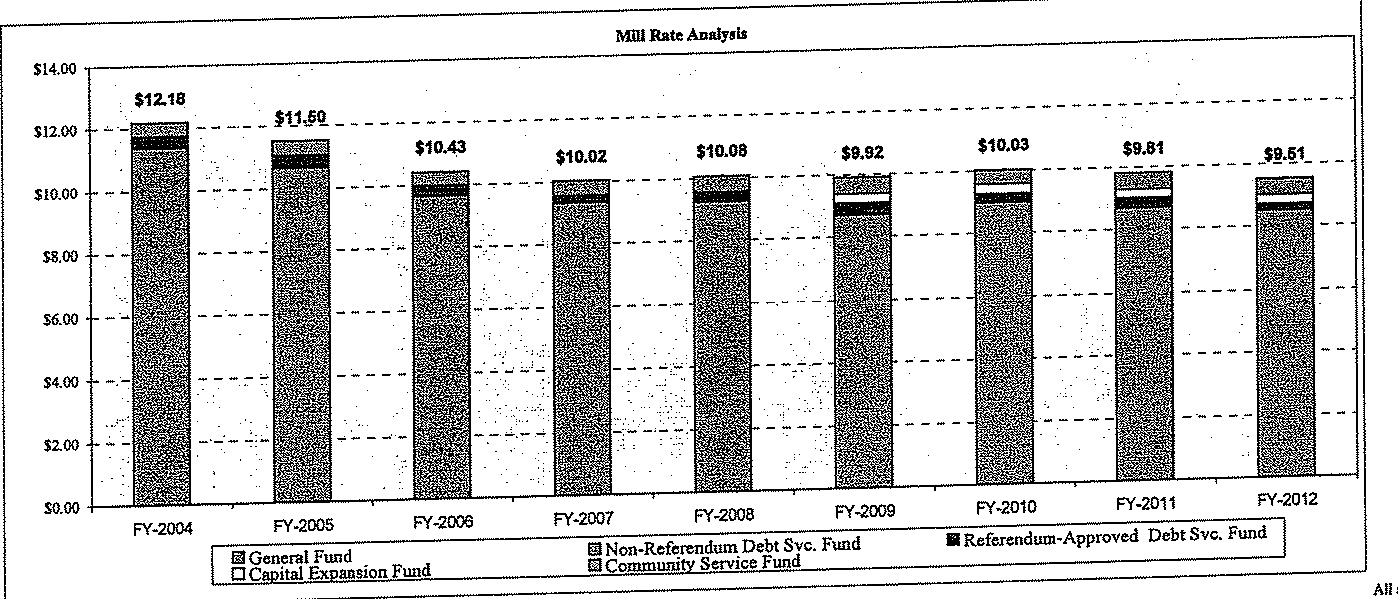
Mill Rate History and Projections With A Referendum, Other Administrative Proposals and Renewal of Maintenance Referendum.
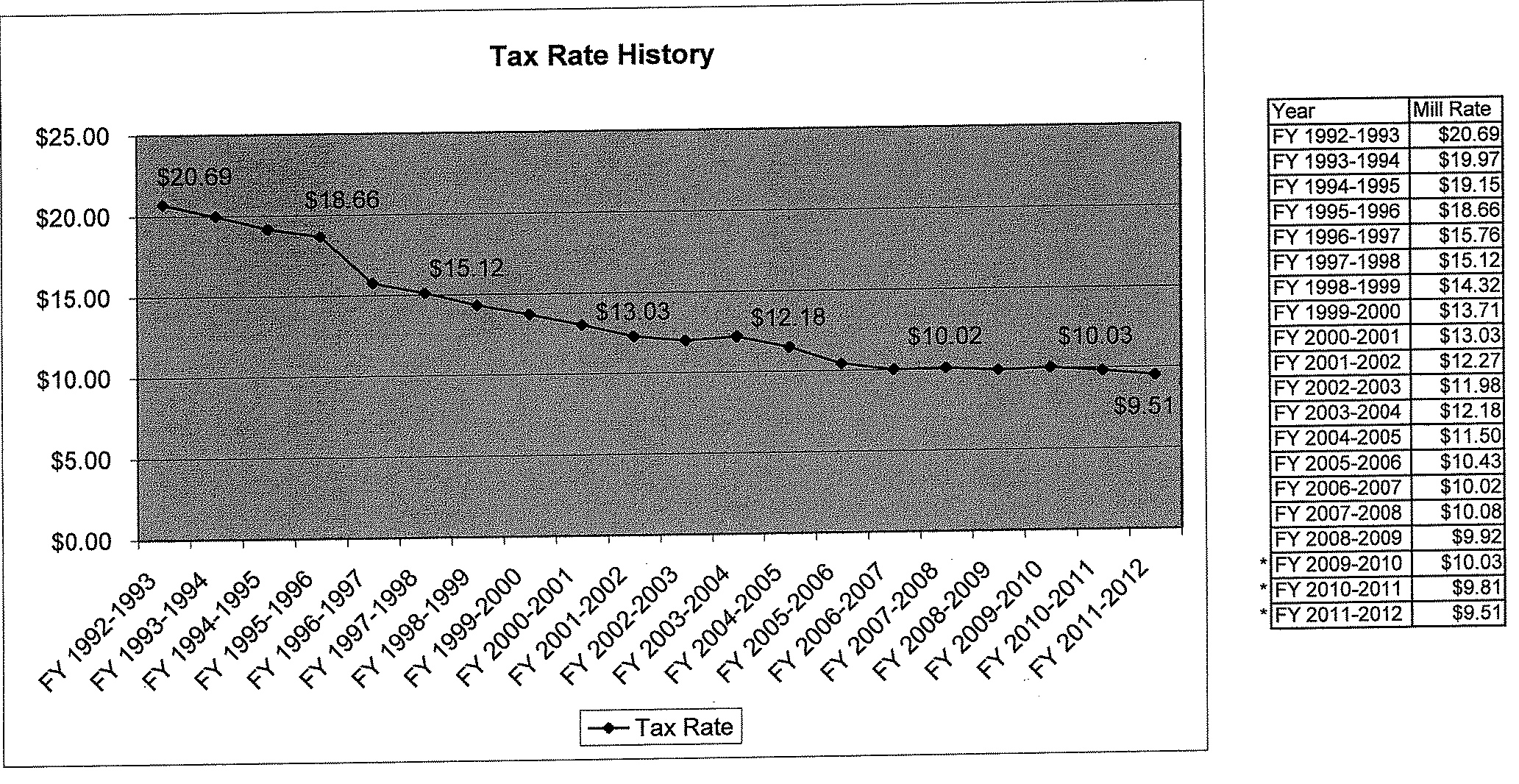
Mill Rate History and Projections with A Referendum, Other Administrative Proposals and Renewal of Maintenance Referendum
The first chart is the status quo. If there is no referendum and nothing else changes mill rates (taxes per $1,000 of property value) will resume their significant downward trend. With the exception of a very slight up-tick in 2007-8, the school mill rate has fallen steadily since 1992-3. For 2008-9, it is less than one half of what it was in 1992-3!
If there is a referendum and the proposed changes are enacted, the downward trend will also continue with the exception of another slight up-tick for 2009-10 (charts 2 and 3). The calculations I’ve seen say that for $250,000 home taxes will drop about $27.50 from the current rate in the second year and about $100.00 in the third.
This will be accomplished in four ways. First, by not seeking revenues to the amount of the projected gaps. Second, by slowing the rate of growth of the operating Fund Balance (Fund 10) and using some of the Community Service (Fund 80) Fund Balance to lower that levy without cutting programs. Third by moving money to a Capital Expansion Fund (Fund 41) which shifts the responsibility for some revenue from local taxpayers to the state (I’ll offer a more complete explanation at a later date). All of these are fiscally sound practices. The last piece is a conservative projection of 4% annual growth in the total value of property in the district.
Mitigate and Do the Right thing
I fully support all of these ideas for mitigating the tax impact, including not seeking the full gap amount. Where I differ is that I think we should seek closer to the gap and ask for $6 million in the first year. Our schools and our children are worth it.
Year 1: 13.24
Year 2: 11.54
Year 3: 10.68
The highest of these puts about where we were in 1999, when the revenue caps had been wrecking their damage for four years. By year three, mill rates would be back at 2005 levels.
I haven’t had a chance to project the tax impact on a $250,000 home for all three years (too many variables), but my initial calculation is that in the first “worst” year it would be $36.30, or about $9.00 more than what the administration proposed. For something as important as education, I think we can afford that much.
I want to leave numbers aside and talk about three things that I observed and heard today while registering my son for first grade. They are minor and they are indicative of what happens when we neglect our schools, or try to do things on the cheap.
On the entrance to the playground there is a ramp with concrete walls on either side. On one side the wall has crumbled and rebar is sticking out. The rebar is covered by empty plastic soda bottles taped on.
While on the playground, I spoke with the custodian. We talked about lots of things. My spouse asked if wood chips had been ordered (they are badly needed). He said they had, but the amount sent in the last few years has not been sufficient for all the surfaces that need covering.
We also spoke about snow removal. Apparently due to budget cuts, there are no longer removal crews assigned to specific schools (in all cases). Each snowfall brings different crews. Before this was the case, there was good communication about the particular characteristics of this school site and the crew knew where to plow and where not to, where to pile snow and where not to. Now it is random and the school custodians spend time each snowfall taking care of what was not done correctly.
A crumbling wall with dangerous metal protruding, a short load of wood chips and not staffing consistently aren’t huge things. Still they are things we should be able to afford to do right. I know we can’t afford them or many other things. I know we still have some Windows 98 computers in our schools.
What does this say about us that we haven’t cared enough to demand that this situation be fixed? What does it say about us that our school officials think that in order to get us to pass a referendum they need promise further cuts?
I’m not sure that the referendum as proposed will change any of this. It may help with some of these. It will keep things from getting (much) worse and that is very important.
I truly believe that quality public education is what creates and preserves prosperous and enjoyable communities; that public schools are the best tool we have for creating opportunities and overcoming inequality; that if we want the next generations to live in a better world our schools are the best tool we have for making that happen.
(If this passes) There won’t be another operating referendum for some time (maybe never if the state finance system gets fixed). Let’s do it right this time.
One more million in the first year and loads of possibilities open up. We can dream a little again. Wouldn’t that be great?
I’ll be working hard in support of a referendum as proposed by the administration (find out how to help by visiting Community and Schools Together), but I’d have a bigger smile on my face as I worked if the Board and the administration would askfor some more opportunities to dream.
Share your thoughts in the comments here and let the Board know what you think. Come to the Board meeting Monday, August 25 (last I heard, there will be public testimony) or write: comments@madison.k12.wi.us.
Thomas J. Mertz
[Slightly revised, 11:50 AM and 12:48 PM, 8/22/08]
Filed under AMPS, Best Practices, Budget, education, Elections, Equity, finance, Local News, Referenda, referendum, School Finance, Take Action, Uncategorized
Great news!
The vote total — 1,234 to 674 is impressive also.
I haven’t found an in-depth newspaper report on the vote yet, but WBAY also has a good story on how the health of schools and the health of communities are intertwined. In a similar fashion, Ken Krall at NewsoftheNorth.Net writes about “A time of discontent in the Northwoods.
In another arena, another school district is facing breaking up. Wausaukee residents will vote Aug. 19 to see if they can afford to keep operating. Recently, two referendums failed in Arbor Vitae.
Rhinelander voters on Sept. 9 will be deciding not on an operating budget per se, but rather whether the 1950s-era school buildings need remodeling.
I didn’t see anyone from the Department of Public Instruction with Doyle on the trip north, probably because of the reception they would receive. The current funding formula leaves the schools here against the wall. But the legislature seems ho-hum about the situation.
We hear about Wisconsin values, traditions and quality of life. Support for public education must be at the base of who we are and who we want to be. From the Northwoods to Milwaukee, schools are essential to preserving and expanding everything that we value about our communities and state. The people of Wausaukee figured that out. I think the people of Madison will come to a similar conclusion in November. I hope our elected officials join them and improve the school finance system in the next legislative session.
Thomas J. Mertz
Filed under "education finance", AMPS, Budget, Elections, finance, Local News, Referenda, referendum, School Finance, We Are Not Alone
 Fund a Classroom Project in Madison
 AMPS
AMPS 