One good thing from the meeting is that although no vote was taken, it is clear that the IRTs will not be cut this year.
Another ting that came out of the meeting was a next step for the Budget process. By Friday of this week, Board members will be submitting lists of the remaining Budget Options marked, yes, no and maybe. I assume that the unanimous “nos” will be removed from consideration at the April 12 meeting and hope that those with a strong majority will be too. If you want to weigh in before the lists are finalized, write the Board at board@madison.k12.wi.us.
I hope these are posted for public perusal in a timely manner (so that the public can contact the Board prior to any decisions).
It was also Johnny Winston Jr,’s last real meeting. Thanks for the service Johnny.
The Budget Book has been posted, but from the discussion Monday and my own quick skims, there are some problems. The biggest, but not only problem is that it doesn’t reflect significant changes that have already been decided, the Reorganization (PART 1, PART 2, PART 3)
being the most significant. I’ve been told that some sort of fix to this and other issues is in the works.
On Monday, there were references to pending Questions and Answers on the budget, but the Q&A page was last updated on March 28.
In other news, Jame Howard was victorious and will be joining the Board. Congratulations and best of luck James (too late to turn back now). I also want to thank Tom Farley for running and his desire to make a contribution to the community.
On Tuesday there were 48 school referenda on the ballot in Wisconsin, 24 passed. All 6 recurring operational measures failed; non-recurring operational votes split 10 to 10, and 14 of 22 debt measures passed. This is no way to fund educational investments. For the full results, see here.
Madison area state officials Mark Pocan and Jon Erpenbach have spoken in favor similar proposals (for Pocan see here, for Erpenbach see here), but despite a Democrat majority they have not even attempted to move them forward. I repeat, have not even attempted; It would be one thing if they tried and failed, but they don’t try or if they do behind closed doors they give up mighty easy.
When pushed they always have a reason why now is not the time to do the right thing. As Pocan’s reaction in this recent Isthmus story shows, they get somewhat annoyed when their constituents aren’t happy with their inaction. There is a reason I put “leader” in quotes.
If by some chance Pocan and others want to take their heads out of the sand and see the harm their inaction is doing, I’d start with the Monday’s Madison School budget hearing (video here). Next, take a look at this week’s school layoffs and more in this post.
A Madison School Board candidate forum with simultaneous translation in both Spanish and English will be held at 12:30 p.m. on March 20, at Centro Hispano, 810 W. Badger Road.
Topics will include Latino student progress, possible expansion of Nuestro Mundo Community school, charter schools and the school district’s equity policy. Audience members may also pose questions.
The event is sponsored by Centro Hispano of Dane County, Communities United, Latinos United for Change and Advancement, Latino Education Council, Nuestro Mundo Inc., and the Wisconsin Charter School Association.
25 March 2010 Community Forum- Involving the Candidates of the April Madison School Board Election; 6:00-7:30 p.m., THE NEW Urban League Center for Economic Development & Workforce Training, 2222 S. Park Street, Madison, Wisconsin || Sponsored by the African American Communication and Collaboration Council (AACCC)
I have seen nothing in he ay of a ground campaign from either, no lit drops, no yard signs…maybe I’ve just missed it.
I’m not going to go through these statements line-by-line, you can read them yourself. I am going to point put a couple of things about each.
Tom Farley: In the State Journal article, Farley said he “favored dropping the district’s plans to institute four-year-old kindergarten in the 2011-12 school year.” This is the exact opposite of what he said when asked directly about this at the Progressive Dane Forum (and here). Beyond that the recent things from Farley are filled with empty buzz words about innovation and transformation, ill-informed criticism of the recent work of district, a misunderstandings about how schools and districts function (here is a hint, classrooms and classroom teachers do not stand alone, they need supports), and seeming reversals about the need to fund education. Charters have become more and more prominent in his campaign.
James Howard: Howard has touted his knowledge and experience, but by beginning his Cap Times piece by proposing and rejecting another operating referendum when anyone who has paid attention knows that a referendum would do nothing to help the current situation in Madison (they have most of the necessary the tax authority, the choice is whether to use it) he creates real doubts about how deep that knowledge is. At least he has been consistent in supporting 4K and on school fiance issues (some waffling on school closures and consolidations). Like most candidates, Howard is also not immune to empty buzz words.
At this point I’m leaning Howard, between the two and leaning toward writing in Art Rainwater overall.
Credit: Computer Vision Laboratory, Columbia University
I want start off with one of the most egregious aspects of a horribly underfunded public school system and what acts of desperations that can ensue, followed by some “respectable” examples of education reform percolating around the country and ending with the next big “shining object” that will command our full attention here in Wisconsin shortly, whether we like it or not.
We begin with Charlotte Hill’s recent reporting at the change.org site that highlighted a distressing development; four inner-city schools in Detroit are “partnering” with Walmart
to offer a course in job-readiness. Student participants earn school credit while learning how to hold down one of the superstore’s infamously low-paying positions. When the bell rings at 3:30, off the students go to their new entry-level jobs, where they work for minimal pay.
Their public school system, like the majority in the country, are struggling. They need money. Enter Walmart, licking their chops to come in and fill the breach. And in their world, students will be conditioned to accept a work environment that is “notorious for its low wages, discriminatory [in its] treatment of female employees, mass lay-offs and refusal to acknowledge, much less support, employee unions,” says Hill. 29 schools were closed this past fall, with 40 more due to be shuttered in the coming year – “financial need — not educational integrity — is driving the decision.”
At the end of the day, Walmart is the true winner in this partnership. Hill reported that
According to the Department of Labor, “Employees under 20 years of age may be paid $4.25 per hour during their first 90 consecutive calendar days of employment with an employer.” From my calculations, 11 weeks of training amounts to just under 90 days of employment. Looks like whichever Walmart executive made the decision to partner with Detroit schools was just living by the corporation’s own slogan: “Save money. Live better.”
The real message goes more like: Your educational system has failed you. Because of mass class inequities, you will not be offered opportunities to succeed in life. In fact, we’ve so given up on you, that even though you still come to school, we’re going to turn school into training on how to hold down the worst job possible and suffer all sorts of labor abuses. Just in case you’ve made it to your teenage years without realizing this, know the world doesn’t care about you, and you might as well give up on your dreams now.
Proposals for enormous changes in the school system have always been a feature during times of economic crisis, but you have to stop and catch your breath at times when some of the more “throw the baby out with the bathwater” schemes get a serious airing from our self-appointed “out of the box” thinkers on education “reform,” or, as one of our local school board candidates would prefer, “transformation.” Take for example Utah state senator, Chris Buttars. He has introduced a bill that would eliminate 12th grade in all public schools in his state, saving, according to Buttars, $60 million dollars from a state shortfall of $700 million. You might say to yourself that such a large hatchet would appear to have a fairly minimal impact on such a large deficit, and would therefore be dismissed out of hand, but you would be wrong. Eight other states are contemplating similar moves. It also wouldn’t probably surprise you to learn that the Gates Foundation is providing the initial planning grant to get this initiative off the ground. And while the impetus for having a so-called board exam system in which students must achieve some core competencies, instead of seat time in a classroom, has some laudatory elements to it, the larger gorilla in the room is that it will take an enormous amount of one-time stimulus money just to get this initiative off the ground in these handful of states.
A question I continue to ask is: why, in all these reports on new initiatives for “reform” (or if you like “transformation”), is it rarely mentioned or raised as a concern, the issue of how these initiatives will be paid for in a long term, sustained way?
Getting back to the actual students who are at the center of this maelstrom of education innovation, as Jessica Shiller has noted:
Seems like the students that would benefit most from having public school for longer would get left out in the cold. Graduating in 11th grade and having to look for a job in a dismal market is not much of an option. Going to community college or a vocational program could offer more, but with graduation rates pretty low, around 25% — to the point that the Gates Foundation is getting involved to help community colleges do better by their students — this also doesn’t seem like a suitable substitute for a full high school education.
Students who don’t do well early in high school might be left with dead-end options. At least if those students have a couple more years, they can try and improve their grades for college, but under these grade elimination plans, there is no room for that. Young people will be sorted into vocational and college-bound tracks at age 15. No more messing around kids: decisions about your futures will be made very early on in life. So much for the late bloomer.
It is rumored that shortly the beautiful minds behind the Wisconsin Way initiative, will finally roll out their plan, one that will have been already largely crafted in the minds of its corporate interests from the get go when they first held their state-wide forums a couple of years ago. It is likely that the fait accompli plan will contain much that is good, some that seems “sensible,” inducing the pundits to skim past the troubling parts in their embrace of “transformations.” For an excellent primer on the Wisconsin Way, please reread the warning signs that Thomas Mertz was writing about already 2 1/2 years ago. Also, look for his excellent coverage of this roll out/fall out to come.
Meanwhile, it doesn’t take great creative thinking to know that the oxygen will be largely sucked out of all the hard work of analyses and stakeholder development that WAES has been engaged in for over a decade and its more recent Pennies for Kids initiative. Perhaps, when the chips are comfortably resting on the ground for a while, some parts or aspects of actual education finance/tax reform will get a hearing. But as we’ve seen in the past, nothing gets done in an election year. Sadly, the struggle for real finance reform, will continue for a long time to come.
The East Attendance Area PTO Coalition, an umbrella group of parent-staff organizations in the East High School attendance area, has invited the four candidates for Madison School Board to its March meeting for a Question and Answer session. The meeting/Q & A will take place tomorrow, March 2nd at the Lakeview branch of the public library, 2845 N.Sherman Ave., in the large meeting room in the rear of the library, from 6:30 to 8 p.m. If you missed the candidate forum last Sunday at Wright Middle School, this is an opportunity to hear what the candidates have to say before the election on Tuesday, April 6th.
Almost certain Democratic Gubernatorial nominee will be participating in a live video chat on Sunday, March 7 at 4:00 PM. You can submit questions in advance by clicking the image above or this link. Now is the time to get school finance reform on his agenda, to make him know that this is an issue that potential voters care about. Ask about long term solutions, Penny for Kids, the current crisis or all of the above. The more specific the better.
As one might guess the the specifics in most areas are lacking. Some things caught my eye. These two bullet points appear to be contradictory:
Giving public school districts the ability to ensure that tax dollars are directly benefiting the classroom. That means removing rules, mandates and regulations that are costing districts more and more money, and empowering local action to control costs.
Strengthening the state government partnership with public school boards, concentrating on enacting policies that ultimately demand excellence and accountability, while ensuring schools are safe and nurturing places for kids to learn.
Virtual schools and charters are singled out for praise and expansion. More contradiction and fewer details here:
Keeping K-12 education funding as Wisconsin’s top budget priority and fixing the broken state budget process to ensure public schools and the UW System receive necessary funding.
He’s right that the budget process is broken, but part of the reason it is broken is that avoiding real revenue reforms, — not K-12 education funding — has been the “top budget priority.” Since elsewhere Neumann talks of keeping revenue growth below the rate of inflation, it is doubtful that the fixes Neumann will support will be of help in providing schools the resources they need. Very doubtful.
The video at the top is from the 2006 Madison referendum campaign, since the voter turnout on Tuesday is expected to be small I thought a little shame might help bring people out.
We are in a new era of referenda. Referenda for building purposes remain much the same, except in many districts property tax increases to make up for drops in state support have made passage more difficult. Operating referenda are also more difficult for the same reason, but there is a twist. Previously the biggest financial issue was that rising costs — many of them mandated or near mandated — outstripped allowed revenue increases (the revenue caps). This problem remains, but in many districts it has receded in importance because the drop in state support has made simply taxing to the max — using all the allowed revenue authority — and the large property tax increases that result intolerable to many voters and Board members. According to the Wisconsin Taxpayers Alliance, a recent record 98 out of 427 districts — including Madison — did not tax to the max for the current year. Every indication is that the percent will be higher this year. For these districts, increased revenue authority via a referendum is irrelevant. These districts have to cut to address the gap between allowed revenues and costs (like always) and are cutting to limit property tax increases. It is a new era.
It is this situation that leading our schools into crisis and making our schools the center of conflict instead aspirations. It is this situation that inspired the Wisconsin Alliance for Excellent Schools to launch the Penny for Kids campaign to increase state education funding and improve how it is allocated. Click the links, find out more and sign the petition.
On Tuesday, eight districts will have a total of ten referenda before the voters; four for construction borrowing, and six for operating expenses (one recurring and five nonrecurring). You can see all the referenda details here.
The Bangor district is asking for $580,000 in demolition and construction debt authority (for the old high school gym, this would be a no interest ARRA loan) and three years on additional revenue authority at $350,000 a year. The district referendum page is here. Here is what the LaCrosse Tribunereported on the operating referendum:
“We’ve pared things down, and even if this one passes we will still have to look at ways to reduce our budget and conserve our expenses,” Superintendent Roger Foegen said. “But the board felt in these tight economic times we couldn’t ask for any more than we are currently getting.”
The district is in the final year of a three-year $350,000 operating referendum, he said.
Without renewal, it will face a $400,000 to $450,000 deficit next school year.
The district already trimmed $600,000 from its annual budget before going to the public three years ago, Foegen said.
“Because of the state funding formula and the things that go into it, we need to maintain it if we are going to keep our current programs and personnel,” he said.
Foegen said the plan will cost the owner of a $100,000 property an estimated $78 in 2010-11; $39 in 2011-12; and $13 in 2012-13.
The Brodhead district has a four year non recurring measure on the ballot. Here is how it breaks down:
2010-2011 $635,000
2011-2012 $810,000
2012-2013 $855,000
2013-2014$1,285,000
Total $3,585,000
The district has a nice referendum page here. It includes a list of cuts made sine 2003-4, which is good reminder that the current crisis comes on top of 16 years of cuts because — by state design — revenues have bee kept below cost-to-continue. You can read the whole list at the link, here are the programs:
Programs or Activities Eliminated
– Jazz Band II eliminated – FHA (Future Homemakers) eliminated
– FBLA (Future Business Leaders) eliminated
– drivers’ education eliminated
– District funding for 7th grade camp eliminated (still runs thru funding by student activity account)
– access to HSED/GED programming at BlackHawk Tech reduced and restricted
– greenhouse no longer heated by District funds (now provided by FFA Alumni)
– eliminated French as an elective class at the HS
The School Board has identified staff and program cuts that will be necessary to balance the budget without a successful referendum. These would include: three elementary teaching positions (moving all grades to three sections, regardless of the number of students in the grade); three teaching positions between the high school and middle school, plus two elective programs (and their teachers) at the high school and middle school; one guidance counselor; two administrators; the high school adventures class; the long-distance learning program; and ALL extra-curricular positions at the high school and middle school. These cuts would be phased in over the next two years.
And, what is the impact of these cuts? Class sizes in the elementary school would increase from the current 18-23 students, to classes in the high twenties. Class sizes in the high school would increase from the current mid-twenties to around thirty, with some classes pushing thirty-five students. With the larger class sizes, students would receive less of the individual attention many of them need to be successful in school. Curriculum development and innovative new programs would fall by the wayside. Students would have less access to advanced coursework, at a time when they most need it to compete with graduates of other schools. And, access to some elective programs that prepare students for specific career fields might be eliminated altogether. Students having problems at school or home would have less access to a counselor.
Remember that Governor Jim Doyle and the Democratic leadership continue to boast of having “protected education.” With “friends” like that — who look the other way while cuts like these are on the table — education doesn’t need enemies.
The Janesville Gazette reports another factor at play in the Bradhead and other votes on Tuesday (the Beloit Daily News includes similar observations):
District officials have “real serious concerns” if the referendum fails because families will have three days to file by the state’s open enrollment deadline to attend different districts, [Superintendent Chuck] Deery said.
“I’ve been hearing from quite a few families that that’s exactly what they’re going to do,” he said. “They won’t wait around (to see the board make the cuts). They want those activities for their kids.”
This is the death spiral. State policies and budgets force program cuts, enrollment declines as temporarily better off districts poach students, accelerating the cuts.
general obligation bonds in an amount not to exceed $7,600,000 for the public purpose of paying the cost of remodeling existing physical education facilities for use as performance center/auditorium, constructing replacement physical education facilities, adding additional elementary classrooms, renovating and remodeling food service and music facilities, and acquiring equipment
Green Lake has the only recurring measure this time around. For reasons that should be obvious recurring referenda make more sense. The Bangor situation described at the top of this post is a perfect example. Three years ago they went through the work to pass a nonrecrring referendum; now three years later they are having to ask again. The reality of a system that does not provide for adequate revenues isn’t likely to change soon (here are those links to help work for change: Wisconsin Alliance for Excellent Schools, Penny for Kids, School Finance Network and the AMPS “Take Action” page) and districts and communities repeatedly “going to referendum” is a divisive waste of resources.
The open enrollment issue is part of this story too. Green Lake has implemented environmental education and International Baccalaureate programs in an attempt to reverse the demographically-driven declining enrollment by attracting new students.
QUESTION: What happens if the referendum vote is no?
ANSWER: The district would have to cut $660,000 in the next budget, and there would be no additional funds for maintenance or technology. This would be followed by more cuts each year after that. There would be program and staffing reductions. Suffice it to say, the school would not be the same as it is today.
QUESTION: Has the district made cuts?
ANSWER: Yes, in the past four years the cuts have totaled over $600,000. This has allowed the district to extend the 2001 referendum extra years beyond the five years it was predicated to last.
[U]pating classrooms; adding a new science wing; converting the current instructional media center and science labs to a larger library and media area and computer classroom; and upgrading heating, ventilation and air conditioning.
This is really the basic essentials, and if we turn this down I don’t know where we will go,” said Hilbert Supt. Tony Sweere, expressing hope that more voters “can get behind this.”
“It amounts to a 25- to 30-year fix for the middle/high school campus, which hasn’t been touched since it was built in 1974-75,” he said. “This will upgrade everything.”
A larger construction referendum failed by 89 votes in November 2008.
Rhinelander is another district with both construction and operating expenses on the ballot (referendum page here). The state finance squeeze has been particularly tough on Rhinelander. They’ve tried repeatedly for relief from referenda without much success. Since 2005, four construction debt referenda have failed, as have five operating votes. The only one to pass was an HVAC upgrade paid for by a one-time operating levy increase.
The current construction ask is for ‘for remodeling and repairing existing buildings” and would also take advantage of the ARRA interest savings.
“The way the state’s school aid formula works means that every school district in the state eventually will go bankrupt, some sooner than later. In time, every district will need to go to referendum, asking residents to exceed the revenue caps,” she said.
State aid to the Rhinelander district has dropped precipitously in the past decade. In 2000-01, state aid was $13.2 million, approximately 52 percent of the general budget. By 2008-09, state aid had dropped to $7.7 million, approximately 28 percent of the general budget, requiring residents to shoulder more of the cost of running the district. State aid is estimated to be at zero for this district in four years. The adjacent graph charts the decline of state aid to the district since 2001 and the corresponding rise in property taxes.
Year Property Taxes State Aid
2000-01 $12,035,267 $13,249,469
2001-02 $13,460,627 $12,387,722
2002-03 $14,108,872 $12,145,111
2003-04 $15,351,872 $11,337,277
2004-05 $17,012,020 $10,089,233
2005-06 $15,613,885 $11,693,310
2006-07 $16,560,823 $10,859,344
2007-08 $18,600,885 $ 9,314,011
2008-09 $19,875,455 $ 7,721,621
The district’s annual budget from state aid and tax revenues for 2008-09 was $27.59 million, down $317,820 from the previous year. Comparatively, in 2001-02, the annual budget from these sources was $25.84 million.
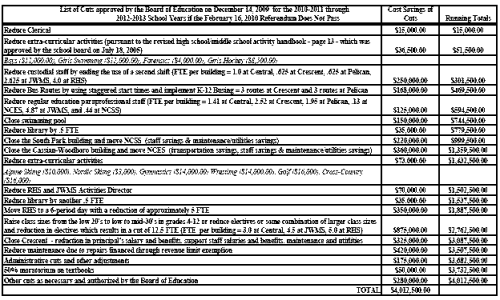
Here are the proposed cuts if the referendum fails (click on image for pdf):
Closing schools, cutting extra-curriculars, raising class sizes, stopping book purchases….throwing the future in the trash.
Shiocton is another example of the false attraction of nonrecurring referenda, compounded by the squeeze of state defunding. Their four year referendum is expiring but because of state cuts in education investments, they had tor raise property taxes last year by 20%. The plan now is to ask for another nonrecurring operating referendum below cost-to-continue and combine that with cuts (this is similar to what Madison did with the “Partnership Plan“).
The referendum asks voters’ permission to exceed state revenue limits by $500,000 for the 2010-11 school year, $600,000 for 2011-12 and $700,000 in each of the following three school years.
Shiocton school Supt. Chris VanderHeyden said the district faces a $900,000 shortfall next school year if it does not take this step to help balance the budget by covering the cost of preserving district education programs.
Regardless of whether the referendum passes or fails, the school district of 790 students in pre- kindergarten through grade 12 will need to cut $400,000 to stay in the black, VanderHeyden said.
About 65 percent of the $400,000 will come in staffing cuts, he said, which includes a reduction of 3.5 teachers and two paraprofessionals. The rest will come from such areas as departmental budgets, athletics, staff development, textbook adoptions and food service. “We will make the cuts but we also need the referendum to balance the budget,” he said. …
The increase this year was up nearly 20 percent. Either way, the tax rate will drop next year, VanderHeyden said. If the referendum passes, property taxes will drop $107 for the owner of a $100,000 home. If it fails, the property taxes will drop $278 for the owner of a $100,000 home.
So if it passes, there will be major cuts and taxes will go down. If it fails, there will be even larger cuts and taxes will go down more. Where is the choice for fully funding education?
Last but not least is Three Lakes. This is one of those districts caught in declining enrollment and relatively high property wealth. It also another district in the last year of a nonrecurring operating referendum. Three Lakes is in worse financial shape, has been squeezed harder, have been cutting for years; according to the district figures, without a successful referendum they will run out of money in February 2011.
Therefore they are asking:
…that the revenues included in the School District budget for three years beginning with the 2010-2011 school year and ending with the 2012-2013 school year be authorized to exceed the revenue limit specified in Section 121.91, Wisconsin Statutes, by $1,517,469 a year, for non-recurring purposes consisting of funding operating expenses.
Three Lakes District Administrator George Karling said the override voters are being asked to approve is necessary to fund current programs and amounts to about half of the annual revenue that has been lost, compared to 10 years ago.
With about $900,000 in the district’s general fund, Karling said Three Lakes would only have funds available to operate through February 2011 absent approval of the override.
Informational material the district sent to voters indicates the district is not allowed to operate at a deficit and would “become insolvent and close in the near future” if the referendum fails.
School Board Clerk Tom Rulseh said the district’s budget is “really tight,” with the budgeted expenditures of $10,507,798.50 for 2009-10 down about $80,000 from the previous school year, while the revenue override is necessary to continue to operate.
“I don’t know where the money would come from” if the referendum fails, Rulseh said.
…When asked whether it would be necessary to approve another revenue override three years from now, Karling said he hopes state lawmakers change Wisconsin’s school funding formula by then to provide more money for Three Lakes, which is considered a “property rich” district and receives little state funding.
He said proposals on the state level to boost funding for K-12 education include an additional 1 percent sales tax, which is known as “A Penny for Kids” and backed by the Wisconsin Alliance for Excellent Schools, and a “65 percent hold harmless” provision to lessen the amount of lost revenue because of declining enrollment.
They also note that dissolving the district would likely lead to even higher property taxes.
That’s the roundup. More votes in April. Before closing I wnat to again share something and suggest you follow my lead. When I do these posts that involve districts all over the state, I often take a look around their web sites. I am always struck by the good work being done, some traditional, some innovative but all a source of pride for the students, the educators, the families and the communities. All the sites are linked at their names, so I suggest you do the same. It is a good reminder of why education is so important and why we need to do better recognizing that. When you are done, help Wisconsin do better by getting involved for change.
The main Madison Metropolitan School District Board of Education meeting this week will be in closed session. There are some other Board related meetings this week that are open. The full notice of all the meetings is here.
Here is what the closed session notice says:
Monday, February 15 5:00 p.m. Special Board of Education Meeting in Executive Session
Renewal or Non-Renewal of the Contracts of Individual Employees pursuant to Wis. Stat. §§19.85(1)(c) and 118.24
Potential Reorganization within the District Affecting Individuals’ Employment and Employment Contracts, including Extensions or Non-extensions of said Contracts, pursuant to Wis. Stat. §§19.85(1)(c)
Adjournment
There are very specific statutorily required procedures for renewal/non renewal deliberations and a closed session is part of them (a non-renewed employee may request a subsequent public hearing).
I’m not sure on the closed session “potential reorganization” discussion as a legal matter or as policy. Not feeling qualified to offer much more than my doubts on the legal issues, I’ll stick to policy, where everyone is qualified to offer an opinion (ain’t America grand?).
There are two parts to the policy issue.
The first is whether all discussions of a potential district reorganization should be had in public. I think they should. I think the public should know what our employees and our elected officials are saying about the current organization and how it might be improved. I always side on more openness.
The second is whether decisions about the structure of an organization of the size and complexity and MMSD should be based on the skills, knowledge, competencies and incompetencies of current employees. I think the answer is no. If these are not part of the decision-making , then there is no reason (certainly no legal justification) for a closed session.
Employees come and go and can be let go (in Wisconsin administrator contracts are limited to two years); the district goes on. Plugging individuals in or unplugging them is not a long-range organizational strategy. Decide what works from a structural point of view and then find the people for the slots. If current employees don’t fit the slots, they should not be renewed, but defining the slots should be prior, separate and public. Even worse is designing the slot to fit an individual’s skill set. The individual will not be there forever and then the organization has an unfillable hole.
So I’d like an open session on reorganization, hope that nothing substantive of the reorganization is discussed in closed session and understand the need for closed sessions on employees. Maybe I’m just curious about the reorganization.
For the other meetings, on Tuesday at noon there is a meeting of the ad hoc Board Committee on revising the Ethics Policy (nothing linked the week, but this from last week); on Wednesday at 8:00 AM the School Food Initiative Committee will discuss ‘”Lunch Lessons” covering all aspects of MMSD food service” (I can’t find any official reference to this group except this from the week of January 25 meeting notice); and on Thursday at 1:30 (at building services on Plaum Rd), the 4-Year-Old Kindergarten Subcommittee on Curriculum will meet. The first thing on the agenda for the last is “Open Meetings Laws,” and that’s a good thing. N o info on the sub-committee, but the main 4K page is here and the Advisory Council page is here (with only the January 26 minutes posted, although they have been meeting for over a year). I do want to note that the times and/or locations of these meetings are not the most accessible. That will happen sometimes but you want it kept to a minimum.
I guess the theme this week was open governance, open meetings and open records. I’m glad to make that the theme, these are essential to democracy.
One good thing about the school governance schedule this week is that everyone can make time to attend the Progressive Dane School Board Candidate Forum, Sunday February 21, 1:30 PM at JC Wright Middle School, 1717 Fish Hatchery Rd. (info, fliers to print and post, and more, here). See you there!
I’m really excited about this event. Things are coming together. Here are the basics:
What: Public Forum featuring all candidates for Madison Board of Education. When: Sunday February 21, 2010; 1:30 to 3:30 PM. Where: JC Wright Middle School, 1717 Fish Hatchery Rd. Madison, WI. Sponsor: Progressive Dane.
On Sunday, February 21, voters in the Madison Metropolitan School District will have their first opportunity to hear and question the School Board candidates on the ballot in the April 6 election. Unopposed incumbents Beth Moss and Maya Cole will begin with short statements on their service and why they are seeking re-election. Next the candidates for Seat 4, James Howard and Tom Farley, will answer questions from Progressive Dane and the audience. Madison District 12 Alder and member of the Board of Education – Common Council Liaison Committee Satya Rhodes-Conway will serve as the moderator.
The more people and the more diverse people who attend and offer questions, the better, so help spread the word. Invite your friends and neighbors; print the flyer at the top and post it at work (smaller handbills here)…spread the word.
I’m just finding the time to post this on the Monday February 8, meeting (preview of that meeting here). To be honest, it wasn’t a very exciting meeting. Most of the real work was done the previous week, when they met as Committees.
Almost everything on the agenda passed 6-0 (Lucy Mathiak, absent) with no discussion. A few things deserve a little comment.
It looks like there will be something of a restart on the La Follette area planning. The Board voted to use technology and other things for 2010-11. The timeline for the restart was given as “6-9 months.” I hope the 9 instead of the 6. Johnny Winston Jr also suggested that the Board be involved in the initial phases, the Board and administration agreed and I think that is good. Overall a good way to move forward on something that was looking like a big mess.
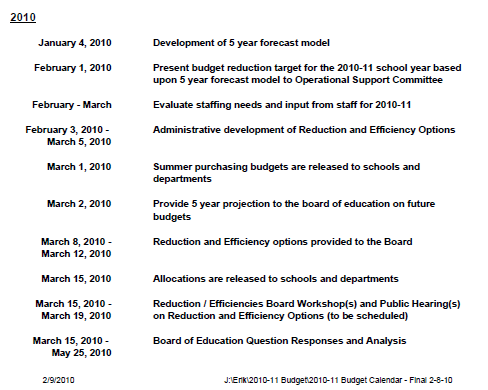
The new Budget timeline was approved (see Gayle Worland’s Wisconsin State Journal story for more). So there is now a plan for how to consider $30 million in cuts. The only big change was that personnel cuts and other cuts will be taken together. Here it is:
Some things to note. First, the May 3-7 meeting where the Board approves reductions will be the first meeting for either James Howard or Tom Farley (see here for info on the February 21 Progressive Dane Candidate Forum). Second, the state mandated budget hearings will be odd this year due to the timing. At that point the Board can add things back, but no real cuts are possible. I would really like that hearing to occur at a time when everything is still on the table. I am also somewhat bothered that the Budget Book comes out after the Public Engagement sessions.
I did hear some good things from the Board and the administration about how this will be be done. They seem committed to gathering as much information as possible, sharing that information with the public, trying to work from some common principles and as much as possible avoiding rancor. It won’t be easy. There will be a lot of pressure from the anti-tax crowd to cut and a lot of pressure from others not to cut specific things. Going into this I do think it is important to keep in mind that the current situation cannot be attributed to local mismanagement. This is a state created problem. If you are going to get mad about the school funding situation, get mad at the state officials.
One other thing I’d like to say is that there have been some positive things done on things like 4K and the Strategic Plan where a real work on defining and implementing a vision for improving educational opportunities has been started and I hope that does not get lost in all this. The Board Members have expressed similar hopes.
On the Retirement Refinance and 4K funding the Board went with option 2B, smaller overall savings but more front loaded. I believe the vote was 5-1, with Marj Passman favoring 5A.
 For a variety of reasons I’m not able to do much blogging this week, but wanted to get some things up and out, hence this quick and sloppy wrap up.








 AMPS
AMPS 