From the Wisconsin Alliance for Excellent Schools (WAES)
Governor’s budget plan for education
gets a bad grade on basic mathematics
As long as the cost of education does not increase, the tools Governor Scott Walker “gave” districts to offset his devastating cuts to school aids might work, theoretically, for some communities. In the real world, however─where costs increase and children need opportunities to succeed, the coming years look pretty bleak.
That was the assessment following Tuesday’s credentialed media only press event behind locked doors where the Governor rolled out his version of the 2011-13 budget for public education. Not everyone was as optimistic as Walker.
Superintendent of Schools Tony Evers called the budget “a crushing challenge,” while the School Finance Network said the budget is “shortsighted and counterproductive” and “the simple fact is that (it) will result in cuts to programs and services and increases in class sizes.”
In general, the Governor’s budget that cuts aid and reduces districts’ revenue authority doesn’t take into account 18 years of cuts to programs and services and basic inflationary cost increases. WAES maintains that sooner or later, the result of the cuts─small, large, and cumulative─will be or already has jeopardized the future of Wisconsin’s children and communities.
Wisconsin’s School Administrator’s Alliance (SAA) said its members are united in their opposition to Governor Walker’s agenda of privatizing public education.” “According to John Forester, the group’s director of government relations, “The school aid cuts in the Governor’s proposed budget plan are of a magnitude not seen since the Great Depression.”
“It is precisely because education is the road to equality and citizenship, that it has been made more elusive for Negroes than many other rights. The walling off of Negroes from equal education is part of the historical design to submerge him in second class status. Therefore, as Negroes have struggled to be free they have had to fight for the opportunity for a decent education.”
“The Negro has no room to make any substantial compromises because his store of advantages is too small. He must press unrelentingly for quality, integrated education or his whole drive for freedom will be undermined by the absence of a most vital and indispensable element — learning.”
“The function of education is to teach one to think intensively and to think critically… Intelligence plus character – that is the goal of true education.”
“Cowardice asks the question, ‘Is it safe?’ Expediency asks the question, ‘Is it politic?’ But conscience asks the question, ‘Is it right?’ And there comes a time when one must take a position that is neither safe, nor politic, nor popular but because conscience tells one it is right.”
Gayle Worland Matthew DeFour in the Wisconsin Sate Journal has the story, there is a new timeline pushing implementation back to 2012-13, an extended input process, some backgorund, a more detailed rational and much more for the proposed Madison Metropolitan School District High School Curricular Reforms (now apparently officially dubbed Career and College Readiness).
The new document only indirectly presents the Dual Pathways proposal (Executive Summary here), but does refer to the initial roll-out as “difficult. It does assert (in boldface type):
Our Theory of Action, process and end goals have not changed, but how we articulate this work has become more explicit, transparent and responsive.
I don’t know how to read this. Obviously the process has changed (if nothing else it is longer). It is hard to know what to make of the idea that what went wrong was not the process, but that they didn’t “articulate” things in a manner that was sufficiently “explicit, transparent and responsive.” I understand the explicit, but if transparency and responsiveness are confined to articulation, I think they’ve missed the point and are stuck in the top-down mentality that is a death sentence for any education reform.
Here is the “Theory of Action” (from the Executive Summary):
As indicated elsewhere in the new document, it appears that he ACT standards (and the EPAS), tthe AP requirements and the Common Core Standards will remain at the center of the reforms. There are a lot of “if/thens” in this, some of which I buy and some of which are difficult to accept. I’d like to see these all of these assertions of causality examined, but apparently that is not part of the plan.
As to the goals, you can’t argue with increased achievement for all students.
Despite my parsing here, I think there is much that is good here. The rationale (with data) is necessary (I’d like to see data going back some years, but that may be just me). The next steps include a variety of committees of district and school staff and despite the defensive assertion that the process hasn’t changed, these committees appear to have real potential for shaping the result.
I don’t see any direct role parents and community members except through the Parent Council and “A specially created business and community council that will meet on a quarterly basis to provide feedback.” As I have noted before, the Parent Council is too large to be a functioning deliberative body and I’m guessing the “business and community council” will be similarly designed for one-way “articulation” not meaningful policy input (I’m not even going to get started on what is wrong with privileging “business” in this manner).
There are no committees or Councils for students with the Student Senate only mentioned in the context of the previously held forum. Lessons not learned.
Perhaps to take care of this, the district has set up a feedback page. Use it, to offer your thoughts.
It also needs to be noted that none of this — not the Dual Pathways, not the new timeline and process — has ever appeared on a Board of Education agenda. Either the Board is out-of the-loop or the basic principles of open governance have been forgotten.
Here is the new timeline:
2010-2011 Including Summer: Planning Year
District-wide K-12 curricular alignment process to occur with the following results:
Established k-12 scope and sequence in all four core content areas.
Essential Understandings, knowledge and skills established K-12.
High School curricular alignment completed in all four core content areas with established course offerings, sequences and essential understandings, knowledge and skills.
Establish initial offerings for consistent accelerated courses to be offered 2011-12.
Establish scaffolds and supports to be provided district-wide.
Plan for Professional Development implementation developed for implementation 2011-12.Implement the EPAS EXPLORE Assessment with all 8th and 9th grade students.
2011-12: Readiness for Implementation
Comprehensive budget aligned to the plan and recommended for approval, November 2011.
Comprehensive professional development plan implemented for staff across all four comprehensive high schools to fully implement recommendations set forth by district committees from 2010-11.
Implement initial accelerated offerings across all four comprehensive high schools.
Finalize course offerings and descriptions for including in 2012-13 course catalogs.
Implement the EPAS EXPLORE and PLAN Assessment with all 8th, 9th and 10th grade students.
2012-13: Implementation
Implement consistent course offerings in all four core content areas with options for both acceleration and scaffolding and supports.
I’m going to close by pasting something I put near the top of my first post on this:
Before I delve into the mess and the proposal, I think it is important to say that despite huge and inexcusable problems with the process, many unanswered questions and some real things of concern; there are some good things in the proposal. One part near the heart of the plan in particular is something I’ve been pushing for years: open access to advanced classes and programs with supports. In the language of the proposal:
Pathways open to all students. Students are originally identified by Advanced Placement requirements and other suggested guidelines such as EXPLORE /PLAN scores, GPA, past MS/HS performance and MS/HS Recommendation. however, all students would be able to enroll. Students not meeting suggested guidelines but wanting to enroll would receive additional supports (tutoring, skill development classes, AVID, etc.) to ensure success. (emphasis added and I would like to see it added in the implementation).
Right now there are great and at times irrational barriers in place. These need to go. I hope this does not get lost as the mess is cleaned up.
I still think those basic ideas of removing barriers of access and providing sufficient supports are essential. I fully support the extended process, more openness and responsiveness throughout the process, but would like to see those barriers come down and supports go up as soon as possible. There is no reason to wait another year on this portion.
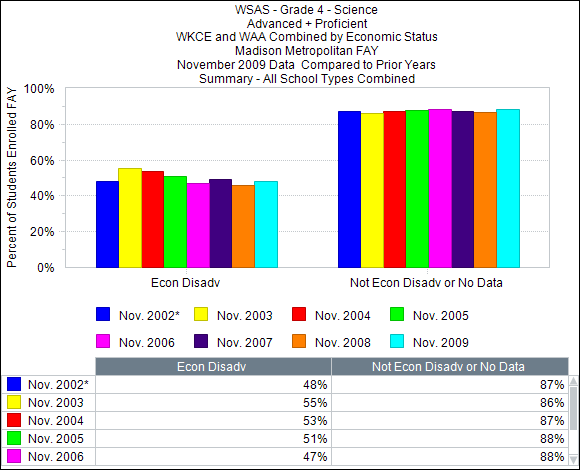
Note: For awhile, I’m going to be illustrating the “On the Agenda” posts with various graphs documenting achievement gaps in MMSD as revealed by the admittedly flawed and limited WSAS/WKCE results. I think regular reminders may do some good.
Between campaigns, grading mid terms and the happenings at West, I’ve been insanely busy. I missed last week’s agenda post and am only doing the minimum today.
Four meetings listed for the Madison Metropolitan School District, none involving the High School Reform (no Student Senate listed).
Monday, October 18 5:00 p.m.
Special Board of Education Meeting
1.Public Appearances
2.It is recommended to change the start time of the Regular meeting of the Board of Education to 7 p.m. for the October 25, 2010, meeting only.
3.Four-Year-Old Kindergarten Data Retreat
4.Adjournment
Doyle Administration Bldg.
545 W. Dayton Street
Madison, WI 53703
McDaniels Auditorium
6:00 p.m. Ad Hoc Board of Education Meeting—Equity and Decision Making
1. Public Appearances
2.Responses to Board Member Questions and Comments regarding the Equity Plan
3.K-12 Literacy Alignment as it relates to Equity
4.Next Meeting Date/Time/Location and Agenda
5.Adjournment
Doyle Administration Bldg.
545 W. Dayton Street
Madison, WI 53703
Room 103
7:00 p.m. Ad Hoc Board of Education Meeting—Five-Year Budget Plan
1. Public Appearances
2.Administrative Recommendations for Five-Year Budget Parameters
3. Overview of MMSD Budget Account Codes
4. Timeline for Development of 5-Year Budget Model
5. Adoption of Goals for Committee
6.Next Meeting Date/Time/Location and Agenda
7.Adjournment
Doyle Administration Bldg.
Room 103
Tuesday, October 19
8:00 a.m.
MMSD Literacy Advisory Committee
1.Welcome and Agenda Review
2.Update from Focus Group on the Library Media Specialist Survey Responses
3.Article Review—“The Why Behind RTI (Response to Intervention)”
4.Presentation on RTI Framework
5.Develop Definition of the Elements of a Comprehensive Literacy Program
6.Discussion of District Literacy Professional Development at Elementary and Secondary Levels
7.Adjournment
Thursday, October 21
Doyle Administration Bldg.
4:30 p.m.
Sustainable Schools Initiative Meeting
1.Check-in/Introductions
2.Presentation—Draft vision and Sustainability Planning Process
3.Small Group Discussion—Draft Visions and Sustainability Planning Process
4.Small Group Report Back
5.Next Steps
6.Next Meeting Dates
Nothing linked — including member lists — for the last two.
All reports – in the media and personal — are that the sit-in at West today was very positive. I was unable to attend, but am glad that students are demonstrating their concerns and getting some attention. [I just got a robo call about our son being absent t tale part in the sit-in…OK]
The plan presented this week is not the Board’s plan. We received the plan the same day the teachers received the plan. The plan was developed by Administration, which is how something like this works. The plan is scheduled to be reviewed by the Board on November 1. This is a review meeting, not a voting meeting. Final review/vote by the Board is scheduled for late November. Now the Board should be reviewing the plan, asking questions and talking/listening to constituents, like students. All feedback is good (if respectful). At the meeting where the Board votes, we can approve/reject the plan as is, modify the plan or approve/reject parts of the plan. We still have a lot of questions and information-collecting to do. Keep your feedback coming as it does help us to understand how this plan would affect each of you. Questions/comments: board@madison.k12.wi.us.
This is a tight time-line, especially for the Student Senate meeting. To expect anyone, especially busy students to have considered input based on minimal information this quickly it asking a lot.
With that in mind, I want to offer some more background things (lots linked in this post, some repeats).
I’m having a lot of concerns about the emphasis on standards. As noted before, we are stuck with the Common Core Standards and adding the ACT College Readiness Standards (click the links to read more — we are adding many things from the ACT and will be writing big checks for the privilege). I don’t like standards-based reform much.
And also these quotes from Deborah Meier elsewhere seem applicable:
If we agreed all the time on most things, we’d never need democracy. But if I want schools that encourage disagreement, it follows that I, too, must compromise. E.g. If I want schools to include the same mix of kids that make up our body politic, then that imposes on someone else’s ideal of public education. If, as Juan Gonzalez argued, schools are the backbone of communities, then neighborhood schools need to be preserved! Ditto for tracking by ability. Can we outlaw schools for “the gifted” to preserve heterogeneity? Can everyone have what is best for themselves while still having the best for the common good?
….
Warts and all. “Smartness” of the kind we seem lately to revere—the kind that gets you into the Ivy League—is not the purpose of the public’s support for public education. Imagine if our standards were set, not on Harvard, but on our concern for the common good?
I fear that by allowing the ACT to define “College Readiness” and then buying products from the ACT to prepare students to take tests from the ACT to demonstrate that readiness, we lose sight of that common good.
An old blog post from “HC English Teachers” that in a positive manner describes the Hersey High reforms — a model for what MMSD is doing – from an outsider perspective is also interesting. I keep going back to the fact that Hersey is a 7% or 8% poverty school and West is 35%. This reminded me of the differences and the conditions for successful reform:
There was a perfect storm that allowed CV to put the program into place… intra-district rivalries, falling ACT scores, an activist superintendent, a principal who was looking for answers. None of those things exist here.
I think there are even more conditions needed, but fear that many are lacking (or under developed) in Madison.
What is lacking most is a desire for change and confidence that change will bring real improvements. I’ll add that some of this lack of desire is based on a lack of acknowledgment that West is failing many students. It doesn’t help there was no mention of achievement gaps in the first document (there is in the second). Here is one graphic of a gap at West.
It is also based on a denial that the most advanced classes at West are segregated in many ways. I think it is worth noting that only 18 African American students, representing 31% of African American 12th graders, took the ACT last year. I don’t want to give up the inclusiveness of the 9th and 10th grade core classes (and am not sure there is need to), but some change is called for to address persistent gaps and segregation at the highest levels.
I’ve kind of morphed into the subject of grouping. I’m going to be lazy and share two things from the Equity Task Force (1 & 2). The first in a chapter by Adam Gamoran and the second is a statement from the National School Psychologists. In the intro to the first for the Task Force I wrote:
At the crudest level it is about equity because it is about resource allocations. Choosing among approaches (or pursuing multiple approaches) will mean dedicating staff, curricular materials, facilities, training and other resources in a manner that will make these unavailable for other uses. We all understand this. Looking at our working definition of equity I see other ways that equity is in play. I don’t have the exact language but my memory is that the three key components are access and opportunity, educational excellence for all, and social responsibility. On access and opportunity the research is clear that without open enrollments, recruitment of historically underserved populations and structures of support, any ability grouping will result in racial, economic and other segregation. Even in heterogeneous classrooms using differentiated instruction, an approach that many believe provides wider opportunity and access to advanced instruction, special efforts are often needed to make sure that minorities and others are not overlooked.
Whatever direction we go in, a statement on this should be considered (sorry, that was my position and I am trying to make this as objective as I can). The real conflicts are about a perceived tension between excellence and social justice. Some of this is due to differing ideas about the definitions of both educational excellence and the social mission of public education. I could go on about each of these for pages, but I will try to be brief. The research about which approaches produce which academic results for which students are far from conclusive (see the Gamoran). What muddies the water further is that some believe that excellence is achieved by getting the most students scoring in the highest range, some look to get the fewest students scoring in the lowest range, some look to have the highest scoring students scoring higher and higher…. All of these and more are legitimate definitions and noble goals.
The research seems to indicate that an approach that absolutely maximizes one of these will be less than optimal according to other definitions. Note the words maximum and less than optimal. It isn’t that the various approaches necessarily have a negative effect on one metric or another, it is that that one approach might do better according to one measure and another according to a different measure. There are choices to be made.
Here is where the social justice issues can come into play. For many a diverse classroom intrinsically has a nonacademic but none-the-less educational benefit for all students. Beyond this, the choices (if you accept that it is impossible for a single approach to maximize excellence across the range of definitions) are choices about the academic component of the social mission of the schools. Is the social mission best fulfilled by catering to the extreme high achievers? Is the most important social mission to lift students from the bottom to the middle; from the middle to the top…? I think we can do very well on all these measures; I don’t think anyone believes we can maximize them all simultaneously. I hope this has helped you see and grapple with the choices we face.
I’ve been thinking about this a lot this week and a phrase keeps popping into my head. Let me close with this, the motto or ideal of the National Association of Colored Women’s Clubs (circa 1890): “Lifting as We Climb.”
There are choices to be made and the last thing I want to say is about the choices.
The students, the parents, the teachers, The Board of Education and a surprising variety of people who have been contacting me are all looking for more information. This is great; informed decisions are the right way to go.
As of now we have two choices — the status quo and the Dual Pathways draft — and there has been very little information about the latter offered, some rose-tinted glasses views of the former and nothing about the possibilities of something in-between. Among the information that is needed is a clear understanding of a variety of options and what these options will mean in terms of budget, student schedules, potential benefits and acknowledged losses (including possibly some electives and the good things about English 9 & 10 and the Social Studies classes).
I know that’s a lot to ask, but I think it is possible and I think it is the way to move forward.
Before I delve into the mess and the proposal, I think it is important to say that despite huge and inexcusable problems with the process, many unanswered questions and some real things of concern; there are some good things in the proposal. One part near the heart of the plan in particular is something I’ve been pushing for years: open access to advanced classes and programs with supports. In the language of the proposal:
Pathways open to all students. Students are originally identified by Advanced Placement requirements and other suggested guidelines such as EXPLORE /PLAN scores, GPA, past MS/HS performance and MS/HS Recommendation. however, all students would be able to enroll. Students not meeting suggested guidelines but wanting to enroll would receive additional supports (tutoring, skill development classes, AVID, etc.) to ensure success. (emphasis added and I would like to see it added in the implementation).
Right now there are great and at times irrational barriers in place. These need to go. I hope this does not get lost as the mess is cleaned up.
This is in four sections: The Mess; What Next?; The Plan: Unanswered Questions and Causes for Concern; and Final Thought.
The Mess
The exact size and shape of the mess — like so much else with this — aren’t clear. You can gauge for yourself by visiting the Facebook pages “Save Our Future- Madison West High” and “Walk-Out Against MMSD High School Reform.” I heard reports that 200 or more students met at lunch yesterday and likely the number will be greater today. The fact that students care and want to do something is great. I’m sure that Administrators and Board Members have also heard from parents and teachers.
Then there is this video:
It is great to hear the passion and desire to be part of the process; it is sad to realize that they feel they have been shut out.
As far as I can tell the proximate cause of the student reaction at West was confused and incomplete information relayed by teachers. The ultimate cause is that this has been drafted and communicated in what seems to be a rushed and top-down manner.
Note the “seems to be.” Much of this has been in the works — at least indirectly — for a long time and there have been some opportunities for input and collaboration along the way (see the High School Initiatives presentation from earlier this year).
So while this doesn’t come out of nowhere, it has also been rushed out in a manner and form that leave much to be desired. Extensive changes of this sort need to be considered and revised in an open, inclusive, deliberate process. To do otherwise misses opportunities for improvement and creates distrust instead of buy-in from those most affected.
At least one Board Member is saying that “the proposed curricular changes are not related to the DPI complaint re. failure to comply with state law on TAG programming.” You can parse that statement carefully and maybe say it is true because things have been in the works prior to the TAG complaint, but it is equally true that the the timing and failed roll out were a reaction to the complaint. To deny or not acknowledge the relationship to the TAG complaint in how this was “finalized” and presented (not conceived) only exacerbates the distrust that is perhaps the biggest mess of all.
You don’t have to take my word on this being rushed and incomplete, just look at some of the early items in the plan that have dates attached: “Plan communicated to all stakeholders in September” with a variety of information to be compiled in September to support the communications. This communication didn’t happen in September and if the supporting information has been prepared, it has not been shared. If it has been prepared and not shared there is much more wrong here than a rushed time-line, there is a basic lack of understanding of communications principles.
There may also be a basic misunderstanding of policy formation principles at work. Part of that communication item for September reads:
Develop data-based rationale for reforming the MMSD high school curriculum providing both an accelerated pathway and a preparatory pathway.
I’m going to be nice and assume that the intent here was to say “Develop a presentation of the data-based rationale…,” because otherwise our self-styled “data -driven” district is making policies and then creating “data-based ratuonale(s)” after the fact. Let’s chalk this up to the rush job.
What Next ?
Hard to say what will come next. There may or may not be a protest walkout at West on Friday. There may or not be a crisis communication strategy from the administration [there is, see the update at the top]. There may or may not be an attempt to go beyond crisis communication and initiate a more open and extensive collaborative process (I’d like that).
The Board of Education will see this on an agenda in some form I have heard (not confirmed) that this will be the first week of November. What form isn’t clear. They may be asked to approve the proposal or they may may simply receive or reject a report. I hope it is the former.
I also want to note that how this comes before the Board matters not only in terms of democratic governance, but because the new Communication Plan protocols require certain things — such as equity and budget analyses — with some Administrative proposals. These are not part of the materials circulating.
My guess is that whatever happens in the coming weeks, at least part of the time-line is out-the-window. Supporting work will be ongoing, but I’d be surprised if the scheduled significant changes to Language Arts and Mathematics are fully implemented in 2011-12. I’ve been surprised before.
In the meantime, effective involvement is crucial. Let the Board know your concerns (board@madison.k12.wi.us). Let Superintendent Nerad know too (dnerad@madison.k12.wi.us). Before voicing an opinion, it is good to do some study and get your facts straight and concerns clear. Keep and eye on the Board agendas (and this space) to see when it comes up and in what form. At every juncture, ask for a chance to be part of the process. If asking doesn’t work, demand.
The Plan: Unanswered Questions and Causes for Concern
From reviewing the proposal itself, a read of postings elsewhere, conversations and emails — with and from students, teachers, parents, Board of Education Members and administrators — some issues have stood out as things that I believe need further attention. What I’m offering here isn’t comprehensive or thorough, but introductory.
Before proceeding I want to again emphasize that the commitment to open access with supports is a huge and positive step (and note that it may be possible that this could be accomplished without the radical changes being proposed).
Pathways, Tracking and Ability Grouping:
I have supported the inclusive model for English 9 & 10 and 9th & 1oth grade Social Studies. I have also thought that real embedded honors would have improved the model. Some of the positive aspects of this will be lost if the new proposal is implemented. There will be two “pathways” and this will almost certainly mean an increase in segregation by race, language and income. I don’t like this.
Despite this inclusive portion of the existing West program, you’d be a fool to believe that segregation and something like tracking aren’t already part of the West reality. I’ll go further and say that I sincerely doubt that in the foreseeable future these will be eliminated.
So the questions become ones about the extent and nature of the segregation or groupings.
Willis D. Hawley makes a useful distinction between tracking and “ability grouping” (read Pathways) based on student movement among the tracks (or programs) and warns that “Ability grouping often turns into tracking.” This, along with the demographics of the pathways would need close monitoring and if there is great segregation with little or no movement, actions should be taken to remedy.
The existence of “embedded honors in the Preparatory Pathway is supposed to facilitate movement. I have serious doubts about that.
Doubts based in part on the fact that the access to the Accelerated Pathway is supposed to be open. This also needs to be monitored and special attention needs to be paid to informal ways that students are discouraged from challenging themselves and the availability of appropriate supports for success.
In general I don’t like the wholesale adoption of any standards, whether from an advocacy group (like the Common Core or for that matter the NACG Standards incorporated in the TAG Plan) or from an organization like the ACT or the College Board (AP), with supporting things for sale (an issue with the Common Core too). MMSD – and other districts — should pick, chose and adapt what is appropriate for local circumstances.
Advanced Placement is a little different. There are real concerns about a “cookie cutter” approach stifling creativity and breadth in teaching and learning. These and other issues have led some districts — including Scarsdale, NY — to abandon AP. There is a growing consensus that the rapid expansion of AP is problematic (for balance see here). Was any of this part of drafting of this plan?
In defense of expanded AP, it does provide an external measure of achievement and it does give students a head start on college. Like so much else, some good and some not so good.
Trade Offs: Electives, Budget and Schedules:
Because of budget and schedule constraints this proposal cannot be implemented without other things being cut. You can’t add support services without either increasing expenditures or eliminating something else. Teachers and students only have time for so many classes, if they are taking new AP classes, they won’t be taking existing offerings. So far there has been no clear statement of what these other things might be.
The rumors were that electives in some form were due to be cut. I have this response from a senior administrator:
This is not true. We are adding Advanced Placement courses in the four content areas. They will be open access courses and may be taken or an elective may be taken. For example Advanced Placement offers only two English courses. We require 4 years of English. This leaves room for elective choices
How much room, both in terms of budget and schedules remains to be seen. I think it is clear that many favored electives will be retained.
I’m not going to give my full Wisconsin and MMSD school funding rap, but I will ask those new to this to visit Penny for Kids, sign the petition, share it with friends, join the Facebook group…get involved.
Where Did This Come From?
As noted above, this has been in the works as part of a series of High School Initiatives. The immediate model for much of it is Hersey High School in Arlington Heights Illinois. Arlington Heights is not Madison and Hersey is not West. One statistic stands out — Hersey has a poverty rate of 7% or 8%, West’s is 35%. A quick review of the Evaluation and Policy Research page at Hersey shows that while the concerns and issues overlap, they are also very different. The review also showed some very questionable choices in what data is presented and how it is presented. Maybe more on this later.
Final Thought:
At the top, I called this mess inexcusable. I see this as a failure of leadership. Couldn’t they anticipate this reaction? Didn’t they read Susan Troller’s “branding” piece? Don’t they now that successful reform requires buy-in? This looks rushed and reactive, not considered and confident. I know lots of very good work has gone into this, but that work is in danger of being lost due to some key failures.
With this in mind, I renew my call for the evaluation of Superintendent Dan Nerad to be made public. Part of restoring confidence has to be sharing with the public what the Board of Education thinks is is going well and what the Board thinks could use improvement. I know at this moment many in the West community have some definite ideas about these matters (positive and negative…I see successes as well as failures).
Video of the People’s Affordable Housing Vision Press Conference, 10/4/2010.
Yesterday the People’s Affordable Vision proposals were introduced at the above press conference. There is much more on Forward Lookout, here and here. These are all good and important proposals.
Also yesterday, I was made aware of the work a couple of friends of mine are undertaking to improve conditions and opportunities for homeless students. I’ll be posting more about this work as it develops.
Each year the FDA publishes data on “Food Insecurity.” It should surprise no one and shame all that Food Insecurity is rising, especially among the young. Food Insecurity is linked to the poverty based achievement gap, directly via health issues and malnutrition, and indirectly because children who don’t know if their school lunch will be their only meal have more to worry about than diagramming sentences or memorizing math facts.
I don’t think there is a national “Housing Insecurity” index, although the Wisconsin Council on Children and Families does a great job tracking many statistics on the well-being of children and advocating for policies that will help (check their Vote for Kids campaign). They report that
• In 2008, 16,241 people, including 4,744 children, used
emergency shelter in Wisconsin homeless shelters.
• For the 2007/2008 school year, 9,331 homeless students
were served by Wisconsin public schools.
Stable housing plays a crucial role in children’s well-being. Kids who grow up in unstable housing situations tend to do worse in school, have more behavioral problems, and suffer poorer health than their peers.
When talking about services to the homeless or housing programs we often use the term “safety net.” When thinking about homeless children I think it needs to be a safety blanket, because some might slip through a net.
Note: For a while, I’m going to be illustrating the “On the Agenda” posts with various graphs documenting achievement gaps in MMSD as revealed by the admittedly flawed and limited WSAS/WKCE results. I think regular reminders may do some good.
The new Board Ad-Hoc Committee on Equity and Decision-Making will hold their first meeting at 5:00 PM in the Doyle Bldg, Rm 103. The agenda revolves around committee goals. There will be public appearances and if you have concerns about equity related things, I’d suggest getting their attention near the start of their work. These could include anything from staffing, to class-size, to achievement gaps, to budgets, to curricula, to… for an idea of what the scope of this committee includes, check the Equity Policy and the work of Equity Task Force (as well as the Equity Report from earlier this year).
One new thing before the Committee is an update on equity work. This partially updates the appendices of the rejected March version of the report, which linked district initiatives to portions of the Strategic Plan and Equity Task Force recommendations. I thought this was the best part of the March version, but it didn’t make it into the final. Good to see it back.
What isn’t good is how much remains to be done.
This will be followed by the full Board meeting at 6:00 PM in the Doyle Bdg Auditorium. There are public appearances scheduled and it can be assumed that both this meeting and the Equity meeting will be carried on MMSD-TV. A note to people not familiar with Board procedures, all public testimony is at the start of the meeting and you have to register by the time they begin.
I’m not going to do the whole agenda this week, but just hit the highlights in approximate order of interest.
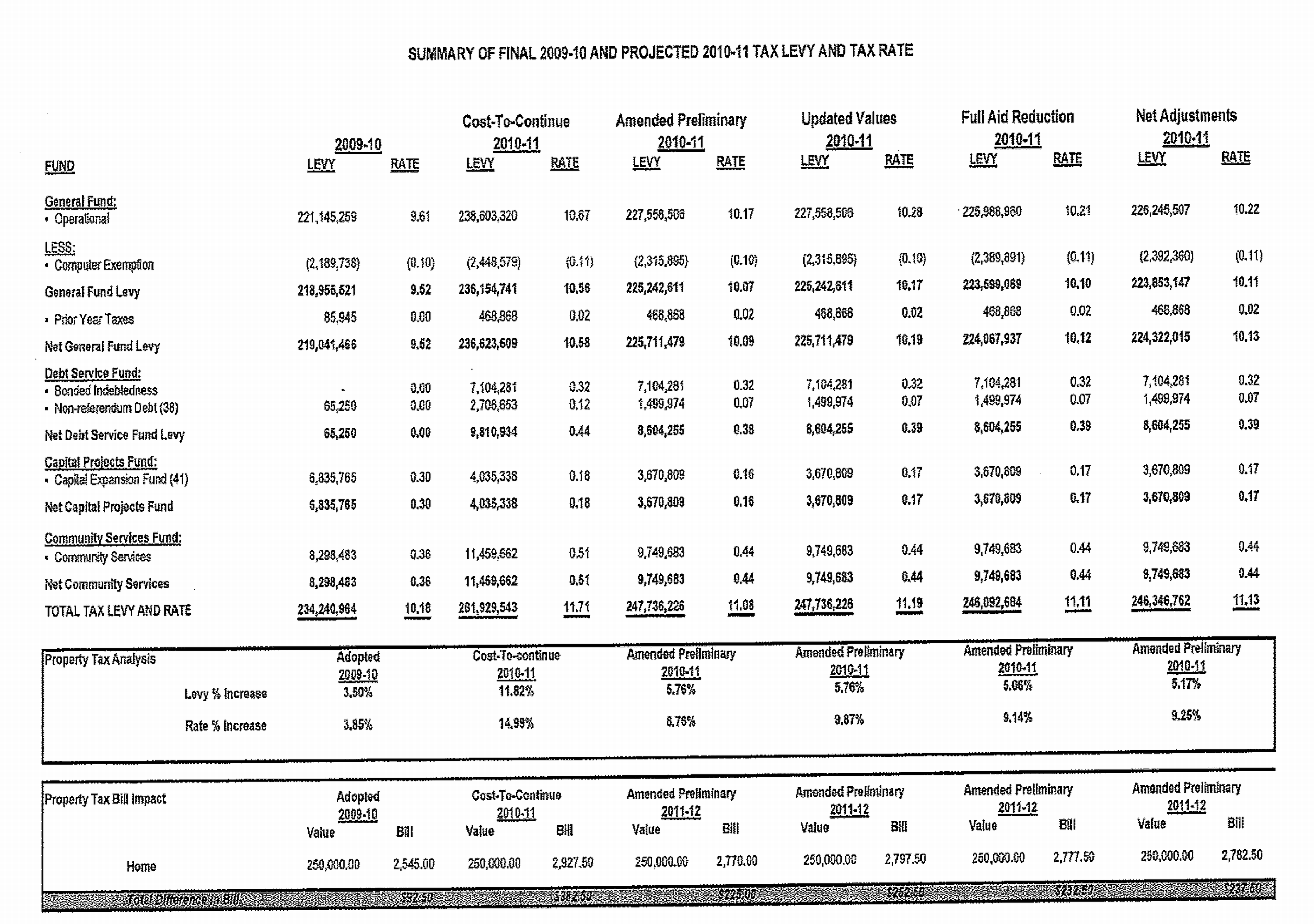
I’d put the Budget Update at the top of my personal list of agenda items. Bad news and good news with a net bad news of a larger increase in the mil rate (from 11.08 to 11.13) and slightly bigger hit to property owners likely (Penny for Kids would help!)
Among the news here is anticipated decrease of $442,501 in state Special Education Categorical aids, and an anticipated increase of $1,569, 546 in state equalization aid from the amounts budgeted in the Spring. Unfortunately the increase in equalization is related to a decrease in property values, meaning that although the total levy will be smaller, the base for that levy is smaller also and the increased equalization only partially covers the difference (Penny for Kids is needed!). There are lots of moving pieces locally — including property values in the district — and statewide that contribute to these adjustments. One of the biggest pieces is the “Third Friday” student count certification. If we are lucky, that number will be previewed at the meeting Monday. None of this is final till the end of October when the tax levy is passed.
On a related and positive note, the district did save $185,954 in short term borrowing costs.
These are combined here in a projected tax levy scenarios I think the last is the most likely.
I don’t like the $250,00 “average home” calculations, but the levy increase expressed in that way is $237.50, or $12.50 more than projected in the Spring ((Penny for Kids! Now more than ever).
And then there is the fund balance. It increased by $5.1 million in 2009-10. MMSD needs to have an open and thorough discussion of fund balance policies and practices (I’ve said this before). In the last three years the fund balance has increased by about $20 million, almost doubling. This is good and bad, but what is all bad is that it has happened without the Board directly addressing the choices being made. This money was collected to educate the children of our district and we (the people it was collected from) deserve to know if building equity at this level is the way it can best be used in the service of education.
Last in the update is “Budget Tracking Table” with big and unexplained changes in the ARRA lines (these may be covered in this previous ARRA update. Nothing on the EduJobs money (my guess is that it will be used for 2011-12 in MMSD).
Next in order of import is the Revised Code of Conduct. It looks like this might finally get done. I haven’t followed all the details, but I do like the Phoenix/Abeyance model as an alternative to expulsions.
It is kind of insider stuff, but I find the the evolution of the Superintendent’/Board of Education Communication Plan fascinating. This is a new iteration and with each version it seems to get more detailed and more exacting. I applaud the effort to clarify roles and expectations, but find it disconcerting that all concerned feel it needs to be spelled out this thoroughly. To me that indicates trust, faith and yes “communication” are not where they should be. Maybe I’m reading too much into this; maybe I’m just more comfortable with improvisational give-and-take.
Last item I’m going to cover (and the last item on the agenda) is the Legislative Liaison Report. Three things here.
First is the recent Resolution passed by the Dane County Board calling for school finance reform (press release here). This got some nice coverage from Neil Heinen on Channel 3000, in the Sun Prairie Star and maybe elsewhere. I worked on this with Supervisor Melissa Sargent and want to give a big thank you to her and the other Supervisors and the Board of Education and community members who supported the Resolution. Look for more Resolutions of this sort around the state in the coming months. As Neil Heinen said “Thanks to the Dane County Board, the voice for school funding reform just got louder.”
Next is Superintendent Tony Evers State of Education address. The big news here is no news on the Fair Funding Framework. For logistical and other reasons, there will be no further details till after the November elections. I’ll leave the “other” alone and note that there will be updated numbers to work with after October 15 aid certifications and the logistical reasons have legitimacy.
Last is a Penny for Kids update. Not 100% sure what this will be, but I will take this opportunity to put on my Wisconsin Alliance for Excellent Schools Board member hat and thank MMSD for actively supporting this campaign.
One more meeting. Ad-Hoc Hiring and Diversity on Tuesday, noon, at JC Wright Middle School. Another goal setting agenda and no linked documents. For some background see this report from September 2009. Staff diversity at all levels remains an issue. I hope that those working and agitating on minority teacher matters realize that this is a national problem and that long term solutions involving improving minority education, higher education opportunities, early recruitment into education fields and supports to achieve professional status are where the real solutions to teaching staff diversity lay. The district’s efforts can and should be improved in the short term (and not just with teachers, the clerical staff numbers are a disgrace), but only very limited improvements should be expected in the diversity of MMSD teaching staff.
Note: For a while, I’m going to be illustrating the “On the Agenda” posts with various graphs documenting achievement gaps in MMSD as revealed by the admittedly flawed and limited WSAS/WKCE results. I think regular reminders may do some good.
Update: The Equity and Decision Making meeting has been canceled due to overlapping membership schedule conflicts and the weekly agenda has been posted (as of now — 12:54 pm — the agenda does not reflect the cancellation).
As with so much involving MMSD these days, I’m taking a wait and see attitude. I will say that I am glad to see equity given attention and linked to decision making (doesn’t equity-driven decision making sound like a better idea than “data-driven” decision making).
“The study suggests that people who say we know how to make failing schools into successful ones but merely lack the will to do so are selling snake oil. In fact, successful turnaround stories are marked by idiosyncratic circumstances. The science of turnarounds is weak and devoid of practical, effective strategies for educators to employ. Examples of largescale, system-wide turnarounds are nonexistent. A lot of work needs to be done before the odds of turning around failing schools begin to tip in a favorable direction.”
So much of the discussion of a “lack of will” devolves into blaming teachers, unions and “the Education Establishment” and is characterized by false promises of “the market” or unspecified “innovation” that reminders of the reality like those found in the Brown Report are drowned out in the blather. The vast majority of public schools serve their communities well; the vast majority of those employed in education want students to be successful and do their best to make that happen.





 AMPS
AMPS 