Category Archives: finance

A Penny for Kids Madison Follow Up

A quick follow up on this post praising our local educational leaders for supporting the  Penny for Kids dedicated sales tax for education campaign.

Madison Metropolitan School District Board of Education President Arlene Silveira highlighted the effort in her most recent Board of Education Progress Report  (read the full Report here):

A Penny for Kids: Wisconsin’s school funding system is broken and is failing our children and our community. Comprehensive school-funding reform is the long-term answer for our schools. To address the funding crisis, Wisconsin Alliance for Excellent Schools has launched “A Penny For Kids” campaign to raise the sales tax one-cent to help fill the gap in public school funding created by the 2009-11 state budget (which was devastating for MMSD) and try to keep a lid on property taxes. The Board voted to endorse the campaign. We hope you will too. To sign the petition and learn more, go to: www.apennyforkids.org.

And from the latest issue of Solidarity!, the Madison Teachers Incorporated newsletter.

Sign the Petition for the WAES “Pennies for Kids” Campaign

MTI has a long history of advocacy for school funding reform. The Union has worked for many years with the Wisconsin Alliance for Excellent Schools (WAES). Executive Director John Matthews and Assistant Directors Doug Keillor and Ken Volante have participated in WAES meetings around the State for more than a decade, in attempt to bring about progressive changes in school funding legislation.

WAES’ new campaign is to increase Wisconsin’s sales tax of 1 cent. The new campaign arose as an emergency response to the drastic cuts resulting from the current state budget. Madison schools were particularly hard hit with a 15% cut in state aid. This outrageous cut came on the heels of a decade and a half of continued revenue limits imposed by the State, which continue to starve our public schools.

One easy first step to announce your support for much needed school funding is to sign the online petition which can be found at http://www.apennyforkids.org. This small step will add to a growing list of supporters and will also help keep one advised of rallies and events in support of the proposal.

The situation in school funding is dire but the WAES proposal comes at just the right time to stabilize funding for our public schools. For more information on the campaign watch for continued updates in MTI Solidarity! or contact Ken Volante (volantek@madisonteachers.org) at MTI Headquarters.

They are doing their part.  Are you doing your’s?

Thomas J. Mertz

Leave a comment

Filed under "education finance", Budget, education, finance, Local News, Pennies for Kids, School Finance, Take Action

WAES School-Funding Reform Update, Week of January 25, 2010

From the Wisconsin Alliance for Excellent Schools.  Table of contents below — related items on AMPS linked –, full update here.

Visit the Penny for Kids website, to learn more, sign the petition and ask others to do the same.  You can also check in with WAES and the Penny for Kids effort on Facebook.

Thomas J. Mertz

Leave a comment

Filed under "education finance", Arne Duncan, Budget, education, finance, Local News, Pennies for Kids, School Finance, Take Action, Uncategorized

Honesty from a Department of Education Official — Policies Are “Harming the Education of Students”

Diogenes searching with his lamp.

From Caroline Grannan, Examiner.com a report on a radio appearance by Peter Cunningham, (assistant secretary of communications for the U.S. Department of Education), where he “readily agreed with the views of another program guest that overreliance on standardized testing is detrimental to students, and that “many” charter schools, a model being promoted as a solution for troubled schools, are not successful” (listen here).

Also on the program was Richard Rothstein of the Economic Policy Institute.  As Grannan reports:

Race to the Top, Rothstein charged, is “accentuating the harm that NCLB did.” NCLB’s emphasis on testing only for math and reading is unchanged in RTTT.

“A major consequence of No Child Left Behind that’s done major harm to American education is the narrowing of the curriculum,” Rothstein said. Sciences, history, social studies, music, the arts and physical education are neglected or abandoned as educators struggle to adhere to NCLB’s emphasis on math and reading, Rothstein explained, and “Race to the Top doesn’t change that.” Abandoning other subjects “does the most harm to disadvantaged students,” Rothstein added.

Moderator Warren Olney followed up Rothstein’s comments with the question to Cunningham: “Are standardized tests a good measure of teacher performance and ultimately of school performance?”

“No, they’re not,” Cunningham admitted bluntly. “Education has been corrupted. In addition to narrowing the curriculum by abandoning other topics, what this kind of system does is create incentives to game the system. We’re actually harming the education of students in this country.” He mentioned, without more specifics, the “hope” of reauthorizing NCLB to include testing in more subjects. The prospect of increasing testing is likely to raise more concerns, but the discussion didn’t pursue that issue.

On the subject of charter schools, Rothstein disputed the view promoted by both the Bush and Obama administrations that charters are a solution for troubled schools. “The research is pretty consistent,” he said. “Charter schools on average don’t have better student performance than regular schools.”

Rothstein got no argument from Cunningham, who responded, “We 100 percent agree with Mr. Rothstein that many of them are not good” and called for more accountability for charter schools. [emphases added].

These flashes of honesty are nice, but it is sad that administration official simply acknowledging what both informed  common sense and the weight of research say is cause for hope or cheer.

There really is no excuse for the misrepresentations we have come to see as the norm and the knowing pursuit of harmful policies should be criminal.

Wisconsin, like 40 other states is so desperate for money that it has thrown away common sense and hard won research-based knowledge to twist our laws in a manner that buys us a ticket to a lottery where the prize is money that must  be spent to a great degree on testing policies that do more harm than good.  What is wrong with these people?  What is wrong with us?

Thomas J. Mertz

2 Comments

Filed under "education finance", Arne Duncan, Best Practices, education, finance, Gimme Some Truth, Local News, National News, No Child Left Behind, School Finance, Uncategorized

Chop Chop — Early Cuts Come to Neenah

The Sweet, “Chop Chop” (click to listen or download).

In Neenah, they are getting an early start on cutting programs, services and personnel (read the students’ educational opportunities).  According to the Appleton Post Crescent the Board has enacted over 50 program cuts and fee increases to address an anticipated $2.8 million gap between allowed revenues and projected costs in the 2010-11 school year.  These cuts total $2.7 million, so there are more to come.  Probably much more,because if the legislators don’t address revenue shortfalls (think Penny for Kids), I don’t see anyway that there won’t be a state “budget reconciliation” in April or May, with either lower revenue limits, reduced state aid or (most likely) both.

Let’s look at what got lopped off this round (full administrative analysis here):

  • $628,000 by deferring textbook purchases
  • $240,000 by cutting four teachers at Shattuck Middle School as part of a streamlined house structure
  • $200,000 by cutting five educational assistants for special education
  • $168,000 by cutting three educational assistants and one administrative assistant
  • $162,400 by limiting eighth-graders to one fine arts class and one practical arts class
  • $150,000 by cutting two counselors
  • $100,000 by reducing staff and support for co-curricular activities
  • $80,000 by reducing overtime for hourly employees
  • $70,000 by cutting a bookkeeper at the central office
  • $60,000 by cutting a teacher from the gifted and talented program
  • $60,000 by cutting an academic support teacher
  • $42,000 by eliminating the third-grade strings program from the school day
  • Here are some other figures of interest. 

    If Wisconsin wins a Race to the Top grant and if that grant is funded at the requested level, Neenah will receive $412,938 in funding that can only be spent on programs approved by the Federal Department of Education.

    For the 2009-10 school year, to make up from cuts in state education investment, raised their tax levy $2,184,046 or by 6.8% (calculated from here and here).

    In Madison, a 15% cut in state aid is anticipated for 2010-11 (absent a “budget reconciliation”) and cuts in educational opportunities will likely be $3 million to $4 million range.  Madison has adopted a budget time line, but has not brought the axes out yet.

    There are only one group of people who can reverse the trends playing out in Neenah, in Madison and around the state:  our elected officials in the State Legislature.  There is only one proposal that has any kind of chance at all of making this happen: the Penny for Kids dedicated sales tax for education.  Go to the site and sign the petitionWrite your legislatorsWrite your local paper. Keep in touch with the Penny for Kids campaign on Facebook and Twitter (I’ll confess that I don’t “tweet”).

    Neenah’s early; many, many more cuts in many, many more districts will follow if nothing is done.

    Thomas J. Mertz

    1 Comment

    Filed under "education finance", Budget, education, finance, Local News, Pennies for Kids, School Finance, Take Action, Uncategorized

    (Essentially Nothing) Is This the Best They Can Do?

    Billy Preston, “Nothing from Nothing” (click to listen or Download

    I just read State Representative Kim Hixson’s press release on the passage by the Assembly Education Committee of Assembly Bill 150, creating a state level tax deduction of up to $500.00 for educators who purchase supplies for their students.  This is a fine idea, but really nothing to brag about.

    The logic as I see it is,  A)Public support of education is on the decline (they know this because they passed the budgets and left the “formula” and these are the sources of the decline); B)To make up for the decline educators are reaching in their own pockets to buy supplies (at an average annual rate of $1,752 according to this); C) Therefore we will change the tax code to slightly ease the burden on teachers.

    It get’s worse.  The legislation only applies if there isn’t a concurrent Federal deduction in place, like there has been in recent years and is expected to be in future years.  Thanks for nothing.

    I find it disgusting that this is the best they have done to adequately fund education in Wisconsin.  Nothing.

    Please, remind them they can do something.  The Penny for Kids campaign is the best thing going in this area.  Sign the petition, drop the legislators a note, write letter to your local paper.  Don’t do nothing.

    Thomas J. Mertz

    Leave a comment

    Filed under "education finance", Budget, education, finance, Gimme Some Truth, Local News, Pennies for Kids, School Finance, Take Action, Uncategorized

    Some Leadership in Madison on Penny For Kids!

    On Monday, January 11, 2010, both the Madison Metropolitan School District Board of Education and the Board of Madison Teachers Incorporated acted to support the Wisconsin Alliance for Excellent Schools (WAES) Penny for Kids dedicated sales tax for education campaign!  They showed leadership.

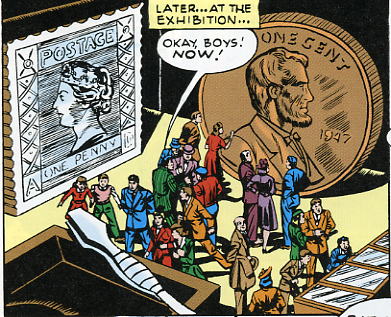
    The district and the union have great track records of being on the front lines of school finance reform advocacy.  Our community has been good too.  We can all be better.  As the comic panel above says “Now!”  If nothing is done, the 2010-11 budgets are going to be bad (a projected loss of 15% in state aid in Madison).

    There will be some opportunities to get more involved soon (stay tuned to AMPS), but for now the simple and almost  painless thing to do is visit the website, learn more, sign the petition and ask others to do the same.  You can also check in with WAES and the Penny for Kids effort on Facebook.  How much easier can it get?

    We now have some leadership; we still need more help at all levels.

    Thomas J. Mertz

    Leave a comment

    Filed under "education finance", Budget, education, finance, Local News, Pennies for Kids, School Finance, Take Action, Uncategorized

    Why a Charter School? and Related Questions

    The Ramones, “Questioningly” (click to listen or download)

    I often find the rhetorical device of “asking questions” annoying.  However there are times when the conventional wisdom becomes so pervasive that it is necessary to step back and ask some of the most basic questions.   This has happened with Charter schools.  The most basic question is “Why a Charter School?.”

    This hit me while I was watching the discussion of the Badger Rock Charter School proposal at last Monday’s Madison Board of Education meeting (video here).  At one point Beth Moss said something along the lines of (paraphrasing), “This is the kind of innovative thing that we can’t do with district schools.”  Marj Passman says something similar in an Isthmus story.  This can become a self-fulfilling prophecy.  If you believe that innovations are beyond the district’s capabilities,  then they will be beyond the district’s the district’s capabilities.  One of my related questions is “why not, why can’t the district do innovative things like Badger Rock in the absence of a Charter?”.

    Before going forward I should say three things.  First, our older son attended the Charter (in name only) JC Wright Middle School.  The only relevance that I see in relation to this is that the experience  informed my thoughts, others may think it makes me a hypocrite or something so I thought I’d put it on the table.  Second, this isn’t directly about “why not a Charter?  That’s another topic and one that I’ve hit pieces of in other posts.  Third, I want to say that I agree with many who have expressed admiration for the Badger Rock proposal.  There is much that is creative, innovative, thoughtful and good.  As the discussion on Monday made clear there are still unanswered questions and some issues that will be difficult to resolve.   I do not oppose the recommendation to seek the planning grant on the agenda 12/11.  This is only indirectly about that proposal.

    What it is directly about is re-starting a discussion or consideration of the advantages of Charters as a policy choice and extending that discussion or consideration to include ideas about what districts can and cannot do.  The current assumption that thoughtful innovation requires Charter Schools bugs me.  It bugs me even more that the the preferred path for community partnerships like the one envisioned by the Badger Rock group has become Charters.

    There was a time when districts, communities and even corporate partners initiated exciting educational work in the context of traditional district schools, district magnet schools, district laboratory schools, embedded programs and other non-Charter ways.  In Madison Shabazz and Spring Harbor are obvious examples that this can be done.  I attended a district Magnet, Laboratory School in Evanston Illinois, where more recently they have created embedded Dual Language Immersion and Afrocentric programs.  It can still be done.

    The “we can’t do it without a Charter” attitude seems lazy.  First I’d like to know in some detail why it supposedly can’t be done without a Charter.  If that proves to be the case,  than in most instances wouldn’t the best policy be to figure out why and change things so that the benefits of innovation could be achieved through district programs?  It is sad that so many have given up on the reforms that would benefit all students in order to pursue those that will only touch very few (even the staunchest Charter advocates understand that for the foreseeable future the vast majority of American children will attend district schools).

    I’ll offer one answer to the titular question: Money!  Unfortunately Federal policy-makers, foundations and many others are all acting on the unexamined assumption that innovation or even diversity of educational programing requires Charters.   I have a friend who is a Superintendent of a small district.  He is justly proud of an environmental Charter school he helped create.  We’ve never talked about it much, but a  couple of months ago he started describing how the only reason to have it be a Charter was the money.   This is pragmatic, but it only shifts the question to “Why is money available for Charters and not district-based creative programs?”

    Let’s ask the questions and examine the assumptions and do what we need to expand creativity and energy in districts and district schools.  Let’s also make sure they have the resources to do this.

    As I was finishing this I saw a great post on a related topic from Richard Kahlenberg (hat tip Jim Horn, Schools Matter).  Among other things Kahlneberg contrasts the segregative  impact of Charters with the  desegregative history of magnet schools.  Worth reading.

    Also worth reading is Madison Board Member Lucy Mathiak on the Badger Rock proposal (welcome to the Madison EduBlogoSphere Lucy).

    Thomas J. Mertz

    1 Comment

    Filed under "education finance", Arne Duncan, Best Practices, education, Equity, finance, Local News, Uncategorized

    Tax Talk — Are they listening?

    I just did a quick surf of recent news stories and opinion pieces from around Wisconsin and it should be clear to all that our State’s current system of raising revenues and  and funding of essential services (including, but not limited to education services) isn’t working and isn’t sustainable.  Yet nobody in power is talking about this and they don’t appear to be listening either.  Keeping their heads in the sand isn’t going to change the reality and fiddling with things like Race to the Top while the state catches fire is more of the same in terms of questionable short term patches where long-term structural work is needed.

    I’ll get to the clips below, but first a call to action.   The people we elected to state office promised to address these matters, but they haven’t and things just keep getting worse.  With tax collections down 12%, a state “budget reconciliation” is almost certain this Spring.  It will likely entail cuts in state services,  cuts in shared revenue to municipalities and Counties and cuts in state education aid.  Unless there is public pressure it will likely not include addressing the structural problems of an inadequate revenue system.  The only sustained and realistic work being done that puts the structural issues on the table is the Penny for Kids campaign to enact a dedicated sales tax for education.  If you are tired of the way things are going, learn more about the campaign and sign on as a supporter.  Penny for Kids is not the big fix, but it will stop some of the cuts and will move Wisconsin in the right direction.  If you are in Madison, the School Board will be considering a resolution in support on Monday (1/11/2010)  and it would be good to check in with them and let them know your thoughts.  For anyone in the state, contact your legislators and the Governor, write  a letter to the local paper…get active.

    Here is what is happening and what people are saying.

    In Oshkosh, “Crowd tells school board to raise taxes, not cut budget.”  Due to declining state revenues and an inadequate revenue cap, the Oshkosh  district must cut between $2 million and $3 million in programs and services form next year’s budget.  Because  even cuts of this size would require substantial property tax hikes, cuts in the $5 million range and not taxing to the maxare under consideration.  In a promising sign, the crowd was against these further cuts:

    Those attending Tuesday’s meeting spoke out against every one of those options, saying the cuts would dismantle the district’s efforts to improve its quality of education. Most had a special interest such as preserving their home school, keeping equity and stability for students with special needs, maintaining small class sizes. The common thread tying almost all speakers together was a preference for raising taxes over saving money.

    “We’ve been fighting to get the waste out of our schools for what, 10-15 years? There ain’t no more waste, folks,” said Oshkosh resident Thatcher Peterson, who has had two daughters graduate from the district.

    Heidi Supple, parent of a third grader at Lakeside Elementary, said, “I don’t know about your stocks or your IRAs, but everything is down right now. If I’m going to invest in anything, I’m going to invest in our children.”

    Madison and many others districts did not tax to the max last year.  This may become an annual controversy.  Without state level revenue reform it will spread.  Local School Boards are caught in the middle.

    Fewer details, but similar issues are playing out in Neenah.

    The Neenah school board faced a huge crowd Tuesday night after announcing nearly $3 million in budget cuts some parents fear are too steep.

    The cuts include 26 jobs — 16 of them are teaching positions — eliminates a popular elementary strings and band program, reduces funds for special education, and limits arts options for eighth-graders.

    The standing room only crowd on-hand was trying to persuade the school district not to make drastic cuts. Still, school board members say there’s just no money.

    Penny Paiser-Wilson’s elementary music class is on the front line of the budget deficit. It’s one of many cuts being proposed by the Neenah Joint School District for the Fall of 2010.

    And at the end of the story, this line:  “The school board president says the deficit is due to a drop in state funding.”  He got that right.  Statewide, state created problems call for statewide, state created solutions.  Raising local property taxes even more is not the answer.

    According to Jonathan Krause, the Wisconsin Covenant — a promise of a college education to all those who qualify — is $2 billion in the red.  First they break the “New Wisconsin Promise” of  “A Quality Education for Every Child” along with numerous campaign promises about education, services, tax fairness and sustainability, but this wasn’t enough.  They had to raise kids’  hopes, get them to sign  a pledge and then break that pledge.   Nice.

    It isn’t just education.  Library budgets are precarious as this letter from Stevens Point documentsChris Liebenthal reports on the decline in Milwaukee Co.  parks due to budget cuts here.   County budgets cut human services, cities struggle to plow the streets…and our state officials — the only ones who can do something about arresting this decline  — spend their time and our tax dollars making Cheese the official state snack.

    There is a good overview from the Milwaukee Public Policy Forum.  They share my sense of urgency:

    So what does this mean for state, county and municipal officials in Wisconsin? It means that the fundamental problems that have created persistent and growing structural deficits at the state, Milwaukee County and City of Milwaukee will not magically disappear and must be the subject of equally persistent focus in 2010.

    Are our elected officials paying attention?

    In closing, Dave Zweifel has a great column on the need for revenue reform.  I’m not sure I support all that is being proposed, but these ideas (and others, including Penny for Kids) deserve consideration — something there is no indication will happen unless the public pressure mounts.  Here is a long excerpt:

    Gary Bahr of Belleville should have been elected to the state Assembly when he ran for the western Dane County seat back in 1994.

    The retired small-town banker is one of the few who has consistently challenged our legislators to think outside the box about taxes. He rightfully insists that the state should completely scrap its present tax system and start over with one that makes sure everyone except the very poor pays a fair share of taxes.

    Instead, state government keeps the same broken system in place, tinkering on the edges every budget year and in these hard economic times unconscionably pushing a bigger burden down to the local level, where the regressive property tax is already chasing people out of their homes. In the end, everything stays the same, even the deficits. And now comes the news that legislators have cut back on reimbursing local governments for the services they provide state buildings — a move that puts another $4 million on the backs of Madison property taxpayers alone.

    For two decades now, Bahr has been urging the Legislature to take our public schools and county governments off the property tax. Taxes on property ought to be used strictly for municipal services like police, fire and garbage pickup. And everyone who benefits from the services, including churches and nonprofits, would pay property taxes, which he estimates would be about 85 percent less than they are now.

    If you care about the state, our children and the future;  get involved, do something to make our elected officials back up their words with real positive action.  If they won’t,  help elected people who will.

    Thomas J, Mertz.

    Leave a comment

    Filed under "education finance", Best Practices, Budget, education, finance, Local News, Pennies for Kids, School Finance, Take Action

    WAES School-funding Reform Update, January 5, 2010

    From the Wisconsin Alliance for Excellent Schools.  Table of contents below; pdf of full update here.

    * Sign petition urging legislators to consider “A Penny for Kids”
    * Governor’s school-funding reform … raise property taxes?
    * UW education dean wonders if a “Race to the Top” is what is needed
    * Neenah, Stevens Point deal with school budget deficits
    * School-funding formula is moving the pain around the state
    * New school but old funding problems for Greenfield
    * Greenfield joins WAES, but your help is needed
    * School-funding, education reform forum set in Middleton, Jan. 28
    * Rep. Mark Pocan talks funding reform in the Lions’ Den
    * Gazette surprised Wisconsin spends less than average on schools
    * IWF, WTA note drops in Wisconsin’s spending and taxing ranks
    * New report says better early education would benefit the economy
    * Correction to an earlier story
    * Help WAES correct e-mail update glitch
    * School-funding reform calendar

    You can now connect with WAES on Facebook!  If you haven’t yet, take a few minutes to learn about Penny for Kids and sign the Petition here.

    Thomas J. Mertz

    Leave a comment

    Filed under "education finance", Arne Duncan, Best Practices, Budget, education, finance, Local News, Pennies for Kids, School Finance, Take Action

    4K “Surplus” and other Board of Education Agenda Items (With Live Blogging)


    Note: Because I was writing this as the meeting was going on, I did some live blogging.  I’ve taken out those portions of the post and linked them here.  They are mostly on the Reading Recovery report and proposal.  Some interesting things.  Worth reading or watching the video when it is up. — TJM

    Please also note a correction/expansion in the Reading recovery section (12/08/200. 10:45 AM).

    Monday, December 7 will be a very busy evening for the Madison Metropolitan School District Board of Education.  Tonight, among other things they will consider 4 year old kindergarten implementation plans and costs; Reading Recovery matters; a 3% total package increase for District Administrators; and Strategic Plan Performance Objectives and Measures, Core Performance Measures and First Priority Action Steps (with costs).  Unless I am mistaken, these will be discussed in Committees tonight and then come back to the Board for action next Monday and some, like 4k even later.  That’s the new system.

    4 year Old Kindergarten

    Since the Wisconsin State Journal article is misleading, I’ll start with that one. The headline calls 4K a “Junior Mint” (bad pun) and the article includes this passage:

    Under state funding rules, the Madison School District would not be fully reimbursed for its 4K expenses until the third year of the program, when the district would actually reap a surplus from the state.

    So during its first year in Madison public schools, 4K would run an estimated deficit between $2.64 million and $3.87 million. By year three, however, the program would show a surplus of close to $4 million. (emphasis added)

    The big problem with this framing is that the projected surplus is not in state funding but in revenue limit authority and last I checked well over 80% of MMSD’s revenue limit authority is collected via local property taxes.

    It makes a big difference which stack the coins come from, such a big difference that cuts in the state share induced the Madison Board and many others to not use all of their authority this year.  They thought that property taxpayers couldn’t or wouldn’t stand for it.  As a result, MMSD will not be doing maintenance projects that had been previously funded via a voter approved referendum.

    I don’t see any discussion of where the start up costs  will come from (maybe I missed it), but my guess is the district’s growing Fund Balance.

    One thing I will say for the MMSD is that they used a conservative (and depressing) $200 per pupil annual revenue limit increase for their projections.

    I don’t know enough about costs to judge those projections.  I’m a little skeptical of the surplus in general because almost across the board, across the state revenue limits do not keep up with cost-to-continue.  I do know that we should try to move 4k forward if we can afford it and these look like viable options.

    Reading Recovery

    There is a long and controversial history with the Reading Recovery remediation in Madison.  I’ve always been supportive of the program, but a bit skeptical of the claimed local “success” rate (if the reality was anywhere near what was being reported, then much good and even “bang for the buck” was happening).  The report linked above gives some better data, a lower “success” rate and some options for the future.  I’m very glad to see this level of analysis.  I haven’t had the time to do more than skim, but I’m more confident of the conclusions than I was previously.

    With that in mind, I would tentatively support the third of the three options offered (the administration recommends the second).

    I especially like the pre-K to 5 continuity and the inclusion aspects.

    Correction/Expansion:  I confess to having only skimmed when I posted earlier.  Having looked closer I see I misunderstood option 3.  Now that I am clearer, I support option 2. This is the one that takes the Reading Recovery that is working — full implementation with wrap around supports and followup —  and puts it in the neediest schools and eliminates the partial and unsupported implementations.  I would prefer to expand the version that is working, but that is not an option before the Board (I misunderstood #3 to be that option).

    Administrative Pay and Benefits

    The proposal is for 1.48% pay increase and a 3% total package increase to cover (1.52%) increased benefit costs.  There is something unseemly about administrators getting a pay increase at a time when we aren’t taxing to the max, aren’t doing maintenance and will be looking at program cuts in the Spring.  I know most work hard and most do a good job…but…. times is tough all over and most of these people earn in the six figure range.

    No cost estimate is included.  There should be.

    My gut reaction is give them the benefit costs increase and not the salary.  Times is tough.

    Strategic Plan

    When I first read these I had some concerns about the possible lack of  disaggregated reporting called for.  The “Core Performance Measures” draft says “All measures related to students will be disaggregated…” but there is no similar statement for the non-performance (ie participation) measures in the big “Strategic Objectives Performance Measures” and in places specific disaggregations are identified (Special Ed for one).   I was given assurance that the intent is to have all of these disaggregated and that in some manner that will be made part of the public record at the meeting.

    I’ve posted requests and discussed the issue on this blog, asked in public and private, as an individual and as an Equity Task Force member for disaggregated data on participation in advanced and other programs.  We can’t know how we are doing on removing barriers to educational opportunities without this information.  I do hope that after all these years we get it and on a regular basis.  Let’s see how bad the disproportionalities are and then see how the efforts to address these are working.

    On a related note, I’ve been told that the required Equity Report information will be included in a broader January report.  I’m glad something is happening and appreciate those on and off the Board who have pushed.

    This is very late for an annual report (it will be 21 months since the policy was enacted) and not ideal.  If the intent was to have at least one meeting  a year where the focus was on equity measures, placing this in a larger report will not achieve this goal.

    I have some similar concerns with the “Core Performance Measures” and the lager (200 item) “Strategic Objectives Performance Measures.”  Ideally the Core items will give the “forest” and the larger ones will be for those of us who like to get lost in the trees.  There is no doubt in my mind that the items on that larger list will get very little attention from the Board…information overload.  This makes it crucial that the Core list include the right things.

    I don’t think it does that.  Here is the list:
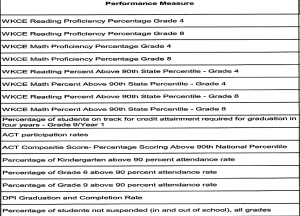
    I see a lot of use of the WKCE, probably too much.  I also don’t see anything about how well we are doing changing district culture and school climate, increasing participation in anything but the ACT, direct evaluation of any Strategic Plan associated initiatives…This isn’t a whole lot different than what NCLB requires.  In fact some of these have the NCLB fiction of 100% proficiency as the goal.   Not good.

    Take a look at some different things in the big list and think about what you’d like to see included.  Post in comments if you want.  I’d especially like to hear what members of the Strategic Plan Team.  I plan to try in the next week or so…time is tight so I might not get a chance to do much.  One idea is to look at the effects of the Individual Leaning Plans that will be piloted.

    One more thought on the big list for now and then a a little more.

    This one is personal.  On page 11 there are three items about Community Engagement.  All simply ask for number counts of community members at engagement sessions, on advisory groups…  There needs to be something about the quality of the experience.  Having attended too many engagement sessions and served on Task Force, I can tell you that these experiences can and do produce disengagement.  This needs to be addressed, the quality needs to be improved and counting numbers of participants won’t even put the problem on the radar.

    Thomas J. Mertz
    Leave a comment

    Filed under "education finance", Best Practices, Budget, Contracts, education, finance, Gimme Some Truth, Local News, School Finance, Uncategorized