Category Archives: Local News

Glendale Elementary: Looking past the stats

66310.jpg
photo by: Mike DeVries/The Capital Times

A behind the scenes examination of Glendale Elementary, along with an audio slide show, is on tap in this well written piece in the Capital Times. Let’s hope this a foreshadowing of things to come as our afternoon paper attempts to reinvent itself from dead tree technology to a cyber presence in a couple of weeks from now.

Robert Godfrey

Glendale Elementary may be failing by test-based standards, but it’s succeeding by human ones.

The question of how we recognize good schools and bad ones has become a pressing issue.

In Washington, Congress is debating the reauthorization of the No Child Left Behind legislation. Locally, Madison and Sun Prairie parents have recently been upset over boundary changes that some see as sending their children to less desirable schools.

At the same time, the movement toward inclusivity in special education, a growing minority population and increasing poverty rates throughout Dane County, particularly in Madison, have put a sharp point on some important questions:

  • Do advanced students suffer when they share a classroom with struggling students?
  • How should schools address the stresses of poverty?
  • Are test scores a reliable measure of a school’s effectiveness?

This story doesn’t attempt to answer those questions; educational researchers have been struggling with them for decades. Instead, it puts one Madison elementary school under the microscope where all those currents come together — a school that by No Child Left Behind’s test-based standards is clearing failing. Yet, by the assessment of a number of parents, volunteers and other fans, the school is succeeding beyond all expectations.

A closer look at Glendale Elementary, a 50-year-old Madison school within the noisy shadow of U.S. 51, shows a school where success is occurring in ways that test scores can’t measure and poverty rates don’t reveal.

Leave a comment

Filed under AMPS, education, Local News, No Child Left Behind

TAME’s Proposal on Military Recruiting in MMSD

schneider_war.jpg

At the March 3d Board of Education meeting Truth and Alternatives to Militarism in Education (TAME) presented a detailed proposal for regulating military recruiting in Madison schools.  Proposed policy changes developed by staff and the Board will be on the agenda at the Board’s March 24 workshop meeting (no public testimony).  I hope that TAME’s ideas are given serious consideration.

From TAME: 

TAME is a small group of citizens working hard to educate school boards, students, and parents about the excessive recruiting measures to sustain the all-voluntary armed forces.  Because the Madison School administration has been letting slide enforcement of the current Board of Education policy regarding military recruiters in Madison’s schools, and because the Madison School Board chose to allow the military to advertise on scoreboards in the gymnasiums and football fields, also a violation of the policy, T.A.M.E. became more publicly active in the last 4 months to stop this abuse and misuse of power.  In discussions with School Board members and administrators, it became clear that the Board and administration was looking for more suggestions regarding this issue.  Thus, T.A.M.E. developed this list of suggestions, and presented them at the B.O.E. General meeting on March 3, 2008.

No Child Left Behind requires that military recruiters be given the same access to students as recruiters for all other post-secondary opportunities (colleges, trade schools, employers, internships…) enjoy.  The penalty for non-compliance is loss of federal funding.  As far as I can tell from the earlier Board discussions, TAME and the district share a goal of making sure that students are not targeted by continuous high and low pressure pitches by military recruiters, while assuring that all representatives of post-secondary opportunities have the access they need to help students make informed decisions.  The problems come in with drafting and enforcing a policy in a manner that reasonably limits the military but doesn’t penalize a representative of MIT or MATC from saying hello to a student while grabbing a pop in the cafeteria.  The reality is that military recruiters are hanging around the cafeterias looking for those opportunities and this has to stop.

In 2008 the military budgeted $19,210 for each recruit!  That’s why they can pay people to hang around cafeterias.  The reason they have to spend that much is that most potential recruits are smart enough to realize that joining the military carries dangers and restricts freedoms in ways that other options don’t. 

The military has a place in our society (I pray for the day when it isn’t needed) and can be a good choice for some young people.   Nothing in TAME’s proposal hinders those students interested in the military from learning more, from finding out if it is a good choice for them.   TAME just wants to make sure that they have an equal opportunity to learn about options that don’t have over $19,000 to spend targeting them (imagine if the Peace Corps had that budget).  Read the TAME proposal and weigh in with the Board prior to their March 24 meeting.

 Thomas J. Mertz

Related Resource:

Rethinking Schools Special Section on Military Recruitment (scroll down)

Leave a comment

Filed under education, Local News, nclb, No Child Left Behind, Take Action, Uncategorized

SAGE Thoughts

lu-yu-god-of-tea.jpg

The Student Achievement Guarantee in Education (SAGE) contracts for MMSD schools will be on the agenda at Monday’s (3-10-2008) Special Board of Education Workshop meeting.  I have mixed feelings about the SAGE program because of the choices it forces school district to make.

A serious overhaul of the school funding system is needed and one of the things that should be addressed are the problems with SAGE.  Most of the proposals I’ve seen (Wisconsin Alliance for Excellent Schools, School Finance Network, Alan Odden…) would minimize or eliminate some of the issues discussed below.

I am all in favor of targeting resources (or the money to pay for resources) to children in poverty and schools with high concentrations of children in poverty.  I also think all four parts of the SAGE program are great:

Program Elements

SAGE promotes academic achievement through the implementation of four school improvement strategies:

  • class sizes of no more than 15:1 in grades K-3;
  • increased collaboration between schools and their communities;
  • implementation of a rigorous curriculum; and
  • improved professional development and staff-evaluation practices.

SAGE does this by providing districts with $2,000 per student in poverty at SAGE schools (next year it will be $2,500, the first increase since the program started over a decade ago).  I even like the fact that there are some strings associated with the money, that it has to be used in certain ways.  In this fiscal climate legislators and tax payers want to know that their money will be spent wisely and the preponderance of research (and here) indicates that the areas SAGE money can be spent are productive best practices.

The two of the biggest problems with SAGE are that 1) There are a limited number of SAGE contracts, meaning there is a cap on the number of schools (and children) that can benefit from the program (MMSD has 20 contracts);  and 2) SAGE does not direct extra resources to poor children in non-SAGE schools (it isn’t easy being a poor child in a rich school).  I’ll add a number 3, that SAGE does nothing for children after third grade).   As a result of these —  and the fact that SAGE funding is insufficient (it is an under-funded “mandate”) — the SAGE program promotes economic segregation in our schools.

Economic segregation was among the considerations in the recent West-side attendance area boundary discussions.  The Equity Task Force has weighed in with guidelines to minimize economic segregation.  I am an unapologetic believer in promoting integration as a key element of the social mission of public education.   However, the case for  economic integration does not rest solely on these ideals, significant research has demonstrated that poor children tend to achieve more in schools with an economic balance (and here and here and here…. Note that  —  like everything else in education research — there are no absolutes and that there are schools with very high poverty proportions where achievement is also high and schools with low poverty where achievement is not so high).   These finding are reflected in the local data below (see also the “Classmates Count” study).

poverty-mmsd.jpg

Graphic taken from “Effect of Concentration of Poverty in School on Reading Scores (MMSD).”

The problems come in because unless there are high concentrations of poverty in individual schools, meeting the SAGE program requirements demands great expenditures from general operating budgets, budgets that are already stretched to near the breaking point.

For simplification, I am only going to do the math for approximate classroom teacher wages and benefits costs (this means that expenses having to do with community collaboration, curriculum, staff development, evaluation, specials teachers, facilities and supplies are not included).  A full time equivalent teacher costs MMSD about $76,000/year in wages in benefits.   There are 28 schools in MMSD serving K-3 (not counting the hand-full of students listed at Lincoln; there will be 29 schools next year).  Among those schools the average number of kindergartners is 72, to make the math easier (and more dramatic), let’s use a school with 63 kindergarten students (these are  crude estimates because the the way the numbers break down with 21/1 and 15/1 are crucial and the use of multi grade classrooms opens up some other possibilities for maximizing SAGE dollars).   At a 21/1 pupil/teacher ratio this would mean the school would require 3 kindergarten teachers and classrooms.

63/21 = 3.0.

At a 15/1 ratio the school would require 5 kindergarten teachers and classrooms.

63/15 = 4.2 (round up to 5…SAGE requires 15/1 or less).

At $76,000 per teacher the difference in cost is $152,000.  Using next year’s SAGE funding ($2,500/student in poverty) it would take about 61 students in poverty to make SAGE to pay for itself.

152,000/2,500 = 60.8 (round up to 61).

Out of a class of 63, this means a poverty proportion of 96.8% is required for SAGE class size reduction to be “fully funded.”  No K-3 schools in Madison are currently at or above this level.  The closer you get to that 96.8% the less general operating money is needed.   Here is a chart for percentage of kindergarten students in poverty and local implementation costs (the unfunded portion) based on the assumptions and calculations above:

30%

$104,750
40% $89,000
50% $73,250
60% $57,500
70% $41,750
80% $26,000

This creates a dilemma.  Maximizing SAGE dollars pulls toward concentrating poor children; best practices pushes toward balancing poverty at the school level.

SAGE also creates a related dilemma in the allocation of contracts between big schools with low poverty and small schools with higher poverty numbers.  Using the contract in a big school can bring in more SAGE dollars, but will also require more local dollars also.  Using the contract in a small school will mean fewer total students will benefit and may mean fewer students in poverty benefit.  I’m going to use Gompers and Chavez to illustrate this (see here).

Gompers (2007 figures)

154 K-3 students, 60% low income, about 93 SAGE funded students,

at $2,500/student = $232,500 in SAGE dollars.

Cost differential for 15/1 ratio (four more classrooms) = about $228,000.

Chavez (2007 figures)

482 K-3 students, 27% low income, about 130 SAGE funded students,

at $250,00/student = $325,000 in SAGE dollars.

Cost differential for 15/ratio (12 more classrooms) = about $912,000.

So fully implementing (K-3) a SAGE contract at Chavez instead of Gompers would bring in more money,  serve more students and more students in poverty, but at an additional cost to the district of about $684,000 per year.  Tough choices.

In Madison these choice are made even more difficult by the fact that we have about seven schools between 23% and 33%  poverty level, but only enough SAGE contracts for two or three these schools.  These schools vary greatly in size, and the exact percentages cannot be known till after the third Friday counts in September, further complicating the issue and making the equity based choices even more elusive.

In the past Madison has worked around some of these issues via implementing various levels of SAGE (K-1, K-3, whole school…) and using local funds to reduce class size in non-SAGE schools.  Madison has also won praise for leveraging federal, state and local monies to maximize the impact of all the dollars (see: Resource Distribution in the Implementation of Class Size Reduction Policy: Looking Inside the Black Box of District Practice, MMSD is “Maxwell”). Last year was the first year the district moved away from locally based class size reductions.  Without a successful referendum in November 2008, it won’t be the last.

In closing, there are some questions surrounding what options a district has in transferring SAGE contracts.  Last year the administration analysed choices based on the assumption that contracts could be moved (and here). Recently, the Board of Education was advised that “neither the statutes nor the administrative rules expressly prohibit the transfer of a contract.”  The DPI guidelines from February of 2007 state:

Transfer of contracts has been allowed when SAGE schools have been closed, consolidated, or moved to new buildings to ensure the benefits of the program could follow the students to their new location.

  • Within the term of a five-year SAGE contract the contract may be moved by the district from an existing school to a different school more in need of the program only with the consent of the recognized representatives of both the staff and parents of the school giving up the contract
  • At the end of a five-year contract the district board may transfer a SAGE contract from one school to another the SAGE requirements will immediately apply to the school to which the contract is transferred.

I don’t know what decisions the Board might make on Monday.  With a matter this complicated and with budgetary and equity consequences for the entire district, I believe that in the absence of guidelines or policy directly addressing the issues, these discussions and decisions should take place as part of the budget process and not as a separate item.  I also wish the Board the best with these very difficult issues.  Last, I hope that the community understands that there are no easy or clear choices and that the Board must weigh many factors and options with an eye on what is best for the district as a whole.

Thomas J. Mertz

[Note post edited at 5:42 PM, 3-09-08 to correct mathematical error. The new version uses  a school with 63 kindergarten students as an illustration, the first version used a school with 72.  Because of MMSD policies and the way the numbers work out the cost differences for a school with between 63 and 91 students in a grade would not be as dramatic (only one more teacher required).  The district cannot know if a particular school will hit a sweet spot (64, 65, 66,..) or a sour spot (62, 63, 91, 92…).]


Leave a comment

Filed under "education finance", Best Practices, Budget, education, Equity, finance, Local News, Pope-Roberts/Breske Resolution, Referenda, School Finance, Uncategorized

Quote of the Day

lines.jpg

No boundary changes ever occur without fear, or frustration. That’s what happens when you live in a growing city. Arguments that folks moved to a specific neighborhood for a specific school are weak at best. We cannot afford a school for every neighborhood, and we have to address over-crowding as well as school equity as it relates to children of low income families.

SP-EYE: Keeping an EYE on the Sun Prairie School District

Our neighbors in Sun Prairie are dealing with similar issues in redrawing school boundaries.  Clean and easy attendance area redistrictings are exceedingly rare, add issues of racial, linguistic and economic diversity and there is sure to be conflict.  That’s the nature of the beast.

The MMSD West-side boundaries are on the agenda for Monday, March 3, 2008.

Related items:

“Moving the Lines,” Jason H. Silverman.

“Planning for Equity,” Kelley D. Carey.

“Planning for Integration,” Kelley D. Carey.

Sun Prairie Area School District Boundary Task Force (District Home Page).

More student moves loom in Sun Prairie (Capital Times).

Sun Prairie Parents Weigh In On School Boundary Changes (Channel 3000).

Sun Prairie schools still in a deadlock (Capital Times).

Opposition voiced to boundary changes (Sun Prairie Star).

MMSD New Elementary School page (with boundary proposals).

Parents Upset Over Plan F Recommendation (WKOW).

School Board panel recommends significant changes (Capital Times).

Cheryl Rebholz: Toki Middle School responses unfair (letter to the editor).

Thomas J. Mertz

Leave a comment

Filed under AMPS, Best Practices, education, Equity, Local News, Quote of the Day, Uncategorized

(Now?) Talking about Boundaries and Diversity, 2008 Style

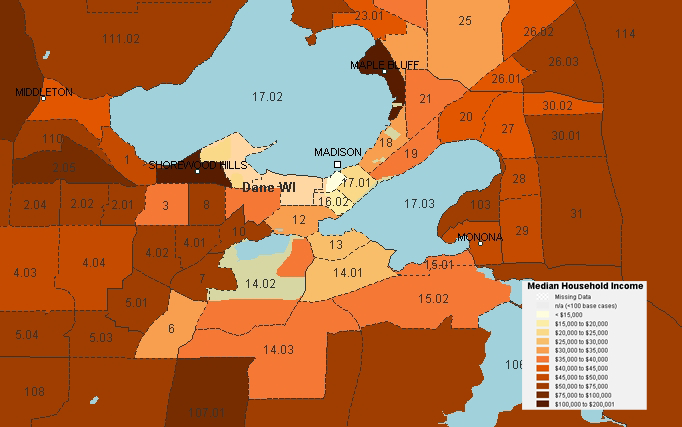
2000-census1.jpg

This is a quick update on the earlier post “(Not?) Talking about Diversity and Boundaries, 2008 Style.” The good news is that it appears that some people have at least started talking. Susan Troller’s article in today’s Capital Times has some good quotes from three Board of Education members. Everything they say is fine and (at least) one addresses resistance to diversity head on:

School Board member Carol Carstensen, who chairs the long range planning committee, said she has been very troubled by the tone of many of the e-mails she and other board members have been getting regarding the proposed changes.

“It’s dramatized for me the significant gap we have in our community,” she said.

“It’s very troubling that we are increasingly separating ourselves and that there are parents who are saying they will not allow their children the experience of going to school with ‘those children,'” she said.

Lucy Mathiak offered a reminder that test scores aren’t everything:

“The performance and the test scores simply don’t warrant this kind of reaction,” she said, adding that hearsay, not actual experience, is fueling a gap between perception and reality at many low income schools.

Along with Beth Moss, Mathiak and Carstensen put things in perspective and reminded the community that perceptions and realities of schools can be changed and that active involved community members are the key:

“My children attended East, and I know how painful it is to have the school your kids attend labeled as some kind of loser ghetto school,” she [Mathiak]said.

“My kids came out of their school experiences as well-educated for life success as I could possibly hope,” she added.

Beth Moss, who is the third member of the long-range planning committee, and who has children who attend Jefferson, said a school’s reputation can change quickly.

“Last year I was sitting with a group of very irate parents who were extremely concerned about school safety, violence and bullying at Jefferson,” she said.

“We talked about it, and some changes were made, but I do find it kind of ironic that now Jefferson is seen as some kind of nirvana,” she said.

“The reality is that no school is perfect,” Carstensen said. “If you don’t like something, do what so many parents have done. Work at it, and change it.”

I’m glad to hear this from our Board members.

The many comments on the Capital Times story show others talking directly about the difficult issues of race, class and diversity. Not everything said there is constructive, but I do think that airing this is better than pretending it doesn’t exist.

Another good sign is the use of language and concepts from the Equity Task Force work at the Long Range Planning forum last week. The notes are posted here. Even though the Board has not directly addressed that portion of the Task Force recommendations, the idea that Madison needs to take affirmative steps to create and maintain schools with reasonably balanced socio economic characteristics (and that schools with low poverty numbers are as unacceptable as schools with high poverty numbers) seems to be gaining currency with some. More good news.

And on a non-local note, Mica Pollock, the author of Colormute: Race Talk Dilemmas in an American School and editor of Everyday Antiracism: Getting Real About Race in School (discussed in the previous post), will be participating in an on-line chat hosted by EducationWeek.org. the chat will be on February 27, but they are taking questions now. More info here.

Thomas J. Mertz

Leave a comment

Filed under AMPS, Best Practices, education, Equity, Local News, Uncategorized

NCLB Action

We haven’t posted much on No Child Left Behind lately.  Time to remedy that.

The reauthorization/reform are still pending, but don’t appear likely in this election year (see also here).  I don’t know if that is good news or bad news.  A straight re-authorization would be very bad news, but a better federal education policy (and less high stakes testing, less money for charters and vouchers, more money for underfunded mandates, more realistic accommodations and exclusions of special education students and English language learners for all testing) would be welcome, whatever the name.

I have to thank Madison teacher Gary L. Stout for prompting me on this post (and to add the Collaborative for Academic, Social, and Emotional Learning to the AMPS Resources page — check it out).  Gary, along with David Wasserman (see here and here, on AMPS) has been doing his best to get out a teacher’s perspective on the damage the law is doing to our schools and children.  Here is an excerpt from his site on NCLB (check out the Social, Emotional, and Academic Learning in Kindergarten material too, it is well worth the time if you care about early education).

Developmentally Appropriate Practices

If a person is truly knowledgeable about what constitutes Developmentally Appropriate Practices (DAP) for our school age children it is inconceivable that they support NCLB.

The concept of Developmentally Appropriate Practices are the cornerstone of what is good for our children in all schools. You will never, ever see the two phrases NCLB and DAP in the same sentence in any credible professional educational journal, never, ever. The more a person studies and works in teaching the more a person sees how developmentally inappropriate NCLB really is.

NCLB is the most destructive, vindictive piece of federal legislation ever passed. It is a deliberate assault on public education. It is a disease that is presently in every classroom, every day. It starts in kindergarten classrooms by undermining all aspects of Developmentally Appropriate Practices. It continues on through the grades and stops in High School when it lures, misleads, misinforms, and recruits our students into the all too real prospects of death or maiming. It is a tribute to the existing presidential administration
and their success at destruction and manipulation. NCLB is an all encompassing cancer that needs to be stopped.

The whole essay is here, including good quotes from our Board of Education members.  One more excerpt on what we can do: Take Action!

What Can We Do?

It is easy to be critical of NCLB. The challenging part is addressing the question of what can we do to change things?

1. We need to unite and get politically active locally and nationally to eliminate NCLB or change it drastically. The problem is that political change is slow. We as a nation have been taking steps backward in the education of our children for five years now. We will continue going backwards on a daily basis as long as NCLB exists as it is today.

2. It is critical for Wisconsin to change the way our public schools are funded. The elimination of revenue caps and the use of property taxes as a major way to fund public schools has got to change.

3. Third, we need to educate many of our co-workers, parents, and the voting public as to the truth about how our schools are being deliberately set up for failure and how our schools are presently failing on a daily basis to meet even the basic needs of all our children
There are also at least three things we can do immediately as a progressive and accountable school district.

1. Stop the one dimensional focus on academic learning and teach to the whole child. We need to teach and give every child the opportunity to grow socially, emotionally, physically, and creatively as well as academically.

In March 2003 I addressed a Madison school board committee suggesting that our school districts emphasis on testing and academic learning at the expense of social, emotional, physical and creative learning was developmentally inappropriate. Since then our approach to teaching to the whole child as become even more one dimensional with the developmentally inappropriate mandates of NCLB.

2. Change the focus of the Madison summer school program. Instead of using behavioral issues as a deterrent to getting into the program, children with behavioral issues should be the first to be enrolled. The public needs to know that when a classroom has just one socially
inappropriate child, that child takes educational opportunities away from every child in the classroom. Social development is similar to reading and math development. They need to be taught every day, in every classroom, at every grade level.

3. We need to remember Rosa Parks and say no to NCLB. Our school district should be commended for having the courage to say no to the Reading First program. Lets have the courage to say no to NCLB. As a community lets find ways to fund our schools without having the George Orwell effect tied to federal dollars.

I’ll add one more.  The Board of Education Communications Committee is planning forums on various topics.  I think the NCLB Act should be one of them.  If you agree, let them know.

Here are some of my other favorite anti-NCLB resources:

The Educator Roundtable (with petition).

Susanohanian.org (with a compilation of NCLB Outrages).

No NCLB.org

Thomas J. Mertz

Leave a comment

Filed under Accountability, Best Practices, Budget, Elections, Equity, finance, Gimme Some Truth, Local News, National News, nclb, No Child Left Behind, School Finance, Take Action, Uncategorized

Everybody Wins!

gold-stars2.jpg

“We’re a Winner,” Curtis Mayfield (listen).The Madison Board of Education voted tonight (7-0) to change the schedules of Board and Committee meetings for the next three months instead of moving non-agenda public comments to the end of meetings.

Open and convenient access for the public has been preserved, the Board has a schedule that they believe will allow them to be more productive and efficient.  Everybody wins.

Many thanks to all who expressed concerns, lent support or offered suggestions

Thomas J. Mertz

Leave a comment

Filed under AMPS, Best Practices, education, Local News, Take Action, Uncategorized

Democracy and Efficiency (part II)

ito13.jpg

On Monday February 18 the public will get a chance to speak to the the Board of Education about the proposal to move public appearances on non agenda items to the end of meetings. I implore all interested members of the public, pro and con, to attend on Monday and make your voices heard. The meeting will be in the Doyle Building auditorium. It starts at 5:00, but the public hearing on the proposal is on the agenda after the report of the Citizens [School] Naming Committee report. I would guess this will be after 5:30.

In an earlier postI promised to offer some constructive suggestions on this proposal and the broad matter of balancing the desire for public participation with the desire for efficiency. I realize that these are not exactly the same “problems” Board President Arlene Silviera identified — “The issue is that the Board would like to focus on its business at a more reasonable hour in order to make good decisions for the children of the district” — but I think they are close enough.

When searching for solutions, it is essential to begin by demonstrating that the “problem” actually exists and if it does the next step is to assess how serious it is.

Here are the Board priorities for the year:

– Develop specific, measurable goals regarding strategic priorities

– Attendance, dropouts, truancy, expulsions, bullying

– Equity discussion – follow through/implementation

– Hiring a new Superintendent

– Considering/weighing options for a possible referendum

I don’t know everything that the Board has done, but based on what I do know and can find I’d like to go through these one by one and assess the progress.

Develop specific, measurable goals regarding strategic priorities

The Performance and Achievement Committee developed and forwarded to the Board a “Strategic Plan Accountability Matrix,” It was approved on November 11 . I believe that this is a partial fulfillment of this priority. The matrix isn’t posted on the district web site so I can’t be sure, but this appears to be related to the ongoing work of the district and Board moving toward implementing value added analysis (a blessing, but a mixed blessing in my opinion, see here, here and here, to start). The strategic priorities should also play some role in the Board’s equity work.

Attendance, dropouts, truancy, expulsions, bullying

After much work, the expulsions policy has been revised. I can’t find much on the others ( code of conduct revision here), but again the equity work should touch on them. Another partial fulfillment.

Equity discussion – follow through/implementation

One meeting devoted largely to Equity where progress was made and a second (at the end of a night made long by on-topic public appearances at the Long Range Planning Committee and other matters), where not much was accomplished. I have many things to say about process the Board has pursued with their equity work (some here), but this is not the place to go into that. I would put this in the “barely started” category.

Hiring a new Superintendent

This is huge and was hugely time consuming. They did a very good job throughout the process and ended up with a fine choice.

Considering/weighing options for a possible referendum

They started this in a timely manner, made some progress but because of the TIF windfall it ended up being “the referendum that wasn’t.”

I think this is a pretty impressive record of accomplishments. Add to it revising the school naming policy, beginning West side boundary discussions, settling the MTI teacher contract, beginning work on community forums and partnerships, as well as other initiatives that are under my radar; and weathering the storms of consolidation and budget reconsideration, General Vang Pao, and private school busing and it looks to me like a fairly successful term. I am skeptical that this record indicates a problem that rises to the level of requiring what I consider the drastic action of making it more difficult (however slightly) for the public to communicate with the Board. Obviously some Board members disagree or it wouldn’t have come up.

Although skeptical, I’ll stipulate that there is a problem, that the Board has been unable to give sufficient attention to their work and priorities. The next step should be to evaluate a range of solutions. The Board produced one “solution” and did little in the way of evaluating its’ effectiveness.

I hope to have documentation of how much time was spent on off-topic public appearances before Monday. Having sat through many meetings, watched video of others and reviewed minutes of even more, my initial impression is that the vast majority of off-topic public appearances this term have been about the school consolidation/budget reconsideration, the General Vang Pao school naming, private school busing and Military ads/recruiting. At least the first two of these are exceptional situations and concern problems of the Board’s own making. Some might say this describes the others also. My point is that week in and week out, year in and year out, off-topic public testimony does not seem to consume all that much time or energy.

In all these cases and more, I believe that the community, the district and the Board have all benefited from the opportunities for open public input. If there is to be any new limit, I would like it to be time based instead of topical. For example, if there are more than 15 registrants, limit of speakers for two minutes.

Any assessment of time or energy spent on off-topic public appearances only makes sense in the context of a comparative assessment of time spent on other tasks. I don’t have documentation on this either, but it seems the Board spends an inordinate amount of time with housekeeping matters, paying bills and and taking other actions that are required by law. The obvious solution is to use a consent agenda, to bundle these matters into a single vote. This has come up twice (that I know of) in Board discussions; once here and the second time during the discussion of the public input “problem.” Despite the efforts of some Board members, it has never appeared on an agenda. It is a reform that makes sense.

I am only going to make one more suggestion here, and this only deals indirectly with efficiency, but I think it would enhance communication and democracy and may induce fewer people to use Board meeting time with public input. Board members should hold office hours. One of the problems with the rituals of public input and the black hole of emailing or writing elected officials is that the public often feels they are not being listened to. I know Board members also have public phone numbers, but calling them seems like such an imposition. Office hours would allow dialogue between Board members and the public — something, for legal and other reasons, sorely lacking at Board meetings. Carol Carstensen used do do something like this in her home by hosting regular open houses, but these raised legal issues that led to their demise. What I am proposing is that Board members rotate and that each week at a designated time one or two be available for appointments or walk in meetings. I really think this would help.

Communication is a two-way street and the public is not without fault in the communication problems that exist. John Dewey wrote:

All communication is like art. It may be fairly said, therefore, that any social arrangement that remains vitally social, or vitally shared, is educative to those who participate in it. Only when it becomes cast in a mold and runs in a routine way does it lose its educative power. “

Too often the public input sessions — both on and off topic — consist of all parties going through the motions. With this in mind, I offer some initial tips on giving effective, communicative public input:

  • Be informed and accurate.
  • Know what can or cannot be done, but also don’t lose sight of and do communicate your dreams for the future.
  • Be polite and respectful (this one can be hard, but at least keep it civil).
  • Don’t rehash old history. Past conflicts and mistakes should be used sparingly and only to point ways forward.
  • Offer realistic alternatives.
  • Try to see the “big picture” and demonstrate that you do.
  • Remember that the School board’s primary focus and reason for being is to improve student achievement for all children
  • Use personal stories, but don’t make it personal, tie them to larger concerns.
  • Thank the elected officials for past and future things.
  • Don’t criticize the people, criticize their actions (or inaction).
  • Sustain involvement. Elected officials have more respect for people who stick around and keep working.
  • Look for common ground, but if it isn’t there be straight forward about that.
  • Don’t make threats.
  • Don’t complain about taxes unless that is the one focus of your testimony.

As usual, this is too long, so I’ll leave it at this. Your suggestions on effective input, Board efficiency or anything else are welcome. Just leave a comment.

Thomas J. Mertz

1 Comment

Filed under Accountability, AMPS, Best Practices, Local News, Take Action, Uncategorized

Democracy and Efficiency (part I)

what-threatens-democracy-2.jpg

The Madison School Board has drawn fire from Progressive Dane for a proposed policy change regarding public appearances.

The change would limit public commentary preceding school board meetings to agenda items. Individuals who want to speak on issues that are not part of the agenda would be required to speak after the business portion of the meeting was complete….

[Board of Education President, Arlene] Silveira objected to characterizing the change as an effort to limit public discussion or input.

“That is simply not true. This has been a discussion about trying to find a solution to a problem in getting the work done we were elected to do. Under this proposal, people can certainly speak on non-agenda items, just not before we begin our business meetings,” she said.

Susan Troller Capital Times, February 9, 2008 (emphasis added)

We need to move beyond the unsupportable assertions that the proposed public appearances policy revision does not limit public input (however slightly) and start asking if the new limits are an acceptable trade-off for increased efficiency.

In democratic governance there is almost always a trade-off between efficiency and democracy. More participatory structures tend to be less efficient (there are some ways of gaining efficiency that have little impact on participation and some ways of enhancing participation that have little impact on efficiency; I will touch on some of these in part II). This extends beyond opportunities for the public to vote, petition or make our voice heard to questions of balance concerning the proper breadth or shape of the responsibilities claimed by or ceded to the public, elected officials and appointed professional administrators. Among democratic systems, the least democratic structures give the most responsibility and power to those at the farthest remove from the public, professional administrators.

In school governance at one end of the spectrum would be the annual school meeting, which vested comprehensive powers in the voters who attended. At the other end would probably be the mayoral appointed superintendents given sweeping powers (Michelle Rhee in Washington DC is a recent example).

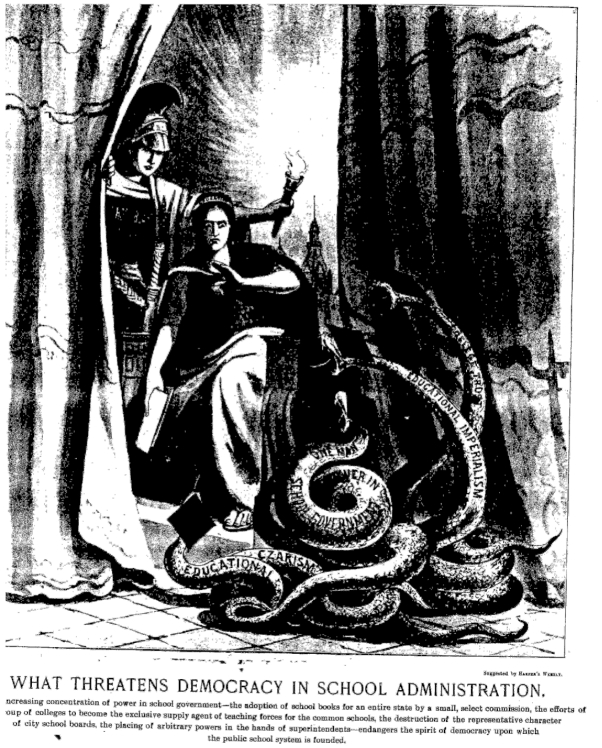
These have been live issues since at least the Progressive Era. In that period those who favored efficiency over democracy, often called “administrative progressives,” mostly triumphed, creating what historian David Tyack called “The One Best System.” Most of the histories of these conflicts focus on the winners. As a historian and an activist I have always been more attracted to their opponents, unstable coalitions of intellectuals (John Dewey for one), women’s groups, unions, Populists, Socialists, teachers, and partisan politicians who resisted what William George Bruce (Milwaukee Democratic politician – who opposed partisan politics in school governance, these coalitions were very unstable and strange –, school board member and founder of the American School Board Journal) called “Educational Czarism.” They had their victories too.

Almost everyone involved had some claim to the label “progressive.” This points to a dilemma in progressivism, then and now. Progressives have faith that politics and government can work for the common good and in order to accomplish this — to advance the common good — government must be efficient. Progressives with a democratic orientation also value democratic structures and wide participation, which make efficiency harder to achieve. This is the dilemma presented by the proposed limit on public appearances concerning non-agenda items.

The conflicts over school governance were and are entwined with conflicts over the purposes of schooling. For the most part Progressive Ea efficiency advocates emphasized the role of the schools in training workers and their opponents were more concerned with education for personal growth and citizenship. This is a gross oversimplification in that both sides favored some form of industrial or vocational education and the conflicts were about who would control it (some of the administrative progressives were happy to have private industry directly in charge) and what forms it would take (manual training was viewed as promoting personal development while vocational education was often seen as an effort to recreate inequalities in the name of “social efficiency”). Still, I think it is important to bring up as a reminder that the structures of education are related to what is taught, constituting a hidden curriculum. The lesson of limiting public appearances is that to some degree the priorities of the Board of Education take precedence over the concerns of the public. This has to be part of the discussion too.

Historically the structures and aims of education in Madison have had a relatively good balance between efficiency and democracy. I would like to see it stay that way.

As I said earlier, I would like to see this proposal set aside and have the Board and the public together tackle the broad questions of balance between efficiency and public participation. I’ve got some specific suggestions that will be included in part II of this post (as soon as I find the time to draft that…need to work on my own efficiency). I am going to close this post with some outlines of what I am talking about.

I would like to see a wider consideration of Board practices, some documentation about how much time has been spent on various tasks (including but not limited to off topic public testimony) and a variety of solutions evaluated, solutions that address “problems” confined to what the Board does as well as solutions involving the public perhaps changing our behavior too.

Whatever the results, I think that this has to be an issue that Board engages the public on. I am very glad that there now will be an opportunity for the public the weigh in on February 18, prior to the vote. That is a start, but however the vote goes, the larger dilemmas of democracy and efficiency aren’t going to go away. Rejecting the proposal could lead to constructive cooperation and creative solutions, enacting it will exacerbate distrust and resentments.


Thomas J. Mertz

For further reading:

David B. Tyack, The One Best System: A History of American Urban Education.

William J. Reese, Power and the Promise of School Reform: Grass Roots Movements During the Progressive Era.

Raymond E. Callahan, Education and the Cult of Efficiency.

Robert B. Westbrook, John Dewey and American Democracy.

2 Comments

Filed under Accountability, AMPS, Best Practices, education, Local News, Take Action

Tin-eared and Wrong-headed

eartrumplb.pngbottom.jpg

Update:

Board of Education President Arlene Silveira just posted this on The Daily Page 

 Time Out. The press release that started this thread was not accurate. There will be public speaking on this topic at the meeting on 2/18.I will continue to come back to the main point. The issue is that the Board would like to focus on its business at a more reasonable hour in order to make good decisions for the children of the district.If people do not like the proposal on the table, please recommend an alternative. An alternative is not to say “let’s leave things as is”. This does not address the problem.Looking forward to your ideas!Arlene Silveira

I am glad to see some movement and agree that both sides need to be creative.

It should be noted that according to all information available to the public prior to this The Daily Page post, the Progressive Dane Press Release was accurate. 

I was contacted earlier today by the Board of Education staff person (after the Press Release was issued) about a change but given no details.  My request for more information has not been answered yet (This is not a complaint about the Board staff people.  They, like so many in the Doyle building, do a great job and are always helpful.  I just want to be as open as possible about what I knew when.). 

See you on the 18th (and maybe the 11th too).

At the Board of Education meeting Monday (2/4/2008) a proposal was put forth to enact new limits on public testimony. This proposal and the way it was introduced and discussed showed some on the Board at their worst, both tin-eared and wrong-headed. These are overlapping criticisms, because with the interactions between elected officials and the public, perceptions (tin-eared) and realities (wrong-headed) are inseparable.

Before I go further a caveat is in order. I did not attend the meeting on Monday and only watched the last 45 minutes or so at home. Still, I’m pretty confident in what I have to say.

The proposal is a revision of Board policies 1220 and 1222. I haven’t obtained a copy of the exact language yet (that points to one problem with the way this is being done and another with the proposal iteslf, when I get an electronic copy I’ll link here), but the gist of it is that they want to move public appearances concerning topics that are not on the agenda for that meeting from the beginning (where they have been since at least 2000) to the end (an indeterminate time). K-12 students are exempted.

The rationale offered is that extensive, “off topic” public appearances have kept the Board from effectively doing the work the Board wants to do. There is no doubt that public appearances before the Board — mostly “on topic” — have at times been exhausting or that there is room for improvement on both sides of communication between the Board and the public. Rather than improving communication, the pending revision seeks to make communication more difficult.

It is outageous for a Board which has acknowledged communication and public relations problems in their goals for the Superintendent (it was also on the initial list of annual Board priorities, but Lawrie Kobza moved to delete it, Ms Kobza was conspicuous in her support of the current effort to limit public appearances) to contemplate such an action, it borders on insane that they would do so in a manner that excludes the public from having any input.

One thing needs to be made clear, whatever Board members say about the intent not being to limit public input, the result is that public input will be limited in terms of both quantity and quality. Logistically the proposal is a nightmare. Let me use the proposal itself as the first illustration.

A very general item appeared on the agenda distributed on Thursday or Friday (1/31 or 2/1). I contacted a couple of people for details and got only vague answers. It appears that the actual proposal was distributed to Board members on Monday (the day of the meeting) and the first chance the public got to see it was via the distribution of copies at that meeting.  [I have been asked to clarify the chronology and given new information to do so. Board members were given a draft policy on Thursday 1/31, an explanation via email on Friday 2/1 and the the proposed policy on Monday 2/4. A vote was possible on Monday, 2/4 but since this was not sure, the possible continuation to 2/18 was already arranged.] Monday afternoon I am contemplating making childcare and other arrangements in order to possibly give public testimony on a proposal that I don’t know the contents of. One source told me there probably won’t be a vote, so I decide not to go (it turns out there was almost a vote). The point of this is that the nature agenda items and the timing of their publication makes it hard for the public to participate. It gets worse. Thanks to the intervention of two members, the Board did not vote and will take this up again on 2/18 (mark the date). That meeting will be a workshop session, meaning no public appearances. In fact, there are no Board meetings scheduled between now and the vote where public appearances are allowed. So I missed my chance and the Board was spared the horror of listening to me for three minutes. I will however be attending the Communications Committee meeting on 2/11 and if public appearances are allowed will be saying my piece (that agenda isn’t out yet), I suggest you do the same.

This was an agendaed item, so if the new policy was in place I still could have testified at the start (and I would have if there has been any way for me to know what it was without going to the meeting). Now I want to look at non-agendaed items and what the Board is contemplating. These fall into two categories. The first consists those things that the Board is not aware of or is doing nothing about; the second consists of those things that Board has been addressing or plans to address at other meetings. If you want to talk with the Board about any of these, you will have to wait your turn. In practical terms, that means planning on sitting through a meeting that may go one hour or may go four hours (tell that to your spouse or try to arrange for childcare on those terms) and then at the very end, after the Board has done what they want, those members that stick around will give your what attention they have left to give. Is this a recipe for effective communication? I understand that the Board wants to work on what the Board wants to work on, but I also understand that the Board doesn’t know everything and that there are some things they know about that they don’t want to deal with. I like the fact that it is relatively easy for the public to try to inform the Board or get them to address things they would rather not, to speak often inconvenient truth to power (or at very least call public attention to these things). In setting the agenda, the Board (especially the President and Vice President) already have great power. This would enhance that power at the expense of the rest of us.

As usual, this is too long, but I want to work through one more example before wrapping it up. Multiple Board members cited the failure of the Board to make any meaningful progress on Equity at their 1/28 meeting as an illustration of why this policy is “needed.” They couldn’t have picked a worse example. On April 16, 2007 the Equity Task Force presented our report to the Board of Education. The Board was busy with more pending matters, gave the summary a brief polite hearing, thanked the Task Force and pledged to return to the report (no vote, but that’s what they said and what the minutes indicate). On June 20, 2007 the Board made Equity a priority for the year. On December 3, 2007 — almost eight months after the Task Force gave them our report and six months after the Board made Equity a priority — the Board held a workshop session on Equity. On January 28, 2008the Board held another workshop meeting on Equity. This is the meeting where little got done and the one that Board members used to place the blame on public appearances. On that front, the lengthy public appearances that night were for the Long Range Planning Committee and were about an agendaed item, so the proposed revision wouldn’t have changed anything!

Looking at the bigger picture, it stretches credibility well past the breaking point to assert that off topic public appearances were a major factor in preventing the Board from addressing Equity for eight months. Don’t play me for a fool. Again, it gets worse. Under the new policy, only agendaed items may be addressed at a time when members of the public are able to easily appear and the Board is paying full attention. In the eight months since the Task Force gave the Board our report, Equity has not appeared on the agenda of a single meeting where public appearances were allowed. Board members also touted other means of communicating with them. Any fool knows these aren’t the same. Prior to the January 28 meeting six Equity Task Force members (myself included) sent the Board a letter expressing concerns about the process of their work on Equity, including the lack of public input. To my knowledge only two Board members responded and our letter and concerns were not part of the discussion at the meeting. I can’t help but think that if we had been able to read that letter to them in person at the start of one or more meetings, things might have been different.

Reading through this I find that I hit the “wrong-headedness” more than the “tin-eared.” It should be obvious how counterproductive ramming through a limitation of public input (without any public input on the proposal) is to the goal of improved communications. If it isn’t, I suggest everyone — including Board members — watch the video. You’ll be amazed at how self-centered and arrogant some of our elected Board members sound.

I admire the hard work of our Board of Education and appreciate the difficulties they face in trying to do what they think is best. However, the best intentions can still lead to bad decisions. Let’s not let that happen this time. Contact the Board, testify at the 2/11 Communications Committee meeting (while you still can), write the newspapers…. If we can move past this wrong-headed mess, we can continue to work together — the board and the Public — to figure out ways to improve communication, a project that has already begun under a the auspices of a planned Progressive Dane School Budget 101 seminar (among other things I’m chair of the PD Education Task Force).

Thomas J. Mertz

An undesirable society, in other words, is one which internally and externally sets up barriers to free intercourse and communication of experience. A society which makes provision for participation in its good of all its members on equal terms and which secures flexible readjustment of its institutions through interaction of the different forms of associated life is in so far democratic.

John Dewey, Democracy and Education

8 Comments

Filed under Accountability, Best Practices, Equity, Local News, Take Action, Uncategorized