Category Archives: National News

Gerald Bracey Will be Missed

Sad news for anyone concerned with honesty and accuracy in education research and reporting, Jerry Bracey has died unexpectedly.

No news reports, but did get a confirmation from Susan Ohanian.

Jerry fought the good fight, with the Education Disinformation Detection and Reporting Agency (EDDRA), on the Huffington Post, in books, articles, columns, calls and notes to editors and reporters, anywhere and anytime that education research was being misused and abused or was simply badly done.

I never met Jerry, but I’ve been a participant in his EDDRA Yahoo Group and have exchanged private messages.  He was combative, friendly and good humored, with a passion for truth and the power of knowledge and education.

One thing that always impressed me was the depth and breadth of his knowledge.   He could always call up and cite relevant reports and articles, new and old,  with apparent ease.  That can’t be replaced.

He will be missed.

Some links to other blogs noting this loss.

DairyStateDad.

EdWonk.

Mike Klonsky’s Small Talk.

Education Notes OnLine.

Giving Jerry the last word (he always seemed to want it), his Nine Myths About Public Schools.

Nine Myths About Public Schools

None of this will likely strike you as particularly new, but it might be good to have a bunch of myths lined up and debunked all in one place.

  1. The schools were to blame for letting the Russians get into space first. Granddaddy of all slanders and a great illustration of the absolute nuttiness with which people talk about education.
    Sputnik, the first man-made satellite to orbit the earth, launched on October 4, 1957. On September 20, 1956, Werner von Braun’s Army Ballistic Missile Agency launched a 4-stage Jupiter C rocket from Cape Canaveral. After the first 3 stages fired, the rocket was 832 miles in the air and traveling at 13,000 miles an hour. The 4th stage could have easily bumped something into orbit. The 4th stage was filled with sand. There were a number of reasons for this including the fact that the Eisenhower administration was determined to keep its weapons rocket program and its space exploration project separate and von Braun’s rocket was clearly a weapon. Its primary intent was to incinerate Russian cities with nuclear warheads. Ike worried how the Russians might react. His Assistant Defense Secretary Donald Quarles actually said “the Russians did us a favor” because they established the precedent that deep space was free and international.Most US engineers in the space program in 1957 would have graduated high school in the 1930s, but in the media, the schools of the 1950s took the hit for Sputnik. Ike was quite puzzled by this.
  2. Schools alone can close the achievement gap. This is codified in the disaster known as No Child Left Behind. Most of the differences come from family and community variables and many out-of-school factors, especially summer loss. Some studies have found that poor children enter school behind their middle class peers, learn as much during the year and then lose it over the summer. They fall farther and farther behind and schools are blamed. Middle class and affluent kids do not show summer loss.
  3. Money doesn’t matter. Tell this to wealthy districts. Money clearly affects changes in achievement although levels of achievement are more influenced by the variables just mentioned. Most studies are short term and look only at test scores, a very foolish mistake. Economists David Card and Alan Krueger also found investments in school show a payoff in terms of long-term earnings of graduates.
  4. The United States is losing its competitive edge. China and India ARE Rising. As economies collapsed all around it, China’s economy grew a remarkable 7% last year. On just humanitarian grounds, we should not wish China and India to remain poor forever, but the more they grow the more money they have to buy stuff from us. As China and India prosper, we prosper. The World Economic Forum and the Institute for Management Development have consistently ranked the U. S. economy as the most competitive in the world. Education is only one part of multi-factor systems in rankings. WEF is especially keen on innovation. Our obsession with testing makes testing a great instrument for destroying creativity.
  5. The U. S. has a shortage of scientists, mathematicians and engineers. This was a myth started oddly enough by the National Science Foundation in the 1980s in a study with assumptions so absurd the study was never published, but the myth lingers on. In fact, Hal Salzman of the Urban Institute and Lindsay Lowell of Georgetown University found that we have three newly minted scientists and engineers who are permanent residents or native citizens for every newly minted job. Within 2 years, 65% of them were no longer in scientific or engineering fields. That proportion might have fallen during the current debacle when people are more likely to hang on to a job even if they hate it. An article in the September 18 Wall Street Journal reported that before the economy collapsed, 30% of the graduates of MIT–MIT–headed directly into finance.
  6. Merit pay for teachers will improve performance. Bebchuk & Fried Pay Without Performance. Adams, Heywood & Rothstein, Teachers, Performance Pay, and Accountability. Bonus pay is concentrated in finance, insurance, and real estate. In most of private sector hard to determine and often leads to corruption and gaming the system. Campbell’s Law: “The more any quantitative social indicator is used for social decision making, the more subject it will be to corruption pressures and the more apt it will be to distort the social processes it is intended to monitor.”
  7. The fastest growing jobs are all high-tech and require postsecondary education. “Postsecondary education” is a weasel word. A majority of the fastest growing jobs do, in fact, require some kind of postsecondary training. But, according to the Bureau of Labor Statistics, they account for very few jobs. It’s the Walmarts and Macdonald’s of America that generate the jobs. According to the BLS, the job of retail sales accounts for more jobs than the top ten fastest growing jobs combined.
  8. Test scores are related to economic competitiveness. We do well on international comparisons of reading, pretty good on one international comparison of math and science, and not so good on another math/science comparison. But these comparisons are based on the countries’ average scores and average scores don’t mean much. The Organization for Economic Cooperating and Development, the producer of the math science comparison in which we do worst has pointed out that in science the U. S. has 25% of all the highest scoring students in the entire world, at least the world as defined by the 60 countries that participate in the tests. Finland might have the highest scores, but that only gives them 2,000 warm bodies compared to the U. S. figure of 67,000. It’s the high scorers who are most likely to become leaders and innovators. Only four nations have a higher proportion of researchers per 1000 fulltime employees, Sweden, Finland, New Zealand and Japan. Only Finland is much above the U. S.  Consider Japan, the economic juggernaut of the 1980’s. It kids score well on tests and people made a causal link between scores and Japan’s economy. But Japan’s economy has been in the doldrums for almost a whole generation. Its kids still ace tests.
  9. Education itself produces jobs. President Obama and Secretary of Education Duncan have both linked any economic recovery to school improvement. This is nonsense. There are parts of India where thousands of educated people compete for a single relatively low-level white-collar job. Some of you might recall that in the 1970’s many sociologists and commentators worried that America was becoming TOO educated, that they would be bored by the work available

Thomas J. Mertz

1 Comment

Filed under Accountability, Best Practices, education, Gimme Some Truth, National News

Education Tweak #13 — Bill Gates Pulls the Strings

Click on image for pdf.

Click on image for pdf.

Previous EdTweaks can be found at www.edtweak.org.

Thomas J. Mertz

Leave a comment

Filed under "education finance", Arne Duncan, education, Gimme Some Truth, National News, School Finance

Education Tweak #12 – Arne Duncan: “You Lie” (+ Bob Dylan Bonus)

Click on image for pdf.

Click on image for pdf.

Previous EDTweaks can be found at www.edtweak.org.

And thanks to my brother for making the connection between the Joe Wilson “You lie” outburst and this classic Bob Dylan performance.

Thomas J. Mertz

Leave a comment

Filed under Accountability, Arne Duncan, Best Practices, Gimme Some Truth, National News, nclb, No Child Left Behind

Obama’s Speech and the technology needed to view it

9237398_4919337eea_o

Well, President Obama gave his speech to school children yesterday (text here, video here) and although the Republic didn’t collapse, the hysteria has continued.

So much has been said about the speech that I’d rather point out some things about access to the speech and technology in education, including recent actions by the Madison district.

As I indicated in a previous post, I’m glad that my children had the opportunity to view this speech in school with their teachers and their peers as a civics lesson.  However, the circumstances were less-than-ideal.  It was brought to my attention that the teachers who instruct my children will have to huddle their class around a computer unless the school decides to hold an all school assembly to use the one projector the school owns to stream it online and blow the image up to a viewable size.

It is not normally an option for them to view it on television in the classroom as they do not have access to C-Span.  At the last minute they were able to tune in on a major network and watch it on the television in their room.

Nowadays, technology has become so pervasive, so essential, so advanced in society, that that the integration into classroom instruction is imperative.  Our children have grown up with technology as their number one way of getting information.  Technology provides for the important bases of communication – the storage of past data and the instant feedback on present information.  Technology continues to expand its beneficial influence into better communication and interaction between teachers and students from all across the globe, better instructional materials that reach out to more people than ever, and better information transfer at lightning speed, among other things.

The transfer of knowledge in education becomes smoother because technology assists in transmitting it in a faster and clearer way.  Technology allows participants in the two-way learning process to communicate and interact better with a variety of audio-visual tools.  Interactive technology and the sharing of resources and curriculum including new knowledge and processes are necessary to demonstrate complex concepts in a clearer manner to our children.  Sesame Street figured this out 40 years ago when I was a child and I defy you to show me one child in our school system that cannot identify the character Elmo.

Technology can be used in many ways as an integral part of the curriculum to meet the needs of diverse learners.  Extensive studies and model schools have shown that educational technology enhances student learning in many cases. Some recent reports have indicated that students who have access to online materials perform better than those who do not. For examples see: Pamela Mendels, “Study Shows Value of Wired Classroom,”Effectiveness of Technology in Schools, 1990-1994,” (a comprehensive review of over 130 recent academic studies which found that technology can lead to improved performance most notably in math, science, social sciences and language arts),  and  Summary of Current Research and Evaluation Findings on Technology in Education.”  Technology is the answer to all the needs of schools and students, but in 2009 our schools do need to make effective use of the tools available. In the current school funding climate, this is difficult.

MMSD is working to address the gaps of technology in our schools.   This draft Information (Library Media) & Technology Plan was approved by the MMSD Board of Education on June 8th.  The plan reflects the input and ideas from hundreds of staff, students, parents, and business and community partners collected during the 2008-09 school year.   The plan is a road map for what the community believes our priorities should be relative to technology use in our schools.

Input from stakeholders in its development was essential. It is not a static document, but one that is dynamic and subject to change – as technologies do.  One specific objective states we must: “…create a technology advisory leadership team that includes students.”  Some of the key ideas suggested in the technology plan are: an emphasis on professional development when teachers are provided new technology in order to fully maximize its value. A wireless network across all schools.  More use of mobile internet devices like laptops, netbooks, and smart devices like iTouches.  Making the learning management system– Moodle —  much more easily accessible to all teachers and students.  Exploring newer software tools that can save time and expand access like Open Office (as an alternative to Microsoft Office) and cloud computing (like Google Docs).  Enhancing the use of technology as a curricular area and a service learning focus.  Opening the schools as “lighted school houses” with technology as a bridge to the community.

This last is very important because as Madison and other districts move towards increased reliance on electronic communication, the gap between those families with easy access and those without becomes more important. At the same time, the fragile ties between the schools and some of the neediest families will be further strained while the benefits to the most well positioned will increase.

Lots of good ideas.  Some of these are being funded via the ARRA Stimulus IDEA and Title I monies, some from the operating budget and some are on hold till funding can be found.

Let’s hope that the next time the President wants to address the students of this country and encourage them to really take their learning seriously, find out what they’re good at, set goals and take the school year seriously, our classrooms will be a part of the 21st Century educational system.  Teachers and students need to be encouraged to participate in civics lessons in a medium that they have grown up learning in.

Jackie Woodruff

1 Comment

Filed under "education finance", Best Practices, education, finance, Local News, National News, School Finance, Uncategorized

Education Tweak #11 (Obama Speaks to School Children)

Click on image for pdf.

Click on image for pdf.

Previous EdTweaks can be found here and on AMPs.

Thomas J. Mertz

Leave a comment

Filed under Gimme Some Truth, National News

Happy Labor Day!

The Labor Day extravaganza starts with a lengthy excerpt from the1886 Platform of the Knights of Labor.  It is a good reminder that the sruggle has been going on for a long time.

Preamble

The alarming development and aggressiveness of great capitalists and corporations, unless checked, will inevitably lead to the pauperization and hopeless degradation of the toiling masses. It is imperative, if we desire to enjoy the full blessings of life, that a check be placed upon unjust accumulation, and the power for evil of aggregated wealth. This much-desired object can be accomplished only by the united efforts of those who obey the divine injunction, “In the sweat of thy face shalt thou eat bread.”

Therefore we have formed the Order of the Knights of Labor, for the purpose of organizing and directing the power of the industrial masses, not as a political party, for it is more — in it are crystalized sentiments and measures for the benefit of the whole people, but it should be borne in mind, when exercising the right of suffrage, that most of the objects herein set forth can only be obtained through legislation, and that it is the duty of all to assist in nominating and supporting with their votes only such candidates as will pledge their support to these measures, regardless of party. But no one shall, however, be compelled to vote with the majority, and calling upon all who believe in securing the greatest good to the greatest number, to join and assist us.

Declaration of Principles

We declare to the world that our aims are:

1. To make industrial and moral worth, not wealth, the true standard of individual and national greatness.

2. To secure to the worker the full enjoyment of the wealth they create, sufficient leisure in which to develop their intellectual, moral and social faculties; all of the benefits, recreation and pleasures of association; in a word, to enable them to share in the gains and honors of advancing civilization.

Next up is a reminder to attend the South Central Federation of Labor LaborFest, at the Labor Temple (Park and Wingra).  Lots of good people, activities for all ages, good food and drink and music from Mel Ford and Paul Cebar and the Milwaukeeans.  You can download a flier here.

While on the topic of reminders, the pending bill requiring that labor history be taught in Wisconsin schools could use your support. Find out more here and also check out the other great things that the Wisconsin Labor History Society has to offer.

Last, that labor classic “I’m Sticking with the Union” as performed by a stellar cast at Pete Seeger’s 90th Birthday concert.

Last year’s Labor Day post, with more music and history can be found here.

Thomas J. Mertz

Leave a comment

Filed under Blast from the Past, education, Local News, National News, Take Action

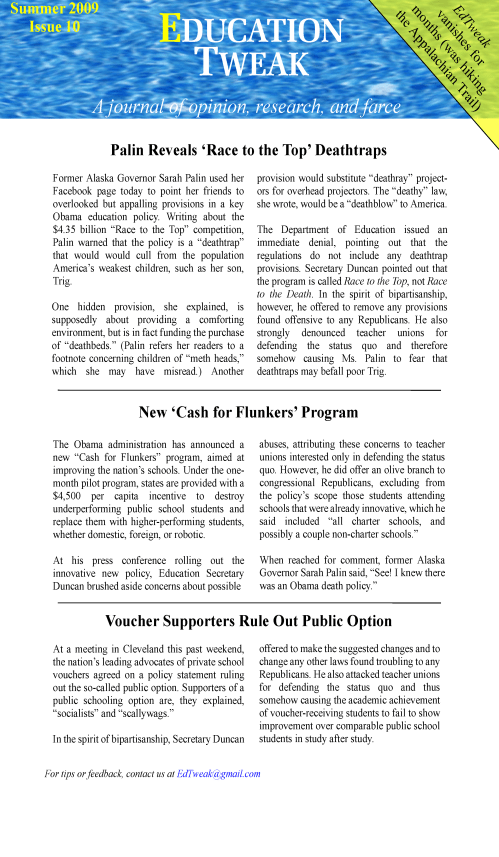
Education Tweak #10

Click on image for pdf

Click on image for pdf

All Ed Tweaks can be found at:  http://edtweak.org/.

Thomas J. Mertz

Leave a comment

Filed under Accountability, Arne Duncan, education, Gimme Some Truth, National News

Sherman Dorn Asks THE QUESTION and Offers Some Answers

riddler45cover1Longtime readers should know that Sherman Dorn is one of my favorite people in the edusphere. His  recent “How can we use bad measures in decisionmaking?” is a fine example of why I value his contributions so much.

His titular question is THE QUESTION at the heart of so much ed policy action these days.  Nobody who isn’t seeking profits or losing their mind likes the tests being used — not Arne Duncan, not Barack Obama, not the people in Madison poised to build a Gifted Education house of cards on them — but almost nobody wants to give up on the tests and many want to expand their use (Arne Duncan, Barack Obama, those house of card builders in Madison).

Everyone talks of better tests, multimodal assessments, new ways of looking at data….  All this can be good, however we aren’t there yet and the simple-minded attraction of letting the flawed data “drive” education policy is strong (the current draft of the MMSD Strategic Plan has both reasonable  data ” inform[ed]”  and frightening “data driven” language).    Additionally, at least three truths often get lost when better assessments and data are discussed (Dorn hits most of all of these).

  1. All assessments and data are of limited utility.  They are snapshots at best; they are only designed to measure specific things; standard deviations and confidence intervals recognize some of the limits, but are rarely part of “accountability” discussions.  the temptation to use assessments for things they are not designed for is always there.
  2. Because better assessments should mean assessing more things in more ways,fulfilling this promise will result in more time and resources devoted to assessment and analysis and less to teaching and learning.
  3. Employing multiple assessments or sophisticated data analysis (ie Value Added) moves away from transparency in accountability. It already clear that few policy makers, much less members of the public, understand the nature of current assessments and accountability practices.  When you employ Value Added techniques all but the most statistically adept are shut out (some Value Added methods are proprietary and even those who commission the analysis are kept in the dark about the nature of that analysis; others are open, but beyond the understanding of most people).   Combining multiple assessments, including qualitative approaches, produces similar issues.   The MMSD Gifted plan is a perfect illustration.  They promise to identify potential and achievement with referrals and multiple assessments over five domains (academic, creative, leadership, visual and performing arts) and then decide who gets the extra services based on “percentile scores.”  Does anyone think that the promised “transparency” of this exercise will be meaningful to parents and Board members?

This was supposed to be about Sherman Dorn’s post, so back to that (although I think the above — especially the local stuff — is a salient context for what Dorn wrote).

After much good introductory material (including a link to the relatively recent, must read Broader, Bolder Approach Accountability Paper), Dorn explores a variety of positions relative to the problems  of “data that cover too little,” and “data of questionable trustworthiness.”  His presentation of their strengths and weaknesses is insightful and informative.

Dorn himself rejects both the “don’t worry” and “toss” extremes and seeks to extend (begin?) the conversation in pragmatic directions.  Here is how he closes:

Even if you haven’t read Accountability Frankenstein or other entries on this blog, you have probably already sussed out my view that both “don’t worry” and “toss” are poor choices in addressing messy data. All other options should be on the table, usable for different circumstances and in different ways. Least explored? The last idea, modeling trustworthiness problems as formal uncertainty. I’m going to part from measurement researchers and say that the modeling should go beyond standard errors and measurement errors, or rather head in a different direction. There is no way to use standard errors or measurement errors to address issues of trustworthiness that go beyond sampling and reliability issues, or to structure a process to balance the inherently value-laden and political issues involved here.

The difficulty in looking coldly at messy and mediocre data generally revolve around the human tendency to prefer impressions of confidence and certainty over uncertainty, even when a rational examination and background knowledge should lead one to recognize the problems in trusting a set of data. One side of that coin is an emphasis on point estimates and firmly-drawn classification lines. The other side is to decide that one should entirely ignore messy and mediocre data because of the flaws. Neither is an appropriate response to the problem.

I probably don’t do justice to his post.  Read the whole thing.

The reality is that bad data is being used and that the uses are expanding.  I am not as sanguine as Sherman Dorn about the potential for better data and better ways of using it (I’m guessing he’d object to the word sanguine here, and he’d be right because it does not capture where I think he is coming from.  Take it not as an absolute but only as a comparison with me), but I do know that explicit discussions of the issues involved like Dorn’s post are necessary to progress.

Thanks Sherman for the questions and answers.

Thomas J. Mertz

Leave a comment

Filed under Accountability, Arne Duncan, Best Practices, education, Local News, National News, nclb, No Child Left Behind, Uncategorized

Race to the Bottom? – Quote of the Day

declineOverall, our results consistently indicate that the increased focus on individual teacher performance caused a sizable and statistically significant decline in student achievement. This decline in achievement is also much more pronounced in the case of national exams with an e ffect of up to 40% of a standard deviation. As in the different effects in terms of internal and external results, our triple-difference evidence also documents a significant increase of grade inflation. In addition, in support of a causal interpretation of our results, we also find that in almost all specifications and dependent variables there are no significant differences between the treatment and control groups over time before the introduction of merit-pay. Finally, the inclusion of different control variables or the consideration of different subsets of the data makes only very minor differences to the size of our estimates, as would be the case if assignment to treatment were random.

Graph and quote from Pedro S.  Martins, “Individual Teacher Incentives, Student Achievement and Grade Inflation,” Institute for the Study of Labor (2009).

In 2007 Portugal instituted a merit pay plan.  Azores and Madeira (the graph above) and private schools were excluded.   Using these as a control, the quoted study found that this merit pay plan resulted in a decline is student achievement.

Arne Duncan and Barack Obama have made incentive pay plans a centerpiece of their “Race to the Top” scheme.  It may be a path to the bottom.

More on the “Race to the Top” later this week.

Thomas J. Mertz

Leave a comment

Filed under Accountability, Arne Duncan, Best Practices, Contracts, education, Gimme Some Truth, National News, nclb, No Child Left Behind, Uncategorized

Super Education Blogging

DC_Universe_001The National Journal has a new education blog up with an impressive list of participants.

The list tilts toward corporate “reformers” and their enablers, but there are some good  and thoughtful people too.

The format is that the editors pose a question each week  — the first one is on “the best use of the stimulus money” — and the contributors respond.  No comments from the public are allowed.

Thus far there has not been much interaction among the contributors and many of the responses seem  like well rehearsed boilerplate.  However, given the power and influence of many involved I think it will be worth checking out regularly.

Thomas J. Mertz

Leave a comment

Filed under education, National News