Category Archives: National News

School Finance Action in Los Angeles

Video from Democracy Now (via Laura Chern).

Watch this report on why Los Angles advocates for adequate education investments have begun a hunger strike.

If they can do that in Los Angles, the least you can do is take an hour or more on June 16 to participate in the Walk on the Child’s Side.

Thomas J. Mertz

Leave a comment

Filed under "education finance", Budget, education, finance, National News, School Finance, Take Action, Uncategorized, We Are Not Alone

The Stick — NCLB Sanctions for MMSD

it02It is now official, 7 Madison schools are among the 79 Wisconsin schools that have been “Identified for Improvement” under the No Child Left Behind Act and are now subject to new sanctions and requirements.

Here is the list.

Madison Metropolitan School District Cherokee Heights Middle
Madison Metropolitan School District East High
Madison Metropolitan School District LaFollette High
Madison Metropolitan School District Leopold Elementary
Madison Metropolitan School District Lincoln Elementary
Madison Metropolitan School District Toki Middle
Madison Metropolitan School District West High

One thing about NCLB is that it is all stick and no carrot.  The requirements and restrictions pile up, but the only benefits are maintaining the woefully inadequate level of federal support for federal mandates.

The Madison schools Title I schools (Lincoln and Leopold) will now face new requirements; a more forceful stick.  I can’t find a Wisconsin version of the details of what this means, but here is one from Michigan (Wisconsin page on Adequate Yearly Progress (AYP), here).

I know one thing will be that all students at these schools will be offered transfers with the district paying for transport and pay for supplemental services.

Some things about NCLB bear repeating.

The standardized tests that are the basis of Adequate Yearly Progress  are of extremely limited value in assessing learning and school quality.

Eventually all schools will fail to make AYP.

The standards and data approach that President Obama and Secretary Duncan are so eager to continue will not lead to the kind of education we need.

As I’ve said before, performance on the WKCE should be one tool in assessing schools and students to flag successes and failures fro more attention.  It should not be used to make isolated judgments and it should not be the basis for sanctions.

The Wisconsin State Journal has more.

Thomas J. Mertz

1 Comment

Filed under Accountability, Arne Duncan, Best Practices, education, Local News, National News, nclb, Uncategorized

Data Driven Sanity

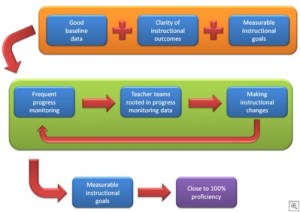
Image from "Guest Blogger Scott McLeod on Data-Driven Decision Making" on the eduwonkette, click on image for more on D3M from that sorely missed blog.

Image from "Guest Blogger Scott McLeod on Data-Driven Decision Making" on the eduwonkette blog, click on image for more on D3M from that sorely missed blog.

Diane Ravitch has some more words of sanity on Data Driven policy making at the Bridging Differences blog.  Click the link for the entire post; here is an excerpt:

This approach rests squarely on the high-stakes use of testing. One only wishes that the proponents of this mean-spirited approach might themselves be subjected to a high-stakes test about their understanding of children and education! I predict that every one of them would fail and be severely punished.

We agree that a better approach is needed to assess how well students are learning what they are taught. We agree that current standardized tests are not adequate to the task of determining the fate—whether they should be rewarded or punished—of children, teachers, and their schools.

I think that testing is important and can be valuable, as it helps to spotlight problems and individuals in need of help. But the determinative word here is “help.” The so-called reformers want to use accountability to find people in need of termination and schools in need of closure. Let’s hope this punishment-obsessed crowd is never put in charge of hospitals!

Unfortunately, events are not breaking in the direction we both prefer. The stimulus bill includes millions so that every state can create a data system. This system will track the test scores of every student, from pre-K to college, and attribute their test score gains (or lack thereof) to their teachers. When the information is available, it will be used and misused. Every teacher (at least those who teach the tested subjects) will have a public record detailing whether his or her students made gains or not. This information will be used to establish calibrated merit pay schemes, so that each teacher will get more or fewer dollars depending on the scores of the year. Is this piecework?

The federal government seems ready to impose a Dr. Strangelove approach on our schools to turn them into “data-driven systems.” Not, as you suggest, “data-informed” systems, but data-driven systems. Teachers will certainly teach to the tests, since nothing else matters. The only missing ingredient from this grand data-driven scheme will be education.

More on data driven policy on AMPS here.

Thomas J. Mertz

1 Comment

Filed under Accountability, Best Practices, education, National News, nclb, No Child Left Behind, Uncategorized

Quotes of the Day — A Tale of Two Governors

Illinois Governor Quinn

[Illinois Governor Patrick] Quinn laid out what a “doomsday” budget might look like if lawmakers “slash and burn” their way to close a deficit of at least $11.6 billion instead of going along with his plan to boost taxes.

“In a tough time we don’t want history to say the people of Illinois threw a lot of their fellow citizens overboard because they didn’t want to make any sacrifices or tough choices,” Quinn told reporters after detailing a litany of possible cuts to more than 300 people at the City Club of Chicago, a local civic club.

94575

Chicago Tribune.

[Wisconsin Governor Jim] Doyle, when asked by a reporter what he would do if the Democratic-controlled Legislature sent him a budget with sales or income tax increases, responded, “I hope that does not come to my desk.”

MMSD Today.

Leave a comment

Filed under "education finance", Budget, education, Elections, finance, Local News, National News, School Finance, Uncategorized

Obama, Duncan, Gingrich, Bloomberg and Sharpton

sthumb_mega_vomit

First there was “Obama Echoes Bush on Education Ideas,” then “Is Arne Duncan Really Margaret Spellings in Drag?,” followed by a very factually challenged major education speech by the President, reach out from Arne Duncan to Green Dot charter school honcho Steve Barr, the appointment of edu-preneur and Bill Gates bag man James Shelton III as head of the Office of Innovation and Improvement, now comes the news that Obama and Duncan are consulting with Newt “Blame the Unions” Gingrich, Michael “Cook the Books” Bloomberg and Al “Where’s My Check?” Sharpton on education policy (hat tip Peter Rickman, via Facebook).

Education takes some hits in the proposed Federal budget too (DOE Budget Page here).

The image above expresses my feelings better than any words can.

Thomas J. Mertz

Leave a comment

Filed under Arne Duncan, education, Gimme Some Truth, National News, nclb, No Child Left Behind, Uncategorized

What’s at stake with the standards movement?: “[T]he kind of individuals we are developing and the kind of nation we wish to be”

The titular quote is from a new book by William A. Proefriedt, High Expectations: The Cultural Roots of Standards Reform in American Education; the video is from a review of that book in the Teachers College Record.

Proefriedt reminds us that the quest for quick and easy (or quick and dirty) standards and accountability has steamrolled a long tradition in America of striving for mass education that cultivates democratic ideals and full individual development while working against  “individual economic rapaciousness” as a danger to the Republic.  This is a tradition we don’t want to lose.

All the “business model” reformers and champions of “consumer interest” as a tool of reform (and that includes Sec. Arne Duncan and President Barack Obama) would do well to read Proefriedt and heed the wisdom of those he has written about.

See also: William A. Proefriedt, “Reading Emerson.”

Thomas J. Mertz

1 Comment

Filed under Accountability, Arne Duncan, Best Practices, education, National News, nclb, No Child Left Behind, Quote of the Day

A Slice of Two-Thirds

Credit: TeckPoh

Credit: TeckPoh

Following several hours of impassioned testimony from administrators, parents, and staff from school districts throughout the state, both large and small, at this week’s School Finance Network Assembly Hearing, it ended, unfortunately, on what could be charitably characterized as a flat note. Despite the hard work of disparate leaders of education groups meeting constantly for the past couple of years to come up with a thoroughly conceptualized school finance reform plan to present to the legislature, a committee composed of organizations in the School Finance Network who have often been traditionally at odds with each other in the past (for example WEAC and WASB ), came to the hearing armed with numbers vetted by both economists at the UW-Madison and the state Legislative Fiscal Bureau, including a number of suggestions for how to pay for this reform. However, the Committee on Education made it clear they were not going to take any action on this plan for the upcoming budget legislation hearings for the 2009-2011 budget. And most discouragingly there was, as far as I’m aware, no newspaper coverage of this event. I saw only one Madison tv crew present. They covered some of the personal testimony at the beginning but were not around to hear the actual presentation of the plan itself, which came late in the proceedings, too late to make it into the evening broadcast.

There are several political issues at play here, and with the funding reform process seemingly ended as soon as it was given its first oxygen to breathe, I think we may be headed towards even more dangerous waters. We will try and cover what rocky shores we may be encountering in future posts (such as the Governor’s push to repeal the QEO without other fundamental reforms). I want to draw your attention to one of them that, frankly, I missed in some of our earlier discussion on AMPS here about the use of federal stimulus money for school budgeting. In the Summary of Governor’s Budget Recommendations, Thomas Mertz pointed out his confusion with the school district’s use of their increase in their federal Title I and Individuals with Disabilities Education Act (IDEA) funding to reduce their levies and the potential bad effects this may have on district’s budgets in subsequent years. I, along with Mr. Mertz, remain quite confused about the Governor’s and the Legislative Fiscal Bureau’s thinking on the added stimulus money to IDEA and Title I as a way to keep within the Fed guidlines of “supplement not supplant.” It would appear that the Governor is planning to scale back his professed desire for the state to provide 2/3’s funding for education and instead reduce it to a level between 62.0% and 63.2% in 2010-11 and the shortfall made up with increased short-term Fed dollars. As an editorial in the New York Times noted the other day:

The education portion of the federal stimulus package gives a $13 billion boost to Title I, the federal program that is meant to provide extra help to disadvantaged schoolchildren. And the Department of Education has issued new guidelines, requiring states to give a clearer accounting of how education dollars are spent. But the federal money won’t get to the students for whom it is intended unless the department bird dogs this issue.

As envisioned by Congress, Title I is supposed to serve as an additional layer of financing for high-poverty schools that already are provided with budgets comparable to other schools in the same system. In reality, states and localities have often shortchanged schools that served the poor and used federal money to make up the difference in their basic budgets.

They further added:

The states and localities will resist the reporting requirement, which could easily unmask unethical financing gaps and even evasions of federal education law. But Arne Duncan, the education secretary, needs to hold them to the rules. The new reporting requirement is absolutely essential to school reform in general and fairness for impoverished children in particular.

But in yesterday’s State Journal report showing that MMSD would be receiving $11.7 million over two years from the stimulus bill, the Governor was quoted as warning school districts against “creating “funding cliffs”: using the short-term dollars to start new programs that would have to be sustained later by other funding.” But isn’t that what he is doing in his budget, promising something and then pretending he’s actually paying for it with two funds that are meant to supplement and not supplant state funding?

The Governor is further quoted, “This money can really protect our property taxpayers, and it also can add real quality to our schools if used correctly,” Doyle said.

Indeed. We’ll wait to see what the Obama administration has to say about this old street hustle 3-cups-and-a-ball routine.

Robert Godfrey

Leave a comment

Filed under "education finance", Accountability, AMPS, Best Practices, Budget, Equity, finance, Gimme Some Truth, Local News, National News, School Finance

Hit Again (again and again…)

3_21_captain_america

Wisconsin may have dodged the bullet of privatizers in our State Superintendent election, but at the national level the for profit, not the public crowd are going forth with guns blazing.  President Obama, Arne Duncan and their crew are showing themselves to be,  in the words of  Diane Ravitch, “Margaret Spellings in Drag.”

Their latest hire fits the profile.  Education Week is reporting and the the Department of Education site confirms the Broad trained,  former edu-preneur with LearnNow, most recently Bill “Money Talks” Gates bag man, James Shelton III (scroll here for a bio)  is the new head of the Office of Innovation and Improvement.

I guess for at least the next four years “innovation” will continue to mean privatization and profit-seeking and improvement will continue to defined by the Ministry of Truth.

In history, one school of thought holds that industrialists and capitalists came to welcome expanded government when they realized they could “capture” the boards and departments and use them for their own ends.   Think of the fox guarding the hen house.  The Obama crew are not liberators, just a changing of the guard.

As Deborah Meir recently wrote about the mindset that is at work in the corridors of power:

Some combination of Harvard and Wall Street smarts are seen as all-purpose disinterested expertise, fit for any purpose. The master key. While disregard of educators has a long history, and demonizing of teacher organizations is hardly new, it has reached new heights. A mere 20 years ago one could not imagine school systems would be run by people who never practiced or studied schooling or education. The assumption that “smarts” based on hands-on knowledge is valuable has lost its historic place in our view of reality. Law and business and finance smarts have ruled the day for this generation. At a cost. And not just in schools….

Our schools and our economy—and, above all, our democracy—require us to restore the balance.

The Obama permanent campaign will be holding listening sessions in Wisconsin.  It might be worth trying to get in a good word for public education by and for the people, not profit.

Thomas J. Mertz

Leave a comment

Filed under Accountability, Arne Duncan, Best Practices, education, Gimme Some Truth, Local News, National News, nclb, No Child Left Behind, Take Action, Uncategorized

FDR 1938 Speech to the NEA

Franklin Delano Roosevelt’s June 1938 speech to the National Education Association (hat tip, Crooks and Liars).

Full text here; some excerpts:

We have believed wholeheartedly in investing the money of all the people on the education of the people. That conviction, backed up by taxes and dollars, is no accident, for it is the logical application of our faith in democracy.


Here is where the whole problem of education ties in definitely with natural resources and the economic picture of the individual community or state. We all know that the best schools are, in most cases, located in those communities which can afford to spend the most money on them—the most money for adequate teachers’ salaries, for modern buildings and for modern equipment of all kinds. We know that the weakest educational link in the system lies in those communities which have the lowest taxable values, therefore, the smallest per capita tax receipts and, therefore, the lowest teachers’ salaries and most inadequate buildings and equipment. We do not blame these latter communities. They want better educational facilities, but simply have not enough money to pay the cost.

There is probably a wider divergence today in the standard of education between the richest communities and the poorest communities than there was one hundred years ago; and it is, therefore, our immediate task to seek to close that gap—not in any way by decreasing the facilities of the richer communities but by extending aid to those less fortunate. We all know that if we do not close this gap it will continue to widen, for the best brains in the poor communities will either have no chance to develop or will migrate to those places where their ability will stand a better chance.

Make them listen to this in Madison and in Washington.

Thomas J. Mertz


Leave a comment

Filed under "education finance", Accountability, Best Practices, Blast from the Past, Budget, education, Equity, finance, Gimme Some Truth, National News, School Finance, Take Action

Dodging the Bullet — What If Rose Fernandez Had Won

fa2handsome1

Looking for something else, I recently surfed to a page on the Florida Department of Education web site.  What I found there — taxpayer funded links to some of the most notorious right-wing, anti public education organizations — made realize how fortunate we are that Tony Evers defeated Rose Fernandez, that we dodged that bullet.

Here is a partial list of the organizations on the FDE site, with links to information from SourceWatch (SW) and/or Media Transparency (MT) and/or people for the American Way (PAW).

Alliance for School Choice, PAW, SW, MT

Center for Education Reform MT.

Heartland Institute, MT, SW.

Milton and Rose D. Friedman Foundation, MT.

Cato Institute, MT, SW, PAW.

Center for Civic Innovation at the Manhattan Institute, MT, PAW, SW.

The Heritage Foundation, SW, MT, PAW.

Other organizations being promoted by the Florida Department of Education include School Choice Wisconsin and those friends of Rose Fernandez,  the Florida Coalition of Virtual School Families, K12 inc, and Connections Academy (here and here for connections to Fernandez).

We should all be grateful to the voters of Wisconsin that our Department of Public Instruction will not end up fronting for this frightening network.

Thomas J. Mertz

3 Comments

Filed under Best Practices, education, Elections, Local News, National News