Category Archives: nclb

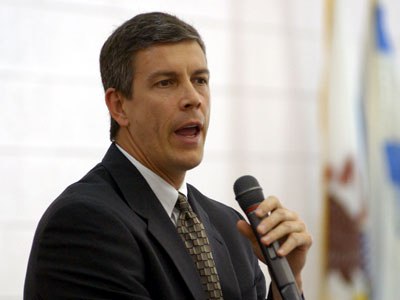
Arne Duncan, Secretary of Education

arne-duncan

Just links.  My own thoughts are much like teacherken’s (below).   I’ll add that the charters/merit pay agenda does not make me happy but balance that by saying that at least the merit pay pilot in Chicago included peer evaluations along with test scores.

The New York Times, Schools Chief From Chicago Is Obama’s Choice for Education.

teacherken, Arne Duncan as Sec Ed – it could have been worse.

Alexander Russo, District299: The Chicago Schools Blog, Duncan Pros and Cons.

Greg Palast, Obama’s “Way-to-Go, Brownie!” Moment?.

Education Week, Duncan is Obama’s Education Secretary Pick.

Good discussions in the comments at all but the NYT.

Thomas J, Mertz

Leave a comment

Filed under Accountability, Arne Duncan, Best Practices, education, Elections, National News, nclb, No Child Left Behind

Why would anyone listen to these people?

Whitney Tilson - Working to bring the magic of the market to education

Whitney Tilson - Working to bring the magic of the market to education

I was reading this New York Times article (Uncertainty on Obama Education Plans) and this got my attention:

One former Teach for America official who has been outspoken is Whitney Tilson, a New York mutual fund manager.

In a recent blog entry, Mr. Tilson said of Dr. Darling-Hammond, “She’s influential, clever and (while she does her best to hide it) an enemy of genuine reform.”

Mr. Tilson is on the board of Democrats for Education Reform, a political action committee based in New York.

Mr. Tilson is a top tier education DINO. He advocates an anti-Union, data and test driven version of  “accountability” based on a market, business, privatization model (see here for more on this mindset).

His expertise is based on a short stint in the classroom via Teach for America and his “success” in the financial industry.

I thought it would be good to examine that “success.”

According to the latest available report from  Tilson Mutual Funds (dated April 30, 2008, well before the current meltdown), one of the funds he controls underperformed in comparison to both the Dow Jones Wilshire 500 and the S&P Total return indices both in the prior year and since its inception.  In fact, this fund lost 10.03% of value after taxes .  You would have done better stashing your money in an old sock than investing in this fund.

The other fund did a bit better, losing only 4.44% of value after taxes and outperforming the Dow Jones, but not the S&P.  The old sock would still have been a better choice.

The year to date on one fund is -23.48%; on the other it is -45.19%.  That old sock is looking better and better.

Tilson isn’t even good at his “day job.”

Why would anyone listen to these people on education?  Why would anyone think that “market driven education reform” as pushed by the very people who profited while creating our financial crisis was a good idea?

I don’t get it.

Thomas J. Mertz

3 Comments

Filed under "education finance", Accountability, Best Practices, education, finance, National News, nclb, No Child Left Behind, School Finance

Education Tweak, #2

edtweak2

Click on image for pdf

The fun continues.

Thomas J. Mertz

Leave a comment

Filed under Accountability, Best Practices, education, Elections, Gimme Some Truth, National News, nclb, No Child Left Behind

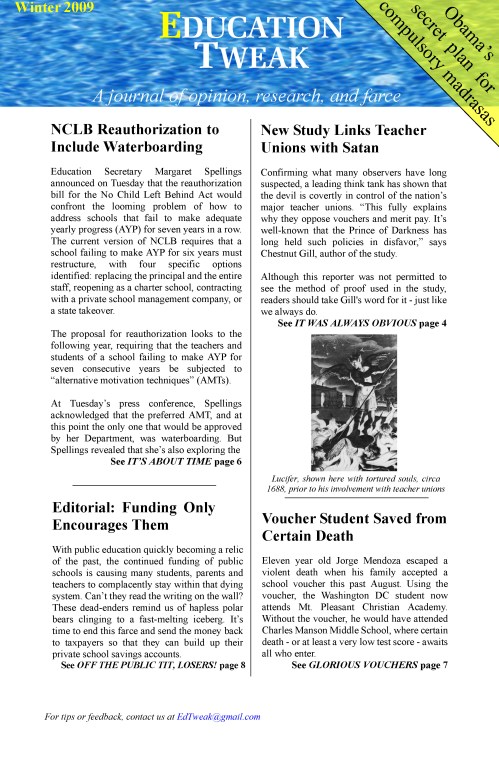
Education Tweak, Winter 2009

edtweak

Click on image for pdf

Enjoy.

Thomas J. Mertz

Leave a comment

Filed under "education finance", Best Practices, Contracts, education, finance, Gimme Some Truth, National News, nclb, No Child Left Behind, School Finance

Quote of the Day — “Most Powerful” Data

“I am not a number,” from The Prisoner.

It’s one reason why the most impressive data we used at the schools I’m most familiar with were the results of interviews with alumnae conducted years after they left us. But even that only helps us if we’re open to hearing what they say. For the possibility—however unlikely—that we may be wrong about this or that has to be uncomfortably confronted—over and over. Sometimes it’s small things and sometimes it’s the big ones. It’s this that I hope good schools do for both their kids and their staff—because this habit of what I call “skepticism” is what democracy rests on. The “data” that are the most powerful are not all the proxy data—like test scores—which we have been inundated with. What we need to be listening to are the real experiences of our students and our graduates, and over time their impact upon the larger world as well.

Deborah Meier, (hat tip, Jim Horn – Schools Matter)

Thomas J. Mertz

Leave a comment

Filed under Accountability, Best Practices, education, National News, nclb, No Child Left Behind, Quote of the Day

“The System…Is Broken”: Milwaukee Public Schools Dissolution Vote

Joan Jett, “You dont know what you got (till it’s gone)” (click to listen or download)

The big news from Milwaukee this week was the 6-3 vote to explore dissolving the school district  This is news so big that even the New York Times covered it.  It is only the first step in what might turn out to be a long process (Alan Borsuk at the Journal-Sentinal has a good Q&A on the details), a similar process is ongoing in Wausaukee.

How did it come to this.?

Milwaukee Superintendent William Andrekopoulos began the meeting where the vote was taken by repeating the sentence: “The state finance system to fund Milwaukee Public Schools is broken.”

This is true.

The broader  statement, ““The state finance system is broken,” is also true.

Legally, politically, demographically and in many other ways the Milwaukee schools are different than the rest of the state, but we all share the same basic, broken system of funding education.  This broken system wrecks havoc on different districts in different ways, but in both the long and short term, it isn’t working as well as it should for any district or any of the students.

If you want to know more about the unique issues Milwaukee faces, I’d start with Supt. Andrekopoulos 2006 testimony before the Special Joint Committee to Review the School Aid Formula and the accompanying documents (scroll down to Oct. 5; if you want to learn about the damage being done elsewhere, check the other testimony).  Some developments since then have also contributed to the situation.  Most of these have been covered very well on Gretchen Schuldt’s Blogging MPS.

Shudlt is a financial analyst with MPS, so she knows her stuff.  Her latest post is a memo from School Board President Peter Blewett complaining/explaining that the vote was not by the Board per se, but by all nine members of the Board meeting as the Strategic Planning Committee.  Perhaps a distinction without difference, but given how convoluted Board rules can be, it could have significance.

I am going to quote an earlier post in full, because it is short and really captures the no-win situation Milwaukee faces:

The ugly outlook

The ugly fiscal outlook for MPS was made quite clear in a report the School Board’s Strategic Planning and Budget Committee got last night.

Here it is in a nutshell.

If the School Board, in adopting a final FY09 budget next month, doesn’t make any cuts to the budget it gave preliminary approval to in the spring, the required tax levy would be 14.9% higher than the levy for the FY08 budget.

If it adopts the budget total proposed by the administration, before the Board amended it, the levy would increase 11.3%; holding spending at FY08 levels would require a 9.1% levy increase.

It’s amazing what a $20 million state aid cut will do, isn’t it?

A property tax freeze would force the School Board to cut $37.5 million from the spring-approved budget, while holding the district’s levy increase to the southeastern Wisconsin average of 6.9% would require a $20.2 million cut.

You can see the chart the committee received here.

What’s a district to do? Any suggestions?

Of course there is glee , but no real answers in the right-wing blogsphere.  Texas Hold’Em Blogger, Nick at Badger Blogger and others have their predictable rants about “educrats,” teachers unions, mismanagement and “trimming the fat.”  The best any can come up with is Owen at Boots and Sabers‘ unsupported statement that “dissolving it outright, or breaking it into several smaller districts, would make a real difference.”  Of course Owen knows this because…well, just because.

The Joan Jett song at the top is there as a reminder that despite all the faults and missteps, MPS does many things well and if it were gone these things would be lost.  The recent comparison of MPS student achievement and  voucher school student achievement demonstrated that Milwaukee schools does as well or better than the only alternative anyone has come up with.

Unfortunately, Governor Doyle has added fuel to the fire being stoked by the anti crowd.  He wants a “complete evaluation” of the situation “wants to know whether MPS is making the best use of the money it has.”  Investigation is in order, but this kind of language isn’t helpful.  First, no organization as large as MPS (or the State of Wisconsin, or AIG, or…) ever always “makes the best use of” their resources.  There are always mistakes and there is always waste.  Every effort can and must (and has) been made to improve, but the “best use” standard is false and unachievable, kind of like all students proficient under NCLB.  Second, Doyle is well aware of the statewide problems caused by a broken school finance system and the particulars of how these have played out in Milwaukee.  Being no fool, he knows that these — not local mismanagement in Milwaukee or Wausaukee —  are the primary problem.  Thus far he has lacked the political courage to act on this knowledge.  There is much hope in some quarters that the election results in November will change this.

A teacher blogger at School Board Watch has the right idea about how this might happen:

I want every school board member to get to Madison weekly and tell the real stories of MPS and our kids. I want the Milwaukee newspapers to ask teachers what we need, and then tell those stories; and even more than that, I want the MJS to get behind a better way of funding schools…

I want the citizens of this state to listen to Libby Burmaster when she says that Wisconsin schools have reached their limit.…because the reality is that MPS is suffering, but so are Florence, River Falls, Sparta, Kimberly, and Hazel Green. And I want everyone to know that we are teaching the greatest proportion of kids in the state who have needs beyond what most of us can imagine or understand.

Next to last word goes to another Milwaukee educator/blogger and a favorite with the AMPS team, Jay Bullock of Folkbum’s Rambles.  He does a fine job reviewing the particulars of the funding situation and ends with a very pessimistic thought,

More likely, it will simply increase the rate at which the parents who can keep bailing on MPS. Those departing students leaves a harder-to-teach population behind, compounding every one of our most expensive problems exponentially.

This is the “starve the beast,” “going out of business,” death spiral that is the dream of the provocateurs of privatization.  We can’t let that happen.  We need to remember the common good and work for it.

The Milwaukee voucher program has hurt the schools financially and already put the district in the targeting sites of the antis.  We have to stand up for Milwaukee and all the other threatened districts before the death spiral is out of control, before it is too late.

Give our schools a system of allocating resources that works, give those that are struggling some time and then see what happens.  These things have to happen in that order, to judge so harshly the products of a broken finance system is senseless.

Thomas J. Mertz

Leave a comment

Filed under "education finance", Accountability, AMPS, Best Practices, Budget, education, finance, Local News, nclb, No Child Left Behind, School Finance, Take Action, Uncategorized

Schools and the Common Good

Elsewhere, I’ve touched on the history of public education and the important idea of the “Common,” as in the Common School and the Common Good. My whole thinking about public education is that our schools are where we express our vision of a good society and try to create that society. In doing this we come together, finding common ground, defining the common good while preparing our children to contribute to a society where the common good is paramount.

This is by definition a secular project; church and state are separate.  The creation of public schools was in part designed to secularize the notion of a common good. But religious groups and thinking are an important part of our society and those visions remain relevant. Earlier I posted some excerpts from the United Church of Christ on public education. Today I’m posting some thoughts from a recent document in the Catholic Social Action tradition, a tradition that has shaped who I am. These come from, A Platform for the Common Good, drafted and ratified by a coalition of Catholic organizations. One of the authors, Robert Beezat, will be speaking at Edgewood College on September 25.

Under the heading of “Promote the General Welfare” there are calls to action on a number of topics, including education.  This is what the platform has to say.

Government Action Needed:

On Education

  • Increase education funding and distribute resources equitably, with special attention to schools in low-income neighborhoods
  • Pay teachers fair and adequate wages and institute programs to encourage teacher retention
  • Provide more arts, music and other cultural enrichment courses
  • Ensure that special education students have the resources and trained teachers they need
  • Ensure that education includes life skills and vocational training to prepare students for jobs
  • Provide free universal preschool/Head Start
  • Fund educational mandates.

Individual/ Community Action Needed:

  • As parents, be involved in our children’s education
  • Hold regional school boards accountable.

Other education related planks appear elsewhere, under the headings “Establish Justice” and “Ensure Domestic Tranquility.”

  • Work to lessen income disparities and to reform tax policies that favor the wealthy and corporate interests.
  • Acknowledge that discrimination, including racism and sexism, continues to impact public systems and encourage public employees and others to engage in anti-discrimination training
  • End discrimination in all institutional forms.Support and promote programs that promote a fair distribution of resources and serve vulnerable populations
  • Support and promote programs and activities that address prejudice and discrimination
  • Write letters to the editor and op-eds to encourage anti-racism education and better relationships within our communities
  • Fund after-school programs, jobs for youth, and continuing education (GED, ESL) for adults

Many, many good and important ideas about how to work toward the common good.  These ideas should be at the heart of the Church’s work, but often get lost.

Thomas J. Mertz

Leave a comment

Filed under "education finance", AMPS, Best Practices, education, Elections, Equity, finance, National News, nclb, No Child Left Behind, School Finance, Take Action

Tears of Rage

Bob Dylan and the Band “Tears of Rage” (click to listen or download)

From Lakeview Elementary (MMSD) teacher Susan J. Hobart in The Progressive Magazine.

One Teacher’s Cry: Why I Hate No Child Left Behind

By Susan J. Hobart, August 2008 Issue

I’m a teacher. I’ve taught elementary school for eleven years. I’ve always told people, “I have the best job in the world.” I crafted curriculum that made students think, and they had fun while learning. At the end of the day, I felt energized. Today, more often than not, I feel demoralized.

While I still connect my lesson plans to students’ lives and work to make it real, this no longer is my sole focus. Today I have a new nickname: testbuster. Singing to the tune of “Ghostbusters,” I teach test-taking strategies similar to those taught in Stanley Kaplan prep courses for the SAT. I spend an inordinate amount of time showing students how to “bubble up,” the term for darkening those little circles that accompany multiple choice questions on standardized tests.

I am told these are invaluable skills to have.

I am told if we do a good job, our students will do well.

I am told that our district does not teach to the test.

I am told that the time we are spending preparing for and administering the tests, analyzing the results, and attending in-services to help our children become proficient on this annual measure of success will pay off by reducing the academic achievement gap between our white children and our children of color.

I am told a lot of things.

But what I know is that I’m not the teacher I used to be. And it takes a toll. I used to be the one who raved about my classroom, even after a long week. Pollyanna, people called me. Today, when I speak with former colleagues, they are amazed at the cynicism creeping into my voice.

What has changed?

No Child Left Behind is certainly a big part of the problem. The children I test are from a wide variety of abilities and backgrounds. Whether they have a cognitive disability, speak entry-level English, or have speech or language delays, everyone takes the same test and the results are posted. Special education students may have some accommodations, but they take the same test and are expected to perform at the same level as general education students. Students new to this country or with a native language other than English must also take the same test and are expected to perform at the same level as children whose native language is English. Picture yourself taking a five-day test in French after moving to Paris last year.

No Child Left Behind is one size fits all. But any experienced teacher knows how warped a yardstick that is.

I spent yesterday in a meeting discussing this year’s standardized test results. Our team was feeling less than optimistic in spite of additional targeted funds made available to our students who are low income or who perform poorly on such tests.
As an educator, I know these tests are only one measure, one snapshot, of student achievement. Unfortunately, they are the make-or-break assessment that determines our status with the Department of Education.

They are the numbers that are published in the paper.

They are the scores that homebuyers look at when deciding if they should move into a neighborhood.

They are the numbers that are pulled out and held over us, as more and greater rigidity enters the curriculum.

I was recently told we cannot buddy up with a first-grade class during our core literacy time. It does not fit the definition of core literacy, I was told. Reading with younger children has been a boon to literacy improvement for my struggling readers and my new English-speaking students. Now I must throw this tool away?

In an increasingly diverse public school setting, there is not one educational pedagogy that fits all students. We study and discuss differentiated curriculum, modify teaching strategies, and set “just right reading levels” to scaffold student learning. But No Child Left Behind doesn’t care about that. It takes no note of where they started or how much they may have progressed.

As a teacher, I measure progress and achievement for my students on a daily basis. I set the bar high, expecting a lot.

I don’t argue with the importance of assessment; it informs my instruction for each child.

I don’t argue with the importance of accountability; I believe in it strongly—for myself and my students.

I have empathy for our administrators who have to stand up and be told that we are “challenged schools.” And I have empathy for our administrators who have to turn around and drill it into our teacher heads, telling us we must do things “this” way to get results. I feel for them. They are judged on the numbers, as well.

No Child Left Behind is a symptom of a larger problem: the attack on public education itself. Like the school choice effort, which uses public funds to finance private schools and cherry-pick the best students, No Child Left Behind is designed to punish public schools and to demonstrate that private is best.

But I don’t think we’ve turned a corner that we can’t come back from. Public education has been a dynamic vehicle in our country since its inception. We must grapple with maintaining this progressive institution. Policymakers and educators know that education holds out hope as the great equalizer in this country. It can inspire and propel a student, a family, a community.

The state where I teach has a large academic achievement gap for African American and low income children. That is unacceptable. Spending time, money, energy on testing everyone with a “one size fits all test” will not eliminate or reduce that gap.
Instead, we need teacher-led professional development and more local control of school budgets and policymaking. Beyond that, we need to address the economic and social issues many children face, instead of punishing the schools that are trying to do right by these students.

We’ve got things backwards today. Children should be in the front seat, not the testing companies. And teachers should be rewarded for teaching, not for being Stanley Kaplan tutors.

Ten years ago, I taught a student named Cayla. A couple of months ago, I got a note from her, one of those things that teachers thrive on.
“Ms. Hobart was different than other teachers, in a good way,” she wrote. “We didn’t learn just from a textbook; we experienced the topics by ‘jumping into the textbook.’ We got to construct a rainforest in our classroom, have a fancy lunch on the Queen Elizabeth II, and go on a safari through Africa. What I learned ten years ago still sticks with me today. When I become a teacher, I hope to inspire my students as much as she inspired hers.”

Last week, I received a call from Niecy, another student from that class ten years ago. She was calling from southern Illinois to tell me she was graduating from high school this month and had just found out that she has won a scholarship to a college in Indiana. I was ecstatic in my happiness for her. We laughed, and I told her I was looking at a photo of her on my wall, building a pyramid out of paper bricks with her classmates.

I also had a recent conversation with Manuel in a grocery parking lot. He reminded me of my promise eight years ago to attend his high school graduation. I plan to be there.
Cayla and Niecy and Manuel are three of the reasons I teach. They are the reasons that some days this still feels like a passion and not a job.
When I pick up the broom at the end of the day to sweep my class due to budget cuts, I remember Cayla.

When I drive home demoralized after another meeting where our success is dissected with a knife manufactured in Texas, I remember Niecy.

When another new program that is going to solve the reading disparity, resulting in higher test scores, is introduced on top of another new program that was supposed to result in the same thing, I remember Manuel.

They are the fires that fuel my passion. They are the lifeboats that help me ride this current wave in education.

Eight or ten years from now, I want other former students to contact me and tell me a success story from their lives. I don’t want to be remembered as the teacher who taught them how to sing “Testbusters” or to “bubble up.” I want to be remembered as a teacher who inspired them to learn.

Susan J. Hobart, M.S. Ed., is a National Board Certified Teacher living in the Midwest.

Thomas J. Mertz

3 Comments

Filed under AMPS, Best Practices, education, Gimme Some Truth, Local News, National News, nclb, No Child Left Behind

Texas, what can I say?

The Barbarians, “Are You a Boy, or Are You a Girl?” (click to listen)

From the state that brought you the “Texas Miracle” that wasn’t (and led directly to the No Child Left Behind mess) comes a flashback to the worst of the 1960s or maybe the 1800s. The Needsville Texas school district has refused to admit a five-year-old boy because his hair is too long (hat tip to Region19 Gazette). “”I’m just afraid if the district gives in, other problems will occur in the future,” said Shelly Sullivan, a former Needville student.” Yeah, like fluoridation in the water, revolution in the streets and maybe respect for individual choices. Horrors.

That the child is Native American recalls the shameful forced assimilation policies of Native American boarding schools.

I know Texas has produced much of worth (especially in music, but can’t forget Governor Anne Richards and others).  Still, things like this make me wonder what goes on down there.

Thomas J. Mertz

Leave a comment

Filed under education, National News, nclb, No Child Left Behind, Uncategorized

New Video from FairTest.org

National Center for Fair and Open Testing.

Hat tip to Jim Horn at Schools Matter.

Thomas J. Mertz

Leave a comment

Filed under Accountability, Local News, National News, nclb, No Child Left Behind