Category Archives: nclb

An exercise in delusion

Hieronymus Bosch

During a speech to the National Association of Latino Elected & Appointed Officials the other day, John McCain launched into a discussion of NCLB and education funding, holding up New York City (with awful – and similar funding issues to Wisconsin) and New Orleans (oy!) as examples of Republican success stories in education. Charter schools, according to him, can be our silver bullet. Pardon me, but we all need a national conversation to start now. However for Mr. McCain, it would seem his mind is made up.

“I mean, they also re-authorized No Child Left Behind, with the lessons we learned in the intervening years since we passed it, in a bi-partisan fashion, I would fully fund those programs that have never been fully funded. But let me also say to you: choice and competition. I believe that every family in America should have the same choice that Cindy and I did. We chose to send our children to a Catholic school. That was because we were able to do so. So I believe that charter schools work. I believe that they’re not much better than public education, but they provide competition. There are two examples I’d like to mention very briefly: New York City and New Orleans. If you missed it, there is now a dramatic uptick in the performance of school children in New York City, a place where a lot of experts thought there would never be improvement. We ought to go up there and see what Mr. Klein and Mayor Bloomberg and others have done and dedicated educators have done in New York City. New Orleans, they had to start at square one, as you know. There are now 30 charter schools in the city of New Orleans. Anyone will tell you that they’re starting to see a dramatic improvement in the quality of education in the city of New Orleans. My friends, choice and competition, reward the teachers, God bless them, find bad teachers another line of work. Choice and competition.”

I’ll bet Mr. “Choice and Competition” has never seen this documentary. He won’t – but you can. Educate yourself. See what magic an unregulated post-Katrina education industry has brought to New Orleans and shades of things to come if some mainstream thinking about reforming education comes to fruition.

Robert Godfrey

1 Comment

Filed under AMPS, Equity, Gimme Some Truth, nclb, No Child Left Behind, School Finance, We Are Not Alone

George Carlin on NCLB, Education and More

Warning, expletives not deleted (it would have been wrong to delete the expletives of the man responsible for bringing the “Seven Dirty Words You Can’t Say on Television” all the way to the Supreme Court).

Don’t rest in peace George; keep stirring up trouble wherever you are.

Thomas J. Mertz

1 Comment

Filed under Best Practices, Gimme Some Truth, National News, nclb, No Child Left Behind, Quote of the Day

“Ain’t No Miracle Worker”

The Brogues, “I Ain’t No Miracle Worker” (click to listen).

There is a lot of excitement about Dan Nerad taking the reins as Superintendent of MMSD. I share this excitement. I’ve had the pleasure of meeting him three or four times, have read numerous articles about him and his work, have talked to people who know him from Green Bay and have researched what he has accomplished in his career. All this leads me to believe that Dan Nerad is a very high quality district leader who will fit well in Madison and contribute greatly to the improvement of our schools.

Still. I worry that expectations are unreasonably high and that we may be setting Nerad and ourselves up for a fall. Over and over again I have heard and read people saying “when Dan Nerad gets here” either preceded or followed by some hope or promise of a positive change. There will be changes and I think that (from my perspective) they will be mostly positive. So what’s the problem? Here is a list:

  • It doesn’t recognize all the good work of the recent past. Not Just Art Rainwater’s contributions, but the contributions of our Board members, our staff and teachers and our community. Looking to Nerad to for huge improvements can make it seem like MMSD has been stagnant or failing. It hasn’t. For some nice overviews and reflections on Art Rainwater and his time with MMSD, see the current MMSD Today.
  • We shouldn’t forget that educational improvement is incremental. Perhaps the best history of educational reform is David Tyack and Larry Cuban’s Tinkering Toward Utopia. In their prologue they write:

Although policy talk about reform has had a utopian ring, actual reforms have typically been gradual and incremental — tinkering with the system. It may be fashionable to decry such change as piecemeal and inadequate, but over long periods of time such revisions of practices adapted to local contexts can substantially improve schools. Rather than seeing the hybridizing of reform ideas as a fault, we suggest it can be a virtue. Tinkering is one way of preserving what is valuable and reworking what is not.

The point in the last sentence is related to my concerns about belittling what has been accomplished in our schools. Tyack develops this further in one of my favorite essays “A Conservationist Ethic in Education Reform.”

  • No policy, reform, set of policies or reforms will make everyone happy. Uncontested school board races and an apparent conflict and controversy avoidance strategy by the Board of Education may have lulled some into thinking that divisions are a thing of the past in Madison school politics. They aren’t. I recognize that most people involved share many values and even have much agreement about how best to put those values into action, but also know from personal experience that there are passionate disagreements among people of good will when it comes to education. Whatever Dan Nerad does or does not do, tries or does not try, some vocal segments of our community will object that it is too much or too little or just plain wrong. The divisions that have been hidden will become apparent again at some point. I believe that Dan Nerad is skilled at working toward consensus, finding common ground and building coalitions. This will serve him (and our community) well, but it won’t satisfy everyone.
  • The challenges Madison’s schools face are great, too great for any individual to address alone. The issues raised by demographic changes are well documented; the insane choices created by the state school finance system are well known; the pressures from testing and other ill-devised mandates of NCLB are readily apparent. I don’t believe these are intractable, but I do recognize that there are no simple answers and that sustained hard work and cooperation from all associated with the district and all segments of our community are necessary if we are to be successful in meeting these challenges. Dan Nerad cannot do this without help from many quarters. Much has been written about his openness, outreach and cooperative spirit, but if some members of the Board of Education continue to be blasé about or dismissive of public engagement, little improvement is possible. The community has to step up too. Schools of Hope (as well as other Urban League programs) and the Foundation for Madison Public Schools are great; Mayor Cieslewicz, Alder Satya Rhodes-Conway and others are actively working to expand school/city/community initiatives; MMSD has wide-ranging partnerships with the University of Wisconsin School of Education and other local research and higher education institutions; PTOs, PTAs and PTGs are doing wonderful things; Thousands of volunteers help our schools on a regular basis; Our legislative delegationespecially Rep. Sondy Pope Roberts — are leaders in the fight for school finance reform; ABC Madison and Get TUFF have been educating and agitating for state school funding changes; Communities and Schools Together and Mad-City Grumps are preparing for the next referendum campaign; countless other individuals and groups are contributing to the betterment of our schools… (apologies if I left out your favorite). An impressive list, but it isn’t enough. We all can and must do more.

So let’s work together to welcome Dan Nerad, expand the good our schools are doing, fix the state finance system, pass a referendum…have realistic expectations about what a change in the superintendency will bring and do our best to help Dan Nerad exceed those expectations.

In this spirit (or maybe just because I like it), here is video from the last referendum campaign.

Thomas J. Mertz

Leave a comment

Filed under "education finance", AMPS, Best Practices, Budget, education, finance, Local News, nclb, No Child Left Behind, Pope-Roberts/Breske Resolution, Referenda, referendum, School Finance, Take Action, Uncategorized

A Broader, Bolder Approach to Education

As promised, a task force associated with the Economic Policy Institute has released a framework for improving education. Here are the highlights from the press release:

1. Continued school improvement efforts. To close achievement gaps, we need to reduce class sizes in early grades for disadvantaged children; attract high-quality teachers in hard-to-staff schools; improve teacher and school leadership training; make college preparatory curriculum accessible to all; and pay special attention to recent immigrants.

2. Developmentally appropriate and high-quality early childhood, pre-school and kindergarten care and education. These programs must not only help low-income children academically, but provide support in developing appropriate social, economic and behavioral skills.

3. Routine pediatric, dental, hearing and vision care for all infants, toddlers and schoolchildren. In particular, full-service school clinics can fill the health gaps created by the absence of primary care physicians in low-income areas, and by poor parents’ inability to miss work for children’s routine health services.

4. Improving the quality of students’ out-of-school time
. Low-income students learn rapidly in school, but often lose ground after school and during summers. Policymakers should increase investments in areas such as longer school days, after-school and summer programs, and school-to-work programs with demonstrated track records.

It reminds me of the video from the Educator Roundtable, in this post and this write up by eduwonkette of an American Education Research Association session, “Research on Neighborhoods and Communities: Implications for Research Methods on Social Contexts.”

It should go without saying that the this expansive view of inequality and education and what should be done about it is not “throwing in the towel,” making excuses for schools or conceding that inequality of educational outcomes is intractable (unlike the genetic determinists on the right). The broader, bolder approach realistically recognizes that educational inequality begins with childrens’ environment, living conditions and resources and seeks to address these inside and outside of school. Makes sense to me.

Become a co-signer to the statement. Work locally to make these things happen.

Thomas J. Mertz

BTW, this is post #300 on AMPS!

2 Comments

Filed under Accountability, AMPS, Best Practices, education, Equity, National News, nclb, Take Action, Uncategorized

Too Late the Truth?

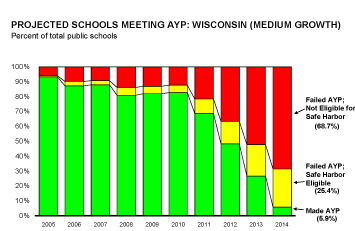
From “The Impact of the Adequate Yearly Progress Requirement of the Federal No Child Left Behind Act on the Great Lakes Region,” a study released by the Great Lakes Center for Educational Research and the Education Policy Studies Laboratory at Arizona State University.

From “The Impact of the Adequate Yearly Progress Requirement of. the Federal “No Child Left Behind” Act on Schools in the Great Lakes Region,” a study released by the Great Lakes Center for Educational Research and the Education Policy Studies Laboratory at Arizona State University.  See also “Many States Have Taken a “Backloaded” Approach to No Child Left Behind Goal of All Students Scoring ‘Proficient'” from the Center on Education Policy.

On June 24, The Department of Public Instruction will release the preliminary Adequate Yearly Progress Reports on schools and districts in Wisconsin, as required by the No Child Left Behind Act. My guess is that MMSD will have a higher number of “failing schools” this year. Think of Madison as being “ahead of the curve.”

AYP is not the best gauge of the work our district is doing; NCLB isn’t a good law and AYP is ridiculous yardstick.

If the flaws in and political manipulation behind NCLB weren’t obvious already, an interview with former Assistant Secretary for Elementary and Secondary Education Susan Neuman in the new Time magazine confirms what we already knew. Excerpts below.

There was always something slightly insane about No Child Left Behind (NCLB), the ambitious education law often described as the Bush Administration’s signature domestic achievement. For one thing, in the view of many educators, the law’s 2014 goal — which calls for all public school students in grades 4 through 8 to be achieving on grade level in reading and math — is something no educational system anywhere on earth has ever accomplished. Even more unrealistic: every kid (except for 3% with serious handicaps or other issues) is supposed to be achieving on grade level every year, climbing in lockstep up an ever more challenging ladder. This flies in the face of all sorts of research showing that children start off in different places academically and grow at different rates.

Add to the mix the fact that much of the promised funding failed to materialize and many early critics insisted that No Child Left Behind was nothing more than a cynical plan to destroy American faith in public education and open the way to vouchers and school choice.

Now a former official in Bush’s Education department is giving at least some support to that notion…

[T]here were others in the department, according to Neuman, who saw NCLB as a Trojan horse for the choice agenda — a way to expose the failure of public education and “blow it up a bit,” she says. “There were a number of people pushing hard for market forces and privatization.”

Neuman also regrets the Administration’s use of humiliation and shame as a lever for school reform. Failure to meet NCLB’s inflexible goals meant schools would be publicly labeled as failures. Neuman now sees this as a mistake: “Vilifying teachers and saying we are going to shame them was not the right approach.”

The combination of inflexibility and public humiliation for those not meeting federal goals ignited so much frustration among educators that NCLB now appears to be an irreparably damaged brand. “The problems lingered long enough and there’s so much anger that it may not be fixable,” says Neuman. While the American Federation of Teachers was once on board with the NCLB goals, she notes, the union has turned against it. “Teachers hate NCLB because they feel like they’ve been picked on.”

Is there a way out of the mess? Neuman still supports school accountability and the much-maligned annual tests mandated by the law. But she now believes that the nation has to look beyond the schoolroom, if it wishes to leave no child behind. Along with 59 other top educators, policymakers and health officials, she’s put her name to a nonpartisan document to be released on Tuesday by the Economic Policy Institute, a Washington think tank. Titled “A Broader, Bolder Approach to Education,” it lays out an expansive vision for leveling the playing field for low-income kids, one that looks toward new policies on child health and support for parents and communities. Neuman says that money she’s seen wasted on current programs should be reallocated accordingly. “Pinning all our hopes on schools will never change the odds for kids.”

The right wing attack machine turned on Scott McClellan when he belatedly told the truth. We can expect the same treatment for Neuman.

Thomas J. Mertz

1 Comment

Filed under Accountability, AMPS, Best Practices, education, finance, Gimme Some Truth, Local News, National News, nclb, No Child Left Behind, Uncategorized

The Teacher Project Film

From Public Schools Insights:

In this third and final installment of our interview, [Dave] Eggers announces his plans to create a new documentary depicting the professional lives of teachers. (You heard it here first.)

Eggers and Oscar-winning documentary filmmaker Vanessa Roth are collaborating on a film they hope will do for teaching what An Inconvenient Truth did for the environment. Featuring footage taken by teachers themselves, the film aims to offer a first-hand view of the challenges educators face every day–and to inspire greater public support for teachers’ work.

Eggers3.jpg

Eggers’ advocacy for public schools and educators took center stage at the TED (Technology, Education, Design) Conference, where “the world’s leading thinkers and doers gather to find inspiration.” (No, I wasn’t invited.) At TED, Eggers introduced Once Upon a School, a new project that shares stories about communities supporting public education and challenges adults across the country to become involved in their local public schools.

Hear Eggers describe his forthcoming documentary project and Once Upon a School in part III of Public School Insights’ exclusive interview

Hat tip to Jim Horn, Schools Matter.

Are We Better Off: Reading, Writing, and Landscaping, Mowing lawns, scrubbing bathrooms, selling stereos: How teachers make ends meet By Dave Eggers (Mother Jones).

Thomas J. Mertz

Leave a comment

Filed under "education finance", AMPS, Best Practices, Budget, Contracts, education, finance, National News, nclb, No Child Left Behind, School Finance

Talkin’ Dropouts

James Brown, “Don’t Be a Dropout.”

Lots of news about dropouts and graduation rates recently.

Education Week just published their Diplomas Count report. It is pretty alarmist. Graduation rate scholars Jim Heckman, Paul LaFontaine, Larry Mishel, and Joydeep Roy raised some issues with how Education Week counted (hat tip to eduwonkette, one of my new favorite education bloggers):

In our examination of the data and methodologies available to estimate high school graduation rates we have found that insights can be gained from household surveys and from administrative data on student enrollment and diplomas granted. However, we find the measures of graduation rates in Education Week’s Diploma Counts project, computed from diploma and enrollment data, to be exceedingly inaccurate. The main problem is the assumption that the number of students enrolled in 9th grade is the same as the number of students entering high school. This assumption artificially lowers the estimates of current graduation rates, especially for minorities who are more likely to be retained (repeat 9th grade). This measure also artificially reduces the growth of the graduation rate over time because the practice of grade retention has grown over time, again, especially among minorities.

The resulting errors are sufficiently large to artificially lower the graduation rate by 9 percentage points overall and by 14 percentage points for minorities. Grade retention also differs sharply across states and localities, distorting geographic comparisons. Last, these measures do not reflect the ultimate graduation rates of a cohort of students because the data do not capture diplomas provided by adult education and other sources than schools.

Paper from Heckman and Lafontaine, here; Paper from Mishel and Roy, here.

The Wisconsin State Journal editorialized in favor of adopting the graduation rate measure endorsed by the National Governor’s Association (NGA) as a single national standard (Leslie Anne Howard of the Dane County United Way had an op. ed., mostly in support of this position). There is much to be said in favor of national statistical standardization, but if the adopted standard is flawed, you open the door to a new set of problems. The NGA measure is largely based on the one used by Florida. Sherman Dorn notes some “troubling issues” with the Florida rate calculations:

  • The inclusion of alternatives to standard diplomas in the graduation numbers, with no public disaggregation
  • The exclusion of alleged transfers and movers from the base (creating an adjusted cohort) without any data quality checks to ensure that transfers really show up at a private school or in another state
  • The exclusion from the base (adjusted cohort) of students who drop out and immediately enroll in GED programs (as transfers to adult programs)

He also has some nice general thoughts on what to look for in graduation rate calculations here and here (lots more on his site, browse around or do a search; his posts are very accessible for those of us who are not steeped in the swamp of grad rate measures).

Information on how Wisconsin calculates dropout and completion rates. Many of the issues noted in the critiques of the various measures are present with Wisconsin’s. MMSD posted am 81.8% “regular diploma” completion rate in 2006-7, but there are great disparities among the rates for white students (90.4%), African American students (61.6%) and Hispanic students (60.8). The 2006-7 dropout rate was 2.699%, also with pronounced racial disparities (data can be accessed here).

Finally, this story in the Cap Times on Operation Fresh Start, (which has a GED component). By the way, I think this is a fine use of Wal-Mart’s money, but I still wish our legislators would get them to pay their fair share of taxes (some recent progress, but a long way to go).

Thomas J. Mertz

Leave a comment

Filed under "education finance", Accountability, AMPS, Best Practices, education, Equity, Local News, National News, nclb, No Child Left Behind, School Finance, Uncategorized

Lead exposure and more

A story today in US News and World Report discusses a study published in PLoS Medicine linking early exposure to lead to later criminality.

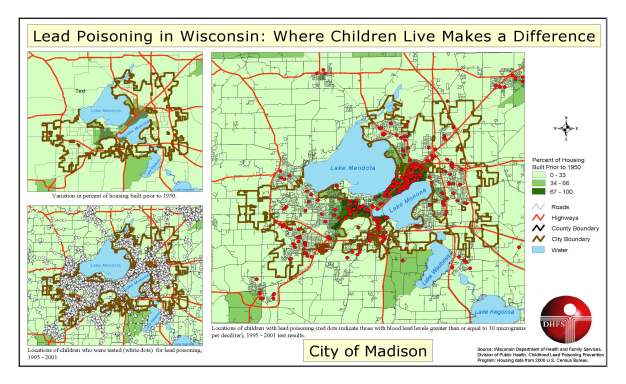
This reminded me of all the hidden dimensions of inequality and how they relate to school success and things like disproportionate Learning, Emotional and Behavioral Disability classifications.

That thought reminded me of this video from the Educator Roundtable.

More resources on lead exposure:

Lead Safe Wisconsin

“Goodbye Old Paint,” in Affordable Housing: A Crisis for Wisconsin’s Families (a publication of WisKids Count, a project of the Wisconsin Council on Families and Children).

Thomas J. Mertz

1 Comment

Filed under AMPS, Best Practices, education, Equity, Local News, National News, nclb, No Child Left Behind

TAME’s Proposal on Military Recruiting in MMSD

schneider_war.jpg

At the March 3d Board of Education meeting Truth and Alternatives to Militarism in Education (TAME) presented a detailed proposal for regulating military recruiting in Madison schools.  Proposed policy changes developed by staff and the Board will be on the agenda at the Board’s March 24 workshop meeting (no public testimony).  I hope that TAME’s ideas are given serious consideration.

From TAME: 

TAME is a small group of citizens working hard to educate school boards, students, and parents about the excessive recruiting measures to sustain the all-voluntary armed forces.  Because the Madison School administration has been letting slide enforcement of the current Board of Education policy regarding military recruiters in Madison’s schools, and because the Madison School Board chose to allow the military to advertise on scoreboards in the gymnasiums and football fields, also a violation of the policy, T.A.M.E. became more publicly active in the last 4 months to stop this abuse and misuse of power.  In discussions with School Board members and administrators, it became clear that the Board and administration was looking for more suggestions regarding this issue.  Thus, T.A.M.E. developed this list of suggestions, and presented them at the B.O.E. General meeting on March 3, 2008.

No Child Left Behind requires that military recruiters be given the same access to students as recruiters for all other post-secondary opportunities (colleges, trade schools, employers, internships…) enjoy.  The penalty for non-compliance is loss of federal funding.  As far as I can tell from the earlier Board discussions, TAME and the district share a goal of making sure that students are not targeted by continuous high and low pressure pitches by military recruiters, while assuring that all representatives of post-secondary opportunities have the access they need to help students make informed decisions.  The problems come in with drafting and enforcing a policy in a manner that reasonably limits the military but doesn’t penalize a representative of MIT or MATC from saying hello to a student while grabbing a pop in the cafeteria.  The reality is that military recruiters are hanging around the cafeterias looking for those opportunities and this has to stop.

In 2008 the military budgeted $19,210 for each recruit!  That’s why they can pay people to hang around cafeterias.  The reason they have to spend that much is that most potential recruits are smart enough to realize that joining the military carries dangers and restricts freedoms in ways that other options don’t. 

The military has a place in our society (I pray for the day when it isn’t needed) and can be a good choice for some young people.   Nothing in TAME’s proposal hinders those students interested in the military from learning more, from finding out if it is a good choice for them.   TAME just wants to make sure that they have an equal opportunity to learn about options that don’t have over $19,000 to spend targeting them (imagine if the Peace Corps had that budget).  Read the TAME proposal and weigh in with the Board prior to their March 24 meeting.

 Thomas J. Mertz

Related Resource:

Rethinking Schools Special Section on Military Recruitment (scroll down)

Leave a comment

Filed under education, Local News, nclb, No Child Left Behind, Take Action, Uncategorized

NCLB News

nclb-cartoon.gif

I’m going to start trying to post regularly on No Child Left Behind.  This is the first (or second) collection of links and excerpts.

Education Secretary Margaret Spellings was before the House Appropriations Committee recently.  The Chronicle of Higher Education reported on the session.

Democrats were harsh, with Rep. Jesse L. Jackson Jr. of Illinois calling the administration’s budget priorities “a bunch of garbage,” and Rep. Rosa L. DeLauro of Connecticut saying she was glad today was the last time she had to hear Ms. Spellings defend the president’s priorities. But Republicans were barely kinder, with Rep. John E. Peterson of Pennsylvania saying the administration’s budget “puts a zero priority on technical education,” and Rep. Dennis R. Rehberg of Montana accusing Ms. Spellings of neglecting American Indians. “I don’t know what you guys are smoking over there,” Mr. Rehberg told Ms. Spellings, “but it just ain’t working.”

The United Church of Christ has some wonderful anti-NCLB resources.  I think my favorite is Ten Moral Concerns in the No Child Left Behind Act.

1. While it is a civic responsibility to insist that schools do a better job of educating every child, we must also recognize that undermining support for public schooling threatens our democracy. The No Child Left Behind Act sets an impossibly high bar—that every single student will be proficient in reading and math by 2014. We fear that this law will discredit public educationwhen it becomes clear that schools cannot possibly realize this utopian ideal.

6. The No Child Left Behind Act blames schools and teachers for many challenges that are neither of their making nor within their capacity to change. The test score focus obscures the importance of the quality of the relationship between the child and teacher. Sincere, often heroic efforts of teachers are made invisible. While the goals of the law are important—to proclaim that every child can learn, to challenge every child to dream of a bright future, and to prepare all children to contribute to society—educators also need financial and community support to accomplish these goals.

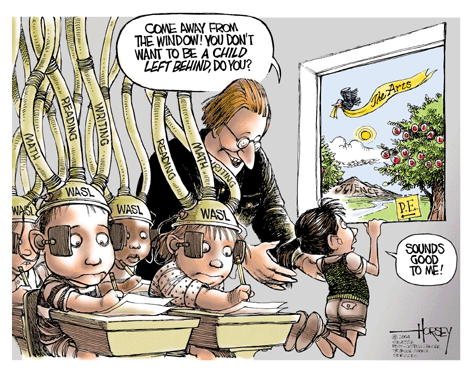
7. The relentless focus on testing basic skills in the No Child Left Behind Act diminishes attention to the hu­manities, the social studies, the arts, and child and adolescent development. While education should cover basic skills in reading and math, the educational process should aspire to far more. We believe education should help all children develop their gifts and realize their promise—intellectually physically, socially, and ethically. The No Child Left Behind Act treats children as products to be tested, measured and made more uniform.

9. The No Child Left Behind Act exacerbates racial and economic segregation in metropolitan areas by rating homogeneous, wealthier school districts as excellent, while labeling urban districts with far more subgroups and more complex demands made by the law as “in need of improvement.” Such labeling of schools and districts encourages families with means to move to wealthy, homogeneous school districts.

The Center on Education Policy has issued a new report on the curriculumn narrowing which has resulted from the high stakes testing in math and reading.

Among the districts that reported both increasing time for ELA or math and reducing time in other subjects, 72%indicated that they reduced time by a total of at least 75 minutes per week for one or more of these other subjects. For example, more than half (53%) of these districts cut instructional time by at least 75 minutes per week in social studies, and the same percentage (53%) cut time by at least 75 minutes per week in science.

Some news on the “opt out” front (states, districts, schools and students considering refusing to comply with the law).  Virginia is on the edge of leaving NCLB behind (hat tip to Jim Horn at Schools Matter).  The Carol Stream (IL) Elementary District 93 has decided not to force children who don’t speak and read English to take tests writen for  English speakers (this is a violation of the law…another tip of the hat to Jim Horn is in order).

District 93 officials say they’re willing to break the law this spring to shield students from the frustration and humiliation of taking an exam not designed for them.

“The board believes it’s appropriate to do that,” District 93 Superintendent Henry Gmitro said. “While there may be consequences for the adults in the organization, we shouldn’t ask kids to be tested on things they haven’t been taught.”

Illinois dropped the test that was designed for English learners this fall, after the U.S. Department of Education made a final ruling that the test wasn’t an adequate measure of state learning standards. The old test was written in simpler English.

As a stopgap measure, English learners will take standard assessments with some special accommodations, such as extended time and audio recordings, while Illinois develops a test that will meet federal guidelines.

Locally, the Wisconsin Peace & Justice Network  is asking people to identify alternate uses for the money that is being spent on the Iraq war.  According to their figures, Madison taxpayers have contributed about $300 million.  After fully funding free quality early child education and restoring MMSD’s cost to continue cuts of the last few years, I would suggest Madison opt out of NCLB at a cost of about $5 million per year.  We can dream.

Last, I’ve added a new blog to the Resources page: the NEA’s NCLB – It’s Time for a Change!.  Check it out.

Thomas J. Mertz

Leave a comment

Filed under "education finance", Accountability, Best Practices, education, Elections, Equity, finance, National News, nclb, No Child Left Behind