Category Archives: Uncategorized

Cuts Coming to Salem

sheetmusic1

“We All Love Our School”,  written by 4th grade Salem students in 2007, performed by 2nd and 3d grade students in 2008-9. Click to listen or download.

We All Love Our School

written by 4th grade Salem students in 2007

Salem is Great. It’s the biggest in the state. We all love our school!
White and blue our colors true. We all love our school!
At Salem we’re having fun.
Salem we’ve just begun
Salem students are the best.
We’re a cut above the rest.
A-round every turn, there is some-thing to learn. We all love our school!
A peaceful place puts a smile on your face. We all love our school!
At Salem we learn and grow.
Salem out to recess we go.
Falcon is our name and learning is our game!

Referenda in six districts failed on Tuesday.  That means each of these districts must to scale back their plans in ways that do the least harm to their students.  This is all part of business as usual under Wisconsin’s broken school funding system.

Here is a preview of what is in store for Salem.  The headline in the Kenosha News promises “Deep Cuts,” 17 layoffs and reductions in music and art.  The story offers further details

Cuts approved Thursday include eliminating band for children in fifth and sixth grade, cutting down on the number of gym classes children take each week, cutting back on art, and reducing reading specialty programs. All after-school sports and clubs would be eliminated, and class sizes would climb in grades three through eight. There were cuts in support staff and the administrative staff as well.

The source of the problem is also explained:

Salem has been facing budget shortfalls as it grapples with state school funding regulations that cap the amount of revenue schools can receive. The district has been covering its operating deficit using savings, but faces a deficit of more than $1 million next school year.

Two board members voiced the lament familiar to many around the state:

“This is killing me,” board member Shane Gerber said during the vote, the names of teachers who are targeted for layoff were read off. In the audience, teachers began to cry as names were read off and some walked out of the meeting.

“We as a board are now faced with cutting programs we know are good for kids,” said President Patty Merrill. “We have attempted three referendums, all three failed. The cuts must be made.”

If you haven’t already, listen to the song at the top and then try to convince yourself that  slowing the bleeding via band aids and reshuffles is the best we can do for the children of Salem and Wisconsin.  When you are done, contact the Governor and your legislators and tell them they need to listen to voices of children also; tell them that these children deserve music and art and reading help and all the other components of a full education.  Sign on with the Wisconsin Alliance for Excellent Schools and the School Finance Network while you are at it.

Thomas J. Mertz

Leave a comment

Filed under "education finance", Best Practices, Budget, education, finance, Local News, Referenda, referendum, School Finance, Uncategorized

Primary Election Roundup

politics040408_fullsize_story11

Some quick results and very few thoughts this morning.

Turnout was pathetic.  During the Presidential campaign season we heard a lot about a new political engagement, especially among the young.   February primaries lack the glamor (and resources) of Presidential votes, but going from about 2.9 million statewide voters in November 2008 to about 250,000 statewide voters in February of 2009 does not bode well for our political culture.  Locally, in Madison District 8 — one of the campus districts — the vote total in November 2008 was about 7,500; yesterday it was 528.   One data point does not make a trend, but this can’t be good for our democracy.

Tony Evers and Rose Fernandez survived the Sate Superintendent primary.  Here are the totals:

Schools Superintendent REPORTING 97%
Tony Evers

88,734

35%
Rose Fernandez

78,830

31%
Van Mobley 34,534 14%
Todd Price 28,641 11%
Lowell Holtz 22,163 9%

I want to thank Todd Price for his effort and his successes in raising awareness of the continuing crises in school funding, testing and other school matters. Tony Evers now has my full support (and I hope to see more evidence of the aggressive advocacy he has claimed).

All nine referenda failed!

The Appleton referenda lost by a 5 to 4 margin.  According to the Post Crescent this will mean “as many as 30 fewer teachers and larger class sizes next fall, plus delaying safety measures for several school buildings.”

The Clinton referendum asking to fund investments in a geothermal HVAC system failed again, this time by a large margin of 968-576.  This is exactly the sort of infrastructure investments we should be making, but under our current state school finance system they are difficult (more here, here and here).

The Highland request for recurring authority to limit program cuts lost 298 to 158.

Class sizes will be going up in Salem.  There is confusion about the margin.  DPI reports that it was 964 to 654.  The Kenosha News says 664 to 654.  More form that source on what this will mean to the quality of education in Salem:

The increase, officials said, was needed to cover expenses for the upcoming school year. School Board President Patricia Merrill said the result means 19 employees would be laid off for the 2009-10 school year, with layoff notices likely to be announced at Thursday’s School Board meeting.

Also on the chopping block are extra-curricular and after-school programs, starting this fall. Other programs scheduled for elimination include the gifted-and-talented program and technical education. Cuts are expected for music, arts, gym and Spanish. Merrill also said technology upgrades could be halted and staff workshops and travel will be reduced.

Superintendent Dave Milz said class sizes will likely increase.

“I’m not sure how any of these things can be beneficial for the kids,” Milz said. “This will certainly prove to be a challenging experience for the board and community to overcome.”

Referenda were narrowly defeated in Salem last June and September.

The vote in Siren was very close, 156 to 167 (turnout is important!).  There is talk of going back to the voters, but programing cuts are likely.

The votes on the three asks in Waupun were also relatively close.  Out of about 2,700 votes cast, they ranged from 698 in the “ongoing operational expenses vote,” to 26 votes in the “textbooks” and “materials” measure.  There will likely be school closures, and many cuts.

Closing the two outlying schools is a ticket item that would address about half of the budget deficit. No other suggestions presented could put a dent into it as closing Alto and Fox Lake elementary schools.

School board president Cathy Loomans said, “The business we’re in is about putting teachers in front of students. So the majority of our budget is staffing, and unfortunately, when you make these kinds of cuts, they have to come from staffing and that’s going to directly affect class size. There’s no way anymore to insulate the students from making these kinds of cuts.”

“Looking at what cuts we’re going to do, we have to look at what’s best for all the students to give the students across the district an equitable education,” Anne Kraintz, school board member, said.

For more information on the situation in Waupun (from one perspective), check out this site.

All around, not a great day for the future of education in Wisconsin.

Thomas J. Mertz

Leave a comment

Filed under "education finance", Best Practices, Budget, education, Elections, Equity, finance, Local News, Referenda, referendum, School Finance, Uncategorized, We Are Not Alone

Vote Today! – Today’s School Votes

Today’s election is very important.  Wisconsin will decide which two candidates for State Superintendent of Public Instruction will be on the April ballot; districts around the state have significant referendum questions and there are a couple of local Aldermanic races in Madison where there are candidates who I think deserve support (there are also some other primaries for judges and Board of Education and other Aldermanic races around the state).  The projected turnout is only 6%-10%, so your vote may make the difference.

First and foremost, Todd Price is the clear choice for State Superintendent.   Price has a thorough understanding of the difference quality public education can make in the lives of individuals, the health of our communities and the future of our state.  He also has correctly diagnosed and offered solutions to the problems of our state school finance system, our testing regimen, NCLB and more.  Most importantly, Todd Price has brought an urgency to this race that others lack.   We don’t need another state superintendent who accepts the continued erosion of our schools under a broken state finance system, underfunded programs for our highest need students and the misplaced priorities of NCLB and WKCE.  We need a State Superintendent who will challenge our governor, our legislators and our local school officials to do better.  Todd Price will be that State Superintendent.  Vote for Todd Price.

There are nine referenda in six districts on the ballot today.  The districts are Appleton, Clinton,  Highland,  Salem, Siren and Waupun.  I don’t have time this morning to fully explore these measures (if possible, I will add some links later), but essential things like preserving smaller class size (Appleton and Siren), investing in sustainable energy (Clinton), keeping neighborhood schools open (Waupun), paying for books, technology and other learning materials and avoiding further programing cuts will be decided.  I hope they all pass.

I am going to offer some quotes from a Todd Price press release and interview on these measures and the system that has led 151 referenda votes since January 1, 2008, most simply to preserve  or limit cuts to current programs, maintain or upgrade facilities, or build needed schools.

Price characterizes the need for these votes as “a regrettable symptom of a school finance system that has been harming our students, our communities, and our state for far too long.”…

“Referenda are band aids, temporary fixes. Our districts keep asking for more band aids just to stop the bleeding. It is time to address the real problem; it is time to fix Wisconsin’s broken school finance system.”…

“These campaigns to provide an adequate education for all children divide communities and distract from the essential task of working together for the education of all children,” Price explains. “One neighborhood is pitted against another, people on fixed incomes who can’t afford tax increases but know education is important are frustrated, educators and boards of education spend too much time trying to pass referenda instead of working to improve education; parents and concerned community members end up volunteering on campaigns instead of in the classrooms.”…

Racine Unified is a good example. The district struggles on an annual basis to balance its budget without making significant cuts to programs or going to referendum for extra money. It’s led to a contentious relationship between the district and the public, left schools in disrepair and resulted in relatively poor student performance.

Last, voters in Madison District 2 need to keep one of our city’s most Progressive and hardest working Alders in office — vote for Brenda Konkel.  In District 8, newcomer Katrina Flores is the best choice and as a grad student in the School of Education a sure friend to the schools.

Thomas J. Mertz

Leave a comment

Filed under "education finance", Accountability, Best Practices, education, Elections, finance, Local News, nclb, No Child Left Behind, Referenda, referendum, School Finance, Take Action, Uncategorized

What does Van Mobley mean by a “Basic Education for the Real Economy” (and who gets a “basic education” and who gets something richer)?

martin08

John Nichols in the Capital Times seems enamored with State Superintendent of Public Instruction candidate Van Mobley’s sound byte  “”Basic Education for the Real Economy.” Me, I’m confused, skeptical and suspicious.  Mostly, I think it sounds like an abandonment of public education as a means of expanding equality of opportunity and an embrace of the idea of social and economic stratification via  “appropriate education.”  In other words, a “basic education”  and some vocational skills for the masses, something better for the ruling classes.  I will say I am impressed with the sound byte itself — it sounds very good and is open to many interpretations.  It appeals to John Nichols and the “reading, riting and rithmatic” crowd.  Nice political rhetoric.

Before continuing I want to say two things.  First, if you believe like I do in public education as our best tool for moving towards equality, I think Todd Price is the best choice to keep that vision alive.  Second, despite what I think is an inexcusable lapse in not further examining Van Mobley and his rhetoric, John Nichols deserves some credit for being one of the few journalists in the state who has given the Superintendent’s race regular coverage.

Next, I think the full statement is in order:

Basic Education for the Real Economy

For the last twenty years we have geared our education system to prepare our children to thrive in the “New Economy.” Guess what? The “New Economy” is collapsing. It was a chimera. It is time to get back to the basics of reading, writing and arithmetic. What do children learn from the internet if all they can do is look at the pictures? As Superintendent I will refocus class time on the basics.

Since Mobley is a historian, I’m going to play historian too.   This Struggle for the American Curriculum (click the link for Herb Kliebard’s masterful book by that name) is as old as public education itself.   There are lots of versions:  Education for Democratic Citizenship vs. Education for a Trained Workforce; Manual Training for all as part of a varied education vs. Industrial Education for some and liberal arts and the classics for others; Booker T. Washington’s Vocational Education vs. WEB DuBois quest for excellence in liberal arts and sciences…  One consistent thing has been that calls for “basic education” have rarely been mouthed by those looking for equity and equality.  The “back to basics” crowd generally know that the elite have the resources to supplement the “basics” and that by limiting the education of the non-elite, they all but guarantee a recreation of inequality.

Mobley also writes of the failure of the “New Economy” as a reason for his emphasis on the basics.  This is a false dichotomy.  Our only chices aren’t “the basics” vs. “Education for  New Economy.”  However, there is some truth here, but only some.  The whole “World is Flat,” “Education for the 21st Century,” line of thinking  rests on some shakey oversimplifications.  As the Center for the Study of Jobs & Education in Wisconsin and United States has ably demonstrated, the “New Economy” jobs have always been few and far between.  This doesn’t change the need to work towards the promises of democracy and equality of opportunity and may reinforce the need for our schools to provide full and varied educations in order that people in all occupations may  achieve full and varied successes.

Mobley’s statement also made me think of something I was teaching today.  The topic was how railroads transformed America in the 19th Century.  I always use the computer revolution as a comparison to communicate that railroads touched every aspect of life, from work, to entertainment, to agriculture, to politics…to education.  To further this point, I also quoted Henry Adams (from The Education of Henry Adams):

This relatively small part of its task was still so big as to need the energies of a generation, for it required all the new machinery to be created — capital, banks, mines, furnaces, shops, power-houses, technical knowledge, mechanical population, together with a steady remodelling of social and political habits, ideas, and institutions to fit the new scale and suit the new conditions. The generation between 1865 and 1895 was already mortgaged to the railways, and no one knew it better than the generation itself.

Mobley asserts that because the “New Economy” bubble burst, our students need only a  “basic” education.  Adams reminds us that innovations like railroads and computers, and the commitment societies make when they “mortgage” their futures by embracing them, remake and remodel everything.   The depression of 1893 did not mean that America no longer needed a “mechanical population;” the recently burst bubble does not mean that our children will thrive with just the “basics.”   Just because only some  of today’s students will work at “knowledge based” “New Economy” jobs doesn’t mean that they won’t benefit in myriad ways from a well rounded education that includes knowledge about computers and the world that computers are such a big part of.

I’ll admit that all this is riffing on a very short and not very clear statement by Mobley.  Unfortunately, that’s all I have to work with.  Even in his WisconsinEye interview and the candidate forum, Mobley did not say much more about this.  Slick.  Mobley needs to be pressed; consider this the first prod.

Vote for Todd Price, Tuesday February 17, 2009!

Thomas J. Mertz

Leave a comment

Filed under Best Practices, Elections, Local News, No Child Left Behind, Take Action, Uncategorized

Andy Hall, Moving On

2410935952_732ff04a9c

Andy Hall, long time education reporter for the Wisconsin State Journal is leaving the paper to start a nonprofit Wisconsin Center for Investigative Journalism. Andy is a fine reporter and will be missed.

Andy writes clearly and always does his homework.  Part of the project at AMPS has been to improve understanding of education issues by addressing the failings of the media coverage; I don’t think we’ve ever seen a need to use one of Andy’s stories as an example of what’s wrong.

Beyond consistently excellent coverage of the Madison schools, he derserves special praise for his 2007 “Squeezing Schools” series, which has had a statewide impact by doing much to enhance comprehension of Wisconsin’s broken school finance system.

This is the kind of thing we need journalists to do more of.  A couple of quotes from Andy indicate that continuing this sort of work is the mission of his new undertaking.

“Mainstream journalism is in economic trouble, but the needs of our democracy are greater than ever,” said Andy Hall, executive director of the center and its sole initial employee.”

…”He said the mission is to protect the vulnerable, expose wrongdoing and seek solutions to pressing problems.”

We wish Andy and the Center the best!

Thomas J. Mertz

1 Comment

Filed under "education finance", education, finance, Gimme Some Truth, Local News, School Finance, Uncategorized

Non Sequitur of the Day — More from the MMSD Math Report

[Edited 10:25 PM]
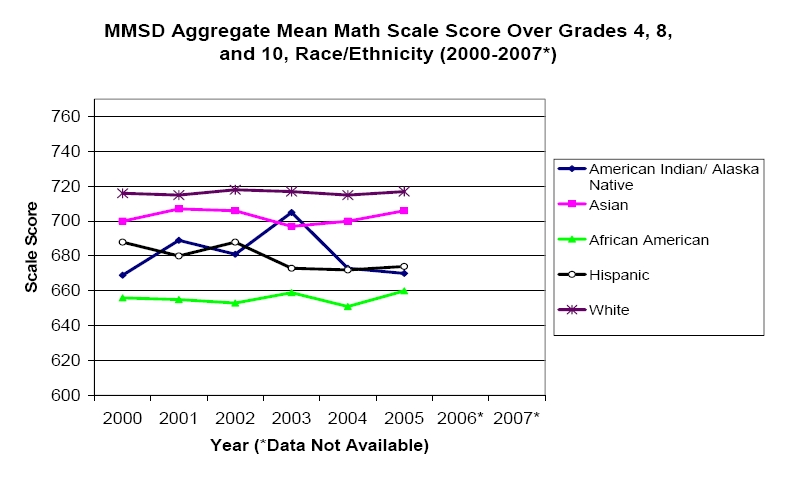
From MMSD Mathematics Task Force Report

From MMSD Mathematics Task Force Report

Assigning a meaning and interpretation to the decline in mathematics achievement scale scores over eight years is more difficult. As indicated in Exhibit I.3, the racial composition of the MMSD changed over this same period from about one-third minority students to nearly one-half minority students.

MMSD Mathematics Task Force Report, section 3, page 7.

Wow.

In the middle of a discussion of declining achievement, after a warning that this trend is difficult interpret — bang — a “helpful” reminder about the growing minority population.  Talk about you subtle invitations to insert your favorite crap about race and intelligence.  Shameful.  Disgusting.

Look, we all know that achievement gaps are a reality but this is not the way to discuss or present that information.  It might be OK if it was followed by some discussion of why these gaps exist and what can, (should and must) be done to address the gaps.

Don’t look in the report for that.  The only recommendations that even indirectly acknowledge the gaps are these:

8. In making improvements and investing resources, the district should consider how best to reduce the large achievement gaps among subgroups of students.

9. More time should be provided for teacher collaboration for teachers to learn from each other, analyze achievement data, meet needs of diverse learners, plan for instruction, and ensure both horizontal and vertical alignment of the curriculum. (See Section 4: Survey of Teachers, Parents, and Students.)

And there is no accompanying discussion of strategies to address the gap [correction, these issues are given some attention in the section on curriculum materials, basically saying that the materials MMSD uses are among those found to be good in addressing achievement gaps]. I thought they were supposed to give more guidance on  “how best.”

If I’m reading the charts right (the presentation leaves much to be desired), low income 10th graders score below non-low income 8th graders.  They are over two years behind.   This and other achievement differentials deserve serious attention.  Instead the Task Force gives us colorful charts and an invitation to racism.

Somewhere the lessons about high expectations leading to higher achievement have been lost.

I’m going to close with two items from the Equity Task Force work that actually made it into the policy:

1. Schools will be excellent only when students of all economic and demographic groups are achieving at high levels.

2. Schools should reflect fairness and high expectations for all learners.

Somebody should have told the Math Task Force these things.

Thomas J.  Mertz

Leave a comment

Filed under Best Practices, education, Equity, Local News, Uncategorized

MMSD Math Task Force Report, Thoughts on Teacher Preparation

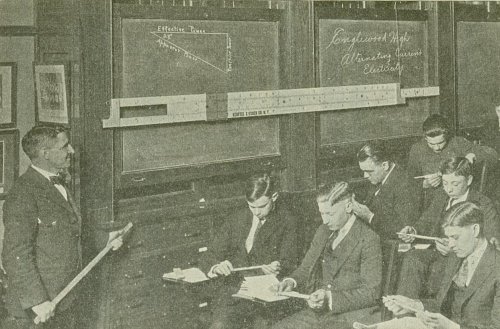
From the International Slide Rule Museum

From the International Slide Rule Museum (click on image to visit).

In anticipation of next week’s public discusions of the Mathematics Task Force Report, I’ve been dipping into parts of that document.  So far, the section I’ve looked closest at  — Teacher Preparation — is pretty disappointing.  It isn’t that I disagree or agree with the conclusions (I don’t have much of an opinion), it is that the work is superficial and read closely provides little or no support for either the assertions made or the recommendations.

The introductory section on “information concerning recommendations from research reports and professional organizations for the mathematical preparation of middle school mathematics teacher” is generally fine and the review of requirements and programs in Wisconsin and neighboring states is also adequate.  However, it is worth noting that even this part of the report begins with an untested assumption that the middle schools are the proper area of focus.  Additionally  as one researcher observed “what counts as subject matter knowledge and how it relates to student achievement remains inadequately specified.”    In other words, we don’t know what what teachers should know to  improve achievement (the MMSD report indirectly touches on complexities of defining what teachers should know but does not acknowledge how thin the research base linking teacher preparation to achievement is).

Where the report is lacking is in the assessment of the appliabicality of this material to MMSD.  This is done in only the most cursory manner.

The main recommendations on teacher preparation — prioritizing “hiring middle school mathematics teachers who have advanced preparation in mathematics” (later clarified to mean “completing mathematics coursework that focuses on enhancing teachers’ understanding of the mathematical content that they teach“) and providing “increased opportunities for middle school mathematics teachers to enhance their knowledge of mathematics for teaching middle school but also require participation by more (if not all) middle school mathematics teachers” —  seem reasonable.  The real question is how much of a priority should these be, how pressing is the need.

There isn’t much here that helps answer that question.

As far as I can tell the recommendations and analysis are mostly a simplified version of the Conference Board of the Mathematical Sciences (CBMS) 2001 report The Mathematical Education of Teacher applied to MMSD without any real consideration of the situation in Madison.

This is most obvious in the use of “middle grades” to mean grades 5-8, when MMS middle schools are grades 6-8.  Therefore, the recommendations, which are focused on the “middle grades,” are not aligned with how Madison defines the middle grades.  You’d think that at some point, someone would have said “Let’s make this fit Madison and use their definition.”  They didn’t and instead stuck with what is the arbitrary definition used in the CBMS (for the arbitrariness of this definition, see Chapter 4, footnote one of the CBMS report).

In and of itself, this isn’t a big deal.  However, it is illustrative of a larger problem.  The whole teacher preparation section is an exercise in forcing Madison into preconceived ideas about what is wrong with and what needs to be done about Math education, with little attention given to assessing what is wrong with and what needs to be done with Math education in Madison.  That many of the ideas appear to be supported more by belief than evidence compounds the problem.

Taking a cue from the popular simplistic international comparisons induced crisis mentality, (for  example see the multiple citations of this report, which despite looking only at the coincidence of teacher preparation differences  and TIMMS score differences  —  think of all the other possible reasons for the achievement differences  —  says it is “premature” to “make recommendations to change the nature of US middle school teacher preparation in mathematics.”), in the introductory section, in support of the lead recommendation the MMSD report asserts  ‘The adequacy of teacher preparation is a significant problem that cannot be solved without a substantial investment in mathematics content-based professional development and a change in hiring priorities at the district level.”  There is almost no evidence offered to support this assertion.

In the teacher preparation section a caveat is added:  “it is questionable whether most of the MMSD middle school mathematics teachers possess the depth of mathematical knowledge required for effectively teaching middle school mathematics .” (emphasis added, there are many caveats in this section).

“Questionable” isn’t good enough in these days of scarce resources.

Despite an extensive survey of teachers, the only attempt to assess the mathematical knowledge and training of our teacher corps is a simple counting of those who have been certified by DPI in the subject area.  One recommendation of the report is that the certification process needs to be expanded and improved, so the report itself recognizes the inadequacy of that measure.  Moreover, certification in subject areas confers no advantages under the current teacher contract, so it is very possible that additional MMSD teachers meet the certification requirements but have not bothered to go through the process.

Certification is a much less important than knowledge.  Any agenda concerning teacher preparation should begin with the recommendation that MMSD find out how prepared our teachers are, if they know the things that research shows make them better teachers, improve achievement.  Pretty simple.

I would suggest starting with the materials being developed by the Learning Mathematics for Teaching Project at the University of Michigan or a similar inventory.  Let’s find out what our teachers know and don’t know before deciding that the solution involves teachers who know more.  Our teachers may be lacking or they may not.  Until that question is answered, the task force recommendations are unsupported and unsupportable.

As a former task force member, I am sympathetic to the constraints of the work, but this task force had grant money, professional consultants and other resources that set the bar higher.  Under these circumstances, the section on teacher preparation is woefully inadequate and disappointing.

One last clarification, I have not looked at the other sections of the report extensively and my criticisms of this section may not be indicative of the report as a whole.

Thomas J. Mertz
6 Comments

Filed under Accountability, Best Practices, education, Local News, Uncategorized

Quote of the Day – Priorities

l_image101688cd0b59388fa7c1672e286d

If one accepts the reasonable principle of supporting the new president whenever he makes policy from the left or addresses basic social needs, shouldn’t progressives be cheering the White House as it rolls out the dozers, Cats and big cranes? Aren’t high-speed mass transit and clean energy the kind of noble priorities that best reconcile big-bang stimulus with long-term public value?

The answer is: no, not at this stage of our national emergency. I’m not an infrastructure-crisis denialist, but first things first. We are now at a crash site, and our priority should be to save the victims, not change the tires or repair the fender, much less build a new car. In the triage situation that now confronts the president-elect, keeping local schools and hospitals open should be the first concern, rebuilding bridges and expanding ports would come next, and rescuing bank shareholders at the very end of the line.

Inexorably, the budgets of schools, cities and states are sinking into insolvency on a scale comparable to the early 1930s. The public-sector fiscal crisis — a vicious chain reaction of falling property values, incomes and sales — has been magnified by the unexpectedly large exposure of local governments and transit agencies to the Wall Street meltdown via complex capital lease-back arrangements. Meanwhile on the demand side, the need for public services explodes as even prudent burghers face foreclosure, not to speak of the loss of pensions and medical coverage. Although the public mega-deficits of California and New York may dominate headlines, the essence of the crisis — from the suburbs of Anchorage to the neighborhoods of West Philly — is its potential universality.

Mike Davis, ” Why Obama’s Futurama Can Wait: Schools and Hospitals Should Come First in Any Stimulus Package.”

Thomas J. Mertz

Leave a comment

Filed under "education finance", Best Practices, Budget, education, finance, National News, School Finance, Uncategorized

Vote Today! Vote Yes for Schools!

Vote today!  Vote Yes for Schools!

Not much else to say, so some special election day musical selections.

Chis Stamey and Yo la Tengo, “Vote” (click to listen or download).

Chick Webb Orchestra with Ella Fitzgerald, “Vote for Mister Rhythm” (click to listen or download).

Sam Cooke, “A Change is Gonna Come” (click to listen or download).

Thomas J. Mertz

Leave a comment

Filed under AMPS, Elections, Referenda, referendum, Take Action, Uncategorized

Madison Referendum: More Than Affordable…

Successful Recurring Recurring Referenda as % of Revenue Limits, Nov. 2004 - Nov. 2008.

Successful Recurring Recurring Referenda as % of Revenue Limits, Nov. 2004 - Nov. 2008.

For a number of reasons, I’m fairly confident that the MMSD referendum will pass.  In fact, I still think that Madison could have and should have passed a larger referendum.  I’ll start with the could have and then revisit some of the should have.

The graph at the top of the page shows successful recurring operating referenda since November, 2004 as percentages of the district revenue caps in place at the time of the votes (operating referenda linked to building projects were not included, the final total price was used for multi-year recurring referenda, $13 million in Madison’s case).  The pending Madison referendum is in red.  This referendum represents 4.98% of the district’s revenue limit; the average of all the successful referenda is 8.53%.  If Madison had asked for the average percent, it would have been an over $22 million referendum.  With $22 million, we could have restored valued programs, renewed the maintenance and technology revenue authority, realistically considered new ways to improve the education our district offers, and more.  The lesson here is that other districts, with much less of a culture of educational support, have passed relatively more sizable measures than we are considering.

For further evidence that Madison could have afforded more, we need look no further than the the recently approved 2009-10 budget and mil rate (district documents, here).  Due to greater than expected growth in the tax base, individual tax rates went down more than expected, from 9.92% to 9.81%.  This points to two important things.  First, the starting point for referendum-related tax increases is lower than anticipated.  Second, the quality of our schools continues to be a contributing factor to our healthy local economy.

Affordability is a matter of opinion and it is impossible to prove or disprove the outcome of offering the voters a larger referendum, but both the above pieces of evidence are suggestive of a positive prognosis.  With counterfactuals, that’s about as good as you can do.

I could offer at least 24,189 reasons why there should have been a larger referendum.  I just want to touch briefly on three today.  First, I do not believe that there are $3 million worth of cuts over the next three years that will not have a negative effect on the quality of education our district provides; second, there are many valuable things that have been cut in that past that I think should have been considered for restoration;  last, there will be a need for a maintenance referendum in 2010 and I believe that an extension of this should have been included.

When discussing the quality of education, it is always important to begin with the observation that we are a district with high needs.  We have a higher percentage of students with disabilities, students in poverty and English language learners than the state average (data can be accessed here and is summarized here).  These categories are important, because each of them are covered by underfunded mandates.  Because our percentages are higher and the mandates are underfunded, Madison must spend a higher percentage (than the average district) of our general operating revenue to address these needs.

This is part of the reason that I do not believe that after 15 years and over $60 million worth of cuts, $3 million more worth of “harmless” cuts can be found.   I am not naive enough to pretend that there aren’t programs and positions that are not as effective as they should be, but I do believe that there are also new and old ways that money reallocated from these budget lines could be used to improve the quality of our schools.  As framed by this referendum, any new ideas or restorations of old services will only be possible after $3 million worth of cuts are found.

In a letter to the Cap Times Steve Pike detailed some of the ways past cuts have harmed our schools.  I have touched on some of others here (as well as other places).  Both in local budget discussions and in the fight for state finance reform, I have repeatedly said “we cannot afford to cut more.”  I believe that.  I believe that many of the cuts that have already been made were harmful.  We have more deteriorating facilities, less current technology, larger classes, less community outreach and parent-teacher contact, a smaller variety of offerings, more difficult situations with specials classes, fewer support staff…than we used to have and and we should have.

The maintenance and technology renewal is somewhat different, but just as important.  The 2009-10 school year is the last year of the non-recurring maintenance and technology referendum passed in 2006.  In the 2010-11 year, MMSD will lose $5.5 million in revenue authority from this referendum (while adding an anticipated $4 million or $9 million — depending on how you count it — from the referendum on the ballot November 4).  The current referendum could have been offered so that this amount was included on a recurring basis, beginning in 2010.  This amount would have still left the referendum well below the average (as percentage of revenue limits) of passed recurring referenda pictured at the top.  As far as I can tell this possibility was never publicly considered by the Board of Education.  Because of this oversight, the district, the Board and the community will have to engage in an additional referendum process and campaign.

I’ve been campaigning on behalf of the referendum and will enthusiastically vote yes because the the alternative is so obviously wrong.  My enthusiasm will be tinged with regret that the referendum could have been bigger and better, could have provided more room for dreaming and less need for cutting.  I believe that a referendum like that would have passed also and our children and our community would have both benefited.

The referendum on the ballot is more than affordable, but less than it should have been.  Vote Yes for Schools!

Thomas J. Mertz

Leave a comment

Filed under "education finance", Best Practices, Budget, education, Elections, finance, Local News, Referenda, referendum, Uncategorized