Excerpted. Full presentation, including Madison Supt Dan Nerad, at WisconsinEye.
[SAGE section edited to correct a misunderstanding, TJM]
Yesterday, Wisconsin State Superintendent of Public Instruction Elizabeth Burmaster gave her annual “State of Education” speech and released a budget proposal which would greatly improve the state of education (press release, here). It isn’t comprehensive reform, but the message and the proposals are very good.
In the speech, she presented “access and opportunity in public education” as “moral issues,” “social justice issues,” and as an “economic imperative.”
This strong and accurate rhetoric was accompanied by a realistic portrayal of the harm that our broken system of funding education has wrought over the last 15 years and promising budget initiatives to put Wisconsin back on the right path.
Some highlights on the state of education.
Public education in Wisconsin has been stretched to the limit. Wisconsin’s dedicated educators have been resilient in balancing the needs of today with tomorrow’s expectations….
Faced with 15 years of revenue caps and rising costs, school boards have struggled to preserve academic success and promote innovation. They have been forced into agonizing decisions to close schools, cut programs, eliminate services, and limit educational opportunities.
Public education in Wisconsin has been stretched to the limit. Is the breaking point near? Ask any one of these district superintendents. Our schools and communities can stretch no longer.
Today, I am proposing a state education budget that significantly reinvests in our PK-12 system.
These budget highlights appeared in the speech:
A budget that commits to two-thirds state funding.
A budget that brings local property taxpayer relief.
A budget that prioritizes early childhood education, small class sizes, global literacy, teacher recruitment,compensation, and repeal of the QEO.
A budget that addresses increasing child poverty and the rising cost of transportation, special education,English-language learners, public libraries, and operating small, rural school districts.
And, a budget that, for the first time in 15 years, provides real revenue limit relief for all our schools.
As always, the devil is in the details; in this case the details are good.
Restoring real 2/3 funding is huge, but for many districts the biggest boon would be the Revenue Limit Flexibility proposal (not all — see the problems of Milwaukee, which does not tax to the limit now). This would allow for annual per pupil revenue authority increases of $335 in fiscal year 2010 and $350 in 2011; in percent terms this moves the limit increase from about 2.5% to about 3.0%. In real dollars (based on stable enrollments), for MMSD this alone would mean about $1.2 million more in 2010-11 than would be available if current law continued (the MMSD projections for the referendum use a somewhat lower estimate of future revenue authority). It gets better.
There are lots of meaningful adjustments in categorical aids and other things. I’m just going to note that there is a proposal for a significant increase in Sparsity and Transportation, which would help the “small but necassary” districts that have been struggling for years and concentrate on the SAGE, Bilingual/Bicultural and Special Education portions.
The SAGE proposal uses the phrase “fully fund.” This addresses situations like the one in 2003-4 when districts submitted reimbursements for more students than had been budgeted for. It would entail an increase of $3.7 million the first year and about $5.4 million the second.
Tempering my enthusiasm (along with knowledge that this just the first step of a long budget process) is the increasing difficulty of districts in covering the local costs of implementing SAGE (see here), the lack of any expansion in the number of SAGE contracts and the lack of a poverty categorical aid beyond the early grades. As many of you know, Madison and other districts have had to make some hard choices when assigning their limited SAGE contract to particular schools and many poor children in schools with 30% or less poverty rates have been left out as a result. We are also all aware that the educational problems associated with poverty are not confined to the early grades and that many poor children also move frequently and will come to districts in the later grades without having had the benefits of SAGE funded small classes.
Bilingual/Bicultural aid rates would remain at the current 12%. Nothing to get excited about, but in the current anti-immigrant political climate maintaining the status quo is something.
Burmaster also proposes that the basic 28% Special Education rate is be maintained and that High Cost Special Education be fully funded (in fiscal year 2008 it was prorated at 39.6%). The first year increase in the High Cost aid is from $5.4 Million to $7.4 Million, which is significant.
There is much more here that is good — click the links at the top to explore –, but the basic, broken structures remain intact (despite a call for the repeal of the QEO). I’d still like to see comprehensive education fiance reform, reform that begins with the question “What does quality education for all children, in each of our districts cost?, ” and finds an answer to the revenues questions next. What Burmaster has proposed is another set of band-aids — most excellent band-aids of the highest quality administered with great skill and expertise — but band-aids, nonetheless.
Then there is the whole matter of the Governor and the Legislature taking Burmaster’s proposal and doing what they will with it. One more reason to elect a pro-education Assembly.
Of the 12 referendum questions on the ballot yesterday — 8 operating and 4 to issue debt, — 8 passed (5 operating and 3 debt). Of the operating referenda that passed, all were nonrecurring. That means that when the authority expires, these districts will be headed “off the cliff.” Thankfully, Madison had the wisdom to facilitate long-term planning with a recurring referendum.
One by one, in reverse alphabetical order.
A “big” win in Weston (after a close loss in April) — 482 to 308 — on a three-year non recurring in amounts for $210, 000 to $575,000. This means that for the next three years Weston will survive and be able to ““keep the books and equipment in the budget year after year.” Got that — in order for a school district to have books, they need the approval of the voters at a referendum. Are you listening Governor Doyle? Are you listening State Legislators? Are you listening voters as you look toward your November ballots? Click the links and try to get the ears of our elected officials.
Shawano got approval to go ahead with the $24.9 Million construction of an Early Childhood – Grade 2 facility and upgrades and additions to other buildings by a vote of 2,186 to 1,842. “The children of Shawano won tonight,” said Lincoln Elementary principal Troy Edwards.
Bad news from Salem, where $1.16 Million recurring referendum went down 677 to 286. Time for more cuts.
Board members will be forced to cut staff, said board vice president Larry Kamin. The layoff notices will go out in February…
Officials have said as many as seven full-time teachers could be cut, increasing class sizes above state-recommended minimums. Combined-grade classes could also become a reality, officials said.
Salem serves about 1,100 students. The equivalent loss for Madison would be about 153 teachers.
Tiny Rubicon’s non recurring $150,000 a year measure passed 132 to 91. See this previous post for a list of past cuts and what was at stake.
The news for Rhinelander was not so good. Voters there defeated both the request to issue $23.35 Million in debt to renovate, add to and improve existing buildings and build a new facility (3,180 to 3,135) and a recurring referendum in the amount of $225,000 for operations ($3,204 to 3,105). This was a scaled back version of a referendum that failed in April. Prior to the vote The Rhinelander Daily Newseditorialized:
We believe this community needs to reinvest in our schools so that today’s students get an education that fits today’s world; so students get an education that provides them with options and opportunities. We need an educational system that students can take pride in and that the community can grow around.
and characterized the vote as “an opportunity to do great things, for the schools and the community.”
It is now a missed opportunity. How many other opportunities have been missed in our state because voters don’t fully understand that providing quality education requires successful referenda? How many opportunities have been missed because Boards of Education are reluctant to even ask the voters (or, as in case of Madison, are reluctant to ask for the funding required to maintain our present level or restore valued programs and services that have been cut in the past)? How many have been missed because our elected officials lack the will to enact a way of funding schools that is based on educational needs? Way too many.
A 959 to 866 victory in Montello means they can take a step back from the edge of do-or-die finances. Failure of the two-year non recurring $950,000 measure would likely have set them on the road to dissolution. This breathless video report from WISC-TV tells part of the story and doesn’t even tell that part very well.
I don’t know which is worse, breezy or breathless. The details of school funding are complex (see here for an accessable introduction), but one fact is simple: Each year, without referenda, the (nearly) mandated costs increase faster than the allowed revenues. How hard would it be to convey that information every time referenda are the topic? Apparently too hard for most local members of the fourth estate. In addition to omitting that basic and essential information, the video report neglects to clearly state that when the non recurring authority runs out, Montello will likely be back on the edge and mis-characterizes consolidation as a panacea. By most accounts, consolidation buys a year or two away from crisis while the erosion created by our “going-out-of-business” way Wisconsin funds education continues to eat away at the future of our children and our state.
The referendum in Mineral Point also went down. The vote on the five-year non recurring referendum was 599-328. For a guide to the damage this no vote will lead to, see here.
The story in Deerfield is much more encouraging. The six-year non recurring referendum passed 422 to 265. as I’ve noted repeatedly, the community involvement process in Deerfield was exemplary.
“We had a very active group of citizens that came together eight months ago and spent eight months looking at all the needs of the district. They were vital in terms of putting this plan together. They came to the board with the referendum plan and the board backed that plan unanimously,” [Superintendent Michelle] Jensen said.
Small class sizes will be kept, technology upgraded, plumbing HVAC and electrical work will be done and there will be a new track (replacing one built 30 years ago). These are basic things that a district should be able to do without having to hold a referendum.
“These referendum questions are focused on a win for everybody, and I think that’s why they were successful,” said Colby Superintendent Terry Downen. “We certainly hope to save programs as a result of softening the blow of increasing costs by having these additional savings in place.”
[Neillsville Superintendent John] Gaier said if the state’s school funding formula remains unchanged, every district in Wisconsin, including Neillsville, will continue asking taxpayers for more money.
Madison media, pay attention. Notice how simple it was to give some of the bigger picture by including that quote from Superintendent Gaier.
Congratulations to all the winners, my most sincere empathy to the losers and to all, let’s fix the system that requires these referenda, let’s “Get’er done.”
Peter Gascoyne has helpfully provided the following presentation on mill rates and property assessments in MMSD and Madison. This information sets the context for the November 4 operating referendum.
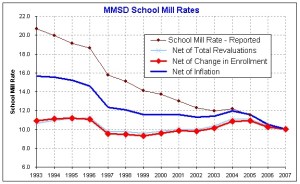
As the cost of running the district continues to rise, and as Madison homeowners and families find it increasingly difficult to make ends meet, it is easy to think that our property taxes are also ever rising. But that’s not the case, at least as regards the portion that goes toward our schools. Over the past 15 years, the schools’ portion of Madison property taxes has declined 6%, on average. The decrease is 9% if you adjust for today’s higher enrollment figures (1993 = 23,600; 2007 = 24,200). And it plunges to a 36% decrease if you adjust for inflation; (a dollar today is worth 30% less than it was 15 years ago).
The chart below, based on local funding of MMSD and data from the city assessor’s office, shows the recent history of school mill rates, the rate that is applied to your assessed property value to determine how much you contribute towards Madison schools (10 mills = 1.0% of the assessed property value). The reported rate has dropped from 20 mills to 10, but property values have doubled thanks to the general rise in home prices (termed “revaluations” by the assessor’s office), so the rate is more appropriately captured below by the “Net of Revaluations” line. That line is then adjusted for school enrollment (the red line), and inflation (the heavier blue line).
(click on image for pdf)
There are three important caveats to the above statements: 1.) school taxes are lower on average, but if your home has increased in value by more than about 110% since 1993, then you will be paying more for schools; 2.) it is the schools portion of property taxes that is lower on average; the remaining portion of property taxes that pays for the city, Dane County, Wisconsin, and MATC, has risen; 3.) other sources of Madison school funding (state and federal funds, and grants and fees) have also gone up; (I have not done the much more complicated calculation of real increase in funding there).
That the infamous schools’ portion of property taxes has declined over these past 15 years is quite a surprising result, and certainly counterintuitive to what one might expect. How is this possible? First, the school finance structure put in place by the state years ago has worked, at least as far as holding down property taxes. The current structure allows about a 2% increase in expense each year, consistent with the CPI (Consumer Price Index) at the state level. (In fact, local funding of the MMSD has increased from $150 million in 1993 to $209 million in 2007, equivalent to about a 2.4% increase each year.) Of course, the problem is that same structure allows for a 3.8% wage hike for teachers if districts wish to avoid arbitration, an aspect that has essentially set an effective floor on salary increases (with salaries & benefits representing 84% of the district budget). The difference between the revenue increases and the pay increases, about 1-2% annually, is why we face these annual painful budget quandaries that can only be met by cuts in school services, or by a referendum permitting higher school costs, and taxes.
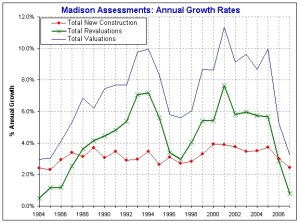
The second reason today’s property taxes are lower than they have been historically is growth, in the form of new construction (i.e. new homes & buildings, as well as remodelings). What we each pay in school property taxes is the result of a simple fraction: the numerator is the portion of school expenses that is paid through local property taxes, while the denominator is the tax base for the entire city (actually the portion of Madison and neighboring communities where kids live within the MMSD). The more the tax base grows, the larger the denominator, and the more people and places to share the property taxes with. Since 1993, new construction in Madison has consistently grown at about 3% per year. Indeed, since 1980 no year has ever seen new construction less than 2.3% nor more than 3.9%. So every year, your property taxes are reduced about 3% thanks to all the new construction in town. I leave it to the reader to speculate how much the pace of new construction and revaluations will decline if the schools here should decline in quality.
FYI, the figure below shows how new construction and revaluations have behaved in Madison since 1984, as well as total valuations (which is the sum of the two).
Contrast the excellent coverage of what’s at stake for the various referendums taking place this coming Tuesday by my colleague TJ Mertz, in the post immediately below this one, with what was reported yesterday in the Wisconsin State Journal regarding three local ones chosen for coverage.
Three area school districts are holding referendums Tuesday — two say it’s to avoid the presidential election hoopla and another wants to finalize its budget as soon as possible.
Deerfield, Mineral Point and Weston school districts are each asking to exceed the revenue limit in order to pay for everything from daily operating expenses to maintaining staffing levels.
This type of coverage reflects the difficulties Madison will face in it’s referendum in November, this breezy piece failed to mention one of the basic W’s of good journalism – “why.” Why are these districts forced to go to referendum? For the low information voter reading about about one of these referendums for their community for the first time, they may wonder, why haven’t these school boards learned to live within their means during these tight economic times? Legitimate question, but the piece doesn’t provide the answer – it’s a dysfunctional state school finance system. A sentence or two would have sufficed. Instead, the reader is left to draw their own conclusions. I’ve brought up this issue previously of troubling referendum coverage that ignores the “why” of the story, with another journalist from the State Journal who replied to my critique (ironically enough, part of his piece was on the last failed referendum in Weston). It’s a pity the editors at the Journal have missed another opportunity to explain this budgeting shortfall, for one of the most critical functions of our government, educating our children.
Do we really need any more evidence that the way Wisconsin funds schools doesn’t work? As Beth Sweeden exemplified so well in “I Just Want to Be A School Volunteer Again,” (her open letter to the Joint Finance Committee a year and a half ago), too many good people — educators, parents and others — are putting too much energy into trying to address the structural budget gaps the system creates, energy that could and should be spent working to help educate and improve our schools.
Today I am mostly going to write about the operating referenda not related to new capital projects to be held next Tuesday, September 9. I’ll get to the November 4 measures eventually.
That leaves seven operating referenda being voted on Tuesday.
Deerfield, after extensive community input and involvement, is asking for five year non-recurring authority to address structural operating revenue gaps in amounts ranging from $275,000 to $475,000 per year. I liked this from the Community Advisory Committee’s Final Report:
Ideally, some time in the next 5 years the Wisconsin State Legislature will come up with a more sane way of funding K-12 education than pitting schools against homeowners. (We can always hope…).
Another Madison neighbor, Mineral Point, has a five-year nonrecurring referendum on the ballot. The annual amounts escalate from $590,000 to $1 million. The district’s referendum documents are here. This is from the “Why a Referendum” document:
The Referendum Remedy
The revenue gap and the declining enrollment penalty are built into Wisconsin’s school funding formula. Together they ensure under funded schools. State law allows school districts to exceed the revenue limit, but only by conducting a referendum vote.
Preserving Quality Education
School quality means many things to many people and Mineral Point has high expectations for its schools.
Quality means good instruction in core academic classes and Mineral Point students out perform students statewide on nearly all measures.
Quality means providing opportunities in the fine arts, world languages, career and technical courses, health, PE, and extra and co-curricular activities.
Quality also means providing program variety so that students of varying interests and abilities can pursue a meaningful educational path.
Quality means being able to attract and retain quality staff members who are highly skilled, motivated and hard working. And that means competitive wages and benefits, ongoing training, the tools to work with and reasonable workloads.
The only path to maintaining quality education is via referenda. This has to change.
Montello will also vote on a nonrecurring operating referendum on September 9. After three failed referendums in the last year or so, they are only asking for two years at $950,000. Consolidation talks with Westfield continue and dissolution is very much on people’s minds. Administrator Jeff Holmes broached the topic back in July, now Board Member John Sheller is “scared to death” about the possibility. Here is a video report from WKOW-TV:
If the referendum fails, we may have another Florence or Wausaukee to deal with.
It is nice to see the Madison media cover this story. It would be better yet if they did more with the big story of how the way all districts are funded makes it extremely difficult to maintain quality education and they should place the pending Madison referendum in this larger context.
Neillsville had a failed referendum in 2006, now they are asking for a five-year non recurring authority in the amount of $300,000 a year. According to the district fact sheet, because of declining enrollments and rising property values passing the referendum will still result in property tax mill rates going down in the district. Video from WEAU on this one:
The small Rubicon Joint 6 district is trying for a three-year nonrecurring at $150,000 a year. In the recent past, they have eliminated World Languages and instructional aids, reduced Physical Education, Art, Music, Reading Specialists, Guidance, and Library services. They have prepared the following cut list for consideration in the event of a failed referendum:
Eliminate Cleaning (currently 50%)
Eliminate Guidance (currently 40%)
Eliminate Secretarial/Tech support (currently 80%)
Eliminate Writing tech (currently 20%)
Eliminate PE (currently 60%)
Eliminate Art (currently 25%)
Eliminate General Music (currently 25%)
Eliminate Instrumental Music (currently 25%)
Eliminate Instructional Aide (currently 50%)
Eliminate Forensics
Eliminate Student Council
Eliminate School Nurse
Eliminate Athletics
Eliminate Librarian (currently 20%)
Eliminate Library Aide (currently 80%)
Reduce Administrator 40%
No new text books
Minimal Support Staff Salary Increase
Increase student fees $20/child
Increase Athletic fee to $40 per child
Reduce tech upgrades to $1,000 per year
No additional middle school lockers (currently more students than lockers)
No new English text books
Reduce classroom supplies
Is there any doubt that these cuts would harm the education of the students?
The Salem School District voters will decide on a $1.16 million recurring referendum on Tuesday. In June a smaller four-year nonrecurring referendum failed by 34 votes out of 504 cast. Major cuts loom there too. Technical Education and Gifted and Talented may be eliminated, class sizes will increase up to 29 or 30, Chior and languages would be reduced, a total of 13 staff postions would likely be cut (see here, here and here for more details). Insanity.
Last, but not least is Weston. An April vote on a recurring referendum failed 395-364 (much more here). The new proposal is nonrecurring at $210,000 the first two years and $575,000 the last year. Like elswhere, the cuts have been going on for a long time and getting deeper each year. Republican State Senator Dale Schultz (a favorite on AMPS) was quoted on the referendum in Weston and a possible future referendum in Reedsburg:
“It’s just a dirty shame people have to put so much time and effort into another referendum,” Schultz said…
Schultz praised Weston administration and school board for doing all they could under the existing system.
“They have done an excellent job being fiscally responsible,” Schultz said. “I don’t know what more people could expect from a school district.”
Maybe he read Beth Swedeen’s letter. It sure sounds like it.
I wish all the districts well and hope they all pass. Check back after Tuesday for the results and updates on the November referenda in the weeks ahead.
Today, housing values are plummeting; unemployment is edging up…
The chart above shows housing value trends. After a drop in January, the general direction is up; by about $20,000 since the first of the year on both average and median. Sales have slowed and both the average and the median are down slightly in year-to-date measures, but one look at this chart and others reveal how unsupportable the verb “plummeting” is. There is a slight downward trend for August, but if you look at prior years there have been downward trends in August since at least 2005. According to the Dane County Real Estate Blog:
The Dane County market certainly needs to get better (especially the condo market), but once again the national numbers show that we’ve avoided the meltdown that is occurring in other parts of the country.
Blaska is even further from the truth on unemployment. According to the Department of Workforce Development’s latest report unemployment in Madison dropped 0.3% in July, is the same as it was one year ago, is the lowest rate of any Wisconsin Metro area, is 1.2% below the state rate (unadjusted) and 2.4% below the national rate (unadjusted). Sorry Dave, going down, not up and doing very well in comparisons.
Better luck next time you decide to pull “facts” out of thin air.
One reason Madison continues to attract jobs and homebuyers is the quality of our public schools. Keep our community strong and prosperous, Vote Yes for Schools!
“Educate in order that your children may be free.”
Irish Proverb often quoted by Margaret Haley.
“Only through the freedom of their teachers could the children remain free.”
Margaret Haley, ca 1899.
Margaret Haley is one of my heroes. She was a woman of great ideals who acted on these ideals and accomplished much. She began as an underpaid elementary school classroom teacher, with no job security and subject to the whims of her supervisors. To win protections, security and respect for the mostly female elementary school teachers, she organized the Chicago Teachers Federation (CTF). She led the affiliation of the CTF with the Chicago Federation of Labor and fully participated in the radical world of turn-of-the-century labor politics in that city. She was the first woman to speak at a National Education Association meeting where her 1904 talk “Why Teachers Should Organize” scandalized the conservative, professor-and-administrator-dominated organization. She helped secure the passage of Illinois’ Woman’s School Suffrage law, which like those in about 30 other states and territories granted women limited suffrage and office-holding rights for school related elections and posts. She was a fighter; her autobiography is titled Battleground and she was dubbed a “lady labor slugger.” You can see why she is one of my heroes.
Perhaps her finest hour was the 1900 “tax fight.” When the Board of Education pled poverty and failed to pay hard-fought-for raises to the teachers in the CTF. In order to remedy the situation, Haley led a team that researched and then sued to secure back taxes totaling over $600,000 from major utility and street car companies; money that the politicians were not interested in collecting. This was more than enough to pay for the raises. At about the same time she exposed sweetheart and (tax free) lease arrangements of School District property with major Chicago businesses, including the Chicago Tribune. The courts refused to find wrong in the Tribune case, but Haley had many successes fighting for education against corporate power and the politicians who protected that power.
Check out the LaborFest (1602 S. Park, 12:00-5:30), great atmosphere, great music, good food, cold beer, fun for the kids. I’ll be there, both to celebrate with my family and friends and to promote the November MMSD referendum with CAST. Come and raise a glass to Margaret Haley and others worth honoring.
I’ve been so tied up with life and the referendum stuff that I haven’t been much paying attention to the city budget process. A story in today’s Wisconsin State Journal got my attention, this graphic in particular. Two items on the possible cut list will directly impact the school district budget and at least three more will make things harder for our schools to do their job.
These possible cuts have been identified early in the budget process. Mayor Cieslewicz asked all departments to list what they would propose in the way of a 5% budget cut. If things go as the Mayor envisions, about 37% of these cuts will need to be enacted. Nothing is set in stone at this point. The Mayor will propose his budget in October and the Common Council will act in November.
The two proposed cuts that will force the school district to find more money to makeup the shortfall are a proposal to require the district to pay $522,000 for crossing guards and a proposal to increase bus fares, including pass programs. MMSD spent about $800,000 on Madison Metro bus pass subsidies last year. The proposed 33% fare increase translates into another $264,000 (or a shift to students and families). These two items add up to $786,000.
To me , that’s 786,000 more reasons not to do a referendum on the cheap. If the November referendum passes, we aren’t going to get a second shot at asking for more operational revenue authority in the foreseeable future. No matter what else happens to create new needs — like the city budget — there will be no second chances. We need to do more than loosen the bonds that have tied the district’s hands, we need to take the ropes all the way off (more on those thoughts here).
The other cuts are in the areas of library hours and social services and childcare tuition aid.
Since we have lived in Madison I have considered the limited library hours a source of shame. Cutting further, or closing a branch will harm both the educational climate and the quality of life.
We all know that children, especially those in poverty, come to school carrying the baggage of their home lives and that the kinds of things that social service help with are the kinds of things that if not addressed make it harder for students to be successful and create behavioral problems which effect the school climate and hurt all students. The “Broader, Bolder” manifesto correctly stated, we need to recognize “the powerful impact on student achievement of numerous contextual and environmental factors such as early learning, parenting, health, poverty, and the cognitive, cultural, and character development that occurs outside schools” and address this via the very same types of social services now on the chopping block.
Last, but far from least is $106,000 cut in the the childcare tuition aid. Childcare is not education, but they can be mutually supportive. Childcare also relieves some of the stress of working and single parents, creating a home environment more conducive to learning. The worst case scenarios, which will no doubt be manifested in some households, are that the cuts in childcare tuition aid will leave some children without guidance or protection for significant time periods and/or increase the childcare responsibilities older siblings, distracting them from their academic work. Not good.
I believe that Mayor Dave is sincere in his desire to build mutually supportive structures and relationships among the school district, the city and the county. All of these cuts would move us further from that goal.
The first round of hearings has passed, but you can contact the Mayor and the Common Council to remind them that supporting education in all ways is essential keeping Madison a great city. Don’t forget to mention that the city has a much freer hand with taxing authority than the revenue-capped school district.
[There are three parts to this post: A news roundup, an explanation and analysis of the administrative proposal and my thoughts on why the first year of the referendum should be $6 million instead of the $5 million proposed. Although they are intertwined, the bulk of each part is presented in the order listed. — TJM]
Some clarifications on this report. Marjorie Passman is incorrectly identified as Lucy Mathiak. The “list of potential cuts” mentioned is very, very, very initial. It is a first effort to identify general areas that may be discussed for cuts. I heard more than one Board member grumble about what was in the list. Board President Arlene Silviera has promised to schedule a discussion of this list and potential cuts in general at a future date. I suggest all hold off on critiquing or complaining till that discussion takes place. We all know that $6 million to $8 million in cuts would be painful. For now, let’s just use our imagination as to where this pain would be experienced.
Some clarifications on this report. First the use of $2 million from the Fund Balance in the first year is based on an estimated $4 million growth in the Fund Balance as the 2007-08 year is closed out (more below). The “other” $2 million from the Community Services Fund (Fund 80) Fund Balance as part of the plan to minimize the tax impact, is actually a plan to decrease the Fund 80 levy by that in amount in 2009-10 and use excess money previously collected instead to fund on going Fund 80 programing.
That said, Madsen has a quote from Superintendent Dan Nerad worth citing:
We’re about two things here: one is ensuring that the needs of our kids are met to be educated well and the other is to be sensitive to taxpayers going forward.
And Hall quotes Marj Passman with a sobering reminder of what this is about:
[W]e’re desperate and we need this passed and even if it is passed we’re not adding anything back.
Supt. Nerad is calling this a partnership. So what’s the partnership and what’s the plan? The partnership is an addendum to the deal that was struck long ago when public education was established. At that time and since, our society has entrusted our children, our tax dollars and our futures to public schools with the understanding that the schools with the help of community members will educate the rising generation, create a society based on opportunity for all and be good stewards of the public funds provided for this most important work. While asking the voters for more funds via a referendum, Supt. Nerad demonstrates good faith and worthiness in two ways. First, the request is substantially less than is needed for “cost-to-continue” budgeting and there is a promise to meet these shortfalls by finding new ways to do things without sacrificing (and maybe improving) the quality of education. Second (but not unrelated), Supt. Nerad and Assistant Supt. Erik Kass have sought and found ways to minimize the impact of exceeding the revenue caps on local property tax payers. In other words, the addendum might read: “In exchange for a small increase in our revenue authority — less than 1.5% — we promise to use this increase responsibly to educate while doing our best to minimize the burden placed on local property taxpayers.”
This sounds like a pretty fair deal. I think it would be a better deal for our community if we upped the “small increase in our revenue authority” a bit.
I want to go through the details of the plan and my thoughts in three parts. First, what is (and is not) proposed for the referendum, then the ways that the costs to property taxpayers will be mitigated. Finally some words on why I think that the district should ask for more money in the first year. There will be some overlap.
The (Proposed) Referendum.
Three year, recurring.
$5 Million year one (projected gap, $8.11 million).
$4 million year two (projected gap, $4.37 million).
$4 million year three (projected gap, $4.26 million).
Recurring means that it is cumulative. The authority to exceed the revenue cap the second year will be $9 million and the third year and beyond $13 million. The advantages of a recurring referendum are two-fold: It allows for better long-term planning and it minimizes the gap and probable cuts to meet that gap in subsequent years. The disadvantage is that recurring referenda are more easily demagogued. I’m not sure why this is so, except that the words “Permanent Tax Increase” carry some emotional weight. Of course the same people who use this appeal complain about the lack of long-range planning. Consistency is rarely the strong suit of the complaining classes.
What isn’t proposed is preserving everything the way it is now. There will be cuts or reorganizations or reallocations each of the three years. They won’t be huge, they probably won’t be too divisive, but they will happen each year.
I value the fresh perspective and approaches Dan Nerad has brought. I am glad that there will be comprehensive strategic planning and that new ways of doing things will be implemented. I understand that this is being connected to asking for less than the gaps in the referendum and that is a legitimate connection.
I don’t think asking for this much less than the gaps is for the best. I think that in order for our children to realize the full benefit of contributions of the new administration we should authorize resources at least equal to a cost-to-continue budget. I’m not advocating keeping things as they are; I’m advocating reforms without cuts. I’m advocating $6 million for the first year (because of the recurring formulation, this also funds the subsequent years). This money can be used to do things like restore Ready-Set-Goals, revitalize the equity work of the district, expand funding of supplemental positions via something like the equity resource formula, fix some of the problems with class size and specials, initiate world languages in the early grades…and most importantly implement initiatives identified through the strategic planning processwith less pressure to defund existing programs.
I think that as a community we can afford this. That brings me to the tax impact parts of the plan.
Mitigating the Property Tax Impact
As presented by Dan Nerad and Erik Kass, the tax impact mitigation plans have little directly to do with the referendum itself. It is likely that most of these would be implemented even if there was no referendum. However, they are indirectly related in two ways. First, they are a demonstration of the partnership principles that Supt. Nerad has articulated; second, in very real ways they make a referendum more affordable to the local taxpayers. I want to start this part of my consideration with a some charts from the administration’s presentation.
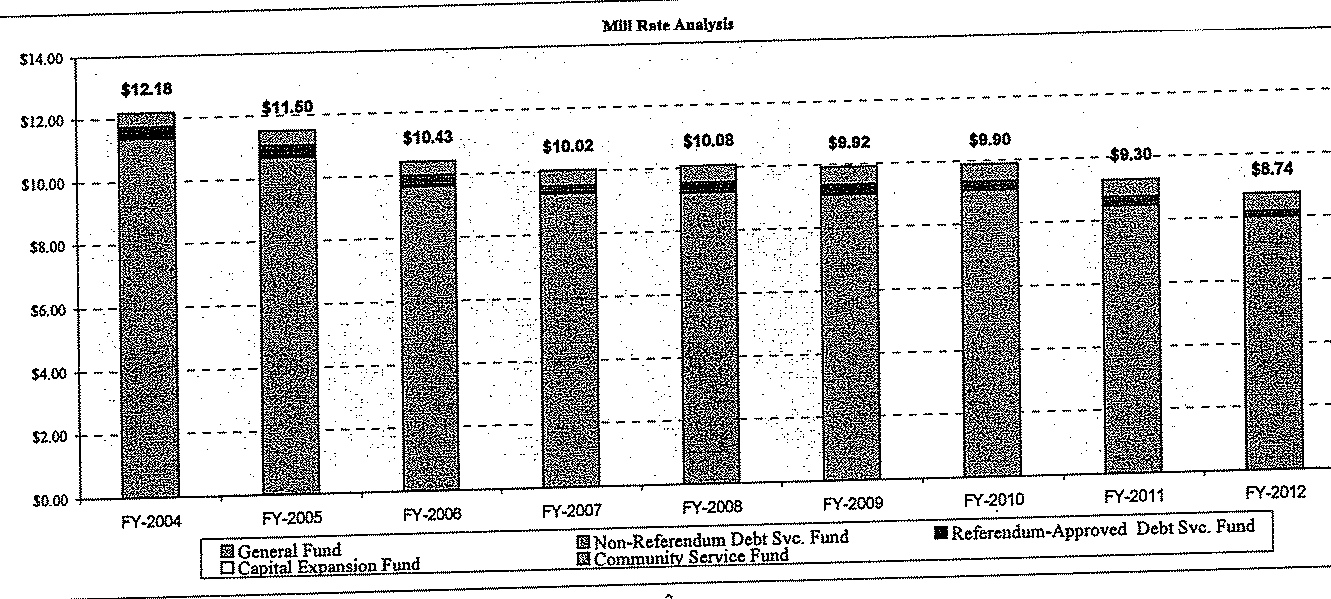
Mill Rate History and Projections without a Referendum
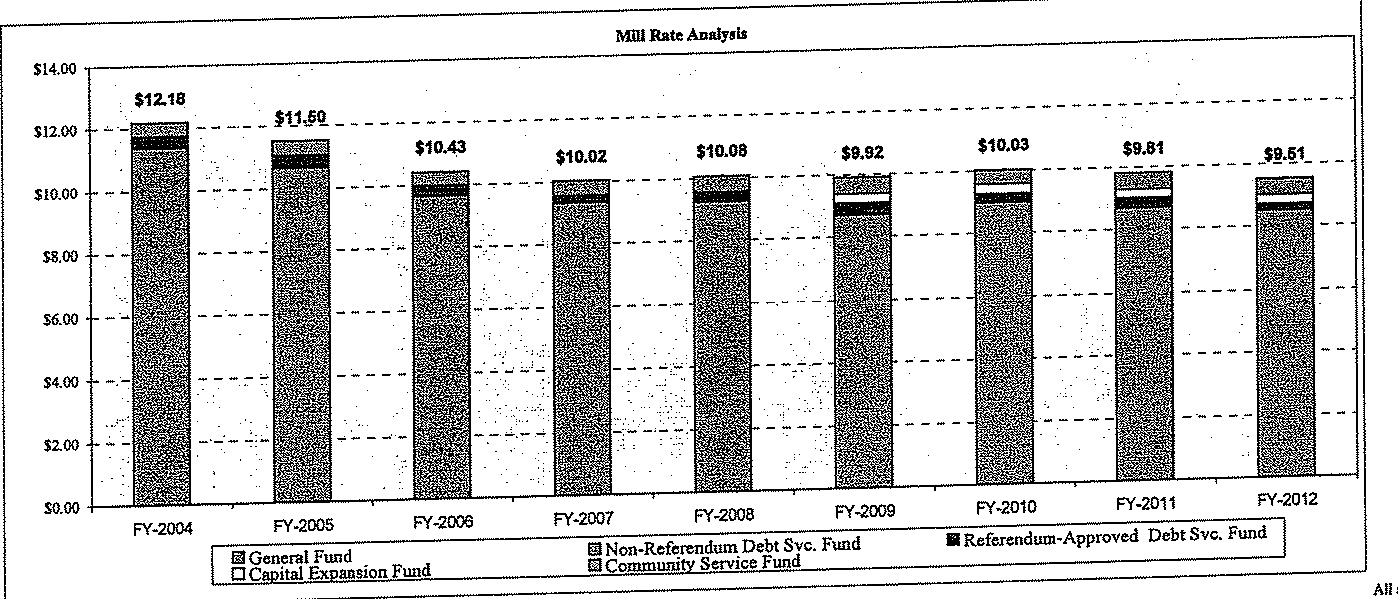
Mill Rate History and Projections With A Referendum, Other Administrative Proposals and Renewal of Maintenance Referendum.
Mill Rate History and Projections with A Referendum, Other Administrative Proposals and Renewal of Maintenance Referendum
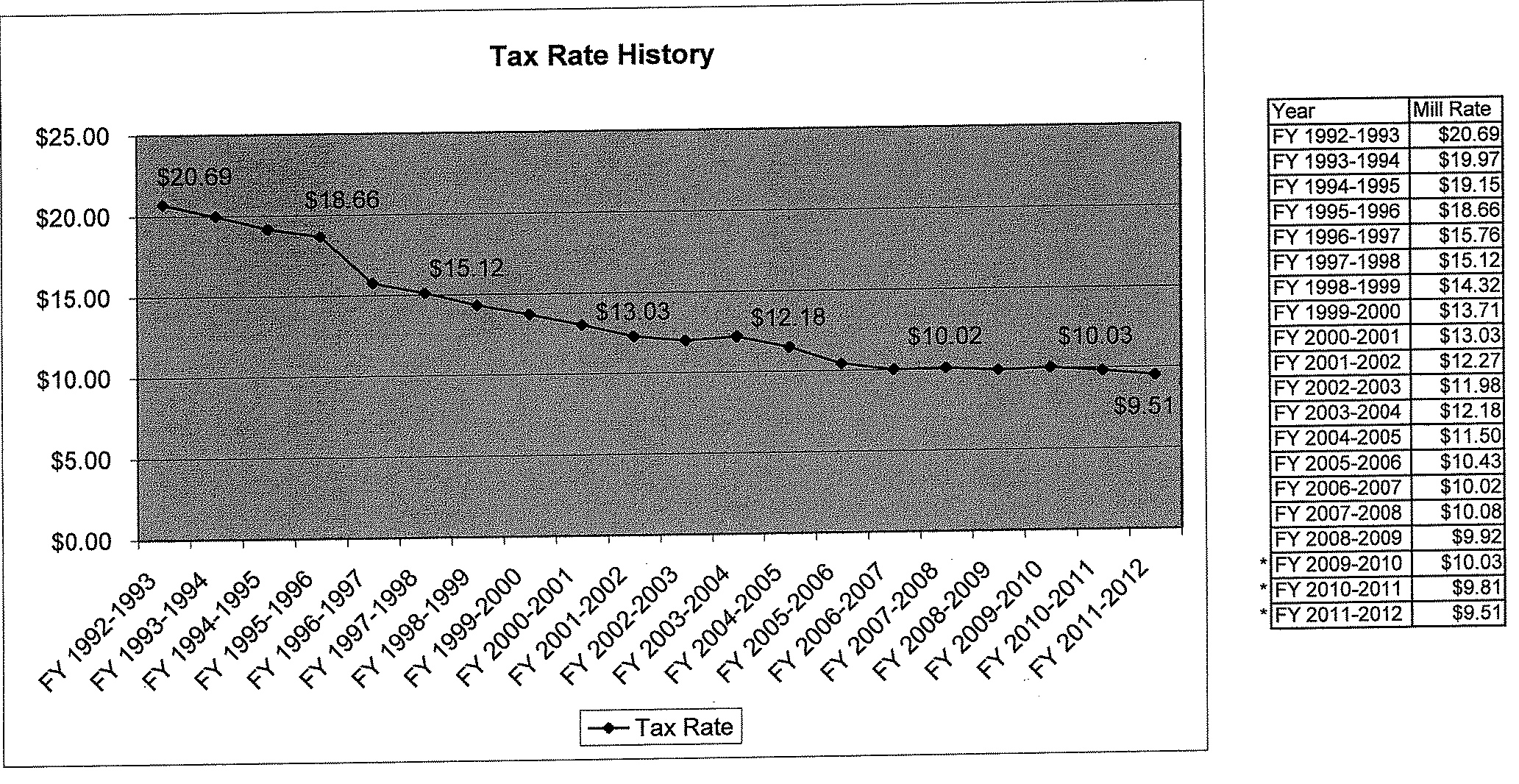
The first chart is the status quo. If there is no referendum and nothing else changes mill rates (taxes per $1,000 of property value) will resume their significant downward trend. With the exception of a very slight up-tick in 2007-8, the school mill rate has fallen steadily since 1992-3. For 2008-9, it is less than one half of what it was in 1992-3!
If there is a referendum and the proposed changes are enacted, the downward trend will also continue with the exception of another slight up-tick for 2009-10 (charts 2 and 3). The calculations I’ve seen say that for $250,000 home taxes will drop about $27.50 from the current rate in the second year and about $100.00 in the third.
This will be accomplished in four ways. First, by not seeking revenues to the amount of the projected gaps. Second, by slowing the rate of growth of the operating Fund Balance (Fund 10) and using some of the Community Service (Fund 80) Fund Balance to lower that levy without cutting programs. Third by moving money to a Capital Expansion Fund (Fund 41) which shifts the responsibility for some revenue from local taxpayers to the state (I’ll offer a more complete explanation at a later date). All of these are fiscally sound practices. The last piece is a conservative projection of 4% annual growth in the total value of property in the district.
Mitigate and Do the Right thing
I fully support all of these ideas for mitigating the tax impact, including not seeking the full gap amount. Where I differ is that I think we should seek closer to the gap and ask for $6 million in the first year. Our schools and our children are worth it.
The projections for what this will cost get very complicated. If my calculations are correct adding $1 million to the first year would produce the following mill rates:
Year 1: 13.24
Year 2: 11.54
Year 3: 10.68
The highest of these puts about where we were in 1999, when the revenue caps had been wrecking their damage for four years. By year three, mill rates would be back at 2005 levels.
I haven’t had a chance to project the tax impact on a $250,000 home for all three years (too many variables), but my initial calculation is that in the first “worst” year it would be $36.30, or about $9.00 more than what the administration proposed. For something as important as education, I think we can afford that much.
I want to leave numbers aside and talk about three things that I observed and heard today while registering my son for first grade. They are minor and they are indicative of what happens when we neglect our schools, or try to do things on the cheap.
On the entrance to the playground there is a ramp with concrete walls on either side. On one side the wall has crumbled and rebar is sticking out. The rebar is covered by empty plastic soda bottles taped on.
While on the playground, I spoke with the custodian. We talked about lots of things. My spouse asked if wood chips had been ordered (they are badly needed). He said they had, but the amount sent in the last few years has not been sufficient for all the surfaces that need covering.
We also spoke about snow removal. Apparently due to budget cuts, there are no longer removal crews assigned to specific schools (in all cases). Each snowfall brings different crews. Before this was the case, there was good communication about the particular characteristics of this school site and the crew knew where to plow and where not to, where to pile snow and where not to. Now it is random and the school custodians spend time each snowfall taking care of what was not done correctly.
A crumbling wall with dangerous metal protruding, a short load of wood chips and not staffing consistently aren’t huge things. Still they are things we should be able to afford to do right. I know we can’t afford them or many other things. I know we still have some Windows 98 computers in our schools.
What does this say about us that we haven’t cared enough to demand that this situation be fixed? What does it say about us that our school officials think that in order to get us to pass a referendum they need promise further cuts?
I’m not sure that the referendum as proposed will change any of this. It may help with some of these. It will keep things from getting (much) worse and that is very important.
I truly believe that quality public education is what creates and preserves prosperous and enjoyable communities; that public schools are the best tool we have for creating opportunities and overcoming inequality; that if we want the next generations to live in a better world our schools are the best tool we have for making that happen.
(If this passes) There won’t be another operating referendum for some time (maybe never if the state finance system gets fixed). Let’s do it right this time.
One more million in the first year and loads of possibilities open up. We can dream a little again. Wouldn’t that be great?
I’ll be working hard in support of a referendum as proposed by the administration (find out how to help by visiting Community and Schools Together), but I’d have a bigger smile on my face as I worked if the Board and the administration would askfor some more opportunities to dream.
Share your thoughts in the comments here and let the Board know what you think. Come to the Board meeting Monday, August 25 (last I heard, there will be public testimony) or write: comments@madison.k12.wi.us.
Thomas J. Mertz
[Slightly revised, 11:50 AM and 12:48 PM, 8/22/08]






 AMPS
AMPS 