Category Archives: Uncategorized

October 7, Rally to Defend Public Education

Thursday, October 7 · 12:30pm – 1:30pm in Library Mall on the UW Campus there will be a rally to defend public education.  This is part of a national effort to combat reduced governmental investments in education at all levels, from pre-kindergarten through grad school.

As the press release says:

Rally organizers call for making public education a top funding priority in Wisconsin, so that every child has access to a high-quality public education from kindergarten through college. Since an educated population spurs the economy and benefits all state residents, they also call for reforming the tax system so that everyone pays their fair share, including the wealthy and large corporations operating in Wisconsin. Increasing access to higher education for underrepresented groups and ensuring fair and competitive pay for academic workers are also top priorities.

Here is the list of speakers:

  • Ben Manski, Coordinator, Democratizing Education Network
  • Mike Bell, UW-Madison faculty member (Sociology)
  • Thomas J. Mertz, Board Member, Wisconsin Alliance for Excellent Schools
  • Mindy Preston, UW-Madison undergraduate student (Computer Sciences; Classical Humanities)
  • Kevin Gibbons, UW-Madison graduate student (Environmental Studies); Co-President of the Teaching  Assistants’    Association
  • Elizabeth Wrigley-Field, UW-Madison graduate student (Sociology); member of the International  Socialist   Organization
  • Mark Thomas, Steward, AFSCME Local #171

I’ll be speaking on K-12 and pushing Penny for Kids.  I could use some help collecting signatures on the Penny petition.  Contact me if you are willing and able.

Strong public education is the best means we have of moving toward a better future.  Join us to make sure that message comes through loud and clear.

Thomas J. Mertz

Leave a comment

Filed under "education finance", Budget, education, finance, Local News, National News, Pennies for Kids, School Finance, Take Action, Uncategorized

Housing, Homelessness and Education

Video of the People’s Affordable Housing Vision Press Conference, 10/4/2010.

Yesterday the People’s Affordable Vision proposals were introduced at the above press conference.  There is much more on Forward Lookout, here and here.  These are all good and important proposals.

Also yesterday, I was made aware of the work a couple of friends of mine are undertaking to improve conditions and opportunities for homeless students.  I’ll be posting more about this work as it develops.

The Madison Metropolitan School District’s Transition Education Program (TEP) has been called  “outstanding” and has won at least one award.   We should be proud of the work  our district does, but I’m not sure we can ever do enough in seeking to help students who are homeless.    I have heard that there are currently about 400 homeless students served by the MMSD TEP program.  I’d guess that there are many more who’s housing is less than secure.

Each year the FDA publishes data on “Food Insecurity.”  It should surprise no one and shame all that Food Insecurity is rising, especially among the young.  Food Insecurity is linked to the poverty based achievement gap, directly via health issues and malnutrition, and indirectly because children who don’t know if their school lunch will be their only meal have more to worry about than diagramming sentences or memorizing math facts.

I don’t think there is a national “Housing Insecurity” index, although the Wisconsin Council on Children and Families does a great job tracking many statistics on the well-being of children and advocating for policies that will help (check their Vote for Kids campaign).  They report that

• In 2008, 16,241 people, including 4,744 children, used
emergency shelter in Wisconsin homeless shelters.
• For the 2007/2008 school year, 9,331 homeless students
were served by Wisconsin public schools.

And observe:

Stable housing plays a crucial role in children’s well-being. Kids who grow up in unstable housing situations tend to do worse in school, have more behavioral problems, and suffer poorer health than their peers.

When talking about services to the homeless or housing programs we often use the term “safety net.”  When thinking about homeless children I think it needs to be a safety blanket, because  some might slip through a net.

Sign on in support of the People’s Housing Vision (petition site), Vote for Kids and stay tuned for ways to get involved with,  ideas, programs and policies to  improve the lives and opportunities of homeless kids.

Thomas J. Mertz

5 Comments

Filed under Best Practices, education, Equity, Local News, Take Action, Uncategorized

“Political Dynamite”= School Funding

From MPTV’s Fourth Street Forum.

[Original Airdate: October 1, 2010] POLITICAL DYNAMITE: PAYING FOR WISCONSIN’S SCHOOLS Wisconsin has a crisis when it comes to paying for schools. The fallout hurts children, teachers and our future. 4th Street Forum explores school tax fairness and high quality education. With Host DENISE CALLAWAY, Director of Communications, Greater Milwaukee Foundation and with guests, in order of appearance, TONY EVERS, PhD, Wisconsin State Superintendent of Public Instruction; WILLIE HINES, Milwaukee Common Council President; ANNELIESE DICKMAN, JD, Research Director, Public Policy Forum and WILLIAM HUGHES, PhD, Greendale Superintendent of Schools.

Penny for Kids?  Penny for Kids!

Thomas J. Mertz

Leave a comment

Filed under "education finance", Budget, education, finance, Local News, Pennies for Kids, School Finance, Uncategorized

On the Agenda: MMSD Board of Education, the week of September 27, 2010

Note: For a while, I’m going to be illustrating the “On the Agenda” posts with various graphs documenting achievement gaps in MMSD as revealed by the admittedly flawed and limited WSAS/WKCE results. I think regular reminders may do some good.

For the Madison Metropolitan School District Board of Education and related bodies, hree meetings on Monday this week, one on Tuesday.

The Four-Year-Old Kindergarten Advisory Council continues their work at 9:00 on Monday, at the 4C offices.

The new Board Ad-Hoc Committee on Equity and Decision-Making will hold their first meeting at 5:00 PM in the Doyle Bldg, Rm 103.  The agenda revolves around committee goals.  There will be public appearances and if you have concerns about equity related things, I’d suggest getting their attention near the start of their work.  These could include anything from staffing, to class-size, to achievement gaps, to budgets, to curricula, to… for an idea of what the scope of this committee includes, check the Equity Policy and the work of Equity Task Force (as well as the Equity Report from earlier this year).

One new thing before the Committee is an update on equity work.  This partially updates the appendices of the rejected March version of the report, which linked district initiatives to portions of the Strategic Plan and Equity Task Force recommendations.   I thought this was the best part of the March version, but it didn’t make it into the final.  Good to see it back.

What isn’t good is how much remains to be done.

This will be followed by the full Board meeting at 6:00 PM in the Doyle Bdg Auditorium.  There are public appearances scheduled and it can be assumed that both this meeting and the Equity meeting will be carried on MMSD-TV.  A note to people not familiar with Board procedures, all public testimony is at the start of the meeting and you have to register by the time they begin.

I’m not going to do the whole agenda this week, but just hit the highlights in approximate order of interest.

The biggest item for most is the recommendation on the extension of TID 32 to fund the Edgewater project.  Board Members Ed Hughes and Lucy Mathiak have both posted on this, and I put something on Forward LookoutSome time ago I laid out why I thought this was a bad idea and in their memo to the Board the administration agrees with that conclusion (if not all the particulars), saying the extension will have a ““significant negative effect…upon our district.”   Following  their own paths, Hughes and Mathiak come to the same conclusion.

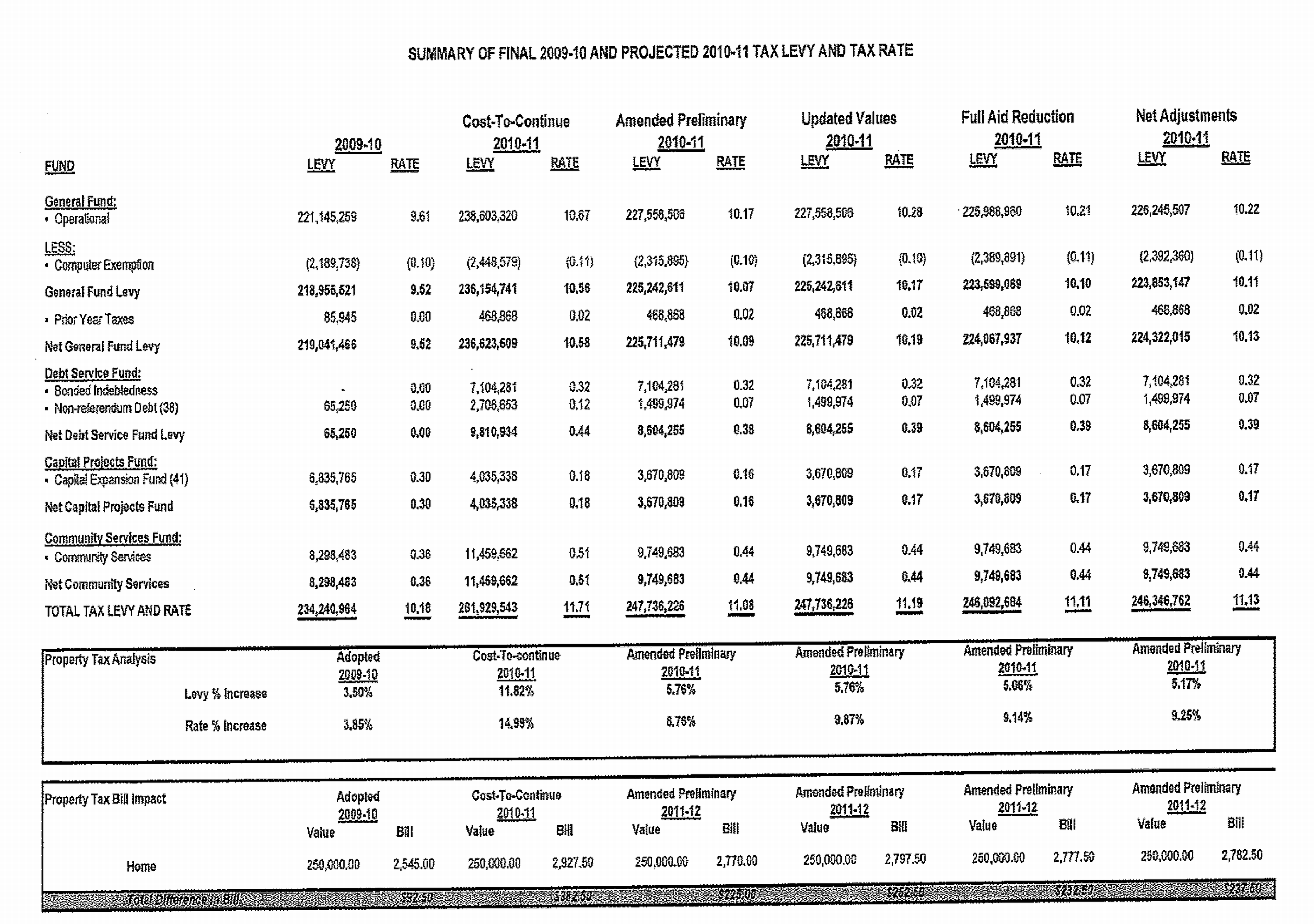
I’d put the Budget Update at the top of my personal list of agenda items.  Bad news and good news with a net bad news of a larger increase in the mil rate (from 11.08 to 11.13) and slightly bigger hit to property owners likely (Penny for Kids would help!)

Among the news here is anticipated decrease of $442,501 in state Special Education Categorical aids, and an anticipated increase of $1,569, 546 in state equalization aid from the amounts budgeted in the Spring.  Unfortunately the increase in equalization is related to a decrease in property values, meaning that although the total levy will be smaller, the base for that levy is smaller also and the increased equalization only partially covers the difference (Penny for Kids is needed!).  There are lots of moving pieces locally — including property values in the district — and statewide that contribute to these adjustments.  One of the biggest pieces is the “Third Friday” student count certification.  If we are lucky, that number will be previewed at the meeting Monday.  None of this is final till the end of October when the tax levy is passed.

On a related and positive note, the district did save $185,954 in short term borrowing costs.

These are combined here in a projected tax levy scenarios I think the last is the most likely.

I don’t like the $250,00 “average home” calculations, but the levy increase expressed in that way is $237.50, or $12.50 more than projected in the Spring ((Penny for Kids! Now more than ever).

And then there is the fund balance.  It increased  by $5.1 million in 2009-10.   MMSD needs to have an open and thorough discussion of fund balance policies and practices (I’ve said this before).  In the last three years the fund balance has increased by about $20 million, almost doubling.  This is good and bad, but what is all bad is that it has happened without the Board directly addressing the choices being made.   This money was collected to educate the children of our district and we (the people it was collected from) deserve to know if building equity at this level is the way it can best be used in the service of education.

Last in the update is “Budget Tracking Table” with big and unexplained changes in the ARRA lines (these may be covered in this previous ARRA update.  Nothing on the EduJobs money (my guess is that it will be used for 2011-12 in MMSD).

Next in order of import is the Revised Code of Conduct.   It looks like this might finally get done.  I haven’t followed all the details, but I do like the Phoenix/Abeyance model as an alternative to expulsions.

It is kind of insider stuff, but I find the the evolution of the Superintendent’/Board of Education  Communication Plan fascinating.  This is a new iteration and with each version it seems to get more detailed and more exacting.  I applaud the effort to clarify roles and expectations, but find it disconcerting that all concerned feel it needs to be spelled out this thoroughly.  To me that indicates trust, faith and yes “communication” are not where they should be.  Maybe I’m reading too much into this; maybe I’m just more comfortable with improvisational give-and-take.

Last item I’m going to cover (and the last item on the agenda) is the Legislative Liaison Report.  Three things here.

First is the recent Resolution passed by the Dane County Board calling for school finance reform (press release here).   This got some nice coverage from Neil Heinen on Channel 3000, in the Sun Prairie Star and maybe elsewhere.  I worked on this with Supervisor Melissa Sargent and want to give a big thank you to her and the other Supervisors and the Board of Education and community members who supported the Resolution.  Look for more Resolutions of this sort around the state in the coming months.  As Neil Heinen said “Thanks to the Dane County Board, the voice for school funding reform just got louder.”

Next is Superintendent Tony Evers State of Education address.  The big news here is no news on the Fair Funding Framework.  For logistical and other reasons, there will be no further details till after the November elections.  I’ll leave the “other” alone and note that there will be updated numbers to work with after October 15 aid certifications and the logistical reasons have legitimacy.

Last is a Penny for Kids update.  Not 100% sure what this will be, but I will take this opportunity to put on my Wisconsin Alliance for Excellent Schools Board member hat and thank MMSD for actively supporting this campaign.

Much more on this agenda, technology purchases, big donations, contracts, Board/Common Council Liaison meeting …check for yourself to see what I missed.

One more meeting.   Ad-Hoc Hiring and Diversity on Tuesday, noon, at JC Wright Middle School.  Another goal setting agenda and no linked documents.  For some background see this report from September 2009.   Staff diversity at all levels remains an issue.  I hope that those working and agitating on minority  teacher matters realize that this is a national problem and that long term solutions involving improving minority education, higher education opportunities, early recruitment into education fields and supports to achieve professional status are where the real solutions to teaching staff diversity lay.  The district’s efforts can and should be improved in the short term (and not just with teachers, the clerical staff numbers are a disgrace), but only very limited improvements should be expected in the diversity of MMSD teaching staff.

Thomas J. Mertz

2 Comments

Filed under "education finance", Accountability, Budget, education, Equity, finance, Local News, Pennies for Kids, School Finance, Uncategorized

Updated — (Not) On the Agenda — MMSD Board of Education the Week of September 20th, 2010

Note: For a while, I’m going to be illustrating the “On the Agenda” posts with various graphs documenting achievement gaps in MMSD as revealed by the admittedly flawed and limited WSAS/WKCE results. I think regular reminders may do some good.

Update: The Equity and Decision Making meeting has been canceled due to overlapping membership schedule conflicts and the weekly agenda has been posted (as of now — 12:54 pm — the agenda does not reflect the cancellation).

As of this writing, no agendas have been posted linked to the Madison Metropolitan School District Board of Education web page.  However, the Board Calendar shows three meetings today:

Special BOE Meeting-Closed, Start: Sep 20 2010 5:00 pm,  Doyle Administration Building, 545 W. Dayton St.,Room 103

Ad Hoc BOE Meeting-Five Year Budget Plan, Start: Sep 20 2010 6:30 pm, Doyle Administration Building, 545 W. Dayton St., Room 103

Ad Hoc BOE Meeting-Equity and Decision Making, Start: Sep 20 2010 6:30 pm, Doyle Administration Building, 545 W. Dayton St., Room 100A.

I’m assuming that the closed meeting is a continuation of the Superintendent Evaluation.

The other two are part of of the new Committee structure (Ed Hughes posted on this topic).

As with so much involving MMSD these days, I’m taking a wait and see attitude.  I will say that I am glad to see equity given attention and linked to decision making (doesn’t equity-driven decision making sound like a better idea than “data-driven” decision making).

Thomas J. Mertz

Leave a comment

Filed under Best Practices, Budget, education, Equity, Local News, Uncategorized

On the Agenda: MMSD Board of Education, the Week of August 30, 2010

Note: For a while, I’m going to be illustrating the “On the Agenda” posts with various graphs documenting achievement gaps in MMSD as revealed by the admittedly flawed and limited WSAS/WKCE results. I think regular reminders may do some good.

Time for the Metropolitan School District Board of Education to get down to some serious work.  Past time.

I had high hopes that this would be a productive Summer for improving education and the governance of education in MMSD, but with 1/3 of their term complete this Board hasn’t given the public much to see.  I phrased that carefully because the one thing they have been working on is the Superintendent evaluation and all that has taken place behind closed doors, so the public hasn’t seen anything (yet, I hope).  More on the Superintendent evaluation below.

Two meetings this week; one open to the public and the other another closed session on the Superintendent evaluation.  The open meeting is 5:00 Monday, August 30 at the Lowell Center, 610 Langdon Street, Madison, WI, Room 118.   Note that this location means that there will be no broadcast or video record of the meeting via MMSD-TV.  The closed meeting is Tuesday at 5:00,  Room 103 or the Doyle Building.

The open meeting is billed as a “Workshop,” so no public testimony invited.

The first item is the approval of numerous minutes of previous meetings: October 23, October 26, 2009; February 22, March 15, April 5, May 10, June 1, June 21, June 23, and June 28, 2010.

Next comes:

Standing Committees of the School Board: Review of experience to date under the standing committee structure established by Board Policy 1031 and appointment of standing committee chairs and discuss various options.

The current structure — described in the linked policy —  was put in place at the request of Superintendent Dan Nerad.

This and other items on the agenda closely resemble the items on  the June 21 Workshop meeting.  That meeting was about goal setting for the year and also included a discussion of committee structure.

I attended that meeting, but lost my  notes in a hard drive failure.  My memory is that some progress was made on setting goals, but there was much work left to do.  My memory on the committee structure issue was that 5 of the 6 members with experience under the current structure desired changes, that there was interest in aligning the committees with the non-existent goals and that nothing was decided.

All this has been hanging there since June 21.  Without goals and a committees, the Summer has largely been wasted.

The next couple of items are also about Board duties and schedules:

3.Designating appointments/representatives and review of time commitments, expectations, roles/responsibilities in connection with:

a) The School Board Member liaisons to MMSD
schools/programs under Board Policy 1041;
b) School Board Member liaisons to community groups
implementing specific MMSD-supported initiatives; and
c) MMSD Board/School representation to various
organizations, associations, boards, committees, etc. as
described under Board Policy 1041

4.School Board and Board Committee meeting schedule and meeting structure through the first semester of the 2010-2011 school term, including identifying potential needs for public input/listening sessions, any ad hoc committees, etc.

I’m not clear on what all these committees, programs, organizations…are, or whether any of this is new (I like the idea of new, semi-formal relationships with community organizations).

As to the schedule (#4), there is only one subsequent meeting currently scheduled;  a September 13, Special Board meeting.

After these they will consider revisions of the ethics policy.  There was a draft circulated at some meeting and I have it on file (I may try to dig it up and scan), but having seen it I’m not at all clear what they are trying to accomplish or why this has become a priority.

Last up,  is  “Next Steps for Future Board Development Meetings and Topics.’  Board development is good and important, but with only 2/3 of the term left I hate to see too much time and energy devoted to Board Development.

I keep coming back to this.  Every year about 1/3 of the time and energy is devoted to budget matters, that leaves 2/3 to try to make things better.   Put it another way; it is September, budget season starts in January.  Past time to get to work.

This just leaves the closed meeting on the Superintendent evaluation.  Not much to add to what I wrote here.  My big point is that almost all of  this process should be public.  I will repost the links to things that are public:

Superintendent Goals from MMSD Board of Education Progress Report – January, 2010.

Process for Evaluation from July 20, 2009.

Revised Process for Evaluation, August 17, 2009.

Minutes of meetings where this was discussed:  November 28, 2009September 21, 2009; September 14, 2009.

That’s all folks…

Thomas J.  Mertz

3 Comments

Filed under Accountability, Best Practices, Budget, education, Uncategorized

The problems with merit pay and testing

Value added measures used for merit pay and teacher pay, sounds fair, but the reality can be quite different. In this video by Prof. Daniel Willingham, he describes six problems (some conceptual, some statistical) with evaluating teachers by comparing student achievement in the fall and in the spring.

Robert Godfrey

Leave a comment

Filed under Uncategorized

On the Agenda, MMSD Board of Education the Week of August 9, 2010

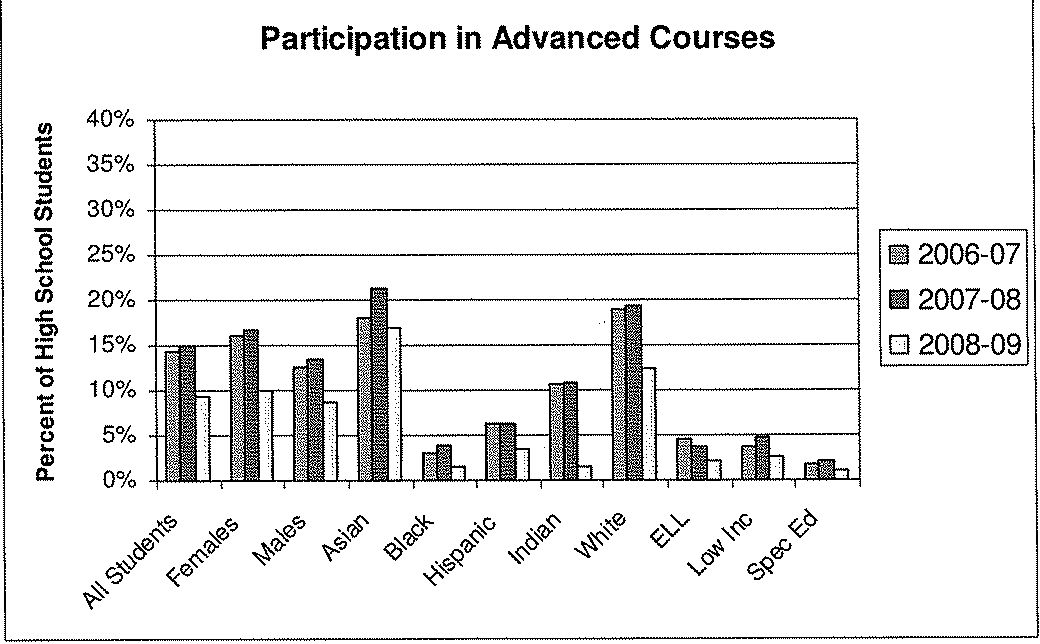
Note: For a while, I’m going to be illustrating the “On the Agenda” posts with various graphs documenting gaps in MMSD. This one is from the Equity Report, which is on the agenda.

After an unplanned break from blogging, I’m going to ease back in with a partial run down of  this week’s Board of Education agenda.

There are two meetings on Monday August 9, an Executive (closed) session at 5:00 PM in Doyle RM 103 and an open session in the Auditorium at 6:00 (plus an exchange of proposals on the Security Assistant contract on Friday).  The agendas for the first (and last) are here.  Unfortunately the link to the open meeting agenda is broken (fixed now).  A Board member scanned a copy for me and I’ve uploaded that (the hyperlinks don’t work, but you can get to the documents by pasting the appendix designation after http://boeweb.madison.k12.wi.us/files/boe/Appx, for example MM 2-8 becomes http://boeweb.madison.k12.wi.us/files/boe/Appx 2-8.pdf).

The big item of public interest on the closed session agenda is the Superintendent Evaluation.  It is perfectly legal to do this in a closed session, but I don’t think it is good policy.   Voters have only the Board to hold accountable and the Board has chosen to funnel most or all administrative accountability into the Superintendency.  The public can’t make an informed judgment on the Board when this process takes place behind closed doors.

In the two plus years Dan Nerad has headed MMSD, I haven’t seen a single document reflecting the Board’s assessment of his job performance and public discussions on this topic have been rare, indirect  and partial.

If you are interested in the terms and process of the evaluation, there are some public documents.

Superintendent Goals from MMSD Board of Education Progress Report – January, 2010.

Process for Evaluation from July 20, 2009.

Revised Process for Evaluation, August 17, 2009.

Minutes of meetings where this was discussed:  November 28, 2009September 21, 2009; September 14, 2009.

The approved Process requires that a summary document be made public.  I’ll be waiting for that.

I’ll close this section with a quote from Nerad:

Q: How do you receive feedback based on your performance?

A: One of the things that is in some ways unique… is that I report to the Board of Education. I have seven bosses, and they do an evaluation process of me… I’m a big believer in self-assessment, so part of my evaluation will be to self-assess. I’m also a believer in what’s called 360-degree feedback, where you get feedback from others involved in the organization, so part of it will involve that… So ultimately it does come down to the Board of Education with multiple kinds of inputs that evaluate my performance.

Sounds good, but having 360-degree visibility would be better.

I’m running late on this, so the only thing from the open meeting I want to highlight is the “Annual” Equity Report (annual is in quotes because the policy requiring an annual report was passed in June of 2008 and this is the first report — a previous atempt from earlier this year was sent back for revision — I wonder if any of this came up in the Superintendent Evaluation?).

You can read more about my hopes and wishes for the Report in this post and this one too.

In terms of information provided, this version is an improvement over the first attempt.   That said, there is still room for improvement (both with the report and in achieving equity) and there is at least one thing about the first version I like better.

What I liked about the first version was that it attempted to identify district initiatives that addressed the recommendations of the Equity Task Force.  This isn’t required, but it was nice and useful.

The current version uses selected equity-related  Strategic Plan measures more than the Equity Task Force work.  In this way it serves as a preview of what can be expected with the Strategic Plan reports.

I’m withholding most judgment until I have a chance to hear the presentation and the reactions of the Board, but there are some things I do want to note.

Might as well start with the graph at the top.  Pretty disturbing.  The Equity Task Force thought that expanded access to advance programs was of the highest importance and this indicates that the number of high school students taking advanced courses is declining and the diversity of those students is not markedly improving.

Two notes before going deeper on this.  First, “advanced courses” isn’t defined and second, the graph without data makes it very hard to know what is happening with the demographics.

What is worse is the Report simply says “the reason for the decline is unclear” and moves on.  That isn’t good enough.  The purpose of having this report is to raise red flags so that inequities and bad trends get attention and action.  Noting the lack of clarity of causality isn’t going to reverse this trend.

In light of the dismal data on the diversity of TAG participation, I’d also like to see data for all advanced programs, not just high school courses.

The other thing that really bothered me was the note that the Report isn’t “applicable” to “Budget Implications.”   This appears to be pro forma, but resource allocations are central to the concept of equity advanced by the Task Force and reflected in the district Policy.  Quoting from the Policy:

Achieving equity often requires an unequal distribution of resources and services in response to the unequal distribution of needs and educational barriers.

How can you have  report on Equity that reflects this assertion and has no budgetary application?

Other things to note:

  • More presentations of data by school would be good.
  • The extensive use of climate surveys is a good idea (these are broken down by school), but I’d like to see school level demographic breakdowns here.

I want to get this up, so I’m leaving it at this for now.

Thomas J.  Mertz

Leave a comment

Filed under Accountability, Best Practices, Budget, education, Equity, Local News, Uncategorized

Democrats the New Republicans? Education Policies and Much More

Let me preface this by saying that I am dues-paying member of the Democratic Party of Wisconsin (as well as Co-Chair of Progressive Dane) and don’t want to paint with too broad a brush.  Yet the trends and developments  I see everywhere (and have been seeing for sometime) are too disturbing to ignore.  Democrats are repeatedly championing destructive conservative policies in the service of economic elites while pushing aside both common sense and social justice.  The current GOP extremist obstructionism is beside the point, except that it enables the Democratic moves to the right because with the major parties the choice becomes one of very bad (Dems)  versus unbelievably insanely bad (GOP).

Let’s start with the “EduJobs” Bill.  I think last time I mentioned it, Senator Tom  Harkin and Rep. David Obey were pushing for $23 billion in aid to states to prevent teacher layoffs.  After it was killed, President Obama gave it a push.  This is a classic example of the kind of selective use of Presidential power that Glenn Greenwald has been documenting at Salon.  The progressive positions get the rhetoric, but the conservative policies get the muscle.

The deficit hawks managed to get the the allocation whittled down to $10 billion, but rather than pay for it via more progressive taxation or the kind of deficit spending that Keynesian economics has demonstrated  to be effective in these kind of economic times, there was insistence that cuts elsewhere in education be part of the package (makes me think of the Madison Metropolitan School District budget madness where cuts were justified because  “people are reluctant to pay higher taxes”).

The good news is that those cuts were to be taken from the Race to the Top education deform con game.  The bad news is that all the Education DINOs (Democrats in Name Only) and their allies, are up in arms protesting the cuts to their favored scheme of more Charter Schools, and more tests used for more things (and here and here and here).  This follows their typical union bashing over the distracting issues of which teachers are slated to lose their jobs.  What a spectacle, “Democrats” and self- proclaimed education reformers more interested in destroying organized labor and expanding Bushian policies than in keeping teachers in the classrooms.

Now the biggest Education DINO, President Obama, has threatened to veto the bill if the cuts to Race to the Top remain.

A little break for sanity.  This week the Journal of Education Controversy posted a new critique of the Obama/Arne Duncan education policies from the National Council of the Churches of Christ in the USA.  Here is an excerpt:

We reject the language of business for discussing public education.

Not only has the language of the marketplace entered discussions of school governance and management, but we also notice that the language of business accountability is used to talk about education, a human endeavor of caring. The primary mechanism of the No Child Left Behind Act has been annual standardized tests of reading and math for all children in grades 3-8, followed by punishments for the schools that cannot rapidly reach ever increasing test score production targets. We worry that our society has come to view what is good as what can be measured and compared. The relentless focus on testing basic skills has diminished our attention to the humanities, the social studies, the arts, and child and adolescent development. As people of faith we do not view our children as products to be tested and managed but instead as unique human beings, created in the image of God, to be nurtured and educated.

I want to point out that although comes from a perspective of faith, the values espoused are also in the humanist tradition.

A  side trip away from education to note that the White House and the  Democratic leadership choose to court Scott Brown (R. MA) and  other Republicans by making the financial regulation bill more Wall Street friendly and rejected Russ Feingold’s (D. WI) efforts enact legislation that the banks and the hedge fund managers didn’t like, losing his vote.  This same “leadership” has failed to enact an extension of unemployment benefits.

The links between Wall Street and Education DINOS are many.  Kenneth Libby has started a new site — Democrats for Education Reform (DFER) Watch —  to document these and other aspects of the deform effort.  Some of this has to do with an elitist, technocratic, market based worldview, a desire to tear down a non-market based system of public education that works very well for most American students and communities,  destroy organized labor and a related desire to inculcate students with these values.  Some of it also has to do with the profit motive.  As Juan Gonzalez has reported, the semi-privatization of education via Charters and Vouchers offers wealthy donors significant tax credits (leading to further starvation of the public sector).  Here is a clip from his appearance on Democracy Now explaining how it works.

I can’t leave this topic without checking in again on my favorite Education DINO poster boy, Whitney Tilson.  He’s a DFER leader who also manages investment funds.  The fees from this “work” support a lavish lifestyle, generous political contributions and his extensive education policy advocacy.  Unfortunately for his investors, his funds lose money.  Let’s go to the charts:


Since inception, the Tilson Dividend fund has done slightly better than the NASDAQ and the  Tilson Focus fund slightly worse; both have lost money.  After taxes and fees are accounted for, investors are out even more.  As I said before, you would have done better stashing your money in an old sock than giving it to Whitney Tilson to invest.   As I asked at the same time, why would anyone trust our education system and our children’s futures to the people responsible for the economic disaster, people who have wrought havoc on our society and can’t even show a profit for their clients in the free market they love so well? I don’t have an answer, but like so much else that is wrong with politics it might have something to do with those campaign donations.

I’ll close by noting that closer to home Tom Barrett — the leading Democratic Candidate for Governor — has expressed has more concern for property taxpayers than enthusiasm for fixing Wisconsin’s broken school funding system.

Thomas J. Mertz

Leave a comment

Filed under "education finance", Arne Duncan, Budget, Contracts, education, Elections, finance, Gimme Some Truth, Local News, National News, nclb, No Child Left Behind, School Finance, Uncategorized

On the Agenda — MMSD the week of June 28, 2010

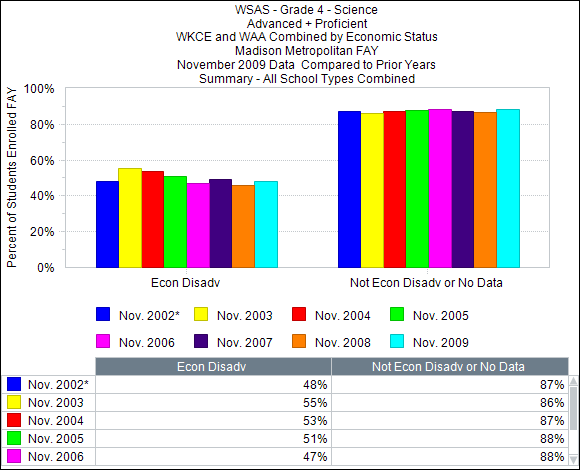
Note: For a while, I’m going to be illustrating the “On the Agenda” posts with various graphs documenting achievement gaps in MMSD as revealed by the admittedly flawed and limited WSAS/WKCE results. I think regular reminders may do some good. Note also the 37% gap here between children in poverty and those more economically secure.

Only two Madison Metropolitan School District Board of Education related meetings this week.

The first is the 4-Year old Kindergarten Advisory Committee meeting 9:00 A, Monday June 28 at 4C (Community Coordinated Child Care) 5 Odana Court.  The agenda consists primarily of updates from the sub committees.  The biggest news on this front (other than all signs continue to point to a 2011-12 start-up) is that a revised  RFP for Community Providers has been issued.

The other meeting is the Ad Hoc Board Committee on Ethics, Noon, Monday June 28, Doyle Administration Bldg., Room 103.  I’ve talked with Board members, heard a short discussion of this at last Monday’s Board meeting, have read the memo from legal counsel distributed at that meeting (but not a draft of  the proposed revisions, if those were distributed I missed them), and am still not clear on what the intent is.

That’s it for this week.  A few notes on related matters.  As of now the Board schedule for July is:

July 6, Ad Hoc Board Meeting (likely more on Ethics).

July 12, Special Board Meeting and Regular Board Meeting.

July 19, Special Board Meeting.

At the June 21 organizational session no decision was reached on committee structures, so for the time being all meetings will be of the full Board, meeting as the full Board.

I hope to use this semi break to catch up with posts on what happened at the last two Board meetings and some other district developments, including a retrospective post on the budget process.

Meanwhile, there is a Board of Education Progress Report out.  Note that as of the date it was distributed (June 21), the statement on SAGE:  “The Board is considering how to handle this change in state funding,” was already out of date.  At the June 14 meeting the Board decided to move the SAGE Block schools to an 18/1 ratio and allocate the remaining SAGE schools with “flexibility” between 15/1 and 17/1.

Thomas J. Mertz

Leave a comment

Filed under education, Local News, Uncategorized