
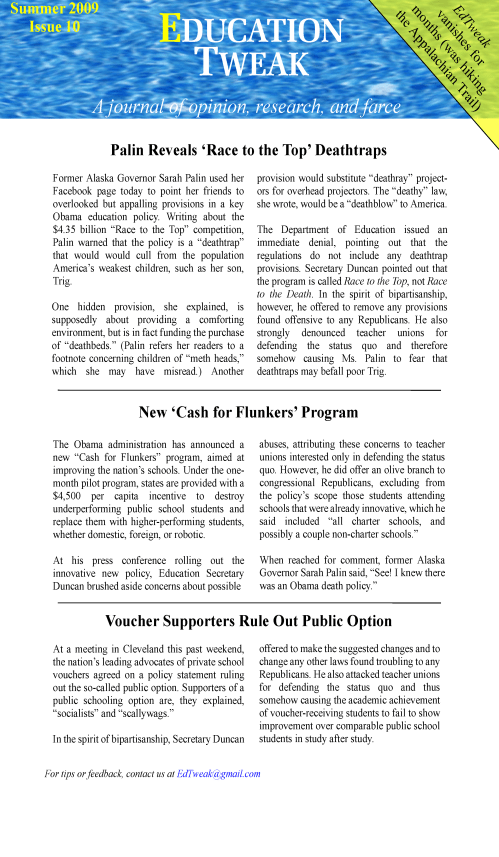
Click on image for pdf
All Ed Tweaks can be found at: http://edtweak.org/.
Thomas J. Mertz
Filed under Accountability, Arne Duncan, education, Gimme Some Truth, National News
 Generation X, “Ready, Steady, Go” (click to listen or download)
1910 Fruitgum Company, “1, 2, 3 Red Light” (click to listen or download)
With much joy and no little fanfare, the preliminary budget passed by the Madison Metropolitan School District in May restored the “Ready, Set, Goal” conferences that teachers and parents found so valuable. With the opening of school less than one week away “Ready, Set, Goal” conferences are not on the schedule. At best they are on hold — perhaps until after the potential to shape those crucial days and weeks –; at worst they will not happen at all. Very disappointing.
Apparently there are contractual issues that have not been settled.
I don’t know what the issues are. I do know that with most of four months to work with, there should have been a way to make the conferences happen.
There had been or is a memorandum of understanding in place to establish “the terms… should finances become available to reinstate the program.” MTI included a desire to renew that understanding in an April 2009 negotiations update. I can’t find a copy of the memorandum, so I don’t know what those terms are/were. I also don’t know if one or both parties are seeking changes to those terms.
While on the topic of “I don’s know,” (lots of them today) I’d like to know what is being done with $267,000 cost included in the preliminary budget (since shifted to stimulus/ARRA sources).
I’d also like to know why at their last meeting the Board was told that they needed to approve $98,918 in ARRA IDEA funding and $160,576 in ARRA Title I funding for “Ready, Set, Goal” conferences in 2009 and what will happen with that money?
Mostly, I’d like to know how such a positive thing went awry.
Thomas J. Mertz
Filed under "education finance", Best Practices, Budget, Contracts, finance, Local News, School Finance, Uncategorized
 As the state budget was being finalized we heard a lot from the Governor and legislative power players about how they had not raised taxes significantly (and here). That talk was meant to direct attention away from the the very significant increases in property taxes that the state budget required from school districts who needed to honor contracts and preserve as much in the way of educational quality as possible while dealing with the biggest gap in recent memory between revenues allowed and/or provided by the state and educational costs.
This misdirection has bled into outright falsehoods when the Governor has asserted that ARRA stimulus money will provide sicgnificant property tax relief (see here also).
I don’t like this misdirection and I really don’t like that the shift to property taxes is the wrong way to go with school funding. Governor Jim Doyle knew this in 2005 when he issued a column titled “Freeze Property Taxes, Not Education.” Both the budget he signed and his recent proposals that would allow districts to raise property taxes if they jump through a series of hoops indicate that he has lost this knowledge. See here for a position paper from the Wisconsin Alliance for Excellent Schools and here for a plan from the School Finance Network that would adequately fund education and provide property tax relief. Maybe someone from the Governor’s office could take a look and refresh his memory.
A recent editorial from the Oshkosh Northwestern asserting that “Property tax bills will define Doyle’s legacy” indicates that the misdirection didn’t work. I hope not, I hope that when the bills come due the anger is directed at state officials and not the struggling local school districts.
School property tax levies will not be finalized until October and the bills won’t hit taxpayers until December, but the size of these property tax increases is starting to become clear as districts around the state consider how they will balance the books.
Racine is considering a 12.08% , mil rate increase. At a community meeting on the proposal the message was that raising property taxes isn’t good, but it is better than more cuts to education:
Speakers favored raising taxes over cutting district staff or programming, which they said would harm children’s education and subsequently harm the local economy and the future.
“We can’t expect our children to be productive and informed citizens if we don’t adequately invest in their success,” said Jennifer Levie, 39, of Racine, a Unified parent and educator. “It’s unacceptable that we would have to make additional cuts to other critically needed programs.”
Taxpayers seemed to feel this way despite the recession and Racine’s high unemployment rate.
“I feel the crunch sometimes when our taxes are raised but I know it is worth it,” said Maria Morales, a Racine Unified grandmother, senior citizen and city taxpayer who supports a tax rate increase. Morales was one of 13 people who spoke at the budget hearing, attended by about 50 community members.
At the local level the choices are tough because at the state level our elected officials refused to make the tough choice to revamp Wisconsin’s revenue system.
Things mostly are in place for for very bad school budget choices in 2009-10 and 2010-11 (a “Cents for Schools” sales tax could provide some emergency relief as well as the basis for longer term school funding improvements). If we want to stop this trend from extending further, the time to act is now.
Thomas J. Mertz
Filed under "education finance", Budget, education, finance, Local News, School Finance, Take Action
Leroy Carr. “How Long, How Long Blues, Pt. 1” (click to listen or download)
There was an interesting quote from my State Representative, Mark Pocan, in the Wisconsin State Journal story on the prospects of Governor Jim Doyle’s agenda as a lame duck.
But Pocan acknowledged fundamental reforms of school financing would be difficult to achieve soon given that they would likely cost money that the state doesn’t have.
“The real comprehensive change of how we fund schools is going to be difficult to do over the next eighteen months,” Pocan said.
“Difficult,” does not mean impossible. Unfortunately, this sounds like yet another lowering of expectations.
One sure thing is that we’ll never know how difficult if Pocan and his colleagues don’t try.
Another sure thing is that there has been no public attempt at comprehensive school funding reform in the months since the Democrats won control of both houses under a Democratic Governor (and no, Doyle’s stitched-together attempts to win favor from Arne Duncan do not count). Please try.
Reading Pocan’s remarks I was reminded of FDR’s first hundred days and what could be accomplished with political will. Here is a list:
First Hundred Days Legislation
March 9 – June 16, 1933
March 9 Emergency Banking Act
March 20 Government Economy Act
March 22 Beer-Wine Revenue Act
March 31 Creation of Civilian Conservation Corps
April 19 Abandonment of Gold Standard
May 12 Federal Emergency Relief Act
May 12 Agricultural Adjustment Act
May 12 Emergency Farm Mortgage Act
May 18 Tennessee Valley Authority Act
May 27 Securities Act
June 5 Abrogation of Gold Payment Clause
June 13 Home Owners Loan Act
June 16 Glass-Steagall Banking Act
June 16 National Industrial Recovery Act
June 16 Emergency Railroad Transportation Act
June 16 Farm Credit Act
Doyle has about 540 days left. If he or members of the Senate and House want to fulfill the promises they have made over and over again, if they want to redeem themselves for what they did to education in the most recent budget, if they want to have something positive to run on in 2010, if they want to invest in our state’s future, if they want to leave a legacy they can be proud of…comprehensive school finance reform is a must and they have to get to work now.
Please try.
Thomas J. Mertz
Filed under "education finance", Arne Duncan, Budget, education, Elections, finance, Local News, School Finance, Uncategorized

United States Office for Emergency Management. - 1941
A hopeful voice emerged today in an editorial in the Wisconsin State Journal, a venue that wasn’t always convinced in the past of the need for education finance reform.
School finance reform should be at the top of Gov. Jim Doyle’s to-do list before he leaves office.
Reform won’t be easy.
Yet fixing the state’s broken system of paying for public education has always been a monumental task. That’s why so many politicians — Democrats and Republicans — have largely ignored it for so long.
Doyle, who announced Monday he won’t seek a third term, has advantages in pressing for major change now, even if he’s viewed as a lame duck.
The Democratic governor won’t have to fear the political repercussions of reform because he’s leaving anyway. And his fellow Democrats who control the Legislature might be happy to let Doyle take ownership of the thorny and complicated issue. Then Doyle can be the fall guy if special and local interests balk at difficult yet necessary state decisions.
Without reform, school districts will only face more pressure to scale back, threatening the quality of public education that’s so vital to a strong economy.
Doyle and the Democrats lifted state-imposed limits on teacher raises earlier this year. That means the biggest expense for schools — employee compensation — is about to jump.
At the same time, Doyle and the Legislature cut state aid to schools while maintaining school revenue caps. That leaves schools with less money to pay its climbing expenses. And the vise will only get tighter.
We hope Doyle was serious Monday when he pledged to “move forward” with school finance reform despite his looming departure.
Doyle told the State Journal editorial board in February that he would unveil far-reaching changes to state policy on school finance this fall. Without a lot of detail, Doyle suggested he would require savings on health benefits for teachers. He also would allow districts more revenue if they agreed to a list of best practices to improve student performance with accountability for results.
The effect on property taxpayers is unclear.
Doyle has talked about fixing school finances for years. He’s made a few tweaks but never finished the job.
As Doyle said to his staff at Monday’s press conference: “Let’s get to work.”
I myself remain skeptical, but hopeful, Governor Doyle will “finish the job.” We’ll keep you posted of any new developments.
Robert Godfrey
Filed under "education finance", AMPS, finance, Gimme Some Truth, Quote of the Day, School Finance

Thomas J. Mertz highlighted some inherent problems with the “Cluster Grouping” scheme envisioned in MMSD’s Talented and Gifted Plan. Given the swift policy creation the board is starting to enact, it is useful to highlight some of the potential downsides to ability grouping.
A dichotomous and discouraging set of statistics, one with the focus both on TAG education and the special education, should give one pause to think further about the school board’s current rush to implementation of the TAG plan without establishing the terms for an evaluation.
The Education for Change site has highlighted the under-representation of children of color in gifted education classes and programs.
* In 1997, African-Americans made up 17.2% of the total student population, but only 8.40% of those assigned to gifted and talented classes or programs.
* Latina/o students comprised 15.6% of the student population, but 8.6% of the students designated for gifted and talented classes or programs.
* King, Kozleski and Landsdowne (2009) reported that in California in 2007, 7.2% of the students enrolled in public education were African-American, yet only 4.13% of those enrolled in gifted and talented educational program were African-American.
The National Research Council Committee on Minority Representation in Special Education reported that Asian/Pacific Islanders are 1/3 more likely than white students to be in gifted programs, while African-American and Latina/o students are less than half as likely to be enrolled in gifted and talented educational classes and programs as Caucasian students.
It is not much of stretch to conclude that many of the problems with the assignment of students to gifted education programs are due in large part to the lack of agreement and an overall subjectivity around defining what giftedness actually means. Therefore, the potential for discrimination here is more evident and explicit.
At the same time, when we look at these same sort of comparisons for assessment evaluations of children in special education, we find some similar and disturbing numbers. Consider the disproportionate number of students of color classified as special needs students. The Twenty-Second Annual Report to Congress on the Implementation of the Individuals with Disabilities Education Act (2000) documents the extent and seriousness of the problem:
* African-American youth, ages 6 through 21, account for 14.8 percent of the general population. Yet, they account for 20.2 percent of the special education population.
* In 10 of the 13 disability categories, the percentage of African-American students equals or exceeds the resident population percentage.
* The representation of African-American students in the mental retardation and developmental delay categories is more than twice their national population estimates.
The same National Research Council panel cited above has also noted that in 1998, African-American students were 59% more likely to be identified as emotionally disturbed than Caucasian students. According to a NAACP study, “contrary to the expectations, is the finding that the risk for being labeled ‘mentally retarded’ increases for blacks attending schools in districts serving mostly middle-class or wealthy white students” (p. 18). In fact, as Losen and Orfield (2002) have noted, African-American children, and especially males, are at increased risk for mental retardation and emotional disturbance identification as the white population of a district increases.
These numbers tell us caution and careful study is the wisest course of action whenever we embark on an effort to pigeonhole children. It always done with the best of intentions (mostly), but a rush to implementing a program so rife with labeling is indeed a worrying one.
Robert Godfrey
Filed under AMPS, Best Practices, education, Equity, Gimme Some Truth, No Child Left Behind

The changes made to the Madison Metropolitan School District Talented and Gifted Plan, in response to concerns raised by one or more Board members at the August 10 meeting, are smaller than I anticipated. There are also some other — relatively small – changes I would like to propose. The Board is scheduled to vote on the Plan at their Monday, August 17th meeting.
My notes and recollections from the August 10th meeting contain two areas where explicit changes were called for. The first was a more unambiguous delineation of who would be included in categories such “underserved,” “multicultural,” etc.,. The second request called for the creation of a new advisory committee that would be reflective of the community as a whole. Superintendent Dan Nerad gave what appeared to be assurances that these revisions would be made (I do not have time to review the video, but if he did not give this assurance, he selected his words very carefully to make it appear that he did). Some changes were made to the TAG Plan in the new iteration, but these have only partially addressed the concerns of Board members.
In addition, one Board member asked essential “what will this look like?” type questions. The response from Superintendent Nerad was that he may be able to give partial answers prior to the vote. This unsatisfactory response was coupled with expressions of urgency that this plan must be passed on August 17th. I find it very troubling that only one Board member asked “what will this look like?” and equally disturbing that our Superintendent called for action from ignorance. If the materials that have been distributed to the Board and made public prior to a vote are any indication, ignorance will reign; these questions will not be answered.
This is part of a disturbing pattern of secrecy and/or and lack of concern for basing decisions on the best possible information (or any information at all), which has characterized this entire TAG process. Extending this pattern, in the newspaper today, executive director of teaching and learning for the district, Lisa Wachtel, displayed an unwillingness, or perhaps an inability, to reveal how many students the district currently identifies as “Talented and Gifted.” This is the most basic information. To even begin a planning process without it, is incomprehensible. For the Board to enact the results of such a process is a dereliction of duty.
An explicit mention of who is being identified in the phrase “underserved,” has only been added in the section on “social and emotional needs.” It does not appear in the sections on identification, it is not a part of the effort towards consistency and transparency, it does not appear in the action steps on increasing participation in advanced courses, it does not appear in the evaluation section, and it does not appear in the communication section. The improved identification, consistency, and transparency along with the call for policy evaluations are probably the four best things in the plan. I support them all heartily (if with some reservations about the limits of what is possible due to both the current state of knowledge and the nature of assessments — not to mention the scarcity of resources). These are also exactly where the need to be explicit is the greatest.
Additionally, there is no inclusion of gender in the new categories. Issues of gender and perceptions of talent are well recognized. Their exclusion is yet another example of the kinds of oversights that are endemic to a rushed and secretive processes (the whole thing reminds me of the State Budget issues that MMSD was so vocal in complaining about).
I cannot find any changes concerning the makeup or role of the Advisory Committee (note, I am away from home and a bit rushed; I am not 100% sure of this and would welcome a correction via the comments). As I noted in an earlier post, the Plan itself reads:
Gifted programs must establish and use an advisory committee that reflects the cultural and socio-economic diversity of the school or school district’s total student population, and includes parents, community members, students, and school staff members.
I will add a few things. First, as much of the above shows, I believe in an open and accessible planning process. State statutes will require this of a committee authorized by the Board. Second, I think the inclusion of TAG experts and advocates is fine, but those outside of the TAG community need to be part of any advisory committee.
That takes care of what little was changed and the first swipes at what else should be. As indicated above, I cannot be as thorough as I like with this post, but I would like to touch on some other ideas for consideration. As I said in my testimony before the Board, my preference would be to do the minimum at this time, initiate an assessment of the current state of affairs and begin planning again with a more representative and open committee. I realize that it is highly unlikely that will happen, so I am offering less radical and perhaps more constructive suggestions.
Strengthen Evaluation
The Board and the community deserve a thorough reporting of success and failures. Before beginning this implementation, there should be metrics that are spelled out. These should include, at the very least, the explicit measures of participation and disproportionality linked to an expanded category of who should be considered “underserved,” as well as some assessments of consistency and transparency. If any form of “ability grouping” is implemented, the evaluation of that policy must consider all students, not just those identified as Talented and Gifted. Lastly, any evaluation should include thorough financial audits of the process and implementation. Going forward with only the vague promise of “evaluations” now, this part of the plan would be a continuance of the pattern of bad governance.
Limit the Actions on Social and Emotional Needs
I support the research and staff development in this area, because I believe that our staff needs the tools to better see where help is needed. I do not think that the pilot programs and collaborative sessions are the best use of district resources. Our social workers, psychologists and allied staff are already overworked. I think a comparative assessment of the unmet social and emotional needs of TAG students and other students is in order, prior to a commitment of resources to programming. Students of all abilities have real needs.
Set aside “Cluster Gouping”
The issues I have raised previously — particularly the lack of research on this practice — in combination with the lack of answers about what an implementation will look like, I recommend that the Board not commit to this policy at this time. Previously, I urged the Board to ask for a trial run of class assignments based on a cluster grouping policy. At a minimum, this trial run should be done and subjected to scrutiny, well before a single child is assigned to a group based on their perceived “ability.” Ideally, any and all discussions of grouping schemes should include multiple options and a thorough examination of the limits of the tools being used to label and group students.
On a side note, there are real problems involved in deciding what the proper universe for evaluation will be in determinations of “giftedness” (World, Nation, State, District, School, Grade …) and these will directly impact implementation. If it is done at the school level — as the “Cluster Grouping” scheme requires — students transferring will move in or out of “giftedness,” depending on the other students at their schools. If the consistency of district-wide metrics is used, the concepts behind “cluster grouping” are abandoned. To me this is further evidence of the arbitrary wrongheadedness of labeling and grouping policies and clearly points to the need for Individual Learning Plans for all students, not just some.
In closing, I want to note that a careful reader will have ascertained that I am in strong agreement with the movement toward improved identification of Gifted and Talented students, staff development designed to improve identification and services, consistent programing across the district, and transparency at every level and step. This common ground I share with the Advisory Committee. I just think we can and must do better in multiple areas, before making commitments to future actions and the resources to pay for them.
Thomas J. Mertz
Filed under Best Practices, education, Equity, Local News, Uncategorized
Vodpod videos no longer available.
An article and video from the Teachers College Record on Detracking seem timely with the MMSD Board vote on a very slightly revised Talented and Gifted Education plan scheduled for Monday August 17 (public comment at 6:00 PM).
The interview is with Professor Kevin G. Welner who had a great essay “Obama’s Dalliance with Truthiness” in TCR earlier this month.
Needless to say, the reforms that Welner describes are very different than what MMSD is poised to enact. Madison is moving toward increased ability grouping. I do not believe the unrepresentative Advisory Committee ever considered Detracking. They certainly did not place that option before the Board or community.
I hope to have more on the TAG plan posted before Monday, but travel plans may make that impossible. Meanwhile more of my concerns are expressed in this post.
Thomas J. Mertz
Filed under Accountability, Best Practices, education, Equity, Local News, Uncategorized
 Longtime readers should know that Sherman Dorn is one of my favorite people in the edusphere. His recent “How can we use bad measures in decisionmaking?” is a fine example of why I value his contributions so much.
His titular question is THE QUESTION at the heart of so much ed policy action these days. Nobody who isn’t seeking profits or losing their mind likes the tests being used — not Arne Duncan, not Barack Obama, not the people in Madison poised to build a Gifted Education house of cards on them — but almost nobody wants to give up on the tests and many want to expand their use (Arne Duncan, Barack Obama, those house of card builders in Madison).
Everyone talks of better tests, multimodal assessments, new ways of looking at data…. All this can be good, however we aren’t there yet and the simple-minded attraction of letting the flawed data “drive” education policy is strong (the current draft of the MMSD Strategic Plan has both reasonable data ” inform[ed]” and frightening “data driven” language). Additionally, at least three truths often get lost when better assessments and data are discussed (Dorn hits most of all of these).
This was supposed to be about Sherman Dorn’s post, so back to that (although I think the above — especially the local stuff — is a salient context for what Dorn wrote).
After much good introductory material (including a link to the relatively recent, must read Broader, Bolder Approach Accountability Paper), Dorn explores a variety of positions relative to the problems of “data that cover too little,” and “data of questionable trustworthiness.” His presentation of their strengths and weaknesses is insightful and informative.
Dorn himself rejects both the “don’t worry” and “toss” extremes and seeks to extend (begin?) the conversation in pragmatic directions. Here is how he closes:
Even if you haven’t read Accountability Frankenstein or other entries on this blog, you have probably already sussed out my view that both “don’t worry” and “toss” are poor choices in addressing messy data. All other options should be on the table, usable for different circumstances and in different ways. Least explored? The last idea, modeling trustworthiness problems as formal uncertainty. I’m going to part from measurement researchers and say that the modeling should go beyond standard errors and measurement errors, or rather head in a different direction. There is no way to use standard errors or measurement errors to address issues of trustworthiness that go beyond sampling and reliability issues, or to structure a process to balance the inherently value-laden and political issues involved here.
The difficulty in looking coldly at messy and mediocre data generally revolve around the human tendency to prefer impressions of confidence and certainty over uncertainty, even when a rational examination and background knowledge should lead one to recognize the problems in trusting a set of data. One side of that coin is an emphasis on point estimates and firmly-drawn classification lines. The other side is to decide that one should entirely ignore messy and mediocre data because of the flaws. Neither is an appropriate response to the problem.
I probably don’t do justice to his post. Read the whole thing.
The reality is that bad data is being used and that the uses are expanding. I am not as sanguine as Sherman Dorn about the potential for better data and better ways of using it (I’m guessing he’d object to the word sanguine here, and he’d be right because it does not capture where I think he is coming from. Take it not as an absolute but only as a comparison with me), but I do know that explicit discussions of the issues involved like Dorn’s post are necessary to progress.
Thanks Sherman for the questions and answers.
Thomas J. Mertz
 Governor Jim Doyle (or his reps) , Mayor Tom Barrett (or his reps), and others (maybe Arne Duncan’s reps) are holding secret meetings to hijack the MPS Innovation and Improvement Advisory Committee for a Mayoral Control proposal. MPS Board President Michael Bonds has resigned from the Committee in Protest.
Lisa Kaiser has the full story, including excerpts from Bonds’ letter and reactions from the Mayor’s office. Milwaukee Talkee is looking for action to stop this and there is an online petition here.
Jim Doyle likes his secret meetings, Arne Duncan likes his Mayoral control, lots of elections to be considered with the expectation that an MPS shakeup would buy Doyle and Barrett some time; the Race to the Top beauty contest is part of this too.
Notice how none of this has to do with educating the students. Notice also that allowing Doyle and Barrett to say, “give the reforms a chance” and the Race to the Top funding are only short term remedies. At some point the chickens do come home to roost.
In a related note, The New Teacher Project gave Wisconsin’s chances for Race to the Top funding a very low rating. Mayoral control could change that. That said, I’m more than wary of making big changes in order to buy a lottery ticket in what is likely a rigged game (that goes for the use of bad student tests for teacher compensation decisions too).
Update: The Journal-Sentinel has more this morning, including an endorsement of the Doyle/Barrett plan from State Superintendent Tony Evers. Mayoral control was not included in the “Milwaukee Public Schools – An Agenda for Transformation” Evers campaigned on; his opponent — Rose Fernandez — pushed for dissolving the Milwaukee Board of Education and replacing it with a team appointed by the Mayor, the County Executive and the State Superintendent.
Thomas J. Mertz
 Fund a Classroom Project in Madison
 AMPS
AMPS 