Democracy and Efficiency (part I)

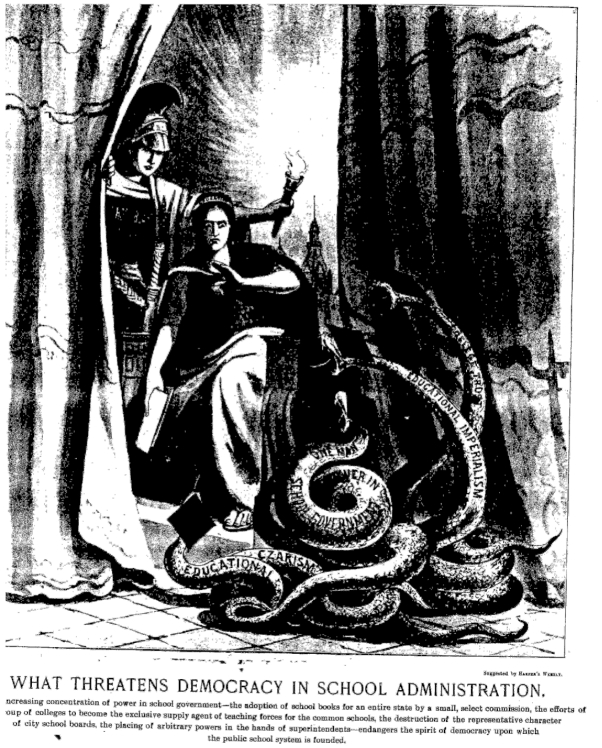
what-threatens-democracy-2.jpg

The Madison School Board has drawn fire from Progressive Dane for a proposed policy change regarding public appearances.

The change would limit public commentary preceding school board meetings to agenda items. Individuals who want to speak on issues that are not part of the agenda would be required to speak after the business portion of the meeting was complete….

[Board of Education President, Arlene] Silveira objected to characterizing the change as an effort to limit public discussion or input.

“That is simply not true. This has been a discussion about trying to find a solution to a problem in getting the work done we were elected to do. Under this proposal, people can certainly speak on non-agenda items, just not before we begin our business meetings,” she said.

Susan Troller Capital Times, February 9, 2008 (emphasis added)

We need to move beyond the unsupportable assertions that the proposed public appearances policy revision does not limit public input (however slightly) and start asking if the new limits are an acceptable trade-off for increased efficiency.

In democratic governance there is almost always a trade-off between efficiency and democracy. More participatory structures tend to be less efficient (there are some ways of gaining efficiency that have little impact on participation and some ways of enhancing participation that have little impact on efficiency; I will touch on some of these in part II). This extends beyond opportunities for the public to vote, petition or make our voice heard to questions of balance concerning the proper breadth or shape of the responsibilities claimed by or ceded to the public, elected officials and appointed professional administrators. Among democratic systems, the least democratic structures give the most responsibility and power to those at the farthest remove from the public, professional administrators.

In school governance at one end of the spectrum would be the annual school meeting, which vested comprehensive powers in the voters who attended. At the other end would probably be the mayoral appointed superintendents given sweeping powers (Michelle Rhee in Washington DC is a recent example).

These have been live issues since at least the Progressive Era. In that period those who favored efficiency over democracy, often called “administrative progressives,” mostly triumphed, creating what historian David Tyack called “The One Best System.” Most of the histories of these conflicts focus on the winners. As a historian and an activist I have always been more attracted to their opponents, unstable coalitions of intellectuals (John Dewey for one), women’s groups, unions, Populists, Socialists, teachers, and partisan politicians who resisted what William George Bruce (Milwaukee Democratic politician – who opposed partisan politics in school governance, these coalitions were very unstable and strange –, school board member and founder of the American School Board Journal) called “Educational Czarism.” They had their victories too.

Almost everyone involved had some claim to the label “progressive.” This points to a dilemma in progressivism, then and now. Progressives have faith that politics and government can work for the common good and in order to accomplish this — to advance the common good — government must be efficient. Progressives with a democratic orientation also value democratic structures and wide participation, which make efficiency harder to achieve. This is the dilemma presented by the proposed limit on public appearances concerning non-agenda items.

The conflicts over school governance were and are entwined with conflicts over the purposes of schooling. For the most part Progressive Ea efficiency advocates emphasized the role of the schools in training workers and their opponents were more concerned with education for personal growth and citizenship. This is a gross oversimplification in that both sides favored some form of industrial or vocational education and the conflicts were about who would control it (some of the administrative progressives were happy to have private industry directly in charge) and what forms it would take (manual training was viewed as promoting personal development while vocational education was often seen as an effort to recreate inequalities in the name of “social efficiency”). Still, I think it is important to bring up as a reminder that the structures of education are related to what is taught, constituting a hidden curriculum. The lesson of limiting public appearances is that to some degree the priorities of the Board of Education take precedence over the concerns of the public. This has to be part of the discussion too.

Historically the structures and aims of education in Madison have had a relatively good balance between efficiency and democracy. I would like to see it stay that way.

As I said earlier, I would like to see this proposal set aside and have the Board and the public together tackle the broad questions of balance between efficiency and public participation. I’ve got some specific suggestions that will be included in part II of this post (as soon as I find the time to draft that…need to work on my own efficiency). I am going to close this post with some outlines of what I am talking about.

I would like to see a wider consideration of Board practices, some documentation about how much time has been spent on various tasks (including but not limited to off topic public testimony) and a variety of solutions evaluated, solutions that address “problems” confined to what the Board does as well as solutions involving the public perhaps changing our behavior too.

Whatever the results, I think that this has to be an issue that Board engages the public on. I am very glad that there now will be an opportunity for the public the weigh in on February 18, prior to the vote. That is a start, but however the vote goes, the larger dilemmas of democracy and efficiency aren’t going to go away. Rejecting the proposal could lead to constructive cooperation and creative solutions, enacting it will exacerbate distrust and resentments.


Thomas J. Mertz

For further reading:

David B. Tyack, The One Best System: A History of American Urban Education.

William J. Reese, Power and the Promise of School Reform: Grass Roots Movements During the Progressive Era.

Raymond E. Callahan, Education and the Cult of Efficiency.

Robert B. Westbrook, John Dewey and American Democracy.

2 Comments

Filed under Accountability, AMPS, Best Practices, education, Local News, Take Action

Quote of the Day

mtos.gif

Image from More Than One Struggle:  The Evoulution of Black School Reform in Milwaukee by Jack Dougherty (a friend and fine historian).

In retrospect, I now realize that the urban school systems we used were engaged in a complex and persistent continuation of the resistance to Brown that characterized the public response since its inception. Rather than being engaged in systemic reforms to meet equity mandates, our school districts were escaping from more global equity initiatives through the development of small, selective choice programs. These programs were undermining the fabric of the common school ideal and silencing possible public conversation about serving the needs of all children in the district on an equal basis. Commitments to the most disadvantaged children were not honored, in my opinion, while new programs designed to attract privileged children became a priority.

Beatrice S. Fennimore, “Brown and the Failure of Civic Responsibility,” Teachers College Record.

These thoughts and this article should be part of the discussion begun in (Not?) Talking about Diversity and Boundaries, 2008 Style .

 Thomas J. Mertz

Leave a comment

Filed under Best Practices, Equity, Quote of the Day, Uncategorized

Tin-eared and Wrong-headed

eartrumplb.pngbottom.jpg

Update:

Board of Education President Arlene Silveira just posted this on The Daily Page 

 Time Out. The press release that started this thread was not accurate. There will be public speaking on this topic at the meeting on 2/18.I will continue to come back to the main point. The issue is that the Board would like to focus on its business at a more reasonable hour in order to make good decisions for the children of the district.If people do not like the proposal on the table, please recommend an alternative. An alternative is not to say “let’s leave things as is”. This does not address the problem.Looking forward to your ideas!Arlene Silveira

I am glad to see some movement and agree that both sides need to be creative.

It should be noted that according to all information available to the public prior to this The Daily Page post, the Progressive Dane Press Release was accurate. 

I was contacted earlier today by the Board of Education staff person (after the Press Release was issued) about a change but given no details.  My request for more information has not been answered yet (This is not a complaint about the Board staff people.  They, like so many in the Doyle building, do a great job and are always helpful.  I just want to be as open as possible about what I knew when.). 

See you on the 18th (and maybe the 11th too).

At the Board of Education meeting Monday (2/4/2008) a proposal was put forth to enact new limits on public testimony. This proposal and the way it was introduced and discussed showed some on the Board at their worst, both tin-eared and wrong-headed. These are overlapping criticisms, because with the interactions between elected officials and the public, perceptions (tin-eared) and realities (wrong-headed) are inseparable.

Before I go further a caveat is in order. I did not attend the meeting on Monday and only watched the last 45 minutes or so at home. Still, I’m pretty confident in what I have to say.

The proposal is a revision of Board policies 1220 and 1222. I haven’t obtained a copy of the exact language yet (that points to one problem with the way this is being done and another with the proposal iteslf, when I get an electronic copy I’ll link here), but the gist of it is that they want to move public appearances concerning topics that are not on the agenda for that meeting from the beginning (where they have been since at least 2000) to the end (an indeterminate time). K-12 students are exempted.

The rationale offered is that extensive, “off topic” public appearances have kept the Board from effectively doing the work the Board wants to do. There is no doubt that public appearances before the Board — mostly “on topic” — have at times been exhausting or that there is room for improvement on both sides of communication between the Board and the public. Rather than improving communication, the pending revision seeks to make communication more difficult.

It is outageous for a Board which has acknowledged communication and public relations problems in their goals for the Superintendent (it was also on the initial list of annual Board priorities, but Lawrie Kobza moved to delete it, Ms Kobza was conspicuous in her support of the current effort to limit public appearances) to contemplate such an action, it borders on insane that they would do so in a manner that excludes the public from having any input.

One thing needs to be made clear, whatever Board members say about the intent not being to limit public input, the result is that public input will be limited in terms of both quantity and quality. Logistically the proposal is a nightmare. Let me use the proposal itself as the first illustration.

A very general item appeared on the agenda distributed on Thursday or Friday (1/31 or 2/1). I contacted a couple of people for details and got only vague answers. It appears that the actual proposal was distributed to Board members on Monday (the day of the meeting) and the first chance the public got to see it was via the distribution of copies at that meeting.  [I have been asked to clarify the chronology and given new information to do so. Board members were given a draft policy on Thursday 1/31, an explanation via email on Friday 2/1 and the the proposed policy on Monday 2/4. A vote was possible on Monday, 2/4 but since this was not sure, the possible continuation to 2/18 was already arranged.] Monday afternoon I am contemplating making childcare and other arrangements in order to possibly give public testimony on a proposal that I don’t know the contents of. One source told me there probably won’t be a vote, so I decide not to go (it turns out there was almost a vote). The point of this is that the nature agenda items and the timing of their publication makes it hard for the public to participate. It gets worse. Thanks to the intervention of two members, the Board did not vote and will take this up again on 2/18 (mark the date). That meeting will be a workshop session, meaning no public appearances. In fact, there are no Board meetings scheduled between now and the vote where public appearances are allowed. So I missed my chance and the Board was spared the horror of listening to me for three minutes. I will however be attending the Communications Committee meeting on 2/11 and if public appearances are allowed will be saying my piece (that agenda isn’t out yet), I suggest you do the same.

This was an agendaed item, so if the new policy was in place I still could have testified at the start (and I would have if there has been any way for me to know what it was without going to the meeting). Now I want to look at non-agendaed items and what the Board is contemplating. These fall into two categories. The first consists those things that the Board is not aware of or is doing nothing about; the second consists of those things that Board has been addressing or plans to address at other meetings. If you want to talk with the Board about any of these, you will have to wait your turn. In practical terms, that means planning on sitting through a meeting that may go one hour or may go four hours (tell that to your spouse or try to arrange for childcare on those terms) and then at the very end, after the Board has done what they want, those members that stick around will give your what attention they have left to give. Is this a recipe for effective communication? I understand that the Board wants to work on what the Board wants to work on, but I also understand that the Board doesn’t know everything and that there are some things they know about that they don’t want to deal with. I like the fact that it is relatively easy for the public to try to inform the Board or get them to address things they would rather not, to speak often inconvenient truth to power (or at very least call public attention to these things). In setting the agenda, the Board (especially the President and Vice President) already have great power. This would enhance that power at the expense of the rest of us.

As usual, this is too long, but I want to work through one more example before wrapping it up. Multiple Board members cited the failure of the Board to make any meaningful progress on Equity at their 1/28 meeting as an illustration of why this policy is “needed.” They couldn’t have picked a worse example. On April 16, 2007 the Equity Task Force presented our report to the Board of Education. The Board was busy with more pending matters, gave the summary a brief polite hearing, thanked the Task Force and pledged to return to the report (no vote, but that’s what they said and what the minutes indicate). On June 20, 2007 the Board made Equity a priority for the year. On December 3, 2007 — almost eight months after the Task Force gave them our report and six months after the Board made Equity a priority — the Board held a workshop session on Equity. On January 28, 2008the Board held another workshop meeting on Equity. This is the meeting where little got done and the one that Board members used to place the blame on public appearances. On that front, the lengthy public appearances that night were for the Long Range Planning Committee and were about an agendaed item, so the proposed revision wouldn’t have changed anything!

Looking at the bigger picture, it stretches credibility well past the breaking point to assert that off topic public appearances were a major factor in preventing the Board from addressing Equity for eight months. Don’t play me for a fool. Again, it gets worse. Under the new policy, only agendaed items may be addressed at a time when members of the public are able to easily appear and the Board is paying full attention. In the eight months since the Task Force gave the Board our report, Equity has not appeared on the agenda of a single meeting where public appearances were allowed. Board members also touted other means of communicating with them. Any fool knows these aren’t the same. Prior to the January 28 meeting six Equity Task Force members (myself included) sent the Board a letter expressing concerns about the process of their work on Equity, including the lack of public input. To my knowledge only two Board members responded and our letter and concerns were not part of the discussion at the meeting. I can’t help but think that if we had been able to read that letter to them in person at the start of one or more meetings, things might have been different.

Reading through this I find that I hit the “wrong-headedness” more than the “tin-eared.” It should be obvious how counterproductive ramming through a limitation of public input (without any public input on the proposal) is to the goal of improved communications. If it isn’t, I suggest everyone — including Board members — watch the video. You’ll be amazed at how self-centered and arrogant some of our elected Board members sound.

I admire the hard work of our Board of Education and appreciate the difficulties they face in trying to do what they think is best. However, the best intentions can still lead to bad decisions. Let’s not let that happen this time. Contact the Board, testify at the 2/11 Communications Committee meeting (while you still can), write the newspapers…. If we can move past this wrong-headed mess, we can continue to work together — the board and the Public — to figure out ways to improve communication, a project that has already begun under a the auspices of a planned Progressive Dane School Budget 101 seminar (among other things I’m chair of the PD Education Task Force).

Thomas J. Mertz

An undesirable society, in other words, is one which internally and externally sets up barriers to free intercourse and communication of experience. A society which makes provision for participation in its good of all its members on equal terms and which secures flexible readjustment of its institutions through interaction of the different forms of associated life is in so far democratic.

John Dewey, Democracy and Education

8 Comments

Filed under Accountability, Best Practices, Equity, Local News, Take Action, Uncategorized

On west side boundary changes

boundary.jpg

Having served on the former west-side boundary task force, and after noticing some posts about new district proposals for boundary changes, I thought I could say a few words about this dangerous topic.

#1. It’s not so dangerous or uncommon. For all the debate and deliberation on this issue, it’s not as important as providing an excellent setting for learning. Like the Crosby, Stills, and Nash song, “Love the one your with” really makes sense in Madison – elementary schools that are well supported seem to do just fine. MMSD tends to keep a very close eye on how things are going at elementary schools, and many of the management/educational fundamentals are strong. They just can’t handle it when people suddenly bail. Successful schools are somewhat self-fulfilling. However, certain schools need special support delivered in a timely and creative manner. I’ll defer to professionals on this one. If pairing is deemed beneficial for _the purposes of learning_ I can support that.

#2. If we are smart, we’ll really think critically about how schools are networked with other children and family services. We should look to better support of early childcare as part of the equation. Parent transportation is another major issue.

#3. While we went over many, many alternatives during task force and break out meetings, we really didn’t make much headway on boundary changes. We didn’t touch pairing or Midvale-Lincoln’s (our school) with a ten foot pole. We didn’t really effectively address race or low-income, or even the efficiency of transportation. However, we did give a lot of comments, which drew more from the community, and we all learned a bit more about neighboring schools. The data resources, the planning processes, and day-to-day knowledge has been growing within the district, and we shouldn’t judge based on old information.

#4. There have been some significant changes since the task force. I threw out my binder a few months after the task force. Once people knew the new school and Leopold addition were to be made, that changed the draw to homes in the areas. Also, changes to the budget and class-size changes have affected the capacity numbers significantly.

#5. This is an iterative, often frustrating and seemingly non-democratic process. At the end of some long day in the near future, a few people, looking at all the data and comments they get in, will make the decision about boundaries and pairing.

#6. Our job is to keep the eyes on the prize, to adapt, to prepare our kids and neighbors for a few bumps, but to stay focused on effective delivery of best practices, well-supported teachers and schools, and effective long-term planning (as best as we can provide).

#7. We need more depth and collaboration. Boundary changes need to be judged on how they effect the learning community throughout their school years. It’s not just about elementary schools, but how friends and our young scholars grow together, meet up at middle school and bring on new challenges. If there is to be another long-range planning task force – it should be with consideration of the _integrated_ effects to the students over their lovely years with the MMSD – not just their elementary experience.

#8. Be nice to folks from research and evaluation. They have no specific agenda – they are simply between the public and the administrators on looking at the issues, adding clarity when they can. We want the best data possible, clearly presented and analyzed. Let’s support that.

#9. We need the city involved. Schools matter for the health of neighborhoods and for city planning, so the city should have a clear voice and a position on the record. For something more creative, the city could facilitate and promote the community use of schools outside the school day and school year. The city can encourage people to get to know the schools on the other side of the boundary – with potlucks and parties, basketball and soccer, concerts and neighborhood meetings at the schools. Boundaries are just lines on a map – and we, with a little boldness, can step over them.

#10. Don’t forget about the east side! Sprecher Road area and other changes are really significant, and we may have to do more of a master plan that brings in all high school attendance areas into the mix.

– Jerry Eykholt

3 Comments

Filed under Best Practices, Equity, Local News, Uncategorized

Quote of the Day

nerad.jpg

When Nerad was hired in Green Bay, the first person that he notified was Eric Jeedas, a Madison taxi driver he has known since their childhood in Kenosha. Last week the pair talked again. This time Nerad was a finalist for the Madison post.

“I would imagine that you folks in Green Bay know that he’s a good guy and competent, and I think that Madison will be very fortunate to have him,” Jeedas said. “Is he up for the job? No question.”

Dan Nerad has proved he was up for every job he’s tackled over the past 33 years, and no doubt he has what it takes to lead Wisconsin’s second-largest school district. We wish him all the best as he begins the transition.

From January 30, 2008 Green Bay Press Gazette editorial.

Thomas J. Mertz

Leave a comment

Filed under Contracts, Local News, Quote of the Day, Uncategorized

(Not?) Talking about Diversity and Boundaries, 2008 Style

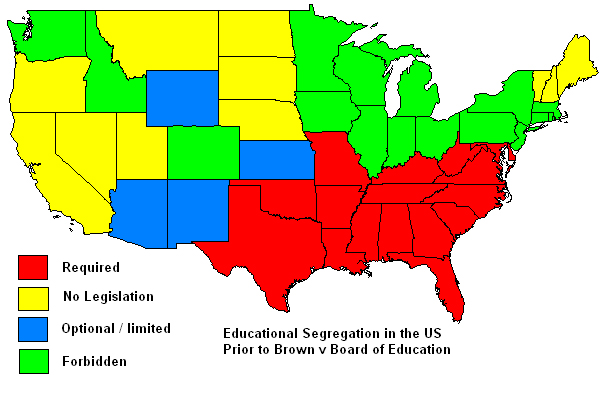
educational_seperation_in_the_us_prior_to_brown_map-copy.jpg

tends3.jpg

low-income.jpg

With the new school opening on the West side, Madison again must confront the competing interests and ideals involved in redrawing school attendance boundaries. The district has produced four plans (more may be in the works, or the existing ones may be tweaked). At a long and unusually non-confrontational meeting Monday (1/28/2008), concerned community members presented their views.

The guidelines used to create these plans include seven non-prioritized criteria, only one of which addresses diversity:

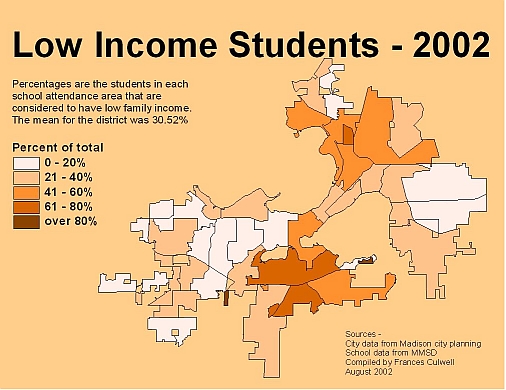
Every attempt will be made to avoid creating schools with high concentrations of low-income families.

It should be noted that this gives no guidance about schools with high concentrations of high-income families.

The Equity Task Force asked the Board to consider having racial, linguistic and/or economic diversity figure more prominently in this and related processes. The Board has taken no action on this.

What role race and linguistic considerations can play in drawing school boundaries is an open constitutional question. In the recent Louisville and Seattle case, Justice Joseph Kennedy’s partial concurrence rejected the plurality’s contention that these could not play any direct role:

School boards may pursue the goal of bringing together students of diverse backgrounds and races through other means, including strategic site selection of new schools; drawing attendance zones with general recognition of the demographics of neighborhoods; allocating resources for special programs; recruiting students and faculty in a targeted fashion; and tracking enrollments, performance, and other statistics by race.

Many consider Kennedy’s to be the “controlling opinion” in that without his vote the court would have been evenly split.

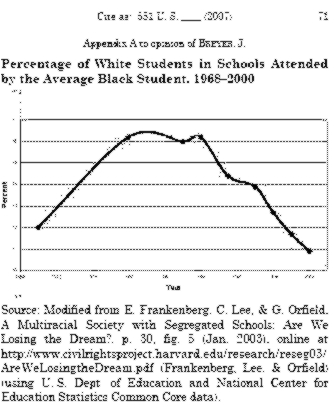
Nationally the trend toward re-segregation (however you measure it) continues. This trend can be seen in the graph above (from Justice Breyer’s dissent in the same case). A recent article in the Christian Science Monitor documents and explores the continued growth of what Gary Orfield calls “apartheid schools” (those with 90% or more minority enrollment). As the article notes, some do not have a problem with this happening, others are less sanguine:

“I don’t think that the education that you get hinges on the color of the person sitting next to you in the classroom,” [Roger] Clegg [president of the (Bradley Foundation funded) Center for Equal Opportunity in Falls Church, Va.] says. “What educators should focus on is improving schools.”

That sounds great in theory, say some experts, but the fact is that segregated schools tend to be highly correlated with such things as school performance and the ability to attract teachers.

“Once you separate kids spacially from more privileged kids, they tend to not get the same things,” says Amy Stuart Wells, an education professor at Columbia University’s Teachers College in New York. “And we need to start thinking about how a school that’s racially isolated can be preparing students for this global society we live in.”

I agree with Wells, both in terms of resource allocations and in terms of the lessons being taught or not taught by segregated learning environments.

Things aren’t that bad in most of Madison, but without a conscious effort to directly confront the issues they will be. As a friend reminded me today. the attention given to test performance data — measures that highly correlate with economic status — have induced some families to judge schools by simplistic measures and avoid those that aren’t “performing.” Often the schools being shunned are good schools with high percentages of students who are poor. In terms of resources, MMSD does what it can to direct resources to those schools with high needs, but the school finance system in general and the underfunding of Title I, Special Education, Bi-Lingual Education, SAGE and a host of other programs make this more difficult each year.

When I start to talk like this, to suggest being more proactive on issues of diversity, many are quick to remind me of the dangers of “becoming like Milwaukee,” meaning a district or city that has been largely abandoned by the middle and upper classes because they believe the schools no longer serve their children. There is no question that the growth in low income and minority students will keep some people from sending thie children to Madison Schools and that under the revenue caps this will have an adverse effect on the all the children in the district. There is also no question that prioritizing the needs of our neediest will exacerbate this. I think that is a price we should be willing to pay.

I am also well aware that dealing with these matters quietly and indirectly is easier for school officials, elected and appointed. Avoiding controversy and pretending differences (of status and opinion) don’t exist is always easier. For the most part MMSD has done a very good, if relatively quiet and indirect job of addressing diversity. I don’t think that is sufficient. I think being loud and direct at times is important.

In a recent Education Week there was a review of a new book, Everyday Antiracism: Getting Real About Race in School, by Mica Pollock. The book offers 65 essays by scholars “who offer advice for educators on recognizing when everyday classroom practices exacerbate racial inequalities and on becoming more constructively conscious and open about race.” In an earlier book, Pollock had coined the term “Colormuteness,” to denote the reluctance to talk about race directly. What Pollack is championing for the classroom, I am urging for the wider public sphere and not just for color or race, but other dimensions of inequality as well.

I was at a meeting last night where the talk turned to the responsibility of communities like Madison to demonstrate that diverse public schools (along with other progressive social policies) can and do work. The idea is that we need to serve as a counter example for those who would throw up their hands and say segregation and inequality are too intractable, or want to privatize schools and services because they have given up on public institutions. Madison has the resources and the communal will to do this and I believe many of us, quietly and indirectly, try. Quietly and indirectly isn’t good enough to meet this responsibility. Quietly and indirectly sends the message that we aren’t confident that we are right and able. We need to be loud and proud, we need to confront and demand and be relentless.

Kind of a long trip from the current West side boundary discussion. To bring it back around, in that context I would like MMSD to say, “yes we do seek diverse schools because we believe that in 1,000 ways diverse schools help combat inequality and segregated schools reinforce inequality. Creating opportunities and combating inequality are central to our mission.” More generally, I would like all associated with the schools to enact policies (including those proposed by the Equity Task Force) and follow practices (including those proposed by the Equity Task Force) that are proudly proactive on matters of racial, linguistic, economic and other inequalities. Last, I’d like us all to talk about this, not around it.

Thomas J. Mertz

wellbehavedwomenseldom.jpg

1 Comment

Filed under AMPS, Best Practices, Equity, Local News, Take Action, Uncategorized

UW Instruction expert: Don’t delay school entry

kindergartners.jpg

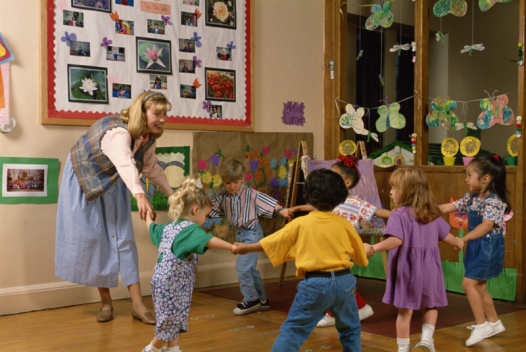
UW researcher Beth Graue suggests that if you are thinking that it might be better to delay your child’s entry into kindergarten for another year, don’t.

If you have reservations about whether your son or daughter is ready for kindergarten, you’re not alone. Many parents agonize over concerns that their child might be among the youngest or smallest in the class. They often wrestle with doubts about their child’s social, emotional or academic readiness.

Her research has found that delaying entry — called “academic redshirting,” after the college sports practice of deferring eligibility for freshmen players — has few positive effects. Children who are older when they start kindergarten might experience initial academic and social advantages, but those generally disappear by the end of third grade. Meanwhile, “redshirts” have higher–than–expected placement in special education and more social, emotional and disciplinary problems.

“Readiness is a relative thing,” she says. “There are some kids who always color outside the lines, and that extra year will just make them bigger, not necessarily more ready.”

She has found that parents are less likely to delay entry for girls with fall birthdays, and these girls tend to do well. When entry is delayed, the consequences are similar, regardless of gender.

“We will always have some kids who are more or less ready, no matter what the cut–off date is,” says Graue.

Parents delay entry for a variety of reasons – most often for social, emotional, physical and biological concerns. They are usually trying to avoid something, such as their kid being the last picked for kickball.

Middle–class parents are more likely to be familiar with redshirting as a strategy from reading parenting magazines and blogs. These families are also better able to provide an enriching home environment. Working–class parents tend to want their kids in school sooner.

Here are a few tips from Graue on preparing your child to start school:

  • Reading to your child every day is the best foundation you can provide.
  • Make the most out of everyday tasks. For instance, having your child set the table with one fork at every place teaches such concepts of one-to-one correspondence and how to follow directions.
  • Give your child lots of play time with peers to practice in cooperating with others.
  • Tour the kindergarten your child will be attending; a prepared child will be more confident.

And yet, there has never been a moments doubt in our minds as parents that our younger daughter has benefited immensely by holding back her start into kindergarten. She seems to be right in the “sweet spot” of where she should be academic-wise and emotionally, seemingly well adjusted for her grade level. A tough one to call. The axiom that all children are different never seemed more apropos.

Robert Godfrey

Leave a comment

Filed under AMPS, Best Practices

Who’s Out to Get Public Schools?

girl-staring.jpg

Gerald Bracey has an interesting report out this morning.

When people think about the groups or individuals who wish to privatize public schools, they probably think of only a few foundations and people. The late Milton Friedman and John Walton and the living Paul Peterson; the Heritage Foundation, Manhattan Institute, Hoover Institution, Heartland Institute, American Enterprise Institute, Goldwater Institute, Bradley, Scaife and a scattering of others.

This is a mistake. A recent study by the National Committee for Responsive Philanthropy studying the years 2002 to 2006 identified 132 separate school choice organizations (www.ncrp.org, “Strategic Grantmaking”). One hundred and four of these 132 received grants from 1,212 foundations with total contributions exceeding $100,000,000 in some years. The Walton Family Foundation (Wal-Mart) dwarfed all others with grants often exceeding $25 million.

These foundations also funded candidates, political parties, political action groups and 501(c)4 organizations. Overwhelmingly, the recipients of this largess were Republican candidates and causes.

… [There’s] a common flaw in the reasoning of the privatizers: it assumes that there are enough private schools to go around. In fact, the existing private schools, even if they wanted these poor kids, which most of them don’t, could accommodate no more than 4% of students now in the public schools. In the early years of the privatization movement, analogies were often drawn to fast food restaurants—new schools would spring up as fast as McDonald’s or Starbucks. The privatizers have apparently gotten past that particular stupidity and realize that a school is a large and complex ecosystem which requires expert knowledge not needed for hamburger flipping.

The privatizers can be critical of how conservatives fund voucher movements. Many think it is silly to fund the large think tanks such as AEI and Heritage, because they end up forming partnerships with people whose primary interest is in maintaining the status quo. Many advocate small funding to, say, parents, who have a direct interest (it is alleged) in change. In fact some people have accused the large conservative think tanks with having a basic distrust of democracy. Giving money directly to parents, on the other hand, reflects a belief that parents can select the schools best for their children.

It is interesting in this connection that supporters of the oldest (18 years) and largest (19,000 students) voucher program in the country, that in Milwaukee, have just begun a million-dollar campaign to build support for the program. According to an article in the January 28, 2008 Milwaukee Journal Sentinel the group “will sponsor television, radio and print advertising over the next four months as well as undertaking other activities aimed at increasing positive opinions of the program.”

Of course, the simplest way to build support would be to show that the program works. This has not been done in Milwaukee or elsewhere (the alleged big gains Paul Peterson found for blacks in New York City disappeared when proper statistical techniques were used). Evaluations of the program after five years reached contradictory conclusions, the most reasonable one being, in my opinion, that the program had no impact on reading achievement and a small impact on mathematics achievement. The researcher, Cecilia Rouse of Princeton, observed, though, that voucher students attended smaller classes and that class size could easily be the source of the voucher students’ advantage. After that evaluation, voucher supporters in the legislature expressed their confidence in the program by killing any further funding for evaluations.

And of course the other meme that will come to be employed with increasing frequency in the future, is the one that says education evaluation is not a science and therefore can’t be trusted. Except of course when it’s your own think tank that produces the results that confirm the efficacy of the voucher program you hope to promote.

Robert Godfrey


7 Comments

Filed under Accountability, Equity, Gimme Some Truth, School Finance, Uncategorized

Wolf in sheep’s clothing or a Trojan horse?

trojan-horse.jpg

In his state of the union address last night, President Bush touted “Pell Grants for Kids,” (PGFK) a $300 million federal voucher program. Pell grants are a popular program that provides needs-based post secondary tuition assistance. The program, like most things involving education, has been underfunded during the Bush presidency. Of course PGFK also tries to do things on the cheap, promising only $500 per student in aid, hardly enough to make a difference for most of the low income families who would be eligible. As policy PGFK is ridiculous; as symbolism it is important. The hook is that like pell grants, the “new” program could be used at private and religious institutions. In 1,000 ways higher education and k-12 education developed differently in this country — for example there are no compulsory higher education laws — and using tax dollars to fund private and religious education for children is not the same as helping adults afford to attend the college of their choice.

Of course unlike PGFK, pell grants can also be used at public institutions. Wouldn’t it be great if Bush had proposed giving every school district $500 more per student in federal aid. Although this probably still wouldn’t take care of all the underfunded federal mandates, it would mean about $12 million a year more for MMSD. Don’t hold your breath.

I put “new” in quotation marks above because this is an old idea all around. It was introduced as “The GI Bill for kids” By Lamar Alexander, when he was Secretary of Education under Bush I. Again, the attempt to create confusion by naming a voucher program after a popular program for adults. This went nowhere and it was reborn as PGFK in 2004, with a push from (then and now) Senator Lamar Alexander. The Senate testimony of (then) Arlington, VA Superintendent Robert Smith from 2004 gives a nice summary of how wrongheaded the proposal was and is. Andrew Rotherman of EdSector/Edwonk noted at the time that this was all about scoring a “political point” for school choice (note: I agree with Rotherman that this was and is about politics; I don’t agree with much else he has to say about it).

The title of this post is a trick question, the correct answer is both. Invoking pell grants covers the wolf of vouchers in the sheep’s clothing. Voucher proponents like Bush and Alexander hope to smuggle a small part of their policies into law under disguise thereby scoring points with people like the Hoover Institution, opening the door to more privatization and further undermining support for public education (and less support means more underfunding, which in turn leads to less support…starve the beast).

Don’t let it happen.

Thomas J. Mertz

Related links:

The New York Times, Grants Would Finance Private Schooling

Educational Whisper, Pell Grants For Kids = Vouchers In Disquise

Senate Hearing from 2004

Think Progress, SOTU: Bush’s ‘Pell Grants for Kids’ Plan Is Vouchers In Disguise

Engaged Intellectuals, Pell Grants for Kids?!

Carpetbagger Report, ‘Pell Grants for Kids’ = Vouchers

1 Comment

Filed under Gimme Some Truth, National News, nclb, No Child Left Behind, School Finance, Uncategorized

Green Bay Educator Offered Madison Superintendent Job

From WKOW:

nerad.jpgDr. Daniel Nerad

Two sources close to the process of selecting a new Madison Schools Superintendent tell 27 News the position has been offered to Green Bay School District Superintendent Daniel Nerad.Green Bay School District spokesperson Amanda Brooker told 27 News Nerad, 56, would not comment Monday on the selection process.Madison School Board President Arlene Silviera also declined comment.School Board members had identified Nerad, Miami-Dade Public Schools administrator Steve Gallon, and Boston Public Schools Budget Director James McIntyre as the three finalists for the position.School District officials have said an offer of the job would be followed by salary negotiation and a site visit by school board members to the candidate’s home area.

Nerad is a Wisconsin native who was named state superintendent of the year in 2006.

Nerad told the Capital Times last week he has passed on other appealing offers to leave his Green Bay position during his thirty year career there. Nerad told the newspaper the Madison opportunity was “unique” because of his admiration for the district’s work and his family’s strong ties to the city. Nerad’s son, Benjamin, is a Madison-based legislative aide for Rep. Tom Nelson (D-Kaukauna).

If Nerad accepts the position and contract terms are finalized, he would replace Superintendent of Schools Art Rainwater, who retires June 30.

(I think) I can say now, he was my first choice. In his public discussion, he hit John Dewey, equity (in a way that I liked), state school finance reform and was great on community involvement and the idea that schools are about more than academic learning. Dewey is a hero to me and the others are issues and ideas near and dear to my heart. Much good about the others, but Nerad fit my desires best.

Congratulations.

Thomas J. Mertz

Leave a comment

Filed under Contracts, Equity, Local News