Monthly Archives: May 2009

Breaking — Doyle Says Yes to More Cuts, No New Taxes

168677803v11_350x350_Front

Watching the budget “fix” press conference via WisconsinEye. Mark Pocan and Mark Miller are by Governor Jim Doyle’s side, so little hope for Joint Finance action.

5% across the board cuts to most state functions; 2.5% cut to education, 2.5% cut to shared revenue.

More double talk about stimulus money and education funding.

Seems to leave the door open to maybe a temporary delay on ending the Qualified Economic Offer.

Claims to “protect” education. Revenue cap allowable increase will be reduced.

Lots of talk about “protecting property taxpayers.” Nothing about investing in the future of our students or our state.

Not good.

More here on WisPolitics.

I guess that we have answers to this quiz.

Thomas J. Mertz

1 Comment

Filed under "education finance", Budget, education, Local News, School Finance, Uncategorized

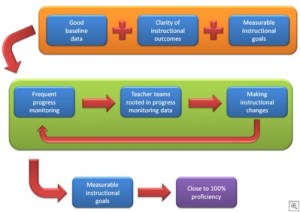
Data Driven Sanity

Image from "Guest Blogger Scott McLeod on Data-Driven Decision Making" on the eduwonkette, click on image for more on D3M from that sorely missed blog.

Image from "Guest Blogger Scott McLeod on Data-Driven Decision Making" on the eduwonkette blog, click on image for more on D3M from that sorely missed blog.

Diane Ravitch has some more words of sanity on Data Driven policy making at the Bridging Differences blog.  Click the link for the entire post; here is an excerpt:

This approach rests squarely on the high-stakes use of testing. One only wishes that the proponents of this mean-spirited approach might themselves be subjected to a high-stakes test about their understanding of children and education! I predict that every one of them would fail and be severely punished.

We agree that a better approach is needed to assess how well students are learning what they are taught. We agree that current standardized tests are not adequate to the task of determining the fate—whether they should be rewarded or punished—of children, teachers, and their schools.

I think that testing is important and can be valuable, as it helps to spotlight problems and individuals in need of help. But the determinative word here is “help.” The so-called reformers want to use accountability to find people in need of termination and schools in need of closure. Let’s hope this punishment-obsessed crowd is never put in charge of hospitals!

Unfortunately, events are not breaking in the direction we both prefer. The stimulus bill includes millions so that every state can create a data system. This system will track the test scores of every student, from pre-K to college, and attribute their test score gains (or lack thereof) to their teachers. When the information is available, it will be used and misused. Every teacher (at least those who teach the tested subjects) will have a public record detailing whether his or her students made gains or not. This information will be used to establish calibrated merit pay schemes, so that each teacher will get more or fewer dollars depending on the scores of the year. Is this piecework?

The federal government seems ready to impose a Dr. Strangelove approach on our schools to turn them into “data-driven systems.” Not, as you suggest, “data-informed” systems, but data-driven systems. Teachers will certainly teach to the tests, since nothing else matters. The only missing ingredient from this grand data-driven scheme will be education.

More on data driven policy on AMPS here.

Thomas J. Mertz

1 Comment

Filed under Accountability, Best Practices, education, National News, nclb, No Child Left Behind, Uncategorized

Quotes of the Day — A Tale of Two Governors

Illinois Governor Quinn

[Illinois Governor Patrick] Quinn laid out what a “doomsday” budget might look like if lawmakers “slash and burn” their way to close a deficit of at least $11.6 billion instead of going along with his plan to boost taxes.

“In a tough time we don’t want history to say the people of Illinois threw a lot of their fellow citizens overboard because they didn’t want to make any sacrifices or tough choices,” Quinn told reporters after detailing a litany of possible cuts to more than 300 people at the City Club of Chicago, a local civic club.

94575

Chicago Tribune.

[Wisconsin Governor Jim] Doyle, when asked by a reporter what he would do if the Democratic-controlled Legislature sent him a budget with sales or income tax increases, responded, “I hope that does not come to my desk.”

MMSD Today.

Leave a comment

Filed under "education finance", Budget, education, Elections, finance, Local News, National News, School Finance, Uncategorized

Cherry Pick’n, Or When Scott Milfred Does Data Driven Policy

cherry+picking1Scott Milfred’s column in the Sunday May 17, 2009 Wisconsin State Journal is a textbook example of the kind of foolishness people indulge in when they are dazzled by data that seems to support their favored policies.

Mr. Milfred likes charter schools. One piece of the recently released test score data for the Madison charter school Nuestro Mundo was positive, Mr Milfred seizes on this single piece of data, giving it no examination or context, then asserting that the entire state needs more charter schools.

In a previous post on the Nuestro Mundo WKCE results, I wrote:

All good, but really too little change or information to justify any action or inaction. Data should inform actions, but not drive them. Do we really want a system where decisions are made based on how 1 or 2 or 3 kids test on a given day?

Apparently Mr.Milfred does, and he wants it for the entire state.

The post quoted above explained that the rise in test scores being hailed amounted to about four kids in fourth grade improving. Further, it noted that mobility issues make it difficult to be certain of even this much. That post also noted that scores in other subjects still lag and that this year’s third grade scores are pretty bad.

Mr. Milfred’s money quote is:

Eighty-one percent of the Nuestro Mundo fourth-graders tested proficient or advanced in English reading on the most recent tests. That’s better than the fourth-graders in the district as a whole, most of whom speak only English.

Getting at the limited utility of this statement requires looking behind the numbers some more.

First, I don’t know where the 81% comes from, DPI/WNSS says 80% and since there are exactly 0 students from the Nuestro Mundo fourth grade whose results are reported, a percentage of 81 is impossible. The district advanced/proficient for fourth graders is 75.9%

If one fewer Nuestro Mundo student had hit the advanced/proficient cut score, the school percent would be 77.5%; two fewer, 75%and below the district average. So that’s the one, or two or three kids whose scores Milfred wants us to base policy on.

Let’s look at some demographics. Nuestro Mundo’s fourth grade class has a 4o% poverty rate; the rate for MMSD’s tested fourth graders is 44.6%. As more than one researcher has noted “…Standardized Achievement Tests are [more] Sensitive to Socioeconomic Status Rather than Instruction…

Nuestro Mundo’s fourth grade has one tested student with disabilities (2.5%); MMSD’s fourth grade as a whole has 251 tested students with disabilities, or 15.7%. Only 47.4% of the fourth graders with disabilities in Madison tested advanced/proficient (note, the testing of some disabled students amounts to a torturous game of asking someone to do what they clearly cannot; the use of these results to judge or punish schools and districts is a sick practice…I have similar feelings about the use of tests in this way with non-English speakers).

You can do the Math, adjust for demographics and Nuestro Mundo’s fourth grade achievement starts to look a lot like the average fourth grade in Madison.

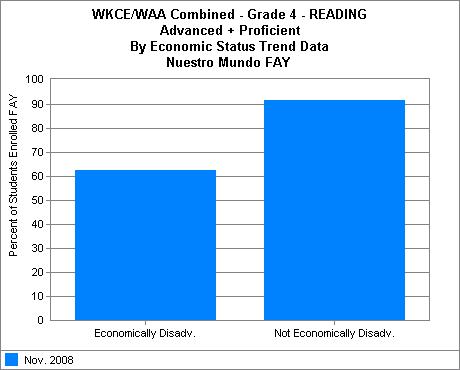
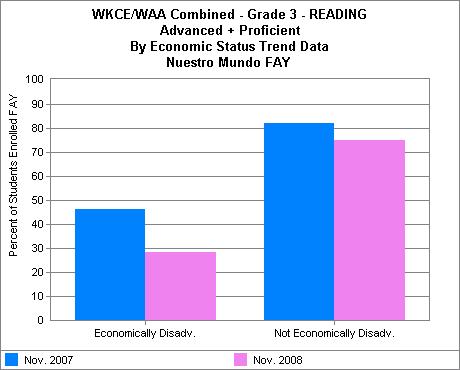
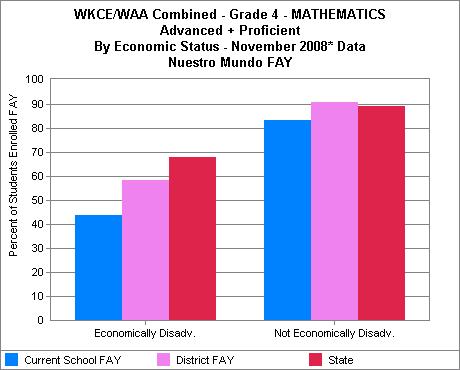
I don’t want to dwell on it much further, but fourth grade math scores at Nuestro Mundo aren’t good, especially for low income or ELL students. Here are a couple of graphs:
CFT0518_184349348

CFT0518_184713393

Only 33.3%  of ELL students scoring advanced proficient on Math gives one pause.

Unlike Mr. Milfred, I’m not simple-minded enough to urge any drastic policy based on these scores. They deserve considered and continued attention, further investigation and perhaps some remediation, but even though they are much more negative than Mr. Milfred’s vaunted reading scores are positive, I don’t think there is enough information here to say (for example) “shut the school down.”

Unfortunately, as long as we have standardized tests substituting for knowledge and learning — in both classrooms and policy debates — people like Mr. Milfred will latch onto some simplistic cherry picked results to push this reform or that.

It isn’t all that different from the mentality that created this economic crisis. In that case, investors wanted to bypass investigation and thought, and boil risk down to a single number. They could check their brains and pretend all was well because “the numbers were good.” Never mind that what was behind those numbers was a mystery to the investors and a house of cards that was doomed to fall.

In education there is a politician’s and polemicist’s desire for easy transparency and accountability. Test scores must be published, but few look at the tests or even the cut scores and scales. The complexities of the tests and scores are swept aside and almost completely forgotten are all things not on the tests and all those things that can’t be boiled down to a single number.

Things like “value added” have the potential to make this worse by removing “the number” further from comprehension by most.

People like Scott Milfred then use things — a number(s) — that they don’t understand, to spout off about other things — education policy — they don’t understand.

Don’t listen to them. Look behind the numbers and the polemics, read and learn and contribute. Education is too important to be hijacked by the lazy likes of Scott Milfred.

One last note. If I read Mr. Milfred’s column correctly, he is a parent of a Nuestro Mundo student. This information should be prominently disclosed when Mr.Milfred, or the Editorial page he is in charge of, opines on the topic. It has not been.

Thomas J. Mertz

Leave a comment

Filed under Accountability, Best Practices, education, Gimme Some Truth, Local News, Uncategorized

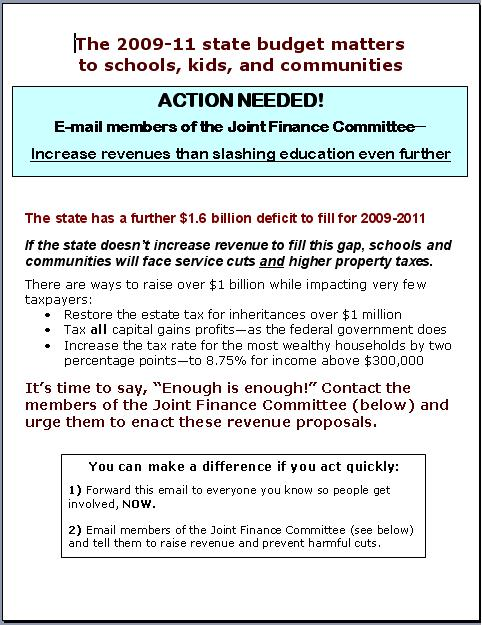
Action Alert

action alert

You can make a difference by letting the members of the Legislature’s Joint Finance Committee know you expect them to use common sense and take a balanced approach to working through the state’s financial crisis. We solve nothing if we dismantle our schools and other important public services. Right now:

  • Pass along this e-mail alert to as many other people as you can.E-mail members of the
  • Joint Finance Committee (click here for their e-mail addresses — http://www.legis.state.wi.us/lfb/jfc.html) with your suggestions about dealing with the gap.

Thanks.

Tom

Thomas S. Beebe, Executive Director
Wisconsin Alliance for Excellent Schools


More on AMPS, here and here and a sample message here.

Thomas J. Mertz

Leave a comment

Filed under "education finance", Budget, education, finance, School Finance, Take Action, Uncategorized

Sow and Reap – More on the Wisconsin State Budget

Jean-Francois Millet, The Gleaners, 1857

Jean-Francois Millet, The Gleaners, 1857

You can only reap what you sow and it looks like Governor Jim Doyle’ s reluctance to reap and sow may be leading Wisconsin to more hard times and lean years.

In a statement today reported by the Journal Sentinel, Governor Doyle indicated that in response to revenue shortfalls, a new proposal requiring 5% cuts in state aid to public schools and local governments is in the works (more here). These would be devastating to programs and services that are already strained.

He used the word “forced,” but in very similar terms to the Republicans, who in the last budget cycle, claimed to have been “forced” to cut aid when they were acting on their own volition, the “forcing” Doyle refers to is in fact a choice being made by the Governor himself.

As previously noted (here and here), there is much potential for Wisconsin to restructure our revenue choices to meet these shortfalls and move toward an equitable and sustainable tax structure.

The Institute for Wiscosin’s Future (IWF) put out a “cliff notes” one page version of the Catalog of Tax Reform Options for Wisconsin today . Here it is:

Tax Reform Option

Taxpayers Affected

Annual Fiscal Impact

(FY2010-‘11)

INCOME TAX OPTIONS
Reinstate the estate tax with a $1 million exemption: When Wisconsin last had this, rates ranged from 0.8% to 16%, averaging 5%. Forty percent or more could be offset by a lower federal tax. The estates of Wisconsin’s wealthiest—about 1% of those dying each year. Estates left to surviving spouses would not be taxed. $21 million FY10; $85 million FY11
Tax 100% of capital gains: Wisconsin now taxes only 40% of capital gains; Governor’s budget proposal would increase that to 60% Investors who profit from sales of stocks, bonds, real estate and other assets. IRS says over 70% of capital gains go to persons with incomes above $100,000. $170 million FY10; $192 million FY11
Increase from 6.75% to 8.75% the income tax on taxable income above $300,000 for joint filers and $225,000 for single filers. Governor’s budget proposal would raise the rate to 7.75%. High-income taxpayers. A couple with $400,000 taxable income would pay $2,000 more, some of that offset by lower federal taxes. $362 million FY10; $272 million FY11
SALES TAX OPTIONS
Extend the sales tax to personal services:

(Such as beauty, barber and other personal care; vets for pets; health clubs; admission to educational events/ places; dues to fraternal organizations; auto club fees; funerals.

Primarily Wisconsin households, though businesses would pay a share. $93 million FY10; $96 million FY11
Increase the state sales tax rate from 5 cents per dollar to 6 cents 82% of the increase would be paid by Wisconsin residents, 9% by state businesses and 9% by residents of other states. $806 million FY10; $847 million FY11

Note: Fiscal impacts based on latest Department of Revenue and Legislative Fiscal Bureau estimates.

The IWF is also a co-sponsor of a press conference bringing people together to “Speak Up for a Budget the Puts People First” (click on the title for more information and a a flier). It is being held next Tuesday, May 19, at 9:30 AM in the State Senate Parlor. Be there if you can.

The ball is also in the Joint Finance Committee’s court. What ever Doyle proposes, they have a big say in the process. It is absolutely essential that they hear from constituents that new revenues are the only way we can sow for a bountiful future. The Committee is chaired by Madison’s Mark Pocan and Monona’s Mark Miller. All the contact info is here. They need to hear from you! A quick call, an email, anything.

The Journal Sentinel story also noted:

A 5% cut would cost schools about $258 million, although some of that could be offset by federal stimulus money (emphasis added).

Confusion still reigns on the stimulus funds. Two quick clarifications may help. First, the “flow through” money has already been earmarked to pay for a large chunk of the state’s share of the inadequate allowable revenue (the inadequate allowable revenue increases have been almost entirely shifted to property taxes). That horse has left the barn. Second, the general rule for the other stimulus money (Title I and IDEA) is to “supplement not supplant.” There are some loopholes, but they aren’t big enough to absorb this hit. In terms of general operating revenues, the stimulus has been basically spent already. Let’s stop pretending otherwise.

Come the the press conference. Get those notes and calls done. This is important.

Thomas J. Mertz

Leave a comment

Filed under "education finance", Best Practices, Budget, education, finance, Local News, School Finance, Take Action, Uncategorized

What Is Wrong With Data Driven Accountability — 17 Paragraphs, 4 Students (at most)

CFT0514_132319B1

CFT0514_133553191

Some good news on the most recent WKCE scores from Nuestro Mundo, as covered in a 17 paragraph Capitol Times story.  Good news, which like much achievement data is of limited use.

The headline trumpets “Promising” gains and the big news is that the cohort now in 4th grade went from 70% advanced/proficient in reading when they were 3d gaders to 81% as 4th graders.  The story also notes that math scores remain dismal and that the current 3d grade cohort’s advanced proficient number is only 51%.

One thing not noted is that this gain of 11% represents exactly 4 more students scoring advanced/proficient (from 29 to 33, because of mobility issues cohorts change and students who were not at the school a full year are not reported — of the current 4th grade at Nuestro Mundo, 3 students are not reported because of this).

More good news is that low income advanced/proficient raw numbers went from 6 to 10 for the cohort (the cohort went from 12 to 16 in total low income, so it is impossible to say if any individual moved up) , limited English from 5 to 6 (cohort was constant) and Hispanic from 6 to 7 (also a constant cohort number).

All good, but really too little change or information to justify any action or inaction.  Data should inform actions, but not drive them.   Do we really want a system where decisions are made based on how 1 or 2 or 3 kids test on a given day?

So congrats for the gains to the Nuestro Mundo staff, students and families and a plea for all — especially policy makers — to keep the good and bad standardized test scores in perspective.

All figures calculated from DPI/WINSS.

Thomas J. Mertz

Leave a comment

Filed under Accountability, Best Practices, education, Local News

Letters to the Editor — School Finance (and the QEO)

image-letter-to-the-editor-stampMany good letters to the editor in response to a recentWisconsin State Journal editorial.

QEO repeal alone would make situation worse

In 1993, Wisconsin adopted a “temporary” formula for funding public schools based on revenue caps, the QEO and a promise of two-thirds funding for education from the state.

Revenue caps and the QEO were set at levels that did not foresee today’s health care and energy costs, or the increasing percentages of students needing services such as special education. State funding falls farther behind the two-thirds goal every year. And under the current budget proposal, we would lose the QEO as well. Revenue caps left alone will not support schools. It will crush them.

It’s time for state government, which created this situation, to take responsibility for solving it. We need a sustainable education system, one that balances the needs of students, teachers and taxpayers.

Simply repealing the QEO will make the situation worse, not better.

— Sherri Swartz, Madison

Today’s schools funded using obsolete system

When I retired in 2006 after a total of over 33 years teaching, 26 of them here, I was earning $47,092, with a master’s degree plus 16 graduate credits, on a pay scale which went no higher than 13 years of experience.

This represents a small annual increase during those 26 years over the equivalent pay scale when I started in 1980 ($18,675).

In what other profession requiring a master’s degree would you expect people to work at those salary rates?

The QEO mandates 3.8 percent. But double digit inflationary increases in health insurance costs eat up most of that.

School districts can’t keep up by financing education mainly with property tax increases. We are trying to pay for education with a horse-and-buggy system. In the 21st century, this simply won’t work. Boomer-aged teachers are retiring, and few young people wanting to survive financially would consider entering such a poorly paid profession.

If you want good teachers, revamp the whole system and control health costs.

— Kay Ziegahn, Richland Center

QEO and revenue caps bad way to fund schools

The QEO does not rise with the cost of living, so teachers are being paid less and less every year. This is unfair, especially for those who have been teaching the longest.

And the revenue caps have caused a lot of damage as well. Several towns have closed schools because they no longer have enough money to run them. Other towns have cut out their sports programs.

And here in Madison, teachers have retired early so younger teachers won’t have to lose their jobs. Programs and courses have been cut, and there is less money for supplies. Computers cannot be upgraded, so they are too slow in some schools.

If we are to keep up with schools around the world, we must eliminate the QEO and the revenue caps. We must fund our schools.

— Genie Ogden, Madison

Reconsider America’s public school concept

As an educator in the public schools, I wonder why it seems like this is a panic. The QEO has been in place since 1993, and this is Gov. Jim Doyle’s second term. There should have been plenty of time to evaluate the QEO and the revenue caps, as well as comparing these to other states.

Wisconsin is not alone in struggling to fund public schools. You can blame it on our “rich” health care benefits, although I’ve never heard GHC referred to as “rich.” Maybe addressing the portion of health care would be reasonable. But Wisconsin cannot expect to attract and keep good teachers if wage increases don’t even come close to the rate of inflation.

People should be reminded that educators not only have a minimum of one degree but must also pay for six credits to maintain the five-year license that we pay for.

It may also be time for states and the Department of Education to revisit the notion of public schools and how to best prepare tomorrow’s workforce. Cutting programs, increased class sizes, fewer technological resources and closed schools is not the answer to funding education.

— Dawn Nonn, Madison

Isn’t it amazing how concerned citizens can so clearly see the need for comprehensive school finance reform, yet our elected leaders seem to be wearing blinders.

Thomas J. Mertz

Leave a comment

Filed under "education finance", Best Practices, Budget, Contracts, education, Elections, Gimme Some Truth, Local News, School Finance, Uncategorized

A Message to State Officials — My Budget Letter

Madison May Day Rally 2009, photo Dace Zeps, click on image for more information.

Madison May Day Rally 2009, photo Dace Zeps, click on image for more information.

There are lots of ways to get a message to elected officials.  You can march and rally, like many of us did on May Day in support of a variety of causes and many more of us will on June 16 to call for long-overdue school funding reform.  You can testify at a hearing like the supporters of the School Finance Network did recently.  You can visit their offices and you can always send a letter.

Here is the letter I sent today.

Governor James Doyle

State Senator Fred Risser

State Representative Mark Pocan

State Capitol
Madison, WI 53708

Dear Sirs

As work on Wisconsin’s biennial budget moves forward, you and your colleagues face increasingly difficult choices.  The current economic crisis and the difficulties you face demand real leadership.

This crisis — in the public and private sectors, at the national, state and local levels – is the product of too many years of looking for quick and easy fixes and savings.  The gimmicks have been exhausted, the savings have been proven illusionary, and the short term view has wrought extensive damage.

It is time to champion a new vision.  Wisconsin needs you to lead the state in a recommitment to a sustainable and progressive system of revenues sufficient to provide the investments in education, social services, health care, and infrastructure necessary for Wisconsin to grow stronger, more prosperous and more equitable.

The Wisconsin Council on Children and Families and the Institute for Wisconsin’s Future have produced a Catalog of Tax Reform Options for Wisconsin.  This document offers many ideas for fair and sustainable revenue policies.  I urge you to put these ideas at the center of your continuing work on the budget.

I am an active citizen, member and supporter of the Democratic Party of Wisconsin.  I have volunteered and donated and even hosted a “Take Back the Assembly” fundraiser in the last election cycle.  I’ve done this because I believed in the Democratic platform planks promising “fair taxation,” full funding of educational mandates, and “access to affordable health care,” and more.  These are the ideas that put you into office.  Now, more than ever you need to put these ideas into action.

As we all look forward to the next election cycle, it may be helpful to think about how difficult it will be to hold on to majorities and offices if all you have to offer is “We survived the economic crisis without too much harm and no fundamental changes in our approach to governance.”  Propping up the status quo also contains risks, but it offers few rewards for the citizens or the Democratic Party.  Change was the watchword last November and the increasingly apparent failures of the old way of doing things have only made the demand for change more pressing.

You are in a position to lead that change.  Please be part of building the future our state needs.

Thomas J. Mertz

Send your own letter (info here, feel free to post it in the comments); join the march and rally on June 16!  Take action!

Thomas J. Mertz

Leave a comment

Filed under "education finance", Best Practices, Budget, education, Elections, finance, Local News, School Finance, Take Action, Uncategorized

WAES School-Funding Update, the Week of May 11, 2009

waesgraphic

Click on the image to visit the Wisconsin Alliance for Excelent Schools

From the Wisconsin Alliance for Excellent Schools.  Headlines/index below, click here for a pdf of the full update, click on the linked items for related posts on AMPS

Thomas J. Mertz

Leave a comment

Filed under "education finance", Best Practices, Budget, education, finance, Local News, Pope-Roberts/Breske Resolution, School Finance, Take Action