Author Archives: Thomas J. Mertz

(Not?) Talking about Diversity and Boundaries, 2008 Style

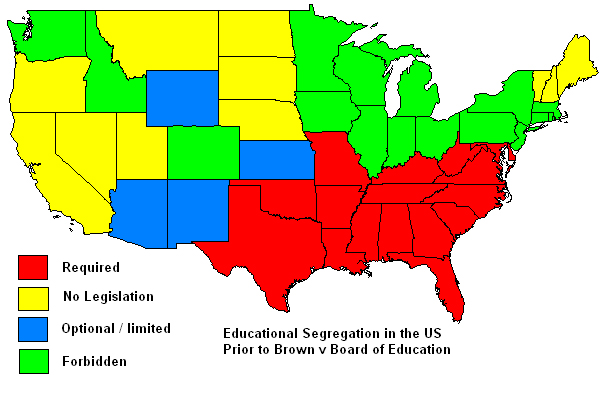
educational_seperation_in_the_us_prior_to_brown_map-copy.jpg

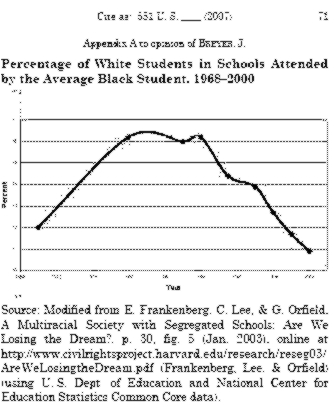
tends3.jpg

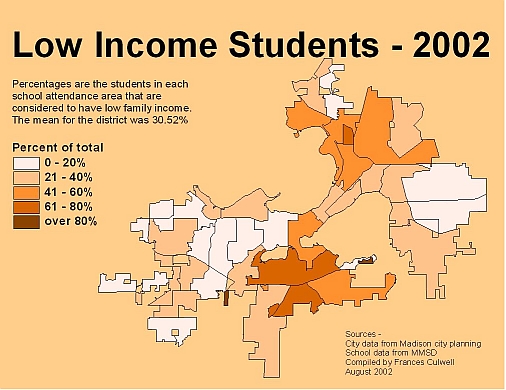
low-income.jpg

With the new school opening on the West side, Madison again must confront the competing interests and ideals involved in redrawing school attendance boundaries. The district has produced four plans (more may be in the works, or the existing ones may be tweaked). At a long and unusually non-confrontational meeting Monday (1/28/2008), concerned community members presented their views.

The guidelines used to create these plans include seven non-prioritized criteria, only one of which addresses diversity:

Every attempt will be made to avoid creating schools with high concentrations of low-income families.

It should be noted that this gives no guidance about schools with high concentrations of high-income families.

The Equity Task Force asked the Board to consider having racial, linguistic and/or economic diversity figure more prominently in this and related processes. The Board has taken no action on this.

What role race and linguistic considerations can play in drawing school boundaries is an open constitutional question. In the recent Louisville and Seattle case, Justice Joseph Kennedy’s partial concurrence rejected the plurality’s contention that these could not play any direct role:

School boards may pursue the goal of bringing together students of diverse backgrounds and races through other means, including strategic site selection of new schools; drawing attendance zones with general recognition of the demographics of neighborhoods; allocating resources for special programs; recruiting students and faculty in a targeted fashion; and tracking enrollments, performance, and other statistics by race.

Many consider Kennedy’s to be the “controlling opinion” in that without his vote the court would have been evenly split.

Nationally the trend toward re-segregation (however you measure it) continues. This trend can be seen in the graph above (from Justice Breyer’s dissent in the same case). A recent article in the Christian Science Monitor documents and explores the continued growth of what Gary Orfield calls “apartheid schools” (those with 90% or more minority enrollment). As the article notes, some do not have a problem with this happening, others are less sanguine:

“I don’t think that the education that you get hinges on the color of the person sitting next to you in the classroom,” [Roger] Clegg [president of the (Bradley Foundation funded) Center for Equal Opportunity in Falls Church, Va.] says. “What educators should focus on is improving schools.”

That sounds great in theory, say some experts, but the fact is that segregated schools tend to be highly correlated with such things as school performance and the ability to attract teachers.

“Once you separate kids spacially from more privileged kids, they tend to not get the same things,” says Amy Stuart Wells, an education professor at Columbia University’s Teachers College in New York. “And we need to start thinking about how a school that’s racially isolated can be preparing students for this global society we live in.”

I agree with Wells, both in terms of resource allocations and in terms of the lessons being taught or not taught by segregated learning environments.

Things aren’t that bad in most of Madison, but without a conscious effort to directly confront the issues they will be. As a friend reminded me today. the attention given to test performance data — measures that highly correlate with economic status — have induced some families to judge schools by simplistic measures and avoid those that aren’t “performing.” Often the schools being shunned are good schools with high percentages of students who are poor. In terms of resources, MMSD does what it can to direct resources to those schools with high needs, but the school finance system in general and the underfunding of Title I, Special Education, Bi-Lingual Education, SAGE and a host of other programs make this more difficult each year.

When I start to talk like this, to suggest being more proactive on issues of diversity, many are quick to remind me of the dangers of “becoming like Milwaukee,” meaning a district or city that has been largely abandoned by the middle and upper classes because they believe the schools no longer serve their children. There is no question that the growth in low income and minority students will keep some people from sending thie children to Madison Schools and that under the revenue caps this will have an adverse effect on the all the children in the district. There is also no question that prioritizing the needs of our neediest will exacerbate this. I think that is a price we should be willing to pay.

I am also well aware that dealing with these matters quietly and indirectly is easier for school officials, elected and appointed. Avoiding controversy and pretending differences (of status and opinion) don’t exist is always easier. For the most part MMSD has done a very good, if relatively quiet and indirect job of addressing diversity. I don’t think that is sufficient. I think being loud and direct at times is important.

In a recent Education Week there was a review of a new book, Everyday Antiracism: Getting Real About Race in School, by Mica Pollock. The book offers 65 essays by scholars “who offer advice for educators on recognizing when everyday classroom practices exacerbate racial inequalities and on becoming more constructively conscious and open about race.” In an earlier book, Pollock had coined the term “Colormuteness,” to denote the reluctance to talk about race directly. What Pollack is championing for the classroom, I am urging for the wider public sphere and not just for color or race, but other dimensions of inequality as well.

I was at a meeting last night where the talk turned to the responsibility of communities like Madison to demonstrate that diverse public schools (along with other progressive social policies) can and do work. The idea is that we need to serve as a counter example for those who would throw up their hands and say segregation and inequality are too intractable, or want to privatize schools and services because they have given up on public institutions. Madison has the resources and the communal will to do this and I believe many of us, quietly and indirectly, try. Quietly and indirectly isn’t good enough to meet this responsibility. Quietly and indirectly sends the message that we aren’t confident that we are right and able. We need to be loud and proud, we need to confront and demand and be relentless.

Kind of a long trip from the current West side boundary discussion. To bring it back around, in that context I would like MMSD to say, “yes we do seek diverse schools because we believe that in 1,000 ways diverse schools help combat inequality and segregated schools reinforce inequality. Creating opportunities and combating inequality are central to our mission.” More generally, I would like all associated with the schools to enact policies (including those proposed by the Equity Task Force) and follow practices (including those proposed by the Equity Task Force) that are proudly proactive on matters of racial, linguistic, economic and other inequalities. Last, I’d like us all to talk about this, not around it.

Thomas J. Mertz

wellbehavedwomenseldom.jpg

1 Comment

Filed under AMPS, Best Practices, Equity, Local News, Take Action, Uncategorized

Wolf in sheep’s clothing or a Trojan horse?

trojan-horse.jpg

In his state of the union address last night, President Bush touted “Pell Grants for Kids,” (PGFK) a $300 million federal voucher program. Pell grants are a popular program that provides needs-based post secondary tuition assistance. The program, like most things involving education, has been underfunded during the Bush presidency. Of course PGFK also tries to do things on the cheap, promising only $500 per student in aid, hardly enough to make a difference for most of the low income families who would be eligible. As policy PGFK is ridiculous; as symbolism it is important. The hook is that like pell grants, the “new” program could be used at private and religious institutions. In 1,000 ways higher education and k-12 education developed differently in this country — for example there are no compulsory higher education laws — and using tax dollars to fund private and religious education for children is not the same as helping adults afford to attend the college of their choice.

Of course unlike PGFK, pell grants can also be used at public institutions. Wouldn’t it be great if Bush had proposed giving every school district $500 more per student in federal aid. Although this probably still wouldn’t take care of all the underfunded federal mandates, it would mean about $12 million a year more for MMSD. Don’t hold your breath.

I put “new” in quotation marks above because this is an old idea all around. It was introduced as “The GI Bill for kids” By Lamar Alexander, when he was Secretary of Education under Bush I. Again, the attempt to create confusion by naming a voucher program after a popular program for adults. This went nowhere and it was reborn as PGFK in 2004, with a push from (then and now) Senator Lamar Alexander. The Senate testimony of (then) Arlington, VA Superintendent Robert Smith from 2004 gives a nice summary of how wrongheaded the proposal was and is. Andrew Rotherman of EdSector/Edwonk noted at the time that this was all about scoring a “political point” for school choice (note: I agree with Rotherman that this was and is about politics; I don’t agree with much else he has to say about it).

The title of this post is a trick question, the correct answer is both. Invoking pell grants covers the wolf of vouchers in the sheep’s clothing. Voucher proponents like Bush and Alexander hope to smuggle a small part of their policies into law under disguise thereby scoring points with people like the Hoover Institution, opening the door to more privatization and further undermining support for public education (and less support means more underfunding, which in turn leads to less support…starve the beast).

Don’t let it happen.

Thomas J. Mertz

Related links:

The New York Times, Grants Would Finance Private Schooling

Educational Whisper, Pell Grants For Kids = Vouchers In Disquise

Senate Hearing from 2004

Think Progress, SOTU: Bush’s ‘Pell Grants for Kids’ Plan Is Vouchers In Disguise

Engaged Intellectuals, Pell Grants for Kids?!

Carpetbagger Report, ‘Pell Grants for Kids’ = Vouchers

1 Comment

Filed under Gimme Some Truth, National News, nclb, No Child Left Behind, School Finance, Uncategorized

Green Bay Educator Offered Madison Superintendent Job

From WKOW:

nerad.jpgDr. Daniel Nerad

Two sources close to the process of selecting a new Madison Schools Superintendent tell 27 News the position has been offered to Green Bay School District Superintendent Daniel Nerad.Green Bay School District spokesperson Amanda Brooker told 27 News Nerad, 56, would not comment Monday on the selection process.Madison School Board President Arlene Silviera also declined comment.School Board members had identified Nerad, Miami-Dade Public Schools administrator Steve Gallon, and Boston Public Schools Budget Director James McIntyre as the three finalists for the position.School District officials have said an offer of the job would be followed by salary negotiation and a site visit by school board members to the candidate’s home area.

Nerad is a Wisconsin native who was named state superintendent of the year in 2006.

Nerad told the Capital Times last week he has passed on other appealing offers to leave his Green Bay position during his thirty year career there. Nerad told the newspaper the Madison opportunity was “unique” because of his admiration for the district’s work and his family’s strong ties to the city. Nerad’s son, Benjamin, is a Madison-based legislative aide for Rep. Tom Nelson (D-Kaukauna).

If Nerad accepts the position and contract terms are finalized, he would replace Superintendent of Schools Art Rainwater, who retires June 30.

(I think) I can say now, he was my first choice. In his public discussion, he hit John Dewey, equity (in a way that I liked), state school finance reform and was great on community involvement and the idea that schools are about more than academic learning. Dewey is a hero to me and the others are issues and ideas near and dear to my heart. Much good about the others, but Nerad fit my desires best.

Congratulations.

Thomas J. Mertz

Leave a comment

Filed under Contracts, Equity, Local News

Money well spent

When the Board of education decided to hire Hazard, Young and Attea to consult on the Superintendent search, there was some grumbling (in Madison there is always some grumbling).  Although the process is not complete, I think the money ($50,000 if I recall correctly) appears to have been well spent.

Everyone I’ve talked to, including Board members, has had good things to say about the qualifications of all three finalists and what each would bring to the district.  I think it is just as important to note that each would bring very different strengths, that the Board has been given a real choice. 

To me that is exactly where they should be at this point; faced with a hard decision, but one that is between distinct choices.

Best of luck to all involved.

Thomas J. Mertz

Leave a comment

Filed under Contracts, Local News, Uncategorized

We are not alone #18

alone2.jpg

Today’s entry in this series is about the Weston School District. Many of you may recall the tragic school shooting there in 2006. What I remember most from the news reports and conversations with people who knew the district, was how the community came together and found strength. They need that strength now.

Like Florence a couple of years ago and maybe Park Falls in the near future the insanity of our state finance system has the Weston district considering dissolution.

It looks like the future existence of the district hinges on an April 1 operating referendum vote. Some excerpts from three Reedsburg Times-Press articles tell the story (here and here and here).

Weston budget critically low

CAZENOVIA-The Weston school district faces another great challenge. If the school cannot solve its financial crisis, the district could be forced to disband, sending Weston’s students to one of its neighboring school districts, which include Reedsburg, River Valley, Ithaca, Wonewoc-Union Center, Hillsboro and Richland. This has happened to other districts in the state that were unable to overcome deficits.

Weston District Administrator Tom Andres and former district administrator Terry Milfred gave a presentation on this crisis to about 70 residents in the school library on an extremely foggy Monday evening. The presentation showcased the district’s current deficit and the larger ones projected each following year in the future that could bankrupt the school by the 2009-10. Without serious cuts or a cash influx, Weston’s administration projects the district’s fund balance to be more than $1.5 million in the red by the 2011-12 school year….

Both Andres and Milfred blame the state’s funding formula and revenue limits, established in 1993, for forcing the district to consider an operational tax funding referendum.

“The general fund goes up and down but typically costs go up,” Milfred said, noting that the cost of utilities has skyrocketed recently. “The legislature anticipated that we might have these kind of problems so they set up the option of having a local referendum. The problem with that is people are used to a referendum for a building or a roof. If people see a referendum for operation, they wonder what’s going on.”

Andres said the predicament has left the school few options.

“If you look at the numbers, you see what happens if we don’t,” he told the audience. “But before we make that step, what does this district want to do?”

Andres has put forward eliminating his own position as another option to cut costs. Andres, a former superintendent and guidance counselor, came out of retirement to help Weston after the 2006 school shooting and was eventually hired as district administrator…

“What we’re going to do is have one administrator for the entire district. That would cut back on some of the expenses going toward administration,” he said before encouraging audience members to air their views…

Support for a referendum

Several audience members spoke out in favor stopping cuts and passing a referendum.

“You are the custodian of the future generation. You shouldn’t be cutting anything,” Roderick Baker, a Cazenovia resident, said. “Somehow we’re going to have to bite the bullet to pay for their education. You know what’s going to hit the fan, and we’re going to have the ante up and pay the bill.”

Bob Smith agreed, saying that the inequality of the school funding system was the culprit.

“The rich schools get the money, the poor school districts don’t. This school district is dying a death of 1,000 cuts,” Smith said. “I have a firm opinion that the future of our country is in our children. There’s no reason why this district or any other district in Wisconsin can’t afford a good system. You need to go to referendum obviously to make up for the lost funds.”

Mitzi Hizel, who lives in the Weston district but works for the Reedsburg School District, said the money not invested in education might be lost on other expense.

“You can invest in kids now or we can pay for it in another way” she said. “It could be public defenders, the prison system and welfare.”

Weston voting on referendum Monday

Three options

The committee looked over three referendum options, but will recommend only one to the board. The district administration projects that the first two, one with allowing $390,000 additional property tax revenue each year and the second starting at $225,000 and rising to $400,000 over four years, will only sustain the district until the 2011-12 school year.

“Real bare minimum, doesn’t get us out of trouble for very long,” Andres characterized them. “Can we break out even so that at the end we don’t ask for more?”

So the committee is recommending a third option, which will raise the mill rate to 12.25 per $1,000 for the next two school years and then keep the mill rate pegged at 12 for the future.

“I don’t think we’re going to satisfy everyone, but I think that’s the best middle ground,” Tim Fichtel, a school board member, said.

Administration projects this will keep the school’s budget in the black at least five years, so the district will not have to return to voters for another operational referendum soon.

“That does keep the books and equipment in the budget year after year,” Kathy Stoltz, Weston’s business manager, said.

After having enough to get by the first two years, eventually this option will give the district some breathing room…

Unless a referendum passes, the district makes severe cuts or the state reforms its school funding formula, Weston will be bankrupt by the 2009-10 school year. The Department of Instruction would likely partition Weston among its neighbors, a fate met by other Wisconsin school districts unable to overcome their deficits.

Weston voters face referendum

CAZENOVIA-Voters in the Weston School District will have a tax limit referendum to vote on this spring. The School Board decided unanimously Monday to ask voters to OK an increased mill rate to keep the district’s finances solvent….

Although it was presented with four options, the board approved the committee’s recommended version of the referendum, in which the mill rate rises from 9.1 per $1,000 of assessed value to 12.25 for the next two years and then levels off at 12. According to the district administration’s forecast, this fourth option will stave off deficits despite continuing enrollment decline.

The first two options would result in a negative fund balance by the 2011-12 school year and the third option would leave only $711 in the district’s fund balance by that year.

“I think on this scenario four, we’ve got our tails covered. We can’t go over that, but we can go less,” Norman Klingaman, a board member, said. “Scenario four gets us what we need but is fiscally responsible.”

If approved the referendum would raise $1.88 million over four years. In the first two years, an owner of a $125,000 home would pay an extra $393.75 per year. In the third and fourth year, that total would dip to $362.50.

Board members especially liked the predictability of the mill rate, including Tim Fichtel and Stan Dugenske.

“Farmers can then budget in a long range,” Dugenske said. “Security is a good draw.”

A lot at stake

Assuming no change is made to the state’s school funding formula and the board does not begin making significant cuts again over the next few years, the administration predicts the district will have both a deficit and a negative fund balance by the 2009-10 school year. This pattern would continue until the district’s fund balance goes into the red by more than $1.5 million in 2011-12.

Meanwhile, our distinguished Governor Jim Doyle continues to all but ignore the obvious failings of school finance in the Wisconsin, instead using his State of the State speech to promote unfunded mandates for third year high school math and science and an undefined merit pay plan for teachers. I am sure the people of the Weston District will welcome his bold action.

Thomas J. Mertz

Leave a comment

Filed under AMPS, Budget, Referenda, School Finance, We Are Not Alone

AMPS not Dead

Technical and other issues have kept AMPS stagnant recently.  Look for a new look (or new looks, we are going to be playing with that) and new posts very soon.

Thomas J. Mertz

1 Comment

Filed under AMPS

They only want to help our schools

mcd-reportcard120507.jpg

Ad Age has a report out on a move by McDonald’s to pick up the printing costs for report cards.
A Happy Meal coupon is included on the card’s cover. “With 27,000 elementary school kids taking their report-card jackets home to be signed three or four times a year, that’s less than 2 cents per impression.”

I guess healthy food advocates can pay for their own report cards.

Robert Godfrey

Leave a comment

Filed under AMPS, Best Practices, Budget, National News, Quote of the Day

Senate Hearing Video — Ruth Page Jones

ruth.jpg

I have the honor of serving on the Wisconsin Alliance for Excellent Schools interim board with Ruth Page Jones. She also heads up Project ABC (Waukesha). She has been fighting the good fight on many fronts for many years.

Her testimony before the Senate Education Comittee speaks for itself (click here for the video). One thing I’d like to highlight is her remarks about guidance counselors, they reminded me of this recent quote of the day from Gloria Balton of Anacostia High School, Washington DC:

“You need more psychologists in the school. You need more counselors in the school, because when you can address the needs of the soul, then you can get them to perform.”

Ms Page Jones also had a great guest column in the Milwaukee Jounal Sentinel recently. Here is an excerpt:

The alliance champions an adequacy approach to reform because we put education and kids first. The Pope-Roberts/Breske resolution that was the topic of the recent Senate Education Committee hearing asks all members of the Legislature to do the same…

The resolution offers a road map to better education for our children. Rep. Sondy Pope-Roberts (D-Middleton), Sen. Roger Breske (D-Eland), their 60 co-sponsors and innumerable supporters ask only that our elected officials commit to making a positive change. That means providing the resources schools need based on the actual costs of effective education while holding the line on local property taxes.

Numerous experts from across the United States have defined the resources necessary for schools to meet state and federal performance standards as well as addressing the diverse needs of districts and students.

Funding adequacy is a critical first step toward restoring educational excellence in Wisconsin, moving us all to a more prosperous future.

Video from Wisconsin Eye — the full November 15 hearing can be accessed here — , excerpts posted via YouTube, playlist of all hearing videos posted thus far, here.

Thomas J. Mertz

Leave a comment

Filed under AMPS, School Finance, Best Practices, We Are Not Alone, Equity, Pope-Roberts/Breske Resolution

Paul Soglin Checks in on School Finance

pennies.jpg

Former Madison Mayor Paul Soglin has given sporadic attention to state school finance issues on his blog. More would be better, but today’s is good:

The Tragedy That is California Education and Now Wisconsin

A trip last week to Los Angeles and San Francisco served as a graphic reminder of the rise and fall of public education in the state of California since the adoption of Proposition 13. The enactment of that law after a 1978 referendum created an unfair tax system, taxing property not on its use, its present value, or its potential for development, but the assessment on the day it was purchased.

The result not only creates an imbalance in taxation but it strangles deprives government of needed revenues. The most important example is California public education. In the three decades following World War II, California public schools were the best in the nation. Now they are among the worst.

Within California, test results and rankings of their schools show a clear delineation along economic lines. Schools in wealthy communities score the best. Obviously, schools in low income areas do poorly.

Starved for adequate funding, each school is dependent upon activist parents and community leaders to raise hundreds of thousands of dollars each and every year. It is no surprise that the poorest communities fail miserably at this semi-privatization of education.

One impact of Proposition 13 was, in part, to privatize the schools. Public schools cannot survive without private resources. The same thing is occurring in Wisconsin where restraints on school expenditures from public funds results in continued fundraising. Some communities like Madison centralize the fundraising for the entire district so that all schools share equitably in the private monies.

In the meantime, while some taxpayers can point to significant savings, the quality of education suffers at greater expense to all of us, particularly those dependent upon a well educated workforce.

If there are problems with the public education system, then fix it. Ensuring failure was not a wise choice.

One correction, Soglin wrote: “Some communities like Madison centralize the fundraising for the entire district so that all schools share equitably in the private monies.”

Madison does not do this. PTO raised funds are not pooled, individual donations may be targeted to individual schools or purposes, the Foundation for Madison Public Schools’ grants are often for a single school and their endowment program is based on matching grants. There is much, much inequity in MMSD fundraising.

For more on wealthy schools (or schools serving wealthy kids) scoring high, see the US News and World Report “Best High Schools” ranking/.

I hate these rankings. If I have time I’ll do a little thing on the method and methodology of the US News & World Report ranking, but without taking the time to look closely at how the rankings are made they are a complete waste of time. Sometimes even after looking they are a waste of time, more often they are interesting but not useful. At least this one is an improvement on Jay Mathews’ ridiculous “Challenge Index” (scroll to comments).

Thomas J. Mertz

Leave a comment

Filed under Accountability, AMPS, Best Practices, Gimme Some Truth, National News

Why hasn’t MMSD done this?

The Onion has identified another efficiency that has the potential to save millions for school districts:

Underfunded Schools Forced To Cut Past Tense From Language Programs
November 30, 2007 | Issue 43•48

WASHINGTON—Faced with ongoing budget crises, underfunded schools nationwide are increasingly left with no option but to cut the past tense—a grammatical construction traditionally used to relate all actions, and states that have transpired at an earlier point in time—from their standard English and language arts programs.

A Chicago-area teacher begins the new past tense–free curriculum.
A part of American school curricula for more than 200 years, the past tense was deemed by school administrators to be too expensive to keep in primary and secondary education.

“This was by no means an easy decision, but teaching our students how to conjugate verbs in a way that would allow them to describe events that have already occurred is a luxury that we can no longer afford,” Phoenix-area high-school principal Sam Pennock said. “With our current budget, the past tense must unfortunately become a thing of the past.”

In the most dramatic display of the new trend yet, the Tennessee Department of Education decided Monday to remove “-ed” endings from all of the state’s English classrooms, saving struggling schools an estimated $3 million each year. Officials say they plan to slowly phase out the tense by first eliminating the past perfect; once students have adjusted to the change, the past progressive, the past continuous, the past perfect progressive, and the simple past will be cut. Hundreds of school districts across the country are expected to follow suit.

“This is the end of an era,” said Alicia Reynolds, a school district director in Tuscaloosa, AL. “For some, reading and writing about things not immediately taking place was almost as much a part of school as history class and social studies.”

“That is, until we were forced to drop history class and social studies a couple of months ago,” Reynolds added.

Nevertheless, a number of educators are coming out against the cuts, claiming that the embattled verb tense, while outmoded, still plays an important role in the development of today’s youth.

“Much like art and music, the past tense provides students with a unique and consistent outlet for self-expression,” South Boston English teacher David Floen said. “Without it I fear many of our students will lack a number of important creative skills. Like being able to describe anything that happened earlier in the day.”

Despite concerns that cutting the past-tense will prevent graduates from communicating effectively in the workplace, the home, the grocery store, church, and various other public spaces, a number of lawmakers, such as Utah’s Sen. Orrin Hatch, have welcomed the cuts as proof that the American school system is taking a more forward-thinking approach to education and the dimension of time.

“Our tax dollars should be spent preparing our children for the future, not for what has already happened,” Hatch said at a recent press conference. “It’s about time we stopped wasting everyone’s time with who ‘did’ what or ‘went’ where. The past tense is, by definition, outdated.”

Said Hatch, “I can’t even remember the last time I had to use it.”

Past-tense instruction is only the latest school program to face the chopping block. School districts in California have been forced to cut addition and subtraction from their math departments, while nearly all high schools have reduced foreign language courses to only the most basic phrases, including “May I please use the bathroom?” and “No, I do not want to go to the beach with Maria and Juan.” Some legislators are even calling for an end to teaching grammar itself, saying that in many inner-city school districts, where funding is most lacking, students rarely use grammar at all.

Regardless of the recent upheaval, students throughout the country are learning to accept, and even embrace, the change to their curriculum.

“At first I think the decision to drop the past tense from class is ridiculous, and I feel very upset by it,” said David Keller, a seventh-grade student at Hampstead School in Fort Meyers, FL. “But now, it’s almost like it never happens.”

Thomas J. Mertz

Leave a comment

Filed under AMPS, Best Practices, Gimme Some Truth, National News, School Finance