Category Archives: Accountability

Senator Miller Gets One Thing Right

finger-pointing-timeSenator Mark Miller (D-Monona) issued a statement giving his spin on education funding in the recently passed Wisconsin budget.  It is a confusing statement, in that Miller seems to all but  ignore the continued shift in funding from the state to local property taxpayers (the old 2/3 formula is long gone, we are now struggling to stay above 60% and if the levy credit is treated as what it is — property tax relief — the real level of state support is hovering a little above 50%) to concentrate on the last minute, behind closed doors insertion that was intended to limit the cuts in state aid to any school districts to 10% or less (Quadric Aid anyone?).

Things didn’t work out as planned,  resulting in some 100 districts (including MMSD) taking hits of 15% (see this editorial from the Appleton Post Crescent for more).  As far as I can tell the $4,519 in lost aid to MMSD that Senator Miller refers to is the portion of the loss due to the 10%/Quadric Aid legislation.  In total MMSD is experiencing a $9 million shift in funding that must be filled by local resources.

I hope to have a chance to write more about Senator Miller’s figures and other budget numbers soon.

For now I want to point to one thing that Senator Miller is correct about.  Here is the quote:

These large cuts are primarily a function of the school aid formula…

I’d add that they are also a function of the reduction in education investments and shifts to local property taxes, but all that can be broadly considered part of the “school aid formula.”

The good news is that Senator Miller as a co-sponsor of the Pope-Roberts/Breske Resolution is on record saying that Wisconsin’s school funding system needs to be  changed and that it should have:

1. Funding levels based on the actual cost of what is needed to provide children with a sound education and to operate effective schools and classrooms rather than based on arbitrary per pupil spending levels;

2. State resources sufficient to satisfy state and federal mandates and to prepare all children, regardless of their circumstances, for citizenship and for post−secondary education, employment, or service to their country;

3. Additional resources and flexibility sufficient to meet special circumstances, including student circumstances such as non−English speaking students and students from low−income households, and district circumstances such as large geographic size, low population density, low family income, and significant changes in enrollment;

4. A combination of state funds and a reduced level of local property taxes, derived and distributed in a manner that treats all taxpayers equitably regardless of local property wealth and income;

The current funding system is inadequate in all these areas and the recent budget moved us in the wrong direction on all of these.

Time to get to work.

All of us can point the finger at the  “school aid formula,” but only Senator Miller and his colleagues in the Senate and the Assembly have the power to change it.

Remind them, please.

Thomas J. Mertz

1 Comment

Filed under "education finance", Accountability, Best Practices, Budget, education, finance, Gimme Some Truth, Local News, Pope-Roberts/Breske Resolution, School Finance, Take Action

A Lesson for Jim Doyle (and others)

classroom1I saw clip last night of Wisconsin Governor Jim Doyle blithely dismissing complaints about the secrecy of the the Democratic-controlled budget process.  I think this quote is from the same media opportunity:

“Everything is totally transparent. Everybody knows what the bills were that were passed by the two houses and they know what the issues of debate are, the differences between the two houses. So there aren’t any secrets here,” Doyle said.

I don’t know if Doyle is so insulated that he doesn’t get it or if he is clumsily poking at a straw man, but either way here are some lessons Doyle and the rest of the Democratic “leadership” should heed.

The electorate wants to know what the the people we voted into office are doing and saying as they make decisions about  the revenues and the allocations (and some policy).  We want to know who supports what; we want to know how hard they fight for what they have promised to fight for (or even if they fight for it at all).; we want to know where they stand when they aren’t  running for office.  We want to know, because in less than two years we will have to decide if they have earned our votes.

Knowing the issues and the end product are part of it, but knowing the behavior of the people who represent me is also part of “open government.”  As long as they insist on keeping the doors closed, I am going to assume they aren’t very proud of their actions (from what I have seen of their products, I can’t blame them).

The rest of today’s Civics lesson comes from the 2008 Democratic Party of Wisconsin Platform:

Government must be an open institution that people trust.”

A couple of other notes.

First, anyone who knows my politics (life-long, left-wing Democrat, currently active locally with Progressive Dane) knows how painful it was to link (in agreement) above to Charles Sykes quoting the McIver Institute.

This brings home something that I’ve noted before; while the GOP and the right-wing have been very vocal about both the budget process and products, the left in Wisconsin has been relatively silent (with Ed Garvey being the one prominent exception).

I find this strange.  Maybe it is because I am from Illinois, where it is understood that loyal Democrats on the left will criticize Democratic centrists, moderates, backroom dealers and the like.  I think this sort of criticism is healthy for the party.  I also believe that in the long run it helps advance the causes I work on, such as public education and open government.

The second note is that more regular AMPS blogging will resume in the next few days.  Check back.

Thomas J. Mertz

1 Comment

Filed under Accountability, Budget, education, Elections, Gimme Some Truth, Local News, Quote of the Day, Uncategorized

The Stick — NCLB Sanctions for MMSD

it02It is now official, 7 Madison schools are among the 79 Wisconsin schools that have been “Identified for Improvement” under the No Child Left Behind Act and are now subject to new sanctions and requirements.

Here is the list.

Madison Metropolitan School District Cherokee Heights Middle
Madison Metropolitan School District East High
Madison Metropolitan School District LaFollette High
Madison Metropolitan School District Leopold Elementary
Madison Metropolitan School District Lincoln Elementary
Madison Metropolitan School District Toki Middle
Madison Metropolitan School District West High

One thing about NCLB is that it is all stick and no carrot.  The requirements and restrictions pile up, but the only benefits are maintaining the woefully inadequate level of federal support for federal mandates.

The Madison schools Title I schools (Lincoln and Leopold) will now face new requirements; a more forceful stick.  I can’t find a Wisconsin version of the details of what this means, but here is one from Michigan (Wisconsin page on Adequate Yearly Progress (AYP), here).

I know one thing will be that all students at these schools will be offered transfers with the district paying for transport and pay for supplemental services.

Some things about NCLB bear repeating.

The standardized tests that are the basis of Adequate Yearly Progress  are of extremely limited value in assessing learning and school quality.

Eventually all schools will fail to make AYP.

The standards and data approach that President Obama and Secretary Duncan are so eager to continue will not lead to the kind of education we need.

As I’ve said before, performance on the WKCE should be one tool in assessing schools and students to flag successes and failures fro more attention.  It should not be used to make isolated judgments and it should not be the basis for sanctions.

The Wisconsin State Journal has more.

Thomas J. Mertz

1 Comment

Filed under Accountability, Arne Duncan, Best Practices, education, Local News, National News, nclb, Uncategorized

Behind Closed Doors — Democratic Caucus Budget Work

Gary Hume, Door Painting (for more information, click the image)

Gary Hume, Door Painting (for more information, click the image)

The WisPolitics Budget Blog reports that after an initial open session, the Assembly Democratic caucus shut the door on the public ” to discuss strategy and process for the budget bill.”

Reps. Cory Mason, D-Racine, and Dean Kaufert, R-Neenah have a bill pending to open caucus sessions to the public. It has been referred to committee. Meanwhile the closed door decisions on our state’s future are being made.

Some developments are public. Rep. Bob Ziegelbauer issued a memo raising objections to some items from the Joint Finance Committee budget, including the QEO repeal and the arbitration changes for teachers. Also on the Education front, Rep. Penny Bernard Schaber raised concerns about education funding in the open caucus session.

Some links to related things.

“Ain’t No Sunshine,” on AMPS.

Assembly Democrats ID concerns with Wisconsin budget, Green Bay Press Gazette.

Editorial: Budget dealings are insult to public, Appleton Post Crescent.

Budget process, contract talks not ‘transparent,’ Eau Claire Leader-Telegram

Assembly Democrats’ Fundraiser Appears Out Of Bounds, Wisconsin Democracy Campaign.

Thomas J. Mertz

Leave a comment

Filed under "education finance", Accountability, Budget, Contracts, education, Elections, finance, Local News, School Finance, Uncategorized

Madison Common Council Supports “Walk on the Child’s Side” Rally

Mayor Dave and kids

The Madison Common Council voted this evening to support the “Walk on the Child’s Side” rally slated for June 16th. The resolution read as follows:

WHEREAS, investment in education is essential to the quality of life and future prosperity of Madison and the State of Wisconsin; and
WHEREAS, for 15 years the school funding system of the State of Wisconsin has produced annual shortfalls between costs and allowed revenues, resulting in annual program cuts of between 1% and 2% for most school districts; and WHEREAS, the school funding system of the State of Wisconsin produces inequities in taxation and educational opportunities and does not adequately provide for the distribution of resources based on the diverse circumstances of students and districts; and WHEREAS, the school funding system of the State of Wisconsin’s over reliance on property taxes places school districts in harmful competition with Counties and Municipalities; and WHEREAS, achieving adequate, equitable and sustainable investment in education requires action by state government; and

WHEREAS, on June 7, 1999 the Price County Citizens Who CARE and their allies began a 240 mile “Walk on the Child’s Side” to carry the message of the need for education finance reform to the Wisconsin State Capitol, arriving in Madison on June 17, 1999; and have repeated this walk in subsequent years and have continued working for education finance reform; and WHEREAS, these efforts have been instrumental in bringing public attention to the need for education finance reform; and WHEREAS, On June 16, 2009 at 11:00 the Price County Citizens Who Care will host a 10th Anniversary “Walk on the Child’s Side” Rally and March in Madison, Wisconsin; and WHEREAS, the Mayor and Common Council of the City of Madison Wisconsin recognizes the need to support our local school districts and that fundamental changes in Wisconsin’s school funding system are necessary;

and WHEREAS, the Mayor and Common Council of the City Madison supports efforts to call public attention to this need and seeks to build coalitions to bring about education finance reform. NOW, THEREFORE BE IT RESOLVED, the Mayor and Common Council of the City of Madison Wisconsin extends support to the “Walk on the Child’s Side” 10th Anniversary Rally and March and encourages the citizens of Madison to support and participate in the “Walk on the Child’s Side” 10th Anniversary Rally and March.

Robert Godfrey

Leave a comment

Filed under "education finance", Accountability, AMPS, Budget, education, Gimme Some Truth, Local News, School Finance, Take Action, We Are Not Alone

“Ain’t No Sunshine,” The Joint Finance Committee Does the Education Budget (and Much Else) Updated

Annular Solar Eclipse at High Resolution Credit & Copyright: Stefan Seip, via NASA (click image for more information)

Annular Solar Eclipse at High Resolution Credit & Copyright: Stefan Seip, via NASA (click image for more information)

Bill Withers, “Ain’t No Sunshine” (click to listen or download)

[Update at the bottom]

Wisconsin is generally considered to have good open meetings/open records, “sunshine” laws. However, it appears that significant revisions of the state’s 2009-11 biennial budget is moving through the Joint Finance Committee (JFC) with little or no public scrutiny, analysis of any sort, and no opportunity for fully informed public input. Meetings were held and crucial votes taken over the weekend, continuing today. This is not good governance.

Late on Thursday May 21, 2009 Governor Jim Doyle and Joint Finance Co-Chairs Mark Pocan and Mark Miller announced a deal on a budget “fix” involving significant cuts to many programs and services, including $291 million in state funding for education. On Friday May 22, Secretary of Administration Michael Morgan issued a memo on the “fix” that was short on details and long on spin. It contained one paragraph on education funding and left many questions unanswered, including whether school districts will be allowed to raise property taxes to make up for the cuts from the state and how the cuts will be balanced between general aid and categorical aid.

Today (Tuesday 5/26) the agenda for the Wednesday, May 27 1:00 PM meeting was announced. It is a full plate including shared revenue for municipalities and counties, taxes, health services, transportation, children and families and the following education items:

Public Instruction — General School Aids and Revenue Limits
Public Instruction — Categorical Aids
Public Instruction — School District Operations
Public Instruction — Choice and Charter

Although the Assembly and the Senate will get a crack at the results of the Joint Finance work, one-party rule will likely mean that what gets decided tomorrow, stays decided.

As of 7:55 PM, May 26, less than 18 hours prior to the Joint Finance meeting where the fate of education for the next two years will be decided, essential questions about the “fix” remain unavailable to the public.

The Legislative Fiscal Bureau (LFB) has been scrambling to prepare new analyses, taking into account the budget cuts Doyle, Pocan and Miller favored over revenue reforms, but they have yet to get to the education matters (click on the link for the latest analyses, as noted the papers for the Wednesday session are not there as of this posting). Without either text of the “fix’ or an analysis, it is impossible to give a fully informed opinion and therefore difficult to attempt to influence members of the Joint Finance Committee or mobilize others to contact the JFC.

The published 2009-11 Budget Procedures for the Joint Committee on Finance, promised that

LFB Budget Papers. The Legislative Fiscal Bureau will attempt to distribute its papers at least 72 hours prior to each of the Committee’s executive sessions.

Obviously this isn’t happening. I don’t blame the LFB; I fault the politicians who apparently want to wield their budget saws and axes in the shadows, outside of public awareness, without public input.

What’s even worse is that without the analyses of the LFB, the members of the Joint Finance Committee will vote without comprehending the full consequences of their choices.

This is bad governance any way you look at it.

For more information of open government, visit the Wisconsin Freedom of Information Council and the Midwest Open Government Project.

Update (2:02 PM, 5/27): According to the WisPolitics Budget blog the 5/27 JFC session will not start till 4:00 PM at the earliest.  An agenda for 5/28 has been released, listing the items that has previously been on the 5/27 agenda.   No LFB papers on the education items have been posted.

Thomas J. Mertz

1 Comment

Filed under "education finance", Accountability, Best Practices, Budget, education, finance, Local News, School Finance, Uncategorized

The Democrats Cut Education and Services, Relative Silence Ensues

beaver-cut-742551There is that old question about whether a tree falling in empty woods makes a noise.  Last Thursday, May 21, 2009 Wisconsin Governor Doyle got out his budget cut saw and began felling numerous trees. He has since passed the saw to the Democratic controlled Joint Finance Committee who are poised to finish the work.  Although many organizations and individuals were very vocal before the cuts were announced, there has been relative silence since.

Prior to the announcement of the budget ‘fix,” 65 organizations joined in an effort to convince lawmakers that new revenues should be part of the answer to state’s deficit.  Other organizations and individuals,  such as the School Finance Network and Paul Soglin and Barry Orton (and me),  sent similar messages.

Since the announced “fix” involving large cuts to core government services, there has been relative silence.  Maybe it is the shock of the  betrayal by Democrats who seem to have abandoned the principles of their platform.  Maybe it is misplaced loyalty or sympathy to elected officials who express regrets instead of glee as they cut away.  Maybe it is just the long holiday weekend.

Whatever the reasons, if this silence continues our elected officials will breathe a sigh of relief knowing that there will be  no political consequences for their betrayal.

One notable exception to the silence comes from Ed Garvey at Fighting Bob.  He gets it almost exactly right:

Is there a difference?

OK, there is a budget shortfall. We know that; we know schools are under-funded; and local governments are have trouble raising money. So why would a Democratic governor cut school aid, lay off state workers, cut aid to local government, and threaten to cut more jobs unless the unionized state employees agree to reduce their pay “or else”? (No bargaining? Bad faith? You betcha. Is that how Democrats negotiate in good faith with the union? “My way or the highway?” Heck, Tommy treated state employees better than that.)

I don’t get it. Isn’t it time Jim Doyle opted to lead? Leadership in these tough times would require him to step on lots of Gucci slippers worn by the big campaign contributers. Time to announce that he won’t run so he can lead, or announce he is running as the governor who believes in fair taxes, good public schools, a respect for the bargaining process, an end to contracting out, and support for an increase in progressive taxes. (Did I mention public financing of campaigns?)

C’mon! Wisconsin Democrats cannot keep cutting just when working families need help. Tell the Neanderthals in the Legislature that there is a difference between the two parties. Lead or get out of the way.

I hope the coming days will bring more protests like Garvey’s.  I’ve got my own in the works , now posted on AMPS.

Thomas J. Mertz

2 Comments

Filed under "education finance", Accountability, Budget, Contracts, education, Elections, finance, Gimme Some Truth, Local News, Uncategorized

Data Driven Sanity

Image from "Guest Blogger Scott McLeod on Data-Driven Decision Making" on the eduwonkette, click on image for more on D3M from that sorely missed blog.

Image from "Guest Blogger Scott McLeod on Data-Driven Decision Making" on the eduwonkette blog, click on image for more on D3M from that sorely missed blog.

Diane Ravitch has some more words of sanity on Data Driven policy making at the Bridging Differences blog.  Click the link for the entire post; here is an excerpt:

This approach rests squarely on the high-stakes use of testing. One only wishes that the proponents of this mean-spirited approach might themselves be subjected to a high-stakes test about their understanding of children and education! I predict that every one of them would fail and be severely punished.

We agree that a better approach is needed to assess how well students are learning what they are taught. We agree that current standardized tests are not adequate to the task of determining the fate—whether they should be rewarded or punished—of children, teachers, and their schools.

I think that testing is important and can be valuable, as it helps to spotlight problems and individuals in need of help. But the determinative word here is “help.” The so-called reformers want to use accountability to find people in need of termination and schools in need of closure. Let’s hope this punishment-obsessed crowd is never put in charge of hospitals!

Unfortunately, events are not breaking in the direction we both prefer. The stimulus bill includes millions so that every state can create a data system. This system will track the test scores of every student, from pre-K to college, and attribute their test score gains (or lack thereof) to their teachers. When the information is available, it will be used and misused. Every teacher (at least those who teach the tested subjects) will have a public record detailing whether his or her students made gains or not. This information will be used to establish calibrated merit pay schemes, so that each teacher will get more or fewer dollars depending on the scores of the year. Is this piecework?

The federal government seems ready to impose a Dr. Strangelove approach on our schools to turn them into “data-driven systems.” Not, as you suggest, “data-informed” systems, but data-driven systems. Teachers will certainly teach to the tests, since nothing else matters. The only missing ingredient from this grand data-driven scheme will be education.

More on data driven policy on AMPS here.

Thomas J. Mertz

1 Comment

Filed under Accountability, Best Practices, education, National News, nclb, No Child Left Behind, Uncategorized

Cherry Pick’n, Or When Scott Milfred Does Data Driven Policy

cherry+picking1Scott Milfred’s column in the Sunday May 17, 2009 Wisconsin State Journal is a textbook example of the kind of foolishness people indulge in when they are dazzled by data that seems to support their favored policies.

Mr. Milfred likes charter schools. One piece of the recently released test score data for the Madison charter school Nuestro Mundo was positive, Mr Milfred seizes on this single piece of data, giving it no examination or context, then asserting that the entire state needs more charter schools.

In a previous post on the Nuestro Mundo WKCE results, I wrote:

All good, but really too little change or information to justify any action or inaction. Data should inform actions, but not drive them. Do we really want a system where decisions are made based on how 1 or 2 or 3 kids test on a given day?

Apparently Mr.Milfred does, and he wants it for the entire state.

The post quoted above explained that the rise in test scores being hailed amounted to about four kids in fourth grade improving. Further, it noted that mobility issues make it difficult to be certain of even this much. That post also noted that scores in other subjects still lag and that this year’s third grade scores are pretty bad.

Mr. Milfred’s money quote is:

Eighty-one percent of the Nuestro Mundo fourth-graders tested proficient or advanced in English reading on the most recent tests. That’s better than the fourth-graders in the district as a whole, most of whom speak only English.

Getting at the limited utility of this statement requires looking behind the numbers some more.

First, I don’t know where the 81% comes from, DPI/WNSS says 80% and since there are exactly 0 students from the Nuestro Mundo fourth grade whose results are reported, a percentage of 81 is impossible. The district advanced/proficient for fourth graders is 75.9%

If one fewer Nuestro Mundo student had hit the advanced/proficient cut score, the school percent would be 77.5%; two fewer, 75%and below the district average. So that’s the one, or two or three kids whose scores Milfred wants us to base policy on.

Let’s look at some demographics. Nuestro Mundo’s fourth grade class has a 4o% poverty rate; the rate for MMSD’s tested fourth graders is 44.6%. As more than one researcher has noted “…Standardized Achievement Tests are [more] Sensitive to Socioeconomic Status Rather than Instruction…

Nuestro Mundo’s fourth grade has one tested student with disabilities (2.5%); MMSD’s fourth grade as a whole has 251 tested students with disabilities, or 15.7%. Only 47.4% of the fourth graders with disabilities in Madison tested advanced/proficient (note, the testing of some disabled students amounts to a torturous game of asking someone to do what they clearly cannot; the use of these results to judge or punish schools and districts is a sick practice…I have similar feelings about the use of tests in this way with non-English speakers).

You can do the Math, adjust for demographics and Nuestro Mundo’s fourth grade achievement starts to look a lot like the average fourth grade in Madison.

I don’t want to dwell on it much further, but fourth grade math scores at Nuestro Mundo aren’t good, especially for low income or ELL students. Here are a couple of graphs:

CFT0518_184349348

CFT0518_184713393

Only 33.3%  of ELL students scoring advanced proficient on Math gives one pause.

Unlike Mr. Milfred, I’m not simple-minded enough to urge any drastic policy based on these scores. They deserve considered and continued attention, further investigation and perhaps some remediation, but even though they are much more negative than Mr. Milfred’s vaunted reading scores are positive, I don’t think there is enough information here to say (for example) “shut the school down.”

Unfortunately, as long as we have standardized tests substituting for knowledge and learning — in both classrooms and policy debates — people like Mr. Milfred will latch onto some simplistic cherry picked results to push this reform or that.

It isn’t all that different from the mentality that created this economic crisis. In that case, investors wanted to bypass investigation and thought, and boil risk down to a single number. They could check their brains and pretend all was well because “the numbers were good.” Never mind that what was behind those numbers was a mystery to the investors and a house of cards that was doomed to fall.

In education there is a politician’s and polemicist’s desire for easy transparency and accountability. Test scores must be published, but few look at the tests or even the cut scores and scales. The complexities of the tests and scores are swept aside and almost completely forgotten are all things not on the tests and all those things that can’t be boiled down to a single number.

Things like “value added” have the potential to make this worse by removing “the number” further from comprehension by most.

People like Scott Milfred then use things — a number(s) — that they don’t understand, to spout off about other things — education policy — they don’t understand.

Don’t listen to them. Look behind the numbers and the polemics, read and learn and contribute. Education is too important to be hijacked by the lazy likes of Scott Milfred.

One last note. If I read Mr. Milfred’s column correctly, he is a parent of a Nuestro Mundo student. This information should be prominently disclosed when Mr.Milfred, or the Editorial page he is in charge of, opines on the topic. It has not been.

Thomas J. Mertz

Leave a comment

Filed under Accountability, Best Practices, education, Gimme Some Truth, Local News, Uncategorized

What Is Wrong With Data Driven Accountability — 17 Paragraphs, 4 Students (at most)

CFT0514_132319B1

CFT0514_133553191

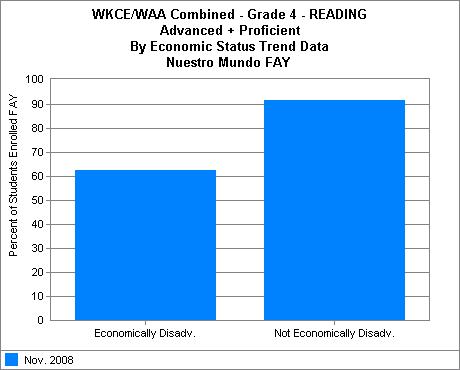
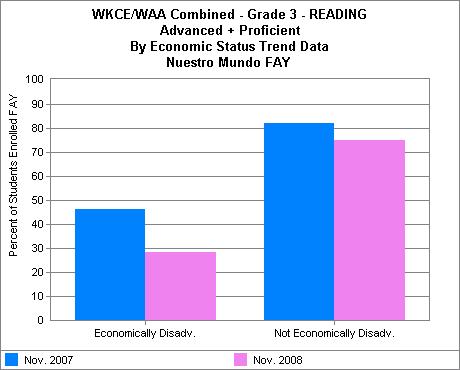
Some good news on the most recent WKCE scores from Nuestro Mundo, as covered in a 17 paragraph Capitol Times story.  Good news, which like much achievement data is of limited use.

The headline trumpets “Promising” gains and the big news is that the cohort now in 4th grade went from 70% advanced/proficient in reading when they were 3d gaders to 81% as 4th graders.  The story also notes that math scores remain dismal and that the current 3d grade cohort’s advanced proficient number is only 51%.

One thing not noted is that this gain of 11% represents exactly 4 more students scoring advanced/proficient (from 29 to 33, because of mobility issues cohorts change and students who were not at the school a full year are not reported — of the current 4th grade at Nuestro Mundo, 3 students are not reported because of this).

More good news is that low income advanced/proficient raw numbers went from 6 to 10 for the cohort (the cohort went from 12 to 16 in total low income, so it is impossible to say if any individual moved up) , limited English from 5 to 6 (cohort was constant) and Hispanic from 6 to 7 (also a constant cohort number).

All good, but really too little change or information to justify any action or inaction.  Data should inform actions, but not drive them.   Do we really want a system where decisions are made based on how 1 or 2 or 3 kids test on a given day?

So congrats for the gains to the Nuestro Mundo staff, students and families and a plea for all — especially policy makers — to keep the good and bad standardized test scores in perspective.

All figures calculated from DPI/WINSS.

Thomas J. Mertz

Leave a comment

Filed under Accountability, Best Practices, education, Local News