Category Archives: Best Practices

MMSD Strategic Planning – Draft

skyline

In the documents for agenda of the Common Council/District Liaison Committee is the most complete version of the strategic planning documents I have seen.  Worth reviewing.  Also, what looks to be the same things on this page, in parts.

No time for analysis this morning, except to note that there is almost nothing directly or indirectly about financial planning and to say that I am not clear what the next steps will be.

I also thought it might be useful to compare with some earlier things.

Educational Framework

Philosophy of Education

Mission, Vision, Priorities and Beliefs

Equity Task Force documents

Thomas J. Mertz

Leave a comment

Filed under Best Practices, education, Equity, Local News

Stand, fidget, and learn

Ben Garvin for The New York Times

Ben Garvin for The New York Times

An interesting piece in the Times this morning really got my wife Iris quite excited, a new way to imagine the classroom setting. A good friend of hers had written her thesis on this very idea when they were studying to be physical therapists. I hope that Madison schools will continue to remain focussed on “all” approaches to quality learning in the classroom.

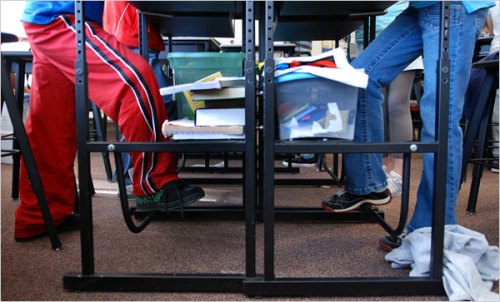
The stand-up desks come with swinging footrests, and with adjustable stools allowing children to switch between sitting and standing as their moods dictate.
“At least you can wiggle when you want to,” said Sarah Langer, 12.

With multiple classrooms filled with stand-up desks, Marine Elementary finds itself at the leading edge of an idea that experts say continues to gain momentum in education: that furniture should be considered as seriously as instruction, particularly given the rise in childhood obesity and the decline in physical education and recess.

Teachers in Minnesota and Wisconsin say they know from experience that the desks help give children the flexibility they need to expend energy and, at the same time, focus better on their work rather than focusing on how to keep still.

Researchers should soon know whether they can confirm those calorie-burning and scholastic benefits. Two studies under way at the University of Minnesota are using data collected from Ms. Brown’s classroom and others in Minnesota and Wisconsin that are using the new desks. The pupils being studied are monitored while using traditional desks as well, and the researchers are looking for differences in physical activity and academic achievement.

Robert Godfrey

Leave a comment

Filed under AMPS, Best Practices, education, Uncategorized

Schools that integrate dance, music, and art

Tucson classroom

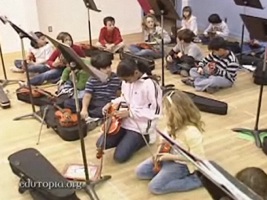
Here’s a delightful piece about public elementary schools in Tucson, Arizona where arts are integrated into every “academic” subject, from math to social studies. For example, first graders write their own operas and fourth graders learn science by playing the violin.

A sweeping initiative in the Tucson Unified School District to improve student achievement through an interdisciplinary curriculum that fuses the arts and academic subjects. The project, Opening Minds Through the Arts, is built on brain-based learning theories and research into children’s neurological development.

And some interesting results.

In the first three years, the nonprofit research firm WestEd tracked the OMA schools along with demographically matched controls: All six schools had high percentages of low-income students, English-language learners, and children of transient families. OMA students significantly outscored their counterparts in reading, math, and writing, and although the benefits held across all ethnicities, Hispanic students, in particular, made substantial gains in writing.

WestEd also found that teachers in OMA schools did better than their peers on every indicator, including lesson planning and design, arts-integrated instruction, and the creative use of varied learning activities. Today, 40 of Tucson’s more than 70 elementary schools have at least some elements of OMA. Pilot projects are under way at 4 of the district’s 20 middle schools.

Corbett, a Title I school with about 600 students, was one of the original OMA sites, and the program initially met resistance there. Teachers worried about sacrificing precious minutes in an already jammed day to music or dance, recalls Principal Joyce Dillon. “Now they say, ‘It’s so completely related to what we’re teaching. I never want to give it up.'”

Robert Godfrey

Leave a comment

Filed under AMPS, Best Practices, education, National News

Gov. Jim Doyle – “Should have….Could have”

doyle-class-journal_media_file_getasp

Doyle should have used this trying time as an opportunity to push for bold change that normally would be too difficult or sweeping to accomplish.

Doyle could have overhauled how the state pays for public education, for example. Instead, he says he’ll work on that after the budget is approved — something he’s said before without much follow-through. (links added)

Wisconsin State Journal, “Wisconsin Gov. Jim Doyle’s Band-Aid of a state budget plays it safe and jacks up taxes, yet it gets some priorities right.”

There is much in the WSJ editorial I do not agree with —  and there is much in the Governor’s budget proposal that is good (more later) —  but the paper is absolutely right that the budget proposal was a missed opportunity to move desperately needed school finance reform forward.

Thomas J. Mertz

Leave a comment

Filed under "education finance", Accountability, Best Practices, education, Elections, finance, Local News, School Finance

Education Tweak #8

Click on image for pdf.

Click on image for pdf.

All the Education Tweaks can be found here.

Thomas J. Mertz

Leave a comment

Filed under Accountability, Best Practices, Gimme Some Truth, National News, nclb, No Child Left Behind

The Stimulus, What Was Not Funded: School Constuction

newspaper3

Excerpts from the Wisconsin State Journal, “Rebuilding Wisconsin, Part 1: A long and costly to-do list.”

PUBLIC SCHOOLS

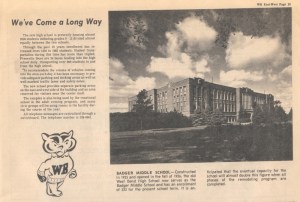
West Bend Public School Superintendent Patricia Herdrich said she can hardly bear to walk through the district’s Badger Middle School. Built in the 1920s, the old school is the worst of the substandard buildings in this district about 75 miles northeast of Madison.

There are, Herdrich said, 13 different levels in the school because of the hodge-podge tangle of additions over the years. There are no elevators.

“You can’t make it accessible,” Herdrich said. “I’ve had kids on crutches crawling up and down stairs.”

In hundreds of school districts across Wisconsin, students are stuck in inadequate and even dangerous buildings, jammed into too-small classrooms or housed in trailers in school parking lots, according to Miles Turner, director of the Wisconsin Association of School District Administrators…

The problem is that, since school expenditures were capped by the state Legislature in 1993, the corner that has been most frequently cut by money-starved districts has been building maintenance and repair.

In its most recent survey of school district spending, the Wisconsin Education Association Council found that 82 percent of the 303 districts that responded have cut money for improvements to buildings and grounds.

And 77 percent reported delaying building maintenance or improvement projects. According to the 2007 infrastructure report from the Wisconsin chapter of the American Society of Civil Engineers, the median reported need of the state’s 431 school districts to catch up on repair and maintenance projects is $695,000 while the average need is $1,768,563.

But some districts are in such dire shape that the cost of delayed projects far surpasses those numbers. Herdrich in West Bend said the district’s total deferred maintenance is $80 million.

Bringing Badger Middle School up to standards alone would cost $29 million, she added…

[A]s the stimulus bill was being put together, the state School Administrators Alliance conducted a needs survey of the state’s school districts.

Only 228 responses were received from all 431 districts, but for just those districts, when it comes to repair, maintenance, and building needs topped $2.5 billion.

Referendums have offered relief only in some districts.

In West Bend, for example, voters defeated a $119.3 million building referendum in 2007 by a 62.6 percent to 37.4 percent margin.

The district had hoped to have another referendum in November but decided against that when the economy went south.

Now, a $68 million building referendum is scheduled for April…

The version of the bill that passed the House of Representatives included what seemed a healthy amount for Wisconsin schools — a total of $729.6 million, including $317.2 million for construction.

But the political debate and resulting compromise in the Senate resulted in much of the money for school construction, including maintenance and repair, being slashed from the bill.

“That line item was zeroed out,” said John Forrester, a spokesman for the School Administrators Alliance. So superintendents such as Herdrich in West Bend, initially buoyed by reports that the stimulus bill could offer some help to repair dilapidated buildings, now find themselves wondering again how to house students safely in the face of failing referendums and dwindling state funds.

It should go without saying that the current broken school finance system requires successful referenda for almost all construction, maintenance and remodeling projects.

Thomas J. Mertz

Leave a comment

Filed under "education finance", Best Practices, Budget, education, finance, Local News, Referenda, referendum, School Finance

And they all shined on . . .

headwork_garden2

A couple of days ago, NPR had a feature on All Things Considered that was quite intriguing.

One county in Virginia has found a new way to reach taxpayers: an automated phone system calls thousands of residents and asks them to participate in school board meetings.

It has proven successful.

It can be tough to attract an audience for local government meetings. School boards and city councils cannot compete with prime-time TV, cable and the Internet. So, some cities are trying to bring the meetings to the people by phone.

The piece highlights the difficulties people have in making evening school board meetings and how one of the most basic technologies is offering citizens the chance to  “vote” on proposal’s and to register their opinions. Could this be a solution for Madison, especially during crucial budgeting meetings?

And while were on the subject of communication, I wonder why the last two meeting agendas have not been emailed to MMSD agenda subscribers and why several “special board meetings” from November still do not have minutes posted?

Robert Godfrey

Leave a comment

Filed under Accountability, AMPS, Best Practices, National News

Quote of the Day — Stunning Illogic and False Hope from the New York Times

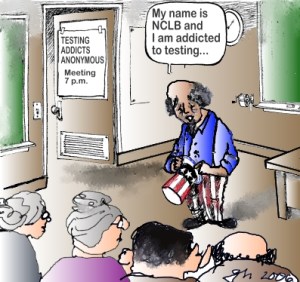
Click the image for more NCLB cartoons.

Click the image for more NCLB cartoons.

The Bush administration allowed states to phony-up statistics on everything from graduation rates to student achievement to teacher training and state education standards. As a result, the country has yet to reach not only the goals that were clearly laid out in the law but also farsighted education reforms dating to the mid-1990s. (emphasis added)

New York Times, “A New Day for School Reform,” editorial, February 21, 2009.

There may be some truth to the cause and effect on teacher training, but the implied idea that the failures of No Child Left Behind are due to  setting standards (curricular and Adequate Yearly Progress) too low is illogical and reinforces multiple flaws in the NCLB.

Some asides at this point.  I want to be clear that communicating high expectations to students in all contexts while giving them the support they need to meet those expectations is good policy.  Changing state standards and cut scores at best comprises a very, very small part of this concept and at worst leads to shaming and other counterproductive punishments.  Better — not necessarily higher — curricular standards do have a place in reform.

First, standards in practice mean standardized tests and standardized tests are very limited as assessments and even more limited as a means of improving education.  To be fair, there is some language in the stimulus package (the subject of the quoted editorial) that may induce a move away from standardized tests (see below).

Second, and most importantly, the whole notion that lax standards are the biggest problem in education defies logic and the historical record.

In terms of logic, just ask yourself if the way to improve archery scores is to use smaller targets.  If they can’t hit the larger target, how will they hit a smaller target?

As to the history, here is the data for Wisconsin under the current system:

Year # Schools Failed AYP # Districts Failed AYP
2007-8 153 4
2006-7 92 2
2005-6 87 1
2004-5 49 1

This graphic tells us about the history and projected future (more here).
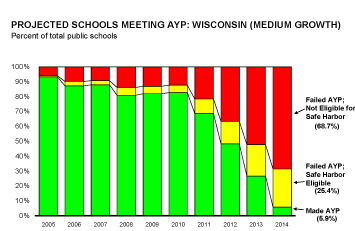
From “The Impact of the Adequate Yearly Progress Requirement of the Federal No Child Left Behind Act on the Great Lakes Region,” a study released by the Great Lakes Center for Educational Research and the Education Policy Studies Laboratory at Arizona State University.

The current standards have resulted in clear trend of increasing failure to meet those standards, a trend that is projected to increase with current standards.

Some quotes from “How Feasible is Adequate Yearly Progress (AYP)? Simulations of School AYP “Uniform Averaging” and “Safe Harbor” under the No Child Left Behind Act” by Jaekyung Lee may help clarify.

It does not appear to be feasible for many schools across the nation to meet the current AYP target within its given 12-year timeline. It is not realistic to expect schools to make unreasonably large achievement gains compared with what they did in the past. Many schools are doomed to fail unless drastic actions are taken to modify the course of the NCLB AYP policy or slow its pace. (emphasis added)

When a majority of schools fail, there will not be enough model sites for benchmarking nor enough resources for capacity building and interventions. This situation can raise a challenging question to the policymakers: is it school or policy that is really failing? There is a potential threat to the validity of the NCLB school accountability policy ultimately if such prevailing school failure occurs as an artifact of policy mandates with unrealistically high expectations that were not based on scientific research and empirical evidence. (emphasis added)

An identified problem with NCLB is that standards are unrealistically high, the New York Times’ solution, raise the standards.  Stunning illogic.

This is the kind of “harder is better” mentality reflected in the Pangloss Index and expected from people like the Walton and Bradley Foundation funded  Thomas B. Fordham Institute, not “the paper of record.”

Later in the editorial, the assessment reform potential of the stimulus bill is touted:

States will also be required to improve academic standards as well as the notoriously weak tests now used to measure achievement — replacing, for instance, the pervasive fill-in-the-bubble tests with advanced assessments that better measure writing and thinking.

This seems to be a gross overstatement.  Here are the relevant parts of the stimulus bill:

(4) STANDARDS AND ASSESSMENTS.-The State-
(A) will enhance the quality of the academic assessments
it administers pursuant to section 1111(b)(3) of the
ESEA (20 U.S.C. 6311(b)(3)) through activities such as
those described in section 6112(a) of such Act (20 U.S.C.
7301a(a));
(B) will comply with the requirements of paragraphs
(3)(C)(ix) and (6) of section 1111(b) of the ESEA (20 U.S.C.
6311(b)) and section 612(a)(16) of the IDEA (20 U.S.C.
1412(a)(16)) related to the inclusion of children with disabilities
and limited English proficient students in State
assessments, the development of valid and reliable assessments
for those students, and the provision of accommodations
that enable their participation in State assessments;
and
(C) will take steps to improve State academic content
standards and student academic achievement standards
consistent with section 6401(e)(1)(9)(A)(ii) of the America
COMPETES Act.

A and C  send us to the two prior acts, with vague “such as” language in A.  Here is the section cited in A:

(1) To enable States (or consortia of States) to collaborate with institutions of higher education, other research institutions, or other organizations to improve the quality, validity, and reliability of State academic assessments beyond the requirements for such assessments described in section 1111(b)(3).

(2) To measure student academic achievement using multiple measures of student academic achievement from multiple sources.

(3) To chart student progress over time.

(4) To evaluate student academic achievement through the development of comprehensive academic assessment instruments, such as performance and technology-based academic assessments.

and the section cited in C:

(ii) identifying and making changes that need to
be made to a State’s secondary school graduation
requirements, academic content standards, academic
achievement standards, and assessments preceding
graduation from secondary school in order to align
the requirements, standards, and assessments with
the knowledge and skills necessary for success in academic
credit-bearing coursework in postsecondary education,
in the 21st century workforce, and in the Armed
Forces without the need for remediation;

I certainly don’t see a requirement to end “fill-in-the-bubble tests” here.  I see some good but weak language opening the door to multiple assessments, some possibility of better assessments in general and buzz words about the “21st century workforce.”  I also have not seen anything in Wisconsin’s plans for the stimulus money that indicates that the WKCE will be gone anytime soon (since the contract requires two-year notice be given, I don’t see that long awaited day being pushed up).

This editorial is unfortunately typical of the confusion on education policy in our media and consequently in our society.  Education policy can be confusing.  This makes the role of the press even more critical and the failures of logic and accuracy like those in the Times editorial more damaging.

Thomas J. Mertz
2 Comments

Filed under Accountability, Best Practices, education, Gimme Some Truth, National News, nclb, No Child Left Behind, Quote of the Day, Uncategorized

A Little Education Policy Humor

18447

The Coasters, “Charlie Brown” (click to listen or download)

With the stimulus, elections, budget and school finance proposals, a few smiles seems like a good idea.  It has been a little while since the last Education Tweak so I thought I’d pass along a couple of items from the Britsh site NewsBiscut (hat tip to Judy Schmidt).

Balls announces Hindsight to be taught in schools
The Minister of Education, Ed Balls, has announced today that from September 2009, the teaching of hindsight will become a compulsory addition to the national curriculum at Key Stage 3 and above.

‘Clearly, the benefits of hindsight have long been recognised, but schools have provided little or no formal teaching of the subject to date. It is to remedy this deficit that we are moving straight to an expectation that a minimum of an hour per week’s hindsight will be taught to all children aged 11 plus’ from the beginning of the next academic year.’

Further details of the curriculum are to be released shortly, but the Minister did confirm that both GCSE and A level Hindsight would be offered to students, although pupils wishing to pursue the subject would not be able to sit their final exams until several years after the completion of their formal education.

The Government are also considering the teaching of ‘Retrospective Foresight’ ‘Tip of the Tongue’ phenomena and ‘Unknown Unknowns’ although there have been delays drawing up the syllabus for the latter.

While the Opposition supported the new plans, the Conservatives said that the teaching of Hindsight should have been introduced much earlier. ‘Knowing what we know now, it’s obvious that hindsight should have been introduced ages ago,’ said Tory education spokesman Michael Gove. ‘I can’t believe that they have waited until now.’

National Curriculum to include ‘Bleedin’ Obvious’

The Department of Education has announced that it is widening the National Curriculum to include lessons in the Bleedin’ Obvious.
Research has shown that much of Britain’s workforce is under-educated in this area, and continues to fall for email scams, Readers Digest appeals and offers of extended warranties.

‘In the modern global economy Britain’s workforce needs to be highly skilled and educated,’ said Junior Education Minister Sarah Beaumont. ‘Frankly if we still got people thinking that they really are the millionth visitor to a certain website, then there really isn’t much hope for any of us.’

Lessons in the Bleedin’ Obvious will also explain that being rude to a policeman who has pulled you over for a driving offence will not result in a quick resolution of the matter or smaller fine nor is it generally making worth making jokes about bombs and terrorism to airport security staff.

Pupils will also be taught that if they get seriously into debt with the bank, then paying it off by borrowing lots of money from that dodgy bloke on the estate may not be the end of all their problems. Another lesson includes learning what happens if you try and clear the compacted grass cuttings off the lawn mower blade while it is still connected to the mains.

‘It’s great to get proper training in the Bleedin’ Obvious before we head out to the workplace’ said 16 year old Simon Jonson. ‘I’ve seen a really well paid job I want to apply for that will let me work from home. It was advertised on a bit of paper tied onto a lamp post so it must be from a really reputable source.’

Thomas J. Mertz

Leave a comment

Filed under Best Practices, Gimme Some Truth

Cuts Coming to Salem

sheetmusic1

“We All Love Our School”,  written by 4th grade Salem students in 2007, performed by 2nd and 3d grade students in 2008-9. Click to listen or download.

We All Love Our School

written by 4th grade Salem students in 2007

Salem is Great. It’s the biggest in the state. We all love our school!
White and blue our colors true. We all love our school!
At Salem we’re having fun.
Salem we’ve just begun
Salem students are the best.
We’re a cut above the rest.
A-round every turn, there is some-thing to learn. We all love our school!
A peaceful place puts a smile on your face. We all love our school!
At Salem we learn and grow.
Salem out to recess we go.
Falcon is our name and learning is our game!

Referenda in six districts failed on Tuesday.  That means each of these districts must to scale back their plans in ways that do the least harm to their students.  This is all part of business as usual under Wisconsin’s broken school funding system.

Here is a preview of what is in store for Salem.  The headline in the Kenosha News promises “Deep Cuts,” 17 layoffs and reductions in music and art.  The story offers further details

Cuts approved Thursday include eliminating band for children in fifth and sixth grade, cutting down on the number of gym classes children take each week, cutting back on art, and reducing reading specialty programs. All after-school sports and clubs would be eliminated, and class sizes would climb in grades three through eight. There were cuts in support staff and the administrative staff as well.

The source of the problem is also explained:

Salem has been facing budget shortfalls as it grapples with state school funding regulations that cap the amount of revenue schools can receive. The district has been covering its operating deficit using savings, but faces a deficit of more than $1 million next school year.

Two board members voiced the lament familiar to many around the state:

“This is killing me,” board member Shane Gerber said during the vote, the names of teachers who are targeted for layoff were read off. In the audience, teachers began to cry as names were read off and some walked out of the meeting.

“We as a board are now faced with cutting programs we know are good for kids,” said President Patty Merrill. “We have attempted three referendums, all three failed. The cuts must be made.”

If you haven’t already, listen to the song at the top and then try to convince yourself that  slowing the bleeding via band aids and reshuffles is the best we can do for the children of Salem and Wisconsin.  When you are done, contact the Governor and your legislators and tell them they need to listen to voices of children also; tell them that these children deserve music and art and reading help and all the other components of a full education.  Sign on with the Wisconsin Alliance for Excellent Schools and the School Finance Network while you are at it.

Thomas J. Mertz

Leave a comment

Filed under "education finance", Best Practices, Budget, education, finance, Local News, Referenda, referendum, School Finance, Uncategorized