Category Archives: Best Practices

Quotes of the Day — Accountability

19rothstein5151

The federal No Child Left Behind Act has succeeded in highlighting the poor math and reading skills of disadvantaged children. But on balance, the law has done more harm than good because it has terribly distorted the school curriculum. Modest modifications cannot correct this distortion. Designing a better accountability policy will take time. We cannot and should not abandon school accountability, but it’s time to go back to the drawing board to get accountability right…

Designing a new accountability system will take time and care, because the problems are daunting. Observations of student behavior are not as reliable as standardized tests of basic skills, so we will have to accept that it is better to imperfectly measure a broad set of outcomes than to perfectly measure a narrow set. We will have to resolve contradictory national convictions that schools should teach citizenship and character, but not inquire about students’ (and parents’) personal opinions. To avoid new distortions, we’ll need to make tough decisions about how to weight the measurement of the many goals of education.

Richard Rothstein, “Getting Accountability Right,” Education Week.

These quotes and the commentary were directed at NCLB reform, but I think they are also applicable to the MMSD Strategic Planning process that begins next week and want to note that Todd Price is the only candidate for State Superintendent of Public Instruction who is voicing similar ideas about the failings of NCLB and the need for more than adjustments.

Related at eduwonkette (and a hat tip); and from the Annenberg Institute, “Beyond Test Scores: Leading Indicators for Education” (many other great resources at the Annenberg site).

Thomas J. Mertz

Leave a comment

Filed under Accountability, Best Practices, Elections, National News, nclb, No Child Left Behind

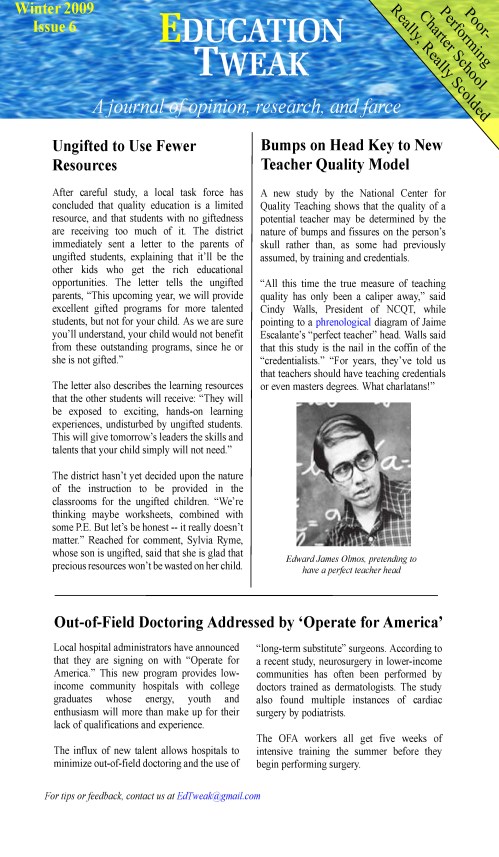
Education Tweak #6

Click on image for pdf.

Click on image for pdf.

All the EdTweaks can be found at http://edtweak.com/.

Thomas J. Mertz

Leave a comment

Filed under Best Practices, Gimme Some Truth, National News, nclb, No Child Left Behind

Quote of the Day – “A better approach”

mind-the-gap

A better approach for state leaders is to concentrate on closing the gap between what the state requires school boards to spend and the amount the state allows school boards to collect in revenue.

Wisconsin Sate Journal, editorial January 6, 2009.

The larger point of the editorial — that those considering getting rid of the QEO without providing a means for additionally  revenue are  irresponsible — is correct also.

Thomas J. Mertz

Leave a comment

Filed under "education finance", Best Practices, Budget, education, finance, Local News, Quote of the Day, School Finance

Non Sequitur of the Day — More from the MMSD Math Report

[Edited 10:25 PM]
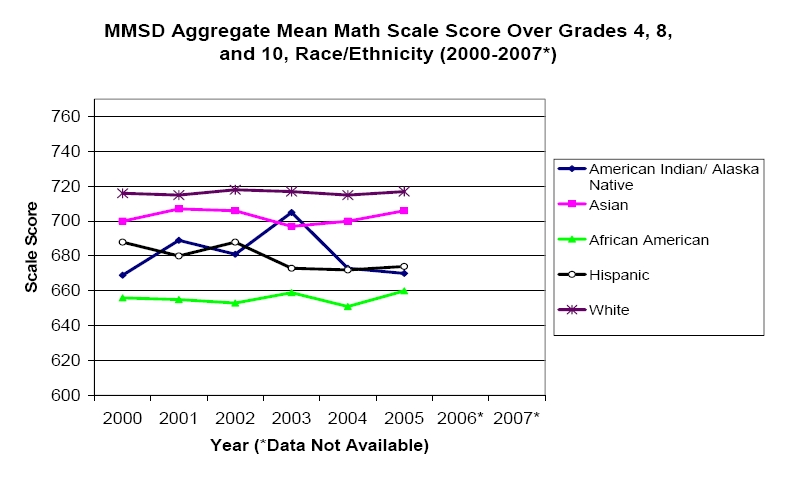
From MMSD Mathematics Task Force Report

From MMSD Mathematics Task Force Report

Assigning a meaning and interpretation to the decline in mathematics achievement scale scores over eight years is more difficult. As indicated in Exhibit I.3, the racial composition of the MMSD changed over this same period from about one-third minority students to nearly one-half minority students.

MMSD Mathematics Task Force Report, section 3, page 7.

Wow.

In the middle of a discussion of declining achievement, after a warning that this trend is difficult interpret — bang — a “helpful” reminder about the growing minority population.  Talk about you subtle invitations to insert your favorite crap about race and intelligence.  Shameful.  Disgusting.

Look, we all know that achievement gaps are a reality but this is not the way to discuss or present that information.  It might be OK if it was followed by some discussion of why these gaps exist and what can, (should and must) be done to address the gaps.

Don’t look in the report for that.  The only recommendations that even indirectly acknowledge the gaps are these:

8. In making improvements and investing resources, the district should consider how best to reduce the large achievement gaps among subgroups of students.

9. More time should be provided for teacher collaboration for teachers to learn from each other, analyze achievement data, meet needs of diverse learners, plan for instruction, and ensure both horizontal and vertical alignment of the curriculum. (See Section 4: Survey of Teachers, Parents, and Students.)

And there is no accompanying discussion of strategies to address the gap [correction, these issues are given some attention in the section on curriculum materials, basically saying that the materials MMSD uses are among those found to be good in addressing achievement gaps]. I thought they were supposed to give more guidance on  “how best.”

If I’m reading the charts right (the presentation leaves much to be desired), low income 10th graders score below non-low income 8th graders.  They are over two years behind.   This and other achievement differentials deserve serious attention.  Instead the Task Force gives us colorful charts and an invitation to racism.

Somewhere the lessons about high expectations leading to higher achievement have been lost.

I’m going to close with two items from the Equity Task Force work that actually made it into the policy:

1. Schools will be excellent only when students of all economic and demographic groups are achieving at high levels.

2. Schools should reflect fairness and high expectations for all learners.

Somebody should have told the Math Task Force these things.

Thomas J.  Mertz

Leave a comment

Filed under Best Practices, education, Equity, Local News, Uncategorized

MMSD Math Task Force Report, Thoughts on Teacher Preparation

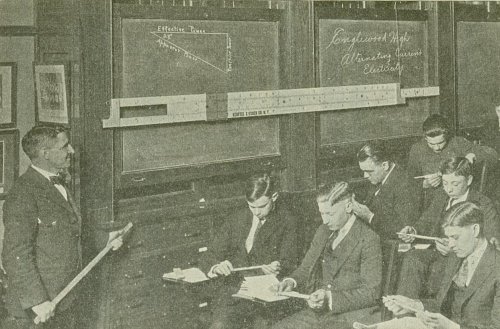
From the International Slide Rule Museum

From the International Slide Rule Museum (click on image to visit).

In anticipation of next week’s public discusions of the Mathematics Task Force Report, I’ve been dipping into parts of that document.  So far, the section I’ve looked closest at  — Teacher Preparation — is pretty disappointing.  It isn’t that I disagree or agree with the conclusions (I don’t have much of an opinion), it is that the work is superficial and read closely provides little or no support for either the assertions made or the recommendations.

The introductory section on “information concerning recommendations from research reports and professional organizations for the mathematical preparation of middle school mathematics teacher” is generally fine and the review of requirements and programs in Wisconsin and neighboring states is also adequate.  However, it is worth noting that even this part of the report begins with an untested assumption that the middle schools are the proper area of focus.  Additionally  as one researcher observed “what counts as subject matter knowledge and how it relates to student achievement remains inadequately specified.”    In other words, we don’t know what what teachers should know to  improve achievement (the MMSD report indirectly touches on complexities of defining what teachers should know but does not acknowledge how thin the research base linking teacher preparation to achievement is).

Where the report is lacking is in the assessment of the appliabicality of this material to MMSD.  This is done in only the most cursory manner.

The main recommendations on teacher preparation — prioritizing “hiring middle school mathematics teachers who have advanced preparation in mathematics” (later clarified to mean “completing mathematics coursework that focuses on enhancing teachers’ understanding of the mathematical content that they teach“) and providing “increased opportunities for middle school mathematics teachers to enhance their knowledge of mathematics for teaching middle school but also require participation by more (if not all) middle school mathematics teachers” —  seem reasonable.  The real question is how much of a priority should these be, how pressing is the need.

There isn’t much here that helps answer that question.

As far as I can tell the recommendations and analysis are mostly a simplified version of the Conference Board of the Mathematical Sciences (CBMS) 2001 report The Mathematical Education of Teacher applied to MMSD without any real consideration of the situation in Madison.

This is most obvious in the use of “middle grades” to mean grades 5-8, when MMS middle schools are grades 6-8.  Therefore, the recommendations, which are focused on the “middle grades,” are not aligned with how Madison defines the middle grades.  You’d think that at some point, someone would have said “Let’s make this fit Madison and use their definition.”  They didn’t and instead stuck with what is the arbitrary definition used in the CBMS (for the arbitrariness of this definition, see Chapter 4, footnote one of the CBMS report).

In and of itself, this isn’t a big deal.  However, it is illustrative of a larger problem.  The whole teacher preparation section is an exercise in forcing Madison into preconceived ideas about what is wrong with and what needs to be done about Math education, with little attention given to assessing what is wrong with and what needs to be done with Math education in Madison.  That many of the ideas appear to be supported more by belief than evidence compounds the problem.

Taking a cue from the popular simplistic international comparisons induced crisis mentality, (for  example see the multiple citations of this report, which despite looking only at the coincidence of teacher preparation differences  and TIMMS score differences  —  think of all the other possible reasons for the achievement differences  —  says it is “premature” to “make recommendations to change the nature of US middle school teacher preparation in mathematics.”), in the introductory section, in support of the lead recommendation the MMSD report asserts  ‘The adequacy of teacher preparation is a significant problem that cannot be solved without a substantial investment in mathematics content-based professional development and a change in hiring priorities at the district level.”  There is almost no evidence offered to support this assertion.

In the teacher preparation section a caveat is added:  “it is questionable whether most of the MMSD middle school mathematics teachers possess the depth of mathematical knowledge required for effectively teaching middle school mathematics .” (emphasis added, there are many caveats in this section).

“Questionable” isn’t good enough in these days of scarce resources.

Despite an extensive survey of teachers, the only attempt to assess the mathematical knowledge and training of our teacher corps is a simple counting of those who have been certified by DPI in the subject area.  One recommendation of the report is that the certification process needs to be expanded and improved, so the report itself recognizes the inadequacy of that measure.  Moreover, certification in subject areas confers no advantages under the current teacher contract, so it is very possible that additional MMSD teachers meet the certification requirements but have not bothered to go through the process.

Certification is a much less important than knowledge.  Any agenda concerning teacher preparation should begin with the recommendation that MMSD find out how prepared our teachers are, if they know the things that research shows make them better teachers, improve achievement.  Pretty simple.

I would suggest starting with the materials being developed by the Learning Mathematics for Teaching Project at the University of Michigan or a similar inventory.  Let’s find out what our teachers know and don’t know before deciding that the solution involves teachers who know more.  Our teachers may be lacking or they may not.  Until that question is answered, the task force recommendations are unsupported and unsupportable.

As a former task force member, I am sympathetic to the constraints of the work, but this task force had grant money, professional consultants and other resources that set the bar higher.  Under these circumstances, the section on teacher preparation is woefully inadequate and disappointing.

One last clarification, I have not looked at the other sections of the report extensively and my criticisms of this section may not be indicative of the report as a whole.

Thomas J. Mertz

6 Comments

Filed under Accountability, Best Practices, education, Local News, Uncategorized

Wisconsin State Superintendent Candidates

dpilogo1

There are five announced candidates for the position of State Superintendent of Public Instruction.  Assuming at least three file the necessary signatures by Tuesday, January 6, 2009,  there will be a primary on February 17 and the top two vote getters will be in the general election on April 7.

Here are the candidates, with links to their web sites.

Todd Alan Price (web site now up and more  info here).

Tony Evers.

Lowell Holtz.

Rose Fernandez.

Van Mobley.

Price is the only one who I have been able to find saying good and meaningful things about Wisconsin’s broken school finance system.

  • Fixing the School Funding Formula. Costing out per student what it actually takes to fund an excellent education. Analyzing the tax base for funding the school system, reviewing options to improve the school funding formula and proposing an effective solution to make fair and equitable the allocation of resources for every child.

The Capital Times (via the AP) has more about the candidates.

The story reveals a curious obsession with the Qualified Economic Offer.  The State Superintendent has no constitutional role in changing the QEO and if the last few years are any guide, the bully pulpit doesn’t count for much there either.

Why does our media obsess on the QEO in stories where it is nearly irrelevant and ignore it when it is crucial?  I wish they’d get it right.

Thomas J. Mertz

Leave a comment

Filed under "education finance", Best Practices, education, Elections, Local News, School Finance

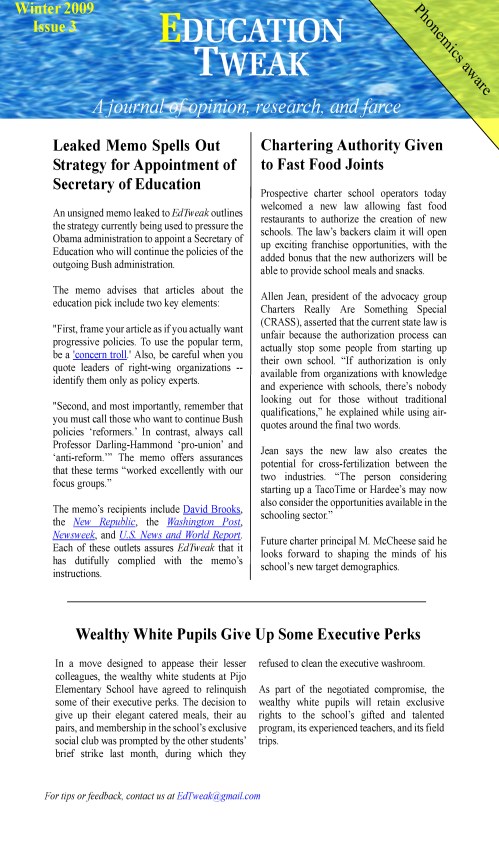
Education Tweaks, 3, 4, 5

Click on image for pdf.

Click on image for pdf.

Click on image for pdf

Click on image for pdf

Click image for pdf.

Click image for pdf.

All the Education Tweaks can now be found at this page.

Thomas J.  Mertz

Leave a comment

Filed under Best Practices, education, Gimme Some Truth, National News, nclb, No Child Left Behind

Education Stimulus?

school_funding

Governor Doyle joined with his counterparts from NY, MA, NJ and OH in a conference call outlining their priorities for a stimulus package. The request includes $250 billion for education (including higher education) over the next two years.

I can’t find details of any specifics except a disturbing mention from Doyle that there should be a requirement that states spend at least as much as they had in 2006 on education.  I don’t think taking steps backward is the way to go.

President-Elect Obama gave vague lip service to education in his radio address this week.

Our Senator Russ Feingold made no mention of education in his list of priorities for 2009.  You can let him know that this isn’t acceptable here.

An earlier discussion of education and the stimulus from EdWeek here and related posts on AMPS here and here.

Thomas J. Mertz

Leave a comment

Filed under "education finance", Best Practices, Budget, education, finance, National News, School Finance

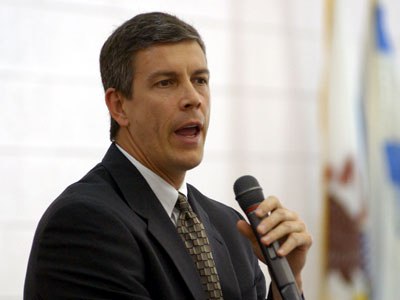
Arne Duncan, Secretary of Education

arne-duncan

Just links.  My own thoughts are much like teacherken’s (below).   I’ll add that the charters/merit pay agenda does not make me happy but balance that by saying that at least the merit pay pilot in Chicago included peer evaluations along with test scores.

The New York Times, Schools Chief From Chicago Is Obama’s Choice for Education.

teacherken, Arne Duncan as Sec Ed – it could have been worse.

Alexander Russo, District299: The Chicago Schools Blog, Duncan Pros and Cons.

Greg Palast, Obama’s “Way-to-Go, Brownie!” Moment?.

Education Week, Duncan is Obama’s Education Secretary Pick.

Good discussions in the comments at all but the NYT.

Thomas J, Mertz

Leave a comment

Filed under Accountability, Arne Duncan, Best Practices, education, Elections, National News, nclb, No Child Left Behind

Why would anyone listen to these people?

Whitney Tilson - Working to bring the magic of the market to education

Whitney Tilson - Working to bring the magic of the market to education

I was reading this New York Times article (Uncertainty on Obama Education Plans) and this got my attention:

One former Teach for America official who has been outspoken is Whitney Tilson, a New York mutual fund manager.

In a recent blog entry, Mr. Tilson said of Dr. Darling-Hammond, “She’s influential, clever and (while she does her best to hide it) an enemy of genuine reform.”

Mr. Tilson is on the board of Democrats for Education Reform, a political action committee based in New York.

Mr. Tilson is a top tier education DINO. He advocates an anti-Union, data and test driven version of  “accountability” based on a market, business, privatization model (see here for more on this mindset).

His expertise is based on a short stint in the classroom via Teach for America and his “success” in the financial industry.

I thought it would be good to examine that “success.”

According to the latest available report from  Tilson Mutual Funds (dated April 30, 2008, well before the current meltdown), one of the funds he controls underperformed in comparison to both the Dow Jones Wilshire 500 and the S&P Total return indices both in the prior year and since its inception.  In fact, this fund lost 10.03% of value after taxes .  You would have done better stashing your money in an old sock than investing in this fund.

The other fund did a bit better, losing only 4.44% of value after taxes and outperforming the Dow Jones, but not the S&P.  The old sock would still have been a better choice.

The year to date on one fund is -23.48%; on the other it is -45.19%.  That old sock is looking better and better.

Tilson isn’t even good at his “day job.”

Why would anyone listen to these people on education?  Why would anyone think that “market driven education reform” as pushed by the very people who profited while creating our financial crisis was a good idea?

I don’t get it.

Thomas J. Mertz

3 Comments

Filed under "education finance", Accountability, Best Practices, education, finance, National News, nclb, No Child Left Behind, School Finance