Category Archives: Budget

Back in Stride — Walk On the Child’s Side Update

From the Wisconsin Alliance for Excellent Schools:

What: 10th anniversary Walk on the Child’s Side

Who: All Wisconsinites who care about their public schools

Where: Walk from the UW-Madison Library Mall to the steps of the State Capitol

When: 11 a.m. on Tuesday, June 16

Make a statement for school-funding reform

* Your legislators will be invited to walk with us. Make sure they are there representing, you, your community, and your children.

* Speakers at the Capitol will include Randy Braun, Walk on the Child’s Side veteran and superintendent of the Cameron School District; Randy Kunsch, CARE member and Walk veteran; Mary Bell, WEAC president; Art Rainwater, former Madison school district superintendent and Walk veteran; and Jennifer Morales, Walk veteran and former Milwaukee school board member. Other speakers, including students, will be added.

* Off-site parking will be available with shuttle buses running to and from the event.

* Bring and sign or banner telling who you are and where you are from. Event organizers will have materials to make signs at the last minute.

* Wear your original Walk on the Child’s Side shirt. Some will be available on a first-come, first-served basis.

A decade after the first Walk on the Child’s Side and 15 years since the state’s school-funding system was passed into law, not much has changed except that the funding crisis has deepened among Wisconsin’s public school children and schools. If you come to Madison for the anniversary Walk, you will make an important statement on behalf of those children, their schools, and all of our futures.

The Walk on the Child’s Side will begin at the University of Wisconsin-Madison Library Mall at 11 a.m. and end at the Capitol. Several speakers will talk about the history of school-funding reform and call for legislative action. Walkers will end the day visiting with their elected officials to ask them to work together for comprehensive reform. What’s new since the last update Sponsors of the 10th anniversary Walk on the Child’s Side are Price County Citizens Who CARE, Northern Tier Uniserv, and the Wisconsin Alliance for Excellent Schools. If this isn’t the biggest and best Walk, legislators and the Governor won’t get the message.

Download a flier here.  Save the date and spread the word!

Thomas J. Mertz

Leave a comment

Filed under "education finance", Best Practices, Budget, education, finance, Local News, School Finance, Take Action, Uncategorized, We Are Not Alone

MMSD Equity Report Due

Logo for the 2008 Minority Student Achievement Network (MSAN) Conference, for more on MSAN click the image.

Logo for the 2008 Minority Student Achievement Network (MSAN) Conference, for more on MSAN click the image.

On June 2, 2008 The Madison Metropolitan School District Board of Education adopted a new Equity Policy (policy here, minutes here, video here). This policy requires a two-part annual report on equity, described as follows:

Reporting

Administration will report on an annual basis to the Board of Education the extent of progress on specific measures in eliminating gaps in access, opportunities and achievement.

Administration will develop an annual report that will provide data on the distribution of staff, financial, and programmatic resources across all schools.

In six days, a year will have passed since this policy was adopted. By the end of that six days, the annual equity report is due.

After all of the work of the Equity Task Force and all of the disappointments — with the Board of Education never even discussing important portions of the Task Force work (and here), and with the Board’s confused and inattentive dropping of the implementation portion of the draft policy (and here) — the only clear victory for the Task Force and Equity was the annual report requirement.

It is essential that this report be issued, be substantive, and be given a thorough examination by the Board and the public.

Although it was an open secret and a common complaint that the previous Equity Policy was never followed, I’m going to take it on faith (for now) that the required report will be issued. I can’t control how the Board treats this report, but I will do my best to raise public awareness and facilitate an examination. That leaves the substance of the report and I have some ideas I would like to share.

In part, as a response to NCLB and state laws, The MMSD administration already issues reports on achievement and achievement gaps. A report on access and opportunities would be something new, and would get to the heart of some of the concepts of Equity put forth by the Task Force and adopted by the Board:

Goals

  1. The district will eliminate gaps in access, opportunities, and achievement by recognizing and addressing historic and contemporary inequalities.
  2. The district will recognize and eliminate inequitable policies and practices at the district level.

Ideally, the first annual report would provide a baseline to assess if progress is being made in access and opportunities.

I would suggest that this portion of the report be as comprehensive as possible, broken down by school and demographics, and place a particular emphasis on access and opportunities for advanced programs or individual work. Evidence of disproportionality is the key. Under state statutes, the district already reports on disproportionality in special education referrals and placements (link to the  PowerPoint presentation because unfortunately I can’t find an actual report on line). This could serve as a model.

The report should include both opportunities (by school) and participation in fine arts programing, world languages, technical and vocational education, remedial and other support opportunities — did you know that at least three elementary schools have no Reading Recovery –, honors, Talented and Gifted (TAG, including In Step referrals and outcomes), accelerated programs, AP, really anything and everything that is outside of the core, basic curriculum. All of this should cover curricular, co-curricular and extra-curricular opportunities and access.

I said above that special attention needs to be given to advanced opportunities. I was twice recently reminded of how important this issue is. The first time was the complete absence of African American and Hispanic students taking the qualifying test for West High School Accerelated Biology. The second time was in an Capital City Hues interview with long-time Madison educator Tenia Jenkins. Ms Jenkins had this to say:

So you set up a mechanism that targets one group and the other groups obviously benefit from it. But there are some groups where that doesn’t happen, for example, the gifted and talented classes in the district. They’ve been around for 20-25 years. And most Black children are still not benefiting from them, only a few here and a few there. So what we are simply asking is for the district to set up the same kind of thing for Black children that they are doing for White students in terms of gifted and talented classes.

The perception and reality is that TAG is (mostly) for “White students.” This must change. One way to start is by forcing the administration, the Board, and the public, to confront the stark data on disproportionate access, opportunities and participation.

The other part of the report involves resources. There is one breakdown of resources in the annual budget, but I don’t believe that this is sufficient for Equity purposes.

There are three things I would like to see incorporated into the resources analysis: an assessment of needs, staffing descriptions, dollar and FTE allocations.

The first would involve some version of the Equity Resource Index/Educational Needs Index developed by previously by the district to distribute resources based on factors that have been demonstrated to negatively impact academic success.

The second should be along the lines of this being a user friendly look at school staffing prepared on Middle Schools in 2006 (link corrected, previous linked document here — TJM, 5/28/09).

Last, budgetary resources need to be considered in terms of both Full Time Equivalent (FTE) and dollars per student. One the most important recent lessons on Equity is that experienced teachers tend to be in lower needs schools, dollar figures for staffing capture some of this inequity because more experienced and better trained teachers rise higher on the pay scale. An example of the latter from 2006 can be accessed here.

These differing versions of looking at resources need to be presented in a manner that makes the relationships among them transparent.

There are other things I would like to see in an Equity Report — such as demographic breakdowns of classroom assignments by school, demographics of requests for inter and intra district transfers and transfers granted — but these fall outside of the report requirements in the policy. You take what you can get.

I’m looking forward to the Equity Report, the discussion it prompts, and (I hope) the actions that come from that discussion.

One last note. I know that much faith has been placed in the current Strategic Planning process, but it would be a mistake if that process supplanted, not supplemented the good work on Equity (and other things) that came before.

Thomas J. Mertz

Leave a comment

Filed under "education finance", Budget, education, Equity, Local News, School Finance, Uncategorized

“Ain’t No Sunshine,” The Joint Finance Committee Does the Education Budget (and Much Else) Updated

Annular Solar Eclipse at High Resolution Credit & Copyright: Stefan Seip, via NASA (click image for more information)

Annular Solar Eclipse at High Resolution Credit & Copyright: Stefan Seip, via NASA (click image for more information)

Bill Withers, “Ain’t No Sunshine” (click to listen or download)

[Update at the bottom]

Wisconsin is generally considered to have good open meetings/open records, “sunshine” laws. However, it appears that significant revisions of the state’s 2009-11 biennial budget is moving through the Joint Finance Committee (JFC) with little or no public scrutiny, analysis of any sort, and no opportunity for fully informed public input. Meetings were held and crucial votes taken over the weekend, continuing today. This is not good governance.

Late on Thursday May 21, 2009 Governor Jim Doyle and Joint Finance Co-Chairs Mark Pocan and Mark Miller announced a deal on a budget “fix” involving significant cuts to many programs and services, including $291 million in state funding for education. On Friday May 22, Secretary of Administration Michael Morgan issued a memo on the “fix” that was short on details and long on spin. It contained one paragraph on education funding and left many questions unanswered, including whether school districts will be allowed to raise property taxes to make up for the cuts from the state and how the cuts will be balanced between general aid and categorical aid.

Today (Tuesday 5/26) the agenda for the Wednesday, May 27 1:00 PM meeting was announced. It is a full plate including shared revenue for municipalities and counties, taxes, health services, transportation, children and families and the following education items:

Public Instruction — General School Aids and Revenue Limits
Public Instruction — Categorical Aids
Public Instruction — School District Operations
Public Instruction — Choice and Charter

Although the Assembly and the Senate will get a crack at the results of the Joint Finance work, one-party rule will likely mean that what gets decided tomorrow, stays decided.

As of 7:55 PM, May 26, less than 18 hours prior to the Joint Finance meeting where the fate of education for the next two years will be decided, essential questions about the “fix” remain unavailable to the public.

The Legislative Fiscal Bureau (LFB) has been scrambling to prepare new analyses, taking into account the budget cuts Doyle, Pocan and Miller favored over revenue reforms, but they have yet to get to the education matters (click on the link for the latest analyses, as noted the papers for the Wednesday session are not there as of this posting). Without either text of the “fix’ or an analysis, it is impossible to give a fully informed opinion and therefore difficult to attempt to influence members of the Joint Finance Committee or mobilize others to contact the JFC.

The published 2009-11 Budget Procedures for the Joint Committee on Finance, promised that

LFB Budget Papers. The Legislative Fiscal Bureau will attempt to distribute its papers at least 72 hours prior to each of the Committee’s executive sessions.

Obviously this isn’t happening. I don’t blame the LFB; I fault the politicians who apparently want to wield their budget saws and axes in the shadows, outside of public awareness, without public input.

What’s even worse is that without the analyses of the LFB, the members of the Joint Finance Committee will vote without comprehending the full consequences of their choices.

This is bad governance any way you look at it.

For more information of open government, visit the Wisconsin Freedom of Information Council and the Midwest Open Government Project.

Update (2:02 PM, 5/27): According to the WisPolitics Budget blog the 5/27 JFC session will not start till 4:00 PM at the earliest.  An agenda for 5/28 has been released, listing the items that has previously been on the 5/27 agenda.   No LFB papers on the education items have been posted.

Thomas J. Mertz

1 Comment

Filed under "education finance", Accountability, Best Practices, Budget, education, finance, Local News, School Finance, Uncategorized

Let’s Call Cuts, Cuts — Budget Rhetoric Fact Check

pete_townshend_rs_958_170.6478946

Pete Townshend photographed by Annie Leibovitz, for more information click on the image.

The Who, “Won’t Get Fooled Again” (click to listen or download)

This budget season in Wisconsin began with Governor Jim Doyle’s Orwellian statement that ““Not getting cut is the new increase in this budget.” It has been all downhill from there. The latest cut of $291 million in education aid has been accompanied by the misleading factoid that after these changes, school district revenues from federal, state and local sources are still expected to increase by approximately 5% on a biennial basis.

This distracting rhetorical labeling of cuts in programs and services as a monetary “increase,” is a classic Republican ploy. The idea is to discourage an examination of the impact of the cuts. In the case of the Governor’s latest budget proposal, touting the 5% figure is an attempt to hide more than cuts. It shifts the accountability from state resources to federal and local ones, creating a funding cliff of federal stimulus money that can only be used in targeted ways.

Never mind that conservative estimates put the cost of continuing the same educational opportunities for Wisconsin’s students at a level that would require a biennial increase at a minimum of 7.5% to 8%. Never mind too that the majority of that 5% comes from federal money, over which Doyle has little or no say, and most of which will be gone in two years, leaving the state and the districts on the edge of a cliff. Also, about 1/3 of that federal money comes with huge strings attached and can only be used for specific purposes, mostly to “supplement, not supplant” state and local expenditures. Further, to get to that 5% increase, school boards will need to significantly increase property taxes….(more about the numbers below and in a subsequent post).

Never mind all this, the Governor wants us to think about that 5% increase and forget about the reality of cuts in educational opportunities and shifts from state money to federal and local revenues.

The governor wants you to ponder, “how can people complain about cuts to education when there is an increase?” Don’t be fooled (again).

The rhetoric and numbers concerning school funding coming out of the Governor’s office have consistently been presented in ways designed to obscure the reality of significant decreases in state aid, as well as a level of combined state and federal aid that is far below “cost-to-continue” or even the level required to keep school budget cuts at the 1% to 2% that has been the norm in Wisconsin for the last 15 years under our broken state school finance system.

Before further going into the recent rhetoric and numbers, a little history lesson is in order.

All sorts of budgets — schools, states, households… — grow each year even if there is no expansion, because the same activities, programs, services or purchases get more expensive. This is the idea behind “cost-to-continue” or “same service” budgeting. It gives a baseline that says, if we want to continue doing the same things in the same ways, this is what it will cost.

Way back in 1996, President Bill Clinton proposed changes in the Medicaid program. The changes included new efficiencies and discontinuing some things. As a result, the total cost of the Clinton proposal was less than the cost of continuing the program as it had been (although more than current spending levels). Clinton repeatedly referred to “cuts” in the Medicaid budget.

Then Speaker of the House (and now Obama advisor), Newt Gingrich, repeatedly called Clinton a “liar” for saying he was cutting the Medicaid budget. According to Gingrich, the only things that counted as cuts were those that decreased the dollars. This rejection of “cost-to-continue’ basis became the Republican frame for budget discussions.

[Read about the Clinton/Gingrich conflict over the meaning of “cuts” here.]

In most cases, the GOP has used this to try to deny that less than “cost-to-continue” increases are cuts. That’s what State Rep. Brett Davis and other Republicans did in the last budget cycle.

In the past, Democrats in Wisconsin resisted this rhetorical fraud; now Governor Doyle is doing exactly what Gingrich and Davis did, telling us that cuts aren’t cuts. Pretty disgusting.

At the press conference on the budget fix Governor Doyle said, “overall school districts will have more money.” He also said that it would be difficult for some districts, and rhetorically averred from “sugar coating” the situation. Yet the emphasis on the “increase” is a coat of sugar.

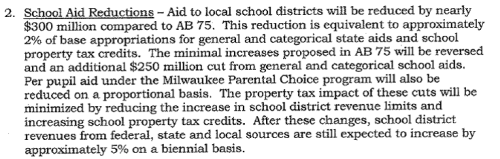
This message of an overall increase was repeated, with numbers attached, in a memo issued today by Secretary of Administration Micheal L. Morgan. Here is the main part on education funding:
memo excerpt

Note the last line “school district revenues are still expected to increase by approximately 5% on a biennial basis.” Elsewhere in the memo the total new “School Aid Reduction” is given as $291 million.

Just to be clear (before moving on), that reduction isn’t from real district-by-district “cost-to-continue” budgeting or even from a “cost-to continue,” based on the already inadequate funding levels of the 2007-09 state budget. It is from the previous Gubernatorial proposal which represented a significant decrease in school aid levels, resulting in an estimated shift from the fictional 2/3 state portion of general aids to less than 62% coming from the state, as well as cuts in categorical aids of 1% (the Legislative Fiscal Bureau memo is here). It looks like the new cuts will bring a further shift to property taxes (to be examined in a subsequent post). The new reductions are Doyle’s second cut with the knife (or the third if you count the annual cuts created by the structural gap built into Wisconsin’s school funding system, a system that Governor Doyle has not lifted a finger to fix).

By my calculations a 5% increase in total education funding (federal, sate and local)  over the biennium comes to about $1.105 billion ( I am working on a post providing a closer look at the numbers and fed/state/local breakdowns). About 35% of this increase is in $381 million of ARRA/Stimulus funding for Title I and IDEA programing. This money cannot be spent on general operations, and with some limited exceptions, must be used to supplement not supplant state and local funded efforts targeting children in poverty and special education students. The inclusion of this money is questionable as both rhetoric and policy. Without this money included, the net increase over the biennium would be about 3.28% (remember that cost-to-continue is at least 7.5% to 8%).

About 50 districts in Wisconsin will receive no Title I money and only about 35 will receive over $1 million in IDEA money. The Wisconsin Association of School Boards further notes that

…the U.S. Education Department is asking states to submit much more detailed information on how they plan to improve student learning before they can tap a sizable portion of the second round of ARRA funding, which is scheduled to go out in the fall. To tap a portion of special education aid and Title I funding for disadvantaged students, states must explain how they will comply with transparency and accounting requirements.

If the state simply offsets state aid for federal aid, there may be difficulty in securing the second round of funding. The U.S. Department of Education also plans to allocate $4.35 billion in “Race to the Top” grants, which aim to reward states and districts that make significant strides in closing achievement gaps, raising academic standards, tracking student progress, and improving the distribution of high-quality teachers. Dramatic cuts to state education spending may hinder the state’s and local school districts’ efforts to secure these grants.

In other words, if Wisconsin school districts use the stimulus money in the manner the Governor has advised, the state may be ineligible for the remainder of their anticipated payments and will certainly be disqualified from the $5 billion in the “Race for the Top” funding.”

The 5% is a chimera and the cuts are real. As Curtis Mayfield said, “If you are cut you are going to bleed.” All the talk of 5% increases won’t change that reality.

Education in Wisconsin has been cut repeatedly for 15 years and the blood has been flowing for just as long. Even though the Governor only pulled the knife out again late on Thursday, May 21, some districts are already anticipating the latest bloodletting.

On Wisconsin Public Television’s “Here and Now,” Madison Superintendent Dan Nerad spoke of $2 million in additional cuts (on top of the $3.8 million already cut). Nerad also spoke of the difficulty of the timing of the Governor’s announcement, the continuing uncertainty about flexibility to make up for lost state revenue with property taxes under the revenue caps, and most importantly the need for comprehensive school finance reform to give Wisconsin adequate, equitable and sustainable education funding.

The Sheboygan Area School District cut $5 million and eliminated 45 full time teaching positions, 11 librarians and 2 guidance counselors three weeks ago. In the wake of the Governor’s announcement, they anticipate the need for $3 million to $5 million more in cuts.

In Hudson, where unemployment is a full point above the state average, the district has struggled to preserve education while limiting property taxes. Ideas to address the problems include a salary freeze, cuts in transportation, summer programs, layoffs

You can be sure that there will be ugly budget sessions in districts around the state in the months to come. AMPS will report on as many as we can.

One indication of the direction this is going comes from the Wisconsin Association of School Boards. Their most recent press release carried the message “Don’t Cut Our Future,” but a legislative alert issued a day prior included a request for members to lobby for “Changing state statutes to allow school boards to lay off staff for the 2009-10 school year.” These are desperate times.

Cuts and layoffs, cuts so large and late that school boards need a change in the law to make them, cuts on top of cuts. Too many cuts to hide behind the transparent rhetoric of “5% increases.”

Stop insulting the people of Wisconsin with this talk of Governor Doyle. Stop using Republican spin to hide the full impact of your politically motivated choice to cut, instead of tax . Stop undermining any hope for comprehensive reform in the future by muddying the water with talk of increases at a time when you are cutting.

Let’s call all cuts, cuts.

Thomas J. Mertz
Leave a comment

Filed under "education finance", Budget, education, Elections, finance, Gimme Some Truth, Local News, School Finance, Uncategorized

The Democrats Cut Education and Services, Relative Silence Ensues

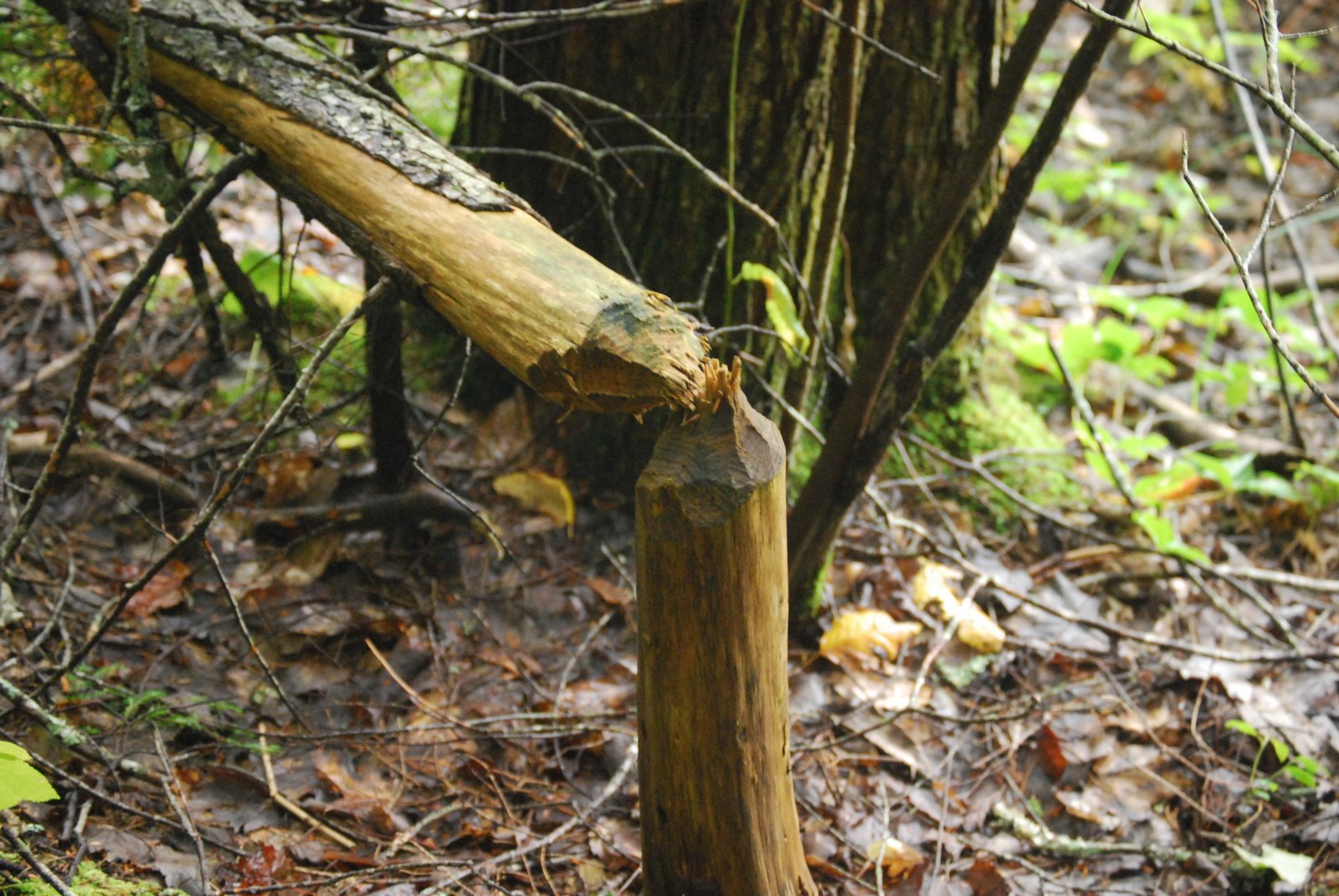
beaver-cut-742551There is that old question about whether a tree falling in empty woods makes a noise.  Last Thursday, May 21, 2009 Wisconsin Governor Doyle got out his budget cut saw and began felling numerous trees. He has since passed the saw to the Democratic controlled Joint Finance Committee who are poised to finish the work.  Although many organizations and individuals were very vocal before the cuts were announced, there has been relative silence since.

Prior to the announcement of the budget ‘fix,” 65 organizations joined in an effort to convince lawmakers that new revenues should be part of the answer to state’s deficit.  Other organizations and individuals,  such as the School Finance Network and Paul Soglin and Barry Orton (and me),  sent similar messages.

Since the announced “fix” involving large cuts to core government services, there has been relative silence.  Maybe it is the shock of the  betrayal by Democrats who seem to have abandoned the principles of their platform.  Maybe it is misplaced loyalty or sympathy to elected officials who express regrets instead of glee as they cut away.  Maybe it is just the long holiday weekend.

Whatever the reasons, if this silence continues our elected officials will breathe a sigh of relief knowing that there will be  no political consequences for their betrayal.

One notable exception to the silence comes from Ed Garvey at Fighting Bob.  He gets it almost exactly right:

Is there a difference?

OK, there is a budget shortfall. We know that; we know schools are under-funded; and local governments are have trouble raising money. So why would a Democratic governor cut school aid, lay off state workers, cut aid to local government, and threaten to cut more jobs unless the unionized state employees agree to reduce their pay “or else”? (No bargaining? Bad faith? You betcha. Is that how Democrats negotiate in good faith with the union? “My way or the highway?” Heck, Tommy treated state employees better than that.)

I don’t get it. Isn’t it time Jim Doyle opted to lead? Leadership in these tough times would require him to step on lots of Gucci slippers worn by the big campaign contributers. Time to announce that he won’t run so he can lead, or announce he is running as the governor who believes in fair taxes, good public schools, a respect for the bargaining process, an end to contracting out, and support for an increase in progressive taxes. (Did I mention public financing of campaigns?)

C’mon! Wisconsin Democrats cannot keep cutting just when working families need help. Tell the Neanderthals in the Legislature that there is a difference between the two parties. Lead or get out of the way.

I hope the coming days will bring more protests like Garvey’s.  I’ve got my own in the works , now posted on AMPS.

Thomas J. Mertz

2 Comments

Filed under "education finance", Accountability, Budget, Contracts, education, Elections, finance, Gimme Some Truth, Local News, Uncategorized

“Walk on the Child’s Side” June 16 — Don’t Forget

phillips1Don’t forget to save the date for the June 16, “Walk on the Child Side” 10th anniversy school funding action.

In light of the recent budget moves in Wisconsin, this action has never been more necessary.

WEAC has a good page up on the event, here is what they have to say:

School funding reform rally is June 16 in Madison

Ten years after a group of northern Wisconsin educators first walked across the state to draw attention to the need to reform school funding, they will return to Madison for a rally focusing on the fact that “the kids are still waiting.” And everyone who supports school funding reform is invited and encouraged to attend.

The school funding reform rally will begin at 11 a.m. Tuesday, June 16, at the Library Mall on the University of Wisconsin-Madison campus. Participants will march to the State Capitol and rally on the Capitol steps.

“We need to help our legislators understand that we can’t wait much longer,” according to a flier supporting the rally. “We need to help our kids now.”

The rally marks the 10-year anniversary of the first Walk on the Child’s Side, a 240-mile march along Wisconsin highways, from Butternut to Madison, to draw attention to the plight of school districts and Wisconsin’s children as a result of a failed system of school funding. Walk on the Child’s Side was held for four years.

This year’s rally is sponsored by the Price County Citizens Who CARE (the original sponsor of Walk on the Child’s Side), the Northern Tier UniServ, and the Wisconsin Alliance for Excellent Schools.

WEAC President Mary Bell, who participated in the original Walk on the Child’s Side, said WEAC supports the 10-year reunion rally. She will attend and encourages all supporters of school funding reform to join in the march and rally.

“Despite the realities of Wisconsin’s economic recession, our advocacy for school funding reform must continue in full stride,” Bell said. “When the economy turns around, we need to have all eyes focused on school funding reform as the top priority for reinvestment.”

Teri Hanson, a representative of CARE and a key organizer of the original walks, said this year’s event will be a celebration of how far the funding reform movement has come and, more importantly, will deliver a message to state government that “Wisconsin’s schools are in crisis and the governor and Legislature have ignored it for far too long.”

The event will include live entertainment and speeches. Organizers are working on convenient parking locations and shuttle buses to make attendance as easy as possible.

Information updates will be provided on the WAES Web site at www.excellentschools.org.

The rally is timely, as the Legislature debates the 2009-11 state budget. According to the Legislature’s calendar, budget deliberations will begin on June 9 and run through June 30. Participants are encouraged to bring signs and banners and to schedule visits with their lawmakers while in Madison.

Sponsors are asking participants to:

  1. Make sure your group or organization is behind this event.
  2. Talk to your school board about bringing a bus load of school and community members for the day.
  3. Start a phone tree and begin arranging some car pools.
  4. Discuss your community’s participation at meetings of your clubs, organizations, or groups.
  5. Tell your legislators you expect them to attend and then make sure they do.
  6. Use your organizing skills to make sure you bring at least 10 people with you … or more.

For more information:

Be there! Make your voice heard!.

Thomas J. Mertz

3 Comments

Filed under "education finance", Best Practices, Budget, education, finance, Local News, School Finance, Take Action, Uncategorized

Breaking — Doyle Says Yes to More Cuts, No New Taxes

168677803v11_350x350_Front

Watching the budget “fix” press conference via WisconsinEye. Mark Pocan and Mark Miller are by Governor Jim Doyle’s side, so little hope for Joint Finance action.

5% across the board cuts to most state functions; 2.5% cut to education, 2.5% cut to shared revenue.

More double talk about stimulus money and education funding.

Seems to leave the door open to maybe a temporary delay on ending the Qualified Economic Offer.

Claims to “protect” education. Revenue cap allowable increase will be reduced.

Lots of talk about “protecting property taxpayers.” Nothing about investing in the future of our students or our state.

Not good.

More here on WisPolitics.

I guess that we have answers to this quiz.

Thomas J. Mertz

1 Comment

Filed under "education finance", Budget, education, Local News, School Finance, Uncategorized

Quotes of the Day — A Tale of Two Governors

Illinois Governor Quinn

[Illinois Governor Patrick] Quinn laid out what a “doomsday” budget might look like if lawmakers “slash and burn” their way to close a deficit of at least $11.6 billion instead of going along with his plan to boost taxes.

“In a tough time we don’t want history to say the people of Illinois threw a lot of their fellow citizens overboard because they didn’t want to make any sacrifices or tough choices,” Quinn told reporters after detailing a litany of possible cuts to more than 300 people at the City Club of Chicago, a local civic club.

94575

Chicago Tribune.

[Wisconsin Governor Jim] Doyle, when asked by a reporter what he would do if the Democratic-controlled Legislature sent him a budget with sales or income tax increases, responded, “I hope that does not come to my desk.”

MMSD Today.

Leave a comment

Filed under "education finance", Budget, education, Elections, finance, Local News, National News, School Finance, Uncategorized

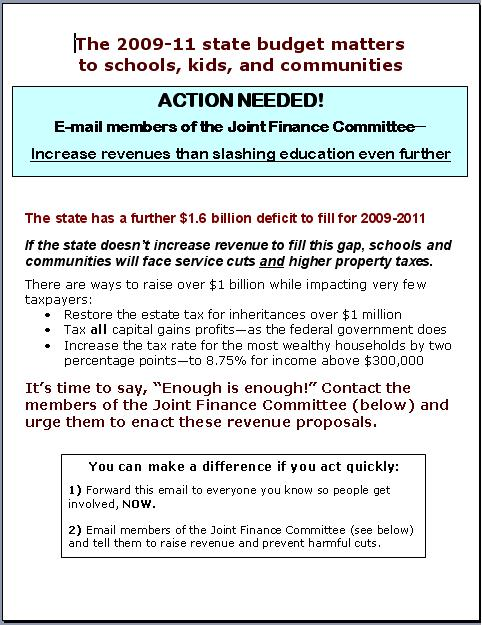
Action Alert

action alert

You can make a difference by letting the members of the Legislature’s Joint Finance Committee know you expect them to use common sense and take a balanced approach to working through the state’s financial crisis. We solve nothing if we dismantle our schools and other important public services. Right now:

  • Pass along this e-mail alert to as many other people as you can.E-mail members of the
  • Joint Finance Committee (click here for their e-mail addresses — http://www.legis.state.wi.us/lfb/jfc.html) with your suggestions about dealing with the gap.

Thanks.

Tom

Thomas S. Beebe, Executive Director
Wisconsin Alliance for Excellent Schools


More on AMPS, here and here and a sample message here.

Thomas J. Mertz

Leave a comment

Filed under "education finance", Budget, education, finance, School Finance, Take Action, Uncategorized

Sow and Reap – More on the Wisconsin State Budget

Jean-Francois Millet, The Gleaners, 1857

Jean-Francois Millet, The Gleaners, 1857

You can only reap what you sow and it looks like Governor Jim Doyle’ s reluctance to reap and sow may be leading Wisconsin to more hard times and lean years.

In a statement today reported by the Journal Sentinel, Governor Doyle indicated that in response to revenue shortfalls, a new proposal requiring 5% cuts in state aid to public schools and local governments is in the works (more here). These would be devastating to programs and services that are already strained.

He used the word “forced,” but in very similar terms to the Republicans, who in the last budget cycle, claimed to have been “forced” to cut aid when they were acting on their own volition, the “forcing” Doyle refers to is in fact a choice being made by the Governor himself.

As previously noted (here and here), there is much potential for Wisconsin to restructure our revenue choices to meet these shortfalls and move toward an equitable and sustainable tax structure.

The Institute for Wiscosin’s Future (IWF) put out a “cliff notes” one page version of the Catalog of Tax Reform Options for Wisconsin today . Here it is:

Tax Reform Option

Taxpayers Affected

Annual Fiscal Impact

(FY2010-‘11)

INCOME TAX OPTIONS
Reinstate the estate tax with a $1 million exemption: When Wisconsin last had this, rates ranged from 0.8% to 16%, averaging 5%. Forty percent or more could be offset by a lower federal tax. The estates of Wisconsin’s wealthiest—about 1% of those dying each year. Estates left to surviving spouses would not be taxed. $21 million FY10; $85 million FY11
Tax 100% of capital gains: Wisconsin now taxes only 40% of capital gains; Governor’s budget proposal would increase that to 60% Investors who profit from sales of stocks, bonds, real estate and other assets. IRS says over 70% of capital gains go to persons with incomes above $100,000. $170 million FY10; $192 million FY11
Increase from 6.75% to 8.75% the income tax on taxable income above $300,000 for joint filers and $225,000 for single filers. Governor’s budget proposal would raise the rate to 7.75%. High-income taxpayers. A couple with $400,000 taxable income would pay $2,000 more, some of that offset by lower federal taxes. $362 million FY10; $272 million FY11
SALES TAX OPTIONS
Extend the sales tax to personal services:

(Such as beauty, barber and other personal care; vets for pets; health clubs; admission to educational events/ places; dues to fraternal organizations; auto club fees; funerals.

Primarily Wisconsin households, though businesses would pay a share. $93 million FY10; $96 million FY11
Increase the state sales tax rate from 5 cents per dollar to 6 cents 82% of the increase would be paid by Wisconsin residents, 9% by state businesses and 9% by residents of other states. $806 million FY10; $847 million FY11

Note: Fiscal impacts based on latest Department of Revenue and Legislative Fiscal Bureau estimates.

The IWF is also a co-sponsor of a press conference bringing people together to “Speak Up for a Budget the Puts People First” (click on the title for more information and a a flier). It is being held next Tuesday, May 19, at 9:30 AM in the State Senate Parlor. Be there if you can.

The ball is also in the Joint Finance Committee’s court. What ever Doyle proposes, they have a big say in the process. It is absolutely essential that they hear from constituents that new revenues are the only way we can sow for a bountiful future. The Committee is chaired by Madison’s Mark Pocan and Monona’s Mark Miller. All the contact info is here. They need to hear from you! A quick call, an email, anything.

The Journal Sentinel story also noted:

A 5% cut would cost schools about $258 million, although some of that could be offset by federal stimulus money (emphasis added).

Confusion still reigns on the stimulus funds. Two quick clarifications may help. First, the “flow through” money has already been earmarked to pay for a large chunk of the state’s share of the inadequate allowable revenue (the inadequate allowable revenue increases have been almost entirely shifted to property taxes). That horse has left the barn. Second, the general rule for the other stimulus money (Title I and IDEA) is to “supplement not supplant.” There are some loopholes, but they aren’t big enough to absorb this hit. In terms of general operating revenues, the stimulus has been basically spent already. Let’s stop pretending otherwise.

Come the the press conference. Get those notes and calls done. This is important.

Thomas J. Mertz

Leave a comment

Filed under "education finance", Best Practices, Budget, education, finance, Local News, School Finance, Take Action, Uncategorized