Category Archives: Contracts

Race to the Bottom? – Quote of the Day

declineOverall, our results consistently indicate that the increased focus on individual teacher performance caused a sizable and statistically significant decline in student achievement. This decline in achievement is also much more pronounced in the case of national exams with an e ffect of up to 40% of a standard deviation. As in the different effects in terms of internal and external results, our triple-difference evidence also documents a significant increase of grade inflation. In addition, in support of a causal interpretation of our results, we also find that in almost all specifications and dependent variables there are no significant differences between the treatment and control groups over time before the introduction of merit-pay. Finally, the inclusion of different control variables or the consideration of different subsets of the data makes only very minor differences to the size of our estimates, as would be the case if assignment to treatment were random.

Graph and quote from Pedro S.  Martins, “Individual Teacher Incentives, Student Achievement and Grade Inflation,” Institute for the Study of Labor (2009).

In 2007 Portugal instituted a merit pay plan.  Azores and Madeira (the graph above) and private schools were excluded.   Using these as a control, the quoted study found that this merit pay plan resulted in a decline is student achievement.

Arne Duncan and Barack Obama have made incentive pay plans a centerpiece of their “Race to the Top” scheme.  It may be a path to the bottom.

More on the “Race to the Top” later this week.

Thomas J. Mertz

Leave a comment

Filed under Accountability, Arne Duncan, Best Practices, Contracts, education, Gimme Some Truth, National News, nclb, No Child Left Behind, Uncategorized

Before the Teachers Get the Blame

scapegoatThe Wausau Daily Herald has a story up entitled “Removal of state cap on teacher salaries expected to increase taxes.”  The removal of the QEO without comprehensive school funding reform was a bad idea, but it is much too early to tell what the post-QEO contracts look like and whether they will contribute to property tax increases.

No matter if the post QEO settlements are more than 3.8% or less than 3.8%, it isn’t too early to tell that there will be property tax increases.

Besides forcing greater than usual programing cuts on school districts, the recently passed Wisconsin budget accelerated the shift in education funding to property taxes.  With all the last minute, behind closed doors  changes, I’ve been having trouble getting numbers I’m confident of, but the state funding according to the old formula used to arrive at the old 2/3 guarantee will be in the 61% to 62% range this biennium.  If you take out the levy credits – money that never goes near a school — the level of state funding looks to be about 50%.

Madison — with no new teacher contract at this time — will have to use $9 million more in local monies simply to cut $3 million from the programs included in the balanced budget passed in May (or use the Fund balance or re-budget, this $3 million cannot be made up by property taxes under the revenue caps).  $3 million in cuts and $9 million in revenues needed and none of this involves the QEO repeal.   If all the $9 million is shifted to property tax payers,  it would lead to about a 54¢ mil rate increase, or about $135 on a $250,000 home.   None of this has anything to do with the QEO repeal.

Actually, that’s not quite true, they are related because the same people are responsible.  The QEO repeal, the shift in education funding to property taxes, the mandated program cuts, the unwillingness to move on comprehensive school funding reform, the betrayal of the Wisconsin Promise of “A Quality Education for Every Child,” are all examples of the kind of “leadership” Wisconsin has, the sad state of of the Governor’s office, the Assembly and the State Senate.

When property taxes go up, put the blame and the pressure where it belongs; give Governor Doyle and your representatives the message.

Thomas J. Mertz

1 Comment

Filed under "education finance", Accountability, Budget, Contracts, education, finance, Gimme Some Truth, Local News, School Finance, Take Action

Behind Closed Doors — Democratic Caucus Budget Work

Gary Hume, Door Painting (for more information, click the image)

Gary Hume, Door Painting (for more information, click the image)

The WisPolitics Budget Blog reports that after an initial open session, the Assembly Democratic caucus shut the door on the public ” to discuss strategy and process for the budget bill.”

Reps. Cory Mason, D-Racine, and Dean Kaufert, R-Neenah have a bill pending to open caucus sessions to the public. It has been referred to committee. Meanwhile the closed door decisions on our state’s future are being made.

Some developments are public. Rep. Bob Ziegelbauer issued a memo raising objections to some items from the Joint Finance Committee budget, including the QEO repeal and the arbitration changes for teachers. Also on the Education front, Rep. Penny Bernard Schaber raised concerns about education funding in the open caucus session.

Some links to related things.

“Ain’t No Sunshine,” on AMPS.

Assembly Democrats ID concerns with Wisconsin budget, Green Bay Press Gazette.

Editorial: Budget dealings are insult to public, Appleton Post Crescent.

Budget process, contract talks not ‘transparent,’ Eau Claire Leader-Telegram

Assembly Democrats’ Fundraiser Appears Out Of Bounds, Wisconsin Democracy Campaign.

Thomas J. Mertz

Leave a comment

Filed under "education finance", Accountability, Budget, Contracts, education, Elections, finance, Local News, School Finance, Uncategorized

Voices of Dissent — The Wisconsin State Budget

By Milton Glaser, for more information click the image.

By Milton Glaser, for more information click the image.

A couple more voices of dissent on the Wisconsin State Budget deal (joining those previously noted, Ed Garvey, the Wisconsin Council on Children and Families and me).

Dustin Beilke had this to say on the Isthmus/Daily Page:

How unfortunate, then, that so many of the thoughts running through my mind during the 4 hours and 43 minutes I spent plodding along the course had to do with the state budget and the recent announcement that state leaders were agreeing to more state employee layoffs and “furloughs,” and across-the-board spending cuts. These reductions will mean less aid to the poor and the elderly, larger classes and fewer course offerings for public school children, less financial aid for college students whose parents aren’t rich, fewer books in libraries-a lower quality of life for all of us, a dimmer future for the youngest among us, and desperation for those losing their jobs or their last shreds of dignity.

The small handful of commentators who still track state government mostly praised the governor and the Joint Finance Committee for making these “tough choices.”

I disagree. The tough choice would have been the one that most commentators no longer even seem to consider: raising taxes. Among the state’s editorialists, columnists, bloggers and radio commentators Ed Garvey is the only one I found making this obvious suggestion (The Republicans in the Legislature are saying the Democrats are raising taxes even though they aren’t, but I don’t think that counts.)

Other states are increasing taxes during these times when the circumstances so obviously demand it. The New York Times editorial page is encouraging states to do the right thing rather than further denigrate our economy and our future with draconian cuts and layoffs.

The logic behind cutting budgets during an economic downturn like the one we are in is faulty at best. It says that taxpayers cannot afford higher taxes when they are already losing their jobs and having their homes repossessed. But the unemployed do not pay income taxes. And when one level of government shortchanges us, like the state, the burden falls to another level of government or upon our most vulnerable fellow citizens.

But economic logic is not what takes tax increases off the table. It is the political logic that says it is harder to raise campaign money and win re-election if your opponent can say you raised taxes. It is mostly wrong: Incumbents almost always win no matter what they do. But the campaign professionals who generate the political logic don’t specialize in taking risks and are not in the business of serving the public interest.

John Smart’s post on Fighting Bob is about the education cuts in the budget.

Spare our schools

The new state budget realities might lend credence to the notion of cutting funding for our public schools, but as a former school board members I am here to say that is exactly the wrong answer. We must fully support our schools as the surest method to grow the economy out of this economic hole.

Who could possibly think that we can solve our nation’s very serious economic problems with a less-than-well educated work force?

Please, Governor Doyle and legislators, don’t cut school aids, not even by a single dollar. Please allow local revenue limits to increase as much as possible under the law. Please don’t hamstring school boards by repealing the QEO. Please don’t change the rules for contract arbitration. And please do not throw the fiscal responsibility for our schools out to
referendum and onto the backs of local property-taxpayers.

I know, I know – the first comment will be, “So – where will the money come from?” Well, there are ways and there are means.

A recent study showed that a 1 percent increase in the state sales tax would, if dedicated to education, basically solve all of our problems. That would bring us to 6 percent, at the same level as Michigan, and still lower than Illinois and Minnesota. Another suggestion is to reduce the list of tax-exempted products and services, thus bringing in more revenue and making the system more fair at the same time.

There are other revenue plans under consideration in Madison, such as treating capital gains as income – and the combined reporting proposal (an attempt to close the “Las Vegas Loophole” that allows interstate corporations to avoid paying taxes on profits made in Wisconsin by lumping them in with profits made in other states) and, of course, a long overdue increase in the beer tax to $10 per barrel.

If you are not familiar with the Institute for
Wisconsin’s Future
, I encourage you to check them out. The IWF was established in 1994 to research our economic policies and make suggestions and corrections. It is a non-profit, non-partisan organization, and is “rooted in the belief that an educated, engaged citizenry is key to improving individual outcomes.”

Take a look at their suggestions, which are well analyzed and supported by thorough vetting.

Although I failed in my recent bid to be elected to the board of the new Chequamegon School District in Glidden and Park Falls, that doesn’t mean that I am no longer concerned about our schools and our kids.

Everyone who knows me knows that. I am contacting my state legislators and the governor’s office asking them to support our schools. Will you do so, too? The future of our state depends on it.

You can register your own dissent by contacting elected officials, writing letters to the editor (details here) and joining the Walk on the Child’s Side on June 16.

Thomas J. Mertz

5 Comments

Filed under "education finance", Budget, Contracts, education, Elections, finance, Gimme Some Truth, Local News, Referenda, referendum, School Finance, Take Action

Wisconsin Budget “Fix” — The Saws Come Out

Two Lumbermen with Saw, from the Wisconsin Historical Imgages Collection

Two Lumbermen with Saw, from the Wisconsin Historical Images Collection

Albert  King, “Crosscut Saw” (click to listen or download).

Such large cuts to education in the Wisconsin state budget “fix” just released (budget papers references in the text can be found here), that the axes are temporarily going up on the shelf and the saws have come out .

No time for a full analysis, just listing some of the low lights:

  • Delete sate general school aids increase, $21,945,700.
  • Reduce General School Aids Funding, “$147,001,900 GPR annually in funding for general school aids, which would represent a reduction of approximately 3.1% from base level funding of $4,799,501,900.”
  • Undo the previous use of Stimulus money to fill 2008-9 gap. [see comments]
  • Reduce per pupil Revenue Limit increase from $277 to $200 for 2009-10 and set adjustment at $275 for 2010-11.
  • A “hold harmless” provision for Revenue Limit adjustments if the Consumer Price Index is negative (something good).
  • Delete SAGE increases.
  • Modify the effective date of the QEO repeal to July 1, 2010. “For school
    district collective bargaining agreements that begin on or after July 1,2009, and that are not settled on the effective date of the bill, provide that until July 1, 2010, interest arbitration on unresolved economic issues would only be permitted if consented to by both the school district employer and the collective bargaining representative. In addition adopt Alternative B1 in Paper #330.”
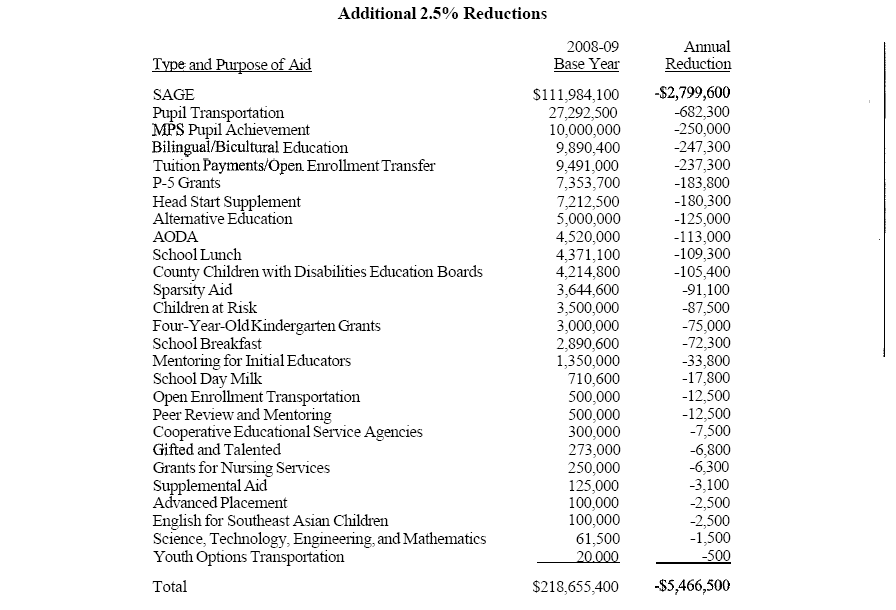
  • 2.5% reductions in categorical aids, see below for the ugly impact

cutsUgly, ugly ugly.  It is all ugly and will get uglier as the implementation of these cuts is debated in districts around the state.

More later, including a fact check to see if total education revenues actually ” increase by approximately 5% on a biennial basis.

Thomas J.  Mertz

7 Comments

Filed under "education finance", Budget, Contracts, education, Local News, School Finance, Uncategorized

Rumors and Deals — Wisconsin State Budget Update

whispering

Legislative “leaders” met behind closed doors for nine hours yesterday, May 27, 2009.  The Committe on Joint Finance is expected to “finish their work” in a public session starting at Noon today.  The agenda is here.

s_handshake3

Because they are meeting outside of the light of public scrutiny and the Legislative Fiscal Bureau has not posted budget papers on the education portion of the “fix,” we have to rely on rumors and memos from interested parties to learn what is happening.  Fortunately, the team at the WisPolitics Budget Blog has been doing a fine job reporting what little is rumored or known.

The big three education developments are some numbers on the Allowable Revenue Limit increase, a suggested compromise/delay on ending the Qualified Economic Offer from WEAC and the first inklings of a compromise proposal on Milwaukee voucher schools from State Senator Lena Taylor.

On the Revenue Caps, the word is that the new allowable increase for 2009-10 will be between $200 and $210 per pupil, instead of the $277 in the Governor’s initial budget.  By my calculations, that means about a $1.7 million to $1.8 million cut for the Madison Metropolitan School District.  No word on further cuts to categorical aid (yet).

The QEO compromise issue is complicated (I am not sure I understand it), but the general idea is that the proposed elimination of the QEO and the changes in arbitration rules would be delayed and temporary reforms would be put in place.  The proposal from WEC also includes things like allowing four year contracts and combining bargaining units.  You can read the WEAC memo here.  I haven’t seen a reaction yet from the Wisconsin Association of School Boards.

Without more details, it is hard to get a handle on Senator Taylor’s proposal on voucher schools.  here is what WisPolitics is reporting:

In February, Doyle called for a series of changes to the program that would require choice schools to meet many of the standards now imposed on public schools. That includes requiring the same number of instruction hours each year as public schools, administering standardized tests, and requiring all teachers and administrators to have a bachelor’s degree.

“What I’ve offered as a modification is really in many ways more stringent than what the governor has done,” Taylor said.

Taylor said today the compromise package had not been drafted yet.

But some key changes to the governor’s proposal include:

*Removing a requirement that schools must be accredited prior to accepting MPCP students, which Taylor said would be problematic for newly formed schools. Accreditation agencies require schools to be operating before they can be accredited. In its place, the compromise would require schools not yet accredited and wishing to enter the choice program to be screened by the Department of Public Instruction to determine whether they have the financial wherewithal to properly operate and have their educational plan and curriculum approved by a pre-accreditation agency. Furthermore, schools would have to undergo yearly academic audits by the accrediting agency.

*Requiring teacher’s aides to have at least a high school diploma, an area the governor’s proposal does not address.

*Giving schools two years before having to administer the Wisconsin Knowledge and Concepts Examination to students, whereas the governor’s proposal would require that to happen within one year.

See more in Milwaukee Notes.

And as the Joint Finance Committee does their work, school districts await the bad news and prepare for more cuts in educational opportunities.

Menasha just got through cutting $1.27 million and agreeing to use over $200,000 from their Fund Balance to avoid further cuts (including maintaining SAGE).  What comes out of the JFC, the Legislature and the Governor’s office will likely lead them to reexamine these decisions look for additional cuts.

The Waupun Area School District has already cut $1.1 million from their 2009-10 budget and anticipate the latest hit from the state will require laying off 12-15 staff members, larger class sizes and fewer opportunities.

Whatever the Governor and his people tell you, the cuts are real.

Stay tuned.

Thomas J. mertz

Leave a comment

Filed under "education finance", Budget, Contracts, education, finance, Local News, School Finance, Uncategorized

The Democrats Cut Education and Services, Relative Silence Ensues

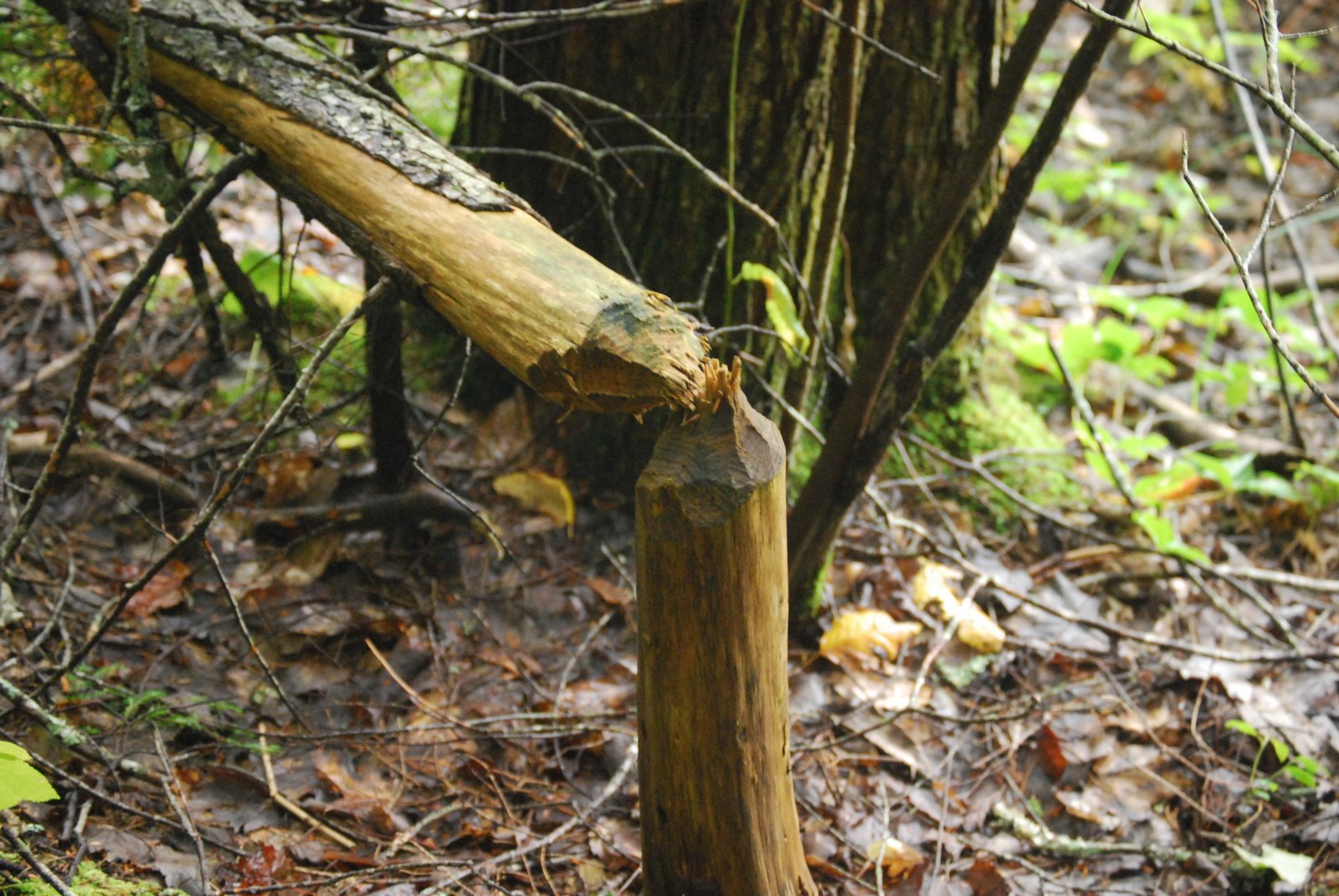
beaver-cut-742551There is that old question about whether a tree falling in empty woods makes a noise.  Last Thursday, May 21, 2009 Wisconsin Governor Doyle got out his budget cut saw and began felling numerous trees. He has since passed the saw to the Democratic controlled Joint Finance Committee who are poised to finish the work.  Although many organizations and individuals were very vocal before the cuts were announced, there has been relative silence since.

Prior to the announcement of the budget ‘fix,” 65 organizations joined in an effort to convince lawmakers that new revenues should be part of the answer to state’s deficit.  Other organizations and individuals,  such as the School Finance Network and Paul Soglin and Barry Orton (and me),  sent similar messages.

Since the announced “fix” involving large cuts to core government services, there has been relative silence.  Maybe it is the shock of the  betrayal by Democrats who seem to have abandoned the principles of their platform.  Maybe it is misplaced loyalty or sympathy to elected officials who express regrets instead of glee as they cut away.  Maybe it is just the long holiday weekend.

Whatever the reasons, if this silence continues our elected officials will breathe a sigh of relief knowing that there will be  no political consequences for their betrayal.

One notable exception to the silence comes from Ed Garvey at Fighting Bob.  He gets it almost exactly right:

Is there a difference?

OK, there is a budget shortfall. We know that; we know schools are under-funded; and local governments are have trouble raising money. So why would a Democratic governor cut school aid, lay off state workers, cut aid to local government, and threaten to cut more jobs unless the unionized state employees agree to reduce their pay “or else”? (No bargaining? Bad faith? You betcha. Is that how Democrats negotiate in good faith with the union? “My way or the highway?” Heck, Tommy treated state employees better than that.)

I don’t get it. Isn’t it time Jim Doyle opted to lead? Leadership in these tough times would require him to step on lots of Gucci slippers worn by the big campaign contributers. Time to announce that he won’t run so he can lead, or announce he is running as the governor who believes in fair taxes, good public schools, a respect for the bargaining process, an end to contracting out, and support for an increase in progressive taxes. (Did I mention public financing of campaigns?)

C’mon! Wisconsin Democrats cannot keep cutting just when working families need help. Tell the Neanderthals in the Legislature that there is a difference between the two parties. Lead or get out of the way.

I hope the coming days will bring more protests like Garvey’s.  I’ve got my own in the works , now posted on AMPS.

Thomas J. Mertz

2 Comments

Filed under "education finance", Accountability, Budget, Contracts, education, Elections, finance, Gimme Some Truth, Local News, Uncategorized

Letters to the Editor — School Finance (and the QEO)

image-letter-to-the-editor-stampMany good letters to the editor in response to a recentWisconsin State Journal editorial.

QEO repeal alone would make situation worse

In 1993, Wisconsin adopted a “temporary” formula for funding public schools based on revenue caps, the QEO and a promise of two-thirds funding for education from the state.

Revenue caps and the QEO were set at levels that did not foresee today’s health care and energy costs, or the increasing percentages of students needing services such as special education. State funding falls farther behind the two-thirds goal every year. And under the current budget proposal, we would lose the QEO as well. Revenue caps left alone will not support schools. It will crush them.

It’s time for state government, which created this situation, to take responsibility for solving it. We need a sustainable education system, one that balances the needs of students, teachers and taxpayers.

Simply repealing the QEO will make the situation worse, not better.

— Sherri Swartz, Madison

Today’s schools funded using obsolete system

When I retired in 2006 after a total of over 33 years teaching, 26 of them here, I was earning $47,092, with a master’s degree plus 16 graduate credits, on a pay scale which went no higher than 13 years of experience.

This represents a small annual increase during those 26 years over the equivalent pay scale when I started in 1980 ($18,675).

In what other profession requiring a master’s degree would you expect people to work at those salary rates?

The QEO mandates 3.8 percent. But double digit inflationary increases in health insurance costs eat up most of that.

School districts can’t keep up by financing education mainly with property tax increases. We are trying to pay for education with a horse-and-buggy system. In the 21st century, this simply won’t work. Boomer-aged teachers are retiring, and few young people wanting to survive financially would consider entering such a poorly paid profession.

If you want good teachers, revamp the whole system and control health costs.

— Kay Ziegahn, Richland Center

QEO and revenue caps bad way to fund schools

The QEO does not rise with the cost of living, so teachers are being paid less and less every year. This is unfair, especially for those who have been teaching the longest.

And the revenue caps have caused a lot of damage as well. Several towns have closed schools because they no longer have enough money to run them. Other towns have cut out their sports programs.

And here in Madison, teachers have retired early so younger teachers won’t have to lose their jobs. Programs and courses have been cut, and there is less money for supplies. Computers cannot be upgraded, so they are too slow in some schools.

If we are to keep up with schools around the world, we must eliminate the QEO and the revenue caps. We must fund our schools.

— Genie Ogden, Madison

Reconsider America’s public school concept

As an educator in the public schools, I wonder why it seems like this is a panic. The QEO has been in place since 1993, and this is Gov. Jim Doyle’s second term. There should have been plenty of time to evaluate the QEO and the revenue caps, as well as comparing these to other states.

Wisconsin is not alone in struggling to fund public schools. You can blame it on our “rich” health care benefits, although I’ve never heard GHC referred to as “rich.” Maybe addressing the portion of health care would be reasonable. But Wisconsin cannot expect to attract and keep good teachers if wage increases don’t even come close to the rate of inflation.

People should be reminded that educators not only have a minimum of one degree but must also pay for six credits to maintain the five-year license that we pay for.

It may also be time for states and the Department of Education to revisit the notion of public schools and how to best prepare tomorrow’s workforce. Cutting programs, increased class sizes, fewer technological resources and closed schools is not the answer to funding education.

— Dawn Nonn, Madison

Isn’t it amazing how concerned citizens can so clearly see the need for comprehensive school finance reform, yet our elected leaders seem to be wearing blinders.

Thomas J. Mertz

Leave a comment

Filed under "education finance", Best Practices, Budget, Contracts, education, Elections, Gimme Some Truth, Local News, School Finance, Uncategorized

The Man With a “Plan”

94575

After greeting the School Finance Network (SFN) plan with little better than contempt and offering a budget proposal that at best slows the bleeding in school finance (after 15 years of steady blood loss), Wisconsin Governor Jim Doyle has previewed his own “plan” for fixing school funding.  It may be a good starting point for talking (not as good a starting point as SFN’s work), but I don’t think contains the answers to the financial and other struggles of our schools and I don’t like the way it only provides the  resources needed to “improve student performance” (which unfortunately will likely be defined by the flawed and limited WKCE) to those districts that meet criteria that have nothing to do with education.

Like many policy proposals these days, it uses rewards and punishments, carrots and sticks.  The reward is an opportunity to escape from the revenue caps, to no longer have to cut 1%-2% of educational programing annually.  The punishment is to continue under the system that has eaten away at our schools, limited our students’ opportunities and put our state’s future in danger for the past 15 years.

The rewards are tied to the following ill-defined (at this point) policies:

• Join together for the purposes of negotiating union contracts

• Make employees use the state health plan unless the school district already has a plan that is cheaper

• Require schools to agree to a list of practices that would improve student performance

• Provide compensation for teachers that better reflects the needs of individual schools such as those in rural districts that struggle to attract teachers for some subjects

I’m going to leave the contracts, compensation and health insurance aside for now in order to say a few words about #3, the “best practices.”

Doyle cited the work of Alan Odden as the basis for the kind of practices he has in mind.  The Wisconsin School Finance Adequacy Initiative Final Report for 2007 has some good ideas about “best practices” based on research  and good estimates of the costs of these practices, also based on research.   Some of the things in the Odden report are stronger than others and some would be difficult for many districts, but small classes, formative assessments used wisely, teacher coaches, staff development are all good ideas.

What Odden and SFN both propose is funding these practices for all schools.  Doyle seems think that access to best practices should be a reward available only to those who get all their ducks in order. I guess the New “New Wisconsin Promise” will be “A Quality Education for Every Child Who Lives in District that Joined with Other Districts to Negotiate Contracts and Limit Health Care Costs.”

I want to make it clear that neither Odden nor SFN wants to simply give the schools more money to do whatever they want (although both do show proper respect for the  professional knowledge of our state’s educators).  Both include means of targeting money to research based programs and both also propose “accountability” evaluations.

There are ways to target money toward best practices but still make the resources available to all schools  (the Student Achievement Gaurentee in Education — SAGE — program is a partial example).  You can do categorical aids which can only be spent in certain ways,  you can do grants, you can do reimbursements.  Instead, Doyle ties the resources for best educational practices to his ideas of the best financial and policy (and probably political) practices.  As education policy, this makes no sense.

We’ve had 15 years in Wisconsin under a system of school finance that is based on the politics of tax policies, not education.  As a nation, with No Child Left Behind we’ve been punishing schools instead of helping them.

If Doyle’s plan moves forward, I sincerely hope that education is put first and that the stick punishment is put away;  that the very good ideas about funding promising educational practices are enacted in a manner that will reach all districts, all schools, and all students in Wisconsin.

Thomas J. Mertz
2 Comments

Filed under "education finance", Accountability, Best Practices, Budget, Contracts, education, finance, Local News, nclb, No Child Left Behind, School Finance

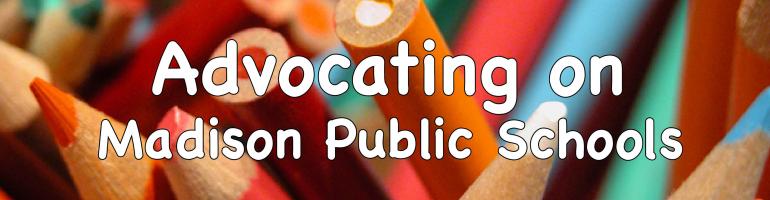
Education Tweak, Winter 2009

edtweak

Click on image for pdf

Enjoy.

Thomas J. Mertz

Leave a comment

Filed under "education finance", Best Practices, Contracts, education, finance, Gimme Some Truth, National News, nclb, No Child Left Behind, School Finance