Category Archives: “education finance”

On the Agenda (#1) — MMSD, Week of March 1, 2010 (Updated)

Update: The High School Report and the Infinite Campus proposal to increase usage are off the agenda due to time considerations.  There is also a new Re-Organization Budget (appendix A) updated with corrected calculations showing different “savings” figures.

Another very busy week with Madison Metropolitan School District governance matters.  So busy that I’m doing a once over “lightly” (can’t really call something this long light) with this post and time permitting intend to post in more detail on some of the items such as the much-delayed and unacceptable Equity Report,  and maybe the budget matters (five year analysis here , MSCR cuts and effciencies here and  time-line here), the Reorganization proposal (memo, appendix one, appendix two) and perhaps others.  You can access the entire week’s notice of meetings here.

The week starts bright and early with a Monday, 8:00 AM visit from the Madison Legislative delegation to Falk Elementary School.  This is something Board Member Maya Cole has been pushing.  The idea is to bring those in control of school funding into the schools to witness and here about the difficulties their actions and inaction have created.  Beyond actually getting the legislators there and listening, the key to success is to find the right balance between “we are doing a good job” and “the children’s education is suffering.”  Professional educators have a lot of trouble with the latter.   Here is a guide to a similar exercise from the Illinois Education Association, the key point they make is to stay on message.

This is a Committee meeting week.  Most items are first presented this week to the Board — meeting as Committees — for discussion and then return next week to the Board — meeting as the Board — for votes.   The Committee meetings are consecutive and commence at 5:00 PM in Doyle Administration Bldg., 545 W. Dayton Street, Room 103.  Like almost all Board meetings, these will be carried by MMSD-TV.  Public appearances for all items and committees are at the start of the first meeting.

This week, the first Committee is Planning and DevelopmentHere is the agenda.

The big item is the Reorganization (memo, appendix one, appendix two).  This is the first public look and it is listed as an action item for the March 8 meeting (the Board previously discussed some version or some aspects in closed session, the big problem with closed sessions is you don’t know what happened).   There is a lot here and I have not had time to look closely, but will offer some initial observations.

  • The big idea is to align the structure with the Strategic Plan.
  • The “side by side” is nice, but comparative organizational charts would be useful too.  You really can’t tell the players without a scorecard.
  • What might be the biggest change is the adding Chief Learning Officer to the title of Deputy Superintendent and changing the duties and structure accordingly.  I say might, because it is difficult to see how this will not continue to be a primarily administrative (as opposed to educational) position.  Steve Hartley who holds the position now is retiring.  I’ve heard nothing about who might be filling the revamped position next year.
  • The other big change involves what is now Teaching and Learning.  A  new Department of Professional Development is being created, moving this out from under Teaching and Learning.
  • Teaching and Learning will be re-dubbed Curriculum and Assessment.
  • TAG moves to the Elementary and Secondary departments (I’m not clear on waht that means or who they will report to).
  • The Special Asst. for Race and Equity becomes the Assistant Director of Equity and Parent Involvement, in the Curriculum and  Assessment Department, with Cultural Relevance Resource Teachers and Minority Service Coordinators in the new division.  The emphasis on Parent Involvement in the new name doesn’t jibe with the new organizational home.  Come to think of it, it also doesn’t jibe with the definition of Equity in the district Policy (curriculum and assessment are only two parts of that and not — in my opinion or as reflected in the policy — the most important parts.
  • In a related matter, the Affirmative Action officer will be moved Superintendents officer with duties involving Community Partnerships.
  • Although Community Partnerships are being moved, the Public Information Department becomes the Public Information and Community Engagement Department.  Partnerships to the left, engagement to the right?
  • There are things going on with a “Cluster Program” that I’m not clear about.  It appears to be about delivering central office support services via quadrants or clusters, but also appears to be headed by the a principal of Shabazz, with support by principals from small elementary schools and I’m not sure how that will work in practice.  I think I’m missing something.
  • As part of a related restructuring, Alternatives becomes Alternative and Innovative Programs, with some new duties for the director and day-to-day responsibilities for the students and staff of the programs housed in Marquette and Lapham devolving to those principals.  This is another one that doesn’t feel right.
  • MSCR will report to Asst. Sup for Business and Finance.  I think this is to get control of things.
  • The Lead Elementary Principal postilion has been axed, replaced by Director of Early and Extended Learning (4K, after-school, Summer…).
  • The net cut is (I think) five administrative positions.
  • Savings are in the $550,000 range (which as far as I can tell is the same range as the administrative raises recently given without a fiscal analysis or any discussion and not including the raise recently given to Supt. Nerad, also without a public discussion).
  • The savings figure ($556,439.50) includes positions that have been eliminated but due to continuing contracts the personnel involved will remain on the payroll in temporary positions and the proposal calls for Fund Balance money to be used for their salaries and benefits.  This totals $337,538.3, leaving a little under $220 Grand in savings for the 2010-11 budget.  As the Board looks at the 2010-11 Budget, these kind of deceptive labels need to stop.
  • A lot of people are being asked to do more, some with less to work with.
  • Much, much more on rationales, leadership councils, renamed departments and positions…I get some of it, but am not clear on the what, or why with much.

Next on the agenda is the Badger Rock Charter School Planning Grant Application.  This looks unchanged from the last time it was before the Board.

This Committee closes with the Lindbergh Elementary Community Garden Proposal.  This looks great.   More on school/community gardens here (with music!).

Operational Support is next (agenda linked).

Any good feelings lingering from the garden proposal won’t last long as the Board takes up the Five-Year Financial Outlook to include Projected Budget Gaps and Tax Impacts.  No smiles here.

Lets’ start with the projected deficits (the gap between allowed revenues and cost-to-continue):

These are with 4K.  That’s about $19.5 million in savings, efficiencies, program and service cuts over four years (on top of whatever is saved/cut in 2010-11).  Yow.

The projected levy and tax impact numbers are another “yow.”  Some of these come in with 4K and without 4K versions.  These don’t reproduce well, so some just selected parts, figures and notes.

One interesting thing is that they are based on an assumption of no property wealth growth.  My guess is that property wealth in Madison will continue to grow slowly (easing the burden on individual taxpayers), but will grow faster than the rest of the state (leading to cuts in state aid).  How this balances out, I don’t know except that recent history inclines me to believe that Madisonians will be hurt more than helped.

In the “with 4K” projections, if the district taxes to the max and the deficits are met with Fund Balance spending and not cuts etc, the district goes broke in 2014 (no “without 4K version on this one).  Our younger son would be in Middle School that year.

Here is what the tax-to-the max mill rates and taxes look like for 2011-12 through 2014-15(with and without):

The current mil rate is 10.18 (on page nine of the linked document there is a fuller chart, with projections for homeowners that did not reproduce well enough to post).  These are huge tax increases.    Talk about unsustainable.

Insert obligatory Wisconsin Alliance for Excellent Schools and Penny for Kids links along with discretionary School Finance Network link.

Next up is MSCR Proposed Budget Reductions and Efficiencies for 2010-11.  There is much here.; position cuts, schedule changes to save overtime, program cuts, fee increases…much.

MSCR is an orphan.  Some with the school district believe that it is outside the “core mission” and this is true if you look at the strategic plan.  It isn’t true if you look wider and note that MMSD has accepted the taxation authority and responsibility for providing recreational programing.  I wish there was a Parks & Recreation Department in Madison (not necessarily under Kevin Briski), but there isn’t.  There is a hodge-podge and some of it is the the responsibility of the district.   Quality of life in Madison depends in part on a wide variety of recreational activities accessible to all  and like other quality of life matters this means that it is proper for tax dollars to be used to create and to some degree subsidize these activities.   There are a couple of places in the document with asides like (paraphrased)  “based on fees, more like the YMCA” or “maybe the Boys & Girls Club will do something.”  To me this is shirking responsibility.  Maybe not in every case, but as an attitude.

My impression is that there are real savings and efficiencies to be found, some justifiable cuts and fee increases, but a real need to keep opportunities and keep them affordable for all.

The total savings is $1,838,928.  Some big items (dollars and impact, no order):

  • Discontinue after-school contract for low income at Red Caboose and YMCA (my note:  the variety of after-school programs and varied costs of these needs to be addressed).
  • Reduce School Year and Summer Transportation (my note:  all good, except many parts of the city have no or almost no MSCR programing, I’d like to see this addressed also).
  • Increase staff to student ratio by 2.5%.
  • Shift Safe Haven Fee Waivers to Dane County Childcare Assistance (does the County know? Robbing Peter to pay Paul?).
  • Reduce Fee Waivers (adult and youth).
  • Raise Program Fees (some big and OK, some small, some seem too big).
  • Reduce Programing (Middle School, Summer, Penn Park, after-school enrichment, adult…)
  • Discontinue Safe Haven at Lindbergh (this isn’t sitting well with that neighborhood).
  • Much, much more.

Take  a look yourself, but do keep in mind that if we want Madison to be a rich and attractive place to live, part of the price is public support for the things MSCR provides.

Next, Proposal for a Lease and Contract to Permit the Construction of a Cellular/Communications Tower on Gompers/Black Hawk Property.

Then it is time for Approval of the “Resolution Authorizing the Issuance and Sale of $28,590,000 Taxable General Obligation Refunding Bonds”.  This is the retirement refinance/4K finance voted on here.

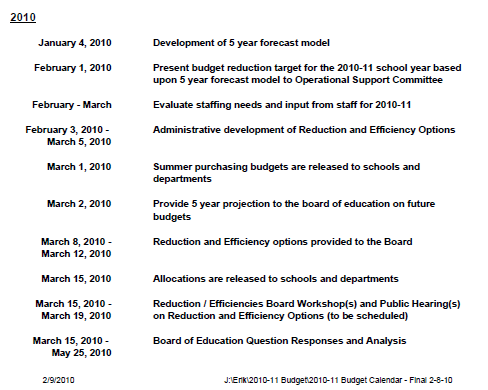
The last big item for this Committee is the budget time-line.  Feast your eyes:

It looks like an intense and unpleasant couple of months.

Everything else is Bills, Purchases and Contracts, Other Financial Transactions as well as the Human Resources update, (with lots of retirements, including Debra Stanko who did more than right in recognizing and addressing our older son’s talents and needs at JC Wright).

Among these, the Formative Classroom Assessment Tool Development and Data Sharing Agreement caught my attention and not in a good way.  The contract is with UW to pay a Grad Student to develop an I-Pod Touch assessment app.  Do we need this; do we want this?

The only reason that I can see to have an assessment app on a handheld device is to be able to assess while teaching, to enter assessment data while walking around the classroom.  I want my teachers in the moment, teaching.  This is the current obsession with data over teaching in a nutshell.  If this is the future, I don’t like it.

The last meeting is the Student Achievement and Performance Monitoring Committee.

The first item is a Madison School & Community Recreation (MSCR) After School Programs report.  This and other reports on MSCR should inform considerations of the proposed changes discussed above.

Then it is time for the long awaited (well over a year and a half late) Annual Equity Report.  A full consideration of this will appear in a subsequent post.  My initial impression is that there is one part part I think is based on a very good concept, but overall it is more than a day late and more than a dollar short.

The lateness and shortness are related significant failures.  The idea was to measure progress or document the lack of progress and the not only has much time been lost in setting the benchmarks, but the shortness has to do with the reports failure to provide those very benchmarks.

First the part I like conceptually.  The final portion of the report takes strategies recommended by the Equity Task Force and links them to things the district is doing, “Programmatic Resources.” . This is very interesting and useful.  I’ve got some doubts about some of the links and there is a certain impression of “we’ve got this covered” that can lead to complacency where urgency is needed.  Still I like the idea and much of the execution.

The Board Equity Policy includes this reporting requirement:

Administration will report on an annual basis to the Board of Education the extent of progress on specific measures in eliminating gaps in access, opportunities and achievement.

Obviously with the first report, progress will be difficult to report (that timing issue again); because of the lack of specific measures it will also be difficult with next year’s (the shortness).

At this time I’m not going to question the measures chosen for achievement, but rather criticize the presentation of the data related to these measures.   There is no raw data, no analysis (statistical or otherwise). Instead we are given selected factoids (the State of the District presentation which serves as the basis for much of the report suffered from a similar lack of information and rigor).

For now a couple of examples will suffice.

Is there any possible way to use this to measure progress or lack of progress?  Remember, this isn’t the analysis of the data presented, this is totality of the data.  They aren’t all that bad; this one is more typical:

At least here there are some numbers.

The other reporting requirement reads:

Administration will develop an annual report that will provide data on the distribution of staff, financial, and programmatic resources across all schools.

As I said above, the programmatic portion is a positive thing.  The staff and financial parts are another story.  Instead of looking at the staffing at particular schools (as was done for middle schools in 2006)  or reports on diversity in various jobs or schools (there was a Human Resources Report about 6 months ago that did the former, I’ll link to it when I get a chance) we get this:
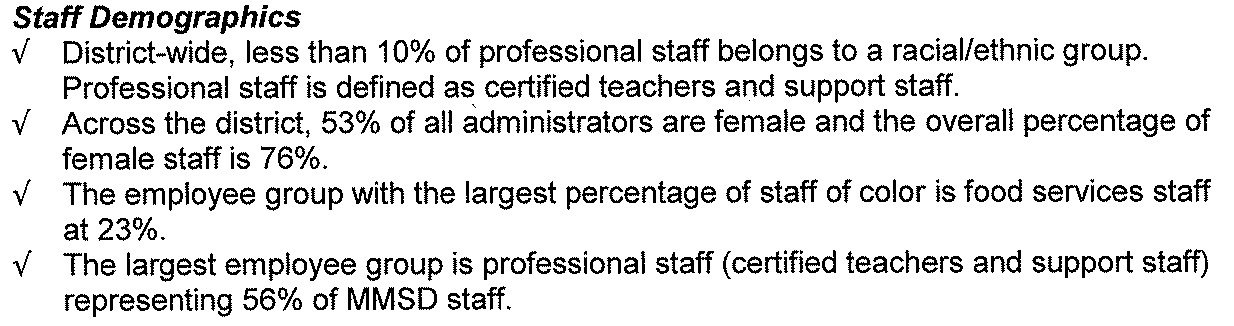
There is no there, there.  Factoids.  Nothing to work with.

In terms of resources, we are given explanations of the Equity Resource Formula and Title I, but no “data” on how these are distributed  “across all schools.”  Information is similarly lacking in other areas:  the goals of the Technology Plan are presented with an Equity framework (good), there is no information on the technology in or slated for particular schools and how that related to Equity (bad); The School Improvement Process is sketched and funds are mentioned (good), but there is no accounting of those funds (bad); Professional Development and Indigent Bus Passes are also mentioned.   More than a dollar short.

As I noted, I’ll be returning to what is and is not here in a subsequent post (see here for an earlier related post).

In closing this topic, I was recently reminded that the Board accepting a report is not the same as approving it.  I understand that, but think that this report should not be accepted.  It is unacceptable.  It does not meet the requirements of the Policy by any stretch of the imagination and does not provide a basis for assessing the future success or failure of the district’s Equity work.  We’ve waited long enough and can wait longer if we must; there is no excuse for not doing this right.

The High School Initiatives agenda item has much of interest on the REal work, the ACT/Eplore initiative, AVID, and the Individual Learning Plan implementation.  I’m not sure how much is new here and don’t have time to dig tonight.

The action items are Recommendations to Increase Usage of the Infinite Campus Student Information System, Renewal of DPI Waiver for Days of Instruction for Sixth and Ninth Grade First-Day Transitions, and Five-Year Education for Employment Plan (precursor to the first and the last were covered in previous “On the Agenda” posts).  Consent items are Learning Materials purchases, 57 High School Diplomas and the enrollment of students in Equivalency programs.

The other meetings this week are the Common Council/BOE Liaison Committee, Wednesday 5:30 PM at the City/County Building and the Superintendent’s Human Relations Advisory Committee, Thursday, 1:15, Doyle Building room 103 (agendas on the Weekly Notice).

Thomas J. Mertz

Leave a comment

Filed under "education finance", Best Practices, Budget, education, Equity, finance, Gimme Some Truth, Local News, Pennies for Kids, School Finance, Uncategorized

Ask Tom Barrett — Get School Funding on the Agenda

Click image to go to the "Ask Tom" page.

Almost certain Democratic Gubernatorial nominee will be participating in a live video chat on Sunday, March 7 at 4:00 PM.  You can submit questions in advance by clicking the image above or this link.  Now is the time to get school finance reform on his agenda, to make him know that this is an issue that potential voters care about. Ask about long term solutions, Penny for Kids, the current crisis or all of the above.  The more specific the better.

In a related matter, Republican Gubernatorial candidate Mark Neumann came out in favor of Education Excellence this week (I think he meant “Educational Excellence”).  A bold stand.  I hear next week he will be singing the praises of apple pie.

As one might guess the the specifics in most areas are lacking.  Some things caught my eye.  These two bullet points appear to be contradictory:

  • Giving public school districts the ability to ensure that tax dollars are directly benefiting the classroom. That means removing rules, mandates and regulations that are costing districts more and more money, and empowering local action to control costs.
  • Strengthening the state government partnership with public school boards, concentrating on enacting policies that ultimately demand excellence and accountability, while ensuring schools are safe and nurturing places for kids to learn.

Virtual schools and charters are singled out for praise and expansion.  More contradiction and fewer details here:

  • Keeping K-12 education funding as Wisconsin’s top budget priority and fixing the broken state budget process to ensure public schools and the UW System receive necessary funding.

He’s right that the budget process is broken, but part of the reason it is broken is that avoiding real revenue reforms,  — not K-12 education funding — has been the “top budget priority.”  Since elsewhere Neumann talks of keeping revenue growth below the rate of inflation,  it is doubtful that the fixes Neumann will support will be of help in providing schools the resources they need.  Very doubtful.

Thomas J. Mertz

1 Comment

Filed under "education finance", Budget, education, Elections, finance, Local News, Pennies for Kids, School Finance, Take Action

All the News from WAES

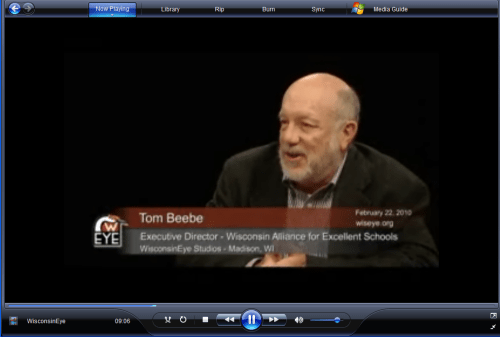
Click on image for video of Tom Beebe of WAES discussing Penny for Kids on WisconsinEye's Newsmakers

Things have been busy with the Wisconsin Alliance for Excellent Schools (WAES) and the Penny for Kids campaign.  Time to catch up a little.

Click on the image at the top for a fine interview with WAES Executive Director (and lone employee) Tom Beebe.  It really explains what Penny for Kids is all about.

The Rural Caucus presented some proposals on school-funding this week.  They aren’t bad, but they aren’t anywhere near enough.  WAES issued a press release, mostly saying that.  Here is an excerpt.

Their package of ideas addresses very real problems. For 15 years, schools and children have been subjected to an unsustainable school funding formula and now they are actually facing drastic cuts in state funding. As a result of this crisis, many schools are cutting personnel, services, and programs, others are fighting just to keep their doors open, and property taxpayers are being overburdened.

So while I applaud the Rural Caucus for their efforts, their proposal falls far short of what our children, schools, and communities need.The ideas forwarded by the Rural Caucus are Band-Aids and Band-Aids won’t stop this kind of bleeding.

What we urgently need is bold thinking and immediate, significant financial help – – a transfusion, not Band-Aids — as well as a long-term solution to the school funding crisis.

It is for this reason that the Wisconsin Alliance for Excellent Schools has launched “A Penny for Kids,” a program that has the support of thousands of voters. It proposes a one-penny increase in the sales tax in order to meet, head on, the revenue shortfall. This transfusion of revenue will buy us the time we need to address the structural failures of our current funding formula.

I appreciate the Rural Caucus’s willingness to take on this issue, but their solution falls far short of the urgent and significant reform that must begin now.

Last, but not least, the latest School-Funding reform Update from WAES (full update linked here, table of contents below with selected items linked to related posts on AMPS:

It is both good and bad that WAES is so busy.  It has become clear that WAES with Penny for Kids is the only group who have recognized the crisis that is happening and are trying to do something about it, in both the long and short term.   WAES can do this because we (I’m on the Board) are truly a grassroots organization, not beholden to the status quo or “the powers that be.”  As people realize this, WAES is attraxting more attention and interest.  That’s good.  The downside is that WAES is resource poor and over-extended.  We need more help from individuals and organizations.  Get in touch with WAES and find out how you can help.

Thomas J. Mertz

Leave a comment

Filed under "education finance", Budget, education, finance, Local News, National News, School Finance, Take Action, Uncategorized

The Move to Digital

A couple of days ago, Governor Jim Doyle announced a grant from the American Reinvestment and Recovery Act to improve the state’s telecommunications network. The goal of the award is to bring fiber optic broadband to 380 Wisconsin communities.  The $28.7 million BadgerNet project will expand infrastructure for rural schools and libraries, via phone lines, throughout the State.

Access to the Internet in the U.S. is about as common as having cable TV. Unfortunately, it’s still a luxury many families cannot afford.  The ongoing cuts in work hours and benefits, or loss of a job altogether, is of course tragic. For many of us, access to technology is something we tend to take for granted. In our increasingly technology-dependent age, access to a computer and the Internet is becoming quite essential. But many of our low-income families cannot afford a computer or Internet access in their home. Many low-income families are fighting hard just to maintain basic living standards.  With education becoming more dependent on the Internet, it’s even more critical that we level the playing field for all students and families.

But, as Mike Ivey of the Cap Times pointed out in his story this week, the reality is that Madison’s poverty rate is climbing — rising nine times faster than the rate of other U.S. cities, according to a new report from the liberal-leaning Brookings Institution, cited by Ivey. Since 2000, the poverty rate (defined as a family of four with an income under $21,800) in Madison has jumped from 15 percent to 17.7 percent. That’s one in every six residents. One of every two students in the Madison Metropolitan School District is now considered “low income” using the free and reduced lunch standard. In 1990, just one in five Madison school kids qualified.  According to the American Community Survey, an annual estimate from the Census Bureau, Madison added nearly 8,400 residents living below the poverty line between 2000 and 2008, a 29 percent increase.  Ivey cited the report’s prediction that “Madison will likely see its poverty rate jump another 1.1 percent this year, surpassing the average poverty rate for the 95 largest U.S. cities.”

In addition to BadgerNet, our school district is also trying to improve the various schools’ access to the internet and to better define its uses as a communication tool.  This access needs to be extended to the families of the students it services.  Jeff Richgels at the Cap Times reported yesterday that due to cost and a lack of digital literacy, over a third of the country does not have high-speed Internet access in the home (defined as non dial-up service).  Broadcasting & Cable reported on an FCC consumer survey that found that “more than a third of the non-adopters (28 million adults) said they don’t have broadband because the price of service is too high (15%); they can’t afford a computer; installation costs are too high (10%); or they don’t want a long-term service contract (9%). According to the survey, the average monthly broadband bill is $41.”

A recent story done by WKOW pointed to the conundrum, “a hard copy of the monthly school news letter is becoming less common these days. That’s one reason why Madison School leaders say they need to change with the times, and find new ways to communicate with parents and community members.”

MMSD posts plenty of information online in the form of press releases, a monthly newsletter, and a video of school-related interest.  They also have Infinite Campus so that parents can keep in touch with what is going on with their child.  Infinite Campus is a district-wide student information system designed to manage attendance, grades, schedules, test scores, and other information about the students in the MMSD.  The Parent Portal is a confidential and secure Web site where you can get current information about your child’s school attendance and grades.   E-mail hyperlinks facilitate communication with classroom teachers. In addition, schools post important information on the home page, such as events, notices, etc,. Attendance information is also available. The Parent Portal allows report cards to be viewed online and printed.

My concern is that in our move to a more online world, we are ignoring a large amount of low income and minority families that do not have an email address.  One example of this came to mind recently. Every year, MMSD asks parents to voice their opinions about the “climate” or feeling at their children’s schools.  They use the survey results to assist with the school improvement planning process.  This survey is available on the MMSD website although, it seems it was never sent out as a press release or included in the MMSD newsletter. The School Climate Survey was sent to the parent’s email address list as generated by each individual school. Surprisingly, this list is apparently not very comprehensive; two of our PTO officers were not on the list, despite having filled out the forms at registration and regularly receive emails from school personnel.

I hope that computers and the internet become as inexpensive as televisions and basic cable service.  Until they are affordable, MMSD cannot rely on the Public Library to be the way for low income families or minority families to access the internet and communicate with their children’s school district.

Jackie Woodruff

(Editor’s Note: We apologize for not crediting Mike Ivey’s fantastic reporting in this post in an earlier iteration posted yesterday)

2 Comments

Filed under "education finance", Accountability, Best Practices, Uncategorized

Action to the South

At Fred Klonsky’s Blog there was recently a mini version of an AMPS type “Buzzsaw/Cuts” post on school budget issues in Illinois:

On this Saturday morning, this is how the state of Illinois is dealing with its school funding crisis: In Lemont, in Galesburg, in East Richland, in Hoopston, in Kaneland, in Waukegan, in Eldorado, in Jasper, in Elgin, in Knoxville, in Indian Prairie District 204, in Plainfield, in Ottawa, in Orion near the Quad Cities, and in Quincy.

I can’t say if the state and school budgets are worse in Illinois or Wisconsin and it doesn’t really matter which has gone further or faster in the wrong direction.  Both are in bad shape and both states are dominated by politicians who believe their re-elections are more important than addressing this reality and the lobbyists and donors who reinforce this message.

At least in Illinois, people are fed up enough to try to make their voices heard.  They have formed the Responsible Budget Coalition.  The video above is from their February 17 rally.  Below is their “We Can’t Wait” video.

We may not have thousands at the Capitol yet, but interest in tax and budget reform is growing and thousands in Wisconsin have signed the Penny For Kids petition.  Click the link to join them.

Thomas J. Mertz

Leave a comment

Filed under "education finance", Budget, education, finance, Local News, National News, Pennies for Kids, School Finance, Take Action, Uncategorized, We Are Not Alone

The Fix Is In

Bob Herbert of the New York Times has been doing an admirable job of outlining the human costs of our neglected infrastructure in his weekly columns. On Saturday he highlighted the conditions in schools throughout the country. And while he noted that getting the nation’s schools up to date is a huge undertaking, it represents only a small part of the overall infrastructure challenge we face as a nation. While highlighting a school in Pennsylvania built in 1861, with asbestos encrusted walls and dodgy electrical wiring, he noted the difficulty in getting good data on the physical condition of the country’s schools.

Lawrence Summers, President Obama’s chief economic adviser, has said that 75 percent of the public schools have structural deficiencies and 25 percent have problems with their ventilation systems.

But how to pay for this? Herbert made the point that:

right now there are not enough people at the higher echelons of government trying to figure out the best ways to raise the enormous amounts of money that will be required, and the most responsible ways of spending that money. And there are not enough leaders explaining to the public how heavy this lift will be, and why it is so necessary, and what sacrifices will be required to get the job properly done.

Suggestions have included such institutions as a national infrastructure or regional infrastructure banks that “would allocate public funds and also leverage private capital for the most important projects.” His larger point was that top governmental leaders should be seeking all kinds of solutions that are both solid and creative, while quickly implementing the best of them.

Which brings us to this next item, one with twist and turns not completely understandable at this point, but certainly not held up by people like myself as a model of how to “get the job properly done” — to use Herbert’s words.

Diane Ravitch, an intellectual on education policy, difficult to pigeonhole politically (appointed to public office by both G.H.W. Bush and Clinton), but best described as an independent, co-writes a blog with Deborah Meier that some of our readers may be familiar with called “Bridging Differences.” This past week she highlighted a possibly disturbing development in the Race to the Top  competition program of the Department of Education, that dangles $4.3 billion to the states with a possible $1.3 billion to follow. Ravitch’s critique suggests that this competition is not run by pragmatists, but rather by ideologues who are led by the Bill Gates Foundation.

If this election had been held five years ago, the department would be insisting on small schools, but because Gates has already tried and discarded that approach, the department is promoting the new Gates remedies: charter schools, privatization, and evaluating teachers by student test scores.

Two of the top lieutenants of the Gates Foundation were placed in charge of the competition by Secretary Arne Duncan. Both have backgrounds as leaders in organisations dedicated to creating privately managed schools that operate with public money.

So, why should it be surprising that the Race to the Top reflects the priorities of the NewSchools Venture Fund (charter schools) and of the Gates Foundation (teacher evaluations by test scores)?

But here’s where the weirdness of this story enters.

Marc Dean Millot, a writer on education policy and someone who has not been overly critical of charter schools and their “education entrepreneurs” in the past, was contracted for 6 months to write on the Scholastic blog, “This Week in Education.” Millot had the temerity to pose some questions about those conflicts of interest at the Department of Education and had asked Sec. Duncan to nick this issue in the bud quickly.

I have now heard the same thing from three independent credible sources — the fix is in on the U.S. Department of Education’s competitive grants, in particular Race to the Top (RTTT) and Investing in Innovation (I3). Secretary Duncan needs to head this off now, by admitting that he and his team have potential conflicts of interests with regard to their roles in grant making, recognizing that those conflicts are widely perceived by potential grantees, and explaining how grant decisions will be insulated from interference by the department’s political appointees.

For his troubles, he was immediately sacked and the offending post removed. Fortunately, nothing is completely lost on the internet and you can read a cached version of his “Connect the Dots” piece here.

Even more chilling is Diane Ravitch’s predictions for the future, regardless of whether Secretary Duncan cleans up this apparent conflict of interest.

As hundreds and possibly thousands more charter schools open, we will see many financial and political scandals. We will see corrupt politicians and investors putting their hands into the cashbox. We will see corrupt deals where public school space is handed over to entrepreneurs who have made contributions to the politicians making the decisions. We will see many more charter operators pulling in $400,000-500,000 a year for their role, not as principals, but as “rainmakers” who build warm relationships with politicians and investors.

When someday we trace back how large segments of our public school system were privatized and how so many millions of public dollars ended up in the pockets of high-flying speculators instead of being used to reduce class size, repair buildings, and improve teacher quality, we will look to the origins of the Race to the Top and to the interlocking group of foundations, politicians, and entrepreneurs who created it.

We indeed are entering another chapter in the deepening decline in support for public education. Our looming deficit in Madison is just one example of many across the country. What we shouldn’t have to battle so vigourously is our elected and unelected “advocates.” Sadly, this also includes some of our own friends in the state capital.

Robert Godfrey

Leave a comment

Filed under "education finance", Accountability, AMPS, Arne Duncan, Best Practices, Gimme Some Truth, National News, nclb, We Are Not Alone

WISC EDITORIAL — THE PUBLIC’S SCHOOLS/ UNSUSTAINABLE BUDGETS

I need to add the The Wisconsin Alliance for Excellent Schools “stepped up” a long time ago and and is urging a step a Penny for Kids.  State officials talk the talk, but they need to walk the walk.  Sign on with WAES and Penny for Kids to remind them.

Thomas J. Mertz

Leave a comment

Filed under "education finance", Accountability, Budget, education, finance, Gimme Some Truth, Local News, Pennies for Kids, School Finance, Take Action, Uncategorized

February 16, 2010 Wisconsin Referendum Votes (Updated with Results)

Update, results:

Bangor, both pass, operating 379 yes votes to 214; construction 437 yes votes to 157 no votes.

Brodhead, fails, 1,021-828.

Edgar, passes 706 to 629.

Green Lake, fails, 393 to 374.

Hilbert, passes, 419 t0 305.

Rhinelander, both pass, operating 3,646 to 3,111, construction, 3,664 to 3,089.

Shiocton, pass, 8 votes, can’t find totals.

8 pass, 2 failed.

The video at the top is from the 2006 Madison referendum campaign, since the voter turnout on Tuesday is expected to be small I thought a little shame might help bring people out.

We are in a new era of referenda.  Referenda for building purposes remain much the same, except in many districts property tax increases to make up for drops in state support have made passage more difficult.  Operating referenda are also more difficult for the same reason, but there is a twist.  Previously the biggest financial issue was that rising costs — many of them mandated or near mandated — outstripped allowed revenue increases (the revenue caps).  This problem remains, but in many districts it has receded in importance because the drop in state support has made simply taxing to the max — using all the allowed revenue authority  — and the large property tax increases that result  intolerable to many voters and Board members.  According to the Wisconsin Taxpayers Alliance, a recent record 98 out of 427 districts — including Madison — did not tax to the max for the current yearEvery indication is that the percent will be higher this year.  For these districts, increased revenue authority via a referendum is irrelevant.   These districts have to cut to address the gap between allowed revenues and costs (like always) and are cutting to limit property tax increases.   It is a new era.

It is this situation that leading our schools into crisis and making our schools the center of conflict instead aspirations.  It is this situation that inspired the Wisconsin Alliance for Excellent Schools to launch the Penny for Kids campaign to increase state education funding and improve how it is allocated.  Click the links, find out more and sign the petition.

On Tuesday, eight districts will have a total of ten referenda before the voters; four for construction borrowing, and six for operating expenses (one recurring and five nonrecurring).  You can see all the referenda details here.

The Bangor district is asking for $580,000 in demolition and construction debt authority (for the old high school gym, this would be a no interest ARRA loan) and three years on additional revenue authority at $350,000 a year.  The district referendum page is here.  Here is what the LaCrosse Tribune reported on the operating referendum:

“We’ve pared things down, and even if this one passes we will still have to look at ways to reduce our budget and conserve our expenses,” Superintendent Roger Foegen said. “But the board felt in these tight economic times we couldn’t ask for any more than we are currently getting.”

The district is in the final year of a three-year $350,000 operating referendum, he said.

Without renewal, it will face a $400,000 to $450,000 deficit next school year.

The district already trimmed $600,000 from its annual budget before going to the public three years ago, Foegen said.

“Because of the state funding formula and the things that go into it, we need to maintain it if we are going to keep our current programs and personnel,” he said.

Foegen said the plan will cost the owner of a $100,000 property an estimated $78 in 2010-11; $39 in 2011-12; and $13 in 2012-13.

The Brodhead district has a four year non recurring measure on the ballot.  Here is how it breaks down:

2010-2011 $635,000
2011-2012 $810,000
2012-2013 $855,000
2013-2014$1,285,000
Total $3,585,000

The district has a nice referendum page here.  It includes a list of cuts made sine 2003-4, which is good reminder that the current crisis comes on top of 16 years of cuts because — by state design — revenues have bee kept below cost-to-continue.  You can read the whole list at the link, here are the programs:

Programs or Activities Eliminated

– Jazz Band II eliminated – FHA (Future Homemakers) eliminated

– FBLA (Future Business Leaders) eliminated

– drivers’ education eliminated

– District funding for 7th grade camp eliminated (still runs thru funding by student activity account)

– access to HSED/GED programming at BlackHawk Tech reduced and restricted

– greenhouse no longer heated by District funds (now provided by FFA Alumni)

– eliminated French as an elective class at the HS

There is also a narrative  of what will likely be cut if the referendum fails here are some excerpts:

The School Board has identified staff and program cuts that will be necessary to balance the budget without a successful referendum. These would include: three elementary teaching positions (moving all grades to three sections, regardless of the number of students in the grade); three teaching positions between the high school and middle school, plus two elective programs (and their teachers) at the high school and middle school; one guidance counselor; two administrators; the high school adventures class; the long-distance learning program; and ALL extra-curricular positions at the high school and middle school. These cuts would be phased in over the next two years.

And, what is the impact of these cuts? Class sizes in the elementary school would increase from the current 18-23 students, to classes in the high twenties. Class sizes in the high school would increase from the current mid-twenties to around thirty, with some classes pushing thirty-five students. With the larger class sizes, students would receive less of the individual attention many of them need to be successful in school. Curriculum development and innovative new programs would fall by the wayside. Students would have less access to advanced coursework, at a time when they most need it to compete with graduates of other schools. And, access to some elective programs that prepare students for specific career fields might be eliminated altogether. Students having problems at school or home would have less access to a counselor.

Remember that Governor Jim Doyle and the Democratic leadership continue to boast of having “protected education.”  With “friends” like that — who look the other way while cuts like these are on the table — education doesn’t need enemies.

The Janesville Gazette reports another factor at play in the Bradhead and other votes on Tuesday (the Beloit Daily News includes similar observations):

District officials have “real serious concerns” if the referendum fails because families will have three days to file by the state’s open enrollment deadline to attend different districts, [Superintendent Chuck] Deery said.

“I’ve been hearing from quite a few families that that’s exactly what they’re going to do,” he said. “They won’t wait around (to see the board make the cuts). They want those activities for their kids.”

This is the death spiral.  State policies and budgets force program cuts, enrollment declines as temporarily better off districts poach students, accelerating the cuts.

Edgar is asking to issue

general obligation bonds in an amount not to exceed $7,600,000 for the public purpose of paying the cost of remodeling existing physical education facilities for use as performance center/auditorium, constructing replacement physical education facilities, adding additional elementary classrooms, renovating and remodeling food service and music facilities, and acquiring equipment

The main Wausau Daily Herald story is here.  There are also a number of letters to the editor, all the ones I saw were in support.

Green Lake has the only recurring measure this time around.  For reasons that should be obvious recurring referenda make more sense.  The Bangor situation described at the top of this post is a perfect example.  Three years ago they went through the work to pass a nonrecrring referendum; now three years later they are having to ask again.  The reality of a system that does not provide for adequate revenues isn’t likely to change soon (here are those links to help work for change:  Wisconsin Alliance for Excellent Schools, Penny for Kids, School Finance Network and the AMPS “Take Action” page) and districts and communities repeatedly “going to referendum” is a divisive waste of resources.

The open enrollment issue is part of this story too.  Green Lake has implemented environmental education and International Baccalaureate programs in an attempt to reverse the demographically-driven declining enrollment by attracting new students.

The Green Lake referendum page is here, with this video:

Vodpod videos no longer available.

Here are two items from their Q&A:

QUESTION: What happens if the referendum vote is no?

ANSWER: The district would have to cut $660,000 in the next budget, and there would be no additional funds for maintenance or technology. This would be followed by more cuts each year after that. There would be program and staffing reductions. Suffice it to say, the school would not be the same as it is today.

QUESTION: Has the district made cuts?

ANSWER: Yes, in the past four years the cuts have totaled over $600,000. This has allowed the district to extend the 2001 referendum extra years beyond the five years it was predicated to last.

Also worth reading is this from the RiponPress.com:  School: Tax effect would be minimal.

Hilbert is another construction project debt vote and like Bangor is looking to take advantage of stimulus related no interest loan opportunities.  They are asking for $4.7 million.  The Appleton Post-Crescent decribes the projects:

[U]pating classrooms; adding a new science wing; converting the current instructional media center and science labs to a larger library and media area and computer classroom; and upgrading heating, ventilation and air conditioning.

This is really the basic essentials, and if we turn this down I don’t know where we will go,” said Hilbert Supt. Tony Sweere, expressing hope that more voters “can get behind this.”

“It amounts to a 25- to 30-year fix for the middle/high school campus, which hasn’t been touched since it was built in 1974-75,” he said. “This will upgrade everything.”

A larger construction referendum failed by 89 votes in November 2008.

Rhinelander
is another district with both construction and operating expenses on the ballot (referendum page here).   The state finance squeeze has been particularly tough on Rhinelander.  They’ve tried repeatedly for relief from referenda without much success.  Since 2005, four construction debt referenda have failed, as have five operating votes.  The only one to pass was an HVAC upgrade paid for by a one-time operating levy increase.

The current construction ask is for ‘for remodeling and repairing existing buildings” and would also take advantage of the  ARRA interest savings.

On the operating expenses and state funding, here is how SDR business director Marta Kwiatkowski described the situation in the Daily News:

“The way the state’s school aid formula works means that every school district in the state eventually will go bankrupt, some sooner than later. In time, every district will need to go to referendum, asking residents to exceed the revenue caps,” she said.

State aid to the Rhinelander district has dropped precipitously in the past decade. In 2000-01, state aid was $13.2 million, approximately 52 percent of the general budget. By 2008-09, state aid had dropped to $7.7 million, approximately 28 percent of the general budget, requiring residents to shoulder more of the cost of running the district. State aid is estimated to be at zero for this district in four years. The adjacent graph charts the decline of state aid to the district since 2001 and the corresponding rise in property taxes.

Year Property Taxes State Aid

2000-01 $12,035,267 $13,249,469

2001-02 $13,460,627 $12,387,722

2002-03 $14,108,872 $12,145,111

2003-04 $15,351,872 $11,337,277

2004-05 $17,012,020 $10,089,233

2005-06 $15,613,885 $11,693,310

2006-07 $16,560,823 $10,859,344

2007-08 $18,600,885 $ 9,314,011

2008-09 $19,875,455 $ 7,721,621

The district’s annual budget from state aid and tax revenues for 2008-09 was $27.59 million, down $317,820 from the previous year. Comparatively, in 2001-02, the annual budget from these sources was $25.84 million.

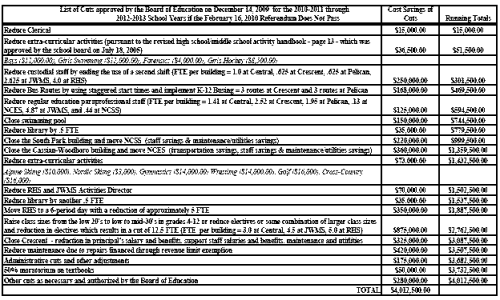
Here are the proposed cuts if the referendum fails (click on image for pdf):

Closing schools, cutting extra-curriculars, raising class sizes, stopping book purchases….throwing the future in the trash.

Shiocton is another example of the false attraction of nonrecurring referenda, compounded by the squeeze of state defunding.  Their four year referendum is expiring but because of state cuts in education investments, they had tor raise property taxes last year by 20%.  The plan now is to ask for another nonrecurring operating referendum below cost-to-continue and combine that with cuts (this is similar to what Madison did with the “Partnership Plan“).

Here is how the Appleton Post Crescent explained things:

The referendum asks voters’ permission to exceed state revenue limits by $500,000 for the 2010-11 school year, $600,000 for 2011-12 and $700,000 in each of the following three school years.

Shiocton school Supt. Chris VanderHeyden said the district faces a $900,000 shortfall next school year if it does not take this step to help balance the budget by covering the cost of preserving district education programs.

Regardless of whether the referendum passes or fails, the school district of 790 students in pre- kindergarten through grade 12 will need to cut $400,000 to stay in the black, VanderHeyden said.

About 65 percent of the $400,000 will come in staffing cuts, he said, which includes a reduction of 3.5 teachers and two paraprofessionals. The rest will come from such areas as departmental budgets, athletics, staff development, textbook adoptions and food service. “We will make the cuts but we also need the referendum to balance the budget,” he said. …

The increase this year was up nearly 20 percent. Either way, the tax rate will drop next year, VanderHeyden said. If the referendum passes, property taxes will drop $107 for the owner of a $100,000 home. If it fails, the property taxes will drop $278 for the owner of a $100,000 home.

So if it passes, there will be major cuts and taxes will go down.  If it fails, there will be even larger cuts and taxes will go down more.  Where is the choice for fully funding education?

The best answer is that choice has to be made at the state level.  Here are those links again: Wisconsin Alliance for Excellent Schools, Penny for Kids, School Finance Network and the AMPS “Take Action” page (the last has links to contact state officials).

Last but not least is Three Lakes.  This is one of those districts caught in declining enrollment and relatively high property wealth.  It also another district in the last year of a nonrecurring operating referendum.  Three Lakes is in worse financial shape, has been squeezed harder, have been cutting for years; according to the district figures, without a successful referendum they will run out of money in February 2011.

Therefore they are asking:

…that the revenues included in the School District budget for three years beginning with the 2010-2011 school year and ending with the 2012-2013 school year be authorized to exceed the revenue limit specified in Section 121.91, Wisconsin Statutes, by $1,517,469 a year, for non-recurring purposes consisting of funding operating expenses.

In the Rhinelander Daily News District Administrator George Karling and others give the big picture:

Three Lakes District Administrator George Karling said the override voters are being asked to approve is necessary to fund current programs and amounts to about half of the annual revenue that has been lost, compared to 10 years ago.

With about $900,000 in the district’s general fund, Karling said Three Lakes would only have funds available to operate through February 2011 absent approval of the override.

Informational material the district sent to voters indicates the district is not allowed to operate at a deficit and would “become insolvent and close in the near future” if the referendum fails.

School Board Clerk Tom Rulseh said the district’s budget is “really tight,” with the budgeted expenditures of $10,507,798.50 for 2009-10 down about $80,000 from the previous school year, while the revenue override is necessary to continue to operate.

“I don’t know where the money would come from” if the referendum fails, Rulseh said.

…When asked whether it would be necessary to approve another revenue override three years from now, Karling said he hopes state lawmakers change Wisconsin’s school funding formula by then to provide more money for Three Lakes, which is considered a “property rich” district and receives little state funding.

He said proposals on the state level to boost funding for K-12 education include an additional 1 percent sales tax, which is known as “A Penny for Kids” and backed by the Wisconsin Alliance for Excellent Schools, and a “65 percent hold harmless” provision to lessen the amount of lost revenue because of declining enrollment.

They also note that dissolving the district would likely lead to even higher property taxes.

That’s the roundup.  More votes in April.  Before closing I wnat to again share something and suggest you follow my lead.  When I do these posts that involve districts all over the state, I often take a look around their web sites.  I am always struck by the good work being done, some traditional, some innovative but all a source of pride for the students, the educators, the families and the communities.  All the sites are linked at their names, so I suggest you do the same.  It is a good reminder of why education is so important and why we need to do better recognizing that.  When you are done, help Wisconsin do better by getting involved for change.

Here are those links again: Wisconsin Alliance for Excellent Schools, Penny for Kids, School Finance Network and the AMPS “Take Action” page.

Vote Yes for Schools (and do more)

Thomas J. Mertz!

Leave a comment

Filed under "education finance", Best Practices, Budget, Contracts, education, Elections, finance, Local News, Pennies for Kids, Referenda, referendum, School Finance, Take Action, Uncategorized, We Are Not Alone

Buzzsaw Time — Wisconsin School Budget Roundup

Just some of the stories  about the budget struggles of Wisconsin districts in the last week or so (linked and excerpted with emphases added).   Bad all over.

If you want things to get better, do something, join those working for change:  Wisconsin Alliance for Excellent Schools, Penny for Kids (SIGN THE PETITION!), School Finance Network and the AMPS “Take Action” page.

Let’s start with Madison: “A horrible situation’ – Madison schools face $30 million budget hole

The Madison School District is facing a $30 million budget hole for 2010-11, a dilemma that could force school board members this spring to order massive cuts in programs, dramatically raise property taxes, or impose a combination of both.

District officials will unveil a list of possible cuts — which could include layoffs — next month, with public hearings to follow.

“This is a big number,” School Board President Arlene Silveira said. “So we have to look at how we do business, we have to look at efficiencies, we have to look at our overall budget, and we are going to have to make hard decisions. We are in a horrible situation right now, and we do have to look at all options.”

I think what’s happened is the state of Wisconsin has effectively passed along the tax problem to the local level, in terms of either we raise taxes to support public education, or public education isn’t going to be supported,” said Erik Kass, assistant superintendent for business services.

Sauk Prairie Schools get budget input

“We’re going to have to start cutting some of these more main items,” [Superintendent Craig] Bender said, adding that every dollar in the budget is important to someone. “We didn’t start this process because we thought this was the best way to improve education, but we’re doing it though believing we’ll try to make it better wherever we can.”

Baraboo School Board grapples with more budget cuts

“We can address things one-by-one as we have been,” he [Board member Sean McNevin] said, “or we can take a top-down approach,” and hand the administration a set number of cuts with which to grapple.

Every fiscal cut we make tends to lay us on the road of mediocrity … but at some point it’s going to have to happen.”

[Baraboo High School Principal Machell] Schwarz said the district had been dealing with slim budgets for the past 10 years, however.

“We need to continue looking at the big picture, and stop focusing on money, and focus more on kids,” she said.

Monona’s Maywood [school] may close

The Monona Grove school district is scrambling for ideas to plug a budget hole of about a million dollars, including a proposal to consolidate the Monona community’s two elementary schools, Maywood School and Winnequah School.

“We have to look at every option. We have budgetary problems just like everyone else because of the state funding system and the poor economy,” [District Superintendent Craig] Gerlach noted in a phone interview on Thursday.

“I don’t want to close a school. But we have a predicted $1 million deficit every year for the next five years. We can’t balance the budget without threatening programs in our district that people have come to expect. In the long run, we can’t afford the luxury of this school,” he [Peter Sobol, Monona School Board vice president] said, noting that $250,000 in annual savings could keep four or five teachers in the classroom.

The Oshkosh Northwestern reports “Financial turmoil for school finances across Wisconsin due to state budget.”

But, nearly one in four districts, including Oshkosh, chose to tax below their caps this year despite the budget squeeze. The Wisconsin Taxpayers Alliance, an independent research group, reports 98 out of 427 districts did not tax to their revenue limits.

The change, he [Dale Knapp, research director for the Taxpayers Alliance] said, likely stems from a significant financial shakeup in the thick of a floundering economy. State lawmakers last summer cut aid to schools for the first time since the state’s education funding system was established in 1993. Local property tax payers were left with the burden of making up the difference if districts didn’t cut spending.

“When you talk to residents about the cuts being made to your school programs and then ask for a 10 percent or higher increase in the school levy, there’s a disconnect there, and that’s hard to take in,” Knapp said.

Many parents and educators in the district, along with some board members, have complained that cutting more than necessary only exacerbated today’s budget problems.

“It’s time for us to tax to the full levy. I’ve thought about that for a long time,” board member Karen Bowen said during a January school board discussion about the issue. “I don’t see how we can do good things for our kids if we just slash and burn.

More from Oshkosh.   First, some videos from WBAY-TV (I’m not sure of the right order, but they are all worth a watch).

Oshkosh School Board Decides Budget Cuts

Students, Teachers React to Oshkosh School Cuts

Oshkosh North Faces Cutting 70 Classes

Oshkosh Students Frustrated About Classes on the Chopping Block

For those who don’t watch, here’s the basic situation as described in this story:

The Oshkosh School Board had some difficult decisions to make Wednesday night — facing a multi-million dollar budget shortfall and making unfavorable cuts. The district faces a $4 million deficit.

In a late-night vote, after hours of discussion, the school board voted to increase the student-teacher ratio at North and West high schools to 25-to-1. This effectively eliminates an estimated 35 or 36 teaching jobs.

However, the school board rejected a plan to consolidate five of its middle schools into four buildings. Two elementary schools would close, and Perry Tipler Middle School would become an elementary school. Now, Tipler will remain a middle school.

The board took no action on the possibility of raising taxes.

A big crowd was on-hand for the school board meeting. About 80 people spoke out — many endorsing a double-digit tax hike to avoid drastic cuts.

The emotional audience was mostly teachers, parents, and students. Many said the cuts being proposed were too much.

Some of the cuts are catastrophic,” high school senior Derek Maters said. “If you look at the depth of them, it’s reaching from people who are looking at a tech career to people looking at a college career.

One more from Oshkosh: Dozens speak mind on proposed school cuts.

High school students easily accounted for most of the crowd at Alberta Kimball Auditorium at Oshkosh West High School, where hundreds gathered to hear the results of the meeting. One student presented the school board a petition with more then 480 student signatures opposing the cuts.

“For those who are not able to escape the district, you’re condemning their success,” said high school student Dereck Mathers, referring a report created by the high schools’ assistant principals detailing the impact of teacher layoffs on course offerings.

The report lists 43 West High classes and 67 North High classes that would no longer be offered next year if the resolution passes. The report predicts 787 West students and 1,142 North students would be impacted

“The problem with this is that if these courses are cut, many students will have to compromise for a lower level (education),” said Connor Schroeder, vice president of West High School’s student government.

West High School junior Ryan Steffen said he believes the cuts would create more impersonal relationship between students and over-worked teachers.

“I would like to speak for all the teachers because I’d like to not see them cut,” he said. “I know the passion they bring into work.”

Reading and hearing these students made me think of our older son.  He is at West and MMSD high school students  are in the process of choosing classes for next year.  I told him that it is very possible some of the classes he picks will not be offered due to budget pressures.  Hard to tell him that.  He’s volunteered on referendum campaigns and for school board candidates.  He did this because we taught him that being involved was a way to preserve and expand educational opportunities.  We’ve won those battles, we even won the battles to “Take Back the Assembly,” but the Assembly took back the victories.  Hard to tell him that too.

Here are those links again: Wisconsin Alliance for Excellent Schools, Penny for Kids, School Finance Network and the AMPS “Take Action” page.

Next…

Budget forecasts show deficits for Kimberly Area School District

Budget forecasts suggest the Kimberly Area School District could have a $3.1 million structural deficit in five years should factors including state aid and teacher-to-student ratios remain unchanged.

[Scott] Gralla, [a consultant with PMA Financial Network] said there’s optimism that legislators will eventually restore higher funding levels to schools. Kimberly isn’t alone in the depth of deficits projected.

This is not out of the norm at all for districts your size,” Gralla said.

Proposed change isn’t elementary Whitnall district considers regrouping younger students

This proposal may only be the beginning of possible budget cuts, as the district could face a deficit between $1 million to $3 million.

Whitnall lost about $1.3 million in state aid last year and officials are unsure how much they will get from the state for the 2010-11 school year.

Nekoosa prepares to cut teacher jobs, programs

About $720,000 worth of reductions are planned for next school year, about $485,000 of which will come from the removal or reduction of 11 Nekoosa School District teaching staff members, according to documents provided to the public at Tuesday’s Nekoosa School Board meeting.

The plan includes eliminating a math and technical education teacher position from Nekoosa High School, a first-grade teaching job at Humke Elementary because of enrollment numbers, and English and social studies teachers at Alexander Middle School.

Several other positions are likely to have hours reduced, including choral music and art at Alexander, and business education and family and consumer education at the high school. A high school counseling position being vacated this summer because of a retirement also will not be filled.

“We are absolutely in financial crisis,” Superintendent Wayne Johnson said. “Virtually every school district in the state of Wisconsin is a little worse or a little better off than we are. The state funding formula is flat-out broke.”

Wisconsin Rapids, Public has chance to comment on proposed WRPS cuts tonight

The Wisconsin Rapids School Board must cut about $2 million from its budget for next school year

Nicolet’s finances chief concern of School Board candidates

We had cut as much as possible without cutting education,” he [candidate Joe Kasle] said. “We did not cut the arts, feeling that is part of having well rounded students. We had fund balance left to get through only 18 months. If the referendum had failed, we would have had to go to referendum again. After 17 years of 2 percent funding from the state and 4 to 5 percent increases in costs, there was just no money.”

That’s it for now.  I have more links and stories, but this is too depressing to do all in a couple of sittings.

Don’t get depressed, get mad, get active:  Here are those links again: Wisconsin Alliance for Excellent Schools, Penny for Kids (SIGN THE PETITION!), School Finance Network and the AMPS “Take Action” page.

Thomas J. Mertz

Leave a comment

Filed under "education finance", Best Practices, Budget, education, finance, Local News, Pennies for Kids, School Finance, Take Action, Uncategorized, We Are Not Alone

Board of Education Wrap Up, Quick and Late

I’m just finding the time to post this on the Monday February 8,  meeting (preview of that meeting here).  To be honest, it wasn’t a very exciting meeting.  Most of the real work was done the previous week, when they met as Committees.

Almost everything on the agenda passed 6-0 (Lucy Mathiak, absent) with no discussion.  A few things deserve a little comment.

It looks like there will be something of a restart on the La Follette area planning.  The Board voted to use technology and other things for 2010-11.  The timeline for the restart was given as “6-9 months.”  I hope the 9 instead of the 6.  Johnny Winston Jr also suggested that the Board be involved in the initial phases, the Board and administration agreed and I think that is good.   Overall a good way to move forward on something that was looking like a big mess.

The new Budget timeline was approved (see Gayle Worland’s Wisconsin State Journal story for more).  So there is now a plan for how to consider $30 million in cuts.  The only big change was that personnel cuts and other cuts will be taken together. Here it is:

Some things to note.  First, the May 3-7  meeting where the Board approves reductions will be the first meeting for either James Howard or Tom Farley (see here for info on the February 21 Progressive Dane Candidate Forum).  Second, the state mandated budget hearings will be odd this year due to the timing.  At that point the Board can add things back, but no real cuts are possible.  I would really like that hearing to occur at a time when everything is still on the table. I am also somewhat bothered that the Budget Book comes out after the Public Engagement sessions.

I did hear some good things from the Board and the administration about how this will be be done.  They seem committed to gathering as much information as possible, sharing that information with the public, trying to work from some common principles and as much as possible avoiding rancor.  It won’t be easy.  There will be a lot of pressure from the anti-tax crowd to cut and a lot of pressure from others not to cut specific things.   Going into this I do think it is important to keep in mind that the current situation cannot be attributed to local mismanagement.   This is a state created problem.  If you are going to get mad about the school funding situation, get mad at the state officials.

One other thing I’d like to say is that there have been some positive things done on things like 4K and the Strategic Plan where a real work on defining and implementing a vision for  improving educational opportunities has been started and I hope that does not get lost in all this.  The Board Members have expressed similar hopes.

Here are those links again: Wisconsin Alliance for Excellent Schools, Penny for Kids, School Finance Network and the AMPS “Take Action” page.

On the Retirement Refinance and 4K funding the Board went with option 2B, smaller overall savings but more front loaded.  I believe the vote was 5-1, with Marj Passman favoring 5A.

Superintendent Dan  Nerad’s contract renewal/extension was passed with no public discussion.  Maya Cole abstained.

That’s about it.

Thomas J. Mertz

Leave a comment

Filed under "education finance", Budget, education, Elections, finance, Local News, Pennies for Kids, School Finance, Uncategorized