Category Archives: “education finance”

Legislative Advocacy Action — Save the Dates

2009-041

Wednesday April 1, 20096:00 PM at  Wright Middle School — the Madison Metropolitan School District will be hosting a “Legislative Informational Community Session” to “provide updates on school funding and state budget issues that affect the MMSD” and “discuss and share strategies on how the community can get involved in advocating for our schools.”  For more on the MMSD Legislative Agenda, click on this link.

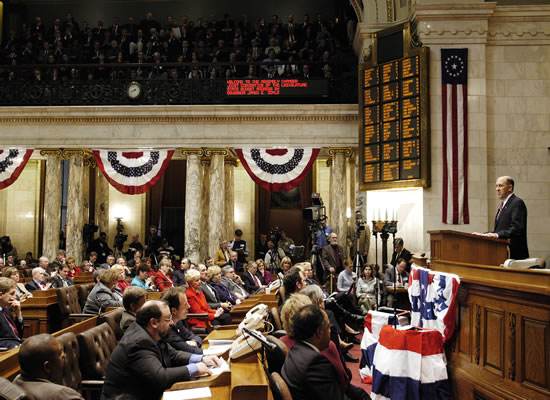
Tuesday April 21, 2009, 1:00 PM at Room 413 North in the Capitol — the Wisconsin Assembly Education Committee will be holding a public hearing on the School Finance Network education funding reform proposal.  It is important that we get a good crowd to demonstrate the importance  school funding reform.

Also, don’t forget the Wisconsin Council on Children and Families Advocacy Day at the Capitol on March 18.

Make you voice heard!

Thomas J. Mertz

Leave a comment

Filed under "education finance", Budget, education, finance, Local News, School Finance, Take Action, Uncategorized

The Charter Choice in Madison and the Nation

schoolbudgets

On Monday, March 9, 2008 The MMSD Board of Education will consider an application from the Nuestro Mundo community to begin the process of chartering a dual language immersion secondary school.

Although the application is very impressive and Nuestro Mundo appears to be a good and well run school, I urge the Board to turn away this effort to expand charters in Madison.  MMSD is initiating an elementary  non charter dual language immersion program and there is talk of a non charter dual language middle school also.  I believe that this is the the better path.

In an editorial today the Wisconsin State Journal puts forth self contradicting nonsense in favor of the charter proposal.  In a letter to that paper last week, Nuestro Mundo parent Judith Kujoth employed questionable and unsupported assertions of causality to advocate for the middle school proposal.  I’m just going to hit the low lights.

The editorial begins:

Madison needs to get past its outdated phobia of charter schools.

Charter schools are not a threat to public schools here or anywhere else in Wisconsin (emphasis added).

Later in the editorial they note the President Obama has pledged to double the Federal money for charters and note that the group hopes to get $1.1 million in Federal planning grants.  It doesn’t take a genius to figure out that Obama’s funding of charters, like that of George W. Bush, will divert money from traditional public schools.  That $1.1 million that they hope to get is $1.1 million that isn’t and won’t be available for our underfunded district schools.  Yes, charters are a threat.  An insidious threat, because regardless of the merits of a particular proposal or the drawbacks of charters as a policy choice, cash strapped state and local decision makers are easily seduced by the promise of this money.

The editorial continues:

They are an exciting addition and asset to public schools — a potential source of innovation, higher student achievement and millions in federal grants.

And when charter schools do succeed at something new, their formula for success can be replicated at traditional schools to help all students (emphases added).

This is exactly what has happened in Madison.  Nuestro Mundo pioneered dual language immersion, the district saw good things happening and they are now in the process of “replicating.”

Apparently the State Journal doesn’t really believe this because later they opine:

The School Board should reward their success by opening the door to a charter middle school. Instead, too many board members seem bent on keeping any dual-language middle school within the framework of a traditional school.

So it isn’t about what is best for the district and the students at all, it is about “rewarding” certain people.  This goes to the heart of one big problem with charters:  They divide; they Balkanize.

What is good for the district as a whole and most children can easily get lost when well organized charter groups advocate tirelessnessly for their “rewards.”  This is true at the state and national levels also.  This is another way that charters threaten public education.

Even the most optimistic charter advocates must recognize that there is no realistic scenario where most children will not be in traditional public schools.  The Board’s job is to do what is best for all children; in practice they must make the utilitarian calculations about what is best for most children and that means doing everything they can to strengthen the district schools most children will attend.  This may include limited charters for purposes of innovation and to address persistent problems, but it certainly does not include “rewarding” anyone at the expense of the district as a whole.

Kujoth covered  much of the same shakey ground as the State Journal, so I’m only going to touch on one paragraph in her letter that caught my attention.

Creating a charter school will have many benefits. The law affords charters greater flexibility to create curricula and measure progress. Students in these schools often have higher rates of achievement because educators have flexibility to design teaching methods that appeal to the needs of each student and to change modalities when they aren’t working without being constrained by traditional district practices (emphasis added).

Note the “often” before “higher rates of achievement. ”  In fact there is no consistent evidence that students in charters have any higher achievement, the best evidence is that achievement is about the same or slightly lower than in traditional schools.

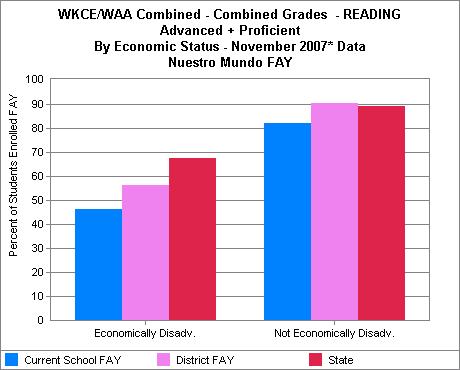
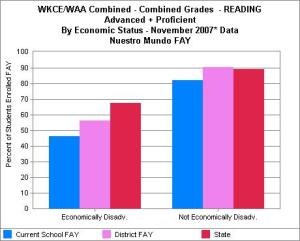
I’m skeptical of standardized tests as a measure of achievement, but it worth noting that Nuestro Mundo students have performed below the levels of students in other MMSD and Wisconsin schools and that this difference is more pronounced for low income students (chart from DPI)
ns-read-w-state-and-district-cft0308_1848031bb

In the next sentence, also with no evidence what so ever, she asserts the cause for this nonexistent achievement gain to be the “flexibility to design teaching methods that appeal to the needs of each student and to change modalities when they aren’t working.”  Since some charters, KIPP for instance,  are infamous for their inflexibility (and resultant push outs of students), this is a laughable generalization about charters.

The last line, the final assertion that “traditional district practices constrain flexibility is also counter to my experience as an MMSD parent.  The teachers my children have had — good and bad — have been very flexible in their teaching.  Even if my experience is not typical and the constraints on flexibility are a real problem isn’t the answer to work to free all teachers from these constraints, not set up a charter where only some children benefit from flexibility?

If these represent the best case for the new charter proposal, the Board should have an easy time rejecting it, unless political pressure holds sway.  I urge the Board to do what is right, not what might be popular.

In the spirit of honesty, I must state that my older son attends James C. Wright Middle School, a charter, if in name only.  At an earlier point in the history of the school, charter status may have been important.  In the years that I know about, Wright functions as a district specialty school, not a charter in any meaningful way.  I would a support a change in status for Wright to reflect this reality.

Thomas J. Mertz

2 Comments

Filed under "education finance", Accountability, Best Practices, education, Equity, Gimme Some Truth, Local News, Uncategorized

“Do It Again?” Another Referendum for Salem

tantsisyixn_22096_lg

The Kinks, “Do It Again” (click to listen or download)

On Thursday, the Salem Board of Education voted to try again for an operating referendumOperating referenda for the district failed in June 2008, September 2008 and February of 2009.  The September referendum lost by a fairly large margin, but the June and February votes were 269 to 235 and 654 to 694.

Those working for the referenda must feel like Sisyphus forever rolling the stone up the hill, but never getting to the top, or Tantalus, with sustenance always just out of reach.  Unlike those mythological figures, the school supporters and the children of Salem have done nothing to deserve their cruel fate.

Their decision to go to referenda again indicates that they are unwilling to accept the devastating cuts in store for their schools.  I can’t blame them.

Whether this one passes or not, an inordinate amount of time and energy will have been spent trying to secure adequate funding for the district.  This is time that should have been spent educating the students.  That’s what happens when you live in a state with a broken system for funding education.  Sign on with the Wisconsin Alliance for Excellent Schools and the School Finance Network to work to fix this.

Back to Salem.  Advocates continue to make a strong case, reminding all that strong schools are essential for healthy communities.

Proponents of the board have said that increase is needed to save programs and staff, to provide opportunities for children, and ultimately to protect property values in the community. If the school system goes into decline, they argue, the whole community will ultimately be affected.

“I’m scared too, we took a huge pay cut in my family. My wife was out of work,” said Scottie Washington. But he believes families will leave the community and home values will decline if programs are cut. “If this referendum doesn’t pass this is going to be a ghost town,” he said.

The ask this time will be for a three-year non recurring referendum at $1.16 million a year.  The vote will be at a special election on April 28.  This looks like the same measure that was voted down in February.

I haven’t seen a new presentation of potential cuts yes, but the ones form the earlier campaign are probably still in play.

clcik on image for pdf

click on image for pdf

There is much more Salem referendum related material here, including the slideshow embedded below.

It should be noted that the major issue in Salem is and has been class size.  Smaller class sizes is one of the “best practices” that almost everyone agrees helps all children learn and almost every agrees is particularly important for children from poor or difficult backgrounds.  When we know what works, we should make sure that the resources are there to do what works.

I admire the tenacity of the Salem Board and wish them the best.  Let’s follow their example at the state level and “get’r done” on school funding reform (again, join WAES, join SFN).

Thomas J. Mertz

Leave a comment

Filed under "education finance", Best Practices, Budget, education, Elections, finance, Local News, Pope-Roberts/Breske Resolution, Referenda, referendum, School Finance, Take Action, Uncategorized

WAES School-Funding Reform Update, March 2

waesgraphic

Table of Contents below, click here for the full update.

Update — The hearing on the School Finance Network plan highlighted below is still very important, but it is in the process of being rescheduled.  Watch AMPS for more info.

I want to highlight the first item.  Save the Date –March 24 — this is important.  The School Finance Network plan is a very good plan and enjoys broad support.  Attend the hearing and show the legislature you care about school funding.

Update — The hearing on the School Finance Network plan is still very important, but it is in the process of being rescheduled.  Watch AMPS for more info.

School-funding reform update, week of March 2

  • SFN reform plan subject of March 24 hearing at the Capitol
  • SFN plan continues to be in the news around Wisconsin
  • Evers, Fernandez meet in West Allis at state Superintendent debate
  • 2009-11 state budget appears to be on the fast track
  • WAES doing good work, but needs your financial support
  • Tax cuts cost state billions since mid-1990s, LFB report says
  • Four groups renew memberships in WAES
  • Oneida County Board petitions state for school-funding reform
  • Round-up of funding problems from around Wisconsin
  • Early childhood care and education key to economic development
  • Help WAES correct e-mail update glitch
  • School-funding reform calendar
  • The Wisconsin Alliance for Excellent Schools (WAES) is a statewide, independent, membership-based organization of educators, school board members, students, parents, community leaders, researchers, citizens, and community activists whose lone goal is the comprehensive reform of Wisconsin’s school-funding system. If you would like more information about the organization — or on becoming part of WAES — contact Tom Beebe at 920-650-0525 or tbeebe@excellentschools.org.

    Thomas J. Mertz

    Leave a comment

    Filed under "education finance", Budget, education, Elections, finance, Local News, Referenda, referendum, School Finance, Take Action, Uncategorized

    School Funding Action – Florida

    From MYFOX 35, Orlando.

    This weekend thousands of Florida parents, teachers, students, administrators and community members took part in militant “Make Our Schools A Priority” protests against cuts in education.

    The big event was the rally in Orlando reported in the video above (more here), but smaller actions have been held around  the state, some of which included legislators in attendance (examples here and here).

    The economic situation, tax collections, the state budget and local school budgets are all in dire circumstances.  Some of this is detailed on the Channel13, Central Florida web site.  A couple of examples:

    Brevard County:

    MONEY:

    WHAT’S BEEN DONE:

    WHAT COULD HAPPEN:

    Marion County:

    MONEY:

    WHAT’S BEEN DONE:

    I like the militancy, the mass actions and even the confrontational tone.   I sincerely believe that although things are nowhere near as bad in Wisconsin that after 15 years of annual cuts in educational opportunities we also have a crisis in school funding.   I worry that polite advocacy fails to communicate the reality of that crisis.

    A Saturday, March 21 meeting of the Wisconsin Joint Finance Committee will be held at Miller Park.  This would be a great time to turn out some numbers for education and comprehensive education finance reform.

    Back in Florida, the Legislature returns for a budget session on Tuesday facing a $700 million shortfall.  Governor Charlie Crist is scheduled to give his “State of the State” address on that day.

    Hat tip to Sherman Dorn for making me aware of the goings on in Florida.

    For more on school finance in Florida, see the National Access Network state page.

    Thomas J. Mertz

    Leave a comment

    Filed under "education finance", Best Practices, Budget, education, finance, Local News, National News, School Finance, Take Action, Uncategorized, We Are Not Alone

    Jim Doyle, “State of the State,” 2003

    journal_media_file_getasp

    I’ve been doing searches for a second “Broken System, Broken Record” Quotes of the Day (look for it soon) and came across the text of Governor Doyle’s 2003 “State of the State” speech (his first).  He doesn’t use the phrase “broken system,” but he does say some things worth rereading.

    It is time to reform the way Wisconsin funds our children’s education. That is why tonight I am announcing that I will form a Governors Task Force on Education Financing.

    This is too important of an issue to squeeze it into a budget proposal or devise a new plan in just a few weeks.

    To do it right we need to do two things. First, all views must be represented. Parents, taxpayers, teachers, community leaders. Urban districts, rural districts. Wealthy areas, poorer areas.

    Second, the meetings must be open, in full view of the public.

    That Task Force was formed and produced some good work.  Since June of 2004, that work has gathered dust.

    I’m often hard on Governor Doyle in relation to his support for education.  I’ll acknowledge that he has been a friend to education in many ways and deserves credit and thanks for that.  What he has not been (in my opinion) is the champion for education that we need.

    Doyle has done very well in protecting the schools from the worst of the potential cuts under a system that all but guarantees some cuts and some property tax increases; he’s tried to keep the state’s 2/3 funding commitment viable, he’s worked for increases in SAGE and Special Education funding and succeeded in making these programs slightly less underfunded.  All this is good.

    What he hasn’t done (unless you count the recent trial balloon, which may be  a good sign) is  followed up his statement form 2003: “It is time to reform the way Wisconsin funds our children’s education.” That statement was true in 2003; after six years of annual cuts to educational opportunities of 1% to 2% it is even more true today.  I hope that we will soon see Governor Doyle act on this truth and be the champion he could and should be.

    Thomas J. Mertz

    Leave a comment

    Filed under "education finance", Accountability, Best Practices, Budget, education, finance, Local News, School Finance

    Gov. Jim Doyle – “Should have….Could have”

    doyle-class-journal_media_file_getasp

    Doyle should have used this trying time as an opportunity to push for bold change that normally would be too difficult or sweeping to accomplish.

    Doyle could have overhauled how the state pays for public education, for example. Instead, he says he’ll work on that after the budget is approved — something he’s said before without much follow-through. (links added)

    Wisconsin State Journal, “Wisconsin Gov. Jim Doyle’s Band-Aid of a state budget plays it safe and jacks up taxes, yet it gets some priorities right.”

    There is much in the WSJ editorial I do not agree with —  and there is much in the Governor’s budget proposal that is good (more later) —  but the paper is absolutely right that the budget proposal was a missed opportunity to move desperately needed school finance reform forward.

    Thomas J. Mertz

    Leave a comment

    Filed under "education finance", Accountability, Best Practices, education, Elections, finance, Local News, School Finance

    WAES School Funding Reform Update, Week of February 16, 2009

    waesgraphic

    Click here for a pdf of the full update.  Table of contents below.

    School-funding update

    • Governor gets involved in school-funding reform discussion
    • Governor’s budget helps schools keep their heads above water
    • Funding reform effort gaining steam around the state
    • WAES doing good work, but needs your financial support
    • Two new members join WAES; 11 renew memberships
    • HOPE plan making rounds of Legislature again this session
    • New study shows benefits to Wisconsin of combined reporting
    • Norman talks school-funding reform on Milwaukee Public Radio
    • School-funding reform news from around Wisconsin
    • Get involved in budget process at WCCF 2009 Advocacy Camp
    • Help WAES correct e-mail update glitch
    • School-funding reform calendar

    The Wisconsin Alliance for Excellent Schools (WAES) is a statewide, independent, membership-based organization of educators, school board members, students, parents, community leaders, researchers, citizens, and community activists whose lone goal is the comprehensive reform of Wisconsin’s school-funding system. If you would like more information about the organization — or on becoming part of WAES — contact Tom Beebe at 920-650-0525 or tbeebe@excellentschools.org

    Thomas J. Mertz

    Leave a comment

    Filed under "education finance", Budget, education, finance, Local News, Referenda, referendum, School Finance, Take Action, Uncategorized

    The Stimulus, What Was Not Funded: School Constuction

    newspaper3

    Excerpts from the Wisconsin State Journal, “Rebuilding Wisconsin, Part 1: A long and costly to-do list.”

    PUBLIC SCHOOLS

    West Bend Public School Superintendent Patricia Herdrich said she can hardly bear to walk through the district’s Badger Middle School. Built in the 1920s, the old school is the worst of the substandard buildings in this district about 75 miles northeast of Madison.

    There are, Herdrich said, 13 different levels in the school because of the hodge-podge tangle of additions over the years. There are no elevators.

    “You can’t make it accessible,” Herdrich said. “I’ve had kids on crutches crawling up and down stairs.”

    In hundreds of school districts across Wisconsin, students are stuck in inadequate and even dangerous buildings, jammed into too-small classrooms or housed in trailers in school parking lots, according to Miles Turner, director of the Wisconsin Association of School District Administrators…

    The problem is that, since school expenditures were capped by the state Legislature in 1993, the corner that has been most frequently cut by money-starved districts has been building maintenance and repair.

    In its most recent survey of school district spending, the Wisconsin Education Association Council found that 82 percent of the 303 districts that responded have cut money for improvements to buildings and grounds.

    And 77 percent reported delaying building maintenance or improvement projects. According to the 2007 infrastructure report from the Wisconsin chapter of the American Society of Civil Engineers, the median reported need of the state’s 431 school districts to catch up on repair and maintenance projects is $695,000 while the average need is $1,768,563.

    But some districts are in such dire shape that the cost of delayed projects far surpasses those numbers. Herdrich in West Bend said the district’s total deferred maintenance is $80 million.

    Bringing Badger Middle School up to standards alone would cost $29 million, she added…

    [A]s the stimulus bill was being put together, the state School Administrators Alliance conducted a needs survey of the state’s school districts.

    Only 228 responses were received from all 431 districts, but for just those districts, when it comes to repair, maintenance, and building needs topped $2.5 billion.

    Referendums have offered relief only in some districts.

    In West Bend, for example, voters defeated a $119.3 million building referendum in 2007 by a 62.6 percent to 37.4 percent margin.

    The district had hoped to have another referendum in November but decided against that when the economy went south.

    Now, a $68 million building referendum is scheduled for April…

    The version of the bill that passed the House of Representatives included what seemed a healthy amount for Wisconsin schools — a total of $729.6 million, including $317.2 million for construction.

    But the political debate and resulting compromise in the Senate resulted in much of the money for school construction, including maintenance and repair, being slashed from the bill.

    “That line item was zeroed out,” said John Forrester, a spokesman for the School Administrators Alliance. So superintendents such as Herdrich in West Bend, initially buoyed by reports that the stimulus bill could offer some help to repair dilapidated buildings, now find themselves wondering again how to house students safely in the face of failing referendums and dwindling state funds.

    It should go without saying that the current broken school finance system requires successful referenda for almost all construction, maintenance and remodeling projects.

    Thomas J. Mertz

    Leave a comment

    Filed under "education finance", Best Practices, Budget, education, finance, Local News, Referenda, referendum, School Finance

    Oneida County Resolution on School Finance

    559px-map_of_wisconsin_highlighting_oneida_countysvg

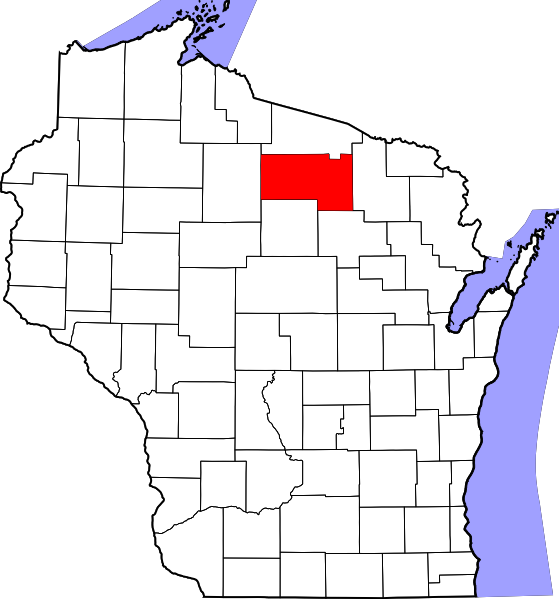
    There was at least one positive vote for the future of education in Wisconsin on February 17th.  The Oneida County Board of Supervisors went on record supporting “legislative change to the state-aid formula to more fairly distribute state-aids throughout the state of Wisconsin” (full resolution here).

    According to the Lakeland Times, Supervisors explained the situation and their votes as follows.

    “… I just thought it would be nice that the people of Oneida County know that the supervisors … will support this resolution and bring it down to Madison,” Dean said. “This resolution, 13-2009, is to support our schools – Rhinelander and other districts. With the decreasing state aids to schools, Oneida County school districts are receiving less state aids based on school aid formulas. Oneida County property taxes is not the answer. The state is obligated – I’ll say it again, the state is obligated – to support the district schools. The Legislature has to make some kind of adjustments … If we send support like this, and other people as well, maybe they’ll see that we do have a problem. In closing – if you think education is expensive, try ignorance.”

    Supervisor Gary Baier agreed, noting “property value rich and tax poor” northern Wisconsin districts are facing an economic crisis under the current school funding formula.

    “The [school funding] formula is broken, it hasn’t worked for years …,” he said. “If they (the state) say they are going to fund it (education) two-thirds, then they ought to fund it two-thirds.”

    I’m going to be asking the Dane County Board to do something similar.

    Thomas J. Mertz

    Leave a comment

    Filed under "education finance", Budget, education, finance, Local News, School Finance, Take Action, We Are Not Alone