Category Archives: “education finance”

Quote of the Day – “A better approach”

mind-the-gap

A better approach for state leaders is to concentrate on closing the gap between what the state requires school boards to spend and the amount the state allows school boards to collect in revenue.

Wisconsin Sate Journal, editorial January 6, 2009.

The larger point of the editorial — that those considering getting rid of the QEO without providing a means for additionally  revenue are  irresponsible — is correct also.

Thomas J. Mertz

Leave a comment

Filed under "education finance", Best Practices, Budget, education, finance, Local News, Quote of the Day, School Finance

Wisconsin State Superintendent Candidates

dpilogo1

There are five announced candidates for the position of State Superintendent of Public Instruction.  Assuming at least three file the necessary signatures by Tuesday, January 6, 2009,  there will be a primary on February 17 and the top two vote getters will be in the general election on April 7.

Here are the candidates, with links to their web sites.

Todd Alan Price (web site now up and more  info here).

Tony Evers.

Lowell Holtz.

Rose Fernandez.

Van Mobley.

Price is the only one who I have been able to find saying good and meaningful things about Wisconsin’s broken school finance system.

  • Fixing the School Funding Formula. Costing out per student what it actually takes to fund an excellent education. Analyzing the tax base for funding the school system, reviewing options to improve the school funding formula and proposing an effective solution to make fair and equitable the allocation of resources for every child.

The Capital Times (via the AP) has more about the candidates.

The story reveals a curious obsession with the Qualified Economic Offer.  The State Superintendent has no constitutional role in changing the QEO and if the last few years are any guide, the bully pulpit doesn’t count for much there either.

Why does our media obsess on the QEO in stories where it is nearly irrelevant and ignore it when it is crucial?  I wish they’d get it right.

Thomas J. Mertz

Leave a comment

Filed under "education finance", Best Practices, education, Elections, Local News, School Finance

Education Stimulus?

school_funding

Governor Doyle joined with his counterparts from NY, MA, NJ and OH in a conference call outlining their priorities for a stimulus package. The request includes $250 billion for education (including higher education) over the next two years.

I can’t find details of any specifics except a disturbing mention from Doyle that there should be a requirement that states spend at least as much as they had in 2006 on education.  I don’t think taking steps backward is the way to go.

President-Elect Obama gave vague lip service to education in his radio address this week.

Our Senator Russ Feingold made no mention of education in his list of priorities for 2009.  You can let him know that this isn’t acceptable here.

An earlier discussion of education and the stimulus from EdWeek here and related posts on AMPS here and here.

Thomas J. Mertz

Leave a comment

Filed under "education finance", Best Practices, Budget, education, finance, National News, School Finance

Why would anyone listen to these people?

Whitney Tilson - Working to bring the magic of the market to education

Whitney Tilson - Working to bring the magic of the market to education

I was reading this New York Times article (Uncertainty on Obama Education Plans) and this got my attention:

One former Teach for America official who has been outspoken is Whitney Tilson, a New York mutual fund manager.

In a recent blog entry, Mr. Tilson said of Dr. Darling-Hammond, “She’s influential, clever and (while she does her best to hide it) an enemy of genuine reform.”

Mr. Tilson is on the board of Democrats for Education Reform, a political action committee based in New York.

Mr. Tilson is a top tier education DINO. He advocates an anti-Union, data and test driven version of  “accountability” based on a market, business, privatization model (see here for more on this mindset).

His expertise is based on a short stint in the classroom via Teach for America and his “success” in the financial industry.

I thought it would be good to examine that “success.”

According to the latest available report from  Tilson Mutual Funds (dated April 30, 2008, well before the current meltdown), one of the funds he controls underperformed in comparison to both the Dow Jones Wilshire 500 and the S&P Total return indices both in the prior year and since its inception.  In fact, this fund lost 10.03% of value after taxes .  You would have done better stashing your money in an old sock than investing in this fund.

The other fund did a bit better, losing only 4.44% of value after taxes and outperforming the Dow Jones, but not the S&P.  The old sock would still have been a better choice.

The year to date on one fund is -23.48%; on the other it is -45.19%.  That old sock is looking better and better.

Tilson isn’t even good at his “day job.”

Why would anyone listen to these people on education?  Why would anyone think that “market driven education reform” as pushed by the very people who profited while creating our financial crisis was a good idea?

I don’t get it.

Thomas J. Mertz

3 Comments

Filed under "education finance", Accountability, Best Practices, education, finance, National News, nclb, No Child Left Behind, School Finance

The Wrong Frame, The Frame of the (Center) Right

brooks-dunce

There is a lot of buzz on David Brook’s latest column and its topic — Obama’s pick for Secretary of Education and the direction of education policy in his administration (weigh in on the latter here).  Many of the buzzers, like Brooks, simplemindedly frame the choice as between choosing a “reformer” and choosing a stalwart defender of the status quo (in Brooks’ case  the latter is described as “teachers’ unions and the members of the Ed School establishment, who emphasize greater funding, smaller class sizes and superficial reforms”).

We’ve seen this in Madison before — the subtle “reformers as good guys,” others as uncaring, self interested or misguided defenders of a failed system.  It wasn’t accurate or useful then and it isn’t now.

Much of the current discourse is derived from what Marion Brady in 2001 identified as a the narrowing of reform to “introducing market forces” via “standards and accountability” and the definition of standards and accountability as  standardized testing and blaming teachers (and teacher unions), with a little privatization in the mix.

If it isn’t obvious to you how wrong and destructive this is, click the link and read what Brady had to say.

For myself, I’ll just hit a few very quick points.  First, market forces aren’t what they’ve cracked up to be (pun intended).  Second, the way to improve teaching is not by attacking teachers, teacher trainers and teacher unions…none of them are going away and all them are interested in improvement.  Greater funding and smaller classes are not superficial, just look at the research or ask a teacher  — oh yeah Brooks has dismissed the knowledge of researchers and teachers, pretty clever of him.  Last, this crisis mentality is throwing the baby out with the bathwater.  We have many great schools and teachers, a system that works for most and desperately needs to be improved in order to work for all.  I don’t see Brooks calling for Socialism or Communism as a fix for a financial and industrial system that is obviously broken; why call for radical changes in an education system that isn’t broken?

A couple of links:  Jim Horn’s take at Schools Matter and Bob Somerby at the Daily Howler on this column and related failings in education reporting (scroll down).

Thomas J.  Mertz

4 Comments

Filed under "education finance", Accountability, Arne Duncan, Best Practices, education, Gimme Some Truth, National News, School Finance

WAES School Funding Update, 12/1/2008

waesgraphic

    The Wisconsin Alliance for Excellent Schools (WAES) is a statewide, independent, membership-based organization of educators, school board members, students, parents, community leaders, researchers, citizens, and community activists whose lone goal is the comprehensive reform of Wisconsin’s school-funding system. If you would like more information about the organization — or on becoming part of WAES — contact Tom Beebe at 920-650-0525 or tbeebe@excellentschools.org.
    *******
    New report calls for balanced approach to solving fiscal deficit

    Most of us who fight for school-funding reform now understand that underfunded schools are just one symptom of a crisis in public structures. To save those services that level the playing field for all of us, we will need a balanced approach to government that includes new revenues as well as prioritization of spending and cuts in non-essential services.

    To answer the constant drumbeat calling for smaller government and no tax increases, a new report details “an inventory of options for reforming the state’s tax system and finding a balanced approach for filling the deficit.” “Catalog of Tax Reform Options” (http://www.wisconsinsfuture.org/publications/taxes/1108WI_TaxReformOptions.pdf) was authored by the Wisconsin Council of Children and Families (http://www.wccf.org/) and the Institute for Wisconsin’s Future (IWF at http://www.wisconsinsfuture.org).

    IWF’s Jack Norman, along with the report’s other authors, talked about the report in the Nov. 22 edition of the Milwaukee Journal Sentinel in an opinion piece entitled “How to raise money for our state (http://www.jsonline.com/news/opinion/34903414.html).” Norman was also Ben Merens’ guest, Nov. 24, on “At Issue” (http://www.wpr.org/merens/index.cfm?strDirection=Prev&dteShowDate=2008-11-24%2017%3A00%3A00) on Wisconsin Public Radio.
    *******
    Budget cuts could degrade Rhinelander High School

    Rhinelander Board of Education meetings are very well attended these days as the community discusses the future of their children’s education in light of a failed Nov. 4 referendum. Recent discussions are centering on moving back to a seven-period day at the high-school and put the hockey and swimming teams on the budget chopping block in light of the need to trim about $2 million from the district’s 2009-10 budget.

    Rhinelander implemented a four-period day 10 years ago because it was good for kids. High school Principal Terry Fondow told the board recently, however, that “because of the district’s fiscal reality” he was proposing moving back to a seven period day. This would mean reducing the number of graduation credits and advanced placement courses, increasing the student-teacher ratio, and eliminating staff. Fondow said, “It’s no doubt that I’m proposing a degradation of the high school, both in breadth and depth (http://www.newsofthenorth.net/article.cfm?articleID=24365).”

    Board President Chuck Fitzgerald told the audience at a recent meeting that the group would be considering budget cuts into April or May, but that athletic programs will be among them (http://www.newsofthenorth.net/article.cfm?articleID=24390). He explained that one proposal is to close the swimming pool which would mean the elimination of the hockey and swimming programs, both of which use the pool.

    Proposing the cuts, administrators said they worry they will damage education. “We are now at the level of cutting severely into what is good for children,” said co-assistant superintendent Carole Witt Starck.
    *******
    Proposed cuts in Merrill could “damage education”

    Options is the key word in the Merrill School District as the community looks to make $750,000 in for the 2009-10 school year (http://www.wausaudailyherald.com/article/20081202/WDH0101/812020464/1981). This discussion also follows on the heels of an unsuccessful referendum to exceed revenue limits ($2.9 million) on Nov. 4.

    Merrill has cut its budget each year since 2000-01, and, during that span, has cut $5 million. Recommendations include eliminating the positions of three literacy teachers, cutting two teachers in high school elective courses, eliminating a middle school band teacher (reducing lesson and instruction time), and eliminating fourth grade at Maple Grove Elementary School by splitting the students among third- and fifth-grade classes.
    *******
    Rural school finance is subject of Dec. 10 “webinar”

    Rural School and Community Trust (http://www.ruraledu.org) will be holding a webinar — a web-based seminar — on the top 10 things you can do to improve Wisconsin’s financing of rural schools. The event will be held on Wednesday, Dec. 10, at 1 p.m. and consist of a conference call and a slide presentation.

    Amanda Adler, director of the Rural Education Finance Center, will host the discussion.

    Webinars are a regular benefit to members of the Rural School Innovation Network (RSIN), but they are also open to non-members for a fee of $45. For more information on this event or joining the RSIN, go to http://www.ruraledu.org/site/c.beJMIZOCIrH/b.3937703/k.5F87/RSIN_News_and_Updates.htm.
    *******
    Waupun hopes third time a charm for referendum

    In an effort to keep two schools open, the administration of the Waupun School District recently came forward with a $3 million “high-stakes referendum” for the April ballot (http://www.fdlreporter.com/article/20081203/FON0101/812030440/0/FON0201).

    In the past two years, voters have rejected two operational referenda. The decision to try again was among seven options outlined to balance the 2009-10 budget and beyond. One Waupun resident said “we have to make it clear (to voters) what will happen if this referendum fails. If people realize these schools will close or their child has to ride the bus over an hour every day, they might vote a little differently.”

    Closing the two schools would save over $400,000. Other options for reducing the budget include cutting additional personnel, a wage freeze for non-represented employees, eliminating four athletic teams, cutting middle school extra-curricular activities, and abolishing the police liaison position.
    *******
    Membership in WAES is more important now than ever

    Two organizations and three individuals are the latest welcomed additions to WAES, a diverse, statewide coalition working for school-funding reform. Joining are Glorie Salas, Ken and Kim Bates, the Neshkoro School Visioning Committee (in the Westfield School District http://www.westfield.k12.wi.us/), and Price County Citizens Who CARE, the group that “started” the school-funding reform movement in Wisconsin when members walked from Butternut to Madison about 10 years ago to “talk about” their problems with the present finance system.

    If you haven’t joined the effort to bring the reform message to everyone, do it now. WAES is an independent, non-profit, dues-supported organization. If we are going to organize communities around the state for change, we need your talent, your time, and your financial support. Go to http://www.excellentschools.org/about/join.htm … it’s quick, it’s easy, and you can join online.

    When you pay your dues, you are helping to finance the core educational mission of WAES. Numbering 120 strong organizations and individuals, our mission is to make sure that as many people as possible get the message of reform. We do that by traveling around the state and holding school-funding change discussions in church basements, schools, kitchens, and meeting halls. You can find out how to bring this message to your community at http://www.excellentschools.org/calendar/SchoolFundingWorkshop.htm.

    Thomas J. Mertz

    Leave a comment

    Filed under "education finance", Best Practices, Budget, education, finance, Local News, Referenda, referendum, School Finance, Take Action

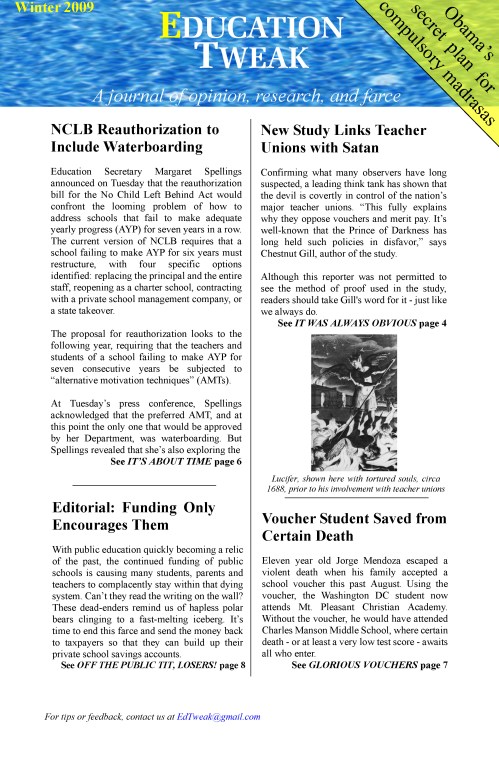
    Education Tweak, Winter 2009

    edtweak

    Click on image for pdf

    Enjoy.

    Thomas J. Mertz

    Leave a comment

    Filed under "education finance", Best Practices, Contracts, education, finance, Gimme Some Truth, National News, nclb, No Child Left Behind, School Finance

    Quote of the Day — The Bailout We Need

    school_funding

    Our preoccupation with the immediate crisis of financial capital is causing us to overlook the bigger crisis in America’s human capital. While we commit hundreds of billions of taxpayer dollars to Wall Street, we’re slashing our outlays for public education….

    The result, across the nation: Teachers are being laid off and new hiring frozen, after-school programs cut, so called “noncritical” subjects like history eliminated, schools closed, and tuitions hiked at state colleges and universities.

    It’s absurd. We¹re bailing out every major bank to get financial capital flowing again. But we¹re squeezing the main sources of our nation’s human capital. Yet America’s future competitiveness and the standard of living of our people depend largely our peoples’ skills, and our capacities to communicate and solve problems and innovate ­ not on our ability to borrow money.

    Robert Reich, “Of Financial Capital and Human Capital: Why We’re Bailing Out Wall Street While Allowing Our Schools to Get Clobbered.”

    Thomas J. Mertz

    Leave a comment

    Filed under "education finance", Budget, education, finance, National News, School Finance

    Building on Victory – Next for CAST

    logo

    Join with CAST to raise school finance reform to top of the agenda!

    The referendum passed – thanks to all for your support and hard work! Now it’s time to turn our energy to school finance reform!

    Without changes in the way Wisconsin finances schools, Madison and other districts will face a future of continued budget cuts and divisive referendum battles. Our local state legislators supported the referendum and support fair funding for schools. We need them to put school finance reform on the top of their agenda for the next state budget.

    Please join CAST on Wednesday, Dec. 3rd 6:30pm at Hawthorne Library and help plan an event at the State Capitol in early January to meet our legislators and ask for their leadership.

    Let’s plan a creative and constructive action that involves everybody– kids, parents, educators, grandparents. Bring your ideas!

    Hawthorne Library is located at 2707 E. Washington Ave., 246-4548, See for this link for directions.

    If you have questions or cannot join us on Dec. 3rd, but have an idea or want to be part of the event in January, please contact Jill Jacklitz at madisoncast@sbcglobal.net

    Community and Schools Together

    Thomas J. Mertz

    Leave a comment

    Filed under "education finance", Best Practices, Budget, education, finance, Local News, School Finance, Take Action

    It depends on how you ask

    telephone_antique

    Johnny Thunders, “Ask me no questions” (click to listen or download)

    A new press release from the Wisconsin Policy Research Institute propaganda mill trumpets “WISCONSIN RESIDENTS OVERWHELMINGLY OPPOSE RAISING TAXES ON BUSINESSES.”  Further down is the actual wording of the question asked of 600 Wisconsin residents: “Business profits are down throughout Wisconsin and many businesses are reducing their workforce. In this environment should state lawmakers increase the tax on businesses?”  This is what is known as a push poll, a “poll” where selected information is provided in order to shape the responses.  People who conduct push polls are not doing research, they are seeking to influence opinion.  People who conduct push polls should be shunned, not trusted.

    Imagine how different the results would have been if instead of the dubious and vague claims about profits and layoffs (unemployment has been steady in our state) the respondents had been told about a 2006 Associated Press study that found “Wisconsin companies saw their profits grow more than twice as fast as their state and local tax bills over a two-decade period.

    Instead of playing games with push polls, anyone who is serious about public policy in our state should be spending some time with a new report from the Wisconsin Council on Children and Families and the Institute for Wisconson’s Future entitled Catalog of Tax Reform Options for Wisconsin.  It is clear that there are many ways we can improve our tax policies and generate the revenues needed to fund education and other things the way we should.

    Thomas J. Mertz

    Leave a comment

    Filed under "education finance", Budget, education, finance, Gimme Some Truth, Local News, School Finance