Category Archives: “education finance”

Quote of the Day – Priorities

l_image101688cd0b59388fa7c1672e286d

If one accepts the reasonable principle of supporting the new president whenever he makes policy from the left or addresses basic social needs, shouldn’t progressives be cheering the White House as it rolls out the dozers, Cats and big cranes? Aren’t high-speed mass transit and clean energy the kind of noble priorities that best reconcile big-bang stimulus with long-term public value?

The answer is: no, not at this stage of our national emergency. I’m not an infrastructure-crisis denialist, but first things first. We are now at a crash site, and our priority should be to save the victims, not change the tires or repair the fender, much less build a new car. In the triage situation that now confronts the president-elect, keeping local schools and hospitals open should be the first concern, rebuilding bridges and expanding ports would come next, and rescuing bank shareholders at the very end of the line.

Inexorably, the budgets of schools, cities and states are sinking into insolvency on a scale comparable to the early 1930s. The public-sector fiscal crisis — a vicious chain reaction of falling property values, incomes and sales — has been magnified by the unexpectedly large exposure of local governments and transit agencies to the Wall Street meltdown via complex capital lease-back arrangements. Meanwhile on the demand side, the need for public services explodes as even prudent burghers face foreclosure, not to speak of the loss of pensions and medical coverage. Although the public mega-deficits of California and New York may dominate headlines, the essence of the crisis — from the suburbs of Anchorage to the neighborhoods of West Philly — is its potential universality.

Mike Davis, ” Why Obama’s Futurama Can Wait: Schools and Hospitals Should Come First in Any Stimulus Package.”

Thomas J. Mertz

Leave a comment

Filed under "education finance", Best Practices, Budget, education, finance, National News, School Finance, Uncategorized

Madison Referendum: More Than Affordable…

Successful Recurring Recurring Referenda as % of Revenue Limits, Nov. 2004 - Nov. 2008.

Successful Recurring Recurring Referenda as % of Revenue Limits, Nov. 2004 - Nov. 2008.

For a number of reasons, I’m fairly confident that the MMSD referendum will pass.  In fact, I still think that Madison could have and should have passed a larger referendum.  I’ll start with the could have and then revisit some of the should have.

The graph at the top of the page shows successful recurring operating referenda since November, 2004 as percentages of the district revenue caps in place at the time of the votes (operating referenda linked to building projects were not included, the final total price was used for multi-year recurring referenda, $13 million in Madison’s case).  The pending Madison referendum is in red.  This referendum represents 4.98% of the district’s revenue limit; the average of all the successful referenda is 8.53%.  If Madison had asked for the average percent, it would have been an over $22 million referendum.  With $22 million, we could have restored valued programs, renewed the maintenance and technology revenue authority, realistically considered new ways to improve the education our district offers, and more.  The lesson here is that other districts, with much less of a culture of educational support, have passed relatively more sizable measures than we are considering.

For further evidence that Madison could have afforded more, we need look no further than the the recently approved 2009-10 budget and mil rate (district documents, here).  Due to greater than expected growth in the tax base, individual tax rates went down more than expected, from 9.92% to 9.81%.  This points to two important things.  First, the starting point for referendum-related tax increases is lower than anticipated.  Second, the quality of our schools continues to be a contributing factor to our healthy local economy.

Affordability is a matter of opinion and it is impossible to prove or disprove the outcome of offering the voters a larger referendum, but both the above pieces of evidence are suggestive of a positive prognosis.  With counterfactuals, that’s about as good as you can do.

I could offer at least 24,189 reasons why there should have been a larger referendum.  I just want to touch briefly on three today.  First, I do not believe that there are $3 million worth of cuts over the next three years that will not have a negative effect on the quality of education our district provides; second, there are many valuable things that have been cut in that past that I think should have been considered for restoration;  last, there will be a need for a maintenance referendum in 2010 and I believe that an extension of this should have been included.

When discussing the quality of education, it is always important to begin with the observation that we are a district with high needs.  We have a higher percentage of students with disabilities, students in poverty and English language learners than the state average (data can be accessed here and is summarized here).  These categories are important, because each of them are covered by underfunded mandates.  Because our percentages are higher and the mandates are underfunded, Madison must spend a higher percentage (than the average district) of our general operating revenue to address these needs.

This is part of the reason that I do not believe that after 15 years and over $60 million worth of cuts, $3 million more worth of “harmless” cuts can be found.   I am not naive enough to pretend that there aren’t programs and positions that are not as effective as they should be, but I do believe that there are also new and old ways that money reallocated from these budget lines could be used to improve the quality of our schools.  As framed by this referendum, any new ideas or restorations of old services will only be possible after $3 million worth of cuts are found.

In a letter to the Cap Times Steve Pike detailed some of the ways past cuts have harmed our schools.  I have touched on some of others here (as well as other places).  Both in local budget discussions and in the fight for state finance reform, I have repeatedly said “we cannot afford to cut more.”  I believe that.  I believe that many of the cuts that have already been made were harmful.  We have more deteriorating facilities, less current technology, larger classes, less community outreach and parent-teacher contact, a smaller variety of offerings, more difficult situations with specials classes, fewer support staff…than we used to have and and we should have.

The maintenance and technology renewal is somewhat different, but just as important.  The 2009-10 school year is the last year of the non-recurring maintenance and technology referendum passed in 2006.  In the 2010-11 year, MMSD will lose $5.5 million in revenue authority from this referendum (while adding an anticipated $4 million or $9 million — depending on how you count it — from the referendum on the ballot November 4).  The current referendum could have been offered so that this amount was included on a recurring basis, beginning in 2010.  This amount would have still left the referendum well below the average (as percentage of revenue limits) of passed recurring referenda pictured at the top.  As far as I can tell this possibility was never publicly considered by the Board of Education.  Because of this oversight, the district, the Board and the community will have to engage in an additional referendum process and campaign.

I’ve been campaigning on behalf of the referendum and will enthusiastically vote yes because the the alternative is so obviously wrong.  My enthusiasm will be tinged with regret that the referendum could have been bigger and better, could have provided more room for dreaming and less need for cutting.  I believe that a referendum like that would have passed also and our children and our community would have both benefited.

The referendum on the ballot is more than affordable, but less than it should have been.  Vote Yes for Schools!

Thomas J. Mertz

Leave a comment

Filed under "education finance", Best Practices, Budget, education, Elections, finance, Local News, Referenda, referendum, Uncategorized

News from CAST

From the Community and Schools Together website:

Many things going on and many new things on the web site.

We are in the last weeks of literature distribution.  Almost 20,000 homes have been reached, another 10,000 or so will be done this weekend (October 25-26) and next week we want to hit as many more as possible.

On October 25 and 26 we still need help in Fitchburg and in the Falk and Huegel areas.  Next week there will be lots of small things – including Maple Bluff and Brams Addition — and major pushes on the North side and to the South and West.

Without you volunteering, we can’t do anything.  Isn’t assuring that our schools avoid $13 million worth of cuts in the next three years worth an hour or so of your time?

To help, email madisoncast@sbcglobal.net or fill out this form.

New on the web site is an up-to-date Endorsement Page, including a letter signed by 49 local elected officials.

The Press/Media Page has also been updated, with videos, a radio interview, many editorials and opinion pieces, more do-it-yourself Advocacy material, and all the latest news reports.

Check out the district referendum pages also.

More updates coming soon.

Thomas J. Mertz

Leave a comment

Filed under "education finance", Best Practices, Budget, education, Elections, finance, Local News, Referenda, referendum, School Finance, Take Action, Uncategorized

We Are Not Alone #25 — Class Size and Segregation Edition

I’ve written about the Student Achievement Guaranty in Education (SAGE) as an underfunded mandate, and noted the trend toward increasing class sizes around the state, especially but not exclusively in districts where referenda have failed.  A report from Verona shows how vulnerable this proven educational practice is —  even in growing districts — under our broken system.

We all know that declining enrollment districts have been hit hard, but despite adding 100 students this year, Verona is considering dropping out or getting kicked out of SAGE, of denying their students the benefits of small classes in the early grades.

Verona is having troubles with the new strictness on the 15/1 ratio, and having troubles paying to keep this ratio out of general operating funds.  If they drop or lose SAGE, they will lose $850,000, but to comply with the rules would mean adding classes at an additional cost of $430,000. Even without the SAGE issue, Verona was looking at $600,000 in cuts for 2009-10. What’s a district to do?

Segregation is one very unfortunate solution.  The way this is reported is scary and not 100% accurate:

One choice would be to group low-income students at a couple schools and designate those as SAGE sites, as many districts – including Madison – already do.

SAGE contracts are limited and in recent years MMSD has cut local funds for class size reduction and moved their limited contracts to high poverty schools.  Madison has not embraced an affirmative policy of economic segregation and still gives some attention to seeking desegregation when assigning students.

Madison has also not embraced a policy of affirmative desegregation and I’ve heard no concern that the Third Friday Count showed Glendale at 80% low income, while the adjoining attendance area for Elvehjem is 25% low income.

The Equity Task Force asked the Board to consider having an annual report on economic segregation in schools and in class assignment.  They have never discussed this proposal  in an open meeting.

Like class size reduction, socio-economic diversity has yeilded positive achievement results.  These are becoming either-or-choices, when we all know we should do both.

Thomas J. Mertz

Leave a comment

Filed under "education finance", Best Practices, Budget, education, Equity, finance, Local News, Referenda, referendum, School Finance, Uncategorized, We Are Not Alone

24,189 Reasons — My Referendum Letter

To be sent to The Capital Times, The Wisconsin State Journal, The Capital City Hues, The Madison Times and maybe more (I may do another edit before sending).  Click on the links to send your own letter!

24,189 Reasons to Vote Yes

According to the official September census, the Madison Metropolitan School District serves 24,189 students.  The individual and collective futures of these students are the best reasons to vote yes on the November 4 operating referendum.

We have an obligation to these students to give them the best opportunities to flourish and to be part making their world a better place than the one we are leaving them.

The world we are leaving our children is a mix of good and bad.  We are a prosperous community in a prosperous nation, but there is great economic uncertainty and growing deficits and debts at all levels.  We have wonderful traditions of self government, but these traditions have been corrupted and our representatives are often ineffective or inattentive.  We have ideals of justice and equality that unite us, but are torn apart by divisions and inequality.  We think of ourselves as a world leader for peace and freedom, but our devastating mistakes have made us an embattled pariah at a time when cooperation is essential.

We need to give the coming generations the tools they need to build on the good and correct the bad.  We can do this in many ways, but strong public schools have to part of it.

Our community understands this; we value education and know the value of education.  Under the broken state finance system, referenda are how we can act on this knowledge to support the quality schools we want and need.

Our schools are very good, but far from perfect.  Fifteen years of trying to do more with less under a broken system have taken their toll.  We can all find things with the schools that we don’t like or think need to be done better, or more, or less.  The improvements we demand aren’t going to happen without the resources supplied by the referendum.

What will happen are more distracting struggles as the district tries to find the least harmful $13 million to $16 million worth of cuts over the next three years.

Dissatisfaction with particulars and desire for improvement aren’t reasons to vote no, they are reasons to vote yes.  Just like we need to give those 24,189 students the tools to make the world better, we need to give our schools the resources they need to build on the good and correct the bad.

Vote yes for schools, vote yes for a better future, vote yes for the 24,189 children who are depending on your support.

Thomas J. Mertz

Franklin-Randall and JC Wright Parent

Chair, Progressive Dane Education Committee

Take care of the children
The children of the world
They’re our strongest hope for the future
The little bitty boys and girls

Make this land a better land
Than the world in which we live
And help each man be a better man
With the kindness that you give
I know we can make it (I know that we can)
I know darn well we can work it out
Oh yes we can, I know we can can

“Yes We Can Can,” by Allen Toussaint, as performed by Lee Dorsey (click to listen or download).

Leave a comment

Filed under "education finance", Accountability, AMPS, Best Practices, Budget, education, Elections, finance, Local News, Referenda, referendum, School Finance, Take Action, Uncategorized

Moneyball

1969 Chicago Cubs, “Pennant Fever” (click to listen or download)

Willie Sutton supposedly once replied to the question, “Why do you rob banks?” with the answer “Because that’s where the money is.”

In his protests against the broken state school finance system in his state, the Illinois State Senator, Rev. James Meeks has shown a similar shrewdness.  The first week of school he led Chicago school children to the rich suburbs to register for school; he went where the money was and the reporters and cameras followed.  Now he has planned a protest outside the first playoff game at Wrigley Field (and here).  Good for him!

I’m sure tickets are going for thousands of dollars, I know that a beer costs $6.00 at Wrigley.  While the “haves” and others enjoy their good fortunes of having the opportunity to enjoy October baseball, it is a good thing that they be reminded that many of our children don’t have decent educational opportunities.

For more information on school finance in Illinois, see this page (and links) from the Access Network.  Like Wisconsin, they have a broken school finance system.  Illinois is also home to a very creative school finance advocacy organization, A+ Illinois.

For our readers in the Milwaukee area, the first home Brewers’ playoff game is Saturday at 5:30 PM.  Not to late to get a protest together.

And for any who care, I am a St. Louis Cardinals fan who spent a good deal of my youth and young adult years regularly attending games at Wrigley.  This post-season, I’m rooting for (in order) the Brewers, the Cubs and the White Sox.

Thomas J. Mertz

Leave a comment

Filed under "education finance", AMPS, Budget, education, finance, National News, School Finance, Take Action

Quotes of the Day – Broken System, Broken Record Edition (#1)

John Hartford, “Dont leave your records in the  sun” (click to listen or download)

Last week, Milwaukee Superintendent William Andrekopoulos strung together the words “State, “Finance,” “Schools,” “System,” and “Broken.” At AMPS, we’ve strung those words together in a variety of ways ourselves or quoted others using these words on more than one occasion.

It thought it might be fun to see who else has said this or similar things about school finance in Wisconsin, who else has given voice to the truth that in Wisconsin, the school finance system is broken.

Here we go, not comprehensive and in no particular order.

We need to do a better job of looking out for taxpayers, and we will. It means making work pay, by encouraging and fostering economic development that pays family-supporting wages and respects the environment. It means ensuring healthy communities, through public health programs and a new, more powerful and consumer-friendly, organization of how we buy prescription drugs and health insurance. It means fixing our broken system of school funding, and making an ironclad guarantee to every Wisconsin child that this state will give you a good start in life a quality education that enables you to succeed in tomorrow’s economy.

Governor Jim Doyle, 2002 victory speech.

The school finance system is broken and needs to be fixed or the quality of public education will suffer significantly.

Cooperative Education Service Agency #3, “Can Wisconsin avoid an educational crisis?” 2007.

Everyone agrees that the school funding system is broken.

Wisdom, “Education Position Paper,” 2007.

Wisconsin’s school-funding system is broken, it needs to be thrown out, and the Legislature needs to come up with a better plan…

Wisconsin PTA, 2007.

First, it’s clear that the school funding system is broken at the state level. I encourage you to join me in calling upon Governor Doyle and our state legislators to fix this broken system that every year forces school boards around the state to cut budgets.

Madison District 12 Alder, Satya Rhodes-Conway, 2007.

Wisconsin’s K-12 education funding system is definitely broken. After 15 years of living under revenue caps and a funding formula that leave school districts with an approximate 1% deficit every year, our schools are increasingly finding themselves having to cut programs and staff. This is especially true in our rural schools where declining enrollment is an issue.

47th Assembly District Candidate, Trish O’Neil, 2008.

The Oshkosh school system isn’t broken; the state funding formula is. I disagree that we have to “fix” our school system because of the budget problems the funding formula creates. Until the state changes the formula, we should ask through an annual referendum to exceed the state budget caps.

Oshkosh Board of Education Member, John Lemberger, 2008.

The current system of funding public education in Wisconsin is broken.

Milwaukee Board of School Directors President, Peter Blewett, 2008.

The school funding system is broken and it was created broken.

Professor Emeritus, Economics,  University of Wisconsin-Platteville, John Simonson.

Partners in WAES believe that Wisconsin’s school-funding system is broken beyond repair and should be linked to the needs of children, giving each of them—no matter where he or she lives—the opportunity to meet rigorous academic goals.

Wisconsin Alliance for Excellent Schools, 2004

School Funding is Broken

  • Mandates, needs and costs continue to grow faster than allowed revenues.
  • Annual service and program cuts of 1-2% over the last 14 years.
  • Over 100 districts in Wisconsin have held referenda in the last year.
  • After 14 years of cutting, essential services are in danger.

Community and Schools Together (CAST), Madison, 2007.

The system is broken. We’ll have to raise taxes.

Superior parent and school board member Kris Kintop, 2003.

We want to be clear that we are painfully aware of the broken system of funding public education in Wisconsin,

Madison Board of Education Member, Lucy Mathiak, 2007.

Wisconsin has conducted several studies on how we can fix the funding of our education system. Isn’t it time that the governor and Legislature start looking at those recommendations and consider other ideas instead of foolishly tinkering with the same old broken system?

Dave Zweifel, the Capital Times, 2007.

The school finance system is broken and needs to be fixed or the quality of public education will suffer significantly.

Dean Isaacson, Platteville School District Administrator, 2008.

Wisconsin is extremely fortunate to have one of the best public education systems in the country. But our school funding system is badly broken, and we are headed in the wrong direction. School districts throughout the state are cutting programs and staff and closing schools. Children have returned to school this fall to find fewer academic choices and larger class sizes.

If we are going to jump-start our economy, we need to find a better way to provide schools with resources to meet the needs of children so we can be assured that we are turning out future workers who can help our state’s businesses thrive.

Dan Burkhalter, Executive Director of the Wisconsin Education Association Council, 2007.

The state school finance system is “broken.

Pete Etter, interim superintendent, Black Hawk School District, 2007.

To be continued.

Thomas J. Mertz

Leave a comment

Filed under "education finance", AMPS, Best Practices, Budget, education, finance, Local News, Quote of the Day, Referenda, referendum, School Finance, Take Action, Uncategorized

Broken System, Hard Choices

Lorette Velvette, “Broke the Circle” (click to listen or download)

Some updates on the hard and harmful choices Wisconsin’s broken system of funding schools is forcing on districts much like MMSD.  It looks like raising class sizes and cutting teachers is popular this time around.

Beloit is facing a $3.5 million gap this year.  This is in part due to lower than expected enrollments, but mostly due to the annual structural gaps that are built into our state’s school finance system.  They will have 30 students in a a fifth grade class this year.

All the excitement about charters in Appleton didn’t prevent  the need for $3.2 million in cuts this year.  They’ve been able to keep 25-1 ratios in k-3, but 4-6 are up to 26-1 and grades 7-12 will rise to 27.5-1.

Green Bay just approved their annual budget, it includes $6.5 million in cuts.  The district is saying the cuts were “reduced” to $4.1 million by stricter staffing guidelines that resulted in eliminating 35 FTE teaching positions.  That looks like a harmful budget cut to me, but if they want to spin it that way and the people in Green Bay buy it, I guess it worked.  The people in Madison would know better.  17.6 FTE support positions have also been cut.  They will save about $500,000 by leasing instead of purchasing equipment (an idea Dan Nerad has indicated will be brought to Madison).  $800,000 of programing was transferred to Fund 80.  From the news report. I can’t figure out what else was cut or reallocated.  It does note that the new 4 year-old kindergarten program is “off the books” and funded via the Fund Balance.

Of further relevance to those interested in the Madison November referendum is that in Appleton the projected tax impact on local homeowners will be  4.7% increase and in Green Bay it will go up 3.7%.  The school mil rate and taxes on an individual home will go down this year in Madison.  With a successful referendum, the projected mil rate will increase 1.1% the first year, and decrease significantly the following years.

Taxes and tax rates are going up along with cuts in Appleton and Green Bay.

Things are different in Madison.  We have the opportunity to slow school budget cuts with no long range mil rate increase.  This is because the economy in Madison is strong, life here is good and people want to move or stay here, so the property tax base keeps growing.

Quality schools are a big part of why Madison is strong and good and attractive.  That’s the circle we want to keep intact; invest in education and it pays off in prosperity and happiness.  Let’s not let the broken state school finance system break the circle in Madison.

Vote Yes for Schools! November 4.

Thomas J. Mertz

Leave a comment

Filed under "education finance", AMPS, Best Practices, Budget, Elections, finance, Local News, Referenda, referendum, School Finance, Uncategorized

Smart, Caring Students, Working for Good

Madison SOS Teen Leaders at the State Capitol

Madison SOS Teen Leaders at the State Capitol (note: SOS is not the group working on the school referendum, but another group working for good in different ways)

Among the items in the MMSD Philosophy of Education is this call for students to be given the tools to engage historical, political and social knowledge to create a “faith in our future:”

To develop faith in our future by understanding and appreciating the history and geography of our nation and our world and their social and political systems.

It doesn’t say anything about working to create that better future, but this story — by Tamara Madsen in the Capital Times on students working on behalf of the Novemember 4 school referendum —  shows that at least some of  our students have grasped the truth that they can and must take active roles in making their community and futures better.

Madison high school students get organized, push referendum

Officials at La Follette were forced to drop the Italian language program from the curriculum for the 2008-09 school year, and students had to scramble to restructure their class schedules.

Stroup said elimination of the courses put many seniors like her in a tough situation when thinking ahead to college.

“Their schedules are messed up now because colleges want you to have four years of the same foreign language, and they’ve had to switch to French and Spanish, and it’s thrown things off for them,” Stroup said.

She is part of a group of Madison Metropolitan School District students intent on bolstering community approval for the school referendum so deeper budget cuts won’t have to be made going forward. Leaders of the group hope to have some two dozen students getting out the word about voting “yes” on Nov. 4.

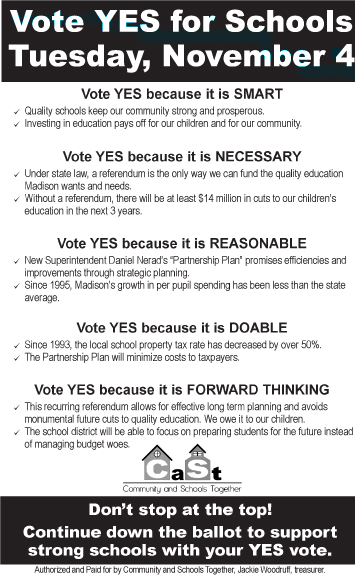
Voters will be asked if they want to let the school district exceed its revenue limits by $5 million during the 2009-10 school year, then by an additional $4 million in each of the following two years. After that, the higher limits would be permanent. The referendum would add $27.50 onto the tax rate of a $250,000 home in the first year, district officials say, but accounting changes would decrease taxes for homeowners in the second and third years.

The district faces an $8.1 million hole in the budget for the 2009-10 school year, $4.4 million for 2010-11 and $4.3 million for 2011-12.

Stroup, a senior and president of La Follette’s Student Athlete Advisory Council, was one of eight students from Madison’s five high schools who met with Superintendent Dan Nerad more than three weeks ago to learn more about the referendum.

Stroup said she came away with a greater understanding of many issues, including the fact that the money being asked for by the district will be used just to continue current programs.

Nerad has already laid out a plan for program and service cuts in the 2009-2010 budget if voters do not pass the referendum. Those include increasing class sizes at elementary and high schools, trimming services for at-risk students, reducing high school support staff, decreasing special education staffing and eliminating some maintenance projects.

Even if the referendum does pass, the $5 million the district would get the first year still would not cover the $8.1 million gap and would force some budget trimming.

“I really want people to understand that this referendum is just to get by; it’s just to help sustain,” Stroup said. “If the referendum doesn’t pass, there’s going to have to be a lot of cuts.

“People think these cuts are insignificant, but they can affect students greatly. The highlight of a student’s day could be going to chess club or forensics, but cutting one of these programs could devastate them.”

The meeting with Nerad was organized by Natalia Thompson, a West High School senior who runs Madison SOS (Speak Out, Sister!), a nonprofit group that seeks to engage high school girls in grassroots activism.

Although she’s not old enough to vote, Thompson, 17, was one of two West students who took time earlier this month to make a public appearance at a Madison School Board meeting to explain why she is in favor of the referendum.

When school started this month, Thompson was disappointed that the writing lab at West was closed due to staff cuts. A federal grant will lead to its reopening in the near future, but other programs are under pressure as well, like West’s Fine Arts Week. The annual event, which takes place in May and has art, drama and dance elements, will not include one-act performances this year because of staff cuts.

Getting the chance to sit down with Nerad and learn more about school finance issues influenced Thompson to act.

“I do really see this as sort of one of the biggest social justice and political issues facing my generation — access to affordable, quality education — and I am seeing through my work in the community how important the schools are,” Thompson said.

She will work with the pro-referendum group Community and Schools Together leading up to the election by writing campaign literature, opinion pieces for news outlets and handing out literature in neighborhoods. She hopes at least 20 to 30 students will join her.

In an effort to collect even more student support, she also created a Facebook page titled “High School Students for the Referendum” that has 60 members.

To do her part, Stroup plans on handing out campaign literature and working on a short speech to give during announcements at La Follette.

Thompson said she’s been pleased with student responses to assist in getting the word out.

“With every student I’ve talked to about it, as soon as I explain what this is — what’s going on, why we need students to get involved — there’s no question it’s something they want to support,” Thompson said. “We’ve been faced with budget cuts since we’ve been in kindergarten.”

Since a state-imposed revenue formula was implemented in 1993 to control property taxes, the school district’s overall budgets have continued to rise due to annual increases in salaries and fixed costs like transportation, but it has had to cut $60 million worth of programs, staffing and services.

District officials are planning sessions at the five area high schools to offer information on the referendum, though they cannot collaborate directly with any advocacy efforts.

Nerad, though, said he will continue to cultivate lines of communication with students by becoming actively involved in the Student Senate and scheduling lunches at schools to establish dialogue.

“I believe we have a mission-based responsibility to ensure that we’re developing in students the skills of civic responsibility, and how to engage around important civic and social issues,” Nerad said. “I believe that part of my role and our role is that we have to model that by ensuring students do have a voice on issues that affect them.”

He said student engagement has always been one of his priorities in his job as superintendent, and he’s been pleased to see students’ interest in the referendum issue. “I think it’s very heartening to see, and it’s less about them and more about students that will follow them.”

tmadsen@madison.com

On a personal note, I’ve had the pleasure of working a little with Natalia and others and I want to tell them what a pleasure it has been and how much their contributions are valued.

Thomas J. Mertz
Leave a comment

Filed under "education finance", AMPS, Best Practices, Budget, education, Elections, finance, Local News, Referenda, referendum, School Finance, Take Action, Uncategorized

Mad City GRUMPS Are Back

There are lots of good new things on the Mad City GRUMPS (Grandparents United for Madison Public Schools) web site.

Here is their “mission statement”

Let’s Pass the November 4th Referendum!!

We are Grandparents United for the Madison Public Schools

We treasure the high quality of public education that Madison has provided our children and their children.

We want to continue to attract people of every educational and income level to Madison on the basis of the quality of our public schools.

We worry that our generation and those that follow have become more fearful of escalating property taxes than the prospect that children may be shortchanged in their learning opportunities.We ARE grumpy, ESPECIALLY when we worry about the eroding resources for public education for our grandchildren and all Madison children.

The site features a brief description of the November 4 referendum, information on school taxes since 1994, frequently asked questions, data on student achievement, and an invitation to help GRUMPS pass the referendum and provide the resources for the good work to continue.

Welcome back.

Thomas J. Mertz

Leave a comment

Filed under "education finance", Accountability, Best Practices, Budget, Elections, finance, Local News, Referenda, referendum, School Finance, Take Action