Category Archives: “education finance”

Quotes of the Day – “Power Concedes Nothing…”

The Chi-Lites, “(For God’s Sake) You’ve Got to Give More Power to the People” (Click to listen).

From Jackie Cody, Oneida County, Wisconsin.

The school funding formula must be changed to offer a long-term solution to the funding of the K-12 public schools in Wisconsin. The elected school officials must take their fight to the state legislators and the governor…

Neither our legislators nor our governor has had the political will or courage to change the formula. They have gotten away with forcing districts to make hard choices over whether to sacrifice maintenance, cut programs, lay off teachers, and eliminate or contract out custodial, maintenance and food preparation, while districts try to live on the fumes of state aid.

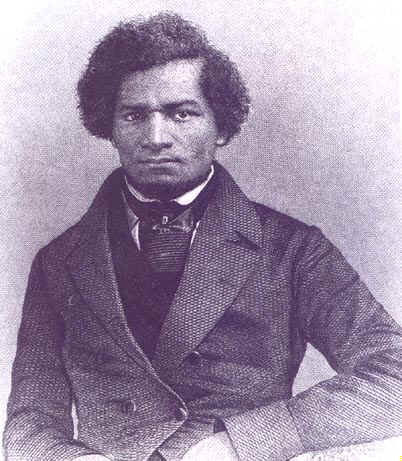
Frederick Douglass said, “Power concedes nothing without a demand. It never has and never will.” The school funding situation has reached the point where I believe Frederick Douglass’ quote is a message we must take to heart.

Legislators and the governor must hear our demand to change the formula and must stop sacrificing this state’s future…which is its children!

It is time for ALL to join together and board the bus and head to Madison! Our children deserve nothing less than this from us.

On the eve of Madison’s Juneteenth Celebration (10:00 AM, June 14, Penn Park) it is an appropriate pleasure to offer a couple additional Frederick Douglass Quotes.

A little learning, indeed, may be a dangerous thing, but the want of learning is a calamity to any people.

If there is no struggle, there is no progress. Those who profess to favor freedom, and deprecate agitation, are men who want crops without plowing up the ground, they want rain without thunder and lightning.

My advice to those who want to join in agitating for school finance reform is to contact the Wisconsin Alliance for Excellent Schools. We need your help!.

Thomas J. Mertz

Leave a comment

Filed under "education finance", AMPS, education, Elections, finance, Pope-Roberts/Breske Resolution, Referenda, School Finance, Uncategorized

The Teacher Project Film

From Public Schools Insights:

In this third and final installment of our interview, [Dave] Eggers announces his plans to create a new documentary depicting the professional lives of teachers. (You heard it here first.)

Eggers and Oscar-winning documentary filmmaker Vanessa Roth are collaborating on a film they hope will do for teaching what An Inconvenient Truth did for the environment. Featuring footage taken by teachers themselves, the film aims to offer a first-hand view of the challenges educators face every day–and to inspire greater public support for teachers’ work.

Eggers3.jpg

Eggers’ advocacy for public schools and educators took center stage at the TED (Technology, Education, Design) Conference, where “the world’s leading thinkers and doers gather to find inspiration.” (No, I wasn’t invited.) At TED, Eggers introduced Once Upon a School, a new project that shares stories about communities supporting public education and challenges adults across the country to become involved in their local public schools.

Hear Eggers describe his forthcoming documentary project and Once Upon a School in part III of Public School Insights’ exclusive interview

Hat tip to Jim Horn, Schools Matter.

Are We Better Off: Reading, Writing, and Landscaping, Mowing lawns, scrubbing bathrooms, selling stereos: How teachers make ends meet By Dave Eggers (Mother Jones).

Thomas J. Mertz

Leave a comment

Filed under "education finance", AMPS, Best Practices, Budget, Contracts, education, finance, National News, nclb, No Child Left Behind, School Finance

Talkin’ Dropouts

James Brown, “Don’t Be a Dropout.”

Lots of news about dropouts and graduation rates recently.

Education Week just published their Diplomas Count report. It is pretty alarmist. Graduation rate scholars Jim Heckman, Paul LaFontaine, Larry Mishel, and Joydeep Roy raised some issues with how Education Week counted (hat tip to eduwonkette, one of my new favorite education bloggers):

In our examination of the data and methodologies available to estimate high school graduation rates we have found that insights can be gained from household surveys and from administrative data on student enrollment and diplomas granted. However, we find the measures of graduation rates in Education Week’s Diploma Counts project, computed from diploma and enrollment data, to be exceedingly inaccurate. The main problem is the assumption that the number of students enrolled in 9th grade is the same as the number of students entering high school. This assumption artificially lowers the estimates of current graduation rates, especially for minorities who are more likely to be retained (repeat 9th grade). This measure also artificially reduces the growth of the graduation rate over time because the practice of grade retention has grown over time, again, especially among minorities.

The resulting errors are sufficiently large to artificially lower the graduation rate by 9 percentage points overall and by 14 percentage points for minorities. Grade retention also differs sharply across states and localities, distorting geographic comparisons. Last, these measures do not reflect the ultimate graduation rates of a cohort of students because the data do not capture diplomas provided by adult education and other sources than schools.

Paper from Heckman and Lafontaine, here; Paper from Mishel and Roy, here.

The Wisconsin State Journal editorialized in favor of adopting the graduation rate measure endorsed by the National Governor’s Association (NGA) as a single national standard (Leslie Anne Howard of the Dane County United Way had an op. ed., mostly in support of this position). There is much to be said in favor of national statistical standardization, but if the adopted standard is flawed, you open the door to a new set of problems. The NGA measure is largely based on the one used by Florida. Sherman Dorn notes some “troubling issues” with the Florida rate calculations:

  • The inclusion of alternatives to standard diplomas in the graduation numbers, with no public disaggregation
  • The exclusion of alleged transfers and movers from the base (creating an adjusted cohort) without any data quality checks to ensure that transfers really show up at a private school or in another state
  • The exclusion from the base (adjusted cohort) of students who drop out and immediately enroll in GED programs (as transfers to adult programs)

He also has some nice general thoughts on what to look for in graduation rate calculations here and here (lots more on his site, browse around or do a search; his posts are very accessible for those of us who are not steeped in the swamp of grad rate measures).

Information on how Wisconsin calculates dropout and completion rates. Many of the issues noted in the critiques of the various measures are present with Wisconsin’s. MMSD posted am 81.8% “regular diploma” completion rate in 2006-7, but there are great disparities among the rates for white students (90.4%), African American students (61.6%) and Hispanic students (60.8). The 2006-7 dropout rate was 2.699%, also with pronounced racial disparities (data can be accessed here).

Finally, this story in the Cap Times on Operation Fresh Start, (which has a GED component). By the way, I think this is a fine use of Wal-Mart’s money, but I still wish our legislators would get them to pay their fair share of taxes (some recent progress, but a long way to go).

Thomas J. Mertz

Leave a comment

Filed under "education finance", Accountability, AMPS, Best Practices, education, Equity, Local News, National News, nclb, No Child Left Behind, School Finance, Uncategorized

Equity Policies — Learning from Others

I’m still working through what did and did not happen with Equity at Monday’s MMSD Board of Education meeting (video here, starting at about the 2 hour and 25 minute mark) and how and why things did and did not happen. The very short version is that the Board passed a policy that did not include the “Considerations” or any implementation regulation or guidance, but thanks to an amendment by Maya Cole does improve upon the draft version’s reporting clause (for more information and my pre-meeting thoughts, see this post).

One of the canards that was part of the discussion was that (Equity) policies can or should not include implementation guidelines or regulations. Policies and implementation plans come in many forms; there is no one right way. For that reason, I’m going do a series of posts on what other districts are doing in this area.

My opinion is that Madison is doing much and isn’t doing enough. Madison is doing much because many of the programs and procedures in place embody equity ideals. Madison isn’t doing enough because there is not a systematic focus on equity related issues and much of what goes on is simply “current practice” and note the result of any clear commitment. Focus and commitment could be derived from a policy or (like in Brookline, MA) a specific initiative. Whatever you think is best, it is always good to know what other districts are doing as a basis for comparison.

Today’s post is from Charlotte-Mecklenburg, NC School District. Like MMSD, CMS is a founding member of the Minority Student Achievement Network.

Here is the entirety of CMS’s “Equitable Educational Opportunities” policy:

The Board of Education is committed to providing equal access to excellent educational opportunities for all its students in all its schools.

The provision of such opportunities for all students is expected to require providing additional resources and implementing innovative strategies to schools serving students with additional educational needs, particularly students at risk of academic failure. Such resources and strategies may include, but are not limited to: differentiated staffing; smaller class sizes; increased instructional supplies and materials; expanded and renovated facilities; innovative family and community involvement initiatives; upgraded technology; comprehensive co-curricular activities; supplemental guidance and counseling; enhanced professional development; and preschool educational opportunities.

In determining whether all students are being provided with such opportunities, the Board of Education shall adopt baseline standards in the following areas: educational opportunities; student achievement; instructional materials and supplies; media equipment and resources; technology; facilities; faculty; teacher/student ratio; and family and community involvement.

On an annual basis, aligned with the annual budget process, the Superintendent shall present to the Board of Education the following: recommendations related to the baseline standards in the areas listed above; assessment of whether all students are being provided equal access to excellent educational opportunities; strategies for ensuring that all students are provided such opportunities; determination of the amounts of funding and resources needed to provide such opportunities; and recommended allocation and reallocation of the funds and resources needed to provide those opportunities.

On an annual basis, aligned with the annual budget process, the Board of Education shall do the following: comprehensively review and revise the baseline standards in the areas listed above; assess whether all students are being provided equal access to excellent educational opportunities; direct the Superintendent to develop strategies for ensuring that those opportunities are being provided; determine the amounts of funding and resources needed to provide such opportunities; seek and direct the Superintendent to seek the funds and resources needed to provide such opportunities; and allocate, reallocate and direct the Superintendent to allocate and reallocate the funds and resources needed to provide those opportunities.

The Board and Superintendent shall appoint a committee to help facilitate the annual analysis of the provision of equal access to excellent educational opportunities for all its students in all its schools. The Superintendent shall establish and implement regulations and strategies designed to accomplish the requirements of this policy.

This is much, much more specific in implementation and reporting than what Madison has adopted. I like it.

For more equity related policies from CMS, click here.

For more on the equity work in CMS, click here, 2006 PowerPoint here.

Thomas J. Mertz

1 Comment

Filed under "education finance", AMPS, Best Practices, Budget, education, Equity, Local News, Uncategorized, We Are Not Alone

Quote of the day

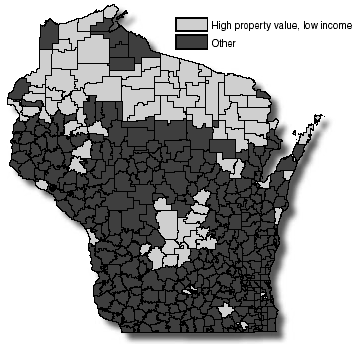
Map from the Wisconsin Atlas of School Finance, by Jack Norman, a publication of the Institute for Wisconsin’s Future.

“I have been on the school board for ten years and we have had to make cuts eight of those years. We are looking at the destruction of education in Northern Wisconsin. What I would like to see is the media saying it’s a problem,” said [Rhinelander School District] school board president Chuck Fitzgerald.

Quoted in the Rhinelander Daily News.

An April 2008 referendum in Rhinelander was defeated by about 3,000 votes. The last referendum to pass in the district was in 1998.

It isn’t just in Northern Wisconsin or Madison where our once great public schools are being destroyed, it is throughout the state. Let’s “Get-er Done” and fix the state school finance system.

Thomas J. Mertz

Leave a comment

Filed under "education finance", AMPS, Budget, education, Equity, finance, Gimme Some Truth, Referenda, School Finance, We Are Not Alone

A Message to Gov. Doyle (updated)

The Wisconsin Assembly joined the Senate last night in passing a budget repair bill. In the Assembly, the Madison delegation was split. Governor Doyle has promised swift action, including some vetoes. Some democrats are saying they will vote to override (some?, all?) vetoes.

The bill is not great for schools. One good thing is the measure closing the “Wal-Mart Loophole.” If we are going to move toward better school funding, fairer tax policies have to part of the answer. Not so great is shifting $125 million from state aids to local school taxes. This will make passing referenda more difficult.

Madison Superintendent Art Rainwater sent a message to Governor Doyle about another bad provision, this one further limits phase in funding for school districts wishing to start 4 year-old kindergarten programs.

May 15, 2008

Governor Jim Doyle
115 East – State Capitol
Madison, WI 53702

Dear Governor Doyle,

I am requesting that you use your partial veto powers to improve the unnecessarily restrictive 4-year old kindergarten language contained in the budget repair bill.

The provision allows for a 5-year phase-in of 4K programs only for school districts that are operating a 4K program during the 2007-08 school year. This language would only benefit a handful of school districts. Allowing all school districts to phase-in 4K programs would assist districts, such as Madison, in potentially moving forward with 4K programs and assist your laudable goal of expanded early childhood opportunities for our state’s children.

Madison Schools has worked with local child care providers to lay the groundwork for a 4K program, but is substantially stymied by funding problems. The inequity in K4 funding should be fixed in the 2009-2011 biennial budget. It is fundamentally wrong for a Milwaukee voucher school to be able to start a 4K program and September and receive the full state reimbursement by the following June – public schools should have the same opportunity.

Please veto the 4K language to allow all school districts the opportunity to phase in a 4K program over a 5-year period. Thank you for your steadfast support of K-12 public education.

Sincerely,

Art Rainwater
Superintendent

The consensus in Madison is growing that we need need to do this in the very near future. If this measure goes through, it will be nearly impossible.

If you believe that we should establish 4k, now is the time to join Superintendent Rainwater in contacting the Governor and our legislative delegation.

Update:

Doyle issued his veto message.  He did not go along with the legislature on the school aid payments, but he did OK the limit on 4K phase in funding.  This is not good news for the future of 4K in Madison and the state.

Thomas J. Mertz

Leave a comment

Filed under "education finance", AMPS, Budget, education, finance, Local News, Referenda, School Finance, Take Action

Board Member Budget Amendments Posted

The MMSD website just posted the proposed budget amendments of Board of Education members (and one from the administration). The Board will consider and vote on the budget on Monday, May 12. It looked like there might be some action (click for video) on class size and specials classes and some other things, but that didn’t happen.

Instead, just one amendment from the administration concerning what seems to be Fund 80 housecleaning on contributions to the Wisconsin Retirement system and the tax levy (anyone know if this is a new issue or how the retirement contributions were handled in prior years?); one from Beth Moss funding the replacement of 143 Windows 98 computers via a reduction in the reserve for contingency; and one from Marjorie Passman employing $60,000 of the Fund 80 levy (contingent on other funding?) to help continue the Madison Family Literacy/Even Start Literacy program at Lakeview/Northport. All seem reasonable to me. That’s it. Relative budget peace.

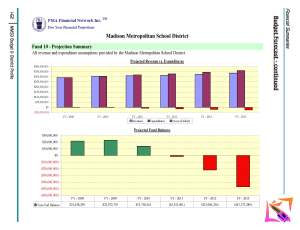
It is important to realize that this peace is the product of a one time distribution of excess Tax Incremental Finance District collections. Next year, we are back to dealing with the “going out of business” system of funding education in Wisconsin. Without a referendum, these are the budget projections (for Fund 10).

Lots of red ink ahead. Time to get to work on a referendum.

Thomas J. Mertz

1 Comment

Filed under "education finance", AMPS, Best Practices, Budget, education, finance, Referenda, School Finance, Uncategorized

Quotes of the Day

From the Wisconsin Center for Education Research report:

Educational equity issues within the school district [MMSD] are the source of much public controversy, with a relatively small but vocal parent community that is advocating for directing greater resources toward meeting the needs of high achieving students. This has slowed efforts to implement strong academic equity initiatives, particularly at the middle and early high school levels.

From Matthew Yglesias:

The rhetoric of No Child Left Behind is, I think, an appealing one. The idea is that, well, no child should be left behind. It’s an essentially egalitarian aspiration — the school system should try to do well for the hardest to teach kids, included ones coming from difficult backgrounds and ones who simply for whatever reason have a hard time with school. The idea of “gifted” programs is basically the reverse vision — that the school system should focus on the easiest cases and push them to the highest level of achievement possible.

There’s not a stark either/or choice between the hard cases and the easy cases, but at some level you do need to make a decision about priorities. Insofar as we’re serious about educational equality, that will to some extent involve shortchanging the best and the brightest. Insofar as we’re serious about taking the most talented as far as they can go, that will involve shortchanging equity. The former strikes me as more desirable than the latter, especially for people who want to think of themselves as being on the left.

From Michael Bérubé:

If we as a society are going to make decisions concerning prioritizing scarce educational resources, it makes sense to me, for us to consider what kind of output we desire. Do we want to, for example, maximize the number of future American Nobel prize winners and enjoy the fruits of the breakthroughs that our most gifted can achieve, or do we want to maximize the educational level of the median American worker? Both results have great value, and if we were to quantify them in terms of dollars, I’m not sure which one would prove to be of greater value to society. But I think these are the questions we should be discussing. And that devoting our resources to maximizing the future opportunities of our least educationally apt children for the sake of doing so, without examining the costs, is fuzzy-headed. Which may or may not be a liberal value. But as liberals we do acknowledge that society is not just a collection of disparate competitive individual maximizers, but that we live in a community where cooperation is also an important value. And that maximizing the strength and resources of that community is itself a liberal value.

The National Access Network just reported that “the United States now has the highest relative childhood poverty rate among developed countries.” When the test scores of white American students are reported separately and compared to the test scores of students in developed countries, the United States ranks third highest. In contrast, if Hispanic and African American test scores are compared to the same international scores, the United States ranks last and next to last. It noted that “the authors of a 2001 Wisconsin study concluded that a weighting of 3.4 times the base cost for education was needed for poverty students to reach state standards.” In a new paper on class size reduction efforts, research found that “Wisconsin SAGE class-size reduction experiments showed positive effects on student performance, especially for disadvantaged students.” Economists estimate that reduction efforts targeting disadvantaged schools nationally would cost about $2 billion, and as the evidence shows, it would reap many benefits.

Robert Godfrey

2 Comments

Filed under "education finance", AMPS, Best Practices, education, Equity, finance, Gimme Some Truth, No Child Left Behind, Quote of the Day

We Are Not Alone #20

At the April 4 th press conference for the release of the MMSD administration’s proposed budget — at the prompting of the press — the “R-Word” (referendum) was discussed. Since the one time Tax Incremental Finance District disbursement saved Madison from the annual rituals of cuts and conflict this year (and gave Art Rainwater the fitting farewell gift of an opportunity to make his last budget a true “cost to continue” budget), referendum talk was the headline in the Capital Times and the State Journal:

Referendum talk is back for schools
Susan Troller

A gaping $9.2 million hole in the Madison school district’s 2009-2010 budget will likely be stirring talk of a referendum as soon as the city’s new schools superintendent, Dan Nerad, takes office at the beginning of July.

By Andy Hall

Madison school officials soon will begin considering whether to ask voters for additional money to head off a potentially “catastrophic ” $9.2 million budget gap for the 2009-10 school year.

We are not alone.

41 Wisconsin school districts had 61 referenda on the ballot April 1st; 33 of these were for basic operating or maintenance expenses (the remainder were to authorize debt for capital projects).

As the State Journal recently editorialized, these referenda are a manifestation of the “no win situation” districts face due to the “system for financing public schools that essentially requires most schools to spend at a faster rate than they are allowed to raise revenue.”

The mess created by the state ‘s outdated and unfair school financing system is not new, but the consequences are mounting. Gov. Jim Doyle and lawmakers tweaked the system a year ago, but the state ‘s political leaders continue to shrink from the overhaul required…

The victims are the students — along with Wisconsin ‘s future in the globally-competitive, knowledge-based economy.

Superintendent Rainwater’s last words at the press conference summed things up nicely (I hope these are not his last words on the subject — Art, enjoy retirement but please continue to advocate for our schools and children):

“The politicians in the state of Wisconsin and those who fund the politicians need to understand what’s going to happen to this state if they lose this great public school system. We will be sitting here 10 years from now, wondering what in the heck happened to us. And what happened is this: We destroyed our ability to compete in a world that is changing.”

Now to the April 1st votes (with links to the Department of Public Instruction summaries):

Now the districts where the referenda failed are looking at what to cut next.

Here is a list of probable cuts (covering two years) from Waupan where the three-year nonrecurring referendum lost by 589 votes:

  • Reduce the teaching staff at Jefferson by 2.0 FTE?s (grade 1 and grade 2)
  • Reduce the teaching staff at Washington by 2.0 FTE?s (grade 1 and grade 2)
  • Eliminate the position of Gifted and Talented Teacher (1.0 FTE)
  • Eliminate the position of Director of Instruction (.8 FTE)
  • Eliminate 1.0 FTE elementary principal
  • Restructure administration
  • Eliminate the position of Police Liaison Officer
  • Eliminate Alternative School Program (.5 ? 1.5 FTE)
  • Reduce High School Health/PE (1.0 FTE)
  • Eliminate High School French (1.0 FTE)
  • Eliminate Guidance position (.6 FTE)
  • Eliminate Media Program (1.0 FTE)
  • Eliminate Library Aide (1.0 FTE)
  • Eliminate Clerical positions (.7 FTE)
  • Eliminate part-time custodians at middle school
  • Eliminate Industrial Arts at the middle school (1.0 FTE)
  • Combine Computer/FCE at the middle school (1.0 FTE)
  • Eliminate Special Education Aide (1.0 FTE)
  • Reduce one section of Honors Math at the middle school level

*FTE – Full Time Employee

As the district website asks, “If we continue to eliminate programs and cut staff, it will diminish and erode the quality of education in our district. What will happen to our kids and our community?”

As they have been for over a decade in Wisconsin, cuts like this are being contemplated around the state —  both in districts where referenda failed in those districts where no referenda were held. AMPS will give updates on these as the school budget season continues. For now, just a couple of videos about Wisconsin Heights, where the second referendum in two years failed, this time by 75 votes out of 1,975 cast (3.8%).

From before the vote:

From after the vote:

What can we do? Keep the pressure on our state officials, especially Governor Doyle; support the Wisconsin Alliance for Excellent Schools; join ABC-Madison; write your local newspapers; and last but not least vote and know where the candidates stand before you vote.

Thomas J. Mertz

Leave a comment

Filed under "education finance", AMPS, Budget, education, Elections, finance, Local News, Referenda, School Finance, Take Action, Uncategorized, We Are Not Alone

What to say?

string-telephone.jpg

Some news analyses of the mixed results of Tuesday’s (April 1st, 2008) various school referendums are in. But it was in the opening lede of today’s piece in the Wisconsin State Journal that especially caught my eye, the ongoing problem of message.

More than half of the public school referendums in the state failed to gain approval from voters in Tuesday ‘s election, sending some districts back to the calculators and calendars.

Of the 61 referendums, 30 passed and 31 failed.

In the tiny Weston School District, a request of $644,000 was denied by 31 votes, 395-364, while in expanding Jefferson, the voters decided the district did not need to spend $45.6 million for a new high school.

In both cases, superintendents thought the schools ‘ messages, while unsuccessful, were clear: Pay now or pay more later. The districts may return with recalculated referendums in the fall because the formula for state aid is not going to change.

I don’t believe this type of reporting/analysis is particularly useful, either for the public or policy makers, for one simple reason; the education community has yet to figure out a way of coming up with a common set of talking points/slogans that will give the voting public, most of whom do not have children in school, a compelling reason for their taxes to be raised (and let’s be truthful here) by less than $30 a year, in the vast majority of referendums. At the same time, I would bet most of these referendums on Tuesday, both the successful ones and those that failed, did not incorporate into their message the fact that school the funding formula is broken. Fortunately, we did not have to go before the voters this year, for reasons explained here, but will WE do any better job than other communities when MMSD will inevitably be facing another multi-million dollar shortfall next year at this time and must ask for voters for relief? The past record on this score is not encouraging.

We still have a balkanized approach to school funding reform campaigns around this state. When will the coalition building over the last ten years begin to pay off?

Robert Godfrey

3 Comments

Filed under "education finance", Elections, Referenda, School Finance, We Are Not Alone