Category Archives: education

How to Destroy Public Education — Lesson One

The Soft Boys – “I Wanna Destroy You” (click to listen or download)

One of the tactics employed by the  enemies of public education is to undermine confidence in our schools in order to weaken financial and other support and induce parents to look for non public options.  Some do this by pointing to real failures — like the achievement gaps between minority/non minority and poor/non poor students – and offering simplistic free market solutions (more on this approach in relation to the Madison Prep proposal very soon in a couple of posts I’m working on — #1 is done and up).

The Bradley, Gates, Walton….funded Fordham Institute puts a new twist on this strategy.  In a new report and the accompanying press materials they attempt to create a panic around research showing that our schools are doing exactly what they should be doing.

The report is called “Do High Flyers Maintain Their Altitude? Performance Trends of Top Students.”   The target audience is parents of high achieving students and policy makers obsessed with misapprehensions about global competitiveness.  The ostensible cause for panic is that over time students move in and out of the top decile on MAP tests; that some percentage of students who were near the top in 4th grade are not so near the top in later grades.  They don’t give much attention to the other part of this, that our schools take some kids from the lower percentiles and help them move to the top.  And although their sample  — not matched to the norm that defines the top 10%  — shows a net increase of “High Flyers,” they find a way to spin the data as a sign of failure (note that the miss-match between the sample and the norm group means that more than 10% of the students may be in the top 10%, but among the total universe of test takers and with real scores, 10% means 10% and there is no way that everyone can be in the top 10%, even in Lake Woebegon or Madison).

From the Press Release:

“If America is to remain internationally competitive, secure and prosperous,” said Chester E. Finn, Jr., Fordham’s president, “we need to maximize the potential of all our children, including those at the top of the class. Today’s policy debate largely ignores this ‘talented tenth.’ This study shows that we’re paying a heavy price for that neglect, as so many of our high flyers drift downward over the course of their academic careers.”

There is another subtext here of pitting the parents of mostly white and economically secure successful students against poor and minority families who tend to make up fewer of the top 10%.  With no apparent irony, above and  elsewhere they even borrow WEB DuBois phrase the “Talented Tenth” in the service of this divide and conquer maneuver:

The study raises troubling questions: Is our obsession with closing achievement gaps and “leaving no child behind” coming at the expense of our “talented tenth”—and America’s future international competitiveness?

No irony; no shame.

One more thing is that the assumption behind the spin is that mobility is bad and reproducing inequality is good.  In fact, that assumption is in one way or another behind their entire campaign against the public sector and the idea of the common good.

One last note:  The report itself has some very interesting and worthwhile data and analysis on achievement mobility, growth across the deciles, demographics in relation to these.  Skip the ideology and it is worth reading.

Thomas J. Mertz

6 Comments

Filed under Best Practices, education, Equity, Gimme Some Truth, National News, nclb, No Child Left Behind

Of two minds and no sense in Two Rivers

There is an editorial in the Herald Times Reporter on the Two Rivers school budget that presents contradictory ideas and ultimately makes no sense.  If you dig a little deeper, you’ll find more that doesn’t make sense.

The editorial titled “Two Rivers school budget laudable” is mostly in praise of the Board of Education for acting on their commitment ” to not raising taxes.”  To do this the Board “cut about $2 million from its $23.7 million budget.”  According to the editorial (the Two Rivers district does not post budget documents), about half of this amount came from increasing staff insurance and pension payments.  The rest from what the paper calls ” another $1 million in labor and materials savings.”

At least the editorial points out that the FitzWalker “tools” don’t actually work at the district level stating clearly “The budget repair bill provision is not, however, the panacea envisioned by Republican lawmakers.”

At this point I want to point out that nowhere in the editorial are students or the quality of education mentioned.  The closest it gets is a couple of places where providing “adequate services” is mentioned as a goal, each time along with and apparently inferior to ” protecting taxpayers.’  Two  paragraphs on Manitowoc, introduced as another district where the “tools” don’t work, is an example of this :

Other school districts are in the same situation. Manitowoc Superintendent Mark Swanson said recently that the tax levy could rise 9.5 percent under current revenue cap and state-aid formulas. The school board likely will need to take austerity measures, including possible staff reductions, to make sure that projection doesn’t become reality.

Swanson, along with other school and municipal leaders throughout the state, wonders what impact this all will have on their ability to provide the services they are paid to deliver — now and in the future.

The penultimate paragraphs capture the contradictory thinking:

Rhetoric about serving the taxpayer at the least possible cost rings hollow if all the tools to achieve that goal are lacking. Commitment to hold the line on taxes is one thing, getting there is quite another.

We hope that other school districts and cities in Manitowoc County follow the lead of the Two Rivers public schools and make a good-faith effort to hold the line on property taxes.

Note “serving the taxpayer” not serving the students, but even in this formulation the impossibility of quality services under these conditions is apparent.

The editorial closes with more praise for Two Rivers and holds that district up as an example for others to emulate:

Two Rivers has demonstrated it can be done, even against highly challenging odds.

“It” being not raising taxes, apparently.  How did Two Rivers do this?  That’s where things get even more senseless.

Some of the answers can be found in a Herald Times news story:

The contract with the teachers union even includes a provision that taxes would not be increased. He said the teachers agreed to a pay freeze and an increase in the amount they pay toward health insurance premiums if needed to balance the budget without raising taxes, but that didn’t become necessary.

First, what is in the water of those Two Rivers?  Why would a Union — if they could (and even pre-FitzWalker tax rates were not subject to collective bargaining, so I don’t see how it could have happened) — negotiate a tax freeze?  Senseless.

And remember that the editorial said that “About half of that savings resulted from the pension and health benefit requirement,” and this story also refers “teachers having to pay more toward their retirement and health insurance benefits,” so something is hinky or at least confused.  Are they paying more or not?

But the real senselessness is found where this and other articles detail where some of the other$1 million in savings came from:

The board had decided to take $235,310 from its fund balance to help balance the budget without raising taxes.

Depleting fund balances is unsustainable (and not an option all districts have).  Very little sense there.

I’m not sure where the other $700,000 plus came from but a column by District Administrator Randy Fredrikson gives a clue on some of it:

A significant portion of our levy is still paying off the new high school and Koenig Elementary School. We have aggressively refinanced these obligations when time and interest rates permitted. This refinancing has also helped us control the budget over the past several years

In order to achieve significant savings from refinancing you have to have significant debt, something that not all districts have.  Interest rates also have to be lower than the initial rate.  Or you could front load savings like MMSD did in 2009 when they refinanced, in that case (and maybe in Two Rivers), there were some real savings via lower rates, but these were weighted to the initial years and in fact payments increased for some future years.  Whatever is going on, it is not sustainable  — repeatedly refinancing is just kicking the can down the road —  and doesn’t make much sense as something to base a blanket recommendation for budgeting on.

One more piece in another story:

Case Elementary School was sold to St. Peter the Fisherman this past summer. St. Peter the Fisherman had been leasing the facility the past six years.

So I guess other districts should look to sell schools also.  Senseless.

What does make sense would be to make the number one priority and goal finding sustainable  means to invest in giving every child the Opportunities to Learn they need and deserve.

Thomas J. Mertz

Leave a comment

Filed under "education finance", Best Practices, Budget, Contracts, education, finance, Gimme Some Truth, Local News, School Finance, Scott Walker, Uncategorized

So you want to be my Senator?

Tammy Baldwin is running for the US Senate.  I’ve been pleased to have her as my Congressperson, but her record on education is undistinguished and unlike Russ Fiengold she rarely — if ever — has stood in opposition to the “New Washington Consensus on Education Reform.”

Today’s news, with her vote in favor of H.R. 2218, the so-called “Empowering Parents through Quality Charter Schools Act” brought this to mind.  So I thought I’d push a little and see what she has to say.

This is the email I sent her:

Congresswomen Baldwin

I was disappointed to see your vote in support of H.R. 2218, the so called “Empowering Parents through Quality Charter Schools Act.”

At a time when our public schools are struggling with severe state and local funding cuts and continue to suffer from under-funded federal mandates, this bill further diverts money to schools which serve very few students and a low percentage of the most difficult to educate.

For more detailed questions and objections see this brief from the NSBA: http://files.nsba.org/advocacy/Oppositionto2218.pdf

Plus I find the name very offensive. Public education funds should be used to educate students, not empower parents to exercise some free market fantasy. Why did you vote for this?

Thank you.

TJM

For more information, the Bill “fact sheet” is heresummary here:;  and text here.

I’ll post any response I get.

Thomas J. Mertz

Leave a comment

Filed under "education finance", Accountability, Arne Duncan, Best Practices, Budget, education, Elections, Equity, Local News, National News, nclb, No Child Left Behind, School Finance, Scott Walker

DOJ CRS, MMSD, ULGM (and TJ) — Updated

Before a group can enter the open society, it must first close ranks. By this we mean that group solidarity is necessary before a group can operate effectively from a bargaining position of strength in a pluralistic society.

Stokely Carmichael and Charles V. Hamilton, Black Power: The Politics of Liberation in America (1967)

[Updated, scroll down for new, additional links.]

Last night I (TJ) was asked to leave the meeting on African American issues in the Madison Metropolitan School District  (MMSD) advertised as being facilitated by the Department of Justice Community Relations Service (DOJ CRS) and hosted or convened by the Urban League of Greater Madison (ULGM) with the consent and participation of MMSD.  I was told that if I did not leave, the meeting would be canceled.  The reason given was that I write a blog (see here for some background on the exclusion of the media and bloggers and here for Matt DeFour’s report from outside the meeting).

I gave my word that I would not write about the meeting, but that did not alter the request.  I argued that as a parent and as someone who has labored for years to address inequities in public education, I had both a legitimate interest in being there and the potential to contribute to the proceedings.  This was acknowledged and I was still asked to leave and told again that the meeting would not proceed if I did not leave.   I asked to speak to the DOJ CRS representatives in order to confirm that this was the case and this request was repeatedly refused by Kaleem Caire of the ULGM.

I left.

I do not believe that MMSD should have agreed to these conditions.  Absent a formal mediation agreement,   I also do not think that the DOJ CRS should have agreed or imposed these conditions (because of all the secrecy, I don’t know which it was).    I think it is wrong and as Neil Heinen editorialized, ultimately counter productive.

I am not sure that leaving was the right decision, but I did not want to risk creating an impression that I believed my presence was more important than any potential understandings of the issues involving African Americans in MMSD which may have been gained via the meeting.

Prior to leaving I was assured that others who however loosely could be considered members of the media would also be asked to leave and that if they did not the meeting would be canceled.  I have been told that Milele Chikasa Anana, the publisher of Umoja Magazine was in attendance throughout, so this apparently was not the case.

__________

Prior to deciding to (attempt to) attend the meeting, I had been thinking about a lunch I had with Charles V. Hamilton some years ago (that’s why he is quoted at the top).   We talked at length about the theory and practice of pluralism.  I have immense respect for the idea expressed in the quote that all groups —  especially those who have experienced discrimination and disfranchisement — can more effectively advocate for their interests if they first, “close ranks,” find solidarity.   Had that been the purpose of this meeting, I would not have attempted to attend.

This meeting was not about “closing ranks.”  You do not “close ranks” by inviting the DOJ CRS,  MMSD’s leadership (who apparently facilitated)  and members of the public who are not part of the group.  This was something else.  Despite the ban on the media, it was among other things a media event.

__________

Rereading Carmichael and Hamilton I am also reminded that their vision of the functioning of Black Power in the “open society” was revolutionary.  This quote gets at some of that:

But while we endorse the procedure of group solidarity and identity for the purpose of attaining certain goals in the body politic, this does not mean that black people should strive for the same kind of rewards (i.e., end results) obtained by the white society  (italics added).

I bring this up because the the ULGM Madison’s educational program, especially the Madison Prep proposal,  seems to be more about seeking “success” in the terms defined by the dominant power structure than challenging the structure and how success is defined; more of the KIPP “work hard and be nice” version of education than  Paulo Freire’s Pedagogy of the Oppressed.

Others may applaud that choice or disagree with my interpretation, but if you are invoking group identities in the context of education I think this should be part of the conversation.  It is a long and complex conversation involving balancing and also — in a public school context — giving students the knowledge and tools they need to make those choices for themselves and to be effective or “successful” whatever choices they make.   It is also a conversation I don’t have time to continue this morning.

__________

In a related matter, this evening (9/9/2011) the Board of Education is holding  special meetings to consider the revised Madison Prep planning grant application (link to Cap Times story, when I get a copy of the revision, I’ll post a link) .  The open meeting, with public appearances is at 5:30 in the Doyle Building auditorium.   I like open meetings.

__________

Update

Suggested reading:

Brenda Konkel’s thoughts on the exclusion of boggers and media and her suggestion for how things could have been done differently.

Rebecca Kemble’s report from inside the meeting (and more)

Thomas J. Mertz

2 Comments

Filed under Accountability, Best Practices, education, Equity, Gimme Some Truth, Local News

Save Our Schools Rally — Madison, July 30, 2011 — 3:00 PM

The Staple Singers -“Long Walk To D.C” (click to listen or download)

Yes, it is a long walk to D.C. and many of us who care deeply about the future of public education will not be able to join the Save Our Schools mass action there from July 28 to 3o.    Instead, some of us will be rallying in Madison.   Join us and help spread the word (download flier here and press release here).

Wisconsin Public School Advocates to Rally at the Capitol, Saturday July 30, 3:00 PM

A need for national, state, and local action”

As hundreds of thousands of public school supporters gather in Washington DC the weekend of July 28 to 30, 2011, Wisconsin advocates will hold a rally in support of the Save Our Schools agenda at 3:00 PM on Saturday July 30, near the State St. entrance to the Capitol.

“Public schools are under attack. There is a need for national, state, and local action in support of our schools. Wisconsin has been ground zero in this; the Save Our Schools demands from the Guiding Principles provide a great framework to build our state movement and work to expand opportunities to learn” said education activist Thomas J. Mertz.

The Save Our Schools demands are:

  • Equitable funding for all public school communities

  • An end to high stakes testing used for the purpose of student, teacher, and school evaluation

  • Teacher, family and community leadership in forming public education policies

  • Curriculum developed for and by local school communities

Doing more with less doesn’t work. “The time to act is now. While phony debates revolve around debt ceilings, students and teachers across the country are shortchanged. We need real reform, starting with finally fixing the school funding formula, and putting families and communities first. What child and what teacher don’t deserve an excellent school?” said rally organizer Todd Price, former Green Party Candidate for Department of Public Instruction and Professor of Teacher Education National Louis University.

The event will feature speeches from educators, students, parents and officials, as well as opportunities for school advocates from throughout Wisconsin to connect and organize around issues of importance in their communities.

For more information, visit: http://www.saveourschoolsmarch.org/ and http://saveourschoolswisconsin.wordpress.com/

Thomas J. Mertz

1 Comment

Filed under "education finance", Accountability, AMPS, Arne Duncan, Best Practices, Budget, Contracts, education, Elections, Equity, finance, Gimme Some Truth, Local News, National News, nclb, No Child Left Behind, School Finance, Scott Walker, Take Action, We Are Not Alone

Education, Taxes, and MMSD Board Goals

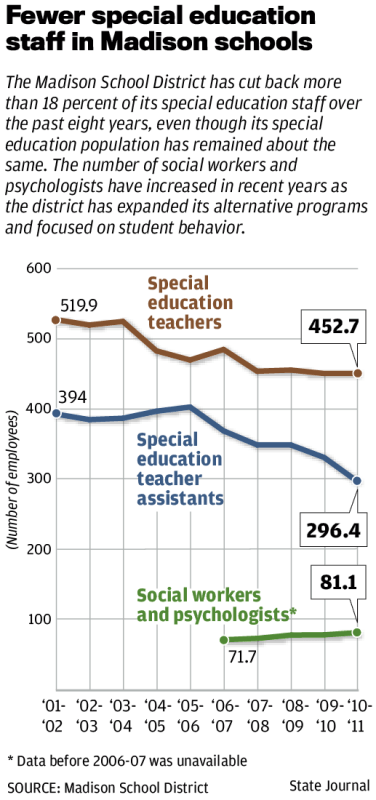
Graph from the Wisconsin State Journal, click image for accompanying story.

I was struck by the relationship between two things in recent Wisconsin State Journal stories.  The first of these is the graph above illustrating the cuts of over 150  Special Education staff positions (from Matt DeFour’s report on the new MMSD Middle School Mental Health initiative).    The second was this quote from Board President James Howard in Defour’s story on greater than anticipated cuts in state aid to the Madison Metropolitan School District:

School Board President James Howard said the board’s goal has been to not raise property taxes and, “I think that’s still our position.”

The short version of my reaction is that if your goal is hold the line on taxes, then I guess you are just fine with cutting programs and services, even those that serve the most vulnerable as Special Education does.  I’m not OK with that prioritization and am not OK with a Board and Board President who are.  The longer version  — including an analysis of how the 2008 referendum fits with this — follows.

[Note, as I was finishing this Board Member Ed Hughes put up a post indicating that he is more open to a property tax increase than president Howard and offering readers an opportunity to weigh in via a pollu.  When you are done here, read that post and vote).

Where to start?  I’ll begin with the obvious truth there are things that MMSD schools should be doing, ways they could be helping students, but are not and that these things cost money.   As a consequence of inadequate funding (among other things), MMSD is failing provide appropriate educational opportunities and services  for some students and excellent opportunities and services for many.  In other words, budget cuts impact education.  If you don’t believe the above, you should probably stop reading now.

The cuts to Special Education staff are one example (note I was cognizant of the 2006 cross-categorical teacher drop due to a change in case load allocations for “Speech and Language Only” students, the cuts to SEAs are somewhat surprising to me).  It is also worth noting that the approved Preliminary 2011-12 Budget appears to cut a further $3,231,626 from Education Services, the department in charge of Special Education, ELL and more (this figure may have changed slightly due to amendments, I’m using the initial Budget because the “approved Preliminary….” isn’t on line).  If any of these cuts come from Special Education, the district may be in danger of losing Federal Funding due to the Maintenance of Effort requirements  of IDEA which as explained in this memo from DPI  do not recognize “savings from reduced staff benefits as exceptions.”

Special Education is just one area where more resources would help; there are many others.  It should also not be forgotten that this preliminary — no new taxes —  budget was balanced by cutting staff compensation, as  Board Member Ed Hughes has said “underpaying our most important employees… a false economy.”

Now on to Board Goals.  I looked at in vain at the statues governing Boards of Education, at the MMSD Policies, at the District Philosophy, at the Mission Statement, at the Strategic Plan for any reference that could support not raising property taxes as a goal superior to providing the best possible education for the students in their charge.

You can look too, you won’t find it.  What you will find is much that calls for the Board to (in the phrase from the Strategic Plan) “vigorously pursue the resources necessary to achieve our mission,” the mission being:

…to cultivate the potential in every student to thrive as a global citizen by inspiring a love of learning and civic engagement, by challenging and supporting every student to achieve academic excellence, and by embracing the full richness and diversity of our community.

The last couple of MMSD budgets have each left about $10 million in revenue authority unused; the approved Preliminary Budget leaves (I believe) about $9 million (again, no final preliminary is on line, so I’m estimating).  It would not have taken, and does not now take much vigor to access these resources.  It may take  a little courage.

I realize that much has changed in the last few years — widespread economic hardship, cuts in state aid by both Democratic and Republican state governments, much slower than anticipated growth in property values, , the opportunity to cut staff compensation under the threat of union busting, dramatic cuts to the revenue limit base  — but despite all of these changes, if you go back to the principles and the details of Partnership Plan used to sell the 2008 Operating Referendum (which passed overwhelmingly) I think you can find plenty of justification for increasing property taxes in order to achieve the mission of the district.  Maybe not to the fully allowed limit (maybe) , but certainly beyond the level the Board President has stated as a goal.

That referendum is the primary reason why even with the FitzWalker mandated 5.5% cut in allowed revenue, Madison has the ability to maintain and even expand opportunities.   In more ways than one, that’s what over 68% of the voters agreed to.  They did not vote to freeze property taxes, they voted to raise them.

The strongest Partnership Plan based case for using the entire $10 million in referendum granted authority this year and every year is that that plan anticipated only a three year total of $9 million in cuts from cost to continue budgets, a total that was about doubled in the combined actual budgets of the first two years.

To me that is compelling, but some Board Members and others will point out the plan anticipated higher state aid and growth in property values than have been realized, and that these factors — along with general economic conditions — justify cutting at a higher level,  I don’t agree, but for the sake of argument I’m willing to stipulate that rather than relying on the “cuts from cost-to-continue ” metric,  we should also look at the total property tax burden.

Looking at the total levy instead of the total cuts is one way to deal with the diminished state aid and the lack of growth in property wealth to produce a conservative estimate of the tax burden agreed to by voters who ratified the Partnership Plan .  However if you are going to elevate  property taxes over other considerations in this manner it is only right to fully account for changes in property taxes and that includes dealing with the School Levy Credits.

As explained by Andy Reschovsky, the Levy Credits are categorized by the state as school aid but in fact function as property tax relief misdirected toward wealthier districts and property owners.  Shifting the almost $900 million a year allocated to the Levy Credits into general state school aids is a centerpiece of State Superintendent Tony Evers Fair Funding for the Future proposal.

Since 2006 the Levy Credits has almost doubled.  For the most part this has been ignored by School Boards in their Levy and Budget deliberations.  I think that was because districts almost always taxed to the max under revenue limits, so there was little reason to look at how the Credits impacted the net taxes of property owners.  One place where this would have made sense was in the otherwise detailed discussions of referendum related tax increases, but  — despite my advice at the time — MMSD did not include the Levy Credits in their presentations for  2008 referendum.

Since 2009-10 MMSD has ceased taxing to the max and has begun making minimizing tax burdens the top or near top consideration, the “goal.”  That means that the Levy Credits need to be part of the discussion, because as Reshovsky explains MMSD taxpayers benefit greatly from the Credits:

Using Madison as an exam-ple, in 2009, the average gross school mill rate was 9.79. The city’s school levy credit allocation resulted in a 1.76 mill rate reduction. Tax bills were then calculated using the net school mill rate of 8.03. Thus, the School levy credit resulted in a $352 tax saving for the owner of property worth $200,000 (.00176 times $200,000), and a tax saving of $880 for the owner of a $500,000 property.

For the purposes of this comparison of the levies anticipated in the Partnership Plan and  the actual/preliminary levies for the period covering the 2009-10 through 2011-12 budgets,  what is most important is that while cutting general school aids for the years 2009-10 and 2010-11, the Democrats increased the Levy Credits and that the Republicans in power have maintained these increases.  At the time voters approved the 2008 referendum, the Levy Credits for MMSD totaled 37,198,954.  For 2009-10 this increased to 40,934,795 and for 2010-11 they were 40,304,862.  I haven’t seen estimates for 2011-12, but the total funding for the Levy Credits is unchanged and it seems safe to assume that the share going to MMSD taxpayers will be about the same.

The table below uses  projected property tax totals from the Partnership Plan, the actual levies for the first two years and the levy from the approved preliminary budget for 2011-12.  To account for the Levy Credits  I’ve subtracted the Levy Credit increases over 2008 (3,735,841 for 2009-10 and 3,105,908 for 2010-11) from the levy totals (using the 2010-11 figure for 2011-12).

According to these figures,  MMSD could levy an additional $7,174,422 and still be within a  conservative interpretation of the tax increases the voters  approved with the 2008 referendum.  I think they should use at least this amount of their levy authority to advance their mission.

In the will of the voters as expressed in the referendum vote, I find no evidence that the community shares  Board President Howard’s stated goal to not raise property taxes and here and elsewhere I find much that supports reasonable tax increases.

Thomas J. Mertz
2 Comments

Filed under "education finance", Accountability, Best Practices, Budget, education, finance, Gimme Some Truth, Local News, Referenda, referendum, School Finance, Scott Walker, Take Action, Uncategorized

Hypocrite of the Day — Sarah Archibald

I’ve written about Sarah Archibald before.  She joined the state payroll when Jim Doyle tapped her to head up Wisconsin’s misguided and failed Race to the Top application, a key element of which was rushed legislation opening the door to the misuse of standardized test scores in teacher evaluations.  Now she is doing education policy for the FitzWalker gang as part of Senator Luther Olsen’s staff, busting unions, paving the way for  privatization via vouchers, enabling  charter school expansion, undermining local control, creating bigger class sizes in our public schools, eroding the opportunities to learn for most of the children of our state, and yes, further expanding the abuse of standardized test-based data to determine the conditions of employment for educators (via the pending SB 95 and AB 130).  You can read more about Archibald’s belief in the “need” to include “student test scores” in evaluating and determining compensation for teachers in this piece of Bradley Foundation funded pseudo scholarship.

We have a pretty good idea of what Dr. Archibald wants for your children and mine (a little more on that below), but what about her’s?  She sends her kids to Wingra School in Madison, where the tuition is $12,000 a year, the teacher student ratio is 12/1, the philosophy is “progressive,” and they don’t believe in tests, standardized or otherwise.  I’ll let Doctor Archibald explain in her own words:

…[W]hy we send our kids to Wingra school. At this school, teachers have the luxury of really recognizing and reinforcing each child. With no scripted curriculum and no standardized tests, teachers can focus on allowing the child to blossom and following the kids’ lead in terms of what they want to learn about. Who knows if they’ll really be prepared for high school or college, but they are held, and that counts for a lot.

I can’t help but close with this oft-quoted passage from John Dewey:

“What the best and wisest parent wants for his own child, that must the community want for all of its children. Any other ideal for our schools is narrow and unlovely; acted upon, it destroys our democracy ” (The School and Society, 1899).

Sarah Archibald is a wise parent who is working to destroy our democracy.   I think she’s earned the Hypocrite of the Day Award.

Thomas J. Mertz

3 Comments

Filed under "education finance", Accountability, Arne Duncan, Best Practices, Contracts, education, Equity, finance, Gimme Some Truth, Local News, No Child Left Behind, School Finance, Scott Walker

Where I Come From

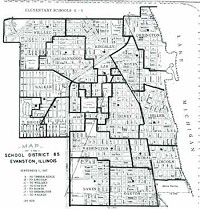
District 65 Attendance Area Map as of Sept. 1, 1967.

I came across a short video earlier this week on the WTTW site.  It appears the video is set not to repost or download, so go to the link to view it.   Really, take the time.

It is an excerpt from a longer documentary on school desegregation in my home town, Evanston,  Illinois.    I’m going to be working to find the whole show.  Evanston was one of the early sites for “affirmative desegregation,” done  to overcome def facto segregation and not under legal compulsion.  I was part of the first Headstart and Kindergarten classes to integrate Foster School, featured in the video.  That’s my kindergarten teacher, Mrs Todd (this must be the afternoon class, because I’m not there and neither are my classmates) and Robin Moran (interviewed) was a  family friend.

The desegregation/integration in Evanston was done largely via a Magnet School plan and there were and are problems.  To read more about the history, see this write-up of a session on the topic I did some years ago for the History of Education Society and this series from the Evanston RoundTable and this from the Chicago Reporter  and check out ShoreFront (these take you up to about 2002, the Roundtable Archives are a good way to catch up from there).

In case you were wondering, that’s where I come from, geographical, ideologically and educationally.

Thomas J. Mertz

2 Comments

Filed under AMPS, Best Practices, education, Equity, Uncategorized

An Endorsement for Andy Heidt — #1 of 7 of the 48th Assembly District Candidates on Education


On July 12 the voters in the 48th Assembly District — covering the East side of Madison, Monona, McFarland and the Town of Dunn  (map here)– will choose a Representative to the State Assembly to replace now County Executive Joe Parisi.  The candidates are (alphabetical, linked to their web sites):  Fred Arnold, Dave de Felice, Andy Heidt, Katherine Kocs, Bethany Ordaz, Vicky Selkowe, and Chris Taylor.

I don’t live in the District, but like all progressives in the state, I have a stake in the race.  Whoever is elected will be in a “safe seat” which means that they have the opportunity to do more than be a consistent vote; they can push the envelope by introducing and promoting significant progressive legislation, the kind of legislation that makes overly cautious party leaders uncomfortable.  With the Republicans in charge, the rhetoric from the Democrats has been heartening, but it should not be forgotten that when they controlled the state from 2008-10 they did nothing to reform school funding except cut $300 million and raise the levy credit, did nothing on the minimum wage, failed to pass the Green Jobs bill, didn’t finish the Union contracts when they could, did much to little in progressive revenue reform…the list goes on.   In this race I think people should look beyond opposing Walker to what kind of legislator the candidates will be when the Democrats are in control.There is no shortage in the legislature of “pragmatic progressives” who can find 1,000 reasons not to do the right things; there is a dire need for courageous leaders who will be steadfast in their advocacy both behind caucus doors and in public.   Andy Heidt will be that kind of leader, that’s why he has my endorsement and why I’ve been helping with his campaign.

To back up this assertion (and as a service to AMPS readers and voters in the 48th), I’m offering a series of posts  examining what the candidates have and have not said about education issues, especially the core issue of school finance, and to a lesser extent the related issues of revenue reform (based primarily on their websites and on internet searches).  In the interest of disclosure, I’ll note that I’m acquainted with three of the candidates and believe I have met at least three others and that some things that I know about them or impressions that have not appeared in campaign statements or biographies are part of the analysis.  If anyone, including the campaigns has anything to add or dispute, please use the comments to bring it to my attention.  This time the order is  from who I consider the strongest to who I consider the weakest (Andy Heidt, Vicky Selkowe, , Bethany Ordaz, Fred Arnold Chris Taylor, Katherine Kocs and Dave de Felice — this may change as I do more research).

Andy Heidt

By my criteria, Andy Heidt is far and a way the best candidate.  Throughout his campaign — beginning with his announcement (covered here by John Nichols) — he  has done more than decry the actions of the GOP, he’s offered positive policy alternatives and pointed to the failure of other Democrats to enact these and other positive proposals.  As Nichols put it:

Heidt’s argument that we must do more than merely prevent Walker from implementing his agenda. We must recognize that the crisis Walker is exploiting has its roots in the failure of Republican and Democratic administrations and legislators to recognize that Wisconsin cannot maintain services and public education if our politicians keep giving away tax breaks to multinational corporations and the wealthy.

Nowhere has this been clearer (or in my head more important) than in his statements on education funding.  Heidt has issued one press release  a “Keeping the Promise” plan (and here, scroll down) for school finance reform ((I helped draft the plan) and a short video.

In the press release, Heidt recognizes the importance of education and shows a “can do” spirit:

There are no more important investments than those we make in our children. They are the future and each generation has an obligation to provide the next with the skills and knowledge they need to be successful. With a fair revenue system, there is no reason we cannot return to the Wisconsin tradition of supporting quality public education.

He also notes past cuts to education under the Democrats  and the inadequacy of their recent counter-proposal to the Republican decimation of our schools.  No other candidate has been explicit on this.

More importantly, no other candidate has offered anything like the detailed “Keeping the Promise” plan, nor the pledges to action contained in that plan.

“Keeping the Promise” has two parts.  First it calls for “immediate action” to address the crises created by 18 years under a broken system, significant cuts in state funding in the 2009-11 budget and the recent Republican measures.  These include enacting the Wisconsin Alliance for Excellent Schools Penny for Kids proposal, expanding sales taxes, shifting the levy credits to the equalization formula,  rolling back vouchers, fully funding SAGE, allowing for growth of the revenue limits based on CPI or the state GDP, taking the profit motive out of virtual schooling and reinstating educator union rights.   The second part build on this by initiating comprehensive reform based on “based on the shared principles of the WAES Adequacy Plan the School Finance Network Plan and the 2007-2008 Assembly Joint Resolution 35.” These are (from AJR 35):

  • Funding levels based on the actual cost of what is needed to provide children with a sound education and to operate effective schools and classrooms rather than based on arbitrary per pupil spending levels.”
  • State resources sufficient to satisfy state and federal mandates and to prepare all children, regardless of their circumstances, for citizenship and for post−secondary education, employment, or service to their country.”
  • Additional resources and flexibility sufficient to meet special circumstances, including student circumstances such as non−English speaking students and students from low−income households, and district circumstances such as large geographic size, low population density, low family income, and significant changes in enrollment.”
  • A combination of state funds and a reduced level of local property taxes derived and distributed in a manner that treats all taxpayers equitably regardless of local property wealth and income.

Heidt vows  to “work tirelessly” to see that this reform is achieved prior to the next biennial budget cycle.

The sad history of AJR 35 (see here for AMPS posts covering that history)demonstrates the need for someone like Heidt in the Assembly.   When the resolution was introduced, the Democrats controlled the Senate and the Governorship, but not the Assembly.  Over 60 legislators signed on and the promise of comprehensive school funding reform was part of the 2008 campaign to “Take Back the Assembly.”  The Democrats did take back the Assembly and once they did AJR 35 and school funding reform disappeared.   Gone.  Silence.  When some of us who wanted them to keep their promises spoke up, we were told to be quiet because speaking or acting on this difficult issue might jeopardize their electoral prospects in November 2010.   I for one didn’t keep quiet, but I’m not taking the blame for the electoral failures of 2010.  Instead I’ll offer an alternative analysis — it isn’t  the people like me who called for action who are to blame, it is the legislators who didn’t act and didn’t want to be reminded of their failure to act (I said much the same well before the November 2010 elections).  Many of those silent, silencing  and inactive legislators are now supporting other candidates who share their priorities and outlook in the race for the 48th.  I’m supporting Andy Heidt.

[Note — I originally conceived this as one long post, covering all the candidates, but that didn’t work out, so I’m doing a series.  This is #1 of 7. — TJM]

Thomas J. Mertz


4 Comments

Filed under "education finance", Accountability, AMPS, Budget, education, Elections, finance, Gimme Some Truth, Local News, Pennies for Kids, Pope-Roberts/Breske Resolution, School Finance, Scott Walker, Take Action, Uncategorized

Exactly — A Voucher Advocate Reveals What is Wrong with Vouchers

I can't vouch for the statistic, but I like the graphic -- TJM

As the voucher movement in Wisconsin is poised to claim at least a partial victory, at an American Enterprise sessi0n ironically titled “School Voucher Programs and the Effects of a Little Healthy Competition” pro-voucher think tanker Grover Whitehurst inadvertently identified a flaw at the heart of the market-obsessed,  school privatization with public money movement.  Education Week reports:

He offered an analogy. A school district decides to allow students to buy meals from off-campus businesses, like the nearby McDonald’s. Public school cafeteria directors have several options to keep students eating in house, Whitehurst said, such as trying to improve outreach to students and encouraging the cafeteria staff to be friendlier. The cafeteria director, he said, “knows about the production function for satisfying customers.”

Just as choice in food consumption has not — in the aggregate — resulted in good and healthy choices, choice in education has not and will not result in good and healthy choices.  Many people either don’t know or don’t want what is good and healthy.  They want what is fast, tasty and popular.  The market doesn’t produce results that are healthy for society.

I don’t care much how people spend their food dollars, but I do care how we spend tax dollars and education dollars.  I don’t want it spent on the educational equivalent of McDonalds.

Thomas J. Mertz


Leave a comment

Filed under "education finance", Accountability, Best Practices, education, Gimme Some Truth, Local News, National News, School Finance, Scott Walker