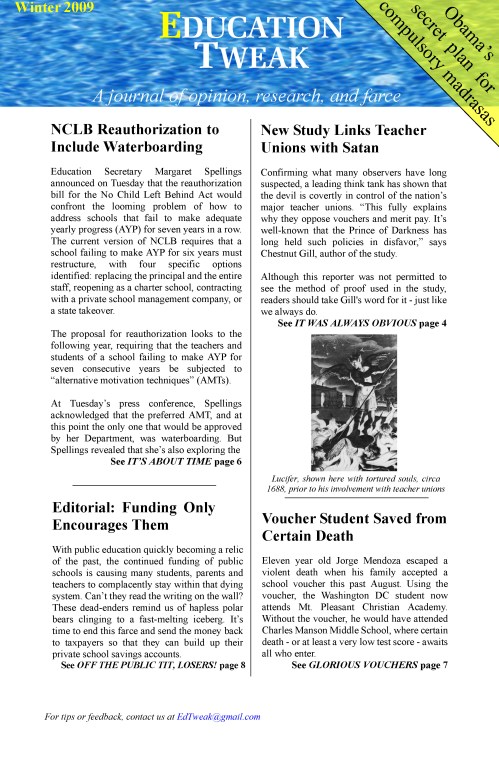
Click on image for pdf
Enjoy.
Thomas J. Mertz
Click on image for pdf
Enjoy.
Thomas J. Mertz
Johnny Thunders, “Ask me no questions” (click to listen or download)
A new press release from the Wisconsin Policy Research Institute propaganda mill trumpets “WISCONSIN RESIDENTS OVERWHELMINGLY OPPOSE RAISING TAXES ON BUSINESSES.” Further down is the actual wording of the question asked of 600 Wisconsin residents: “Business profits are down throughout Wisconsin and many businesses are reducing their workforce. In this environment should state lawmakers increase the tax on businesses?” This is what is known as a push poll, a “poll” where selected information is provided in order to shape the responses. People who conduct push polls are not doing research, they are seeking to influence opinion. People who conduct push polls should be shunned, not trusted.
Imagine how different the results would have been if instead of the dubious and vague claims about profits and layoffs (unemployment has been steady in our state) the respondents had been told about a 2006 Associated Press study that found “Wisconsin companies saw their profits grow more than twice as fast as their state and local tax bills over a two-decade period.”
Instead of playing games with push polls, anyone who is serious about public policy in our state should be spending some time with a new report from the Wisconsin Council on Children and Families and the Institute for Wisconson’s Future entitled Catalog of Tax Reform Options for Wisconsin. It is clear that there are many ways we can improve our tax policies and generate the revenues needed to fund education and other things the way we should.
Thomas J. Mertz
Filed under "education finance", Budget, education, finance, Gimme Some Truth, Local News, School Finance

We should have no difficulty conceding Milwaukee’s [Parental Choice Voucher Program’s] disappointing record while remaining coolly confident that sensible K–12 market reforms have the potential to boost productivity, spur purposive innovation, provide more nuanced accountability, and make the sector a magnet for talent. [Emphasis added]
Note that this faith is a faith in “the market.” That’s been working out real well lately.
I prefer this kind of “faith based policy.”
Thomas J. Mertz
Filed under Best Practices, education, Gimme Some Truth, Quote of the Day

Graph courtesy of Community and Schools Together (CAST)
Excerpted from Wisconsin State Journal editorial:
Wisconsin received more evidence this week that its taxes are too high….
The study, from the Pacific Research Institute in association with Forbes magazine, should give state and local policymakers new incentive to control spending so that taxes can be reduced….
There are reasons to be suspicious of some of the study’s assumptions about what contributes to prosperity….
Wisconsin should beware that prosperity requires public investment in the seeds of growth, including education…
State and local policymakers face tough decisions as they prepare the next round of government budgets. They should redouble their efforts to rein in spending so that tax cuts will become possible.
It appears the editorial board is confused and conflicted. They are eager to cite a study they acknowledge as flawed because it provides red meat for their anti-tax appetites. They recognize that public investment in education and other things is the key to prosperity yet call for tax cuts. Maybe they should have just kept quiet.
The problem with this kind of editorializing is that it creates a climate where the investments we need, like in education, get lost in the general anti-tax stance. The graphic at the top is one measure of local investment in education and it shows that this is far from an area that needs “redouble[d] efforts to control spending.” Instead it indicates that due to the broken state school finance system, our investment has been lacking and that we can and should invest more by passing the November 4, 2008 referendum.
There are good reasons to doubt both the conclusions and the source of the “study.” As the editorial notes, New York — with an economic growth rate of 4.4% last year — is ranked last, while South Dakota’s 2.3% growth rate is accompanied by a number one ranking in “Economic Freedom.” Obviously the relationship between “economic freedom” and prosperity is not as simple as the authors would like us to believe. I don’t want to go into the assumptions behind the construction of their index, but I do want to note that as usual with these right-wing think tank things, taxes are given much weight and no attention is paid to government fees. Wisconsin’s fees are relatively low and this skews thing mightly.
The source, The Pacific Research Institute has been linked to Big Tobacco, the campaign against paper trails for electronic voting, anti-immigrant rhetoric in the battle against expanding government health care programs, attacks against LINUX and open source software, and work on behalf of the privatization of water rights. See a pattern here?
I happen to know one of the authors of the current study, Eric Daniels. Eric and I were in Grad School together; a nice enough guy but nobody I’d look to for policy or moral guidance. Eric is an acolyte of Ayn Rand. Eric’s section of the report is the historical portion and it is a masterpiece of selective use of sources and data, sprinkled with authoritative pronouncements derived from Ayn Rand and Milton Friedman, all disguised as scholarship.
In an interview with EdNews, Doctor Daniels had this to say:
You’re right that there seems to be an emphasis in socialist countries is on helping the less fortunate, but it is only the most benign aspect of the much more perverse deeper emphasis, which is the morality of altruism. The socialist nations demand more than just help, they demand the sacrifice of the strong to the weak, the intelligent to the feeble minded, and the moral to the immoral…
Any honest man with a knowledge of history should see that those who want to help the less fortunate ought to embrace capitalism.
He believes that both the Democratic and Republican parties of are guilty of pushing this dangerous socialist agenda. In a sense he is correct about this, in that both parties correctly see a positive role for government that goes beyond protecting persons and property and includes things like education, food and drug safety, infrastructure… In these days of Lehman Brothers and AIG, that he is wrong about the virtues of unfettered capitalism should go without saying.
I think I know why the State Journal was so confused. They started with the mistaken assumption that the likes of Eric Daniels had anything useful to contribute.
Support a better vision of the common good, Vote Yes for Schools!
Thomas J. Mertz

Of the 12 referendum questions on the ballot yesterday — 8 operating and 4 to issue debt, — 8 passed (5 operating and 3 debt). Of the operating referenda that passed, all were nonrecurring. That means that when the authority expires, these districts will be headed “off the cliff.” Thankfully, Madison had the wisdom to facilitate long-term planning with a recurring referendum.
One by one, in reverse alphabetical order.
A “big” win in Weston (after a close loss in April) — 482 to 308 — on a three-year non recurring in amounts for $210, 000 to $575,000. This means that for the next three years Weston will survive and be able to ““keep the books and equipment in the budget year after year.” Got that — in order for a school district to have books, they need the approval of the voters at a referendum. Are you listening Governor Doyle? Are you listening State Legislators? Are you listening voters as you look toward your November ballots? Click the links and try to get the ears of our elected officials.
Shawano got approval to go ahead with the $24.9 Million construction of an Early Childhood – Grade 2 facility and upgrades and additions to other buildings by a vote of 2,186 to 1,842. “The children of Shawano won tonight,” said Lincoln Elementary principal Troy Edwards.
Bad news from Salem, where $1.16 Million recurring referendum went down 677 to 286. Time for more cuts.
Board members will be forced to cut staff, said board vice president Larry Kamin. The layoff notices will go out in February…
Officials have said as many as seven full-time teachers could be cut, increasing class sizes above state-recommended minimums. Combined-grade classes could also become a reality, officials said.
Salem serves about 1,100 students. The equivalent loss for Madison would be about 153 teachers.
Tiny Rubicon’s non recurring $150,000 a year measure passed 132 to 91. See this previous post for a list of past cuts and what was at stake.
The news for Rhinelander was not so good. Voters there defeated both the request to issue $23.35 Million in debt to renovate, add to and improve existing buildings and build a new facility (3,180 to 3,135) and a recurring referendum in the amount of $225,000 for operations ($3,204 to 3,105). This was a scaled back version of a referendum that failed in April. Prior to the vote The Rhinelander Daily News editorialized:
We believe this community needs to reinvest in our schools so that today’s students get an education that fits today’s world; so students get an education that provides them with options and opportunities. We need an educational system that students can take pride in and that the community can grow around.
and characterized the vote as “an opportunity to do great things, for the schools and the community.”
It is now a missed opportunity. How many other opportunities have been missed in our state because voters don’t fully understand that providing quality education requires successful referenda? How many opportunities have been missed because Boards of Education are reluctant to even ask the voters (or, as in case of Madison, are reluctant to ask for the funding required to maintain our present level or restore valued programs and services that have been cut in the past)? How many have been missed because our elected officials lack the will to enact a way of funding schools that is based on educational needs? Way too many.
Neillsville voters understood what was at stake and approved five-year non recurring authority at $300,000 a year by a vote of 557 to 481.
A 959 to 866 victory in Montello means they can take a step back from the edge of do-or-die finances. Failure of the two-year non recurring $950,000 measure would likely have set them on the road to dissolution. This breathless video report from WISC-TV tells part of the story and doesn’t even tell that part very well.
I don’t know which is worse, breezy or breathless. The details of school funding are complex (see here for an accessable introduction), but one fact is simple: Each year, without referenda, the (nearly) mandated costs increase faster than the allowed revenues. How hard would it be to convey that information every time referenda are the topic? Apparently too hard for most local members of the fourth estate. In addition to omitting that basic and essential information, the video report neglects to clearly state that when the non recurring authority runs out, Montello will likely be back on the edge and mis-characterizes consolidation as a panacea. By most accounts, consolidation buys a year or two away from crisis while the erosion created by our “going-out-of-business” way Wisconsin funds education continues to eat away at the future of our children and our state.
The referendum in Mineral Point also went down. The vote on the five-year non recurring referendum was 599-328. For a guide to the damage this no vote will lead to, see here.
The story in Deerfield is much more encouraging. The six-year non recurring referendum passed 422 to 265. as I’ve noted repeatedly, the community involvement process in Deerfield was exemplary.
“We had a very active group of citizens that came together eight months ago and spent eight months looking at all the needs of the district. They were vital in terms of putting this plan together. They came to the board with the referendum plan and the board backed that plan unanimously,” [Superintendent Michelle] Jensen said.
Small class sizes will be kept, technology upgraded, plumbing HVAC and electrical work will be done and there will be a new track (replacing one built 30 years ago). These are basic things that a district should be able to do without having to hold a referendum.
Colby will get the greenbacks for green schools they requested. The vote on that debt measure was 696 to 287. Another vote to refinance retirement obligations also passed, 738 to 228. The Marshfield News Herald reports:
“These referendum questions are focused on a win for everybody, and I think that’s why they were successful,” said Colby Superintendent Terry Downen. “We certainly hope to save programs as a result of softening the blow of increasing costs by having these additional savings in place.”
[Neillsville Superintendent John] Gaier said if the state’s school funding formula remains unchanged, every district in Wisconsin, including Neillsville, will continue asking taxpayers for more money.
Madison media, pay attention. Notice how simple it was to give some of the bigger picture by including that quote from Superintendent Gaier.
Congratulations to all the winners, my most sincere empathy to the losers and to all, let’s fix the system that requires these referenda, let’s “Get’er done.”
Thomas J. Mertz

(1924 National American Ballet)
Contrast the excellent coverage of what’s at stake for the various referendums taking place this coming Tuesday by my colleague TJ Mertz, in the post immediately below this one, with what was reported yesterday in the Wisconsin State Journal regarding three local ones chosen for coverage.
Three area school districts are holding referendums Tuesday — two say it’s to avoid the presidential election hoopla and another wants to finalize its budget as soon as possible.
Deerfield, Mineral Point and Weston school districts are each asking to exceed the revenue limit in order to pay for everything from daily operating expenses to maintaining staffing levels.
This type of coverage reflects the difficulties Madison will face in it’s referendum in November, this breezy piece failed to mention one of the basic W’s of good journalism – “why.” Why are these districts forced to go to referendum? For the low information voter reading about about one of these referendums for their community for the first time, they may wonder, why haven’t these school boards learned to live within their means during these tight economic times? Legitimate question, but the piece doesn’t provide the answer – it’s a dysfunctional state school finance system. A sentence or two would have sufficed. Instead, the reader is left to draw their own conclusions. I’ve brought up this issue previously of troubling referendum coverage that ignores the “why” of the story, with another journalist from the State Journal who replied to my critique (ironically enough, part of his piece was on the last failed referendum in Weston). It’s a pity the editors at the Journal have missed another opportunity to explain this budgeting shortfall, for one of the most critical functions of our government, educating our children.
Robert Godfrey
Filed under "education finance", AMPS, Budget, education, Elections, finance, Gimme Some Truth, Local News, Referenda, referendum, School Finance, Uncategorized

Chuck Berry, “Don’t You Lie To Me” (click to listen or download)
In his predictable screed against the November 4, 2008 Madison school referendum, Dave Blaska makes at least two statements that are demonstrably false.
Today, housing values are plummeting; unemployment is edging up…
The chart above shows housing value trends. After a drop in January, the general direction is up; by about $20,000 since the first of the year on both average and median. Sales have slowed and both the average and the median are down slightly in year-to-date measures, but one look at this chart and others reveal how unsupportable the verb “plummeting” is. There is a slight downward trend for August, but if you look at prior years there have been downward trends in August since at least 2005. According to the Dane County Real Estate Blog:
The Dane County market certainly needs to get better (especially the condo market), but once again the national numbers show that we’ve avoided the meltdown that is occurring in other parts of the country.
Blaska is even further from the truth on unemployment. According to the Department of Workforce Development’s latest report unemployment in Madison dropped 0.3% in July, is the same as it was one year ago, is the lowest rate of any Wisconsin Metro area, is 1.2% below the state rate (unadjusted) and 2.4% below the national rate (unadjusted). Sorry Dave, going down, not up and doing very well in comparisons.
Better luck next time you decide to pull “facts” out of thin air.
One reason Madison continues to attract jobs and homebuyers is the quality of our public schools. Keep our community strong and prosperous, Vote Yes for Schools!
Thomas J. Mertz
Filed under "education finance", Budget, education, Elections, finance, Gimme Some Truth, Local News, Referenda, referendum, Uncategorized

The Madison Metropolitan School Board approved placing a three-year recurring referendum on the November ballot and enacted tax mitigation policies Monday, August 25, 2008. This is a good referendum, a good package and if passed will help create a positive atmosphere for the anticipated strategic planning that will make our schools even better while minimizing the costs to local taxpayers. Much more in the coming hours, days, weeks and months.
Just one thing that needs to be said now. Both before and after the vote opponents and other “watchdogs” cultivated deliberate misunderstanding by labeling the recurring referendum a “(virtual) blank check.” It is nothing of the sort. It is a “check” (taxation authority to exceed the revenue caps by up to) for $5 million the first year, $9 million the second year and $13 million each year thereafter. A blank check is a check that may be written in any amount; this referendum asks for specific authority up to a maximum. The idea of a “virtual blank check” is illogical demagoguery. Either a check is blank or it isn’t; it is like being a “little bit pregnant,” no such thing. Those who are pushing this line are insulting the people of Madison.
Thomas J. Mertz

Bob Dylan and the Band “Tears of Rage” (click to listen or download)
From Lakeview Elementary (MMSD) teacher Susan J. Hobart in The Progressive Magazine.
One Teacher’s Cry: Why I Hate No Child Left Behind
By Susan J. Hobart, August 2008 IssueI’m a teacher. I’ve taught elementary school for eleven years. I’ve always told people, “I have the best job in the world.” I crafted curriculum that made students think, and they had fun while learning. At the end of the day, I felt energized. Today, more often than not, I feel demoralized.
While I still connect my lesson plans to students’ lives and work to make it real, this no longer is my sole focus. Today I have a new nickname: testbuster. Singing to the tune of “Ghostbusters,” I teach test-taking strategies similar to those taught in Stanley Kaplan prep courses for the SAT. I spend an inordinate amount of time showing students how to “bubble up,” the term for darkening those little circles that accompany multiple choice questions on standardized tests.
I am told these are invaluable skills to have.
I am told if we do a good job, our students will do well.
I am told that our district does not teach to the test.
I am told that the time we are spending preparing for and administering the tests, analyzing the results, and attending in-services to help our children become proficient on this annual measure of success will pay off by reducing the academic achievement gap between our white children and our children of color.
I am told a lot of things.
But what I know is that I’m not the teacher I used to be. And it takes a toll. I used to be the one who raved about my classroom, even after a long week. Pollyanna, people called me. Today, when I speak with former colleagues, they are amazed at the cynicism creeping into my voice.
What has changed?
No Child Left Behind is certainly a big part of the problem. The children I test are from a wide variety of abilities and backgrounds. Whether they have a cognitive disability, speak entry-level English, or have speech or language delays, everyone takes the same test and the results are posted. Special education students may have some accommodations, but they take the same test and are expected to perform at the same level as general education students. Students new to this country or with a native language other than English must also take the same test and are expected to perform at the same level as children whose native language is English. Picture yourself taking a five-day test in French after moving to Paris last year.
No Child Left Behind is one size fits all. But any experienced teacher knows how warped a yardstick that is.
I spent yesterday in a meeting discussing this year’s standardized test results. Our team was feeling less than optimistic in spite of additional targeted funds made available to our students who are low income or who perform poorly on such tests.
As an educator, I know these tests are only one measure, one snapshot, of student achievement. Unfortunately, they are the make-or-break assessment that determines our status with the Department of Education.They are the numbers that are published in the paper.
They are the scores that homebuyers look at when deciding if they should move into a neighborhood.
They are the numbers that are pulled out and held over us, as more and greater rigidity enters the curriculum.
I was recently told we cannot buddy up with a first-grade class during our core literacy time. It does not fit the definition of core literacy, I was told. Reading with younger children has been a boon to literacy improvement for my struggling readers and my new English-speaking students. Now I must throw this tool away?
In an increasingly diverse public school setting, there is not one educational pedagogy that fits all students. We study and discuss differentiated curriculum, modify teaching strategies, and set “just right reading levels” to scaffold student learning. But No Child Left Behind doesn’t care about that. It takes no note of where they started or how much they may have progressed.
As a teacher, I measure progress and achievement for my students on a daily basis. I set the bar high, expecting a lot.
I don’t argue with the importance of assessment; it informs my instruction for each child.
I don’t argue with the importance of accountability; I believe in it strongly—for myself and my students.
I have empathy for our administrators who have to stand up and be told that we are “challenged schools.” And I have empathy for our administrators who have to turn around and drill it into our teacher heads, telling us we must do things “this” way to get results. I feel for them. They are judged on the numbers, as well.
No Child Left Behind is a symptom of a larger problem: the attack on public education itself. Like the school choice effort, which uses public funds to finance private schools and cherry-pick the best students, No Child Left Behind is designed to punish public schools and to demonstrate that private is best.
But I don’t think we’ve turned a corner that we can’t come back from. Public education has been a dynamic vehicle in our country since its inception. We must grapple with maintaining this progressive institution. Policymakers and educators know that education holds out hope as the great equalizer in this country. It can inspire and propel a student, a family, a community.
The state where I teach has a large academic achievement gap for African American and low income children. That is unacceptable. Spending time, money, energy on testing everyone with a “one size fits all test” will not eliminate or reduce that gap.
Instead, we need teacher-led professional development and more local control of school budgets and policymaking. Beyond that, we need to address the economic and social issues many children face, instead of punishing the schools that are trying to do right by these students.We’ve got things backwards today. Children should be in the front seat, not the testing companies. And teachers should be rewarded for teaching, not for being Stanley Kaplan tutors.
Ten years ago, I taught a student named Cayla. A couple of months ago, I got a note from her, one of those things that teachers thrive on.
“Ms. Hobart was different than other teachers, in a good way,” she wrote. “We didn’t learn just from a textbook; we experienced the topics by ‘jumping into the textbook.’ We got to construct a rainforest in our classroom, have a fancy lunch on the Queen Elizabeth II, and go on a safari through Africa. What I learned ten years ago still sticks with me today. When I become a teacher, I hope to inspire my students as much as she inspired hers.”Last week, I received a call from Niecy, another student from that class ten years ago. She was calling from southern Illinois to tell me she was graduating from high school this month and had just found out that she has won a scholarship to a college in Indiana. I was ecstatic in my happiness for her. We laughed, and I told her I was looking at a photo of her on my wall, building a pyramid out of paper bricks with her classmates.
I also had a recent conversation with Manuel in a grocery parking lot. He reminded me of my promise eight years ago to attend his high school graduation. I plan to be there.
Cayla and Niecy and Manuel are three of the reasons I teach. They are the reasons that some days this still feels like a passion and not a job.
When I pick up the broom at the end of the day to sweep my class due to budget cuts, I remember Cayla.When I drive home demoralized after another meeting where our success is dissected with a knife manufactured in Texas, I remember Niecy.
When another new program that is going to solve the reading disparity, resulting in higher test scores, is introduced on top of another new program that was supposed to result in the same thing, I remember Manuel.
They are the fires that fuel my passion. They are the lifeboats that help me ride this current wave in education.
Eight or ten years from now, I want other former students to contact me and tell me a success story from their lives. I don’t want to be remembered as the teacher who taught them how to sing “Testbusters” or to “bubble up.” I want to be remembered as a teacher who inspired them to learn.
Susan J. Hobart, M.S. Ed., is a National Board Certified Teacher living in the Midwest.
Thomas J. Mertz
Filed under AMPS, Best Practices, education, Gimme Some Truth, Local News, National News, nclb, No Child Left Behind

Jimi Hendrix, “If 6 was 9” (click to listen or download)
In the June 10, 2008 edition of “Lasee’s Notes,” State Assembly Member Frank Lasee (Republican, 2nd district) sang the praises of our current system of keeping taxes down by starving education and requiring referenda to address the structural faults in the revenue caps. In the paragraph reproduced below, Lasee cited questionable polling data:
The school referendum system has worked reasonably well and has helped to control property taxes (click for recent news that statewide property taxes have increased 3.8% this year). There aren’t many state elected officials willing to talk about removing these revenue controls (one of WEAC, the state’s teachers union’s top priorities) or taking away these spending controls (with voter override approval). This is because they enjoy 70% approval ratings when citizens are asked. Once citizens get the right to vote, they don’t want to give it up.
I was intrigued by the 70% figure, so I wrote Rep. Lasee to ask where this number came from. Four days later (June 19), I got an email asking that I provide a home address, but promising “If I have your address, I will respond regardless of where you live.” I responded that day, with the requested information. Ten days latter, I emailed again, with my address and asking about the polling numbers. On July 18, I wrote again. I haven’t heard from Rep. Lasee or his office since the initial request for my address. It appears he doesn’t want to answer my question.
Lasee is an embarrassment — it could be that like another embarrassment to the Wisconsin political traditions, Joe McCarthy — he just makes up his numbers.
I’ve done some digging and the closest polling I can find was a news story on a survey commissioned by the Wisconsin Association of School Boards (WASB) and released in 2001. The 70% figure isn’t there, the results are full of contradictions and we have had seven more years of struggles under the state school finance system since then. Here are some highlights from the story:
So 78% favored more local control and over 52% to 59% of the respondents favored a measure that would have allowed major increases in school funding. If the 2% solution had been enacted in 2001 (at $148 per year) and renewed, this would have meant over $24 million more in the 2008-9 MMSD budget. Hard to spin support for a change of that magnitude as support for “the school referendum system.”
After seven years of cuts and conflict, I’d guess the numbers in favor of big and small reform have grown considerably.
Whatever changes may have happened, the only poll I can find does not back Lasee up.
I’m still waiting for an answer from Frank Lasee, but I’m not expecting one.
Thomas J. Mertz
Filed under "education finance", AMPS, Budget, education, Elections, finance, Gimme Some Truth, Local News, Referenda, referendum, School Finance, Uncategorized
 Fund a Classroom Project in Madison
 AMPS
AMPS