Category Archives: Gimme Some Truth

We Are Not Alone #22 (Referendum Roundup)

It must be that time of year, or more likely the “going out of business” state finance system continuing to take its toll on districts in Wisconsin. Five more districts have placed referenda Fall ballots. That brings the total to ten by my count, eight for operation and maintenance and two to issue debt for, renovating and upgrades.

I posted before on the September 9 Colby measures, one of the debt referenda. Interestingly like Colby’s, the other debt referendum — A November 4th vote in the Clinton Community School District — also includes an attempt to move toward energy efficiency and environmentally sound practices, in this case via a Geo-Thermal heating system (Milton is also looking at Geo-Thermal). With this and the other items, Clinton is trying to plan for the future in ways that our school funding system makes nearly impossible.

The district could wait to ask residents to pay for new projects, but [Board President Randy] Gracyalny said gambling on the economy improving and prices going down isn’t a move he wants to make.

“Where will we be three years from now?” he asked. “I don’t know. No one knows. We know where we are now.

“Yeah, we might not absolutely need this, this year. But if we put it off too long, it’s going to get to that point of making some tough cuts.”

It is a smart approach and I wish them the best (more here).

In the districts seeking to pay for operations and maintenance it is the usual recipe of costs rising faster than allowed revenues, with added seasoning of declining enrollments for some.

Taking them in chronological order, Wausaukee will vote on August 19th. This is the “do or (probably) die” referendum. You can read lots more about Wausaukee in previous posts. Sadly, our local media has had nothing to say about this. Nothing. Even the Chicago Tribune picked up the story, but not our Madison newsies. The district has posted a “Fact Sheet” on the referendum and — as they have to — are moving ahead with the dissolution planning. The linked story from the Peshtigo Times is worth reading, especially the lengthy statement Board member Dave Kipp offered before voting against dissolution. Rather than excerpt that, I offer excerpts from a letter to the editor by Gert Wilson, “Retired Teacher”:

Democracy has diminished and that is sad because children learn from adults and what they see is disrespect for others’ opinions and bossy individuals who control meetings to delay or stop procedures. Of course, all people are not guilty of such actions.

We have seen this also at Coleman, Crivitz and Wausaukee in regard to education. The Times has been overwhelmed with nasty discussions, critical items in the paper and parents discussing issues in irate voices along with school boards. As usual, the students pay the price. They probably will, if Wausaukee folds and students have to ride to Crivitz. When will they eat, sleep and do school work? (emphasis added)

Amberg, a few years ago, opted to join the Wausaukee School District. Was that an error? Now it is possible these student will ride to Crivitz. Teachers, school boards and parents, are you happy about all your adult complications? I give credit to all who try to make it right.

Small towns cannot survive peaceably when all this divides friends and parents and teaches some children to rebel, be bossy, be bullies, show disrespect and have drinking problems.

You tell ’em Gert. There is also a good commentary on the Wausaukee situation from Ken Krall at NewsoftheNorth.Net.

Deerfield, Neillsville, and Montello will all vote on September 9.

Deerfield is asking for a five-year nonrecurring, with annual amounts starting at $275,000 and going to $475,000 (another version of planning for the future). Deerfield appointed a Citizens Advisory Committee last year to work on the plan and surveyed the community before proceeding. They’ve also put together a very nice web page explaining the what the referendum is about. Madison could learn some things from our neighbors fifteen miles to the East.

Neillsville has been experiencing declining enrollment at a rate of 30 or more students a year and started out as a low spending district in 1993 when the revenue caps were put in place. This is a double whammy. District spending levels are still based on what they spent over 15 years ago; because the caps are set on per member basis, declining enrollment –especially in small districts — makes it increasingly hard to cover fixed costs such as heating and transportation and almost impossible to pay for diverse offerings that larger districts take for granted. As Superintendent John Gair said: “”We’re at the point now where departments are made up of one person in some cases. If we reduce (spending) any more, we’re going to lose programs for kids.” To meet these challenges, Neilsville is asking for a five-year, $300,000 a year increase in the amount of revenue they are allowed to collect.

According to District Administrator Jeff Holmes, Montello is one year away from joining Wausaukee in dissolution (or exploring consolidation). Last September two referenda were defeated; one operating and one to borrow for things like resurfacing the parking lot and replacing air conditioning. They cut for administrators last year and have not replaced retiring teachers. This time they are going to ask for a two-year non recurring $950,000 increase in their revenue limits. If it passes, two years isn’t very long. Unless the Governor and the Legislators do something quick, they will have to go back to the voters again.

Lafarge, Mercer, Seneca, and Pittsville all have November 4 referenda scheduled.

Some may remember that in 2000 disputed ballots in the Lafarge referendum went all the way to State Supreme Court, which after years of litigation upheld “the intent of the voter” precedents and a referendum victory (unfortunately that same year the US Supreme Court threw away precedent and the Constitution and gave the Presidency to George W. Bush). This time Lafarge is one of two districts (thus far) asking for a recurring referendum, in the amount of $250,000 annually.

In Mercer they’ve reached the final year of a three-year nonrecurring referendum and the wolf is at the door. A rigged state finance system and declining enrollment are threatening to blow the house down. They also convened a Task Force, which laid out the options:

  • Approve the new referendum to keep the school open.
  • Close the school and dissolve the district.
  • Consolidate with another district.

“Dissolving” was also mentioned. They are asking for four-year, $350,000 per year revenue cap relief.

Seneca is another small enrollment, rural district with declining enrollment. I’ve described above what this does to the ability to give students the education they deserve, the Institute for Wisconsin’s Future’s Atlas of School Finance goes into more detail. They are asking for $800,000 a year on a recurring basis.

Pittsville covers 440 square miles and serves 686 students. Wrap you mind around that and you will understand that districts like this are essential (consolidate into a district that serves 1,300 students spread over 1,000 square miles?) and do not enjoy the economies that larger, more compact districts have. Because of these these issues and projected declining enrollment, the plan in Pittsville is to decrease staff even if the three-year $175,000 nonrecurring referendum passes.

These posts are a lot of work, but they are also rewarding. I learn about the districts in Wisconsin, the good they are doing, their hopes and dreams. I urge you to visit a few of the district web sites linked here; look at the pictures, read the mission statements, find things like Pittsville’s “Why enroll your child at Pittsville?” and sense the pride and dedication. You will find it rewarding too.

On most of these web sites I also see the logo for “The New Wisconsin Promise,” and wonder if the slogan “A Quality Education for Every Child” is some kind of sick joke. Our schools — even those in dire financial straits — are still doing a fine job, but how much longer can they and we hang on?

Why can’t we put in place a way of investing in our children’s future that makes those words an accurate boast? Why not Governor Doyle? Why not Senators and Assembly members? Why not?

Take the five minutes to click the links and ask them. Maybe if enough of us do, something will change.

Thomas J. Mertz

Leave a comment

Filed under "education finance", Accountability, AMPS, Best Practices, Budget, Contracts, education, Elections, finance, Gimme Some Truth, Referenda, referendum, School Finance, Take Action, Uncategorized, We Are Not Alone

Education: A shared value and “recession-proof”

An interesting report out on the survey results of presidential pollster Cornell Belcher presented at the recent 8th Annual Quality Education Conference in Washington, DC, focused on the significance of education as a political issue in America. He concluded from his research, as reported by The National Access Network at Teachers College, Columbia University, that “education is a high priority issue for most Americans: it is a “shared value” which is largely “recession-proof”—remaining important even when the economy is down.”

Education has consistently ranked highly among Americans’ most important political concerns. Belcher reported that in 2004, Americans ranked terrorism and moral values among the most important issues, while in 2008, these had been replaced by gas prices. Economic issues and Iraq ranked among the top five issues in both years—not surprising given the economic down turn and problems faced by the military. But education also remained a constant, consistently ranking among the top five political issues regardless of economic circumstances or foreign policy concerns.

Beyond this “shared value,” Belcher also highlighted the different views Americans have of education, which he described as four clusters in the poll. Approximately 30 percent of Americans viewed education as a top priority and believed that structural changes in funding and resource distribution were necessary to improve the educational system. Another 30 percent also value education highly, but they believe the solutions are more individual—increased parental involvement and behavioral changes among students. Another 30 percent value education highly but are not willing to increase funding for it. Finally, less than 10 percent of Americans in the poll did not believe education was a top priority.

Belcher underscored his view that peoples’ core beliefs do not typically change. However, he emphasized a view that various political messages—including those in support of educational equity and opportunity—can be cast to appeal to these different groups.

It’s striking to observe the current discussions on the banking industry bailout and contrast that with the typical rhetoric when it comes to some other core needs of society such as public infrastructure renewal and education. It would appear from this survey that upwards of 60% of Americans are concerned about the public financing of schools to provide more support for our nation’s future, despite the off-the-radar nature of the current public discourse. I wonder what the different percentage categories Madison’s voters would fall into in such a survey. We certainly will have a reality check in an upcoming referendum this fall that will attempt to just keep us above water due to a broken school finance system.

Robert Godfrey

Leave a comment

Filed under AMPS, Gimme Some Truth, National News, School Finance

New Blog – Mica Pollock, schoolracetalk.org

Curtis Mayfield — “Mighty, Mighty (Spade and Whitey)” (click to listen or download)

I’ve highlighted Mica Pollock’s work on the importance of talking about race and other inequalities and ways to cultivate productive conversations here and here on AMPS. She has launched a new blog/site, www.schoolracetalk.org. I suggest you check it out. Here is her description:

I started schoolracetalk.org to create a virtual place where people can talk together about race issues in schools. We have to discuss these issues face to face with local people. But we also need places to go test ideas, and to learn some “gold nugget” ideas from others. We need to think together about how to handle racial inequality and what to “do with” difference and diversity.

Mica Pollock also had a very good guest post at eduwonkette recently.

I’ve said it before in a variety of ways, when those associated with our schools only indirectly address difficult matters of inequality, very little is gained. We might avoid or postpone some conflicts this way, but we don’t move forward toward better schools or a better society.

Thomas J. Mertz

Leave a comment

Filed under Best Practices, Equity, Gimme Some Truth, National News, Take Action, Uncategorized

An exercise in delusion

Hieronymus Bosch

During a speech to the National Association of Latino Elected & Appointed Officials the other day, John McCain launched into a discussion of NCLB and education funding, holding up New York City (with awful – and similar funding issues to Wisconsin) and New Orleans (oy!) as examples of Republican success stories in education. Charter schools, according to him, can be our silver bullet. Pardon me, but we all need a national conversation to start now. However for Mr. McCain, it would seem his mind is made up.

“I mean, they also re-authorized No Child Left Behind, with the lessons we learned in the intervening years since we passed it, in a bi-partisan fashion, I would fully fund those programs that have never been fully funded. But let me also say to you: choice and competition. I believe that every family in America should have the same choice that Cindy and I did. We chose to send our children to a Catholic school. That was because we were able to do so. So I believe that charter schools work. I believe that they’re not much better than public education, but they provide competition. There are two examples I’d like to mention very briefly: New York City and New Orleans. If you missed it, there is now a dramatic uptick in the performance of school children in New York City, a place where a lot of experts thought there would never be improvement. We ought to go up there and see what Mr. Klein and Mayor Bloomberg and others have done and dedicated educators have done in New York City. New Orleans, they had to start at square one, as you know. There are now 30 charter schools in the city of New Orleans. Anyone will tell you that they’re starting to see a dramatic improvement in the quality of education in the city of New Orleans. My friends, choice and competition, reward the teachers, God bless them, find bad teachers another line of work. Choice and competition.”

I’ll bet Mr. “Choice and Competition” has never seen this documentary. He won’t – but you can. Educate yourself. See what magic an unregulated post-Katrina education industry has brought to New Orleans and shades of things to come if some mainstream thinking about reforming education comes to fruition.

Robert Godfrey

1 Comment

Filed under AMPS, Equity, Gimme Some Truth, nclb, No Child Left Behind, School Finance, We Are Not Alone

One day in Iraq: What if it was spent on education

Robert Godfrey

Leave a comment

Filed under "education finance", Accountability, Budget, education, Equity, Gimme Some Truth, National News, Take Action

George Carlin on NCLB, Education and More

Warning, expletives not deleted (it would have been wrong to delete the expletives of the man responsible for bringing the “Seven Dirty Words You Can’t Say on Television” all the way to the Supreme Court).

Don’t rest in peace George; keep stirring up trouble wherever you are.

Thomas J. Mertz

1 Comment

Filed under Best Practices, Gimme Some Truth, National News, nclb, No Child Left Behind, Quote of the Day

Where’s the QEO? (again)

At times I feel like a broken record, asking the same questions over and over again. But as long as our news media continues to leave essential information out of their reports — like pages missing from the middle of a book –, I’m going stay stuck in this groove.

The inspiration today is the story in the Wisconsin State Journal by Sandy Cullen on the arbitrator’s decision on the 2006-2008 MMSD contracts with the Madison Teachers Incorporated affiliated clerical, security and educational assistants bargaining units (disclosure: My spouse is a Special Education Assistant with MMSD). The question (and some of the text) is the same as this post from over a year ago on the MTI teacher contract negotiations: “Where is the QEO?”

If the story had been solely about the district employees covered by the arbitration, leaving out the QEO might have been acceptable. But teachers are part of the story Cullen wrote and once teacher contracts — and the place of health insurance in these contracts — are raised, some discussion of the Qualified Economic Offer Law is needed.

In brief, (quoting from my previous post), “The QEO requires districts that wish to avoid arbitration to offer each year a total package that is at least 3.8% larger than the previous contract. Total package means salary and benefits combined. With health care costs rising that has meant very small salary increases for Madison’s teachers…. This mix or balance has been their choice, how they have wished to “spend” their 3.8%. The state says this is their money and that health care is part of collective bargaining.”

The clerical employees, the security employees and assistants bargain on a very different court of play, one without the floor (or ceiling) provided by the QEO and one that is less orientated toward a single “total package” figure.

As John Matthews of MTI notes in Cullen’s story, ” “I expect they will now come back and try it [to obtain a change in health insurance providers/choices] again with the teacher group.” When that happens, some fool will no doubt point to this arbitrator decision or the the contracts negotiated for administrators or even Dane County employees and accuse the Board or the District or the Union of malfeasance if the changes don’t go through.

A basic understanding of the QEO exposes these comparisons as absurd. For this reason, in the interest of informed public discussion is is essential that all discussions of teacher contracts in Wisconsin include some explanation of the QEO.

A couple of other issues with Cullen’s article.

This paragraph is a bit one-sided and misleading:

“It certainly will be a benefit to both our employees and the taxpayers,” said Superintendent Art Rainwater, adding that the savings were applied to salary increases for the employees affected.

There is nothing wrong with quoting Supt. Rainwater’s view, but good journalism requires some analysis of that view or at very least an acknowledgment of alternative interpretations. On the point Rainwater makes in this paragraph, Cullen provides neither. I think the MTI negotiating team (and according to MTI employee surveys, a majority of the members of the bargaining units) would disagree that it is a benefit to the employees. After all, they fought tooth and nail against the change. The arbitrator’s decision also had some interesting things to say about the “quid pro quo” trade off of wages and insurance choices (“The Arbitrator concluded that the Employer demonstrated by clear and convincing evidence the need for a change, but it failed to establish by that standard that it offers a quid pro quo for the change“). What is clear is that the 2.5% and 2.9% wage increases are near or below the rate of inflation and that they are exactly the same as the increases proposed by the Union, without any health insurance changes. If I read the statement and the District’s position correctly, they are saying the only way we can provide cost of living increases to some of our lowest paid employees is by cutting their benefit costs. I realize that the broken school finance system creates hard choices, but this kind of balancing the books on the backs of the those at the bottom is not a very attractive idea (I can’t find a copy of the administrator agreement or salary scale, does anyone know what annual increases they receive?).

The other thing that bothered me is that you have to get to the last paragraphs of Cullen’s story to learn that this contract expires in September. The parties spent untold hours and dollars reaching a settlement that will be active for all of 2 1/2 months (the insurance portion, only for a month, beginning August 1). There is no attempt to estimate these costs — including the services of hired guns contracted by the district — anywhere. The story cites a $1.6 million savings for next year. That is probably true because negotiations for the next contract will begin with the terms of this contract, but there really is no guarantee. The only guaranteed savings are for the month of August, 2008 (about $130,000, minus administrative costs involved with the changes).

This isn’t about whether the arbitrator, the district or the union were right or wrong; it isn’t about costs and benefits of WPS as an insurance provider. My primary concern here is the lack of quality reporting and how this lack makes it more difficult to have informed public discussion of issues that should be of concern to all of us.

Thomas J. Mertz

1 Comment

Filed under "education finance", AMPS, Budget, Contracts, education, Gimme Some Truth, Local News, School Finance, Uncategorized

Too Late the Truth?

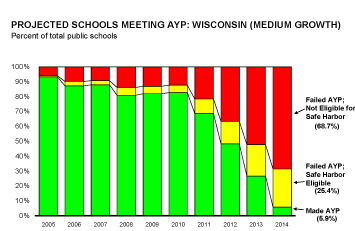
From “The Impact of the Adequate Yearly Progress Requirement of the Federal No Child Left Behind Act on the Great Lakes Region,” a study released by the Great Lakes Center for Educational Research and the Education Policy Studies Laboratory at Arizona State University.

From “The Impact of the Adequate Yearly Progress Requirement of. the Federal “No Child Left Behind” Act on Schools in the Great Lakes Region,” a study released by the Great Lakes Center for Educational Research and the Education Policy Studies Laboratory at Arizona State University.  See also “Many States Have Taken a “Backloaded” Approach to No Child Left Behind Goal of All Students Scoring ‘Proficient'” from the Center on Education Policy.

On June 24, The Department of Public Instruction will release the preliminary Adequate Yearly Progress Reports on schools and districts in Wisconsin, as required by the No Child Left Behind Act. My guess is that MMSD will have a higher number of “failing schools” this year. Think of Madison as being “ahead of the curve.”

AYP is not the best gauge of the work our district is doing; NCLB isn’t a good law and AYP is ridiculous yardstick.

If the flaws in and political manipulation behind NCLB weren’t obvious already, an interview with former Assistant Secretary for Elementary and Secondary Education Susan Neuman in the new Time magazine confirms what we already knew. Excerpts below.

There was always something slightly insane about No Child Left Behind (NCLB), the ambitious education law often described as the Bush Administration’s signature domestic achievement. For one thing, in the view of many educators, the law’s 2014 goal — which calls for all public school students in grades 4 through 8 to be achieving on grade level in reading and math — is something no educational system anywhere on earth has ever accomplished. Even more unrealistic: every kid (except for 3% with serious handicaps or other issues) is supposed to be achieving on grade level every year, climbing in lockstep up an ever more challenging ladder. This flies in the face of all sorts of research showing that children start off in different places academically and grow at different rates.

Add to the mix the fact that much of the promised funding failed to materialize and many early critics insisted that No Child Left Behind was nothing more than a cynical plan to destroy American faith in public education and open the way to vouchers and school choice.

Now a former official in Bush’s Education department is giving at least some support to that notion…

[T]here were others in the department, according to Neuman, who saw NCLB as a Trojan horse for the choice agenda — a way to expose the failure of public education and “blow it up a bit,” she says. “There were a number of people pushing hard for market forces and privatization.”

Neuman also regrets the Administration’s use of humiliation and shame as a lever for school reform. Failure to meet NCLB’s inflexible goals meant schools would be publicly labeled as failures. Neuman now sees this as a mistake: “Vilifying teachers and saying we are going to shame them was not the right approach.”

The combination of inflexibility and public humiliation for those not meeting federal goals ignited so much frustration among educators that NCLB now appears to be an irreparably damaged brand. “The problems lingered long enough and there’s so much anger that it may not be fixable,” says Neuman. While the American Federation of Teachers was once on board with the NCLB goals, she notes, the union has turned against it. “Teachers hate NCLB because they feel like they’ve been picked on.”

Is there a way out of the mess? Neuman still supports school accountability and the much-maligned annual tests mandated by the law. But she now believes that the nation has to look beyond the schoolroom, if it wishes to leave no child behind. Along with 59 other top educators, policymakers and health officials, she’s put her name to a nonpartisan document to be released on Tuesday by the Economic Policy Institute, a Washington think tank. Titled “A Broader, Bolder Approach to Education,” it lays out an expansive vision for leveling the playing field for low-income kids, one that looks toward new policies on child health and support for parents and communities. Neuman says that money she’s seen wasted on current programs should be reallocated accordingly. “Pinning all our hopes on schools will never change the odds for kids.”

The right wing attack machine turned on Scott McClellan when he belatedly told the truth. We can expect the same treatment for Neuman.

Thomas J. Mertz

1 Comment

Filed under Accountability, AMPS, Best Practices, education, finance, Gimme Some Truth, Local News, National News, nclb, No Child Left Behind, Uncategorized

Gender inequality and the math gap

A very interesting study appearing last week in the journal “Science” relied on a test from the Programme for International Student Assessment (PISA). It assessed over 275,000 15 year old teenagers in 40 countries. One of the most fascinating conclusions of this study was that, despite the usual reported gap in math and reading scores between boys and girls, the explanation for such a discrepancy could perhaps lie not in biology but instead could have more to do with gender equality. John Timmer from Ars Technica reports:

On average, girls scored about 2 percent lower than boys on math, but nearly 7 percent higher on reading, consistent with previous test results.

The researchers, noted, however, that the math gap wasn’t consistent between countries. For example, it was nearly twice as large as the average in Turkey, while Icelandic girls outscored males by roughly 2 percent. The general pattern of these differences suggested to the authors that the performance differences correlated with the status of women. The authors of the study built a composite score that reflected the gender equality of the countries based on the World Economic Forum’s Gender Gap Index, data extracted from the World Values Surveys, measures of female political participation, and measures of the economic significance of females.

Scandinavian countries such as Norway and Sweden score very high on gender equality measures; in these nations, the gender gap on math performance is extremely small. In contrast, nations at the other end of the spectrum, such as Turkey and Korea, had the largest gender gap. The correlations between gender equality and math scores held up under a statistical test designed to catch spurious associations. The authors even checked out the possibility of genetic effects not linked to the Y chromosome by examining whether genetic similarity between various European populations could account for these differences, but they found that it could not.

The frightening thing, from a male perspective, is that a lack of gender equality also seems to be holding down girls’ reading scores. Female superiority in reading tests is slightly lower than average in Turkey, but the gap is actually wider in countries with greater equality between the sexes. In Iceland, for example, girls outscore boys by well over 10 percent.

The math gender gap thus joins a long list of differences in test scores that were once ascribed to biology, but now appear to be caused by social influences. The study, however, leaves us with yet another question of this sort: why do boys appear to read so poorly? We clearly can’t ascribe it to social inequality, but that doesn’t mean it isn’t due to some other social factor.

Robert Godfrey

Leave a comment

Filed under AMPS, Gimme Some Truth, National News

Quote of the day

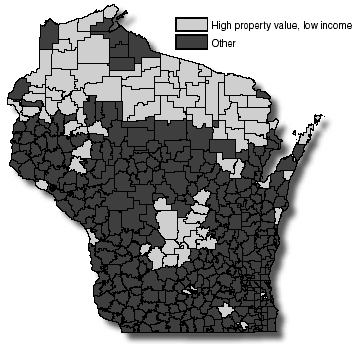
Map from the Wisconsin Atlas of School Finance, by Jack Norman, a publication of the Institute for Wisconsin’s Future.

“I have been on the school board for ten years and we have had to make cuts eight of those years. We are looking at the destruction of education in Northern Wisconsin. What I would like to see is the media saying it’s a problem,” said [Rhinelander School District] school board president Chuck Fitzgerald.

Quoted in the Rhinelander Daily News.

An April 2008 referendum in Rhinelander was defeated by about 3,000 votes. The last referendum to pass in the district was in 1998.

It isn’t just in Northern Wisconsin or Madison where our once great public schools are being destroyed, it is throughout the state. Let’s “Get-er Done” and fix the state school finance system.

Thomas J. Mertz

Leave a comment

Filed under "education finance", AMPS, Budget, education, Equity, finance, Gimme Some Truth, Referenda, School Finance, We Are Not Alone