Category Archives: Gimme Some Truth

Madison Prep and the Attack on Public Education

Mission Of Burma – “Academy Fight Song” (click to listen or download).

[Note;  This post is adapted from an article I wrote over a week ago for the Progressive Dane Newsletter (as of this writing PD has not taken  a position on the Madison Prep proposal).  I’ve only changed minimally for posting here;  one thing I have added is some hyperlinks (but I did not link as thoroughly as I usually do), another is a small  “For Further Reading” set of links at the end,”  and of course the song.  This is intended to be  a broad overview and introduction to what I think are some of the most important issues concerning the decision on the Madison Preparatory Academy presented in the context of related national issues.  Issues raised in this post have been and will be treated in more depth  — and with hyperlinks —  in other posts]

For decades free market advocates such as the Bradley Foundation, the Walton Foundation and the Koch brothers have a waged a multi-front campaign against the public sector and the idea of the common good.  Public education has been one of the key battlegrounds.  In the coming weeks the Madison Metropolitan School District Board of Education will decide whether to approve a proposal for the Madison Prep Charter School.  This proposal and the chief advocate for it – Kaleem Caire of the Urban League of Greater Madison – have their roots in the Bradley/Walton/Koch movement, and like much of that movement they offer false promises of educational progress in order to obscure the damage being done to every child in our public schools.

A Public Hearing on the Madison Prep proposal has been scheduled for Monday October 3, at 6:00 PM in the Doyle Building Auditorium;  The Madison Prep proposal is on the agenda of the PD General Membership Meeting  (Wed , 9/28 , 6:00 p.m, Hawthorne Branch Library, guests welcome).

The campaign to undermine public education, nationally and in Madison, has been very sophisticated politically and simplistic educationally.  Caire and other “choice” advocates zero in on the failings of public schools, while dismissing the successes or often even the possibility of success within a public school context.  This attention to the failings of public schools, especially for poor and minority students, is welcome.  However instead supporting the difficult and uncertain work of finding ways to expand educational opportunities and improve attainment for those being left behind, the self-proclaimed “reformers” offer only unfounded market-based panaceas.

This not only ignores the essential educational work that is needed, it obscures the growing inequalities of wealth and power that are at the core of many of educational struggles.

Madison Prep is a classic case.  The proposals (there have been multiple versions) and the extensive media campaign have centered on a narrative based on selected statistics illustrating gaps in achievement between African American (and to a lesser extent Hispanic) males and other students.  No attempt is made to locate the sources of those gaps, no attention is given to student-related factors such as poverty (Madison Prep advocates prefer to talk about race, not poverty) or mobility (in 2009 173 of the 435 African American 10th graders were in their first year at the school they attended); or to school-based factors such as curriculum, pedagogy, grouping practices, class-size, resource allocations….Instead the one and only “solution” offered is the ill-conceived Madison Prep Charter School.

A big part of this campaign has been directed at unionized public school teachers who are blamed for all the ills of schools.  Charters like Madison Prep promise to address these ills by stripping teachers of their rights and job security, forcing them to work longer hours for less pay and fewer benefits, while expanding administrative supervision via a top heavy structure peopled by multiple well compensated  administrators, a “President” and a “Head of School” and a “Development Director.”  The transfer of wealth and power of the market based economy is mirrored in the structure of the school.

The Madison Prep educational plan itself is an incoherent and contradictory mélange of trendy and unproven elements.  Some of what is being proposed is promising (intensive tutoring, perhaps longer school days and years), some of it educationally empty (uniforms), and some of it likely damaging to creativity and authentic learning (the militaristic discipline of the “No Excuses” models).  None of the elements in-and-of themselves have been shown to make a significant impact on academic achievement and because of the contradictions there is a good chance that the whole will be less than the sum of the parts.

One model being held up by the Madison Prep advocates is the “No Excuses” disciplinary approach of schools such as Chicago’s Urban Prep and the KIPP chain.  These schools often have high attrition rates and/or test scores appreciably lower than schools serving similar students (despite spending more per student, requiring a longer school day and serving a less impoverished population in comparison to the Chicago Public Schools as a whole, on the most recent tests only 11% of Urban Prep’s 11th graders met state standards in mathematics, well below the – still unacceptable – 29% for CPS).  Serious abusive disciplinary practices have characterized some KIPP schools and when these have come to light, because of their Charter status local Boards of Education have been frustrated in their efforts to intervene (some would say the entire KIPP model is abusive and these are not anomalies, but simply “No Excuse” taken to its logical conclusion).

Aligned with the “No Excuses” model is a reactionary and discriminatory call for single-sex education and an implicit rejection of the theory and practice of special education services designed to address the needs of a significant portion of our students.  The initial exclusion of young women from Madison Prep has been addressed, but the issues concerning potential discrimination against gay and transgender students have not been part of the discussion thus far and the outdated models of masculinity and femininity reinforced by this version of single sex education have not been examined.  Like all Charter Schools, Madison Prep will be required to admit special education students, but the “No Excuses” model is antithetical to the best practices in this area.

Madison Prep also promises to offer the rigorous International Baccalaureate (IB) program and employ the “Harkness Method”of Phillip Exeter Academy to cultivate creative thinking and collaborative learning.  As attractive as these are in theory, they hold little promise as a means of addressing the needs of those students featured in the Madison Prep media blitz and call for practices that are at the opposite end of the pedagogical spectrum from the KIPP model.

The presence of IB and the “Harkness Method” in the proposal also highlights an important disconnect between the problem identified — MMSD is failing minority students and the solution offered – a Charter School.  By law, Charter Schools cannot discriminate in admissions (on the basis of race, poverty, academic achievement, or anything else).  Madison Prep cannot target those who are failing/being failed.  IB and Harkness style teaching will likely be very attractive to the families of students who are thriving in MMSD, the top 10%, meaning that if this proposal goes through the majority of the applications may come from students who are about as far from those featured in the sales pitch as possible.

In contrast, the school district and district schools can and do target programs and services to students who are failing and being failed.  That the district needs to be doing more of this and a better job of it is beyond question, but the expense of the Madison Prep proposal will force cuts to all district programs and services, including these.

According to the latest figures available, the five-year cost of Madison Prep will be about $27,000,000 and the cost per student  to the district will be about $15,000 (MMSD’s marginal cost per student is a little below $11,000).  The district will experience some savings because students in Madison Prep will mean fewer students in district schools, but because of the distributed nature educational budgeting, these savings – mostly in the form of fewer teachers – will be minimal (about $500,000 annually) and also come at the cost of more limited course and schedule choices in district schools. Estimates are that the funding Madison Prep for the hundreds of students who will enroll will require cutting an additional $1.5 and $2 million annually from the programs and services that serve 24,000 district students, 12,000 of whom live in poverty.

This will of course make it harder, if not impossible for the public schools to meet the needs of the students in their charge by offering the opportunities to learn they deserve, which will further undermine support for public schools and make market-based solutions and privatization appear superficially more attractive.  This vicious cycle is exactly what the Bradleys, the Waltons and the Kochs want.  Show up at the hearing or write the Board of Education (board@madison.k12.wi.us😉 and let them know that you don’t want this happening in Madison

Thomas J. Mertz

Chair, Progressive Dane Education Task Force

For Further Reading:

Kevin G. Welner, “Free Market Think Tanks and the Marketing of Education Policy.”

Diane Ravitch, “The Myth of Charter School.”

David Sirota,  “The bait and switch of school ‘reform.”

Don Whittinghill, “ Following the Charter Dollars.”

4 Comments

Filed under Accountability, Best Practices, Budget, education, Equity, finance, Gimme Some Truth, Local News, National News, School Finance, Take Action, We Are Not Alone

Is it “all about the kids” (and what that might mean)? — Take Two (in relation to ULGM and Madison Prep)

Note: This image is not from either of the films mentioned, but from another charter school lottery. For reasons that should be clear from the post, I selected a picture where the indiividuals are difficult to identify.

Frankie Beverly & Maze, “Joy and Pain” (click to listen or download)

This is Take Two in a series.  Take One, with a fuller introduction,  can be found here.   Briefly, the idea of the series is to counter anti-teacher and anti-teachers’ union individuals and “reform” groups appropriation of the phrase “it is all about the kids”  as a means to heap scorn and ridicule on public education and public education employees by investigating some of the actions of these individuals and groups  in light of the question “is it all about the kids?”  In each take, national developments are linked to local matters in relation to the Madison Prep charter school proposal.

Take Two: A Picture is Worth A Thousand Words: Public Lotteries and  the Exploitation of Families and Children

The narrative arcs of the highly publicized films The Lottery and Waiting for Superman similarly follow families as they seek admission to charter schools via lotteries.  Both films paint  a picture of public schools as failures and present charter schools as the only means for the families to access quality education.   The words “desperate” and “desperation” are used frequently in reviews to describe the families’ desire to escape public schools (more here and here and here and here…that’s enough).  They are very effective propaganda.

Rick Ayers called Waiting for Superman “a slick marketing piece full of half-truths and distortions.” In a review for the National Education Policy Center’s always wonderful Think Twice” project, William Tate wrote of The Lottery

Unfortunately, in terms of substantiating its narrative argument, The Lottery is at times more like another game of chance—three-card monte—in that it relies far too much on skillful sleight of hand and misdirection. While there is much that is very real and poignant about this film, it fundamentally misdirects viewers away from the actual evidence about the results achieved by charter schools.

A large part of this misdirection is achieved by placing real families and children at the center of the films, by putting human faces on the complex issues of education and using their stories to make things appear simple.  The families plights are employed  in the service of advancing the cause of market-based educational “choice” policies.   The whole enterprise is exploitive, but some aspects are worse than others.

The iconic images of both films are the contrasting  joy and pain of the respective lottery winners and losers; the smiles and hugs contrasted with the tears and hugs.    Among the things kept hidden in the films is the extensive and expensive marketing campaign that produced those images.   Juan Gonzalez reported:

In the two-year period between July 2007 and June 2009, Harlem Success spent $1.3 million to market itself to the Harlem community, the group’s most recent financial filings show.

Of that total, more than $1 million was spent directly on student recruitment. The campaign included posters at bus stops, Internet and radio ads, mass mailings of glossy brochures to tens of thousands of public school parents in upper Manhattan and the Bronx and the hiring of up to 50 community residents part-time to go door-to-door in Harlem soliciting applicants.

All of this was done to fill a mere 900 seats.

I fail to see how spending $1.3 million to market 900 slots can be in the interests of the kids.

But it is the exploitation of the pain and tears that I find most disturbing.  It is the exploitation of the pain and tears that makes me question if it is “all about the kids” because I can see no way that the cause of those particular lottery-losing families quest for a quality education is served by having their moments of disappointment made a public spectacle.

I’m sure choice advocates would argue that the larger cause is being advanced and that in the name of that cause some sacrifices must be made.  As I detailed in a previous post, the idea of the larger cause of “school choice” being worthy of such a sacrifice in the name of “the kids” does  not stand up to scrutiny.  In the aggregate, neither those who enroll in “choice schools” nor those who remain in public schools have experienced a net benefit from this government-funded free-market experiment.   Exploiting some families for the benefit of other families is bad enough, exploiting them for purely ideological reasons is indefensible.

Indefensible, but common.  A search of news sites reveals countless media events staged around charter school lotteries and each one features a mini-version of the Lottery and Waiting for Superman narrative: desperate families, exultant  winners, and defeated losers.  In each case the take away is that — despite all evidence to the contrary — attending public schools instead of a charter school dooms children to brutal and hopeless future.  With each media event that narrative becomes stronger and the evidence recedes more from the public consciousness.  The kids, like everyone else, would be best served by full and honest portrayals of educational options.

Of course that’s not the idea.  The  Walton, Gates, Joyce and Casey Foundation funded National Association of Public Charter Schools publishes a “Lottery Day Event Tool Kit.”  According to the kit:

This event presents a wonderful opportunity to:
• draw media attention to the demand for high-quality charters,
• grow awareness among families of the availability of quality schools of choice, and
• create an opportunity for charters to communicate their quality and
success.

All about the kids?   The most extensive section of kit concerns attracting and communicating with the media.  The families of applicants are treated as little more than props.  In fairness, the kit does suggest that school officials:

Write thank-you notes to parents and students who were not selected. You appreciate the time and effort and know they are disappointed. You are disappointed too, hope that they will apply again, and wish them the very best.

I like the “apply again.”  The media event will need  props again next year.

It isn’t surprising that Madison Prep is planning on following this script.   In response to questions from the Madison Metropolitan School District on admissions , the Urban League of Greater Madison wrote:

If the school receives more than 45 enrollment forms for either grade level in the first year, or enrollment forms exceed the seats available in subsequent years, Madison Prep will hold a public random lottery at a location that provides enough space for applicant students and families. (emphasis added)

What possible good would a public lottery do the winners?  Has anyone considered the harm a public lottery could do the losers?

This lack of attention given to vulnerable lottery losers stands in contrast to the supposed concern the Urban League paid to the confidentiality of parents in their recent “no media (except those friendly to Madison Prep)”  media event.  Here is how Madison.Com reported Urban League CEO Kaleem Caire’s reasoning prior to the meeting:

“This is about the parents first,” he said. “Oftentimes we don’t put them first. And we have to do that this time.

I guess after losing a lottery isn’t one of the times you “have to” put parents or children first.

By-the way,  I’m still waiting for the promised joint statement from Superintendent Dan Nerad and Kaleem Caire “about the meeting.”  If it ever comes (don’t hold your breathe), maybe that will help me understand.   I’m sure that in some fashion they will say “it is all about the kids.”  Forgive me if I don’t believe them.

For further reading (in addition to things linked in the text):

Diane Ravitch, “The Myth of Charter School.”

Michelle Fine, “Memo from Lois Lane” on the Not Waiting for Superman site.

Liana Heitin, “What About the ‘Lottery’ Losers?”

Kevin Drum, “Winners and Losers in the Charter School Lottery.”

Alan Gottlieb, “Life Lottery.”

Thomas J. Mertz

2 Comments

Filed under Accountability, Best Practices, education, Equity, Gimme Some Truth, Local News, National News, Uncategorized, We Are Not Alone

Is it “all about the kids” (and what that might mean)? — Take One (in relation to ULGM and Madison Prep)

Sir Mack Rice “Money Talks” (click to listen or download)

My training as a historian has taught me that all knowledge is tentative and that this is especially true when it comes to assigning motives to people’s actions.  It has also taught me to not accept self-proclaimed motives at face value , to only state an opinion  about the motives of others when there is a preponderance of evidence,  and to look  at actions and consequences as well as  rhetoric when trying to make sense of things.

With those caveats,  I think it is worthwhile to investigate the motives, actions and the consequences of the actions of Kaleem Caire and some of others associated with the Madison Prep proposal and the Urban League of Greater Madison in relation to public education.

Enemies of teachers and teacher unions have seized upon the phrase “it is all about the kids” to ridicule and attack teachers and their representatives.   With union and (almost all) others, of course it isn’t “all about the kids.”  Interestingly, those who blame unions for some or all of the ills of public education — like many of  the proponents  of Madison Prep — often offer their own versions of “it is all about the kids.”  Examples include  Michelle Rhee who named her group Students First (Valarie Strauss pointedly offered a column on Rhee’s organization titled “Rhee’s campaign is not about the kids.”) and the anti-Union political bribery has been done  in Illinois (and elsewhere) under the banner of Stand for Children ( a must-see video here).

This is the first of a series of three “takes,” distinct but related investigations of what else besides concern for “the kids” might be fueling the Madison Prep effort and some thoughts about how a sincere effort largely or even exclusively on behalf of “the kids” can lead to consequences (intended or unintended or both) that many of us see as very harmful to “the kids.”

Take One:  Why did the Walton Family Foundation spend  $157 million last year on “education reform” (and almost as much in previous years) and how this relates to Madison Prep?

The Washington Post reported that in 2010 The Walton Family Foundation gave grants totaling over $157 million to what they deemed “education” reform efforts.  The entire list is here, and you can see the previous years here.  Under “Shaping Public Policy,” you can find such groups as the Barry Goldwater Institute for Public Policy Research; the National Right to Work Legal Defense & Education Foundation;  Wisconsin’s own Right Wing Press Release machine the John K. Maclver Institute for Public Policy, Inc.; and Kaleem Caire’s former employers the Black Alliance for Educational Options (BAEO).

The Walton Foundation describes its educational policy work and goals in this manner:

For parents to be empowered to choose among high-performing schools, local and state public policy must allow for those choices to exist. To this end, we seek to build the capacity of organizations to help enact, strengthen and protect programs that empower parents to choose high-performing schools.

Investment Strategies

Within our Shape Public Policy initiative, we focus on advocacy groups promoting:

  • Public charter school choice;
  • Private school choice;
  • District reforms, particularly open enrollment and district school choice; and
  • Cross-sector parental choice, parents are empowered to choose across school.

Note that the ability “to choose” is the goal, not universal access.   I want to return to this in the context of their relationship to Kaleem Caire  and Madison Prep, but first I want to say that there is a preponderance of evidence that the Waltons’ motives have very little to do “high powered schools” or education (especially the kind of education that makes people ask questions about the doings of people like the Waltons) and everything to do with destroying the public sector.  The same can be said to a great degree about many of the other supporters of Caire’s work, with some overtly racist and segregationist dimensions for at least the Bradley Foundation, who funded The Bell Curve and the Kochs who have been active in the re-segregation of Wake County NC schools (watch this powerful video, appropriately titled ” Why do the Koch brothers want to end public education? “).

As I was working on this Bill Lueders of the Wisconsin Center for Investigative Journalism released the first of his three part series on the Walton’s and other choice advocates’ activities in Wisconsin,  This saves me a lot of trouble preponding the evidence.  In part one you can read about the  tens of thousands of dollars in direct contributions to candidates, the uncounted indirect contributions via front groups,  the ties among individuals like the Waltons and Betsy and Dick DeVos and organizations such as the American Federation for Children and the Alliance for School Choice.    Not mentioned in part one of the Lueders piece is the relationships to American Legislative Exchange Council, another beneficiary of the Walton largesses and one that gets us closer to their public sector destroying mission.  You can also get a glimpse at some of the Walton’s federal activities via Open Secrets, here.

David Sirota’s “The bait and switch of school ‘reform“” brings it back to covers more of this, including the direct profit motive and the alliance of conservative and “neo-liberal” actors.  “Following the Charter Dollars” by Don Whittinghill of the Louisiana School Boards Association is also a must read (for those who want more on Louisiana, “NOLA Public Schools & School Privatization Part 1: Selected Bibliography of Articles, Books, Studies and Informed Opinions–2011 to 10/2010” is a good place to start; for the conservative movement ad the role of “think tanks” in general, this bibliography from the Commonweal Institute \\is very useful..

All these add to evidence that with the schools as well as in the workplace and for working parents, in the electoral arena,  in tax policy, on the environment and with so much more, The Waltons and there free market friends have interests that are very different than the well being of America’s children and very much geared toward weakening, undermining and destroying the good of the public sector.

Still, in a strange way if you believe that the entire American experiment in universal common schooling has been an irredeemable failure, public sector destroying may circle back to the quest for quality education .

I don’t believe that.  I’ve put in countless volunteer hours working for change and improvement in public education, but I’m more of a believer in the “Conservationist Ethic in Education”  and although it is often frustrating, Tinkering Toward Utopia has more appeal to me in public education than creative destruction, especially when the worth of what is being created in the wreckage is questionable at best.

For now though, let’s leave speculation about motives aside, take  them at their word  and assume that this is all or nearly all about the kids  and look at how that has worked out.  In essence that’s what Kaleem Caire has done and what he he is now asking the Board of Education and the taxpayers of Madison to do;  to follow the path prescribed by the Waltons and their ilk and see how it works out for the kids.

For the last decade  Kaleem Caire’s work has been funded by people like the Waltons and the Bradley Foundation, the (Milton) Friedman  Foundation and even the Koch Brothers.   It wasn’t always that way.  When he ran for the Board of Education in 1998 (the first Madison School Board campaign I was part of), the Capital Times reported

If elected, Caire says he will lead the fight against the ”very elitist conservatives who are trying to basically break the back of public education.”

Then he began working with or for these people.  Now he dismisses any objections to these alliances, as in the recent Wisconsin State Journal story:

“On the issue of vouchers, we agreed,” he said of his conservative benefactors. “On other things, we didn’t. I don’t listen to the guilt-by-association crap.”

He pointed out that other funders included the Bill and Melinda Gates Foundation and the Joyce Foundation, considered more left-leaning politically.

First and as an aside, very, very few people in ed policy consider the recent work done by the Gates Foundation (or to a lesser extent the Joyce Foundation) to be “left-leaning.”  They are more right-center  in a landscape that has been shifting steadily to the right.

Second, I don’t think “guilt-by-association” is “crap.”

I understand building coalitions and working with people you might otherwise disagree with toward a common goal, but you do have to choose your comrades and I think there should be some limits on who you are willing to associate with.  Maybe that’s just me.

One reason for limits is that there is a danger of being used, of having the distinct agenda of one party to the deal advanced to a much greater degree than your common goals.   It has become common for conservatives and corporate America to use Civil Rights organizations and minorities to help advance their agendas.  It is no accident that Linda Chavez is the face of the (also Bradley Foundation backed) Center for Equal Opportunity, and their attack on affirmative action and bilingual education at UW and elsewhere.  Just this week there was a story about the Congress on Racial Equality opposing Green Jobs at the behest of their funder ExxonSupporters of the AT&T/T-Mobile merger include the NAACP, the Gay & Lesbian Alliance Against Defamation, (yes, unions are not immune) the National Education AssociationThe national Urban League supports too.  All of these organizations have benefited from generous donations from the telecom behemoth.

I remember Caire’s mentor Howard Fuller saying “we use them, they use us,” but this seems to set the two parties up as equals in the exchange and we all know that one side has millions or billions of dollars at their disposal, while the other brings to the table little more than their energy and ability to complicate the racial politics.

So to see if the deal has been a good one, we have to return to “the kids.”  The Walton’s posit expanded choice as an end of itself;  Kaleem Caire has presented choice as a means to an end, the end being access to quality education and improved educational outcomes.  There is no question that the Waltons have been successful in expanding choice (and I’d add they have made significant progress in their less transparent goal of destroying public education).   Most of the evidence points to the conclusion that the aggregate impact of expanded choice on access to quality education has been negative.

It needs to be acknowledged that many individual children have benefited from expanded choice via vouchers and charters, but when the “greatest good for the greatest number” metric is employed, “choice” is found wanting, as is the Madison Prep proposal.

The latest study of the Milwaukee voucher program y by the Walton-funded University of Arkansas’ School Choice Demonstration Project concluded that in terms of academic achievement of students enrolled in private schools at taxpayer expense do on average no better than similar students  enrolled in MPS schools.   The mandated report from the Legislative Audit Bureau echoed this finding.  Less sophisticated readings of Department of Public Instruction data reveals that voucher students did worse on the WKCE than MPS students; this is true even if the comparison is confined to those eligible for free and reduced lunch.

Voucher proponents interested in student outcomes (no just choice for choice sake) have been reduced to pointing to superior graduation rates (a very questionable measure given the autonomy private schools have in this area) and making a convoluted case that the competition from vouchers has improved public schools.  The latter is both the first and last refuge of the free market reformers.  Their prime directive is that the competition of the market always produces progress.  It is also in the words of sometime Caire collaborator Jay P. Green of the Arkansas Project a win/win assertion for them.  Had the voucher schools performed better this would be evidence of success, but since they did not, the failure of privatization is redeemed by the success in the public sector, success that is said to depend o the presence of the failed private sector.   That’s the political/ideological analysis; more scholarly critiques, rejoinders  and dissents from the conclusions of the Arkansas Project and related “research”  check  the publications of the always worthwhile  National Education Policy Center Think Tank Review Project (and here), as well as Vouchers and Public School Performance: A Case Study of the Milwaukee Parental Choice Program  from the Economic Policy Institute.

The gold standard research on charter school choice is  the 2009 “Multiple choice: Charter performance in 16 states” publication from the The Center for Research on Education Outcomes at Stanford.   Here is their summary of the findings.

The study reveals that a decent fraction of charter schools, 17 percent, provide superior education opportunities for their students. Nearly half of the charter schools nationwide have results that are no different from the local public school options and over a third, 37 percent, deliver learning results that are significantly worse than their student would have realized had they remained in traditional public schools.

17% better, 46% about the same and 37% “significantly worse.”  Choice does not appear to have worked out very well for those who choose charter schools.

I’m not sure there is a rigorous way to assess the impact of “choice”  (charter and voucher), on the public schools.  Too much variation by state and local, too many variables all over and there are some things that I think are important that are difficult or impossible to quantify.  I do want to point to two things that should be part of the equation: money and the ill-defined nexus of support, energy, faith….

In terms of public money, things vary greatly by state, local and to some degree with each individual school.  We can safely say that in recent years federal policies have used federal funding to encourage and support charter schools and that this funding comes from an inadequate pool of total federal education dollars.   At the state level, funding mechanisms and comparative funding for public, charter and voucher-type schools vary widely and one must also consider who attends and the relative costs of educating different students (this is especially important with high needs special education students, who rarely enroll in choice schools).   In some locales and with vouchers in general the public “choice”  outlay per student is lower than the public school outlay; in others it is about the same or higher.  “Choice” proponents see the lower outlays as evidence of savings; opponents point to the how the loss of small number of students from any given school or grade rarely creates opportunities for savings via staff, facilities or program reductions (if you want to offer a class in Mandarin,  the cost will be about the same whether 15 or 25 students are enrolled) and see any diversion of funds as a problem.  I lean very much in the direction of the opponents.   One thing that is very clear is that a whole lot  of private money which could be invested in public schools is going to sell and support school choice.

In the case of Madison Prep, the money piece is clear and bad.  Ed Hughes has all the gory details based on the latest information (as far as I can tell — and I have asked — there is no final proposal or budget, but this link goes to a very basic budget document that came with the announcement of the second proposed school for young women).  The cost per pupil is about $15,000 in comparison to MMSD’s marginal cost per pupil of a little over $10,000 the payments to Madison Prep over five years would total over $27,000,000 and according to Ed Hughes’ calculations funding Madison Prep for hundreds of students will require annual cuts to the programs and services that serve the 24,000 students (12,000 in poverty) in MMSD.  Hughes works out the numbers in detail for “year four” and comes up with a $1.5 million estimate for that year’s Madison Prep related cut to the district budget.

Keep in mind that like all charter schools in Wisconsin, Madison Prep cannot selectively enroll based on race, poverty or academic success, so we really have no idea who these extra resources may go too.    In contrast, the district — if they have the resources — can and does target programs and services and allocations  based on a variety of factors.  I’ve advocated for the district to do this more extensively, more systematically and better.  Approving Madison Prep will further strain targeted programing and make equity based allocations harder and less likely.  Any way you look at the finances, the proposal almost certainly fails the greatest good for the greatest number test.  If it is about the kids, it is only about some of the kids, because most of the kids will see decreased investments in their futures.

I think the intangible aspects of “choice’s” and “choice” advocacy’s impact on public schools, what I called “support, energy, faith….” may be more important than the money.   I written before about the damage done by the self-fulfilling prophesy of looking to charter schools for innovation and creativity.  The big picture harm done by undermining support for public schools is touched on above (and indirectly in this post).   These are important, but I want to focus on something more immediate, the relationships between families and their schools.

An inevitable and often deliberate tactic of choice advocates is to play to and build on feelings of alienation and distrust families feel toward their schools.  The implicit and sometimes explicit messages are “you can trust us, you can’t trust them; we care, they don’t care; we know how to help your child; they don’t know how to help your child.”  A little distrust is healthy and probably justified, as is some skepticism about educational prowess.

However, when this goes too far (as it frequently does)  it strains and may break the family/school ties  of collaboration that are essential to success.   Even if  Madison Prep is approved many, many more struggling students will remain in district schools and these students need the combined and cooperative efforts of their families and the the schools.  If it is about the kids, this has to be taken into consideration.  Unfortunately, I fear that both in Madison and nationally much damage has already been done.

Pulling back a little (and circling back to innovation and creativity),  this cultivation of distrust also, further discourages dissatisfied parents and community members from getting involved in school and district issues, from demanding a seat at the table to fight for their vision of educational improvement.    In terms of helping the kids, there is much good that could be accomplished by having more diverse and dissatisfied  people working for district-wide improvement.

If there are a big take-aways or conclusions from all of this  they are 1. If access to quality educational opportunities and improved educational outcomes are the goal, if defined in this way “choice” advocacy is “all about the kids,” then it has not been a success; 2. “Choice” advocacy has been successful in damaging support for public schools; and 3.  Following the “choice” path laid out be the supporters of Madison Prep may help some, but would have a net negative impact on “the kids” of the district, who this is supposed to be all about.

I’m going to stop there (unless I go back and edit).  Kind of long for “take one.’  “Take two” will be much shorter, I promise (it is)

Note: A Public Hearing on the Madison Prep proposal has been scheduled for Monday October 3, at 6:00 PM in the Doyle Building Auditorium;

Thomas J. Mertz.
1 Comment

Filed under "education finance", Arne Duncan, Best Practices, Budget, Contracts, education, Equity, finance, Gimme Some Truth, Local News, National News, nclb, No Child Left Behind, Take Action, Uncategorized

How to Destroy Public Education — Lesson One

The Soft Boys – “I Wanna Destroy You” (click to listen or download)

One of the tactics employed by the  enemies of public education is to undermine confidence in our schools in order to weaken financial and other support and induce parents to look for non public options.  Some do this by pointing to real failures — like the achievement gaps between minority/non minority and poor/non poor students – and offering simplistic free market solutions (more on this approach in relation to the Madison Prep proposal very soon in a couple of posts I’m working on — #1 is done and up).

The Bradley, Gates, Walton….funded Fordham Institute puts a new twist on this strategy.  In a new report and the accompanying press materials they attempt to create a panic around research showing that our schools are doing exactly what they should be doing.

The report is called “Do High Flyers Maintain Their Altitude? Performance Trends of Top Students.”   The target audience is parents of high achieving students and policy makers obsessed with misapprehensions about global competitiveness.  The ostensible cause for panic is that over time students move in and out of the top decile on MAP tests; that some percentage of students who were near the top in 4th grade are not so near the top in later grades.  They don’t give much attention to the other part of this, that our schools take some kids from the lower percentiles and help them move to the top.  And although their sample  — not matched to the norm that defines the top 10%  — shows a net increase of “High Flyers,” they find a way to spin the data as a sign of failure (note that the miss-match between the sample and the norm group means that more than 10% of the students may be in the top 10%, but among the total universe of test takers and with real scores, 10% means 10% and there is no way that everyone can be in the top 10%, even in Lake Woebegon or Madison).

From the Press Release:

“If America is to remain internationally competitive, secure and prosperous,” said Chester E. Finn, Jr., Fordham’s president, “we need to maximize the potential of all our children, including those at the top of the class. Today’s policy debate largely ignores this ‘talented tenth.’ This study shows that we’re paying a heavy price for that neglect, as so many of our high flyers drift downward over the course of their academic careers.”

There is another subtext here of pitting the parents of mostly white and economically secure successful students against poor and minority families who tend to make up fewer of the top 10%.  With no apparent irony, above and  elsewhere they even borrow WEB DuBois phrase the “Talented Tenth” in the service of this divide and conquer maneuver:

The study raises troubling questions: Is our obsession with closing achievement gaps and “leaving no child behind” coming at the expense of our “talented tenth”—and America’s future international competitiveness?

No irony; no shame.

One more thing is that the assumption behind the spin is that mobility is bad and reproducing inequality is good.  In fact, that assumption is in one way or another behind their entire campaign against the public sector and the idea of the common good.

One last note:  The report itself has some very interesting and worthwhile data and analysis on achievement mobility, growth across the deciles, demographics in relation to these.  Skip the ideology and it is worth reading.

Thomas J. Mertz

6 Comments

Filed under Best Practices, education, Equity, Gimme Some Truth, National News, nclb, No Child Left Behind

Of two minds and no sense in Two Rivers

There is an editorial in the Herald Times Reporter on the Two Rivers school budget that presents contradictory ideas and ultimately makes no sense.  If you dig a little deeper, you’ll find more that doesn’t make sense.

The editorial titled “Two Rivers school budget laudable” is mostly in praise of the Board of Education for acting on their commitment ” to not raising taxes.”  To do this the Board “cut about $2 million from its $23.7 million budget.”  According to the editorial (the Two Rivers district does not post budget documents), about half of this amount came from increasing staff insurance and pension payments.  The rest from what the paper calls ” another $1 million in labor and materials savings.”

At least the editorial points out that the FitzWalker “tools” don’t actually work at the district level stating clearly “The budget repair bill provision is not, however, the panacea envisioned by Republican lawmakers.”

At this point I want to point out that nowhere in the editorial are students or the quality of education mentioned.  The closest it gets is a couple of places where providing “adequate services” is mentioned as a goal, each time along with and apparently inferior to ” protecting taxpayers.’  Two  paragraphs on Manitowoc, introduced as another district where the “tools” don’t work, is an example of this :

Other school districts are in the same situation. Manitowoc Superintendent Mark Swanson said recently that the tax levy could rise 9.5 percent under current revenue cap and state-aid formulas. The school board likely will need to take austerity measures, including possible staff reductions, to make sure that projection doesn’t become reality.

Swanson, along with other school and municipal leaders throughout the state, wonders what impact this all will have on their ability to provide the services they are paid to deliver — now and in the future.

The penultimate paragraphs capture the contradictory thinking:

Rhetoric about serving the taxpayer at the least possible cost rings hollow if all the tools to achieve that goal are lacking. Commitment to hold the line on taxes is one thing, getting there is quite another.

We hope that other school districts and cities in Manitowoc County follow the lead of the Two Rivers public schools and make a good-faith effort to hold the line on property taxes.

Note “serving the taxpayer” not serving the students, but even in this formulation the impossibility of quality services under these conditions is apparent.

The editorial closes with more praise for Two Rivers and holds that district up as an example for others to emulate:

Two Rivers has demonstrated it can be done, even against highly challenging odds.

“It” being not raising taxes, apparently.  How did Two Rivers do this?  That’s where things get even more senseless.

Some of the answers can be found in a Herald Times news story:

The contract with the teachers union even includes a provision that taxes would not be increased. He said the teachers agreed to a pay freeze and an increase in the amount they pay toward health insurance premiums if needed to balance the budget without raising taxes, but that didn’t become necessary.

First, what is in the water of those Two Rivers?  Why would a Union — if they could (and even pre-FitzWalker tax rates were not subject to collective bargaining, so I don’t see how it could have happened) — negotiate a tax freeze?  Senseless.

And remember that the editorial said that “About half of that savings resulted from the pension and health benefit requirement,” and this story also refers “teachers having to pay more toward their retirement and health insurance benefits,” so something is hinky or at least confused.  Are they paying more or not?

But the real senselessness is found where this and other articles detail where some of the other$1 million in savings came from:

The board had decided to take $235,310 from its fund balance to help balance the budget without raising taxes.

Depleting fund balances is unsustainable (and not an option all districts have).  Very little sense there.

I’m not sure where the other $700,000 plus came from but a column by District Administrator Randy Fredrikson gives a clue on some of it:

A significant portion of our levy is still paying off the new high school and Koenig Elementary School. We have aggressively refinanced these obligations when time and interest rates permitted. This refinancing has also helped us control the budget over the past several years

In order to achieve significant savings from refinancing you have to have significant debt, something that not all districts have.  Interest rates also have to be lower than the initial rate.  Or you could front load savings like MMSD did in 2009 when they refinanced, in that case (and maybe in Two Rivers), there were some real savings via lower rates, but these were weighted to the initial years and in fact payments increased for some future years.  Whatever is going on, it is not sustainable  — repeatedly refinancing is just kicking the can down the road —  and doesn’t make much sense as something to base a blanket recommendation for budgeting on.

One more piece in another story:

Case Elementary School was sold to St. Peter the Fisherman this past summer. St. Peter the Fisherman had been leasing the facility the past six years.

So I guess other districts should look to sell schools also.  Senseless.

What does make sense would be to make the number one priority and goal finding sustainable  means to invest in giving every child the Opportunities to Learn they need and deserve.

Thomas J. Mertz

Leave a comment

Filed under "education finance", Best Practices, Budget, Contracts, education, finance, Gimme Some Truth, Local News, School Finance, Scott Walker, Uncategorized

DOJ CRS, MMSD, ULGM (and TJ) — Updated

Before a group can enter the open society, it must first close ranks. By this we mean that group solidarity is necessary before a group can operate effectively from a bargaining position of strength in a pluralistic society.

Stokely Carmichael and Charles V. Hamilton, Black Power: The Politics of Liberation in America (1967)

[Updated, scroll down for new, additional links.]

Last night I (TJ) was asked to leave the meeting on African American issues in the Madison Metropolitan School District  (MMSD) advertised as being facilitated by the Department of Justice Community Relations Service (DOJ CRS) and hosted or convened by the Urban League of Greater Madison (ULGM) with the consent and participation of MMSD.  I was told that if I did not leave, the meeting would be canceled.  The reason given was that I write a blog (see here for some background on the exclusion of the media and bloggers and here for Matt DeFour’s report from outside the meeting).

I gave my word that I would not write about the meeting, but that did not alter the request.  I argued that as a parent and as someone who has labored for years to address inequities in public education, I had both a legitimate interest in being there and the potential to contribute to the proceedings.  This was acknowledged and I was still asked to leave and told again that the meeting would not proceed if I did not leave.   I asked to speak to the DOJ CRS representatives in order to confirm that this was the case and this request was repeatedly refused by Kaleem Caire of the ULGM.

I left.

I do not believe that MMSD should have agreed to these conditions.  Absent a formal mediation agreement,   I also do not think that the DOJ CRS should have agreed or imposed these conditions (because of all the secrecy, I don’t know which it was).    I think it is wrong and as Neil Heinen editorialized, ultimately counter productive.

I am not sure that leaving was the right decision, but I did not want to risk creating an impression that I believed my presence was more important than any potential understandings of the issues involving African Americans in MMSD which may have been gained via the meeting.

Prior to leaving I was assured that others who however loosely could be considered members of the media would also be asked to leave and that if they did not the meeting would be canceled.  I have been told that Milele Chikasa Anana, the publisher of Umoja Magazine was in attendance throughout, so this apparently was not the case.

__________

Prior to deciding to (attempt to) attend the meeting, I had been thinking about a lunch I had with Charles V. Hamilton some years ago (that’s why he is quoted at the top).   We talked at length about the theory and practice of pluralism.  I have immense respect for the idea expressed in the quote that all groups —  especially those who have experienced discrimination and disfranchisement — can more effectively advocate for their interests if they first, “close ranks,” find solidarity.   Had that been the purpose of this meeting, I would not have attempted to attend.

This meeting was not about “closing ranks.”  You do not “close ranks” by inviting the DOJ CRS,  MMSD’s leadership (who apparently facilitated)  and members of the public who are not part of the group.  This was something else.  Despite the ban on the media, it was among other things a media event.

__________

Rereading Carmichael and Hamilton I am also reminded that their vision of the functioning of Black Power in the “open society” was revolutionary.  This quote gets at some of that:

But while we endorse the procedure of group solidarity and identity for the purpose of attaining certain goals in the body politic, this does not mean that black people should strive for the same kind of rewards (i.e., end results) obtained by the white society  (italics added).

I bring this up because the the ULGM Madison’s educational program, especially the Madison Prep proposal,  seems to be more about seeking “success” in the terms defined by the dominant power structure than challenging the structure and how success is defined; more of the KIPP “work hard and be nice” version of education than  Paulo Freire’s Pedagogy of the Oppressed.

Others may applaud that choice or disagree with my interpretation, but if you are invoking group identities in the context of education I think this should be part of the conversation.  It is a long and complex conversation involving balancing and also — in a public school context — giving students the knowledge and tools they need to make those choices for themselves and to be effective or “successful” whatever choices they make.   It is also a conversation I don’t have time to continue this morning.

__________

In a related matter, this evening (9/9/2011) the Board of Education is holding  special meetings to consider the revised Madison Prep planning grant application (link to Cap Times story, when I get a copy of the revision, I’ll post a link) .  The open meeting, with public appearances is at 5:30 in the Doyle Building auditorium.   I like open meetings.

__________

Update

Suggested reading:

Brenda Konkel’s thoughts on the exclusion of boggers and media and her suggestion for how things could have been done differently.

Rebecca Kemble’s report from inside the meeting (and more)

Thomas J. Mertz

2 Comments

Filed under Accountability, Best Practices, education, Equity, Gimme Some Truth, Local News

Save Our Schools Rally — Madison, July 30, 2011 — 3:00 PM

The Staple Singers -“Long Walk To D.C” (click to listen or download)

Yes, it is a long walk to D.C. and many of us who care deeply about the future of public education will not be able to join the Save Our Schools mass action there from July 28 to 3o.    Instead, some of us will be rallying in Madison.   Join us and help spread the word (download flier here and press release here).

Wisconsin Public School Advocates to Rally at the Capitol, Saturday July 30, 3:00 PM

A need for national, state, and local action”

As hundreds of thousands of public school supporters gather in Washington DC the weekend of July 28 to 30, 2011, Wisconsin advocates will hold a rally in support of the Save Our Schools agenda at 3:00 PM on Saturday July 30, near the State St. entrance to the Capitol.

“Public schools are under attack. There is a need for national, state, and local action in support of our schools. Wisconsin has been ground zero in this; the Save Our Schools demands from the Guiding Principles provide a great framework to build our state movement and work to expand opportunities to learn” said education activist Thomas J. Mertz.

The Save Our Schools demands are:

  • Equitable funding for all public school communities

  • An end to high stakes testing used for the purpose of student, teacher, and school evaluation

  • Teacher, family and community leadership in forming public education policies

  • Curriculum developed for and by local school communities

Doing more with less doesn’t work. “The time to act is now. While phony debates revolve around debt ceilings, students and teachers across the country are shortchanged. We need real reform, starting with finally fixing the school funding formula, and putting families and communities first. What child and what teacher don’t deserve an excellent school?” said rally organizer Todd Price, former Green Party Candidate for Department of Public Instruction and Professor of Teacher Education National Louis University.

The event will feature speeches from educators, students, parents and officials, as well as opportunities for school advocates from throughout Wisconsin to connect and organize around issues of importance in their communities.

For more information, visit: http://www.saveourschoolsmarch.org/ and http://saveourschoolswisconsin.wordpress.com/

Thomas J. Mertz

1 Comment

Filed under "education finance", Accountability, AMPS, Arne Duncan, Best Practices, Budget, Contracts, education, Elections, Equity, finance, Gimme Some Truth, Local News, National News, nclb, No Child Left Behind, School Finance, Scott Walker, Take Action, We Are Not Alone

Education, Taxes, and MMSD Board Goals

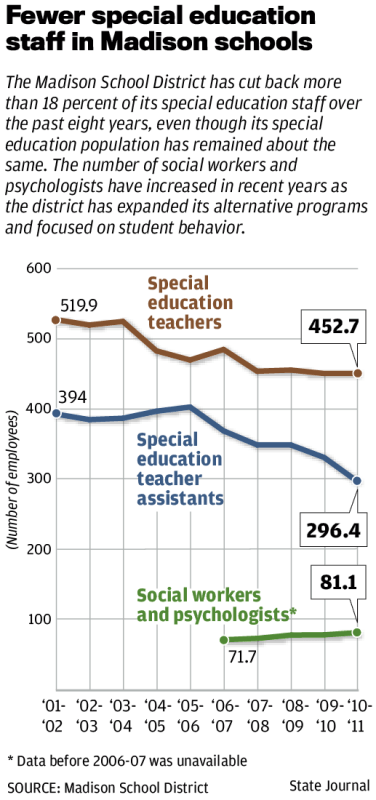
Graph from the Wisconsin State Journal, click image for accompanying story.

I was struck by the relationship between two things in recent Wisconsin State Journal stories.  The first of these is the graph above illustrating the cuts of over 150  Special Education staff positions (from Matt DeFour’s report on the new MMSD Middle School Mental Health initiative).    The second was this quote from Board President James Howard in Defour’s story on greater than anticipated cuts in state aid to the Madison Metropolitan School District:

School Board President James Howard said the board’s goal has been to not raise property taxes and, “I think that’s still our position.”

The short version of my reaction is that if your goal is hold the line on taxes, then I guess you are just fine with cutting programs and services, even those that serve the most vulnerable as Special Education does.  I’m not OK with that prioritization and am not OK with a Board and Board President who are.  The longer version  — including an analysis of how the 2008 referendum fits with this — follows.

[Note, as I was finishing this Board Member Ed Hughes put up a post indicating that he is more open to a property tax increase than president Howard and offering readers an opportunity to weigh in via a pollu.  When you are done here, read that post and vote).

Where to start?  I’ll begin with the obvious truth there are things that MMSD schools should be doing, ways they could be helping students, but are not and that these things cost money.   As a consequence of inadequate funding (among other things), MMSD is failing provide appropriate educational opportunities and services  for some students and excellent opportunities and services for many.  In other words, budget cuts impact education.  If you don’t believe the above, you should probably stop reading now.

The cuts to Special Education staff are one example (note I was cognizant of the 2006 cross-categorical teacher drop due to a change in case load allocations for “Speech and Language Only” students, the cuts to SEAs are somewhat surprising to me).  It is also worth noting that the approved Preliminary 2011-12 Budget appears to cut a further $3,231,626 from Education Services, the department in charge of Special Education, ELL and more (this figure may have changed slightly due to amendments, I’m using the initial Budget because the “approved Preliminary….” isn’t on line).  If any of these cuts come from Special Education, the district may be in danger of losing Federal Funding due to the Maintenance of Effort requirements  of IDEA which as explained in this memo from DPI  do not recognize “savings from reduced staff benefits as exceptions.”

Special Education is just one area where more resources would help; there are many others.  It should also not be forgotten that this preliminary — no new taxes —  budget was balanced by cutting staff compensation, as  Board Member Ed Hughes has said “underpaying our most important employees… a false economy.”

Now on to Board Goals.  I looked at in vain at the statues governing Boards of Education, at the MMSD Policies, at the District Philosophy, at the Mission Statement, at the Strategic Plan for any reference that could support not raising property taxes as a goal superior to providing the best possible education for the students in their charge.

You can look too, you won’t find it.  What you will find is much that calls for the Board to (in the phrase from the Strategic Plan) “vigorously pursue the resources necessary to achieve our mission,” the mission being:

…to cultivate the potential in every student to thrive as a global citizen by inspiring a love of learning and civic engagement, by challenging and supporting every student to achieve academic excellence, and by embracing the full richness and diversity of our community.

The last couple of MMSD budgets have each left about $10 million in revenue authority unused; the approved Preliminary Budget leaves (I believe) about $9 million (again, no final preliminary is on line, so I’m estimating).  It would not have taken, and does not now take much vigor to access these resources.  It may take  a little courage.

I realize that much has changed in the last few years — widespread economic hardship, cuts in state aid by both Democratic and Republican state governments, much slower than anticipated growth in property values, , the opportunity to cut staff compensation under the threat of union busting, dramatic cuts to the revenue limit base  — but despite all of these changes, if you go back to the principles and the details of Partnership Plan used to sell the 2008 Operating Referendum (which passed overwhelmingly) I think you can find plenty of justification for increasing property taxes in order to achieve the mission of the district.  Maybe not to the fully allowed limit (maybe) , but certainly beyond the level the Board President has stated as a goal.

That referendum is the primary reason why even with the FitzWalker mandated 5.5% cut in allowed revenue, Madison has the ability to maintain and even expand opportunities.   In more ways than one, that’s what over 68% of the voters agreed to.  They did not vote to freeze property taxes, they voted to raise them.

The strongest Partnership Plan based case for using the entire $10 million in referendum granted authority this year and every year is that that plan anticipated only a three year total of $9 million in cuts from cost to continue budgets, a total that was about doubled in the combined actual budgets of the first two years.

To me that is compelling, but some Board Members and others will point out the plan anticipated higher state aid and growth in property values than have been realized, and that these factors — along with general economic conditions — justify cutting at a higher level,  I don’t agree, but for the sake of argument I’m willing to stipulate that rather than relying on the “cuts from cost-to-continue ” metric,  we should also look at the total property tax burden.

Looking at the total levy instead of the total cuts is one way to deal with the diminished state aid and the lack of growth in property wealth to produce a conservative estimate of the tax burden agreed to by voters who ratified the Partnership Plan .  However if you are going to elevate  property taxes over other considerations in this manner it is only right to fully account for changes in property taxes and that includes dealing with the School Levy Credits.

As explained by Andy Reschovsky, the Levy Credits are categorized by the state as school aid but in fact function as property tax relief misdirected toward wealthier districts and property owners.  Shifting the almost $900 million a year allocated to the Levy Credits into general state school aids is a centerpiece of State Superintendent Tony Evers Fair Funding for the Future proposal.

Since 2006 the Levy Credits has almost doubled.  For the most part this has been ignored by School Boards in their Levy and Budget deliberations.  I think that was because districts almost always taxed to the max under revenue limits, so there was little reason to look at how the Credits impacted the net taxes of property owners.  One place where this would have made sense was in the otherwise detailed discussions of referendum related tax increases, but  — despite my advice at the time — MMSD did not include the Levy Credits in their presentations for  2008 referendum.

Since 2009-10 MMSD has ceased taxing to the max and has begun making minimizing tax burdens the top or near top consideration, the “goal.”  That means that the Levy Credits need to be part of the discussion, because as Reshovsky explains MMSD taxpayers benefit greatly from the Credits:

Using Madison as an exam-ple, in 2009, the average gross school mill rate was 9.79. The city’s school levy credit allocation resulted in a 1.76 mill rate reduction. Tax bills were then calculated using the net school mill rate of 8.03. Thus, the School levy credit resulted in a $352 tax saving for the owner of property worth $200,000 (.00176 times $200,000), and a tax saving of $880 for the owner of a $500,000 property.

For the purposes of this comparison of the levies anticipated in the Partnership Plan and  the actual/preliminary levies for the period covering the 2009-10 through 2011-12 budgets,  what is most important is that while cutting general school aids for the years 2009-10 and 2010-11, the Democrats increased the Levy Credits and that the Republicans in power have maintained these increases.  At the time voters approved the 2008 referendum, the Levy Credits for MMSD totaled 37,198,954.  For 2009-10 this increased to 40,934,795 and for 2010-11 they were 40,304,862.  I haven’t seen estimates for 2011-12, but the total funding for the Levy Credits is unchanged and it seems safe to assume that the share going to MMSD taxpayers will be about the same.

The table below uses  projected property tax totals from the Partnership Plan, the actual levies for the first two years and the levy from the approved preliminary budget for 2011-12.  To account for the Levy Credits  I’ve subtracted the Levy Credit increases over 2008 (3,735,841 for 2009-10 and 3,105,908 for 2010-11) from the levy totals (using the 2010-11 figure for 2011-12).

According to these figures,  MMSD could levy an additional $7,174,422 and still be within a  conservative interpretation of the tax increases the voters  approved with the 2008 referendum.  I think they should use at least this amount of their levy authority to advance their mission.

In the will of the voters as expressed in the referendum vote, I find no evidence that the community shares  Board President Howard’s stated goal to not raise property taxes and here and elsewhere I find much that supports reasonable tax increases.

Thomas J. Mertz

2 Comments

Filed under "education finance", Accountability, Best Practices, Budget, education, finance, Gimme Some Truth, Local News, Referenda, referendum, School Finance, Scott Walker, Take Action, Uncategorized

Hypocrite of the Day — Sarah Archibald

I’ve written about Sarah Archibald before.  She joined the state payroll when Jim Doyle tapped her to head up Wisconsin’s misguided and failed Race to the Top application, a key element of which was rushed legislation opening the door to the misuse of standardized test scores in teacher evaluations.  Now she is doing education policy for the FitzWalker gang as part of Senator Luther Olsen’s staff, busting unions, paving the way for  privatization via vouchers, enabling  charter school expansion, undermining local control, creating bigger class sizes in our public schools, eroding the opportunities to learn for most of the children of our state, and yes, further expanding the abuse of standardized test-based data to determine the conditions of employment for educators (via the pending SB 95 and AB 130).  You can read more about Archibald’s belief in the “need” to include “student test scores” in evaluating and determining compensation for teachers in this piece of Bradley Foundation funded pseudo scholarship.

We have a pretty good idea of what Dr. Archibald wants for your children and mine (a little more on that below), but what about her’s?  She sends her kids to Wingra School in Madison, where the tuition is $12,000 a year, the teacher student ratio is 12/1, the philosophy is “progressive,” and they don’t believe in tests, standardized or otherwise.  I’ll let Doctor Archibald explain in her own words:

…[W]hy we send our kids to Wingra school. At this school, teachers have the luxury of really recognizing and reinforcing each child. With no scripted curriculum and no standardized tests, teachers can focus on allowing the child to blossom and following the kids’ lead in terms of what they want to learn about. Who knows if they’ll really be prepared for high school or college, but they are held, and that counts for a lot.

I can’t help but close with this oft-quoted passage from John Dewey:

“What the best and wisest parent wants for his own child, that must the community want for all of its children. Any other ideal for our schools is narrow and unlovely; acted upon, it destroys our democracy ” (The School and Society, 1899).

Sarah Archibald is a wise parent who is working to destroy our democracy.   I think she’s earned the Hypocrite of the Day Award.

Thomas J. Mertz

3 Comments

Filed under "education finance", Accountability, Arne Duncan, Best Practices, Contracts, education, Equity, finance, Gimme Some Truth, Local News, No Child Left Behind, School Finance, Scott Walker

An Endorsement for Andy Heidt — #1 of 7 of the 48th Assembly District Candidates on Education


On July 12 the voters in the 48th Assembly District — covering the East side of Madison, Monona, McFarland and the Town of Dunn  (map here)– will choose a Representative to the State Assembly to replace now County Executive Joe Parisi.  The candidates are (alphabetical, linked to their web sites):  Fred Arnold, Dave de Felice, Andy Heidt, Katherine Kocs, Bethany Ordaz, Vicky Selkowe, and Chris Taylor.

I don’t live in the District, but like all progressives in the state, I have a stake in the race.  Whoever is elected will be in a “safe seat” which means that they have the opportunity to do more than be a consistent vote; they can push the envelope by introducing and promoting significant progressive legislation, the kind of legislation that makes overly cautious party leaders uncomfortable.  With the Republicans in charge, the rhetoric from the Democrats has been heartening, but it should not be forgotten that when they controlled the state from 2008-10 they did nothing to reform school funding except cut $300 million and raise the levy credit, did nothing on the minimum wage, failed to pass the Green Jobs bill, didn’t finish the Union contracts when they could, did much to little in progressive revenue reform…the list goes on.   In this race I think people should look beyond opposing Walker to what kind of legislator the candidates will be when the Democrats are in control.There is no shortage in the legislature of “pragmatic progressives” who can find 1,000 reasons not to do the right things; there is a dire need for courageous leaders who will be steadfast in their advocacy both behind caucus doors and in public.   Andy Heidt will be that kind of leader, that’s why he has my endorsement and why I’ve been helping with his campaign.

To back up this assertion (and as a service to AMPS readers and voters in the 48th), I’m offering a series of posts  examining what the candidates have and have not said about education issues, especially the core issue of school finance, and to a lesser extent the related issues of revenue reform (based primarily on their websites and on internet searches).  In the interest of disclosure, I’ll note that I’m acquainted with three of the candidates and believe I have met at least three others and that some things that I know about them or impressions that have not appeared in campaign statements or biographies are part of the analysis.  If anyone, including the campaigns has anything to add or dispute, please use the comments to bring it to my attention.  This time the order is  from who I consider the strongest to who I consider the weakest (Andy Heidt, Vicky Selkowe, , Bethany Ordaz, Fred Arnold Chris Taylor, Katherine Kocs and Dave de Felice — this may change as I do more research).

Andy Heidt

By my criteria, Andy Heidt is far and a way the best candidate.  Throughout his campaign — beginning with his announcement (covered here by John Nichols) — he  has done more than decry the actions of the GOP, he’s offered positive policy alternatives and pointed to the failure of other Democrats to enact these and other positive proposals.  As Nichols put it:

Heidt’s argument that we must do more than merely prevent Walker from implementing his agenda. We must recognize that the crisis Walker is exploiting has its roots in the failure of Republican and Democratic administrations and legislators to recognize that Wisconsin cannot maintain services and public education if our politicians keep giving away tax breaks to multinational corporations and the wealthy.

Nowhere has this been clearer (or in my head more important) than in his statements on education funding.  Heidt has issued one press release  a “Keeping the Promise” plan (and here, scroll down) for school finance reform ((I helped draft the plan) and a short video.

In the press release, Heidt recognizes the importance of education and shows a “can do” spirit:

There are no more important investments than those we make in our children. They are the future and each generation has an obligation to provide the next with the skills and knowledge they need to be successful. With a fair revenue system, there is no reason we cannot return to the Wisconsin tradition of supporting quality public education.

He also notes past cuts to education under the Democrats  and the inadequacy of their recent counter-proposal to the Republican decimation of our schools.  No other candidate has been explicit on this.

More importantly, no other candidate has offered anything like the detailed “Keeping the Promise” plan, nor the pledges to action contained in that plan.

“Keeping the Promise” has two parts.  First it calls for “immediate action” to address the crises created by 18 years under a broken system, significant cuts in state funding in the 2009-11 budget and the recent Republican measures.  These include enacting the Wisconsin Alliance for Excellent Schools Penny for Kids proposal, expanding sales taxes, shifting the levy credits to the equalization formula,  rolling back vouchers, fully funding SAGE, allowing for growth of the revenue limits based on CPI or the state GDP, taking the profit motive out of virtual schooling and reinstating educator union rights.   The second part build on this by initiating comprehensive reform based on “based on the shared principles of the WAES Adequacy Plan the School Finance Network Plan and the 2007-2008 Assembly Joint Resolution 35.” These are (from AJR 35):

  • Funding levels based on the actual cost of what is needed to provide children with a sound education and to operate effective schools and classrooms rather than based on arbitrary per pupil spending levels.”
  • State resources sufficient to satisfy state and federal mandates and to prepare all children, regardless of their circumstances, for citizenship and for post−secondary education, employment, or service to their country.”
  • Additional resources and flexibility sufficient to meet special circumstances, including student circumstances such as non−English speaking students and students from low−income households, and district circumstances such as large geographic size, low population density, low family income, and significant changes in enrollment.”
  • A combination of state funds and a reduced level of local property taxes derived and distributed in a manner that treats all taxpayers equitably regardless of local property wealth and income.

Heidt vows  to “work tirelessly” to see that this reform is achieved prior to the next biennial budget cycle.

The sad history of AJR 35 (see here for AMPS posts covering that history)demonstrates the need for someone like Heidt in the Assembly.   When the resolution was introduced, the Democrats controlled the Senate and the Governorship, but not the Assembly.  Over 60 legislators signed on and the promise of comprehensive school funding reform was part of the 2008 campaign to “Take Back the Assembly.”  The Democrats did take back the Assembly and once they did AJR 35 and school funding reform disappeared.   Gone.  Silence.  When some of us who wanted them to keep their promises spoke up, we were told to be quiet because speaking or acting on this difficult issue might jeopardize their electoral prospects in November 2010.   I for one didn’t keep quiet, but I’m not taking the blame for the electoral failures of 2010.  Instead I’ll offer an alternative analysis — it isn’t  the people like me who called for action who are to blame, it is the legislators who didn’t act and didn’t want to be reminded of their failure to act (I said much the same well before the November 2010 elections).  Many of those silent, silencing  and inactive legislators are now supporting other candidates who share their priorities and outlook in the race for the 48th.  I’m supporting Andy Heidt.

[Note — I originally conceived this as one long post, covering all the candidates, but that didn’t work out, so I’m doing a series.  This is #1 of 7. — TJM]

Thomas J. Mertz


4 Comments

Filed under "education finance", Accountability, AMPS, Budget, education, Elections, finance, Gimme Some Truth, Local News, Pennies for Kids, Pope-Roberts/Breske Resolution, School Finance, Scott Walker, Take Action, Uncategorized