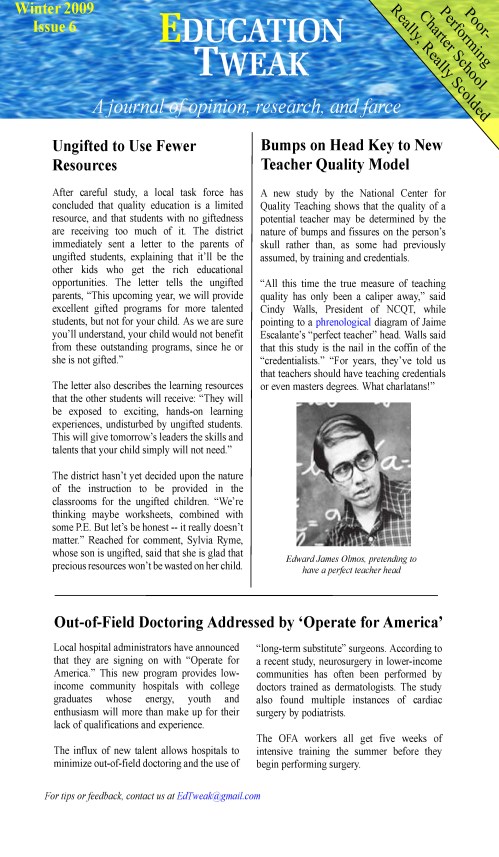
Click on image for pdf.
All the Education Tweaks can be found here.
Thomas J. Mertz

A couple of days ago, NPR had a feature on All Things Considered that was quite intriguing.
One county in Virginia has found a new way to reach taxpayers: an automated phone system calls thousands of residents and asks them to participate in school board meetings.
It has proven successful.
It can be tough to attract an audience for local government meetings. School boards and city councils cannot compete with prime-time TV, cable and the Internet. So, some cities are trying to bring the meetings to the people by phone.
The piece highlights the difficulties people have in making evening school board meetings and how one of the most basic technologies is offering citizens the chance to “vote” on proposal’s and to register their opinions. Could this be a solution for Madison, especially during crucial budgeting meetings?
And while were on the subject of communication, I wonder why the last two meeting agendas have not been emailed to MMSD agenda subscribers and why several “special board meetings” from November still do not have minutes posted?
Robert Godfrey
Filed under Accountability, AMPS, Best Practices, National News
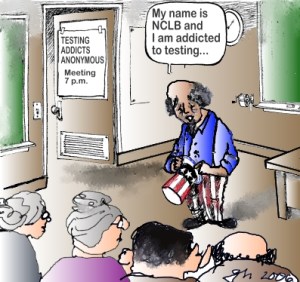
Click the image for more NCLB cartoons.
The Bush administration allowed states to phony-up statistics on everything from graduation rates to student achievement to teacher training and state education standards. As a result, the country has yet to reach not only the goals that were clearly laid out in the law but also farsighted education reforms dating to the mid-1990s. (emphasis added)
New York Times, “A New Day for School Reform,” editorial, February 21, 2009.
There may be some truth to the cause and effect on teacher training, but the implied idea that the failures of No Child Left Behind are due to setting standards (curricular and Adequate Yearly Progress) too low is illogical and reinforces multiple flaws in the NCLB.
Some asides at this point. I want to be clear that communicating high expectations to students in all contexts while giving them the support they need to meet those expectations is good policy. Changing state standards and cut scores at best comprises a very, very small part of this concept and at worst leads to shaming and other counterproductive punishments. Better — not necessarily higher — curricular standards do have a place in reform.
First, standards in practice mean standardized tests and standardized tests are very limited as assessments and even more limited as a means of improving education. To be fair, there is some language in the stimulus package (the subject of the quoted editorial) that may induce a move away from standardized tests (see below).
Second, and most importantly, the whole notion that lax standards are the biggest problem in education defies logic and the historical record.
In terms of logic, just ask yourself if the way to improve archery scores is to use smaller targets. If they can’t hit the larger target, how will they hit a smaller target?
As to the history, here is the data for Wisconsin under the current system:
| Year | # Schools Failed AYP | # Districts Failed AYP |
| 2007-8 | 153 | 4 |
| 2006-7 | 92 | 2 |
| 2005-6 | 87 | 1 |
| 2004-5 | 49 | 1 |
This graphic tells us about the history and projected future (more here).
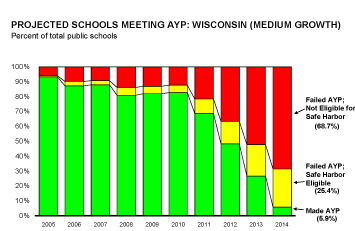
The current standards have resulted in clear trend of increasing failure to meet those standards, a trend that is projected to increase with current standards.
Some quotes from “How Feasible is Adequate Yearly Progress (AYP)? Simulations of School AYP “Uniform Averaging” and “Safe Harbor” under the No Child Left Behind Act” by Jaekyung Lee may help clarify.
It does not appear to be feasible for many schools across the nation to meet the current AYP target within its given 12-year timeline. It is not realistic to expect schools to make unreasonably large achievement gains compared with what they did in the past. Many schools are doomed to fail unless drastic actions are taken to modify the course of the NCLB AYP policy or slow its pace. (emphasis added)
When a majority of schools fail, there will not be enough model sites for benchmarking nor enough resources for capacity building and interventions. This situation can raise a challenging question to the policymakers: is it school or policy that is really failing? There is a potential threat to the validity of the NCLB school accountability policy ultimately if such prevailing school failure occurs as an artifact of policy mandates with unrealistically high expectations that were not based on scientific research and empirical evidence. (emphasis added)
An identified problem with NCLB is that standards are unrealistically high, the New York Times’ solution, raise the standards. Stunning illogic.
This is the kind of “harder is better” mentality reflected in the Pangloss Index and expected from people like the Walton and Bradley Foundation funded Thomas B. Fordham Institute, not “the paper of record.”
Later in the editorial, the assessment reform potential of the stimulus bill is touted:
States will also be required to improve academic standards as well as the notoriously weak tests now used to measure achievement — replacing, for instance, the pervasive fill-in-the-bubble tests with advanced assessments that better measure writing and thinking.
This seems to be a gross overstatement. Here are the relevant parts of the stimulus bill:
(4) STANDARDS AND ASSESSMENTS.-The State-
(A) will enhance the quality of the academic assessments
it administers pursuant to section 1111(b)(3) of the
ESEA (20 U.S.C. 6311(b)(3)) through activities such as
those described in section 6112(a) of such Act (20 U.S.C.
7301a(a));
(B) will comply with the requirements of paragraphs
(3)(C)(ix) and (6) of section 1111(b) of the ESEA (20 U.S.C.
6311(b)) and section 612(a)(16) of the IDEA (20 U.S.C.
1412(a)(16)) related to the inclusion of children with disabilities
and limited English proficient students in State
assessments, the development of valid and reliable assessments
for those students, and the provision of accommodations
that enable their participation in State assessments;
and
(C) will take steps to improve State academic content
standards and student academic achievement standards
consistent with section 6401(e)(1)(9)(A)(ii) of the America
COMPETES Act.
A and C send us to the two prior acts, with vague “such as” language in A. Here is the section cited in A:
(1) To enable States (or consortia of States) to collaborate with institutions of higher education, other research institutions, or other organizations to improve the quality, validity, and reliability of State academic assessments beyond the requirements for such assessments described in section 1111(b)(3).
(2) To measure student academic achievement using multiple measures of student academic achievement from multiple sources.
(3) To chart student progress over time.
(4) To evaluate student academic achievement through the development of comprehensive academic assessment instruments, such as performance and technology-based academic assessments.
and the section cited in C:
(ii) identifying and making changes that need to
be made to a State’s secondary school graduation
requirements, academic content standards, academic
achievement standards, and assessments preceding
graduation from secondary school in order to align
the requirements, standards, and assessments with
the knowledge and skills necessary for success in academic
credit-bearing coursework in postsecondary education,
in the 21st century workforce, and in the Armed
Forces without the need for remediation;
I certainly don’t see a requirement to end “fill-in-the-bubble tests” here. I see some good but weak language opening the door to multiple assessments, some possibility of better assessments in general and buzz words about the “21st century workforce.” I also have not seen anything in Wisconsin’s plans for the stimulus money that indicates that the WKCE will be gone anytime soon (since the contract requires two-year notice be given, I don’t see that long awaited day being pushed up).
This editorial is unfortunately typical of the confusion on education policy in our media and consequently in our society. Education policy can be confusing. This makes the role of the press even more critical and the failures of logic and accuracy like those in the Times editorial more damaging.
Thomas J. Mertz
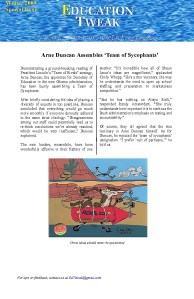
Click on Image for pdf.

Click on image for pdf.
As always, past and future Education Tweaks can be found here.
Thomas J. Mertz
Filed under Best Practices, education, Gimme Some Truth, National News, nclb, No Child Left Behind

The federal No Child Left Behind Act has succeeded in highlighting the poor math and reading skills of disadvantaged children. But on balance, the law has done more harm than good because it has terribly distorted the school curriculum. Modest modifications cannot correct this distortion. Designing a better accountability policy will take time. We cannot and should not abandon school accountability, but it’s time to go back to the drawing board to get accountability right…
Designing a new accountability system will take time and care, because the problems are daunting. Observations of student behavior are not as reliable as standardized tests of basic skills, so we will have to accept that it is better to imperfectly measure a broad set of outcomes than to perfectly measure a narrow set. We will have to resolve contradictory national convictions that schools should teach citizenship and character, but not inquire about students’ (and parents’) personal opinions. To avoid new distortions, we’ll need to make tough decisions about how to weight the measurement of the many goals of education.
Richard Rothstein, “Getting Accountability Right,” Education Week.
These quotes and the commentary were directed at NCLB reform, but I think they are also applicable to the MMSD Strategic Planning process that begins next week and want to note that Todd Price is the only candidate for State Superintendent of Public Instruction who is voicing similar ideas about the failings of NCLB and the need for more than adjustments.
Related at eduwonkette (and a hat tip); and from the Annenberg Institute, “Beyond Test Scores: Leading Indicators for Education” (many other great resources at the Annenberg site).
Thomas J. Mertz
Filed under Accountability, Best Practices, Elections, National News, nclb, No Child Left Behind
Filed under Best Practices, Gimme Some Truth, National News, nclb, No Child Left Behind
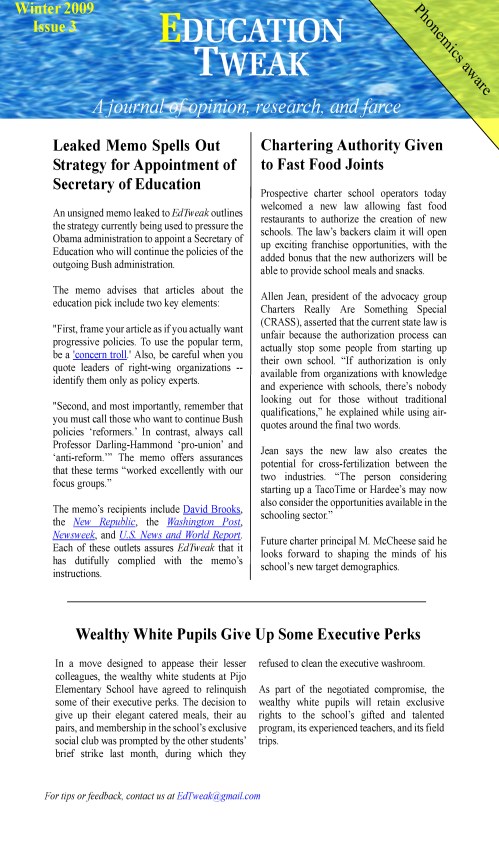
Click on image for pdf.
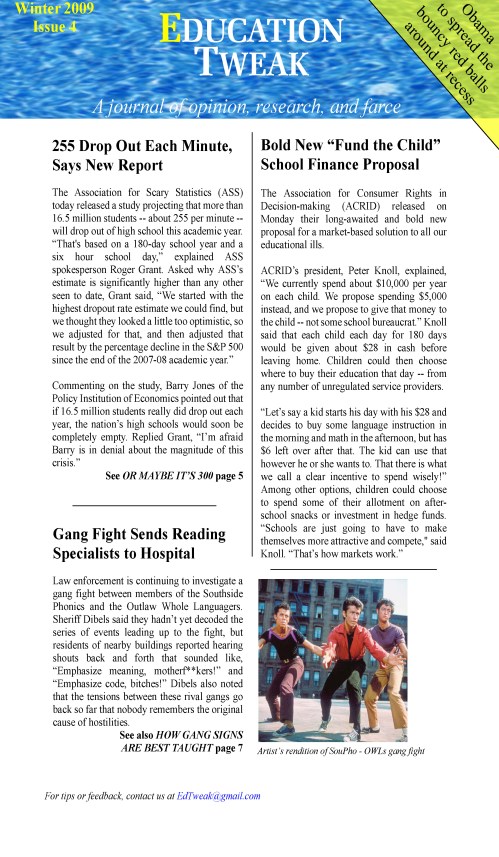
Click on image for pdf

Click image for pdf.
All the Education Tweaks can now be found at this page.
Thomas J. Mertz
Filed under Best Practices, education, Gimme Some Truth, National News, nclb, No Child Left Behind

Governor Doyle joined with his counterparts from NY, MA, NJ and OH in a conference call outlining their priorities for a stimulus package. The request includes $250 billion for education (including higher education) over the next two years.
I can’t find details of any specifics except a disturbing mention from Doyle that there should be a requirement that states spend at least as much as they had in 2006 on education. I don’t think taking steps backward is the way to go.
President-Elect Obama gave vague lip service to education in his radio address this week.
Our Senator Russ Feingold made no mention of education in his list of priorities for 2009. You can let him know that this isn’t acceptable here.
An earlier discussion of education and the stimulus from EdWeek here and related posts on AMPS here and here.
Thomas J. Mertz
Filed under "education finance", Best Practices, Budget, education, finance, National News, School Finance
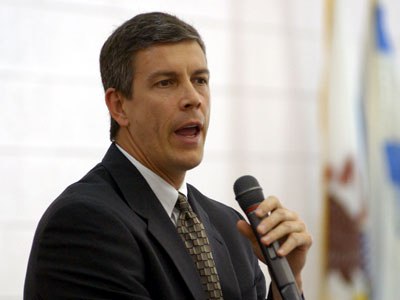
Just links. My own thoughts are much like teacherken’s (below). I’ll add that the charters/merit pay agenda does not make me happy but balance that by saying that at least the merit pay pilot in Chicago included peer evaluations along with test scores.
The New York Times, Schools Chief From Chicago Is Obama’s Choice for Education.
teacherken, Arne Duncan as Sec Ed – it could have been worse.
Alexander Russo, District299: The Chicago Schools Blog, Duncan Pros and Cons.
Greg Palast, Obama’s “Way-to-Go, Brownie!” Moment?.
Education Week, Duncan is Obama’s Education Secretary Pick.
Good discussions in the comments at all but the NYT.
Thomas J, Mertz

Whitney Tilson - Working to bring the magic of the market to education
I was reading this New York Times article (Uncertainty on Obama Education Plans) and this got my attention:
One former Teach for America official who has been outspoken is Whitney Tilson, a New York mutual fund manager.
In a recent blog entry, Mr. Tilson said of Dr. Darling-Hammond, “She’s influential, clever and (while she does her best to hide it) an enemy of genuine reform.”
Mr. Tilson is on the board of Democrats for Education Reform, a political action committee based in New York.
Mr. Tilson is a top tier education DINO. He advocates an anti-Union, data and test driven version of “accountability” based on a market, business, privatization model (see here for more on this mindset).
His expertise is based on a short stint in the classroom via Teach for America and his “success” in the financial industry.
I thought it would be good to examine that “success.”
According to the latest available report from Tilson Mutual Funds (dated April 30, 2008, well before the current meltdown), one of the funds he controls underperformed in comparison to both the Dow Jones Wilshire 500 and the S&P Total return indices both in the prior year and since its inception. In fact, this fund lost 10.03% of value after taxes . You would have done better stashing your money in an old sock than investing in this fund.
The other fund did a bit better, losing only 4.44% of value after taxes and outperforming the Dow Jones, but not the S&P. The old sock would still have been a better choice.
The year to date on one fund is -23.48%; on the other it is -45.19%. That old sock is looking better and better.
Tilson isn’t even good at his “day job.”
Why would anyone listen to these people on education? Why would anyone think that “market driven education reform” as pushed by the very people who profited while creating our financial crisis was a good idea?
I don’t get it.
Thomas J. Mertz
 Fund a Classroom Project in Madison