Category Archives: No Child Left Behind

Schools and the Common Good

Elsewhere, I’ve touched on the history of public education and the important idea of the “Common,” as in the Common School and the Common Good. My whole thinking about public education is that our schools are where we express our vision of a good society and try to create that society. In doing this we come together, finding common ground, defining the common good while preparing our children to contribute to a society where the common good is paramount.

This is by definition a secular project; church and state are separate.  The creation of public schools was in part designed to secularize the notion of a common good. But religious groups and thinking are an important part of our society and those visions remain relevant. Earlier I posted some excerpts from the United Church of Christ on public education. Today I’m posting some thoughts from a recent document in the Catholic Social Action tradition, a tradition that has shaped who I am. These come from, A Platform for the Common Good, drafted and ratified by a coalition of Catholic organizations. One of the authors, Robert Beezat, will be speaking at Edgewood College on September 25.

Under the heading of “Promote the General Welfare” there are calls to action on a number of topics, including education.  This is what the platform has to say.

Government Action Needed:

On Education

  • Increase education funding and distribute resources equitably, with special attention to schools in low-income neighborhoods
  • Pay teachers fair and adequate wages and institute programs to encourage teacher retention
  • Provide more arts, music and other cultural enrichment courses
  • Ensure that special education students have the resources and trained teachers they need
  • Ensure that education includes life skills and vocational training to prepare students for jobs
  • Provide free universal preschool/Head Start
  • Fund educational mandates.

Individual/ Community Action Needed:

  • As parents, be involved in our children’s education
  • Hold regional school boards accountable.

Other education related planks appear elsewhere, under the headings “Establish Justice” and “Ensure Domestic Tranquility.”

  • Work to lessen income disparities and to reform tax policies that favor the wealthy and corporate interests.
  • Acknowledge that discrimination, including racism and sexism, continues to impact public systems and encourage public employees and others to engage in anti-discrimination training
  • End discrimination in all institutional forms.Support and promote programs that promote a fair distribution of resources and serve vulnerable populations
  • Support and promote programs and activities that address prejudice and discrimination
  • Write letters to the editor and op-eds to encourage anti-racism education and better relationships within our communities
  • Fund after-school programs, jobs for youth, and continuing education (GED, ESL) for adults

Many, many good and important ideas about how to work toward the common good.  These ideas should be at the heart of the Church’s work, but often get lost.

Thomas J. Mertz

Leave a comment

Filed under "education finance", AMPS, Best Practices, education, Elections, Equity, finance, National News, nclb, No Child Left Behind, School Finance, Take Action

Tears of Rage

Bob Dylan and the Band “Tears of Rage” (click to listen or download)

From Lakeview Elementary (MMSD) teacher Susan J. Hobart in The Progressive Magazine.

One Teacher’s Cry: Why I Hate No Child Left Behind

By Susan J. Hobart, August 2008 Issue

I’m a teacher. I’ve taught elementary school for eleven years. I’ve always told people, “I have the best job in the world.” I crafted curriculum that made students think, and they had fun while learning. At the end of the day, I felt energized. Today, more often than not, I feel demoralized.

While I still connect my lesson plans to students’ lives and work to make it real, this no longer is my sole focus. Today I have a new nickname: testbuster. Singing to the tune of “Ghostbusters,” I teach test-taking strategies similar to those taught in Stanley Kaplan prep courses for the SAT. I spend an inordinate amount of time showing students how to “bubble up,” the term for darkening those little circles that accompany multiple choice questions on standardized tests.

I am told these are invaluable skills to have.

I am told if we do a good job, our students will do well.

I am told that our district does not teach to the test.

I am told that the time we are spending preparing for and administering the tests, analyzing the results, and attending in-services to help our children become proficient on this annual measure of success will pay off by reducing the academic achievement gap between our white children and our children of color.

I am told a lot of things.

But what I know is that I’m not the teacher I used to be. And it takes a toll. I used to be the one who raved about my classroom, even after a long week. Pollyanna, people called me. Today, when I speak with former colleagues, they are amazed at the cynicism creeping into my voice.

What has changed?

No Child Left Behind is certainly a big part of the problem. The children I test are from a wide variety of abilities and backgrounds. Whether they have a cognitive disability, speak entry-level English, or have speech or language delays, everyone takes the same test and the results are posted. Special education students may have some accommodations, but they take the same test and are expected to perform at the same level as general education students. Students new to this country or with a native language other than English must also take the same test and are expected to perform at the same level as children whose native language is English. Picture yourself taking a five-day test in French after moving to Paris last year.

No Child Left Behind is one size fits all. But any experienced teacher knows how warped a yardstick that is.

I spent yesterday in a meeting discussing this year’s standardized test results. Our team was feeling less than optimistic in spite of additional targeted funds made available to our students who are low income or who perform poorly on such tests.
As an educator, I know these tests are only one measure, one snapshot, of student achievement. Unfortunately, they are the make-or-break assessment that determines our status with the Department of Education.

They are the numbers that are published in the paper.

They are the scores that homebuyers look at when deciding if they should move into a neighborhood.

They are the numbers that are pulled out and held over us, as more and greater rigidity enters the curriculum.

I was recently told we cannot buddy up with a first-grade class during our core literacy time. It does not fit the definition of core literacy, I was told. Reading with younger children has been a boon to literacy improvement for my struggling readers and my new English-speaking students. Now I must throw this tool away?

In an increasingly diverse public school setting, there is not one educational pedagogy that fits all students. We study and discuss differentiated curriculum, modify teaching strategies, and set “just right reading levels” to scaffold student learning. But No Child Left Behind doesn’t care about that. It takes no note of where they started or how much they may have progressed.

As a teacher, I measure progress and achievement for my students on a daily basis. I set the bar high, expecting a lot.

I don’t argue with the importance of assessment; it informs my instruction for each child.

I don’t argue with the importance of accountability; I believe in it strongly—for myself and my students.

I have empathy for our administrators who have to stand up and be told that we are “challenged schools.” And I have empathy for our administrators who have to turn around and drill it into our teacher heads, telling us we must do things “this” way to get results. I feel for them. They are judged on the numbers, as well.

No Child Left Behind is a symptom of a larger problem: the attack on public education itself. Like the school choice effort, which uses public funds to finance private schools and cherry-pick the best students, No Child Left Behind is designed to punish public schools and to demonstrate that private is best.

But I don’t think we’ve turned a corner that we can’t come back from. Public education has been a dynamic vehicle in our country since its inception. We must grapple with maintaining this progressive institution. Policymakers and educators know that education holds out hope as the great equalizer in this country. It can inspire and propel a student, a family, a community.

The state where I teach has a large academic achievement gap for African American and low income children. That is unacceptable. Spending time, money, energy on testing everyone with a “one size fits all test” will not eliminate or reduce that gap.
Instead, we need teacher-led professional development and more local control of school budgets and policymaking. Beyond that, we need to address the economic and social issues many children face, instead of punishing the schools that are trying to do right by these students.

We’ve got things backwards today. Children should be in the front seat, not the testing companies. And teachers should be rewarded for teaching, not for being Stanley Kaplan tutors.

Ten years ago, I taught a student named Cayla. A couple of months ago, I got a note from her, one of those things that teachers thrive on.
“Ms. Hobart was different than other teachers, in a good way,” she wrote. “We didn’t learn just from a textbook; we experienced the topics by ‘jumping into the textbook.’ We got to construct a rainforest in our classroom, have a fancy lunch on the Queen Elizabeth II, and go on a safari through Africa. What I learned ten years ago still sticks with me today. When I become a teacher, I hope to inspire my students as much as she inspired hers.”

Last week, I received a call from Niecy, another student from that class ten years ago. She was calling from southern Illinois to tell me she was graduating from high school this month and had just found out that she has won a scholarship to a college in Indiana. I was ecstatic in my happiness for her. We laughed, and I told her I was looking at a photo of her on my wall, building a pyramid out of paper bricks with her classmates.

I also had a recent conversation with Manuel in a grocery parking lot. He reminded me of my promise eight years ago to attend his high school graduation. I plan to be there.
Cayla and Niecy and Manuel are three of the reasons I teach. They are the reasons that some days this still feels like a passion and not a job.
When I pick up the broom at the end of the day to sweep my class due to budget cuts, I remember Cayla.

When I drive home demoralized after another meeting where our success is dissected with a knife manufactured in Texas, I remember Niecy.

When another new program that is going to solve the reading disparity, resulting in higher test scores, is introduced on top of another new program that was supposed to result in the same thing, I remember Manuel.

They are the fires that fuel my passion. They are the lifeboats that help me ride this current wave in education.

Eight or ten years from now, I want other former students to contact me and tell me a success story from their lives. I don’t want to be remembered as the teacher who taught them how to sing “Testbusters” or to “bubble up.” I want to be remembered as a teacher who inspired them to learn.


Susan J. Hobart, M.S. Ed., is a National Board Certified Teacher living in the Midwest.

Thomas J. Mertz

3 Comments

Filed under AMPS, Best Practices, education, Gimme Some Truth, Local News, National News, nclb, No Child Left Behind

Texas, what can I say?

The Barbarians, “Are You a Boy, or Are You a Girl?” (click to listen)

From the state that brought you the “Texas Miracle” that wasn’t (and led directly to the No Child Left Behind mess) comes a flashback to the worst of the 1960s or maybe the 1800s. The Needsville Texas school district has refused to admit a five-year-old boy because his hair is too long (hat tip to Region19 Gazette). “”I’m just afraid if the district gives in, other problems will occur in the future,” said Shelly Sullivan, a former Needville student.” Yeah, like fluoridation in the water, revolution in the streets and maybe respect for individual choices. Horrors.

That the child is Native American recalls the shameful forced assimilation policies of Native American boarding schools.

I know Texas has produced much of worth (especially in music, but can’t forget Governor Anne Richards and others).  Still, things like this make me wonder what goes on down there.

Thomas J. Mertz

Leave a comment

Filed under education, National News, nclb, No Child Left Behind, Uncategorized

New Video from FairTest.org

National Center for Fair and Open Testing.

Hat tip to Jim Horn at Schools Matter.

Thomas J. Mertz

Leave a comment

Filed under Accountability, Local News, National News, nclb, No Child Left Behind

An exercise in delusion

Hieronymus Bosch

During a speech to the National Association of Latino Elected & Appointed Officials the other day, John McCain launched into a discussion of NCLB and education funding, holding up New York City (with awful – and similar funding issues to Wisconsin) and New Orleans (oy!) as examples of Republican success stories in education. Charter schools, according to him, can be our silver bullet. Pardon me, but we all need a national conversation to start now. However for Mr. McCain, it would seem his mind is made up.

“I mean, they also re-authorized No Child Left Behind, with the lessons we learned in the intervening years since we passed it, in a bi-partisan fashion, I would fully fund those programs that have never been fully funded. But let me also say to you: choice and competition. I believe that every family in America should have the same choice that Cindy and I did. We chose to send our children to a Catholic school. That was because we were able to do so. So I believe that charter schools work. I believe that they’re not much better than public education, but they provide competition. There are two examples I’d like to mention very briefly: New York City and New Orleans. If you missed it, there is now a dramatic uptick in the performance of school children in New York City, a place where a lot of experts thought there would never be improvement. We ought to go up there and see what Mr. Klein and Mayor Bloomberg and others have done and dedicated educators have done in New York City. New Orleans, they had to start at square one, as you know. There are now 30 charter schools in the city of New Orleans. Anyone will tell you that they’re starting to see a dramatic improvement in the quality of education in the city of New Orleans. My friends, choice and competition, reward the teachers, God bless them, find bad teachers another line of work. Choice and competition.”

I’ll bet Mr. “Choice and Competition” has never seen this documentary. He won’t – but you can. Educate yourself. See what magic an unregulated post-Katrina education industry has brought to New Orleans and shades of things to come if some mainstream thinking about reforming education comes to fruition.

Robert Godfrey

1 Comment

Filed under AMPS, Equity, Gimme Some Truth, nclb, No Child Left Behind, School Finance, We Are Not Alone

George Carlin on NCLB, Education and More

Warning, expletives not deleted (it would have been wrong to delete the expletives of the man responsible for bringing the “Seven Dirty Words You Can’t Say on Television” all the way to the Supreme Court).

Don’t rest in peace George; keep stirring up trouble wherever you are.

Thomas J. Mertz

1 Comment

Filed under Best Practices, Gimme Some Truth, National News, nclb, No Child Left Behind, Quote of the Day

“Ain’t No Miracle Worker”

The Brogues, “I Ain’t No Miracle Worker” (click to listen).

There is a lot of excitement about Dan Nerad taking the reins as Superintendent of MMSD. I share this excitement. I’ve had the pleasure of meeting him three or four times, have read numerous articles about him and his work, have talked to people who know him from Green Bay and have researched what he has accomplished in his career. All this leads me to believe that Dan Nerad is a very high quality district leader who will fit well in Madison and contribute greatly to the improvement of our schools.

Still. I worry that expectations are unreasonably high and that we may be setting Nerad and ourselves up for a fall. Over and over again I have heard and read people saying “when Dan Nerad gets here” either preceded or followed by some hope or promise of a positive change. There will be changes and I think that (from my perspective) they will be mostly positive. So what’s the problem? Here is a list:

  • It doesn’t recognize all the good work of the recent past. Not Just Art Rainwater’s contributions, but the contributions of our Board members, our staff and teachers and our community. Looking to Nerad to for huge improvements can make it seem like MMSD has been stagnant or failing. It hasn’t. For some nice overviews and reflections on Art Rainwater and his time with MMSD, see the current MMSD Today.
  • We shouldn’t forget that educational improvement is incremental. Perhaps the best history of educational reform is David Tyack and Larry Cuban’s Tinkering Toward Utopia. In their prologue they write:

Although policy talk about reform has had a utopian ring, actual reforms have typically been gradual and incremental — tinkering with the system. It may be fashionable to decry such change as piecemeal and inadequate, but over long periods of time such revisions of practices adapted to local contexts can substantially improve schools. Rather than seeing the hybridizing of reform ideas as a fault, we suggest it can be a virtue. Tinkering is one way of preserving what is valuable and reworking what is not.

The point in the last sentence is related to my concerns about belittling what has been accomplished in our schools. Tyack develops this further in one of my favorite essays “A Conservationist Ethic in Education Reform.”

  • No policy, reform, set of policies or reforms will make everyone happy. Uncontested school board races and an apparent conflict and controversy avoidance strategy by the Board of Education may have lulled some into thinking that divisions are a thing of the past in Madison school politics. They aren’t. I recognize that most people involved share many values and even have much agreement about how best to put those values into action, but also know from personal experience that there are passionate disagreements among people of good will when it comes to education. Whatever Dan Nerad does or does not do, tries or does not try, some vocal segments of our community will object that it is too much or too little or just plain wrong. The divisions that have been hidden will become apparent again at some point. I believe that Dan Nerad is skilled at working toward consensus, finding common ground and building coalitions. This will serve him (and our community) well, but it won’t satisfy everyone.
  • The challenges Madison’s schools face are great, too great for any individual to address alone. The issues raised by demographic changes are well documented; the insane choices created by the state school finance system are well known; the pressures from testing and other ill-devised mandates of NCLB are readily apparent. I don’t believe these are intractable, but I do recognize that there are no simple answers and that sustained hard work and cooperation from all associated with the district and all segments of our community are necessary if we are to be successful in meeting these challenges. Dan Nerad cannot do this without help from many quarters. Much has been written about his openness, outreach and cooperative spirit, but if some members of the Board of Education continue to be blasé about or dismissive of public engagement, little improvement is possible. The community has to step up too. Schools of Hope (as well as other Urban League programs) and the Foundation for Madison Public Schools are great; Mayor Cieslewicz, Alder Satya Rhodes-Conway and others are actively working to expand school/city/community initiatives; MMSD has wide-ranging partnerships with the University of Wisconsin School of Education and other local research and higher education institutions; PTOs, PTAs and PTGs are doing wonderful things; Thousands of volunteers help our schools on a regular basis; Our legislative delegationespecially Rep. Sondy Pope Roberts — are leaders in the fight for school finance reform; ABC Madison and Get TUFF have been educating and agitating for state school funding changes; Communities and Schools Together and Mad-City Grumps are preparing for the next referendum campaign; countless other individuals and groups are contributing to the betterment of our schools… (apologies if I left out your favorite). An impressive list, but it isn’t enough. We all can and must do more.

So let’s work together to welcome Dan Nerad, expand the good our schools are doing, fix the state finance system, pass a referendum…have realistic expectations about what a change in the superintendency will bring and do our best to help Dan Nerad exceed those expectations.

In this spirit (or maybe just because I like it), here is video from the last referendum campaign.

Thomas J. Mertz

Leave a comment

Filed under "education finance", AMPS, Best Practices, Budget, education, finance, Local News, nclb, No Child Left Behind, Pope-Roberts/Breske Resolution, Referenda, referendum, School Finance, Take Action, Uncategorized

Too Late the Truth?

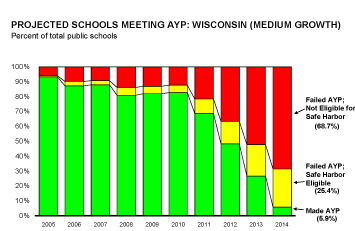
From “The Impact of the Adequate Yearly Progress Requirement of the Federal No Child Left Behind Act on the Great Lakes Region,” a study released by the Great Lakes Center for Educational Research and the Education Policy Studies Laboratory at Arizona State University.

From “The Impact of the Adequate Yearly Progress Requirement of. the Federal “No Child Left Behind” Act on Schools in the Great Lakes Region,” a study released by the Great Lakes Center for Educational Research and the Education Policy Studies Laboratory at Arizona State University.  See also “Many States Have Taken a “Backloaded” Approach to No Child Left Behind Goal of All Students Scoring ‘Proficient'” from the Center on Education Policy.

On June 24, The Department of Public Instruction will release the preliminary Adequate Yearly Progress Reports on schools and districts in Wisconsin, as required by the No Child Left Behind Act. My guess is that MMSD will have a higher number of “failing schools” this year. Think of Madison as being “ahead of the curve.”

AYP is not the best gauge of the work our district is doing; NCLB isn’t a good law and AYP is ridiculous yardstick.

If the flaws in and political manipulation behind NCLB weren’t obvious already, an interview with former Assistant Secretary for Elementary and Secondary Education Susan Neuman in the new Time magazine confirms what we already knew. Excerpts below.

There was always something slightly insane about No Child Left Behind (NCLB), the ambitious education law often described as the Bush Administration’s signature domestic achievement. For one thing, in the view of many educators, the law’s 2014 goal — which calls for all public school students in grades 4 through 8 to be achieving on grade level in reading and math — is something no educational system anywhere on earth has ever accomplished. Even more unrealistic: every kid (except for 3% with serious handicaps or other issues) is supposed to be achieving on grade level every year, climbing in lockstep up an ever more challenging ladder. This flies in the face of all sorts of research showing that children start off in different places academically and grow at different rates.

Add to the mix the fact that much of the promised funding failed to materialize and many early critics insisted that No Child Left Behind was nothing more than a cynical plan to destroy American faith in public education and open the way to vouchers and school choice.

Now a former official in Bush’s Education department is giving at least some support to that notion…

[T]here were others in the department, according to Neuman, who saw NCLB as a Trojan horse for the choice agenda — a way to expose the failure of public education and “blow it up a bit,” she says. “There were a number of people pushing hard for market forces and privatization.”

Neuman also regrets the Administration’s use of humiliation and shame as a lever for school reform. Failure to meet NCLB’s inflexible goals meant schools would be publicly labeled as failures. Neuman now sees this as a mistake: “Vilifying teachers and saying we are going to shame them was not the right approach.”

The combination of inflexibility and public humiliation for those not meeting federal goals ignited so much frustration among educators that NCLB now appears to be an irreparably damaged brand. “The problems lingered long enough and there’s so much anger that it may not be fixable,” says Neuman. While the American Federation of Teachers was once on board with the NCLB goals, she notes, the union has turned against it. “Teachers hate NCLB because they feel like they’ve been picked on.”

Is there a way out of the mess? Neuman still supports school accountability and the much-maligned annual tests mandated by the law. But she now believes that the nation has to look beyond the schoolroom, if it wishes to leave no child behind. Along with 59 other top educators, policymakers and health officials, she’s put her name to a nonpartisan document to be released on Tuesday by the Economic Policy Institute, a Washington think tank. Titled “A Broader, Bolder Approach to Education,” it lays out an expansive vision for leveling the playing field for low-income kids, one that looks toward new policies on child health and support for parents and communities. Neuman says that money she’s seen wasted on current programs should be reallocated accordingly. “Pinning all our hopes on schools will never change the odds for kids.”

The right wing attack machine turned on Scott McClellan when he belatedly told the truth. We can expect the same treatment for Neuman.

Thomas J. Mertz

1 Comment

Filed under Accountability, AMPS, Best Practices, education, finance, Gimme Some Truth, Local News, National News, nclb, No Child Left Behind, Uncategorized

The Teacher Project Film

From Public Schools Insights:

In this third and final installment of our interview, [Dave] Eggers announces his plans to create a new documentary depicting the professional lives of teachers. (You heard it here first.)

Eggers and Oscar-winning documentary filmmaker Vanessa Roth are collaborating on a film they hope will do for teaching what An Inconvenient Truth did for the environment. Featuring footage taken by teachers themselves, the film aims to offer a first-hand view of the challenges educators face every day–and to inspire greater public support for teachers’ work.

Eggers3.jpg

Eggers’ advocacy for public schools and educators took center stage at the TED (Technology, Education, Design) Conference, where “the world’s leading thinkers and doers gather to find inspiration.” (No, I wasn’t invited.) At TED, Eggers introduced Once Upon a School, a new project that shares stories about communities supporting public education and challenges adults across the country to become involved in their local public schools.

Hear Eggers describe his forthcoming documentary project and Once Upon a School in part III of Public School Insights’ exclusive interview

Hat tip to Jim Horn, Schools Matter.

Are We Better Off: Reading, Writing, and Landscaping, Mowing lawns, scrubbing bathrooms, selling stereos: How teachers make ends meet By Dave Eggers (Mother Jones).

Thomas J. Mertz

Leave a comment

Filed under "education finance", AMPS, Best Practices, Budget, Contracts, education, finance, National News, nclb, No Child Left Behind, School Finance

Talkin’ Dropouts

James Brown, “Don’t Be a Dropout.”

Lots of news about dropouts and graduation rates recently.

Education Week just published their Diplomas Count report. It is pretty alarmist. Graduation rate scholars Jim Heckman, Paul LaFontaine, Larry Mishel, and Joydeep Roy raised some issues with how Education Week counted (hat tip to eduwonkette, one of my new favorite education bloggers):

In our examination of the data and methodologies available to estimate high school graduation rates we have found that insights can be gained from household surveys and from administrative data on student enrollment and diplomas granted. However, we find the measures of graduation rates in Education Week’s Diploma Counts project, computed from diploma and enrollment data, to be exceedingly inaccurate. The main problem is the assumption that the number of students enrolled in 9th grade is the same as the number of students entering high school. This assumption artificially lowers the estimates of current graduation rates, especially for minorities who are more likely to be retained (repeat 9th grade). This measure also artificially reduces the growth of the graduation rate over time because the practice of grade retention has grown over time, again, especially among minorities.

The resulting errors are sufficiently large to artificially lower the graduation rate by 9 percentage points overall and by 14 percentage points for minorities. Grade retention also differs sharply across states and localities, distorting geographic comparisons. Last, these measures do not reflect the ultimate graduation rates of a cohort of students because the data do not capture diplomas provided by adult education and other sources than schools.

Paper from Heckman and Lafontaine, here; Paper from Mishel and Roy, here.

The Wisconsin State Journal editorialized in favor of adopting the graduation rate measure endorsed by the National Governor’s Association (NGA) as a single national standard (Leslie Anne Howard of the Dane County United Way had an op. ed., mostly in support of this position). There is much to be said in favor of national statistical standardization, but if the adopted standard is flawed, you open the door to a new set of problems. The NGA measure is largely based on the one used by Florida. Sherman Dorn notes some “troubling issues” with the Florida rate calculations:

  • The inclusion of alternatives to standard diplomas in the graduation numbers, with no public disaggregation
  • The exclusion of alleged transfers and movers from the base (creating an adjusted cohort) without any data quality checks to ensure that transfers really show up at a private school or in another state
  • The exclusion from the base (adjusted cohort) of students who drop out and immediately enroll in GED programs (as transfers to adult programs)

He also has some nice general thoughts on what to look for in graduation rate calculations here and here (lots more on his site, browse around or do a search; his posts are very accessible for those of us who are not steeped in the swamp of grad rate measures).

Information on how Wisconsin calculates dropout and completion rates. Many of the issues noted in the critiques of the various measures are present with Wisconsin’s. MMSD posted am 81.8% “regular diploma” completion rate in 2006-7, but there are great disparities among the rates for white students (90.4%), African American students (61.6%) and Hispanic students (60.8). The 2006-7 dropout rate was 2.699%, also with pronounced racial disparities (data can be accessed here).

Finally, this story in the Cap Times on Operation Fresh Start, (which has a GED component). By the way, I think this is a fine use of Wal-Mart’s money, but I still wish our legislators would get them to pay their fair share of taxes (some recent progress, but a long way to go).

Thomas J. Mertz

Leave a comment

Filed under "education finance", Accountability, AMPS, Best Practices, education, Equity, Local News, National News, nclb, No Child Left Behind, School Finance, Uncategorized