Category Archives: referendum

The Axe Keeps Falling — More Cuts and Layoffs, Trying To More With Less

From the Paul Bunyan murals by James S. Watrous at the University of Wisconsin Memorial Union.  For more information. click the image.

From the Paul Bunyan murals by James S. Watrous at the University of Wisconsin Memorial Union. For more information, click the image.

Bo Diddley, “Bo’s a Lumberjack” (click to listen or download)

As noted last week, under Wisconsin’s broken school funding system, Spring is the season for budget cuts  in districts around the state.  The latest places the axe is falling are Minocqua-Hazelhurst-Lake Tomahawk, Kaukauna, and Oshkosh.

Minocqua-Hazelhurst-Lake Tomahawk (MHLT) is a K-8 district serving 550 students spread out over 350 square miles.  It is a classic “small but necessary” district in dire need of realistic  sparsity aid as one part of an improved system of funding schools.  Governor Jim Doyle’s budget proposal cuts the already inadequate sparsity aid by 1%.

The Lakeland Times reports that the district voted to lay off two teacher, cut the employment of three others by 20%,  lay off four educational support team members and discontinue funding for outside curriculum integration with the Lakeland Union High School (LUHS).

These were obviously painful decisions.  One board member had this to say about the curriculum integration defunding:

“We’re facing decisions that you well know,” board member Billy Fried said. “We’re negotiating with teachers. We’re making cuts in staff, and it’s really hard to look them in the face and also look our taxpayers in the face when we’re kind of shrinking our own, yet maintain an outside service that a lot of us feel confident they [MHLT current staff] can do a good job.”

The probability of an operating referendum in the near future was part of the decision:

“If I had any thoughts or felt that from the administration that it would be detrimental to the students, I would do nothing [and continue the service] … I think, too, one thing to keep in mind is we are going, we know we have to go to referendum soon, and I think we need to show we’ve done every possible thing before we go to referendum,” [Board Member] Laura Ahonen said.

Administrators and others did weigh in on the issue.  Principal Rob Way “admit(ted) that it would be a challenge, but one that they could handle successfully.”  Tom Gabert, Lakeland Union High School Board Member said “The major concern with doing it internally, was that past experience has shown that when there is no money on the table, it often gets neglected.”

Combined with the layoffs and this decision means that MHLT staff will be asked to do more with less.  The newspaper simply noted that the layoff notices were given with “much regret.”

Oshkosh is a much larger district (about 10,000 students) and the layoffs are also larger.  Oshkosh has referendum votes scheduled for April 7 on a complicated mix of building. upgrades and maintenance measures.  Although one of the questions asks for operating funds, these are designated for “the costs of small additions and renovations to existing school facilities and equipment acquisition” and would have no impact on the layoffs.

According to the Oshkosh Northwestern, here is what is being done to balance the budget:

The district plans to propose a freeze on administrator salaries and reduce at least one full-time equivalent administrator, said school district Human Resources Director John Sprangers.

The list includes 36 full-time teachers and nine part-time teachers primarily from middle and high school elective courses. Music and special education departments would take the biggest hit, losing six educators each.

Last year, “The district filled a $1.4 million hole in its budget… entirely by cutting non-personnel expenses such as maintenance and department funds.”  These cuts are part of the reason that there is now a maintenance operating referendum on the ballot.  What an insane circle of robbing Peter to pay Paul and then asking for money to pay back Peter while taking back from Paul…This has to end.

WLUK-TV has more on the story:

Note that both larger class sizes and fewer options will result from the cuts.   According to the Northwestern the middle school schedule will be reconfigured  “allowing each teacher to do more,” (I’ll add “with less” because that’s what is happening, and note that the “more” is in terms of classes and students taught and the the reality in terms of quality and learning will likely be that they are doing less).

The Kaukauna layoffs were actually approved on March 9, 2009.  With so many cuts it is hard to keep up.

Kaukauna serves about 4,100 students with a staff of approximately 500 and a budget of about $52 million.  In order to meet the projected $2.9 million shortfall for 2009-10, the Board froze administrator salaries, and laid off over 10% of their teachings staff.  The projections are based on very conservative estimates of future revenue caps, but past experiences with losing students due to open enrollment and underestimates of costs have taught the Board to be conservative.  One Board member noted that the new cuts will probably lead to the loss of more students via open enrollment.

Delayed maintenance projects,  threatening safety are also a factor in the layoffs.

To avoid big cuts last year, Kaukauna closed a school and sold the administrative building.  The layoffs will mean in increase of about two students per class.  Past cuts mean that like the teachers, administrators will be doing more with less:

Board President Jeff McCabe and clerk Cindy Fallona pointed out that because of cuts, administrators have had to tack on more duties without being compensated. Among them are financial officer Bob Schafer, who is overseeing buildings and maintenance, and human resources director Mary Weber, who is serving as Park principal. Randy Hughes, special education and pupil services director, has helped with administrative duties at an elementary school. Eric Brinkmann, Haen principal, tracks student academic performance for the district.

Superintendent LLoyd McCabe correctly identified Wisconsin’s dysfunctional system of educational investment as the source of all these troubles:

McCabe is hoping state lawmakers will tackle the school funding issue to relieve pressure on districts.

“I think that there’s pretty good agreement that state funding has to be revised and the problem that the state has is that they don’t have the money to do anything about it,” he said.

“Wisconsin schools cannot continue to produce students who rank at the very top of the nation with the funding structure that exists today.”

This leads directly to my “join the fight” plea.

If we don’t put/keep the pressure on, nothing will happen except more cuts, more referendum fights, more kids not getting the education they need and deserve, fewer kids reaching adulthood with the tools to be successful…we all need to get and be active.

Use your own experiences to write your own letters to the editor:

Contact the Governor, your Senators and Representatives.  Make them keep their promises (for more as-yet-unmet promises from Governor Doyle, see here and here).

Don’t forget the April 1, 2009 MMSD “Legislative Informational Community Session” and the April 21 Assembly hearing on the School Finance Network (SFN) plan (details on both, here).

Connect with activists around the state and support real change by joining the Wisconsin Alliance for Excellent Schools.  Keep up-to-date with SFN by signing on as a School Finance Network supporter.

Talk to your friends, neighbors, co-workers…spread the word.

Thomas J. Mertz

Leave a comment

Filed under "education finance", Best Practices, Budget, education, Equity, finance, Local News, Referenda, referendum, School Finance, Take Action, Uncategorized, We Are Not Alone

WAES School-Funding Reform Update, Week of March 23, 2009

waesgraphic

Table of Contents below.  Click here for the entire update and click on linked items for related stories on AMPS.

For more information, check out the Wisconsin Alliance for Excellent Schools web site.

Thomas J. Mertz

Leave a comment

Filed under "education finance", Budget, education, finance, Local News, Referenda, referendum, School Finance, Take Action, Uncategorized, We Are Not Alone

The Axe Is Falling — School Layoffs, Closures and Cuts

Paul Gauguin "The Man with an Axe"

Paul Gauguin "The Man with an Axe"

All over Wisconsin — in districts where referenda failed, in districts where referenda weren’t tried and maybe in some districts where referenda passed — the axe is falling, teachers and programs are being cut and the “New Wisconsin Promise” of  “A Quality Education for Every Child” is sounding more like a cruel joke every day.  As long as Wisconsin’s politicians lack the courage to fix our broken school finance system with the  structural gap between allowed revenues and mandated costs, the annual Spring chopping ritual will continue.

If you know the story already and don’t need the latest details, skip to the bottom for ways to take action and make reform happen.

Appleton, where two referenda failed in February has eliminated 44 teaching positions, the equivalent of 31 full time teachers.  Here is what it will look like in the classrooms according to district financial officer Don Hietpas:

“We’re staffing the high schools this year at 28-to-1 (student-to-teacher ratio). We are staffing the elementary school at one per class than we did last year, so it’s 27-to-1. So the average class size is going up at all levels, except for K-3, which is an area we continue to protect.”

Board President Sharon Fenlon noted an unintended consequence that will have long term implications for districts and the teaching profession:

“It’s very tough,…especially because the layoff is in order of seniority. Many of the people laid-off are quite new to the profession and people we would like to encourage to stay in the profession, and to have to lay them off is very painful.”

Teachers aren’t the only thing on the chopping block in Appleton:

“We’re cutting capital projects, we’re cutting technology, we’re cutting other areas besides classroom teachers, secretaries, para-professionals, administrators, so the reductions will be across the board,” Hietpas said.

Appleton is often held up as the poster district for charter schools in Wisconsin, but all the charters in the world can’t stop the budget cuts when the school funding system is broken.

Eau Claire hasn’t tried a referendum since 2007 and hasn’t passed one since 1999.  After the defeat in 2007 they closed the “Little Red School” and continued with the steady cuts in othe areas.  This year the structural budget gap is about $4.1 million (from a budget of  about $105 million) and things look to be particularly bad.  SAGE has been cut back, athletic directors are gone, salary freezes are being floated and still more cuts will be needed. WEAU News has the list of things being considered:

–10 high school teachers. That would save the district $650,000.

–2 elementary art teachers (while cutting art time from 60 minutes to 45 minutes a week). That would save $124,000.

–15 elementary school support staff or assistants, saving $600,000.
–5 middle school support staff, saving $205,000.
–10 high school support staff, saving $410,000.
–4.5 central office support staff, saving $184,500.

–1.1 library media specialists. That would save $68,700.

–5 custodians, saving $310,000.
–1 senior maintenance position, saving $62,000.

–A vacant staff development/assessment coordinator position, saving $105,200.

Other options to save money include:

–Eliminating custodial overtime on the weekends. It would save the district $35,500, but could mean the cancellation of weekend athletics, music and theatre.

–Reducing elementary art, music, PE, and special ed PE program specialists. That would not cut teacher jobs, but eliminate positions above and beyond their daily duties. It would save the district $39,200.

–Discontinuing Spanish classes in elementary schools because grant funding is no longer available. That would equal a savings of $13,000.

Also on the table is “cutting the number of teams for certain high school sports. ”

As the Board struggles  “”to reduce the programs that have the least impact on the kids,” the head of the local teacher’s union points the finger where it belongs — our state elected officials:

“This problem isn’t going to go away. We’re going to have the same problem next year. We’re going to have it the following year until we really change the way schools are funded in the state of Wisconsin,” says Ron Martin, president of the Eau Claire Association of Educators.

And here from an earlier story:

But Martin says the school district and the school board really aren’t to blame. He says the revenue caps and funding at the state level are the major reason for the budget issues.

“It’s stifling us and in Eau Claire’s situation, it’s killing us.”

Pretty bleak assessment, but absolutely correct.

Waupun is another district that lost referenda votes in February.  Since 1996, eight operating referenda have failed in Waupun.  They’ve gotten used to cuts, but this time in addittion to eliminating 30 positions (30 positions!), it means closing schools.  Nothing divides a district like school closures.  To make matters worse, the schools slated for closure are not in Waupun proper, but in Alto and Fox Lake.  At the March 16, 2009 Board meeting, Fox Lake’s Mayor made a formal request to detach from the district.  The request had not been properly filed, but the Board went on record denying it anyway.  Fox Residents are still exploring options:

Kim Derleth, a member of the Concerned Area Residents for Education (CARE), said the Fox Lake-based organization will hold a special listening session at 6:30 p.m. today (Tuesday) in the Fox Lake Community Center to discuss area residents’ options.

Derleth said the intent of the session is to hear the viewpoints of the public to determine a course of action following Monday night’s “no” vote. One of the options the group has discussed is exploring secession from the Waupun Area School District.

It looks like this controversy won’t go away soon.

In Neneeh they are in the last year of a non recurring referendum and it appears that like Madison last  Novemeber, they asked for less than is needed to meet the structural gaps. In Neneeh’s case, the third year’s over the caps revenue authorization was $1.4 less than the first year’s and $1.2 less than the secon year’s.  It appears they also chose to fund a fiber optic netweork from operating funds.   Through the combination of factors, primary among them a state school fiannce system that is built on annual cuts and doesn’t allow for capital investments without referenda, Neneeh is facing about a $1 million shortfall in an $84.3 million projected budget for 2009-10.

The proposed solution, cut teaching positions:

Under the plan, Neenah would employ the equivalent of 447.5 teachers, compared with 458 teachers this year.

The staffing plan would cut 8.8 positions at the high school and 4.3 positions at the middle schools. It would result in no change at the elementary schools and slight increases in instructional support services (0.2 position) and contingency staffing (0.4 position).

“Staffing plan” may sound better than “cutting teachers,” but whatever the terminology there will be fewer class choices, larger classes (up to 30 students), less individual attention and a decline in educational opportunities.

Merrill and I am sure others have already started their cuts; Janesville and I am sure others are starting to work on theirs.   30 districts are holding referenda in April (the 29 detailed here, plus Salem), some won’t pass.  Sadly, more to come.

Now for the “do something” soapbox boilerplate.  If we don’t put/keep the pressure on, nothing will happen except more cuts, more referendum fights, more kids not getting the education they need and deserve, fewer kids reaching adulthood with the tools to be successful…we all need to get and be active.

Maya Cole’s recent op ed hit the right notes.  Pass it around.  Write your own letters to the editor:

Contact the Governor, your Senators and Representatives.  Make them keep their promises (for more as-yet-unmet promises from Governor Doyle, see here and here).

Don’t forget the April 1, 2009 MMSD “Legislative Informational Community Session” and the April 21 Assembly hearing on the School Finance Network (SFN) plan (details on both, here).

Connect with activists around the state and support real change by joining the Wisconsin Alliance for Excellent Schools.  Keep up-to-date with SFN by signing on as a School Finance Network supporter.

Talk to your friends, neighbors, co-workers…spread the word.

Thomas J. Mertz

Leave a comment

Filed under "education finance", Accountability, Budget, education, Equity, finance, Local News, Referenda, referendum, School Finance, Take Action, Uncategorized, We Are Not Alone

“Do It Again?” Another Referendum for Salem

tantsisyixn_22096_lg

The Kinks, “Do It Again” (click to listen or download)

On Thursday, the Salem Board of Education voted to try again for an operating referendumOperating referenda for the district failed in June 2008, September 2008 and February of 2009.  The September referendum lost by a fairly large margin, but the June and February votes were 269 to 235 and 654 to 694.

Those working for the referenda must feel like Sisyphus forever rolling the stone up the hill, but never getting to the top, or Tantalus, with sustenance always just out of reach.  Unlike those mythological figures, the school supporters and the children of Salem have done nothing to deserve their cruel fate.

Their decision to go to referenda again indicates that they are unwilling to accept the devastating cuts in store for their schools.  I can’t blame them.

Whether this one passes or not, an inordinate amount of time and energy will have been spent trying to secure adequate funding for the district.  This is time that should have been spent educating the students.  That’s what happens when you live in a state with a broken system for funding education.  Sign on with the Wisconsin Alliance for Excellent Schools and the School Finance Network to work to fix this.

Back to Salem.  Advocates continue to make a strong case, reminding all that strong schools are essential for healthy communities.

Proponents of the board have said that increase is needed to save programs and staff, to provide opportunities for children, and ultimately to protect property values in the community. If the school system goes into decline, they argue, the whole community will ultimately be affected.

“I’m scared too, we took a huge pay cut in my family. My wife was out of work,” said Scottie Washington. But he believes families will leave the community and home values will decline if programs are cut. “If this referendum doesn’t pass this is going to be a ghost town,” he said.

The ask this time will be for a three-year non recurring referendum at $1.16 million a year.  The vote will be at a special election on April 28.  This looks like the same measure that was voted down in February.

I haven’t seen a new presentation of potential cuts yes, but the ones form the earlier campaign are probably still in play.

clcik on image for pdf

click on image for pdf

There is much more Salem referendum related material here, including the slideshow embedded below.

It should be noted that the major issue in Salem is and has been class size.  Smaller class sizes is one of the “best practices” that almost everyone agrees helps all children learn and almost every agrees is particularly important for children from poor or difficult backgrounds.  When we know what works, we should make sure that the resources are there to do what works.

I admire the tenacity of the Salem Board and wish them the best.  Let’s follow their example at the state level and “get’r done” on school funding reform (again, join WAES, join SFN).

Thomas J. Mertz

Leave a comment

Filed under "education finance", Best Practices, Budget, education, Elections, finance, Local News, Pope-Roberts/Breske Resolution, Referenda, referendum, School Finance, Take Action, Uncategorized

WAES School-Funding Reform Update, March 2

waesgraphic

Table of Contents below, click here for the full update.

Update — The hearing on the School Finance Network plan highlighted below is still very important, but it is in the process of being rescheduled.  Watch AMPS for more info.

I want to highlight the first item.  Save the Date –March 24 — this is important.  The School Finance Network plan is a very good plan and enjoys broad support.  Attend the hearing and show the legislature you care about school funding.

Update — The hearing on the School Finance Network plan is still very important, but it is in the process of being rescheduled.  Watch AMPS for more info.

School-funding reform update, week of March 2

  • SFN reform plan subject of March 24 hearing at the Capitol
  • SFN plan continues to be in the news around Wisconsin
  • Evers, Fernandez meet in West Allis at state Superintendent debate
  • 2009-11 state budget appears to be on the fast track
  • WAES doing good work, but needs your financial support
  • Tax cuts cost state billions since mid-1990s, LFB report says
  • Four groups renew memberships in WAES
  • Oneida County Board petitions state for school-funding reform
  • Round-up of funding problems from around Wisconsin
  • Early childhood care and education key to economic development
  • Help WAES correct e-mail update glitch
  • School-funding reform calendar
  • The Wisconsin Alliance for Excellent Schools (WAES) is a statewide, independent, membership-based organization of educators, school board members, students, parents, community leaders, researchers, citizens, and community activists whose lone goal is the comprehensive reform of Wisconsin’s school-funding system. If you would like more information about the organization — or on becoming part of WAES — contact Tom Beebe at 920-650-0525 or tbeebe@excellentschools.org.

    Thomas J. Mertz

    Leave a comment

    Filed under "education finance", Budget, education, Elections, finance, Local News, Referenda, referendum, School Finance, Take Action, Uncategorized

    WAES School Funding Reform Update, Week of February 16, 2009

    waesgraphic

    Click here for a pdf of the full update.  Table of contents below.

    School-funding update

    • Governor gets involved in school-funding reform discussion
    • Governor’s budget helps schools keep their heads above water
    • Funding reform effort gaining steam around the state
    • WAES doing good work, but needs your financial support
    • Two new members join WAES; 11 renew memberships
    • HOPE plan making rounds of Legislature again this session
    • New study shows benefits to Wisconsin of combined reporting
    • Norman talks school-funding reform on Milwaukee Public Radio
    • School-funding reform news from around Wisconsin
    • Get involved in budget process at WCCF 2009 Advocacy Camp
    • Help WAES correct e-mail update glitch
    • School-funding reform calendar

    The Wisconsin Alliance for Excellent Schools (WAES) is a statewide, independent, membership-based organization of educators, school board members, students, parents, community leaders, researchers, citizens, and community activists whose lone goal is the comprehensive reform of Wisconsin’s school-funding system. If you would like more information about the organization — or on becoming part of WAES — contact Tom Beebe at 920-650-0525 or tbeebe@excellentschools.org

    Thomas J. Mertz

    Leave a comment

    Filed under "education finance", Budget, education, finance, Local News, Referenda, referendum, School Finance, Take Action, Uncategorized

    The Stimulus, What Was Not Funded: School Constuction

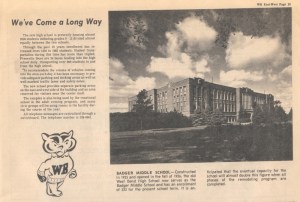
    newspaper3

    Excerpts from the Wisconsin State Journal, “Rebuilding Wisconsin, Part 1: A long and costly to-do list.”

    PUBLIC SCHOOLS

    West Bend Public School Superintendent Patricia Herdrich said she can hardly bear to walk through the district’s Badger Middle School. Built in the 1920s, the old school is the worst of the substandard buildings in this district about 75 miles northeast of Madison.

    There are, Herdrich said, 13 different levels in the school because of the hodge-podge tangle of additions over the years. There are no elevators.

    “You can’t make it accessible,” Herdrich said. “I’ve had kids on crutches crawling up and down stairs.”

    In hundreds of school districts across Wisconsin, students are stuck in inadequate and even dangerous buildings, jammed into too-small classrooms or housed in trailers in school parking lots, according to Miles Turner, director of the Wisconsin Association of School District Administrators…

    The problem is that, since school expenditures were capped by the state Legislature in 1993, the corner that has been most frequently cut by money-starved districts has been building maintenance and repair.

    In its most recent survey of school district spending, the Wisconsin Education Association Council found that 82 percent of the 303 districts that responded have cut money for improvements to buildings and grounds.

    And 77 percent reported delaying building maintenance or improvement projects. According to the 2007 infrastructure report from the Wisconsin chapter of the American Society of Civil Engineers, the median reported need of the state’s 431 school districts to catch up on repair and maintenance projects is $695,000 while the average need is $1,768,563.

    But some districts are in such dire shape that the cost of delayed projects far surpasses those numbers. Herdrich in West Bend said the district’s total deferred maintenance is $80 million.

    Bringing Badger Middle School up to standards alone would cost $29 million, she added…

    [A]s the stimulus bill was being put together, the state School Administrators Alliance conducted a needs survey of the state’s school districts.

    Only 228 responses were received from all 431 districts, but for just those districts, when it comes to repair, maintenance, and building needs topped $2.5 billion.

    Referendums have offered relief only in some districts.

    In West Bend, for example, voters defeated a $119.3 million building referendum in 2007 by a 62.6 percent to 37.4 percent margin.

    The district had hoped to have another referendum in November but decided against that when the economy went south.

    Now, a $68 million building referendum is scheduled for April…

    The version of the bill that passed the House of Representatives included what seemed a healthy amount for Wisconsin schools — a total of $729.6 million, including $317.2 million for construction.

    But the political debate and resulting compromise in the Senate resulted in much of the money for school construction, including maintenance and repair, being slashed from the bill.

    “That line item was zeroed out,” said John Forrester, a spokesman for the School Administrators Alliance. So superintendents such as Herdrich in West Bend, initially buoyed by reports that the stimulus bill could offer some help to repair dilapidated buildings, now find themselves wondering again how to house students safely in the face of failing referendums and dwindling state funds.

    It should go without saying that the current broken school finance system requires successful referenda for almost all construction, maintenance and remodeling projects.

    Thomas J. Mertz

    Leave a comment

    Filed under "education finance", Best Practices, Budget, education, finance, Local News, Referenda, referendum, School Finance

    Cuts Coming to Salem

    sheetmusic1

    “We All Love Our School”,  written by 4th grade Salem students in 2007, performed by 2nd and 3d grade students in 2008-9. Click to listen or download.

    We All Love Our School

    written by 4th grade Salem students in 2007

    Salem is Great. It’s the biggest in the state. We all love our school!
    White and blue our colors true. We all love our school!
    At Salem we’re having fun.
    Salem we’ve just begun
    Salem students are the best.
    We’re a cut above the rest.
    A-round every turn, there is some-thing to learn. We all love our school!
    A peaceful place puts a smile on your face. We all love our school!
    At Salem we learn and grow.
    Salem out to recess we go.
    Falcon is our name and learning is our game!

    Referenda in six districts failed on Tuesday.  That means each of these districts must to scale back their plans in ways that do the least harm to their students.  This is all part of business as usual under Wisconsin’s broken school funding system.

    Here is a preview of what is in store for Salem.  The headline in the Kenosha News promises “Deep Cuts,” 17 layoffs and reductions in music and art.  The story offers further details

    Cuts approved Thursday include eliminating band for children in fifth and sixth grade, cutting down on the number of gym classes children take each week, cutting back on art, and reducing reading specialty programs. All after-school sports and clubs would be eliminated, and class sizes would climb in grades three through eight. There were cuts in support staff and the administrative staff as well.

    The source of the problem is also explained:

    Salem has been facing budget shortfalls as it grapples with state school funding regulations that cap the amount of revenue schools can receive. The district has been covering its operating deficit using savings, but faces a deficit of more than $1 million next school year.

    Two board members voiced the lament familiar to many around the state:

    “This is killing me,” board member Shane Gerber said during the vote, the names of teachers who are targeted for layoff were read off. In the audience, teachers began to cry as names were read off and some walked out of the meeting.

    “We as a board are now faced with cutting programs we know are good for kids,” said President Patty Merrill. “We have attempted three referendums, all three failed. The cuts must be made.”

    If you haven’t already, listen to the song at the top and then try to convince yourself that  slowing the bleeding via band aids and reshuffles is the best we can do for the children of Salem and Wisconsin.  When you are done, contact the Governor and your legislators and tell them they need to listen to voices of children also; tell them that these children deserve music and art and reading help and all the other components of a full education.  Sign on with the Wisconsin Alliance for Excellent Schools and the School Finance Network while you are at it.

    Thomas J. Mertz

    Leave a comment

    Filed under "education finance", Best Practices, Budget, education, finance, Local News, Referenda, referendum, School Finance, Uncategorized

    Primary Election Roundup

    politics040408_fullsize_story11

    Some quick results and very few thoughts this morning.

    Turnout was pathetic.  During the Presidential campaign season we heard a lot about a new political engagement, especially among the young.   February primaries lack the glamor (and resources) of Presidential votes, but going from about 2.9 million statewide voters in November 2008 to about 250,000 statewide voters in February of 2009 does not bode well for our political culture.  Locally, in Madison District 8 — one of the campus districts — the vote total in November 2008 was about 7,500; yesterday it was 528.   One data point does not make a trend, but this can’t be good for our democracy.

    Tony Evers and Rose Fernandez survived the Sate Superintendent primary.  Here are the totals:

    Schools Superintendent REPORTING 97%
    Tony Evers

    88,734

    35%
    Rose Fernandez

    78,830

    31%
    Van Mobley 34,534 14%
    Todd Price 28,641 11%
    Lowell Holtz 22,163 9%

    I want to thank Todd Price for his effort and his successes in raising awareness of the continuing crises in school funding, testing and other school matters. Tony Evers now has my full support (and I hope to see more evidence of the aggressive advocacy he has claimed).

    All nine referenda failed!

    The Appleton referenda lost by a 5 to 4 margin.  According to the Post Crescent this will mean “as many as 30 fewer teachers and larger class sizes next fall, plus delaying safety measures for several school buildings.”

    The Clinton referendum asking to fund investments in a geothermal HVAC system failed again, this time by a large margin of 968-576.  This is exactly the sort of infrastructure investments we should be making, but under our current state school finance system they are difficult (more here, here and here).

    The Highland request for recurring authority to limit program cuts lost 298 to 158.

    Class sizes will be going up in Salem.  There is confusion about the margin.  DPI reports that it was 964 to 654.  The Kenosha News says 664 to 654.  More form that source on what this will mean to the quality of education in Salem:

    The increase, officials said, was needed to cover expenses for the upcoming school year. School Board President Patricia Merrill said the result means 19 employees would be laid off for the 2009-10 school year, with layoff notices likely to be announced at Thursday’s School Board meeting.

    Also on the chopping block are extra-curricular and after-school programs, starting this fall. Other programs scheduled for elimination include the gifted-and-talented program and technical education. Cuts are expected for music, arts, gym and Spanish. Merrill also said technology upgrades could be halted and staff workshops and travel will be reduced.

    Superintendent Dave Milz said class sizes will likely increase.

    “I’m not sure how any of these things can be beneficial for the kids,” Milz said. “This will certainly prove to be a challenging experience for the board and community to overcome.”

    Referenda were narrowly defeated in Salem last June and September.

    The vote in Siren was very close, 156 to 167 (turnout is important!).  There is talk of going back to the voters, but programing cuts are likely.

    The votes on the three asks in Waupun were also relatively close.  Out of about 2,700 votes cast, they ranged from 698 in the “ongoing operational expenses vote,” to 26 votes in the “textbooks” and “materials” measure.  There will likely be school closures, and many cuts.

    Closing the two outlying schools is a ticket item that would address about half of the budget deficit. No other suggestions presented could put a dent into it as closing Alto and Fox Lake elementary schools.

    School board president Cathy Loomans said, “The business we’re in is about putting teachers in front of students. So the majority of our budget is staffing, and unfortunately, when you make these kinds of cuts, they have to come from staffing and that’s going to directly affect class size. There’s no way anymore to insulate the students from making these kinds of cuts.”

    “Looking at what cuts we’re going to do, we have to look at what’s best for all the students to give the students across the district an equitable education,” Anne Kraintz, school board member, said.

    For more information on the situation in Waupun (from one perspective), check out this site.

    All around, not a great day for the future of education in Wisconsin.

    Thomas J. Mertz

    Leave a comment

    Filed under "education finance", Best Practices, Budget, education, Elections, Equity, finance, Local News, Referenda, referendum, School Finance, Uncategorized, We Are Not Alone

    Vote Today! – Today’s School Votes

    Today’s election is very important.  Wisconsin will decide which two candidates for State Superintendent of Public Instruction will be on the April ballot; districts around the state have significant referendum questions and there are a couple of local Aldermanic races in Madison where there are candidates who I think deserve support (there are also some other primaries for judges and Board of Education and other Aldermanic races around the state).  The projected turnout is only 6%-10%, so your vote may make the difference.

    First and foremost, Todd Price is the clear choice for State Superintendent.   Price has a thorough understanding of the difference quality public education can make in the lives of individuals, the health of our communities and the future of our state.  He also has correctly diagnosed and offered solutions to the problems of our state school finance system, our testing regimen, NCLB and more.  Most importantly, Todd Price has brought an urgency to this race that others lack.   We don’t need another state superintendent who accepts the continued erosion of our schools under a broken state finance system, underfunded programs for our highest need students and the misplaced priorities of NCLB and WKCE.  We need a State Superintendent who will challenge our governor, our legislators and our local school officials to do better.  Todd Price will be that State Superintendent.  Vote for Todd Price.

    There are nine referenda in six districts on the ballot today.  The districts are Appleton, Clinton,  Highland,  Salem, Siren and Waupun.  I don’t have time this morning to fully explore these measures (if possible, I will add some links later), but essential things like preserving smaller class size (Appleton and Siren), investing in sustainable energy (Clinton), keeping neighborhood schools open (Waupun), paying for books, technology and other learning materials and avoiding further programing cuts will be decided.  I hope they all pass.

    I am going to offer some quotes from a Todd Price press release and interview on these measures and the system that has led 151 referenda votes since January 1, 2008, most simply to preserve  or limit cuts to current programs, maintain or upgrade facilities, or build needed schools.

    Price characterizes the need for these votes as “a regrettable symptom of a school finance system that has been harming our students, our communities, and our state for far too long.”…

    “Referenda are band aids, temporary fixes. Our districts keep asking for more band aids just to stop the bleeding. It is time to address the real problem; it is time to fix Wisconsin’s broken school finance system.”…

    “These campaigns to provide an adequate education for all children divide communities and distract from the essential task of working together for the education of all children,” Price explains. “One neighborhood is pitted against another, people on fixed incomes who can’t afford tax increases but know education is important are frustrated, educators and boards of education spend too much time trying to pass referenda instead of working to improve education; parents and concerned community members end up volunteering on campaigns instead of in the classrooms.”…

    Racine Unified is a good example. The district struggles on an annual basis to balance its budget without making significant cuts to programs or going to referendum for extra money. It’s led to a contentious relationship between the district and the public, left schools in disrepair and resulted in relatively poor student performance.

    Last, voters in Madison District 2 need to keep one of our city’s most Progressive and hardest working Alders in office — vote for Brenda Konkel.  In District 8, newcomer Katrina Flores is the best choice and as a grad student in the School of Education a sure friend to the schools.

    Thomas J. Mertz

    Leave a comment

    Filed under "education finance", Accountability, Best Practices, education, Elections, finance, Local News, nclb, No Child Left Behind, Referenda, referendum, School Finance, Take Action, Uncategorized