Category Archives: Uncategorized

Who is Paul Vallas and why is he coming to Madison?

Photograph by AP/Worldwide Photos

As Jim Anchower says, “I know it’s been a long time since I rapped at ya…” Sometimes you need a break; expect more soon.

Paul Vallas will be featured at a “school reform town hall meeting” this Saturday, May 26, 1:00 PM at LaFollette High School.  The announcements feature “Madison Metropolitan School District, Verona Area School District, United Way of Dane County, Urban League of Greater Madison & Boys & Girls Clubs of Dane County” as “collaborating” hosts, but as reported by Matt DeFour the United Way  “has requested that our name be removed from all upcoming communications related to the event, but will attend to hear the conversation from all those involved.”

Attempts to clarify MMSD’s role have not yielded a response.  You can try yourself:  Board of Education: board@madison.k12.wi.us, Supt. Dan Nerad: dnerad@madison.k12.wi.us.  I’ve been told unofficially that MMSD is donating the space, which would mean that your tax dollars and mine are being used (see the district facilities rental policy here).  It would really be a shame if our district collaborated in bringing Vallas here, there is very little in his version of school reform that our community, or any community will benefit from.

I can’t answer why he is coming to Madison.  I presume that those who are bringing him would like to see Madison adopt the policies Vallas favors.

I can and will say some things about who Vallas is.  As is common with these things, it depends on who you ask.  The Koch and Bradley funded Manhattan Institute anointed Vallas with their Urban Innovator Award for 2006 (other recipients include Michelle Rhee, Jeb Bush and somewhat inexplicably Jerry Brown).   The (also Bradley funded) Heartland Institute has had consistently good things to say about Vallas.  You might recall that they are the ones with the secret “Operation Angry Badger” plan to “help defend and secure” the rule by the FitzWalker gang.   On the other side, at the Daily Censored, Danny Weil called Vallas “”vassal and executioner of public schools.”

The Wikipedia entry provides a fair if spotty overview of his career.  Here’s a short version.  When Chicago Mayor Richard M. Daley was given control of the Chicago schools in 1995, he appointed then City Budget director Vallas as CEO.  Vallas served till 2002, when disappointing progress the defeat of a Vallas friendly slate in the teacher union election led to his resignation (and here).  He ran unsuccessfully in the Democratic primary for Governor losing to Rod Blagojevich. From there it was to Philadelphia, where he served under the State appointed School Reform Commission from 2002 to 2007 and oversaw (among other things) what was then “the nation’s largest experiment in privatized management of schools.”  He flirted with other Illinois Gubernatorial runs in 2005 and 2008, and the Cook County Board President in 2009 as a Republican (prompting the question, what kind of person became a Republican between 2008 and 2009).  Vallas then became head of the State administered and Charter dominated Louisiana Recovery School District (RSD), where he served from 2007 until 2011.  The RSD is now unquestionably the largest school privatization effort in US history (see this great video of a parent complaining that when Charters are the only choice, there is no choice, more here). More recently he was tapped by an illegally appointed Board as interim Superintendent in Bridgeport CN.  His $228,000 salary is being paid for by the private Bridgeport Education Reform Fund.  Not surprisingly, Vallas’ plan for Bridgeport includes extensive blurring of the line between public and private.  It should probably be mentioned that Vallas’ resume also includes well compensated activities in Chile (leading to mass protests against the reforms he brought) and Haiti on behalf of the Inter-American Development Bank.

A couple of things stand out in his career.  One is that he’s never worked with a locally elected education authority (ie an elected School Board); the other is that privatization is prominent in his toolbox.  He explained the former to New York Times reporter Paul Tough:

When I asked Paul Vallas what made New Orleans such a promising place for educational reform, he told me that it was because he had no “institutional obstacles” — no school board, no collective bargaining agreement, a teachers’ union with very little power. “No one tells me how long my school day should be or my school year should be,” he said. “Nobody tells me who to hire or who not to hire. I can hire the most talented people. I can promote people based on merit and based on performance. I can dismiss people if they’re chronically nonattending or if they’re simply not performing.”

On the latter, a quote from an article Vallas wrote for the aforementioned Manhattan Institute:

We also have flexibility when it comes to work rules, which are decided by the board rather than the state. This has allowed us to do a lot of privatization. Our alternative schools are private schools, as are many of our special-ed schools. Our vocational education programs are also privately run to some extent. And we have contracted out for custodians, lunchroom attendants and the trades. In our system, schools have a choice. If they are not happy with their in-house services, they can privatize them. There’s competition.

It should be added that privatization also includes extensive pinstripe patronage contracts, something Vallas himself is now taking advantage of via his consulting company, winning a $1 million dollar contract that brings him back to the Chicago scene and raising some questions of transparency and conflicts of interest in Rockford).

From these quotes, it is also clear that Vallas would prefer not to have to deal with unions either.  In Chicago and Philadelphia, Charter School expansion helped limit the union presence and Vallas also moved to replace other union workers — such as custodians and food service employees — by contracting with private companies, resulting in lost benefits.  Like many of the market-based school reformers, Vallas talks a good game about addressing the impacts of poverty via education while making it harder for the working poor in his employ to provide for their families.

Vallas also likes tests, a lot.  As in Philadelphia, One of the first things Vallas did in Bridgeport was to institute an extra round of standardized tests and the reason given was that “Traditionally, instruction wanes after the administration of the state tests.  Unfortunately, this “lull” in teaching and learning deprives our students of much-needed academic support.”  This echoes what Vallas said about test-based accountability in Chicago:

Vallas does not see fear as a negative. “My first reaction is that we went for decades of no fear, and where was the creativity then?” he asks, irritation rising in his voice. “Fear is a consequence of poor performance.

“People who are afraid may not have the makeup to move schools forward,” he adds. “A majority of teachers and principals have a lot of confidence in what we are doing and are delighted that we are focusing on raising student achievement.”

The use of fear was part of the picture in Philadelphia for educators and for studentsVallas is also a fan of test (and fear) based evaluations as a basis for teacher employment.

Fear, tests and transparency all came together in Vallas $1.4 million lawsuit against Chicago teacher and Substance reporter George Schmidt, who had published flawed test items from the Vallas initiated Chicago Academic Standards Exams.  Well before Pinapplegate, Schmidt was blowing the whistle on bad tests.  As he details here, his reward from Vallas was the loss of his job and years spent fighting the suit (and to keep Substance going), but was ultimately vindicated when the monetary damages claim was reduced to $0.  Substance is still going strong.

Discussion of testing inevitably leads to discussions of test scores and much of Vallas reputation rests on his reported gains in this area.  Leaving aside the limited utility of standardized teats as a measure of learning or teacher or school or district (or CEO) quality a closer look at Vallas’ record in Chicago does not indicate marked improvement and it is likely that a similar analysis for Philadelphia would also deflate the grandiose claims.  The Consortium on Chicago School Research (CCSR) report “Trends in Chicago’s Schools Across Three Eras of Reform”  This report”addressed the problems in the public statistics by carefully constructing measures and methods to make valid year-over-year comparisons…to create an accurate account of the progress made by CPS since the early 1990s.”  Some of the problems addressed had to do with changes in tests and cut scores, others “not only other changes to the test format, testing conditions, and scoring methods, but also changes in school policies—grade promotion standards, testing policies, and eligibility around bilingual and special education services—and shifts in the types of students being served by the schools.”

I want to point to the “grade promotion” or retention policies as a particular area of importance.  In both Chicago and Philadelphia, Vallas instituted test-based retention policies (an idea so bad that even Scott walker was convinced to abandon it).  Retention’s positive impact on test scores is akin to CEO’s concentrating on quarterly profits and not the big picture of long term health.  Students in third grade the second time around will post higher third grade scores, but the gains are temporary and they are more likely to drop out and suffer other negative outcomes (you can read about the Chicago Civil Rights action on retention here and here and more from Philadelphia here.).

What the CCSR found in general was that “Many of the findings in this report contradict trends that appear in publicly reported data. For instance, publicly reported statistics indicate that CPS has made tremendous progress in elementary math and reading tests, while this analysis demonstrates only incremental gains in math and almost no growth in reading.”  The same pattern is true for the Vallas years, some slight improvement in some reading scores, and slight but more pronounced improvements in math scores.  Large racial gaps grew, Chicago continued to lag behaind the state and “Despite progress, the vast majority of CPS students have academic achievement levels that are far below where they need to be to graduate ready for college.”  It should also be noted that graduation rate improvements slowed under Vallas.  The whole report is worth a read, especially the section on “Changes in School Climate and Organizational Supports,”

No equivalent analysis has been done for Philadelphia, but there is reason to doubt the reported double digit and even 20%+ increases in students meeting standards over Vallas’ tenure.  With the latter there is some apples to oranges going on, the 2002 numbers cover grades 5.8 and 11; but by 2007 grades 3,4,6 and 7 have been added.   Philadelphia did not participate in NAEP during the Vallas years, but the performance on the Terra Nova were not as impressive as it was on the state tests and even here there were  problems.  Still, it is likely that scores did rise significantly in real ways under Vallas, but also needs to be noted that when he left only 47.0% of tested students were proficient in math, only 40.7 in reading and that that the schools turned over to outside Educational Management Organizations were below these dismal numbers.

Post Katrina New Orleans is a classic “not the same students, not the same schools” case that makes comparisons over time difficult, but there is reason not to believe the hype there either.  The Miracle Schools Wiki has lots of links that raise doubts and more.  Of particular concern are allegations made by the Louisiana School Board Association. of “scrubbing” low performers.

There is lots more out there on Vallas,  if you are interested I’d suggest clicking the links in the post, the links below and skipping the event.  If you care about schools and students, your Saturday would be much better spent working to get Scott Walker out of office (contact United Wisconsin to volunteer).  I know mine will be.

For further reading and viewing:

Diane Ravitch, “The Very Rewarding Job of Saving Schools.”

PBS coverage of Vallas (extensive on New Orleans).

Martha Abele Mac Iver and Douglas J. Mac Iver, “WORKING PAPER – Privatizing Education in Philadelphia: Are Educational Management Organizations Improving Student Achievement?”

Edward Hayes, “The man, the myth, the continuing nonsense.”

Debra Vaughan, Laura Mogg, Jill Zimmerman and Tara O’Neill”Transforming Public Education in New Orleans:  The Recovery School District.

Two takes on the fate of the Philadelphia School, now slated for dissolution:

Daniel Denvir, “Who’s Killing Philly Public Schools? Underfunded. Overburdened. About to be sold for scrap.

Doug Martin, “In the City of Corporate Love and Beyond: The Boston Consulting Group, Gates, and the Filthy Rich.”

and since these were mentioned in the Matt DeFour story

The Washington Times, “Military Schools on the Rise.”

Don Feder, “Book covers breach wall of separation.”

Jeffrey Felshman, “The Ten Commandments According to Paul” (parody).

Thomas J. Mertz

7 Comments

Filed under Accountability, Arne Duncan, Best Practices, education, Elections, Gimme Some Truth, Local News, nclb, No Child Left Behind, Scott Walker, Take Action, Uncategorized

Myths of Madison Prep, Part 2

That Petrol Emotion – “Big Decision” (click to listen or download)

Part 1 here, (the introductory material is copied from there).

The discussion around the Madison Preparatory Academy (MPA) proposal and the related events and processes has been heated, but not always grounded in reality.  Many have said that just having this conversation is a good thing.  I don’t agree.  With myths being so prevalent and prominent, a productive conversation is nearly impossible.  Since the vote is scheduled for Monday (12/19), I thought it would be good to take a closer — fact based, but opinionated — look at some of the myths.  This is part two, although there are plenty of myths left to be examined, I’ve only gotten one up here.  I may post more separately or in an update here on Monday.

Three things to get out of the way first.

One is that the meeting is now scheduled to be held at 6:00 Pm at the Memorial High School Auditorium and that for this meeting the sign up period to speak will be from 5:45 to 6:00 PM (only).

Second, much of the information on Madison Prep can be found on the district web page devoted to the topic.  I’m not going do as many hyperlinks to sources as I usually do because much of he material is there already. Time constraints, the fact that people rarely click the links I so carefully include, and, because some of the things I’ll be discussing presently are more along the lines of “what people are saying/thinking,” rather than official statements, also played a role in this decision.  I especially want to emphasize this last point.  Some of the myths being examined come straight from “official” statements or sources,  some are extensions of “official” things taken up by advocates, and some are self-generated by unaffiliated advocates.

Lastly, I want to offer some thoughts on myths.  With my students, I often do assignments on the relationship between myth and history.  There are three things that I tell my students to keep an eye on.  The first is to look at the relationship between the myth and reality (most, but not all myths have some basis in reality).  Second, I ask them to think about how people believing the myth shaped their actions and what came next.  Last, is the “follow the money” idea of exploring who benefited from particular myths and the actions that resulted from those myths.  I’m going to be exploring some of these, but mostly I will be leaving many of them for the reader to ponder further.

On to the myths, in no real order.

Madison Prep will “effectively address the educational needs of children who have under-performed or failed to succeed in Madison’s public schools for at least the last 40 years. “

The quoted portion  is from Kaleem Caire.

Before getting to the crux of the matter, which is the probable effectiveness of the educational program for these students, I’m compelled to say something about the “last 40 years” part.  Essentially, this creates another set of myths having to do with what has and has not changed over the past 40 years.  Beginning with the obvious, the students who could attend Madison Prep were not even born 40 years ago.  More to the point, things like family structure, community structure (and the lack there of), poverty, mobility, the number of English Language Learner students, and so much more, have changed significantly in this time period.  As a historian I’m attuned to continuity and change; interestingly the official Madison Prep team talks about both, but never seems to expend any effort an examining how the continuities and changes have impacted educational successes and failure. Mostly they use continuity to paint an unbroken record of failure and change to invoke a crisis (more on this below).  It should also go without saying that the educational landscape and MMSD practices have changed greatly in the last 40 years.

The usual caveats about the uncertainties surrounding the impact of any educational plan or program are in order, as is the usual appeal to base decisions on the best information you have available, and for one not to take blind leaps of faith.  These are children’s lives and there are scarce educational resources in play here.  Avoiding doing more harm has to be part of this to.  In her support for Madison Prep, MPA Board Member Gloria Ladson-Billings has betrayed history, logic and the very idea of educational research by saying “we can’t do worse.”  Of course we can, and many of the models for Madison Prep do much worse than MMSD.

The best place to start is with the oft-cited Urban Prep of Chicago.  As I have noted in a previous post, MPA’s plan of gender segregation, extended school time and “no excuses” policies, has many similarities to the Urban Prep model.  As I also noted and is well documented elsewhere, Urban Prep is by almost every measure a failure.   The attrition rates are high, the achievement scores are beyond dismal, the gaps between students in poverty and others are large.  They are doing worse – much, much worse than MMSD.

One feature that is unique (or nearly unique) to Madison Prep is employing the International Baccalaureate (IB) as a way to address the needs of students who have “failed to succeed.”  There are many good things about IB, but because of the rigor and resultant attrition rates, it is very problematic for this purpose and in this context.  I fear that IB will be a means to “push out” instead of “lift up.”

Previously, I quoted from a Denver Public Schools report on IB:

There is no available evidence that the IB will increase student achievement in DPS schools or that the IB has had a positive effect on student achievement in similar districts or schools. A thorough search of the literature has netted no empirical studies on the effects of IB on student achievement….

[T]he model is not proven to improve student achievement in schools with low-income populations, to narrow the achievement gap, or to bring  low-achieving students up to proficiency in reading, writing or mathematics.

Now, I want to point to, and quote from, two research reports on IB.  The first was either commissioned or purchased recently  by MMSD from Hanover Research (it is among the materials for the Innovations and Alternatives Committee, one that MMSD had this on file and did not use it for its MPA Administrative Analysis and is inexcusable).  The second is a pair of case studies commissioned by IB of two schools serving “non-traditional” IB students (Bland, J. and Woodworth, K. Case Studies of Participation and Performance in the IB Diploma Program, SRI International, Center for Education Policy. 2009).

Some quotes from the Hanover report:

Studies consistently find that the causal relationship between high achievement and the IB programme is bi-directional high-achieving students are more likely to become IB students, and the IB experience amplifies learning success.

There really isn’t much out there on IB with students who are not already achieving (the case of Southside High in Rockville Centre NY, is interesting, but not applicable for a variety of reasons  — demographics are the biggest — ; the success there seems to have been about boosting middle achievers, and even that success only resulted in about 10% of the students achieving the IB diploma).

Conversely, ineffective programmes tended towards a strict one-size-fits-all approach to the AP/IB curriculum,”which often led to student dropouts, including many minority students who left the programme because they believed that the curriculum, instruction, and environment of the classes were inappropriate for their individual needs. The study also identified other ways in which the AP/IB programmes failed to meet the needs of minority students.

Note that, only supplemented by the “Prep Year,” MPA is employing IB as “one-size-fits-all” approach.

And from the conclusions of the case studies:

MPA will be non selective in admissions, but certainly not in retention/attrition.

Back to the Hanover Report:

Primarily, the biggest failure of the IB/AP courses involved the difference between the programme curricula and the learning needs of students. The inability of IB or AP course curricula to meet the learning needs of minority students and students from impoverished backgrounds was especially problematic.  Ultimately, the study concluded that AP and IB programmes can provide the opportunity for minority students to succeed if a programme works to create a school-wide, an environment that fosters growth, and sufficient support structures to succeed. (Emphasis in the original)

Note that here they are talking about “minority” students, not students who are failing/being failed, as the MPA advocates often do.

The two case studies also deal with students who are not failing.  In one school there were strict admissions requirements, and the other the requirements were looser, but included being at grade level, along with some other factors.  I want concentrate on the second study, because it is closer to MPA’s plan, which will have no admission requirements.  Some charts from the study:

There are two things I want to point out with this chart.  First, notice the drops from 11th grade enrollment to becoming a diploma recipient are significant.  MPA has asserted that all of their students will earn IB diplomas.  That’s  utterly unrealistic.  At the other school in the study, the highly selective Hillsborough, only 89 of the 146 students who entered in 9th grade received IB diplomas.  MPA has also projected an equally unrealistic  5% attrition rate between grades 11 and 12; at Lamar it was 24%.

Attrition is a key issue (self-selection is another, but I don’t have the time to go into that).  It is another way MPA can do worse.  Churning students through, and in effect pushing those who don’t make the cut back to MMSD schools, while in the end serving only those who thrive.  I want make it quite clear that I am not saying this is the intent, but it is was I think the design will produce.  It is exactly those students who Kaleem Caire says are “dangling by their thumbs waiting to be rescued,” who are most likely to be ill served by IB and MPA.

Attrition is among the educational aspects that the MMSD Administrative Analysis ignored.  The chart and figures offered by MPA reveal little or no awareness or understanding of research on IB, or the schools like KIPP (see here) and Urban Prep, that are also part of their model. Here is the MPA chart and discussion:

These attrition projections are much too low, but even by these numbers it looks like only about 70 of the 120 students who started are projected to graduate (assuming that those who leave each year are drawn equally from the initial students and later arrivals).  My guess is that number will be closer to 50 graduating students and maybe even lower, well under half  (if we leave everything the same and only change the 11th to 12 grade figure to match Lamar’s study, you would end up with about 53  of the initial 120 students graduating).  Mostly importantly, those who do graduate, will overwhelmingly be those who would have graduated had MPA never existed in the first place.

This does not mean that some  of those students who leave will not have benefited in some way from MPA. There are some aspects of the school that I think are so bad as to be both harmful academically and otherwise; but IB does have some things to offer some students, and the Prep Year — if done well — could be beneficial.

One of the main points I want to make is that everything I can find, including the International Baccalaureate research materials and the consideration of attrition rates presented above, indicates that MPA will do — the least good — and the most harm — to those who need and deserve the most help.

Madison Prep officials and supporters have worked hard to disseminate myths to the contrary, but from what they have offered, and from what I can find, there is little basis in reality for those myths.

Thomas J. Mertz

2 Comments

Filed under Accountability, Best Practices, education, Equity, Gimme Some Truth, Local News, Take Action, Uncategorized

Myths of Madison Prep, Part 1

Van Morrison – “Too Many Myths” (click to listen or download)

The discussion around the Madison Preparatory Academy (MPA) proposal and the related events and processes has been heated, but not always grounded in reality.  Many have said that just having this conversation is a good thing.  I don’t agree.  With myths being so prevalent and prominent, a productive conversation is nearly impossible.  Since the vote is scheduled for Monday (12/19), I thought it would be good to take a closer — fact based, but opinionated — look at some of the myths.  This is part one, the first set.

Three things to get out of the way first.

One is that the meeting is now scheduled to be held at 6:00 Pm at the Memorial High School Auditorium and that for this meeting the sign up period to speak will be from 5:45 to 6:00 PM (only).

Second is that much of the information on Madison Prep can be found at the district web page devoted to the topic.  I’m not going do as many hyperlnks to sources as I usually do. because much of he material is there  Time constraints, the fact that people rarely click the links I so carefully include, and because some of the things I’ll be discussing are more along the lines of “what people are saying/thinking” than official statements also played a role in this decision.  I want to emphasize the last.  Some of the myths being examined come straight from “official” statements or sources,  some are extensions of “official” things taken up by advocates, and some are self-generated by unaffiliated advocates.

Last, some thoughts on myths.  With my students, I often do assignments on the relationship between myth and history.  There are three things that I tell my students to keep an eye on.  The first is to look at the relationship between the myth and reality (most, but not all myths have some basis in reality).  Second I ask them to think about how people believing the myth shaped their actions and what came next.  Last, is the “follow the money” idea of exploring who benefitd from particular myths and the actions they led to.  I’m going to be doing some of all of these, but mostly I’m also going to leave these up to the reader to ponder.

On to the myths, in no real order.

Madison Prep is a Litmus Test on MMSD’s and/or Madison’s Commitment to Students of Color and/or Students in Poverty and/or Innovation and/or Charter Schools

Madison Prep is a very specific plan with very specific educational strengths and weaknesses, potential legal entanglements, and a myriad of other issues.  The reactions and vote on Madison Prep are largely about these.

I’m reminded that Paul Soglin initially portrayed the Edgewater Development (which he then favored) as a litmus test for Madison.  Now as Mayor it looks like he has killed the project.  As he should have known in 2009, the details and specifics matter.

Yes, attitudes on all of these things listed in the heading  have shaped some of the positions people have taken, but people who share a deep commitment to the education of students of color or in poverty are on both sides of the issue, people who care little about these things are on both sides of the issue.  Many advocates for MPA believe it will help these students,  many opponents believe that it will not (more on that below and in part 2, but see this related post for now)and that it will hurt the majority of these students who will remain in MMSD schools by taking resources away.  It is a pretty bad litmus test if that’s the case.  Similar things are true with the other things in the heading (I doubt many Charter School opponents are in favor although some Charter proponents are against, … you get the idea).

And the alternative isn’t the “status quo.” That’s a false frame that has been very useful for those who attack public education.  Not doing Madison Prep does not mean not doing anything or anything better or different.

Madison Prep advocates have convinced many that there is a need to do things better and/or differently — some of us didn’t need to be convinced — but that’s much different than making the case to do MPA  (some of this is covered in the myths examined below and in part two).

It Is/Isn’t (All) About the Students

I addressed some aspects of this in relation to the Urban League and the “choice” movement in this post and this post.  In those posts I concluded that in the case of much of the “choice” movement there are larger anti-public sector forces in play, that via Kaleem Caire ULGM has strong links to those parts of the “choice” movement, and that at least one part of the Madison Prep plan needlessly exploits children and families in order to benefit the school and the idea of “choice.”

There is a more general part of these myths that applies to all of the institutional players.  It isn’t insulting to recognize the ULGM, MMSD, MTI, and even the Board of Education all have turf at stake in this matter and that they all have imperatives to protect (in the case of MTI a legal imperative to protect) and expand their turf.

It probably isn’t going too far to extend this to many of the individuals whose professional pride, reputations and to some extent livelihoods are in play.  Non-professional advocates also bring some pride to the table and many — myself included — have visions of public education we seek to expand that might be considered “turf.”

Recognizing that it isn’t “all about the students” doesn’t mean that for all it isn’t partially, or mostly, or even primarily about the good of the students, but it does take away the ridiculous posturing some are so fond of.   It can be very useful to document and delineate what else it seems to be about for institutions and individuals, but to attack one side for their interests while refusing to  recognize that  in one way or another everyone has some interest in something other than “the students”  is wrong.

It should be added that for the professional MMSD administrators, I would guess whatever desires they have to protect their turf are balanced by an understanding that controversy is rarely good for careers or school districts.  I think we can see some of this in the last myth in part one.

There Are No Legal Barriers to Approving Madison Prep As A Non-Instrumentality or Risking Legal Challenges In Order to Vote Yes is Worth It

On these legal issues (remember that according to  the Administrative Analysis the sex segregation matters still demand further review, see the ACLU for more) , the initial official MMSD position starts on page 26 of the Administrative Analysis, Ed Hughes posted his unofficial views here and the official ULGM response is here; the “despite the legal issues, vote yes” stuff is all over, the best source being this letter from Kaleem Caire.

Ed Hughes recent proposal to vote to open the school in 2013 demonstrates that  these legal barriers to approval are real and formidable.

I am not an attorney ( I written and  taught legal history, but that doesn’t count for much), so take my legal analysis for what it is, the work of an interested amateur with nothing at stake but pride.  In my opinion there are significant legal barriers to approving a non-instrumentality charter school which would violate the work preservation clauses of existing contracts.

The ULGM makes a couple of main counter legal arguments.

One is that contracts contrary to statutes  or limiting the exercise of statutory powers are void.  I see a couple of problems with this.  First, the cases cited are more about contracts that restrict exercise of constitutional duties than they are about statutory powers.  Second, and I’m not sure this is relevant, the contract did not restrict the exercise of powers when it was signed; it only restricts  the exercise because Act 10 subsequently made memorandums of understanding impossible.  If there is a conflict, it seems to be between Act 10 and the Charter School Statute.

The other is that Act 65, which allows for public employee contracts to be revised in order to cut pay or benefits also allows for a revision to employee non-union (or maybe lower paid union) employees at a non-instrumentality charter school.  This does not seem to be contemplated in the law, but I’d like to see a reaction to this (and the other issues raised by ULGM) from the district legal team.  We will probably get that on Monday; I’d like it sooner (so that we could all have something better than my inadequate legal interpretations and scribblings to go by).

It is likely that even a yes vote would not result in MPA opening.  It would be tied up in courts and odds appear to be that MMSD on behalf of ULGM would lose.

The “vote yes despite the contract/law issues” argument is based on astounding hyperbolic rhetoric, comparisons that don’t work and an end game I don’t understand.  Again, the case is made for the urgency of doing something, but that’s the litmus test myth, something does not equal MPA.   There are some very good reasons to believe that Madison Prep will do more harm than good and there is not a lot of reason to believe that opening this school will accomplish anything comparable to the examples given by Kaleem Caire of ending ” Jim Crow,” or winning Woman Suffrage (see below).   At absolute most, a few kids will have greatly improved educational opportunities.  That would be something real and good, but the scope and scale are wrong for the comparison (on the general overselling of charter schools, the miracleschools wiki is a great place to start).

The examples employed by Caire are about civil and human rights, what ULGM is asking for is to trash a contract in order to open a school.  You can see how strained is this in how Caire squeezes the word “contracts” into his rhetoric:

More importantly, will the Board of Education demonstrate the type of courage it took our elders and ancestors to challenge and change laws and contracts that enabled Jim Crow, prohibited civil rights, fair employment and Women’s right to vote, and made it hard for some groups to escape the permanence of America’s underclass? We know this is not an easy vote, and we appreciate their struggle, but there is a difference between what is right and what is politically convenient.

The history invoked is one of challenging, (sometimes breaking), and changing laws in pursuit of rights.   There is no right to open a school,  only a right to a due process decision on an application (the myth that MPA has not been treated fairly in this process, should be in part 2).  Contracts aren’t part of that history either, except in the sense that when contracts — like housing covenants  and yes ,  some union contracts (discriminatory promotional practices come to mind)  — were thought to be in violation of civil rights laws they were challenged in court (or administrative processes) after the laws were changed, not broken or disregarded.    School Boards don’t have the power to change laws and shouldn’t trash contracts.

On a radio show MPA Board Member John Roach went even further, saying that MMSD should emulate President Obama, who — according to Roach — “broke contracts” in order to kill Osama bin Laden.   In a sense diplomatic agreements are contracts and they were violated, but school boards are not heads of sovereign nations, and opposing Madison Prep really has little in common with the decisions on the choice of tactics in the “War on Terror.”

Or maybe it does, because what Caire and Roach and others are doing is a scorched earth fight, “destroying the village in order to ‘save’ it.”  Presenting these kind of false hopes and choices in this manner makes the always difficult work of school-community relations more difficult by creating unnecessary expectations and  that result  in even greater distrust.

I think the ULGM case is weak; it certainly isn’t a slam-dunk, black letter law thing.  If the vote were yes, there would certainly be challenges, legal expenses incurred, perhaps other repercussions in labor relations, and I’d guess the school wouldn’t open anyway.  With all this in mind, I don’t understand the thinking behind organizing around a false hope in a manner that will make working together in the future harder.

The Madison Prep Educational Plan Has Been Thoroughly Vetted, by MMSD, The Board and the Community.

I can’t count the number of times during this I’ve said the educational program should be central to this discussion.  It has not been.  Some of this is because other — mostly legal — issues have come up, some of it is because the MPA PR campaign and official filings have been very light on discussing how and why they see their program meeting the needs of those whose needs are not being met by MMSD, some of it is because the MMSD administration failed to address these in their analysis, some of it is that all educational programs (proposed or actual) are complex, filled with uncertainty and take work to understand.

When I point out the lack of attention given to the educational program, I am often met with disbelief or contradiction.  I can’t prove that it has not been examined, but I can point to some evidence.  The best evidence that I can think of is the official “Administrative Analysis.”  Here are some excerpts from the “conclusions” on the educational aspects (you won’t find much about education):

On sex segregation:

The Board should review these legal implications before making a judgment regarding how to proceed on this issue.

On the International Baccalaureate  (after a paragraph asking about alternatives to IB at MPA that seems to ignore the statement in the MPA plan that says “Madison Prep will offer both the Middle Years Programme (MYP) and the Diploma Programme (DP) to all its students”, the “analysis” “reccomends”

If Madison Prep is approved, it is recommended that more information be provided detailing the specific requirements for graduation.

And this on “College Preparatory Educational Program”

MMSD Response: The IB curriculum is aligned with the goal of college and career readiness without remediation.

On Harkness Teaching there is a little more in the way of questions, but no more in the way of analysis and conclusions:

…A specific teaching model (e.g. Harkness Teaching) has strengths for a range of learning and social areas (e.g. inquiry-based learning), but used exclusively, may not address the full range of learning situations required. Will other teaching methods/models will be included in Madison Prep? If so, what are examples of other acceptable models and specifically when would other teaching models be appropriate?

Recommendation: If Madison Prep is approved, it is recommended that further detail be provided regarding the appropriateness of Harkness Teaching as an exclusive teaching model or provide descriptions of the range of other acceptable teaching models and when they would be appropriate. Clarify if this method will be used daily, in all subjects, or for specific types of learning on a less frequent basis. Further information is requested regarding the potential impact on student learning and achievement during the several year period of teacher efficacy in situations where teachers may be novice in both methodology and curriculum.

This is actually the closest the analysis gets to engaging in educational issues.  All the rest are about technical matters.  My favorite is the one on the extended day/year that is a back-and-forth about a misreading of the calendar.

Remember that “how a decision to establish or not establish the proposed charter school will impact families to be served” is among the things the Administration is required to provide and the Board of Education is required to consider.  I would think that the education program would be central to that., but it isn’t there, nor has there been an extended Board discussion on this.  No wonder so many  prominent backers are silent on MPA’s educational program.  Which brings me to the next myth, but that has till wait till the next post.

Thomas J.  Mertz

3 Comments

Filed under Accountability, Best Practices, Contracts, education, Equity, Gimme Some Truth, Local News, Scott Walker, Take Action, Uncategorized

Contradictions & Confusion: Madison Prep Board Members in Their Own Words

Tyrone Davis, “Can I Change My Mind” (click to listen or download)

Children should NOT be sitting, waiting in an auditorium, to find out if they won a lottery to get into a school. A right to a good education should be like the right to clean water.  And, since when, did teachers become the demons?

Dr. Gloria Ladson-Billings on “Waiting for Superman.”

Of course  Madison Prep wants the media opportunity of children waiting in an auditorium, some advocates for the school have demonized teachers, the Madison Prep Board has decided that the only way to make the school happen is to employee non-union staff and not pay them for the extended day and year (that they are also seeking  African American and Latino staff, makes this even worse).  It should also be noted that school choice backers like the Kochs, the Waltons and  (Bradley and Koch funded) ALEC aren’t all that  keen on “the right to clean water” either.

I don’t think it’s right to be admitting a large number of students who can’t do the work and then flunking them out.

J. Marshall Osburn explaining why he sued along with the Center for Equal Opportunity for the release of the University of Wisconsin’s affirmative action admissions records

Well that sounds a whole lot like the Urban Prep model of valuing college admissions over learning and college prepardness, which has been repeatedly held up by Madison Prep advocates as a model of success.  Although I detest  the use that was made of the records, I would also like to note that I think UW should have released the records (with personal information redacted) and used the opportunity to educate about why affirmative action in admissions is a necessary and positive practice.  Openness and transparency in public and tax supported institutions is essential.

But where the 4K argument really starts to lose traction is when you consider that there is no solid evidence suggesting that universal preschool programs lead to long-term improved educational outcomes for children….

If you’re still in doubt, and think universal 4K is the solution to our education ills, ask yourself this: When is the last time you heard someone say, “You know what would solve our education problems? One additional year of unionized public schooling.” Given the track record of our public schools over the past forty years, it is completely reasonable to be skeptical that million dollar per year universal 4K programs in Wisconsin will lead to any measurable long-term educational gains for our children. And while preschool can have non-educational positive effects for children, is funding that the taxpayers’ responsibility…. or the parents’?

Torrey Jaekle, opposing 4K, demonizing teacher unions, dismissing non academic aspects of schooling and calling for skepticism and research-based educational policies

I happen to think quality 4K and teacher unions are good and things and the worth of the first is well established, but those aren’t the relevant issues.

Both the “Business Plan” and marketing campaign for Madison Prep repeatedly invoke non-academic goals, this can especially be seen in the “Core Values” section of the Business Plan” (starting on page 50).  I agree, I think schools should be about more than improving test scores, but Jaekle apparently doesn’t.

I’m also a skeptic and believe in research-based policies, which is a big reason that I oppose Madison Prep.  The evidence supporting their educational plan is thin or non-existent.  Two quick examples.  First on sex segregation,  the evisceration of Madison Prep’s “research” by Janet Hyde was devastating (it is a must read).  As Nathan Comp reported in the Isthmus “It [ULGM] says science does support gender-specific learning but was unable to provide Isthmus with any empirical data underlying this element of its model.”

Second, on the International Baccalaureate (IB),  I have been looking at research on IB in non-selective and semi-selective schools and in programs targeted to low income students.  I’ll get that written up eventually, but there isn’t much there to recommend IB as a strategy for addressing achievement gaps and the needs of struggling students.   There is however much that calls into doubt Madison Prep’s attrition projections (IB programs have big attrition numbers, especially in 10th and 11th grade) and their assertion that 100% of their students will fulfill the IB Diploma requirements is laughable.   All the links on this when I get it written up, meanwhile on the achievement gaps, some quotes from a report by the Denver Public Schools:

There is no available evidence that the IB will increase student achievement in DPS schools or that the IB has had a positive effect on student achievement in similar districts or schools. A thorough search of the literature has netted no empirical studies on the effects of IB on student achievement….

[T]he model is not proven to improve student achievement in schools with low-income populations, to narrow the achievement gap, or to bring  low-achieving students up to proficiency in reading, writing or mathematics.

There is no doubt in my mind that the research supporting 4K and quality early childhood education is far superior to the research supporting Madison Prep.

So from abandoning improvement of public schools in favor of choice that serves few students, to embracing models that send unprepared students to college, through ignoring research while planning an educational program, you can see why I’m confused by these people’s support for Madison Preparatory Academy  and willingness to serve on the Board of Directors.

Thomas J. Mertz

Leave a comment

Filed under Best Practices, education, Gimme Some Truth, Local News, Quote of the Day, Uncategorized

People Have the Power: SB 22 Dead (For Now)

Patti Smith – “People Have the Power” (click to listen or download) 

Susan Troller is reporting in the Cap Times that SB 22, the bill creating a partisan, political state charter school authorizing board to override the wishes of local school boards (and more) is dead, for now.  This is a huge victory for  public education in the state,  local control, and the Wisconsin people’s mobilization.

The bill came before the Senate Education Committee on March 23, in the wake of the mass protests.  Hundreds of newly empowered individuals and groups showed up to counter the well laid plans of the FitzWalker gang, School Choice Wisconsin, Wisconsin Charter School Association, American Federation for Children and the rest of the deformers (including Madison Prep’s Kaleem Caire).  The hearing took 10 hours (so long that I had to leave before I could read my testimony).  It was spontaneous, invigorating and beautiful (you can watch it here, via WisconsinEye or read Rebecca Kemble’s report).

It was one of the first occasions where the energy of the protests was translated into this sort of action.   Soon after, much of the energy went toward the Senatorial recall efforts.  This was and is a controversial choice.  Many, myself included, had and have mixed feelings about the wisdom of diverting small d democratic potential into big D Democratic politics.

The wisdom of that choice is still open to debate (and is being debated within the Occupy Movement), but the defeat of SB 22 strengthens the case that it was  a good choice (it does not seal the case by any means).

As Troller explains the post-recall one seat Republican edge made GOP Senator Dale Schultz’s reluctance to support and GOP Senator Mike Ellis’s non-committal enough to kill the bill, for now.

The “for now” means that just that; this could come back from the dead.  One friend suggests that we should all send Schultz and Ellis notes of thanks and support to make sure they don’t defect (and you can do that by clicking their names above) .  My big worry is making sure that the Democrats don’t defect, particularly Senator Lena Taylor.

There are many things I like about Lena Taylor, but she is a favorite of the hedge-fund managers for education deform operating under the name Democrats for Education Reform (DFER, read more at DFER Watch) , having received their generous donations in the past and been named their “Reformer of the Month” for February 2011DFER Wisconsin was and is a strong proponent of SB 22.

In politics money talks and these people have money (as the recent Imagine Schools scandals remind us, some of that money was appropriated from schools and children via charter school scams).   DFER and aligned groups dropped hundreds of thousands of dollars into the recent Denver School Board races; with $3.6 million in contributions “Stand for Children” was able to push their deforms through the Illinois Legislature; the list goes on.

So contacting Lena Taylor would be a good idea too.  You can grab talking points from Public School for the Public Good, AMPS comrade Todd Price; I love My Public School, Martin Scanlan of Marquette, and my testimony linked above.  We may not have millions to give, but we people do have the power, when they use it.

Adding to the “what next” list, the Scott Walker recall kicks in very soon and United Wisconsin is the go to place to help out with that.  Just remember that progress may start with getting better people in office, but it isn’t going to get very far if we don’t remain mobilized, remain powerful.

Thomas J. Mertz

Leave a comment

Filed under Accountability, Best Practices, education, Elections, Equity, Gimme Some Truth, Local News, National News, Scott Walker, Take Action, Uncategorized

Madison Prep, More Questions than Answers

James Brown – “I Don’t Know” (click to listen or download
With only  24 days remaining till the Madison Metropolitan School District Board of Education will vote on the Madison Preparatory Academy  charter and only 9 days until the MMSD administration is required to issue an analysis of their proposal (and that is assuming the analysis is issued on a Sunday, otherwise we are talking only one week), there are still many, many unanswered questions concerning the school.  Too many unanswered questions.

Where to start?

All officially submitted information (and more) can be found on the district web site (scroll down for the latest iterations, and thanks to the district public info team for doing this).

The issues around instrumentality/non instrumentality and the status of staff in relation to existing union contracts have rightfully been given much attention.  It is my understanding that there has been some progress, but things seem to be  somewhat stalled on those matters.

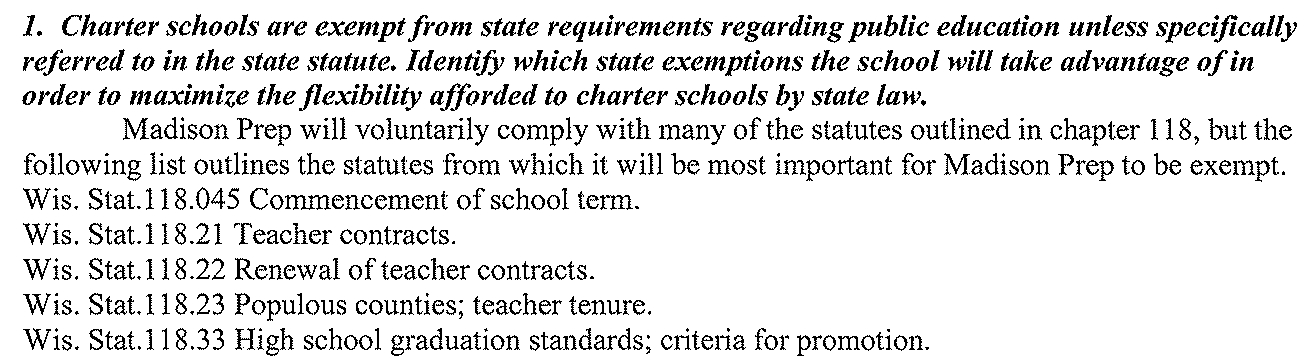
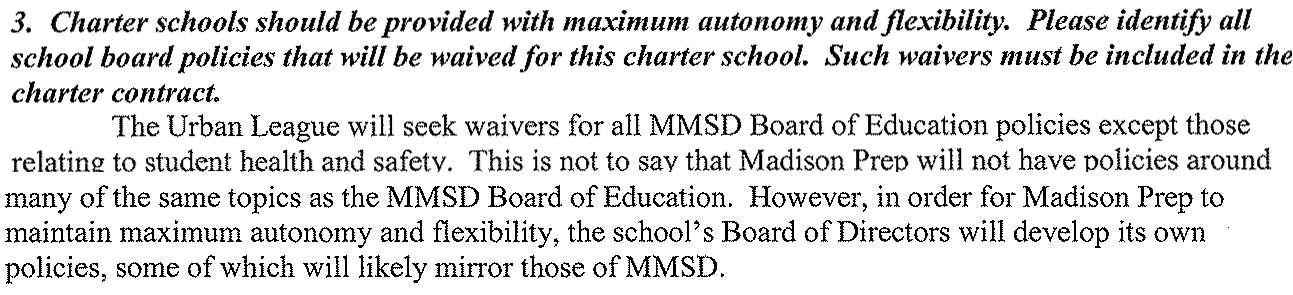
From my perspective, the biggest unanswered questions concern which policies and statutes Madison Prep is seeking waivers from. Inclusion of this information is a requirement for the submission of “detailed proposal” under the district’s policy.  I am at a loss to understand how things have come this far without this requirement being fulfilled.

It is also a common sense requirement since the very definition of a charter school is a school that is exempt from some policies.   It really is essential to know what those policies are.

The last official statements from the Urban League was in the planning grant submission and asked for a blanket waiver of all MMSD policies and select exemptions from state law.  They read (click to enlarge):

and

Well, we all know that the teacher contract statutes have changed greatly since the February date of the planning grant application and now or soon all school staff will labor under the conditions Madison Prep was seeking for their staff.    I do have some concerns and issues about graduation and promotion standards that are not clearly or directly answered in the most recent “Business Plan” or the subsequent “Education Plan” (which tellingly was an addendum to the “Business Plan”).

The MMSD policies are of greater import.  These cover everything from nepotism, to discrimination and much more.  In this case student discipline, suspensions and expulsions are one area of particular concern.  I want to know what they want waived, why and what they intend to do instead.

I’ve written about  some other unanswered questions here (in fairness, the more recent submissions partially answer these) and at the same link you can find more on what the Board is required to consider and the process.  I think a reminder on the latter is important.

According to their policies, among the things they will be considerings are:

…an analysis of how a decision to establish or not establish the proposed charter school will impact families to be served and the overall programs and operation of the District.

and

…at a minimum, consider the information included in the detailed proposal, the information provided by the Superintendent, whether or not the requirements of Board Policy have been met, the level of employee and parental support for the establishment of the charter school, and the fiscal impact of the establishment of the charter school on the District.

Board Members also have many questions which have not been answered.  You can and should review the here on them district web site.  Many, many questions, few answers.  I have been told by Board Members that additional questions have been submitted, but not posted (nor it goes without saying, answered).  Look for updates.

Other community members have questions too.  The topics I’m hearing most about include the adequacy of Madison Prep’s planning for special education students, the wisdom and legality of gender segregation, the potential for discrimination  against LGBTQ students, the budgetary and other impacts on the district and the students in the district,  the selection of students and who will be served, the IB program in general and in relation to struggling students, the attrition analysis…and much more (again, in fairness, we have more information o some of these now than we did two weeks ago).  People I know have asked both MMSD and the Urban League about many of these and have not received satisfactory answers.

The clock is ticking…the district and the Board and the community deserve adequate information in a timely manner;  the Board needs it in order to make a decision.

I believe that the lack of timely information on crucial matters in-and-of-itself recommends against granting the charter.  Under the constitution and the laws of the state the elected Board is charged with the educational well being of MMSD’s 25,000 students and the with fiscal responsibility for the funds provided by taxpayers and others.  In seeking a charter, the Urban League is asking the Board to transfer these for up to 840 students.  This should not be done lightly and  it is incumbent upon the Urban League to demonstrate that they are prepared for these responsibilities.  That so many things remain unanswered at this point does not inspire confidence.

Thomas J.  Mertz

Leave a comment

Filed under Best Practices, Budget, education, Equity, Gimme Some Truth, Local News, Uncategorized

Some Truth About Urban Prep and Why It Matters

The Undisputed Truth – ” Smiling Faces” (click to listen or download)

Introduction

To bolster their case and push their agendas, advocates for market-based education reform and   market-based policies in general tout “miracle schools” that have supposedly produced amazing results .  Urban Prep in Chicago is often exhibit A.

As Diane Ravitch wrote of Urban Prep and other ed deform favorites ” the only miracle at these schools was a triumph of public relations.”

Locally, backers of the Madison Preparatory Academy have incorporated much of the Urban Prep model in their plan and have repeatedly cited the “success” of that  school as evidence of the soundness of their proposal.   Just this weekend Derrell Connor was quoted as saying in relation to Madison Prep “We are using Urban Prep (in Chicago) as an example, which for the last four years has a 100 percent graduation rate and all those kids have gone on to college.”  As I pointed out in a back-and-forth in the comments on that interview, the actual Urban Prep graduation rate is far below 100% (62.6% is the correct figure, my mistakes in the comments, also there have only been two graduating classes, not four) .

While this is better than the figures for African American Males in Chicago and Madison, I tend to discount graduation rates as a metric for autonomous and semi-autonomous schools where what constitutes passing isn’t closely monitored and all involved have a vested interest in higher numbers.  Similar interests are present with the  college admissions figures that are at the center of Urban Prep’s marketing campaign.   Often a counterfactual is employed: “better at Urban Prep or college than in prison,” but there is no way to establish that without Urban Prep these particular students would be headed toward prison and given the family/self selection, many reasons to believe that they would not.  All of this distracts from a a consideration of the desirability of a model that sends under-prepared students to college where at best they receive remediation paid for by scarce family or scholarship funds or student loans.  Also lost is the fact that the vast majority of post-secondary institutions have minimal admissions requirements and that almost all motivated high school graduates (and even GED takers) can gain admission.

That back-and-forth directly prompted this post (it was one of many that have been simmering and was moved to the front burner).  As the title indicates, I want to dig  beyond the hype and look at what has and has not been achieved at Urban Prep.  I also want to explore a bit how the hype has distorted and damaged discussions and deliberations about education and education policy.

An Aside

This most definitely is not a rejoinder to Mr. Connor, but since I did mention him, I will say up front that in both the interview and the comments, I sensed from his words —  more than I have from many others  —  a willingness to acknowledge the complexity of the issues and the limitations of any one educational program.   This is important, because  —  as addressed below  —  I see much of the negative impact of the “miracle school” myth as being due to denial of complexity and limitations.

Some Truth About Urban Prep (Numbers and Charts)

First the caveats.  I don’t now and never will believe that test score data gives anything like a true or full picture of a school (or district or state).  Standardized tests are at best a limited snapshot, designed to sort students, not measure what they know; and so much else of what goes on in schools  —  both good and bad  — and contributes to or detracts from  personal development is not and cannot be quantified with any degree of confidence.   So “some truth,” from some test score data, not the whole truth.  One more caveat is that all numbers are from the Englewood Campus (the others are too new to have posted data).

Gary Rubenstein and others have done the basic work of delineating the abysmal test scores at Urban Prep.   You can view the interactive school Report Card here.  There really is no way to spin 17% of the students meeting state standards as a “success,” (nor  is there any way to look at the 29% meeting standards in the Chicago Public Schools and not demand change of one sort or another).  The idea that Urban Prep is a success to be emulated is absurd.  Further examination of the record only reinforces this conclusion.

What I  want to do here is look a deeper at the differences in achievement (gaps) between “easier to educate” and “harder to educate students  at Urban Prep, specifically around poverty.  One more caveat: looking at gaps based on broad categories like poverty, special education and race also distorts the realities of schools and students, all poverty is not the same (for a fine macro take on this see this from Bruce Baker), special education students have a wide variety of abilities and the of salience race is not simple or constant.

Still, much of the case being made in favor of Urban Prep and Madison Prep is based on standardized test achievement gaps, so looking at the gaps that exist at Urban Prep is reasonable.

Poverty  matters and the gaps based on poverty —  as measured by Free or Reduced Lunch status  — at the almost entirely African American Urban Prep are eye-opening and further  puncture the myth that this school has the answers.

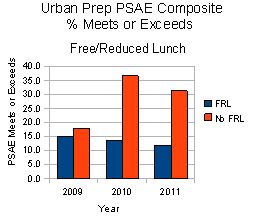
The first chart shows composite percentage meeting (none exceeded) state standards on the Prairie State Achievement Exam (PSAE), all PSAE data from here.

As bad as the scores are for the school as a whole, they are much, much worse for the students in poverty. In the most recent year the gap is 19.7% and only 11.7% of students in poverty meet the standards.

Similar,gaps on the ACT (raw data here).

This shows the percentage of students who achieved a composite score of 20 or greater, a measure of “college readiness,” but not the official ACT version (both measures are problematic for a variety of reasons).  The poverty gap was 18.2 in 2011, with only 5.3% of students in poverty scoring a composite of 20 or greater.

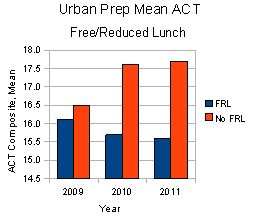
One more from the ACT, this one shows composite means.

The point differences aren’t that great, but the gap is there and neither the 17.7 (for non FRL) nor the 15.5 (for FRL) inspires confidence.   When you learn that Urban Prep has partnered with a for profit ACT Prep company, these scores look even worse.

Whatever might be working at Urban Prep (by these measures), is working much better for non Free/Reduced Lunch students than it is for students in poverty.   It should also be noted that on most of these measures and for most years, with one exception, the gaps have grown.  Poverty matters.

(Some of) Why This Matters

The Big, Big Picture: Structural Inequality

The Big, Big Picture is about structural change in our society and how the myths of “miracle schools” and equality of opportunity via education work against those changes.  The”schools and schools alone can overcome inequality, ” teacher and teacher union bashing corporate reform crowd associated with the Education Equality  Projectsignatories include  Kaleem Caire, Newt Gingrich,  Michelle Rhee,  Whitney Tilson (of DFER),  Dr. Beverly L. Hall (the disgraced former Atlanta Superintendent), Eric Hanushek (of the Hoover Institute)…you get the idea  — make extensive use of the supposed miracle schools to advance their agendas.  They don’t want the myths exposed, they don’t want structural inequality examined.

I’ve spent a good deal of my life studying and working for equality of educational opportunity and strongly believe that public education is the best tool we have for combating inequality, but “social”  equality (“social” as in TH Marshall’s conception of “Social Citizenship” see Linda Gordon and Nancy Fraser for more) and even real equality of educational opportunity requires something much Broader and Bolder than school reform can bring (click the link, I’m a signatory there).

Yet it is incontrovertible  that no school or teacher can fully erase the educational advantages that the children of the educated and the wealthy have over children without books in their homes or even homes at all.  Even at a school like Urban prep, where likely no students are wealthy but many are poor, the differences are pronounced.

In more subtle ways  the myths of meritocracy and educational opportunity have worked against the fuller enactment of social provisions found in most Western nations and continue to obscure and distract from confronting the structures that reproduce inequality.

I have another post  germinating that will cover some of this, so I’m going to keep working to expand Opportunities to Learn  and set this analysis aside for now (related thoughts from Diane Ravitch here).

The Big Picture: Educational Policy

In terms of educational decision-making, a big problem with these myths is that they are false and false premises poison the process.

Because the myths are as attractive as they are false, getting past this is difficult.  People want to believe in miracles.  Add to that they are being spread via a very, very  well-funded marketing and lobbying campaigns and the problem is compounded.   A credulous media doesn’t help either; miracles make great stories ( see ” “Misinformed charter punditry doesn’t help anyone (especially charters!)” by Bruce Baker for a somewhat different take on this).

The reality of expanding opportunities and extending attainment is not as simple or as marketable.  Lists of “proven” policies  — like adequate funding, smaller classes, differentiated resource allocations (poverty aids); differentiated instruction; Quality  early childhood education; experienced; well prepared and compensated staff (not just teachers, but social workers, EAs. librarians, psychologists, counselors,  all in adequate numbers to assure that students get the attention they need);  high expectations and challenging academic work  for all students, quality and culturally relevant instructional materials, school and classroom diversity,  professional learning communities where educators have a respected voice in policy and practices, flexible pedagogy, well designed and frequent interventions for those falling behind, parental and community involvement  —  don’t have the same appeal.

When you add to these an acknowledged  need to attempt to address factors beyond the control of the schools, like mobility, developmental environment, peer cultures, health and medical issues (including but not limited to those like lead poisoning and fetal alcohol syndrome that directly effect learning and disproportionately impact minorities and those in poverty), food insecurity, housing insecurity,…..you’ve lost most of your audience.

If anyone is still listening or reading, you will almost certainly lose them if  you honestly end by saying  “these are some of the things we should be doing and they will help many,  but even with these we won’t achieve equality and maybe not even quality education for all.”   Complex, multifaceted, expensive and uncertain is a hard sell.

Closer to Home

As long as  the myths and narratives of advocates like those pushing Madison Prep remain largely unexamined, the false but attractive stories of simplistic miracles will have an advantage.  Even the  “if not this, what’s the alternative” response to questions and evidence leaves the public relations deck  stacked in their favor.  They have an easily marketed “tight package” but reality isn’t so tight and neither are  good education policy and practice.

Just for the record,  my answer to “if not this what” would begin with the above lists, include a call to implement the recommendations of the Equity Task Force and extend to seeking better understandings of how multiple factors such as mobility, race, poverty, disabilities, language…interact among students in MMSD, and how to and address these (one of my big complaints with the Madison Prep sales pitch is the simplistic framing of achievement as an exclusively  racial issue,  and the even more simplistic conflation of the experiences of African Americans and Latinos) .  I’d also recommend “Why Does the Gap Persist?” by Paul E. Barton as a good starting point on the state of research-based knowledge (along with the Better Bolder materials linked above and …..and….).  Not very tight or marketable, but the kind of things I think we should be talking about instead spreading or busting the myths of Urban Prep and the like.

Many people have  said that it is good that Madison Prep has forced our community to have a conversation about the education of students who are failing/being failed.  I wish we were having that conversation  but we aren’t.  There has been more heat than light and more myth than fact.

Much about the way Madison Prep has been presented has worked against the kind of deliberation I think our students and community would benefit from.  Perhaps the most basic part of this is  the fact that months into the marketing campaign and weeks before the vote on the proposal, the educational program  for Madison Prep is  still very much an outline (the basic requirements under for a “detailed” proposal” under MMSD policy have yet to be satisfied)  and it certainly has not been given much scrutiny.

The educational program should be central to the conversation.  Many communities spend months or years considering in great detail the pros and cons of single aspects of the Madison Prep plan, such as extended time, International Baccalaureate (perhaps relevant to this is the fact that despite claiming an Advanced Placement program Urban Prep students have not taken a single AP exam),  single-sex education (another Urban prep practice), “no excuses” policies (Urban Prep again), extended school day (yep, Urban Prep and like so much of this not supported by research)….With the clock ticking, we’ve spent almost no time on any of these, singly or in combination (as I’ve said repeatedly, the combination matters because the whole could be less –or more — than the sum of the parts).

The clock is ticking, but it isn’t too late.  I have faith that the Board of Education will at least attempt to deliberate based on facts and not myths, as well as some hope that a significant portion of the community, including some supporters of Madison Prep, will welcome and engage in this process.  Some hope.

Thomas J. Mertz

5 Comments

Filed under "education finance", Accountability, Best Practices, education, Equity, Gimme Some Truth, Local News, National News, Take Action, Uncategorized, We Are Not Alone

Madison Prep – 1,2,3 Yellow Light (updated)

The Talking Heads, “1,2,3 Red Light” (live, 1977 — click to listen or download).

[Update — I forgot a huge issue:  Waivers ULGM had previously asked for a blanket waiver of all MMSD policies and some state laws.    There has been no further information on this.]

Big news over the weekend in the Madison Preparatory Academy saga.  There has been significant and positive movement on four issues by the Urban League of Greater Madison (ULGM).  First, they have changed their request from non-instrumentality to instrumentality, increasing control by and accountability to the district.  Second, they have agreed to be staffed by teachers and other educators  represented by Madison Teachers Incorporated (MTI) and follow the existing contract between MTI and the Madison Metropolitan School District (the memo on these two items and more  is here).  ULGM has also morphed their vision from a district-wide charter to a geographic/attendance area charter.  Last, their current budget projections no longer require outrageous transfers of funds from other district schools.   Many issues and questions remain but these move the proposal from an obvious red light to the “proceed with caution” yellow.  It is far from being a green light.

Before identifying some of the remaining questions and issues, I think it is important to point out that this movement on the part on the Urban League came because people raised issues and asked questions.   Throughout the controversies there has been a tendency to present Madison Prep as initially proposed as “THE PLAN” and dismiss any questioning of that proposal as evidence that the questioners don’t care about the academic achievement of minorities and children of poverty.  This has been absurd and offensive.  Remember this started at $28,000 per/pupil.  Well, ULGM has moved this far because people didn’t treat their proposal as if it had been brought down from Mount Sinai by Moses;  if the proposal is eventually approved,  MMSD and likely Madison Prep will be better because these changes have been made.  As this process enters the next phases, I hope everyone keeps that in mind.

There is a Public Hearing on “The Proposal” tonight, October 3,2011 @ 6:00 PM at he Doyle Building (show early, there will be a crowd).  “The Proposal” is in quotation marks because there is much information that is required by Board Policy in a detailed proposal that is either missing or incomplete.  What we have officially — many things have been discussed in the press or on the Madison Prep site in more (but still not satisfactory) detail than appears in the official record —   is all (or nearly all) posted on this page from the district.

In the next 6-8 weeks the Board will vote on the proposal.  According to their policies, among the things they will be considerings are:

…an analysis of how a decision to establish or not establish the proposed charter school will impact families to be served and the overall programs and operation of the District.

and

…at a minimum, consider the information included in the detailed proposal, the information provided by the Superintendent, whether or not the requirements of Board Policy have been met, the level of employee and parental support for the establishment of the charter school, and the fiscal impact of the establishment of the charter school on the District.

What follows is a very initial and very lightly annotated list of what I see as things that should be part of this process.  Because new budget information was only released Friday evening and much other information is lacking, I want to emphasize that this is initial.  They are grouped loosely by topic and in no particular order (I will say I think the last is most important) ; some are things I think are of real concern, others are things that I just think need answers.

Budget Related:

There is much analysis yet to be done on the educational soundness of the choices made in the budget and more, but for now four issues jump out at me.

  1. Fund-raising projections at or above $500,000 per year.  This is a huge figure.
  2. Cost to families of about $770 per student, per year (uniforms, activity fee and field trip fee).  I misread the budget here and it looks like that included lunch and breakfast.  I believe the correct figure is about $270.
  3. No accounting for attrition:  Both ‘No Excuses” and International Baccalaureate (IB) programs have high attrition rates and all schools have some attrition.
  4. In years 6 or 7  IB exam fees kick in .  These could total in the tens of thousands annually.  We only have years 1-5 in the budget.

MTI Contract:

  1. Supervision of MTI members by non-MMSD employees may violate the existing contract. [Update:  And state statutes, which read: ” If the school board determines that the charter school is an instrumentality of the school district, the school board shall employ all personnel for the charter school.”]
  2. “Performance” based bonuses may violate the existing contract.
  3. What happens when the current contract expires.  If Act 10 is still in place, the protections currently available cannot be extended.  Despite the recent movement, the Madison Prep team  has a record being anti-union.

Location and Attendance Area:

The latest information as reported in the Cap Times (not anything official) is:

Caire says the school is looking at facilities to rent on the near west side, with most students likely to come from the current Toki, Cherokee, Jefferson and Wright middle school attendance areas.

First Wright does not have an attendance area of its own but encompasses the whole West area.  I understand this as saying the school will draw from West and Memorial areas, but this needs clarification.    Once clarified, the likely impact on all schools involved must be considered, as well as how this will shape the demographics of all the schools involved, including Madison Prep (remember, charter schools cannot discriminate in admissions).

Single Sex Education:

ULGM has said they intend to  satisfy the legal concerns of DPI at the time they finalize their contact with MMSD (if it gets this far).  This may be OK for DPI and planning grant funding, but seems to be mighty late in the game for MMSD.  I really think that this needs to be cleared up before the Board votes.

There is also the unexamined issue of how this fits with MMSD’s commitment to non-discrimination in relation to transgender students (something that is written into their Charter School Policy).  For those who don’t think this is important, I suggest you read the public testimony from the 2004 meeting that prompted MMSD to become a leader on this issue.

Who Will Attend:

This is related to the Location and Attendance Area matters, but extends beyond.   Given the laws and policies requiring open charter school admissions, I still don’t understand how or why this can work to target those students who are failing/being failed.

The Educational Program:

This is and should always be the crux of the matter.  If the program being proposed can reasonably be said to have a highly likelihood of significantly improving the educational attainment of a significant percentage of those who attend, then (almost) everything else becomes secondary (it doesn’t go away, but it recedes and note that all of the “high likelihoods” and “significantlys” are  – to a great degree  —  subjective).

I wrote before:

The Madison Prep educational plan itself is an incoherent and contradictory mélange of trendy and unproven elements.  Some of what is being proposed is promising (intensive tutoring, perhaps longer school days and years), some of it educationally empty (uniforms), and some of it likely damaging to creativity and authentic learning (the militaristic discipline of the “No Excuses” models).  None of the elements in-and-of themselves have been shown to make a significant impact on academic achievement and because of the contradictions there is a good chance that the whole will be less than the sum of the parts.

There has been nothing from Madison Prep since I wrote that to change my impression.    I’ll be researching and writing more on this in the coming weeks and hope that more information from Madison Prep on their educational plans is forthcoming.

I want to point out that the incoherence and contradictions of what we have seen so far block the supposed path to replicating any possible successes in district schools   If this works, it won’t be at all clear what aspects made it work.

Lately I’ve been digging into IB materials and looking for places where it has been tried with high minority and/or high poverty student populations.  What I’ve found thus far is some real, but pretty limited success, high attrition and that even the “non-selective” programs (most IB programs have a very selective  application process) seem to require students to  be at least at grade level when they begin.  This doesn’t sound like the students featured in the Madison Prep media campaign.

Since I’m on the topic of IB, one other question has occurred to me concerning how Madison Prep intends to implement the program.  Some schools do a “certificate” allowing students to pick and choose which classes they do IB and which they don’t; others do only the “all IB” diploma program; still others have some students on one track and some on the other.  This matters in terms of both vision and budget.  If not all students are supposed to be “all IB,” that will require more non-IB course offerings; if all are “all IB” the exam fees per student will go up (as will attrition).

I’m going to leave this for now, with a promise to expand on those areas that I think are most important and a reminder that thorough vetting is always better than faith-based policy.  Sifting and winnowing, a proud Madison tradition.

Thomas J. Mertz

2 Comments

Filed under "education finance", Accountability, Best Practices, Budget, Contracts, education, Equity, finance, Gimme Some Truth, Local News, School Finance, Take Action, Uncategorized

Is it “all about the kids” (and what that might mean)? — Take Two (in relation to ULGM and Madison Prep)

Note: This image is not from either of the films mentioned, but from another charter school lottery. For reasons that should be clear from the post, I selected a picture where the indiividuals are difficult to identify.

Frankie Beverly & Maze, “Joy and Pain” (click to listen or download)

This is Take Two in a series.  Take One, with a fuller introduction,  can be found here.   Briefly, the idea of the series is to counter anti-teacher and anti-teachers’ union individuals and “reform” groups appropriation of the phrase “it is all about the kids”  as a means to heap scorn and ridicule on public education and public education employees by investigating some of the actions of these individuals and groups  in light of the question “is it all about the kids?”  In each take, national developments are linked to local matters in relation to the Madison Prep charter school proposal.

Take Two: A Picture is Worth A Thousand Words: Public Lotteries and  the Exploitation of Families and Children

The narrative arcs of the highly publicized films The Lottery and Waiting for Superman similarly follow families as they seek admission to charter schools via lotteries.  Both films paint  a picture of public schools as failures and present charter schools as the only means for the families to access quality education.   The words “desperate” and “desperation” are used frequently in reviews to describe the families’ desire to escape public schools (more here and here and here and here…that’s enough).  They are very effective propaganda.

Rick Ayers called Waiting for Superman “a slick marketing piece full of half-truths and distortions.” In a review for the National Education Policy Center’s always wonderful Think Twice” project, William Tate wrote of The Lottery

Unfortunately, in terms of substantiating its narrative argument, The Lottery is at times more like another game of chance—three-card monte—in that it relies far too much on skillful sleight of hand and misdirection. While there is much that is very real and poignant about this film, it fundamentally misdirects viewers away from the actual evidence about the results achieved by charter schools.

A large part of this misdirection is achieved by placing real families and children at the center of the films, by putting human faces on the complex issues of education and using their stories to make things appear simple.  The families plights are employed  in the service of advancing the cause of market-based educational “choice” policies.   The whole enterprise is exploitive, but some aspects are worse than others.

The iconic images of both films are the contrasting  joy and pain of the respective lottery winners and losers; the smiles and hugs contrasted with the tears and hugs.    Among the things kept hidden in the films is the extensive and expensive marketing campaign that produced those images.   Juan Gonzalez reported:

In the two-year period between July 2007 and June 2009, Harlem Success spent $1.3 million to market itself to the Harlem community, the group’s most recent financial filings show.

Of that total, more than $1 million was spent directly on student recruitment. The campaign included posters at bus stops, Internet and radio ads, mass mailings of glossy brochures to tens of thousands of public school parents in upper Manhattan and the Bronx and the hiring of up to 50 community residents part-time to go door-to-door in Harlem soliciting applicants.

All of this was done to fill a mere 900 seats.

I fail to see how spending $1.3 million to market 900 slots can be in the interests of the kids.

But it is the exploitation of the pain and tears that I find most disturbing.  It is the exploitation of the pain and tears that makes me question if it is “all about the kids” because I can see no way that the cause of those particular lottery-losing families quest for a quality education is served by having their moments of disappointment made a public spectacle.

I’m sure choice advocates would argue that the larger cause is being advanced and that in the name of that cause some sacrifices must be made.  As I detailed in a previous post, the idea of the larger cause of “school choice” being worthy of such a sacrifice in the name of “the kids” does  not stand up to scrutiny.  In the aggregate, neither those who enroll in “choice schools” nor those who remain in public schools have experienced a net benefit from this government-funded free-market experiment.   Exploiting some families for the benefit of other families is bad enough, exploiting them for purely ideological reasons is indefensible.

Indefensible, but common.  A search of news sites reveals countless media events staged around charter school lotteries and each one features a mini-version of the Lottery and Waiting for Superman narrative: desperate families, exultant  winners, and defeated losers.  In each case the take away is that — despite all evidence to the contrary — attending public schools instead of a charter school dooms children to brutal and hopeless future.  With each media event that narrative becomes stronger and the evidence recedes more from the public consciousness.  The kids, like everyone else, would be best served by full and honest portrayals of educational options.

Of course that’s not the idea.  The  Walton, Gates, Joyce and Casey Foundation funded National Association of Public Charter Schools publishes a “Lottery Day Event Tool Kit.”  According to the kit:

This event presents a wonderful opportunity to:
• draw media attention to the demand for high-quality charters,
• grow awareness among families of the availability of quality schools of choice, and
• create an opportunity for charters to communicate their quality and
success.

All about the kids?   The most extensive section of kit concerns attracting and communicating with the media.  The families of applicants are treated as little more than props.  In fairness, the kit does suggest that school officials:

Write thank-you notes to parents and students who were not selected. You appreciate the time and effort and know they are disappointed. You are disappointed too, hope that they will apply again, and wish them the very best.

I like the “apply again.”  The media event will need  props again next year.

It isn’t surprising that Madison Prep is planning on following this script.   In response to questions from the Madison Metropolitan School District on admissions , the Urban League of Greater Madison wrote:

If the school receives more than 45 enrollment forms for either grade level in the first year, or enrollment forms exceed the seats available in subsequent years, Madison Prep will hold a public random lottery at a location that provides enough space for applicant students and families. (emphasis added)

What possible good would a public lottery do the winners?  Has anyone considered the harm a public lottery could do the losers?

This lack of attention given to vulnerable lottery losers stands in contrast to the supposed concern the Urban League paid to the confidentiality of parents in their recent “no media (except those friendly to Madison Prep)”  media event.  Here is how Madison.Com reported Urban League CEO Kaleem Caire’s reasoning prior to the meeting:

“This is about the parents first,” he said. “Oftentimes we don’t put them first. And we have to do that this time.

I guess after losing a lottery isn’t one of the times you “have to” put parents or children first.

By-the way,  I’m still waiting for the promised joint statement from Superintendent Dan Nerad and Kaleem Caire “about the meeting.”  If it ever comes (don’t hold your breathe), maybe that will help me understand.   I’m sure that in some fashion they will say “it is all about the kids.”  Forgive me if I don’t believe them.

For further reading (in addition to things linked in the text):

Diane Ravitch, “The Myth of Charter School.”

Michelle Fine, “Memo from Lois Lane” on the Not Waiting for Superman site.

Liana Heitin, “What About the ‘Lottery’ Losers?”

Kevin Drum, “Winners and Losers in the Charter School Lottery.”

Alan Gottlieb, “Life Lottery.”

Thomas J. Mertz

2 Comments

Filed under Accountability, Best Practices, education, Equity, Gimme Some Truth, Local News, National News, Uncategorized, We Are Not Alone

Is it “all about the kids” (and what that might mean)? — Take One (in relation to ULGM and Madison Prep)

Sir Mack Rice “Money Talks” (click to listen or download)

My training as a historian has taught me that all knowledge is tentative and that this is especially true when it comes to assigning motives to people’s actions.  It has also taught me to not accept self-proclaimed motives at face value , to only state an opinion  about the motives of others when there is a preponderance of evidence,  and to look  at actions and consequences as well as  rhetoric when trying to make sense of things.

With those caveats,  I think it is worthwhile to investigate the motives, actions and the consequences of the actions of Kaleem Caire and some of others associated with the Madison Prep proposal and the Urban League of Greater Madison in relation to public education.

Enemies of teachers and teacher unions have seized upon the phrase “it is all about the kids” to ridicule and attack teachers and their representatives.   With union and (almost all) others, of course it isn’t “all about the kids.”  Interestingly, those who blame unions for some or all of the ills of public education — like many of  the proponents  of Madison Prep — often offer their own versions of “it is all about the kids.”  Examples include  Michelle Rhee who named her group Students First (Valarie Strauss pointedly offered a column on Rhee’s organization titled “Rhee’s campaign is not about the kids.”) and the anti-Union political bribery has been done  in Illinois (and elsewhere) under the banner of Stand for Children ( a must-see video here).

This is the first of a series of three “takes,” distinct but related investigations of what else besides concern for “the kids” might be fueling the Madison Prep effort and some thoughts about how a sincere effort largely or even exclusively on behalf of “the kids” can lead to consequences (intended or unintended or both) that many of us see as very harmful to “the kids.”

Take One:  Why did the Walton Family Foundation spend  $157 million last year on “education reform” (and almost as much in previous years) and how this relates to Madison Prep?

The Washington Post reported that in 2010 The Walton Family Foundation gave grants totaling over $157 million to what they deemed “education” reform efforts.  The entire list is here, and you can see the previous years here.  Under “Shaping Public Policy,” you can find such groups as the Barry Goldwater Institute for Public Policy Research; the National Right to Work Legal Defense & Education Foundation;  Wisconsin’s own Right Wing Press Release machine the John K. Maclver Institute for Public Policy, Inc.; and Kaleem Caire’s former employers the Black Alliance for Educational Options (BAEO).

The Walton Foundation describes its educational policy work and goals in this manner:

For parents to be empowered to choose among high-performing schools, local and state public policy must allow for those choices to exist. To this end, we seek to build the capacity of organizations to help enact, strengthen and protect programs that empower parents to choose high-performing schools.

Investment Strategies

Within our Shape Public Policy initiative, we focus on advocacy groups promoting:

  • Public charter school choice;
  • Private school choice;
  • District reforms, particularly open enrollment and district school choice; and
  • Cross-sector parental choice, parents are empowered to choose across school.

Note that the ability “to choose” is the goal, not universal access.   I want to return to this in the context of their relationship to Kaleem Caire  and Madison Prep, but first I want to say that there is a preponderance of evidence that the Waltons’ motives have very little to do “high powered schools” or education (especially the kind of education that makes people ask questions about the doings of people like the Waltons) and everything to do with destroying the public sector.  The same can be said to a great degree about many of the other supporters of Caire’s work, with some overtly racist and segregationist dimensions for at least the Bradley Foundation, who funded The Bell Curve and the Kochs who have been active in the re-segregation of Wake County NC schools (watch this powerful video, appropriately titled ” Why do the Koch brothers want to end public education? “).

As I was working on this Bill Lueders of the Wisconsin Center for Investigative Journalism released the first of his three part series on the Walton’s and other choice advocates’ activities in Wisconsin,  This saves me a lot of trouble preponding the evidence.  In part one you can read about the  tens of thousands of dollars in direct contributions to candidates, the uncounted indirect contributions via front groups,  the ties among individuals like the Waltons and Betsy and Dick DeVos and organizations such as the American Federation for Children and the Alliance for School Choice.    Not mentioned in part one of the Lueders piece is the relationships to American Legislative Exchange Council, another beneficiary of the Walton largesses and one that gets us closer to their public sector destroying mission.  You can also get a glimpse at some of the Walton’s federal activities via Open Secrets, here.

David Sirota’s “The bait and switch of school ‘reform“” brings it back to covers more of this, including the direct profit motive and the alliance of conservative and “neo-liberal” actors.  “Following the Charter Dollars” by Don Whittinghill of the Louisiana School Boards Association is also a must read (for those who want more on Louisiana, “NOLA Public Schools & School Privatization Part 1: Selected Bibliography of Articles, Books, Studies and Informed Opinions–2011 to 10/2010” is a good place to start; for the conservative movement ad the role of “think tanks” in general, this bibliography from the Commonweal Institute \\is very useful..

All these add to evidence that with the schools as well as in the workplace and for working parents, in the electoral arena,  in tax policy, on the environment and with so much more, The Waltons and there free market friends have interests that are very different than the well being of America’s children and very much geared toward weakening, undermining and destroying the good of the public sector.

Still, in a strange way if you believe that the entire American experiment in universal common schooling has been an irredeemable failure, public sector destroying may circle back to the quest for quality education .

I don’t believe that.  I’ve put in countless volunteer hours working for change and improvement in public education, but I’m more of a believer in the “Conservationist Ethic in Education”  and although it is often frustrating, Tinkering Toward Utopia has more appeal to me in public education than creative destruction, especially when the worth of what is being created in the wreckage is questionable at best.

For now though, let’s leave speculation about motives aside, take  them at their word  and assume that this is all or nearly all about the kids  and look at how that has worked out.  In essence that’s what Kaleem Caire has done and what he he is now asking the Board of Education and the taxpayers of Madison to do;  to follow the path prescribed by the Waltons and their ilk and see how it works out for the kids.

For the last decade  Kaleem Caire’s work has been funded by people like the Waltons and the Bradley Foundation, the (Milton) Friedman  Foundation and even the Koch Brothers.   It wasn’t always that way.  When he ran for the Board of Education in 1998 (the first Madison School Board campaign I was part of), the Capital Times reported

If elected, Caire says he will lead the fight against the ”very elitist conservatives who are trying to basically break the back of public education.”

Then he began working with or for these people.  Now he dismisses any objections to these alliances, as in the recent Wisconsin State Journal story:

“On the issue of vouchers, we agreed,” he said of his conservative benefactors. “On other things, we didn’t. I don’t listen to the guilt-by-association crap.”

He pointed out that other funders included the Bill and Melinda Gates Foundation and the Joyce Foundation, considered more left-leaning politically.

First and as an aside, very, very few people in ed policy consider the recent work done by the Gates Foundation (or to a lesser extent the Joyce Foundation) to be “left-leaning.”  They are more right-center  in a landscape that has been shifting steadily to the right.

Second, I don’t think “guilt-by-association” is “crap.”

I understand building coalitions and working with people you might otherwise disagree with toward a common goal, but you do have to choose your comrades and I think there should be some limits on who you are willing to associate with.  Maybe that’s just me.

One reason for limits is that there is a danger of being used, of having the distinct agenda of one party to the deal advanced to a much greater degree than your common goals.   It has become common for conservatives and corporate America to use Civil Rights organizations and minorities to help advance their agendas.  It is no accident that Linda Chavez is the face of the (also Bradley Foundation backed) Center for Equal Opportunity, and their attack on affirmative action and bilingual education at UW and elsewhere.  Just this week there was a story about the Congress on Racial Equality opposing Green Jobs at the behest of their funder ExxonSupporters of the AT&T/T-Mobile merger include the NAACP, the Gay & Lesbian Alliance Against Defamation, (yes, unions are not immune) the National Education AssociationThe national Urban League supports too.  All of these organizations have benefited from generous donations from the telecom behemoth.

I remember Caire’s mentor Howard Fuller saying “we use them, they use us,” but this seems to set the two parties up as equals in the exchange and we all know that one side has millions or billions of dollars at their disposal, while the other brings to the table little more than their energy and ability to complicate the racial politics.

So to see if the deal has been a good one, we have to return to “the kids.”  The Walton’s posit expanded choice as an end of itself;  Kaleem Caire has presented choice as a means to an end, the end being access to quality education and improved educational outcomes.  There is no question that the Waltons have been successful in expanding choice (and I’d add they have made significant progress in their less transparent goal of destroying public education).   Most of the evidence points to the conclusion that the aggregate impact of expanded choice on access to quality education has been negative.

It needs to be acknowledged that many individual children have benefited from expanded choice via vouchers and charters, but when the “greatest good for the greatest number” metric is employed, “choice” is found wanting, as is the Madison Prep proposal.

The latest study of the Milwaukee voucher program y by the Walton-funded University of Arkansas’ School Choice Demonstration Project concluded that in terms of academic achievement of students enrolled in private schools at taxpayer expense do on average no better than similar students  enrolled in MPS schools.   The mandated report from the Legislative Audit Bureau echoed this finding.  Less sophisticated readings of Department of Public Instruction data reveals that voucher students did worse on the WKCE than MPS students; this is true even if the comparison is confined to those eligible for free and reduced lunch.

Voucher proponents interested in student outcomes (no just choice for choice sake) have been reduced to pointing to superior graduation rates (a very questionable measure given the autonomy private schools have in this area) and making a convoluted case that the competition from vouchers has improved public schools.  The latter is both the first and last refuge of the free market reformers.  Their prime directive is that the competition of the market always produces progress.  It is also in the words of sometime Caire collaborator Jay P. Green of the Arkansas Project a win/win assertion for them.  Had the voucher schools performed better this would be evidence of success, but since they did not, the failure of privatization is redeemed by the success in the public sector, success that is said to depend o the presence of the failed private sector.   That’s the political/ideological analysis; more scholarly critiques, rejoinders  and dissents from the conclusions of the Arkansas Project and related “research”  check  the publications of the always worthwhile  National Education Policy Center Think Tank Review Project (and here), as well as Vouchers and Public School Performance: A Case Study of the Milwaukee Parental Choice Program  from the Economic Policy Institute.

The gold standard research on charter school choice is  the 2009 “Multiple choice: Charter performance in 16 states” publication from the The Center for Research on Education Outcomes at Stanford.   Here is their summary of the findings.

The study reveals that a decent fraction of charter schools, 17 percent, provide superior education opportunities for their students. Nearly half of the charter schools nationwide have results that are no different from the local public school options and over a third, 37 percent, deliver learning results that are significantly worse than their student would have realized had they remained in traditional public schools.

17% better, 46% about the same and 37% “significantly worse.”  Choice does not appear to have worked out very well for those who choose charter schools.

I’m not sure there is a rigorous way to assess the impact of “choice”  (charter and voucher), on the public schools.  Too much variation by state and local, too many variables all over and there are some things that I think are important that are difficult or impossible to quantify.  I do want to point to two things that should be part of the equation: money and the ill-defined nexus of support, energy, faith….

In terms of public money, things vary greatly by state, local and to some degree with each individual school.  We can safely say that in recent years federal policies have used federal funding to encourage and support charter schools and that this funding comes from an inadequate pool of total federal education dollars.   At the state level, funding mechanisms and comparative funding for public, charter and voucher-type schools vary widely and one must also consider who attends and the relative costs of educating different students (this is especially important with high needs special education students, who rarely enroll in choice schools).   In some locales and with vouchers in general the public “choice”  outlay per student is lower than the public school outlay; in others it is about the same or higher.  “Choice” proponents see the lower outlays as evidence of savings; opponents point to the how the loss of small number of students from any given school or grade rarely creates opportunities for savings via staff, facilities or program reductions (if you want to offer a class in Mandarin,  the cost will be about the same whether 15 or 25 students are enrolled) and see any diversion of funds as a problem.  I lean very much in the direction of the opponents.   One thing that is very clear is that a whole lot  of private money which could be invested in public schools is going to sell and support school choice.

In the case of Madison Prep, the money piece is clear and bad.  Ed Hughes has all the gory details based on the latest information (as far as I can tell — and I have asked — there is no final proposal or budget, but this link goes to a very basic budget document that came with the announcement of the second proposed school for young women).  The cost per pupil is about $15,000 in comparison to MMSD’s marginal cost per pupil of a little over $10,000 the payments to Madison Prep over five years would total over $27,000,000 and according to Ed Hughes’ calculations funding Madison Prep for hundreds of students will require annual cuts to the programs and services that serve the 24,000 students (12,000 in poverty) in MMSD.  Hughes works out the numbers in detail for “year four” and comes up with a $1.5 million estimate for that year’s Madison Prep related cut to the district budget.

Keep in mind that like all charter schools in Wisconsin, Madison Prep cannot selectively enroll based on race, poverty or academic success, so we really have no idea who these extra resources may go too.    In contrast, the district — if they have the resources — can and does target programs and services and allocations  based on a variety of factors.  I’ve advocated for the district to do this more extensively, more systematically and better.  Approving Madison Prep will further strain targeted programing and make equity based allocations harder and less likely.  Any way you look at the finances, the proposal almost certainly fails the greatest good for the greatest number test.  If it is about the kids, it is only about some of the kids, because most of the kids will see decreased investments in their futures.

I think the intangible aspects of “choice’s” and “choice” advocacy’s impact on public schools, what I called “support, energy, faith….” may be more important than the money.   I written before about the damage done by the self-fulfilling prophesy of looking to charter schools for innovation and creativity.  The big picture harm done by undermining support for public schools is touched on above (and indirectly in this post).   These are important, but I want to focus on something more immediate, the relationships between families and their schools.

An inevitable and often deliberate tactic of choice advocates is to play to and build on feelings of alienation and distrust families feel toward their schools.  The implicit and sometimes explicit messages are “you can trust us, you can’t trust them; we care, they don’t care; we know how to help your child; they don’t know how to help your child.”  A little distrust is healthy and probably justified, as is some skepticism about educational prowess.

However, when this goes too far (as it frequently does)  it strains and may break the family/school ties  of collaboration that are essential to success.   Even if  Madison Prep is approved many, many more struggling students will remain in district schools and these students need the combined and cooperative efforts of their families and the the schools.  If it is about the kids, this has to be taken into consideration.  Unfortunately, I fear that both in Madison and nationally much damage has already been done.

Pulling back a little (and circling back to innovation and creativity),  this cultivation of distrust also, further discourages dissatisfied parents and community members from getting involved in school and district issues, from demanding a seat at the table to fight for their vision of educational improvement.    In terms of helping the kids, there is much good that could be accomplished by having more diverse and dissatisfied  people working for district-wide improvement.

If there are a big take-aways or conclusions from all of this  they are 1. If access to quality educational opportunities and improved educational outcomes are the goal, if defined in this way “choice” advocacy is “all about the kids,” then it has not been a success; 2. “Choice” advocacy has been successful in damaging support for public schools; and 3.  Following the “choice” path laid out be the supporters of Madison Prep may help some, but would have a net negative impact on “the kids” of the district, who this is supposed to be all about.

I’m going to stop there (unless I go back and edit).  Kind of long for “take one.’  “Take two” will be much shorter, I promise (it is)

Note: A Public Hearing on the Madison Prep proposal has been scheduled for Monday October 3, at 6:00 PM in the Doyle Building Auditorium;

Thomas J. Mertz.

1 Comment

Filed under "education finance", Arne Duncan, Best Practices, Budget, Contracts, education, Equity, finance, Gimme Some Truth, Local News, National News, nclb, No Child Left Behind, Take Action, Uncategorized